Doubleday, 2011.
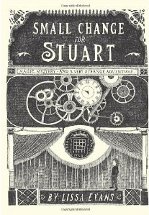
(Ages 7+) Recommended. S. Horten is not the ideal name for
someone who is small for his age and Stuart gets very annoyed at being
mistaken for a seven year old when he's actually ten. However, When the
Horten family return to live in the village where Stuart's dad grew up,
Stuart discovers a role model. His Great Uncle was a magician known as
Teeny Tiny Tony Horten, but he disappeared during world War Two and
left behind a secret warehouse of magic tricks that no one has been
able to find.
With help from next door's annoying triplets Stuart is in a race
against time to solve the magic clues set by his Great Uncle and
discover the warehouse before its contents fall into the wrong hands.
Lissa Evans has concocted a wonderful mix of original plot and
traditional mystery. Young readers will easily identify with a host of
memorable characters. Stuart's mixed feelings about his height are
handled sensitively. His parents and other grown ups are delightfully
vague and slow witted, and readers will take great pleasure in staying
one step ahead of them. The initially irritating triplets reinforce the
value of friendship and teamwork but these important principles are
neatly tucked into an entertaining and original story. This would be
great to read aloud to lower juniors and is well worth buying for your
library.
Claire Larson
On Orchard Road by Elspeth Edgar
Walker Books, 2011. ISBN 9781921720291.
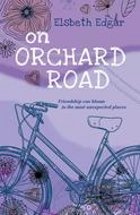
(Ages: 11 +) Highly recommended. As the story begins Jane is moving to
the country with her dad, leaving her mother and premature baby sister
in hospital in Melbourne. She is feeling resentful at the changes the
intrusion of the baby has brought and is very fearful of being in a new
school and town. At first her worst fears are realised and she is
targeted by a bully at school. However a nasty run in with him and some
of his mates results in her meeting a reclusive and intriguing old
woman.
The story from here also involves a teenage boy Michael who with the
old woman helps Jane to recognise the many blessings in her life.
Teenage girls will enjoy the gentle romance between Jane and Michael.
The theme of coping with change is dealt with sensitively and the
lovely descriptive prose makes it an ideal addition to any collection.
It would be an excellent shared novel for upper primary and could be
used by school counselors as well.
Chris Lloyd
The moon and the gecko : Patjuka wura Punu : story from Paakantji Community by Pajantji Community with Liz Thompson
Sharing our stories (series). Pearson Education. 2011 ISBN 978 1 4425
4691 2
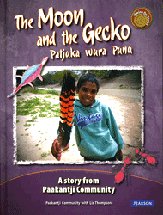
(Ages 8+) Recommended. Aboriginal folklore. This charming Creation
story from the Paakantji people of Wilcannia tells how the land came to
be, through the tale of one jealous young man and his uncle and his two
wives. The lad tricks his uncle into climbing high into a tree looking
for grubs, but when his uncle is a long way up, the boy creates a wind
which makes the tree sway. Uncle catches hold of the sky and the
boy is able to get all the grubs for himself. The uncle becomes the
moon and his image can still be seen there. The wives, angry with Punu,
call their dingoes and they attack the boy, going off into the
sandhills where they become bull ants. Punu turns into a gecko and
lives behind the bark in the tree. Each part of the story tells how
something came to be in the Wilcannia area, and reminds the listeners
of the places in their area, the reasons behind the rules given by the
elders and the plants and animals which exist there.
For students reading this book, a comparative study could be made of
other Creation stories and the similarities and differences between
them could be discussed.
As with the other in this fine series, Sharing our stories, the
introductory pages tell a little of the place the stories are set, and
where the Paakantji people live, before introducing the storyteller,
Murray Butcher.
The vibrant illustrations by the students at Wilcannia Primary School
are a visual treat, adding to the story. At the end of the book are
several pages with the students' own words, and those of several of the
elders. All is followed by the story retold in the Paakantji language,
while each page has a few lines at the bottom explaining some of the
words used in the text. A most useful addition to the classroom.
More about this series can be found at this website.
Fran Knight
Stoner and Spaz by Ron Koertge
Candlewick Press, 2002. ISBN 9780763621506.
(Age: 15+) Ben Bancroft is a sixteen year old with cerebral palsy and a
mindset that keeps him on the fringes of life. He is a movie buff and
spends all his spare time in the local Rialto Theatre. Colleen Minou,
is a larger than life, tattooed high school student with a drug problem
and not the kind of girl Ben's grandmother and guardian, would like him
to be around. When they meet Ben is entranced. Despite her troubled
image, Colleen brings warmth and friendship. She sees beyond Ben's
disability and gives him a new confidence to engage with the world.
With the help of a family friend, Ben pursues an interest in film
making but life with Colleen is a roller coaster. Ben is a positive
influence, motivating her to become clean but can he really count on
her?
There are many disenfranchised individuals in society behind the labels
of disabled, drug addicted or homeless. This book gives the reader the
opportunity to see the personalities behind these labels and hopefully
develop insight and empathy.
Stoner and Spaz conveys important messages in a style that is
both
humorous and poignant. This is a book that could stimulate interesting
discussion about stereotypes and preconceptions and a worthy addition
to the school library.
Tina Cain
Now playing : Stoner and Spaz II by Ron Koertge
Candlewick Press, 2011. ISBN 9780763650810.
(Age: 15+) This equally entertaining follow up to Stoner and Spaz
continues developing the relationship between Ben and Colleen. She is
making headway in her fight against drug addiction and gaining some
acceptance from Ben's grandma. She is the only girl that seems
indifferent to his cerebral palsy and he loves how she makes him feel.
However now he has met A.J. and not only is she clever, stable and
ambitious, she also shares Ben's passion for movies. While Ben is
trying to work out what he really wants, Colleen tracks down the mother
who abandoned him as a child. Now he has another complicated
relationship to challenge him.
This book has the same witty, fast paced dialogue as its predecessor
and is an enjoyable read. It covers the same issues of drug addiction,
disability, relationships and self acceptance however Ben's character
is more mature and evolved. Readers who loved the first book will enjoy
this one too.
Tina Cain
Grug's Big Book of Fun by Ted Prior
Simon and Schuster, 2011. ISBN: 9780731815020.
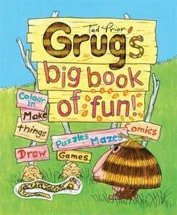
(Ages 4+) This is a well produced picture and activity book. It has 160
pages of colour and black and white pages and includes some stickers as
well. The book has an Aussie theme and young people will enjoy learning
about Grug and Australia. I learnt that Grug is a Burrawang. This is a
tree mainly found on the coast of New South Wales. This would be an
ideal gift for a young person about to travel around Australia for an
extended holiday.
Chris Lloyd
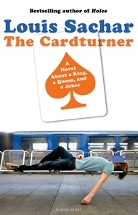
The Cardturner by Louis Sachar
Bloomsbury, 2011. ISBN 9781408808511.
(Ages 15+) As a longtime fan of Louis Sachar I was very keen to read
this new title. The main character Alton is 16 and not looking forward
to his long summer holidays. His girlfriend is now going out with his
best friend and he is expected to spend to drive his old, very rich and
blind great Uncle to bridge tournaments four times a week. His parents
are hoping that time with Alton will result in Uncle Lester giving the
family some of his wealth.
Unexpectedly Alton finds himself enjoying the challenge of learning
about bridge and also coming to understand the circumstances that have
made Uncle Lester the way he is. He forms an alliance with teenager
Toni whose family has been connected with Uncle Lester through tragedy
for many years. The book has many explanations of the rules and playing
strategies of bridge and these can become a little intrusive. Sachar
does often give the readers warnings that explanations are coming and
it is not essential that they be read.
The characters are engaging but I feel it is mainly a book about bridge
rather than people. It comes as no surprise to learn that Sachar is an
avid bridge player. Young people may not persevere till the end unless
they also have a love of card playing.
Chris Lloyd
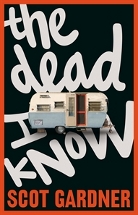
The dead I know by Scot Gardner
Allen and Unwin, 2011. ISBN 9781742373843.
This book is unusual in that it deals with death, not usually a topic
dealt with in society. More specifically, it touches upon the
funeral industry and the disposal of the dead. It does this sensitively
and respectfully and this is one of the strengths of the book.
Aaron Rowe has dreams and sleepwalks. He often wakes up in
unexpected places and doesn't know how he got there. He lives with his
Mam in a caravan and is bullied by another resident of the caravan
park. Aaron's life begins to change when he starts a job as an
assistant to a funeral director. Through the care and understanding of
John Barton, Aaron begins to take hold of his life and to confront his
dreams and sleepwalking. At the same time, he has to deal with his
Mam's descent in dementia.
This book can be read and enjoyed on many levels. Aaron is a
likeable character who has a lot to deal with. Ultimately the dreams
and sleepwalking are resolved and Aaron is able to deal with the
problems in his life realistically and satisfactorily. His Mam's
dementia is explained as all the parts of the puzzles in the book fit
together. I particularly like this book and would recommend it to
secondary students.
David Rayner
Wildwood by Colin Meloy
The Wildwood Chronicles, Book 1. Ill. by Carson Ellis. Penguin,
2011. ISBN: 9780670075157.
Recommended for ages 9+. Living a quiet, uneventful life in
Portland, things change for Prue when her baby brother, Mac, is
abducted by a murder of crows. She watches him being carried into
the Impassable Wilderness, a section of the map of which no-one is
prepared to speak or visit. Naturally, Prue decides to rescue him
and, chatting to herself as she tries to create a plan, is overheard
by her classmate, Curtis. The following day, having hidden her
brother's disappearance from her parents, Curtis follows Prue as she
goes in search of Mac. Gaining entry to the woods, they meet an
assortment of human and animal characters, some of whom they find
they can trust and others whose motives are questionable. There is
more than a touch of the Chronicles of Narnia in this title, as
magical elements abound, battles are fought and blood is shed in the
process of overcoming the evil forces.
With this being the first title in the series, Meloy has spent much
time introducing the setting and characters; therefore, at times the
action is somewhat slow. Nonetheless, Wildwood is
competently written, perhaps with the aim of being accessible to
both children and the young adult audience, as some of the language
tends to be more complex. The dissension between the different
groups living within Wildwood, their pre-conceived notions of one
another, the desire for supremacy of each group and the political
battles in which they are involved could be paralleled with issues
in many other countries. Simpler themes such as tenacity, loyalty,
family, friendship and the importance of team work could also be
drawn out if this series were to be used in the classroom. The
quality of the paper makes this a book you wish to have and hold, as
do the illustrations which are integral. With six colour plates and
multiple maps, in addition to many full page and smaller black and
white illustrations and silhouettes scattered throughout, one's
imagination is fired but there is also much portrayed for the
reader's pleasure.
Jo Schenkel
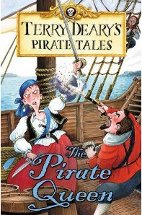
The Pirate Queen by Terry Deary
A and C Black Publishers, 2011. ISBN 978 1 4081 2835 0. The Pirate Queen is a short novel aimed at readers age 8 to
10. Pirate stories always seem to be aimed at boys but girls and
boys alike will enjoy this tale of pirates and treasure. It is
written by Terry Deary, author of the Horrible Histories
series and uses fact and fiction to create a mini history lesson and
an adventurous tale.
The Pirate Queen is Grace O'Malley, an Irish pirate who took over
from her Dad. The story is told from the point of view of her
daughter, Catherine. Catherine wants to be just like her ma so
sneaks on board. She is soon discovered and rather than get in
trouble she climbs the mast. It is here Catherine sees another ship
and the Pirate Queen and her crew attack and rob it. Unfortunately
another ship comes along and they are stopped. Catherine remembers a
story her ma always tells and jumps to rescue her. Will she be
successful or will Catherine be the reason Grace O'Malley is finally
captured and punished by the Queen of England?
All young readers will enjoy this quick moving tale of a feared
pirate and the daughter who loves her.
Kylie Kempster
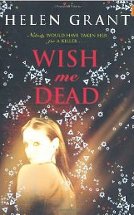
Wish me dead by Helen Grant
Penguin, 2011. ISBN: 978-0-141-33770-8.
(Age 15+) 'It all started with a little wooden box in the old
witch's house hidden away in the middle of the forest. I didn't mean
the first one, it was only meant to be a bit of fun. I didn't mean
for anyone to get hurt. I wished that Klara Klein would die and it
happened. I wished for the local busybody who destroyed my family to
die and it happened. With each wish I make the body count increases
due to the wishes I make and my wishes alone.'
For shy Steffi Nett what started as a bit of fun with her friends
has turned into something deadly. One night Steffi and her friends
decide to go to the town's haunted house which was believed to be
the home of a witch and try out the myth of putting hexes on people.
After the first wish comes true, the group of friends are eager to
find out if other wishes can be realized. With the death rate
increasing with each wish made, is it possible that the wishes could
be used for good and possible to save a life?
Helen Grant's story is about a shy girl who is too scared to speak
up to other people. This leads to her parents being able to map out
her future for her without a say or her friends being able to push
their weight around and making Steffi do what they want her to do.
Although the pace of the story was slow at the start, I found the
rest of the book had a fast flowing storyline and I found it hard to
put the book down. I would recommend this book for older readers as
some younger reader may find parts of the book upsetting. An example
that would upset younger readers would be the details of the deaths
of Klara Klein and the local busybody. I enjoyed being able to
follow the storyline along and working out the mystery but at the
same time I was taken by surprise at times as I didn't expect
certain turns in the plot. After reading Wish Me Dead I
would like to read other novels from the same author as I enjoyed
the style of mystery this author was able to put in her book.
Lauren Pfeiffer (Student)
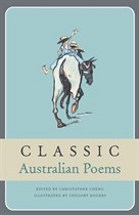
Classic Australian poems ed. by Christopher Cheng
Random House, 2011. ISBN 978 1 74275 3621.
Christopher Cheng invites his readers to enjoy, recite, laugh and be
moved by the poetry presented in this compilation from the late
Nineteenth and turn of the Twentieth Centuries. Cheng fondly recalls
happy childhood moments spent enjoying and studying these favorites
and I concurred with him before applauding his choices.
My initial impression was that Banjo Patterson and Henry Lawson
featured over prominently. I also pondered whether their depiction
of dour, pioneering, outback battlers was a true reflection of a
population which at the time was confined mainly to the Eastern
coast of the nation. It was not long however before I was nodding
assent and acknowledging how important the bush narrative is for a
nation which for too long has placed excessive emphasis on military
history and sporting achievement.
Perpetuating the romance of rural living and celebrating lairish
defiance of disaster and hardship might be fraudulent for the vast
majority of us who have never experienced it, but it's a heritage
with which Cheng invites us to identify, at least for the time it
takes to read and enjoy the poetry.
The only criticism I have with this book is that it was confined to
'Classic Poems', hence the aforesaid poets dominate with Henry
Kendall and C.J. Dennis whilst relatively modern poets like Bruce
Dawe don't feature. For what it's worth, some of the most meaningful
verse in my experience has come from contemporary popular music and
I know that young people genuinely engage with and share this
textual form. If poetry compilers continue to ignore this verse,
students will never see Lawson or Dennis because they will not have
opened books to find Archie Roach, Paul Kelly Missy Higgins or Kasey
C.
Rob Welsh
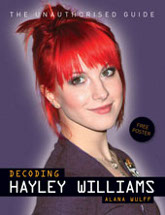
Decoding Hayley Williams by Alana Wulf
Random House, 2011. ISBN 978 1 74275 2921.
(Age: 12+) Decoding Hayley Williams is the unauthorised
guide to the lead singer of the band Paramore. It gives statistics
on her life, interesting quotes and amazing colour photographs
chronicling her career. Fans of Paramore will enjoy reading this
book and discovering how the band started, how they changed band
members and all other career highlights. I would recommend this to
readers aged 12 and over and it is aimed more at girls as it
discusses her fashion and style as well as details about the band.
There is a lot of text to read and most of the pictures are of
Hayley. There is only one negative thing about purchasing this book
and that is whether or not you have Paramore fans who will want to
read it or general music fans who like to read this information
style biography. It would be good to have in school libraries for an
example of biography writing rather than always looking at the lives
of people who are no longer with us or are sporting heroes.
Kylie Kempster
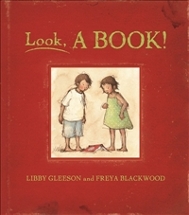
Look, A BOOK! by Libby Gleeson and Freya Blackwood
Little Hare, 2011. ISBN 9781921541803.
Recommended. Unbeknownst to her, the book falls from the lady's bag
as she pushes her shopping trolley towards home, a ramshackle old
house in a poorer area of town. It lies in the dust until two
children come along and discover it. And it is then their REAL
discoveries begin As they perch on top of the old outhouse to read
it, their dreary, drab world comes alive through the magic of the
words and their imaginations. But, the greatest impact is when they
return it to the lady . . . the last page sums up the
power of story in a way that words cannot.
This is a true collaboration between author and illustrator that
will become a classic - it needs to be shared. In my opinion, I have
just seen the winner of the CBCA Picture Book of the Year, 2012.
What more can be said?
Barbara Braxton
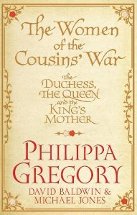
The Women of the Cousins' War. The Duchess, the Queen, and the King's Mother by Philippa Gregory
Simon and Schuster, 2011, ISBN 9780857201775.
(Age: Senior students) Recommended. This work is a non-fiction
companion volume to Philippa Gregory's fictional Cousins' War series
set between 1415 to 1509 and during the Wars of the Roses in
England. The three women who feature in that series, Jacquetta of
Luxembourg, Elizabeth Woodville and Margaret Beaufort, all became
influential, respected and feared despite women having few legal,
political and dynastic rights at that time. Jacquetta was the
matriarch of the powerful Woodville family and friend of Margaret of
Anjou, wife of Henry IV. Elizabeth Woodville was her daughter and
wife of Henry's successor, Edward IV. Margaret Beaufort was a
descendent of Edward III and the mother of Henry VII, the first
Tudor king. This book is in part a discussion about the difference
between fiction and history; the author, Philippa Gregory discusses
each, and ultimately claims that there are more similarities between
them than are usually accepted. Historians, she claims, work from
established facts to speculate about character, motive and reactions
just as the best writers of historical fiction do. The three essays
that follow, by Gregory and two professional historians, David
Baldwin and Michael Jones, are examinations of the historical
evidence about the three women. The essay by Michael Jones on
Margaret Beaufort is particularly interesting in its use of primary
sources to reach conclusions about Margaret's life and character.
Some of the claims made in relation to each of the three women could
be debatable, but the book is very readable. It contains a map of
battles, a dynastic chart of the York and Lancaster families
(fortunately), illustrations and an extensive bibliography.
Jenny Hamilton