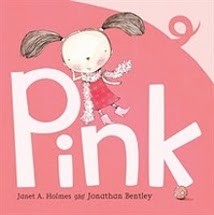
Little Hare Books, 2011. ISBN 9781921541797.
(Age: 5-7) Lily is the main character in this story. She not
only loves the colour pink but also likes to share things.
Even though she likes to share, she has no-one to share with; she is
lonely.
Lily likes certain things but has no-one to share with. She
finds no fun playing by herself. She asks different animals to play
with her but they all have different excuses or mannerisms.
Until she meets a pig who also happens to be pink! He enjoys
playing games with her and sharing!
All the things Lily likes are in different shades of pink, including
the pig! This is an easy story to read where children will
learn about how nice it is to share - the beginning of
friendship. A very pink picture book that 5-7 year olds will
enjoy.
Janet Cassidy
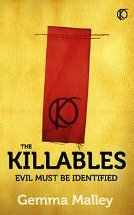
The Killables by Gemma Malley
Hodder and Stoughton, 2012. ISBN 9781 444 7227 2
(Ages: 12+) Recommended. Dystopian future. Elvie comes home from
work and finds the Brother waiting. He informs her that her dreams
are not those of an evil person but of the City and its protection,
but after he leaves, her mother tells her never to upset them again,
having the Brother come to their house is embarrassing, making her
workmates and neighbours suspicious. After all, suspicion of being
evil, of having any evil thoughts could mean that she is
reclassified, denying services given by the System.
We are in a dystopian world, one where evil can surreptitiously
enter one's mind and body, and so everyone must be on the lookout
for its presence. There are hints that the world before descended
into chaos, the Horrors are now far behind them, but strict
adherence to the rules of the Great Leader must be observed.
But we know that Evie has these thoughts, she thinks about things
which would cause concern if known, and worse, she believes herself
to be evil. We follow her one night as she meets a boy in the tree
on the green, the brother of the boy she is betrothed to marry,
Raffy, a boy who needs watching. But one night, Lucas comes to Evie
with the strangest of stories, and impels her and Raffy to leave the
confines of the City walls.
As with the wonderful Declaration trilogy, Malloy has
created a believable future where a small group of zealots has
imposed their beliefs on the populace and keeps them docile through
the New Baptism, the removal of the amygdala when they join the
community or are born into it. Anyone deemed evil is relegated to a
K class and never heard of again. An absolutely engrossing first
story of The Killables series.
Fran Knight
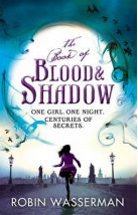
The book of blood and shadow by Robin Wasserman
Atom, 2012. ISBN 9871907411441.
Without a doubt, Robin Wasserman's Da Vinci Code for teens
is as addictive and mysterious as its first line; 'I should probably
start with the blood'. Wasserman cleverly dangles a carrot in front
her readers . . . What blood? Whose blood? . . . so that they
willingly follow from beginning to end.
Just one night, and Nora Kane's world was no more . . . as if
darkness had consumed life as she knew it and left, trailing in its
wake, a never-ending nightmare; her best friend confined within the
walls of a mental asylum, her boyfriend gone without a trace (let
alone a goodbye) and Chris . . . dead at her boyfriend's hands.
Suddenly, Nora, a high school student, is handed a puzzle like none
other to solve; not only does her boyfriend's fate rest with it but
it's also . . . in Latin?
This cleverly written historical mystery follows Nora's journey as
she traces 'the blood' overseas to the sinister streets of Prague,
where its roots, she discovers, date far back to the 1500's. Soon,
Nora finds herself in the middle of a centuries-old battle for the
Lumen Dei, a divine device said to connect man and God. In the wrong
hands, the world's fate is compromised . . .
Robin Wasserman ingenuously incorporates flashbacks from the past
into The Book of Blood and Shadow so that the storyline
becomes incredibly complex; readers are kept on their toes.
Countless suspicious and mysterious characters appear throughout her
novel . . . it is unpredictable and compelling until the very last
page.
Emilia Corbo (Student)
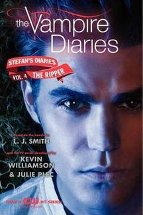
Stefan's Diaries Volume 4: The Ripper by L.J. Smith
Harper Teen, 2011. ISBN 978006211393.
(Ages: 14+) This is the fourth book in a spin off book series from
the television series The Vampire Diaries. Stefan is a young
vampire living in Victorian England on an isolated property, where
he is working as a groundskeeper. When he reads about the murders
being committed in London by a man dubbed The Ripper he is worried
that the murderer may be his estranged brother and fellow vampire
Damon.
After his arrival in London he meets up with not only his brother
but other new vampires and their callous and evil behavior means
that his attempts to save another young women being murdered are
ultimately futile. The storyline is not resolved at the end of the
book as there is another novel that continues the diaries of Stefan.
Not having read any of the other books in the series or watched the
TV show I did find parts of the plot hard to follow as it switched
between the present and past events. The book is short and easy to
read and I am sure that fans of the other books will be keen to
follow the progress of the handsome Stefan. A Year 9 girl assured me
that the first in this series was the only book she had finished
since Year 5.
Chris Lloyd
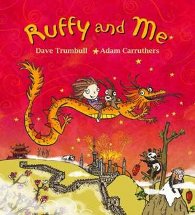
Ruffy and me by David Trumbull and Adam Carruthers
Scholastic, 2012. ISBN 978 1 86291 875 7.
Picture book, Travel. A world map will be needed in the classroom
for this book about the travels of the narrator and his dog, Ruffy,
on an emu through Australia, a dragon through China, a train through
India, a London bus in England, and a motorbike through America. The
antics are non stop fun as the pair of rhyming lines finishes with
the count of: 'One two three' on each double page. A counting book
with a difference, each double page has three things to find,
directed by the thing mentioned in the rhyming couplet.
The exuberant illustrations on each double page will draw the
readers' attention as they scurry to locate the plethora of things
represented, and locate the three as directed from the rhyme. The
last double page will be a point of interest as the readers find the
things spoken of in the story and work out whether it was all a
dream based on the toys he already had.
Fran Knight
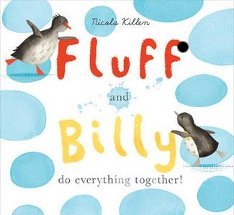
Fluff and Billy do everything together by Nicola Killen
Egmont, 2011. ISBN 9781405254250.
Fluff and Billy are two penguins who do everything together -
climbing, sliding, screaming, splashing - everything. Whatever Fluff
does, Billy copies. And it's starting to aggravate Fluff, especially
after he gets a snowball in the chest. So begins a time of them not
talking to each other, until . . .
This is a delightful story with simple but enchanting illustrations
that will engage the youngest child as a read-aloud. Miss 9-months
loved the rhythm and laughed at the pictures, but now Miss 5 has
started school and is beginning to read, I'm looking from another
perspective as well. This book has power as a beginning reader
because of its repetitive text which is made very predictable by the
illustrations. Within the space of one read-along she was able to
read it for herself, giving her a huge boost of confidence and
independence.
When I was in a school situation I had grab bags that parents could
borrow for a week. Inside were seven books that were just right for
bedtime reading including at least one for little people to share
with their parents. It gave them such a sense of empowerment to read
a 'real book' not just a take-home reader. Fluff and Billy would be
perfect for this, and even if not in a grab bag, it would be on the
Recommended Reads table for my beginning readers to borrow. What an
amazing lesson they would learn about what the library has to offer
them. It's not just for the big kids!
Barbara Braxton
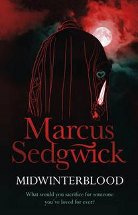
Midwinterblood by Marcus Sedgwick
Indigo, 2011. ISBN 9781780621234.
(Age: 14+) Highly recommended. It is the year 2073 and Eric, a
journalist, travels to the secretive island of Blessed, where it is
rumoured that no one ever grows old, but where children are never
born. When he arrives on the island, he is captivated by its wild
beauty, but is aware of strange happenings. Here he meets the
beautiful Merle and falls in love.
With the use of seven interlinked stories, Sedgwick brings to life
different times on the island, all joined with the common theme of
love and sacrifice. Sedgwick is a master of prose and his sparsely
written stories echo through the ages tales of soul mates and Kings
who must be ritually killed to ensure that the people keep living.
There are moments of horror and deep sadness as the story unfolds.
As I read I became fascinated by the story of the island. The
beautiful dragon orchid is a key to understanding what is happening.
It has enormous power to extend the life span but its use has
devastating effect on the fertility of the people on the island.
The mixture of ancient lore, of blood sacrifice and eternal love has
an intensity to it that made the book very difficult to put down. It
is dark and thrilling and I was often appalled at the violence of
the sacrifice, the picture of the knife poised above the victim on
the altar staying with me well after I finished reading. The idea of
eternal love is beautifully explored and Sedgwick manages to
maintain the fear that the lovers will never be reunited.
A fantasy that is adult in its treatment, this book will be relished
by readers who have read previous books by Sedgwick or who want a
literate, almost Gothic like story to thrill.
Pat Pledger
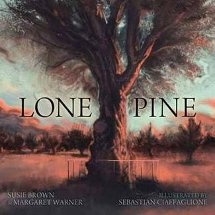
Lone Pine by Susie Brown and Margaret Warner
Ill. by Sebastian Ciaffaglione. Little Hare, 2012. ISBN 978 1 921541
34 6.
Warmly recommended. Picture book, ANZAC. A story not well known
about the Lone Pine Battle at Gallipoli during World War One, is
told through the tale of the pine tree which stands in the gardens
at the War Memorial in Canberra.
One young man, searching for his brother's body after the Battle of
Lone Pine, came across a branch with a pine cone still attached.
Sending this back to his mother in Australia, she raised three small
trees from the cone, two doing well, and one withering and dying,
just like her three sons. In 1930, one of the two surviving trees
was put on the train and sent to Canberra where the new War Memorial
was being built, and the other planted at the Inverell Park as a
memorial to her dead son. In 1934 the Duke of Gloucester planted the
tree in the gardens at the War Memorial, and there it stands today
as a testament to the courage of the Australian troops at the Battle
of Lone Pine.
This moving story will be well used at ANZAC Day in schools as it
reminds us all of the sacrifice made by the families of Australia,
in sending heir sons to fight a losing battle at Gallipoli. The
bareness of the battlefield, stripped of its trees for shelter, is
recalled when veterans took back trees grown from the seeds of the
Lone Pine at Canberra to Turkey to remind us of the area so
devastated by war nearly 100 years ago. The evocative illustrations
concentrate the eye onto one scene on each double page spread. They
are uncluttered, at times almost bare, tugging an emotional response
from the reader, and telling a story through the images presented.
At the end of the book is an outline of the family involved, giving
another layer to the story, and a brief summary of what happened to
the pine trees that were grown from the boy's seeds. For
those wanting to read a story on ANZAC Day which is a little
different from the norm, then this will fit the bill perfectly. It
is not well know, it portrays all that is significant about ANZAC
Day to Australians, and tells how families were affected by the war.
That it is true adds another layer of meaning and discussion with
classes. For those lucky enough to live in Canberra, a trip to the
amazing War Memorial will be that much richer.
Fran Knight
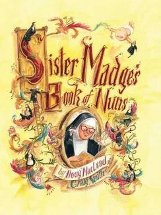
Sister Madge's book of nuns by Doug MacLeod and Craig Smith
Working Title Press, 2012. ISBN 978 1 921504 43 3.
Recommended. Picture book. Poetry. Humour. First published in 1986,
this welcome reissue will set classes a rhyming all over again, as
teachers read the poems aloud, students read them to themselves or
to friends, and parents read them to their children before sleep.
What a treat is in store for those not familiar with MacLeod's
irreverent rhymes and Smith's detailed funny illustrations (for
Adelaide people, look out for references to Adelaide buildings and
sights). From Sister Bossy, used to telling all the other nuns what
to do, until faced with an angel to whom she offered no compassion,
to Sister Isobel getting rid of most of her students while at the
zoo (Adelaide, of course) to Sister Brock, the builder, each poem is
hilarious, involving and minutely illustrated.
I love Sister Poppy with her penchant for collecting the Women's
Weekly, and adore Sister Flo in her vegetable garden, and aspire to
be part of Sister Stephanie's gang. But most of all I love reading
these poems aloud and can now replace my old tattered copy with a
brand new one.
Fran Knight
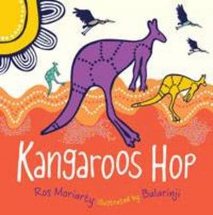
Kangaroos hop by Ros Moriarty
Allen and Unwin, 2012. ISBN: 9781742379159.
(Age 2-6) Kangaroos hop, birds fly, echidnas shuffle, butterflies
dance, lizards run, fish swim, crabs crawl, goannas climb and frogs
jump . . . each animal moves in its own way. What they must avoid is the
crocodile sleeping on the edge of the water. This simple, repetitive
story builds to the point where each of the animals arrives at the
riverbank.
Throughout the book, the illustrations reflect the indigenous style
of art, with stylised and simplistic animal shapes covered in
patterns and dots. Generally, the colours used are earthy and cool.
The final page of the story provides the translation of the story
into Yanyuwa language.
Suitable for very young children, this could also be used in a
junior primary classroom to 'celebrate animals, verbs and the
brilliant art of Balarinji design studio'.
Jo Schenkel
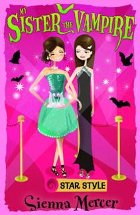
My sister the Vampire: Star style by Sienna Mercer
Egmont, 2011.ISBN 9781405257008.
This book is one in a series about identical twins Ivy Vega and
Olivia Abbott. The girls have been brought up in separate families
and only discovered each other as teenagers. Despite Ivy being a
publicity shy blood snacking vampire and Olivia an extroverted
vegetarian the girls have plenty of shared adventures.
This book finds Ivy and Olivia taking on Hollywood. Olivia wins a
prized role in an upcoming movie but there's a catch. The director
is adamant that Ivy must also star in the movie much to her horror.
In the meantime Olivia is forced to keep her relationship with
dreamy teen superstar, Jackson Caulfield, under wraps. Jealous vamp
actress, Jessica Phelps, has some ideas of her own.
Vampire stories are all the rage for adolescents although the
vampire association in this story is minimal. Light on meaningful
insights, this novel is probably best suited to younger teens.
Tina Cain
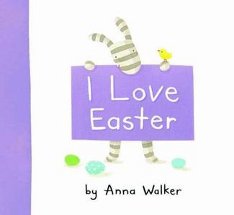
I love Easter by Anna Walker
Scholastic Australia, 2012. ISBN: 9781741696448.
(Age: 3-6) Hard cover. Picture book. Ollie (the curious Zebra) and
the irrepressible Fred (the dog) are back in another seasonal
adventure. I Love Easter explores the Western cultural norms
of Easter. Ollie and Fred visit an Easter fair, make a hat for the
Easter Hat parade, watch chicks and ducks, and hunt for eggs.
Using pen and ink illustrations with plenty of white space, Anna
Walker again shows her talent as both an author and illustrator in
this recommended book for children age 2 to 6. By writing in a
predictable and rhyme filled fashion across all her books, Walker
makes her work accessible and inspiring time and time again.
Young readers will delight in the familiarity of the writing style
and illustrations, with a range of other books by Walker covering
people and events such as Christmas, Birthdays, Grandmothers, Dads,
Mums, Dancing, and Singing.
The books are ideal read alouds for the preschool set, but are also
highly useful for new readers, with a familiar set of characters and
a predictable writing format. All too often, finding books with
authentic yet accessible text is challenging, but Walker's
presentation of the lovely and welcoming Ollie achieves just this.
Many of Walker's books, I Love Easter included, feature
sight words with which many young readers are familiar, and the
pictures correlate with the text, enhancing the use of reading cues.
Moving beyond the books themselves, the I Love series
provides a natural opportunity for extension, inspiring readers to
create I love books of their own. A well timed and enjoyable Easter
read.
Freya Lucas
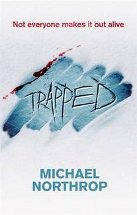
Trapped by Michael Northrop
Atom, 2011. ISBN 9781907411366.
When it starts to snow on Tuesday morning, all 15 year old Scotty
Weems is concerned about is his basketball game being cancelled.
However, as the snow continues to fall relentlessly and begins to
accumulate at an unthinkable pace, Scotty soon discovers that
missing the game is the least of his worries. Trapped by Michael Northrop is the gripping story of a group
of teenagers who find themselves stuck inside their school during
perhaps the worst blizzard on record in New England. Scotty recounts
the week he and six of his classmates were trapped without adults,
phone reception, heat or power, resulting in the thrilling tale of
their fight for survival. As time progresses and snowfall rises,
frustration grows and friendships are challenged, until a shattering
event paves the way to a crucial decision.
From Elijah, the loner with a hidden personality, to Les, the school
bully who may not actually be as bad as he seems, Northrop explores
each character's personality in depth, engendering the reader to
empathize with and relate to each and every one of the trapped
students. This novel not only follows the seven students' bout for
survival, but also covers the countless issues faced by teenagers
every day, such as friendship, bullying, crushes and zits!
Scotty's detailed perspective makes for an exceptional novel, taking
the reader on a rollercoaster ride of emotion, until they too feel
trapped in Tattawa Regional High School during the week-long
blizzard. This fast-paced novel contains all the necessities -
action, drama, humour, conflict, even romance, engaging the reader
from the very first page and staying with them long after the very
last!
Lucymarie Silvestri (Student)
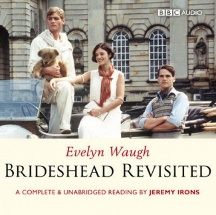
Brideshead revisited by Evelyn Waugh (Audio book)
BBC Audio, 2002. Read by Jeremy Irons. 11 hours, 20 mins (10 CDs).
Evelyn Waugh, 1945.
(Ages: 15+) Family and relationships. Anyone who has seen the
excellent television series of this well known book will love this
audio version read by Jeremy Irons. Driving to Canberra last month
his voice filled our car and it was like watching the BBC series all
over again. And we had lots to discuss. The story of Charles Ryder's
infatuation with the Flyte family reflects the disillusionment of
many who have found that what they loved was not what they thought.
Charles is seduced by Sebastian's life of luxury and ease when he
meets him at Oxford in the 1920's. But as Charles becomes more
involved with the family, Sebastian's health deteriorates and his
dependence upon alcohol becomes apparent. Charles is asked by Lady
Flyte to spy upon her son and when he fails to do this, he is
dismissed, and Sebastian banished abroad.
Years later, Charles meets Sebastian's sister, Julia and they become
lovers, Charles moving into the Flyte mansion. Here he is confronted
yet again with their religion and its hold upon the members of the
Flyte family. His love for Julia is compromised by her religion,
especially after the death of her father.
The Catholic religion stamps the behavior of the whole Flyte family,
several members constrained with guilt, and this underline much of
their behaviour towards each other. Despite Sebastian, his father
and Julia separating themselves from it, they all come back to it in
the end. Charles cannot understand this at all, and it is this
argument which finally separates him from Julia, causing the pair
the greatest unhappiness. Each of the characters is selfish, from
Charles' mother going off to the Spanish Civil War, leaving her
husband and infant son, or Charles later leaving his wife and
children to live with Julia, or Lord Flyte leaving his family to
live in Italy with his lover, all are selfish, and despite our
approbation, have qualities we can admire.
It is a wonderful book, audio tape and TV series, and one which
could be paired with many novels which deal with the effect religion
has on a family, or could be compared with The Great Gatsby,
for example, showing a person being overwhelmed by someone else's
wealth and generosity. As a study of life between the wars, too, it
is redolent of the luxury and ease of some classes of people, and
again, the theme of the loss of innocence, and the agony of
disillusionment, comes through it all.
Fran Knight
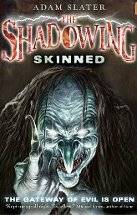
Skinned by Adam Slater
The Shadowing series. Egmont, 2011. ISBN: 978-1-4052-5364-2
(Age: 11+) Having defeated the first wave of creatures from the
netherworld, the hunter Fetch, with the help of the spirit Jacob and
his dog Doom, Callum Scott continues to battle the next onslaught of
creatures as The Shadowing begins. This time, Callum needs to summon
all of his chime child powers to locate and defeat the witch-like
creature Black Annis who lures, murders and devours children. Aware
of his need to improve his knowledge and skills, Callum employs his
spirit ally Jacob to train him during the night and his new friend,
and supernatural authority, Mellissa to teach him the knowledge he
needs to fulfil his chime child duties. As more mysterious
disappearances of children are reported across England, Callum and
Melissa begin to realise the gateway to the Netherworld is opening
at a faster rate than first thought, and that the Black Annis is not
the only creature that is intent on devastating the world of the
living. A coven of evil creatures is planning something much more
sinister.
Like the first book in The Shadowing series there are quite
gruesome descriptions of the murders of children, which seem more
explicit than the first novel, and are no doubt the aspect of the
book that makes it most attractive to upper primary and lower
secondary school readers. This said, younger readers should be
warned that this imagery could cause nightmares.
Adam Fitzgerald