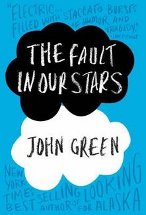
Penguin, 2012. ISBN 9780143567592.
(Age: 13+ years) Highly recommended. John Green, author of Looking
for Alaska and Will Grayson, Will Grayson, writes about teenage
sufferers and survivors of cancer in his latest novel The Fault
in our stars. The narrator, sixteen year old Hazel, has
thyroid cancer which is being held at bay by a miracle drug.
However, intelligent, clear-eyed and iconoclastic, she knows and
accepts that the remission is temporary. Through Support Group,
which provides her and the reader with some black humour, she meets
other sufferers, one of whom is Augustus, a survivor of bone cancer.
Hazel, knowing that her life will be short, does not welcome love
and resists accepting it. However, Augustus is attractive, amusing,
smart and consequently irresistible. Together Hazel and Augustus
reject the glib assurances and encouragements offered by
well-meaning but ignorant non-sufferers. They experience as much of
life as they can, initially through reading. Hazel's favourite book
is about a cancer family; she wants to find out what happens to the
survivors, and the reader realizes that this is a central concern of
her life. What will her mother, her very caring and loving mother,
do when Hazel dies? Augustus uses his Wish (from a Cancer charity)
to find the author who has no answers for them. However the trip to
Amsterdam, complete with Augustus's prosthetic and Hazel's oxygen
tanks, to find him becomes a memorable time for them as they
experience happiness and have to accept its transience. Hazel,
accepting of her future, unexpectedly has to be clear-eyed and
resolute about another's suffering. Hazel learns that survivors must
provide their own answers, and sufferers their own happiness,
however fleeting. The word-play in the novel is a pleasure, and the
insights into the lives of cancer victims seem perceptive and
convincing. Ultimately the novel is very sad, but it is also very
funny, and without being didactic offers some wisdom about what is
important in life. It is highly recommended.
Jenny Hamilton
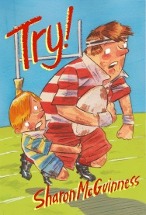
Try! by Sharon McGuinness
Ill. Tom Jellett. Self published flipbook and ebook. 2012.
"Jesse Baxter was crazy about football.
Not soccer.
Not AFL.
Not even rugby union. "
For Jesse, football meant league. Rugby league. Whenever he talked
about football, Jesse's palms grew sweaty, his feet itched and his
heart beat faster."
All Jesse wanted to do was play real football. But Jesse's mother
did not agree - like most mums, she was concerned that he was too
small for such a rough-and-tumble sport, particularly when Jesse's
nickname was 'Flea'. But persistence (and taking out the garbage)
pays off and Jesse gets to join a team. However, he soon learns that
while being little can be a barrier, it's just a detour not a
roadblock if you are really focused on your goal. His story of
triumph over adversity will resonate with many.
Our very own Sharon McGuinness (of Mrs Mac's Library fame)
has published this book just in time for the rugby league season
when hundreds of Jesses will be signing up for their local league
teams and watching their idols play on television. Using her
teaching experience and teacher librarian expertise, Sharon has
written it for those who are emerging readers ready for novels with
short chapters interspersed with terrific illustrations, and is
ideal for those boys who are looking for stories about their
favourite game that they can read for themselves. It comes complete
with links to follow that give more information about the sport, and
teaching notes including an interactive whiteboard game and being
able to colour the cover in your favourite team colours.There's even
an opportunity to submit a book trailer which might be featured on
the site. Try! comes in two formats - a flipbook which is a pdf file
that reads like a book for $5.00 or an ebook compatible with a
variety of devices for $6.95. All the purchasing details are
available from Sharon's new
site, Mrs Mac's Books.
I've been anticipating the release of this book for quite some time
now, and I'm so glad that it is finally here, because it will fill a
gap and a need that will mean that the teacher librarian is just as
much a hero as Jesse is. Congratulations, Sharon.
Barbara Braxton
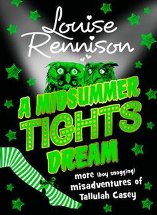
A Midsummer Tights Dream by Louise Rennison
HarperCollins, 2012. ISBN: 9780007156849.
Tallulah Casey arrives back at Dother Hall Performing Arts College,
excited about being reunited with her recently acquired friends
Flossie, Honey, Jo and Vaisey. Amidst much hugging and hand knitted
garments, she receives a warm welcome from her stand in parents, Mr.
and Mrs. Dobbins and the twins, Max and Sam. In her 'squirrel room',
Tallulah continues to write in her diary and measure the growth of
her 'corkers'. Boarding in a private home and not at school, she
enjoys having the freedom to visit Ruby, her bulldog Matilda and the
baby owls. School resumes and she is immersed in the daily life.
This is not without its ups and downs with regard to 'boy interests'
of Tallulah and her group of friends. With a new musical to rehearse
and family issues with which to contend, life is never dull and
boring.
As with the Georgia Nicholson titles, Rennison has created a
likeable, hilarious and endearing character in Tallulah and girls
will be clamouring to read this series. With themes of friendship,
crushes and snogging, acceptance of others no matter what their
differences and a smattering of somewhat eccentric teachers and
interesting vocabulary, this is another entertaining title. There
are certain parallels between this and Sue Townsend's title The
Secret Diary of Adrian Mole. I laughed out loud at the main
characters in each book as they measured various parts of their
anatomy to gauge their movement into adolescence. An easy read for
girls in Upper Primary and early secondary school, I can see they
will always be on loan and never on my library shelves!
Jo Schenkel
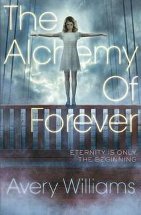
The alchemy of forever by Avery Williams
Simon and Schuster, 2012. ISBN 9780857076816.
(Age: 12+) Seraphina was only 14 years old when she turned immortal.
Her boyfriend Cyrus shared his father's formula for immortality with
her, which enabled their souls to move from one body to the next for
eternity, ending the life of the body's original soul in the
process.
Nevertheless, Sera became tired of murdering innocent people once
six hundred years passed. She came to a final decision to die and
leave her controlling boyfriend behind, until she came across
Kailey. Seraphina couldn't perform another murder on a young girl,
even if Kailey's life was almost gone . . . But when she falls in
love with Kailey's world, she realises that for the past few
decades, she may have something to live for. But does it mean that
Cyrus is ready to let her go? The Alchemy Of Forever is written in the first person and is
a fast paced novel. The style in which the author writes is likable
from the beginning, especially when it came to the action bits, but
the actual book is cold and expressionless. It's written in a diary
form and not many descriptions were made of particular characters
and settings. The Alchemy Of Forever is a somewhat
interesting book, but I wouldn't suggest reading it more than once.
The characters didn't develop with the book, as they stayed the same
for the whole story without changing, so it was quite boring when it
came to dialogues. However when it came to action, such as the bit
where Sera was running for her life, it was interesting to read. In
fact the way Avery Williams was writing about it, the whole bit was
quite fascinating.
This book will definitely not become a bestseller, but it is a good
novel to read in your spare time, as it includes many interesting
plot twists, with the main one at the end.
Nika Aroutiounian
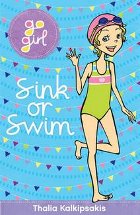
Go Girl: Sink or swim by Thalia Kalkipsakis
Hardie Grant Egmont, 2012 ( first published 2008 ). ISBN 978
174297138 4.
(Age 7-10) The Go Girl books have been around for a few
years but the recent publications are new stories with a new jacket
style. This series is Australian and according to the publisher's
website 'provide(s) simple, real-life stories about characters
experiencing and exploring new situations . . .'
Bec in Sink or Swim is excited about being promoted to a new
swimming group. She goes from being the best swimmer to the least
experienced in her group. Everything is going fine until the big
race when Bec becomes nervous about her performance.
Bec has to learn to deal with her anxiety and to trust her own
abilities. This would be a situation that many children encounter
and it gives them an insight into dealing with their own worries and
stress.
Thalia Kalkipsakis has made Bec a believable character and girls
will be able to identify with her problems.
I would recommend this book to girls aged 7 to 10 years.
For the earlier books go to this site
but for this new series visit here
(the students will need to log in with a password for this site).
Jane Moore
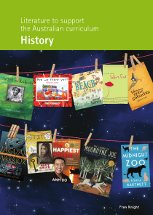
Literature to support the Australian curriculum: History by Fran Knight
Pledger Consulting, 2012. ISBN 978-1-876678-26-5.
(Age: Teacher reference. Primary and secondary) Recommended. In the best traditions of teacher/librarianship, Fran Knight has produced another aid to supporting, extending and enriching the curriculum for teachers and students. Good literature can offer much in developing students' understanding of situations they cannot experience themselves, such as historical contexts. This book provides annotated lists of a wide range of books covering all topics in the Australian Curriculum: History from Personal Histories for the Foundation Year students to the Shogun Japan for Year 8 and Vietnam and the Environmental Movement of the 1960's.
One of the challenges for many teachers in tackling the Australian Curriculum: History is their own personal knowledge of the topics they need to teach. Using the books listed provides an exciting approach to developing a rich understanding for teachers and students alike. For many teachers, developing their own understanding of the historical concept will be a necessary precursor to teaching it. Reading some of the titles on the list will be a wonderful aid for teachers to get the pick up some of the 'back-story' to a historical period. Who wouldn't want to read about Krakatau or the Indian mutiny during the English Empire? Alternatively you might be interested to read about the Feathered soldiers: an illustrated tribute to the Australian wartime messenger pigeon. Maybe a graphic novel of Auschwitz or a child-friendly Canterbury tales would be of interest. Reviewing this resourceful list, I found myself wanting to grab a pile of books and get reading.
Fran's knowledge of literature spans a significant time. Her annotations are reliable and thoughtful. She understands how classrooms work and the variety of students within each class and so each section contains a variety of reading levels and styles of books - including graphic novels and picture books for senior students. She also includes links to Teacher Guides for books when available.
Many titles are recent releases although a few are a little older, the majority being published after 2004. Some titles may require a little finding - for example in online booksellers offering second hand editions. Some may need to be accessed from specific organisations such as a regimental bookseller rather than your favourite bookseller but the search will be worth it. Some titles are also available in Google Book editions.
Diana Warwick
Editor's note: This is available from http://www.readplus.com.au/resources.php
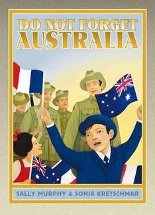
Do not forget Australia by Sally Murphy and Sonia Kretshmar
Walker Books Australia, 2012. ISBN 978 1 921529 86 3.
(Ages: 6+) Warmly recommended. Picture book. World War One. In
France Henri missed Australia as one of the continents in the class
quiz, prompting him to comment, 'who cares about Australia', but as
this book shows the people of the village in which he lived still
remember Australia today because of the efforts of the Australian
13th, 14th and 115th brigades which took the place back from
the German army in 1918. The place, Villers-Bretonneux, still
commemorates the efforts of the Australians who fought and died
there, as well as the efforts of countless Victorian school
children, who after the war, collected money to rebuild their
school.
Told through the tale of young Henri, displaced from his home and
village by the German advance, and Billy in Melbourne, waiting for a
letter from his father on the Western Front, the two lives intersect
as Henri and his mother take food to the Australians camped outside
their town, and Billy's father writes to his family about the
townsfolk who have treated them so well.
Today the school in Villers-Bretonneux still boldly flies an
Australian flag, with the motto, 'Do not forget Australia' in each
classroom, and services held every Anzac Day.
This is a different story to add to the growing number of picture
books about Australia's efforts during the two world wars, and will
be well used by teachers and librarians to augment the interest
shown in our deployment overseas.
A page of information at the end of the book will intrigue readers
and impel them into further research and involvement in the new
Australian curriculum with its emphasis on History.
Fran Knight
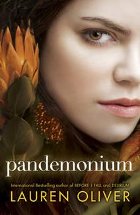
Pandemonium by Lauren Oliver
Hodder and Stoughton, 2012. Trade Paperback ISBN 9789 1444722932.
Hardback ISBN 978 1 4444722925.
Despite the setting of a harsh, dystopian world where people are
'cured' of emotion, living almost as automatons, Lauren Oliver's
story is ultimately satisfying, and, more importantly, for its
teenage audience, uplifting.
The setting is the United States of America that is no longer united
- a bleak fenced world of cities rather than states, outside of
which no-one lives as the countryside was bombed and the inhabitants
annihilated. In a modern Orwellian world, it seems
that the worst fears of the 20th century have become reality in the
area of the wintry north-eastern countryside where the story
opens. Lena, afraid, bruised and terrified, is recovering in a
ramshackle house, trying to keep warm and fed along with the rag-tag
community who have rescued her from the beating that appears to have
killed her boyfriend, Alex.
The story opens to a young woman, Lena, who finds people who are
willing to help her provided that she works alongside them to stay
alive and to migrate when the weather becomes intolerable.
This community has a few leaders, and one, Raven, is demanding and
secretive, in response to trying to survive and to avoid the purging
of their kind, called so ironically, the Invalids. These are
people who refuse to be deadened by the 'cure', wanting instead to
live freely, and to work to restore the world that has been lost.
Lena is torn by loyalties to her earlier love, having experienced
disillusionment with her own family and life, finally making some
important discoveries about herself, her family and her
friends. This heroine is a good model for young readers,
clinging, as she does, to the human yearning for love and the desire
to help others to live a good life with real care and concern for
others.
Elizabeth Bondar
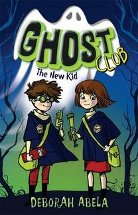
Ghost Club: The New Kid by Deborah Abela
Random House Australia, 2012. ISBN 978 1 74275 080 4.
(Ages: 8-12) 'Who ya gonna call?' Ghost Club. Like the 80's film
Ghostbusters, Ghost Club is called in to deal with pesky and
downright dangerous ghosts. Young Angeline and Edgar are two
of the best ghost catchers the club has and we follow them on a
variety of ghostly pursuits. Competent and well equipped with many
ghost busting gadgets, the brother and sister duo deal with
frightening spectres with calm and aplomb.
As the title suggests, a new kid named Dylan joins the Ghost Club
and is teamed up with Angeline and Edgar. Dylan does not show
the excitement or fearlessness the other long term members have and
he (as would I) is horrified and fearful of the ghostly activities
around him.
This is a fun, ghostly romp with a mystery to solve at Castle
Koszmar, where a very angry ghostly figure is causing havoc. It
seems ghosts have feelings too you know!
There are a variety of bizarre and entertaining characters in this
novel and to add to the drama the children are being secretly filmed
and watched by a disapproving eye.
This is a slightly spooky read for 8 to 12 year olds and students
who have enjoyed the novel will be happy to know there is another
book on the way.
Jane Moore
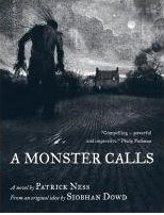
A monster calls by Patrick Ness
Walker Books, 2011. ISBN 978 1 4063 1152 5
(Age: 10+) Highly recommended. Horror. Death.
From the start, the creeping menace of the Yew tree outside Conor's
window invades the imagination of the reader. The amazing
illustrations by Jim Kay storm through the book, evoking the shadow
world that the monster lives in, paralleling the world now inhabited
by Conor as he tries to care for his mother. The threat evoked
by the malice of the monster's presence is palpable, but Conor
derides its ability to make him cower in fear, as he knows something
far worse. He has lived with his nightmare for a while, waking at
12.07 each night with a thuddering heart and sick dread. His mother
sometimes stirs from her own disturbed sleep, vomitting in the
basin, or awake with the aftermath of chemotherapy.
In this phenomenal tale begun by the late Siobhan Dowd, and written
by Ness, we are treated to a superlative horror story, one that will
ensure that word of mouth impels its speed around any group of young
people from 10 to 15. Fenced in by the cancer which affects his
mother, Conor finds that he is invisible at school, his one time
friends avoid him, the bullies eventually giving up on him, bringing
his resentment to the surface. All the time, the monster calls at
12.07, telling his stories which impel him to action. His
destruction of his grandmother's front room brings no respite.
Beating up the bully, finds only compassion from the school, not
expulsion. Everywhere he turns he is pitied, not punished and it is
only with the last story that the monster makes him understand what
he has kept hidden from everyone else as well as from himself.
Death makes its way into every family and this is the story of how
one boy deals with it in the most extraordinary way, transferring
his feelings to the Yew Tree outside the house, using it as a prop
for his emotionally charged life, coping with an absent father, a
grandmother he does not care for, and ultimately his dying mother.
What began as a horror story, pulling in the reader through its
breathtaking illustrations and storytelling, ends as an acceptance
of the reality of death and the coming together of the boy and his
mother.
Fran Knight
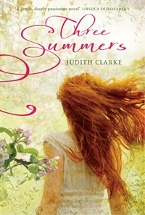
Three summers by Judith Clarke
Allen and Unwin, 2012. ISBN: 978-1-74237-827-5.
A charming story Three Summers is a tender novel about
fascination, letting go and of love. Set over the course of three
generations, the fictional town of Barinjii, Victoria still observes
the practices of the parish throughout the years. Full of moral
codes and life lessons the novel, told in three parts, follows Ruth
Gower's through her life of uncertainties and documents the impacts
of four essential characters.
Ruth is on the cusp, a child set to become an adult as she leaves
secondary school and passes into the next stage of her life. Ruth is
different from her mother and her grandmother in the way that she
has choices and opportunity beckons her to Sydney. With a town
opposed to her going, Ruth's Gran is determined that her
granddaughter will escape the backwards town of Barinjii and be free
to travel the world. But leaving means leaving Fee, pregnant and
happily engaged and the elusive Tam Finn whose actions continue to
raise questions in Ruth's mind. But Ruth's leaving isn't the end of
her dealings with Tam Finn, not entirely at least. Tam Finn might be
missing but his suspected child is found when, by an odd choice of
the fates a girl with Tam's dark hair and grey eyes who just happens
to share her name with Tam's infamous peacock Dancy is fostered by
Ruth.
The novel deals with loss, lust, and love making for a quiet lesson
about relationships, trust and the observing of tradition. I would
recommend this book for girls aged thirteen and up.
(Kayla Gaskell, Student, age 16)
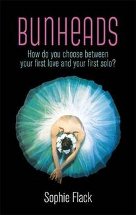
Bunheads by Sophie Flack
Atom, 2012. ISBN 9781907411274.
(Age: 15+) Recommended. This is an entertaining story about 19 year
old ballet dancer, Hannah Ward. As a youngster she dreamed of being
a ballerina, leaving home at the tender age of 14 to become a member
of the Manhattan Ballet Company. Hannah knows all too well the
rigours of the ballet dancer's life: the many hours of rehearsal,
the nightly performances, not to mention the hours in the gym,
toning and strengthening the body. Whilst many of the performers
have a shared history - having joined the company as young teens -
they are nevertheless all competing for similar roles, particularly
the coveted solo. Competition is fierce, discipline is vital.
This is brought into sharp focus for Hannah when she meets Jacob
Cohen, a musician and college student. Sophie's commitment to her
ballet career prevents them from spending much time together and she
becomes increasingly aware of what she is giving up in her
dedication to dance. Sophie realises that most girls her age are at
college, spreading their wings, having fun at parties; she rues the
fact that even though she has lived in New York for the last five
years she really doesn't know the city - having had little spare
time to explore beyond the boundaries of the theatre where she
rehearses and performs seemingly all year round.
As a former ballet dancer herself, the author (Sophie Flack) clearly
has first-hand experience of the trials and tribulations as well as
the joys of dance. And she presents a warm and well-rounded portrait
of Hannah and her fellow ballet dancers. We see both the dedication
that is needed to perform at the highest level but also the rewards;
the joy of soaring as a ballerina, the thrill of performance.
Lovers of ballet are sure to enjoy this novel with its frequent use
of dancing terminology but equally, those who do not have a dance
background will enjoy the human story behind the dance: the struggle
to find one's place in the world and the courage needed to change
tack.
Deborah Marshall
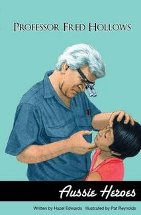
Professor Fred Hollows by Hazel Edwards
New Frontier Publishing, 2012. ISBN 9781921042751.
(Age 7+) According to the Macquarie dictionary, a hero is 'a
person of distinguished courage or performance'. Professor Fred
Hollows qualified on both counts and is a fitting subject for a
series about 'Aussie heroes'. He used his skills as an
ophthalmologist to treat people around the world, and refused to
accept that the cost of medical treatment should deny anyone the
gift of sight.
Hazel Edwards is an experienced and able story teller. In her
biography, the issues that drove Fred Hollows are as apparent as the
course of his extraordinary life. Technical information is
interwoven with the story, so that readers are aware of major eye
diseases and the medical procedures used to alleviate or cure them.
With the glossary incorporated into the text, its absence at the end
of the book is not noticed. The story is driven along in a
conventional manner. Each compact chapter has a well-defined purpose
and each paragraph begins with a topic sentence. The author's use of
these techniques reminds us why they are so effective in historical
narrative.
One drawback to 'heroic' history is that its subjects can seem one
dimensional. Hazel Edwards has avoided this pitfall by mentioning
some of Fred Hollows' idiosyncrasies, without being judgmental or
detracting from his achievements. She has also emphasised that Fred
and Gabi Hollows were partners in work as well as in life, and has
ended the story with Gabi's tireless efforts to continue her
husband's legacy.
The large font, clear, explicit writing style and timeline, make
this text suitable as a story for younger children and as a source
of information for older primary students. While the illustrations
are realistic and sympathetic, the absence of an index and
photographs gives the book the appearance of an unassuming reading
text rather than a work of non-fiction. Any student or teacher, who
is unaware of the value of Hazel Edward's biography, could miss an
opportunity to learn about the life's work of a true 'Aussie hero'.
Elizabeth Bor
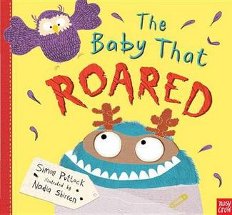
The baby that roared! by Simon Puttock
Ill. by Nadia Shireen. Noisy Crow, 2012. ISBN 978 0 85763 018 6.
(Ages: 6+) Picture book. Humour. Poor Mr and Mrs Deer have no
baby, and wish they had. They want something to play with, to cuddle
and love, to read stories to. One day a baby is left on their
doorstep with a note, asking them to do just that. They are
enthralled, but once the baby begins to roar they are perplexed as
to what to do. They enlist the help of friends, who make various
suggestions, but each time one of their friends stay with the baby,
they disappear. A whole range of reasons for the roaring baby
is given by each of the friends before they disappear, until Granny
Bear comes along and suggest the baby needs burping with very funny
results.
This is a very funny introduction to the needs of a baby, told in a
humorous and enticing format, with illustrations that will enchant
and delight the readers. Children will hear for themselves the range
of needs a baby has, from being cuddled, loved, given milk to drink,
having nappies changed and so on. This can be read on many levels,
as an amusing story to share with a class, or for individual
reading, the characters will delight the reader. In a class where
babies and their needs is under discussion, this will form a very
neat introduction to the topic, providing a marvellous opening to
discussion about the needs and wants of a baby through a picture
book with animal characters.
Fran Knight
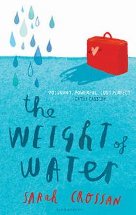
The weight of water by Sarah Crossan
Bloomsbury, 2012. ISBN 978 1 4088 300 2.
(Ages: 12+) Recommended. Verse novel. A verse novel told in first
person, of a woman and her daughter, Kasienka, who emigrate to Great
Britain from Poland in their search for her husband and the girl's
father who left two years before.
Through the one and two page chapters we read of the girl's anguish
at leaving all she knows to go to a country where she finds herself
isolated by her lack of English, relegated to a lower class to learn
the language, friendless and alone. Her mother, similarly is
isolated, despite finding work in the local hospital, where patients
ask for someone who can speak English. Their next door neighbour
becomes their only friend, an African doctor, forced to work at a
menial job in a hospital to keep himself alive.
Mother has an amazing idea, to ask at every house for knowledge of
her husband, and so a map of Coventry is used to work out their
progress. Each day they take one street and knock on all the doors,
as well as using their meagre funds to have copies of a notice with
his details on it made, posting them up in the streets.
All the while, Cassie is putting up with bullying at school, as she
tries to make friends, and develops a relationship with a boy,
William, who she meets at the swimming pool. Swimming keeps her
afloat in more ways than one. Her secret life is at odds with her
mother's presumption that she is a good girl, and this all changes
when their neighbour finds Tara, Cassie's father.
In small bites we are led into Cassie's world, fighting
discrimination and bullying, coping with a distracted mother,
ignorant teachers and an alien world. The brief lines encapsulate
her feelings and emotions as we see all that happens through her
eyes. The power of these short phrases to expose this young girl's
life is extraordinary and will intrigue secondary girls, who will
delight in taking this beautifully presented little hardback book
with its wrap around cover to their hearts.
Fran Knight