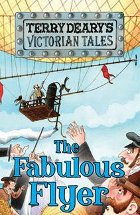
Ill. by Helen Flook. Terry Deary's Victorian tales (series). A and C
Black, London. 2012.ISBN 9781 4081 5408 3.
(Ages: 7+) Early chapter book. Humour. Historical.
Deary seems to have made a hit with his tales of derring-do, set in
ancient times. There are four each in the series about Egypt, Rome
and Greece, with another four set int he times of the Vikings,
Pirates and Knights. Each story is complete in itself, consists of a
half dozen chapters of about 6 pages each, is well illustrated and
is interesting and exciting. Each has all the ingredients to keep
newly independent readers reading to the end and feeling most
successful at doing so. This is one of a new series set in Victorian
times.
In this particular tale, our hero, Henri Giffard is about to fly his
contraption, a steam driven airship. Seen through the eyes of Marie,
the homeless child living in the loft in the top of the barn where
Henri is making his machine, we see the derision hurled at him from
his landlord, Mr Herbert as he demands more money for the use of the
barn. Through Marie's observance we hear about how the machine has
been invented and built, finally flying over the roof tops of Paris
in1859.
Deary's story gives a potted history of Giffard and his machine and
incidentally tells the reader a great deal of information about the
life of street children at the time, ensuring readers will be glued
to each page. Two pages at the end of each book render the
historical facts in a brief summary for the reader. In this case the
tale is very sad, as Henri could not replicate the success of 1859,
eventually going blind.
Fran Knight
How to keep a boy as a pet by Diane Messidoro
Electric Monkey, 2012. ISBN: 978-1-4052-5816-6.
The book How to Keep a Boy as a Pet by Diane Messidoro is a
very gripping story written as a blog by the star of the show, Circe
Shaw. Circe is a pending journalist who wants to become exactly like
her idol, Jess Bradley; a famous journalist who tells things like
they are. Joining in our tale is Circe's best guy-friend, Ben and
her best friend, Tash. Ben has known Circe all her life and results
in calling her 'Witchy' a nickname suited to her because her name
sounding like the word 'Curse' when said incorrectly. Tash and Ben
are an 'Item' and much to Circe's displeasure they tend to get a bit
carried away. Circe's summer project is to write a journalistic
article on a new totally hot topic, something so stunningly,
fantastically, sophisticated that it will benefit not only the rest
of her life, but her career and maybe even her love life. After
posting a few things online about her conundrum of not finding an
article for her blog, an unexpected comment appears. When reading
this inspiring comment (posted by the fantastically mysterious,
super smart, Savvy Rose, a stranger from overseas) Circe sees that
the writer of this comment (Savvy) mentions that boys are like pets;
how odd. Keen to investigate this meaning Circe digs deeper, using
all her journalistic powers to find out the answer and to see if
this theory is true. During her investigation, Circe discovers more
than the meaning to these words, a meaning that puts everything in
perspective and changes her life for the better.
This wondrous novel by Diane Messidoro is very inspiring and keeps
you wanting more as Circe follows on her journalistic quest to save
her love life and her future. The text is written in a blog format
so you know absolutely what's going on with whom, what, when and
where. This format makes the book so easy to dip in and out of but
demands not to be forgotten, especially if you are taking on more
than one book at a time.
Sarah Filkin (Student)
Ella and Olivia series by Yvette Poshoglian
Ill. by Danielle McDonald. Scholastic, 2012 Best friend showdown. ISBN 978 1 74283 355 2 Cupcake catastrophe. ISBN 9781 74283 354 5
(Ages: 6+) Early chapter books
Designed for those young girls newly arrived at reading chapter
books by themselves, these stories about two best friends, Ella and
Olivia, will not stretch the imaginations of its readers. Simple
stories, simply told, without too much complication will make these
an easy read for new independent readers, wanting to achieve quick
success. In Best friend showdown, the girls' teacher gives them a
carton of chocolates to sell as a fundraiser for their new school
hall. Each girl has some difficulty selling the chocolates, and the
result is neat indeed as Ella's younger sister sells them for her
when she is at netball. Along the way the selling of chocolates is
not questioned, but the idea of winning and coming second is nicely
explained, as is the idea of the sister helping out. Cupcake catastrophe is also very straightforward, and will
give young newly independent readers a sense of achievement when
they get to the end of this story. In this one the two girls apply
their skills in the kitchen, making cupcakes for a party with their
family. but when someone bites into the cake, they realise that
perhaps they have used salt instead of sugar. A lesson is learnt.
Attractively packaged, with clear, simple line drawings, these books
(and yes, there are more to come) will have an instant audience in
junior primary classes.
Fran Knight
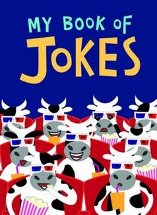
My book of jokes ill. by Bronwen Davies
Scholastic, 2012. ISBN 1 74283 165 7.
(Ages 6+) Jokes. These take me back to the playground, when on yard
duty, teachers are a target for the jokes of the younger primary
children who had just heard many of the humorous jokes that have
been around in various forms for generations.
Why didn't the chicken cross the road?
Because it was chicken.
This one, printed across the back cover reveals the sorts of jokes
heard countless times at home and in the classroom, as youngsters
cotton on to the idea of a joke.
Where do cows like to go on the weekend?
Off to the moovies, of course.
Printed in large clear font, with the question of the recto, and the
answer the next page on the verso, the riddles are enhanced by
clear, bold coloured illustrations, adding to the humour in the
joke. 23 jokes in the book will add to the fun to be had in the
classroom when first talking about the difference between jokes,
riddles and funny stories, poems, limericks and quintains. Students
could be invited to add to the number given in the book, a class
book could be collated, or jokes shared between classes. Whatever
way the book is used it will add another level if humour in the
classroom, and help kids and indeed the teacher, to smile.
What kind of dog can tell the time?
A watch dog.
And there are 20 more!
Fran Knight
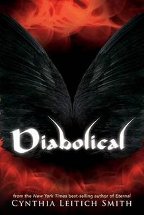
Diabolical by Cynthia Leitich Smith
Candlewick Press, 2012. ISBN 9781921977626.
'Slipped' angel Zachary and his werewolf friend, Kieren enrol in a
New England boarding school, a school full of hand-picked students
with their own secrets. Zachary feels he has to protect the soul of
Lucy, a friend of Miranda's and a student at the school. Zachary and
Kieren plan to talk Lucy into leaving the school but soon realise
that it's easier said than done. The school's ten students need to
work together to survive the school's challenges. Worse, is this all
a setup to trick Zachary to become a fallen angel?
Everyone is back for the final installment of Tantalize. I loved the
idea of Miranda being redeemed. Diabolical is told from three
perspectives; Kieren (the werewolf), Zachary ('slipped'angel) and
Miranda (vampire). It was a little confusing reading form three
perspectives but it kept the book interesting. A really good end to
the Tantalise series.
Cecilia Richards (student).
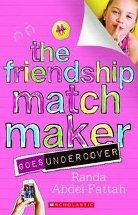
The friendship match maker goes under cover by Randa Abdel-Fattah
Scholastic, 2012. ISBN 978 1 86281 948 8.
(Ages: 9+) Highly recommended. Humour.
The second in this entertaining series has Lara giving up her
matchmaking skills to spend time with her new best friend, Tanya.
But looking around the schoolyard, shows her that her skills are
still required, and when a new boy, Majur joins the class, she has
to do something, but secretly. Emily has asked to join Lara and
Tanya to do a presentation for class, and with the problem of Chris
bullying Majur, Lara finds that she must spend time away from the
library where the girls are doing their work, and go into the
schoolyard and particularly the sports area.
When Emily and Tanya begin to suspect she is not pulling her weight
with the class work, a problem occurs. How can Lara retain her new
best friend, keep up with her school work, but also help those who
require her considerable talents. Saddled with Chris taking her
behind the canteen, his favourite bullying spot, Lara is in a
quandary, even more so when he asks her to find him a friend.
Full of wit, and told with a light touch, this story is funny and
serious, alighting on the problems of classroom control, schoolyard
friendships, bullying and how home life impacts upon the classroom.
I loved the library described as a refugee camp, waiting for those
needing protection from the likes of Chris, and was dismayed at the
bullying he receives from his father, pointing to the fact that
bullies are often bullied at home.
Again the writing flows smoothly, each incident adding another layer
to the well drawn characters, leading to finding a friend for Chris.
Lara is a most appealing character, her foibles cleverly being part
of her charm. She is so self assured and confident in her own
skills of people management that she cannot see things which the
reader can see, right in front of her eyes. The subtle humour will
be obvious to the book's readers, who will take delight in Lara's
attempts at going undercover.
Fran Knight
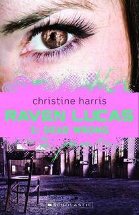
Raven Lucas : Dead wrong by Christine Harris
Scholastic, 2012. ISBN 9781 86291 928
0.
(Ages: 10+) Recommended.
Adventure.
The second in the series of stories about young gun, Raven, the
storyline is at once familiar and startlingly different as Raven
pursues lines of inquiry trying to track her father's disappearance.
There are many people on her trail: the slimy Gerald, her father's
business partner, the stepsister, Bell, her father's secretary,
Marissa, as well as the two from the papers, the journalist and
photographer, who seem to be there at every turn. But there is also
someone she does not know, but is aware of their presence, stalking
her in the dark underground passages of the car park, returning her
shoes that she threw off while running away, watching from a safe
distance. Marissa asks to meet her but she is found in her car,
wrecked in a ravine, and when Raven and Bell go to visit her in
emergency, wanting questions answered, they find she has been moved
to a different hospital, but no-one knows where. The plot darkens.
The storyline has familiar overtones, but the main characters are
full of life and interest and will intrigue middle to upper primary
students. Raven's support group of friends, an interesting and
diverse group, adds to the pleasure of reading, as do her encounters
with Joe, who may or may not be an undercover agent. Police wearing
sneakers who bundle her into the boot of their car, Joe who will not
give a straight answer, and the mysterious biker who she sees
kissing Bell, all add an air of mystery which will keep readers
glued to the end.
Fran Knight
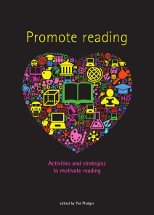
Promote Reading edited by Pat Pledger
Pledger Consulting, 2012. ISBN 978-1-876678-27-2.
Highly recommended. The National Year of Reading is a great time to
reflect about reading in our schools and classrooms. There has been
lots of discussion about accountability through testing, NAPLAN
scores and lexiles which have their place but 'No matter how many
times you weigh the pig, it won't get fatter'. [Anon.]
So how do you get fatter pigs? You won't be able to unless there is
a desire or passion for reading. A love for reading goes hand in
hand with learning the skills. This publication gives teachers and
teacher librarians a list of strategies to promote that love.
There is a wide range of activities from the visual, graffiti walls
and shelf talkers to the verbal, such as book talks and book clubs.
Modern tools include QR codes and book trailers. 'Pee and reads' and
'Loo reviews' show there are no out of bounds areas for reaching
your audience.
Suggestions can be used as a one off or throughout the year and
include activities useful to primary and secondary school. New and
not so new teachers and teacher-librarians will all find something
worthwhile.
This publication contains lots of great advice (nearly 100 pages)
given by experienced educators from all around Australia and even
overseas and is a must have purchase for every school.
Jane Moore
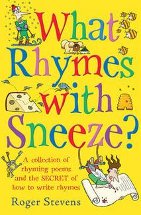
What rhymes with sneeze? by Roger Stevens
A and C Black, London, 2012. ISBN 9781 408 1 5576 9.
(Ages 8+) Recommended. Poetry. Non Fiction. An absorbing poetry book
which shows and gives examples of every type of poem imaginable,
will be a great reviver for a classroom in which poetry needs to be
'done'! Choose any chapter and an explanation is given of the type
of poem (eg Ballad, sonnet, limericks) along with explanations of
the type of rhyme that can be found in a poem (rhyming couplets,
half rhymes etc). The last section devote it pages to instructions
for 'how to', which is entertaining as well as instructive.
Each section gives plenty of examples of poems to illustrate what is
being taught, and many sections have descriptions of how to go about
making one of your own. So as a classroom exemplar it is invaluable,
making poetry lessons a rounded experience instead of something to
be ticked off a list of things to do before the end of term. The
last chapter in the book contains nonsense poems and talks of Lear
and Lewis Carroll, before including my favourite poem, Jabberwocky,
showing students how they can replicate this nonsense poem
themselves.
This book is a great stand by in the classroom, and also one which
kids will enjoy reading themselves.
Fran Knight
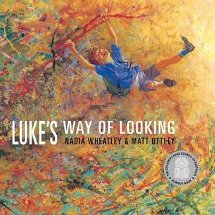
Luke's way of looking by Nadia Wheatley
Ill. by Matt Ottley. Walker books, 2012. ISBN 9781 921977 72 5.
(Ages: All) Highly recommended. Picture book. Difference.
Walker Books has reprinted dozens of Australian classics, and this
is another superb publication, an award winner, which will intrigue
readers all over again, probably replacing an old well used copy on
the library shelves, while introducing it to younger teachers.
The story of Luke, derided by a teacher and some of the students for
his art which is not confined to the strictures of the teacher, has
huge appeal. There are all sorts of layers here to think about and
discuss: the issue of bullying, people's different ways of seeing
the same thing, imagination, individuality, being true to oneself
amongst others. Luke remains true to his own version of what he
sees, although he cannot explain it, eventually staying away from
school. On this day he visits the local art gallery, and sees for
the first time, the works of others who see things as he does.
Bolstered in his own individual way of seeing things, her returns to
school a much happier student, able to retain his individuality and
belief in himself.
Writing down what I feel about the book underlines to me even more
Nadia Wheatley's consummate skill at portraying Luke and his 'way of
looking' succinctly and precisely. The words I have used seem lame
compared with Wheatley's prose and the way each sentence is
constructed, having a particular place while promoting thought in
the overall story.
The illustrations are pure magic. The incredible image on the first
two pages of the overbearing teacher, his hand reflected largely on
the wall behind them, the group of boys almost cowering under his
influence leads the reader into his derision of Luke's artworks, the
small boy and his work minute under the teacher's looming form on
the next pages. Luke strays from school, taking the tram to the Art
Gallery where he sees things he has never seen before. Colour
becomes more important on each page as Luke's spirit is lifted, the
images themselves are joyous and positive, the people on the bus
home, welcoming and interested. Returning to school sees a return to
the sepia of the first few pages, but then Luke's colour takes over,
and it is the teacher whose image is reduced. The juxtaposition of
full page illustrations, smaller framed illustrations, the way the
print lies on the page, all add to the myriad of talking points this
wonderful book promotes. And this new edition provides editorial
comment from Dr Robyn Morrow, Nadia Wheatley and Matt Ottley, adding
another level of discussion for students, readers, parents and
teachers to digest, think about and consider.
Fran Knight
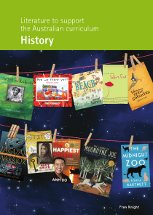
Literature to support the Australian Curriculum: History by Fran Knight
Pledger Consulting, 2012. ISBN 978 1 876678 26 5.
Highly recommended for all schools. This resource is a God send for
time-poor teachers and school librarians. The Australian Curriculum
for History has delivered us a lot of content without too much
direction on how to teach it, or how to fit everything into a
crowded curriculum. Through using relevant literature teachers will
be able to engage students through stories and also integrate
English and History in interesting ways.
This resource lists and annotates many interesting and available
literature resources in an easy to follow format. It is organised
around year levels and clearly states the History focus for that
year level. There is plenty of room to add your own resources too,
which I found useful. It includes extra information such as
available teacher notes for individual titles.
An essential resource for purchase.
Chris Lloyd
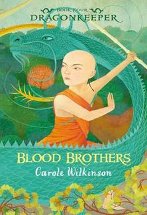
Blood brothers by Carole Wilkinson
Dragonkeeper series. Book four. Black Dog Books, 2012. ISBN 978 1
742031 89 7.
(Ages: 9+) Highly recommended. Fantasy. Tao, a novice in a remote
Buddhist Temple, believes he's living according to the precepts of
the Buddha. Then Kai comes into his life and makes life far more
difficult. Kai is a youngster for a dragon but he has seen many
years, 465 to be exact.
Tao is sent by his Abbot to the town of Luoyang, the place of his
birth and his ancestral home, to beg for alms. However Luoyang
has been decimated by war and little is left standing and the
remaining population have nothing left to give. The Han army
is camped outside the town and barbarian raiders are on the move and
it is not a safe time to travel. During one of the battles Kai and
Tao meet Pema, a young girl who has survived by her wits and nerve
since her family was killed. She proves to be a great problem for
Tao who tries desperately to hold on to his vows as a novice monk.
Tao has the attributes of a dragonkeeper and Kai believes he and Tao
are destined to be together. Tao of course cannot be a dragonkeeper
and becomes a monk. For Tao this is vital because he needs to gain
merit to ensure his twin brother Wei gains karma for his next life.
Carol Wilkinson again weaves an engrossing story with the nomad
raiders proving moments of great danger and suspense for all the
main characters. The relationship between Tao and Kai and Tao and
Pema is intriguing and begs the question how will they be
resolved? For those familiar with the Dragonkeeper series, the
character of dragons, their foibles, tingling, gonging speech,
precocious nature and weaknesses will be nothing new, yet
Wilkinson's dragons are always endearing and annoying in almost
equal measure. Her narrative has plenty of twists and turns and
gives an insight into a refreshingly different fantasy world.
Mark Knight
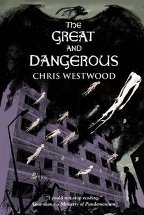
The great and dangerous by Chris Westwood
Frances Lincoln Children's Book, 2012. ISBN 978-1-84780-249-1.
Highly recommended. What a page turner! I just couldn't put this
book down. I was entranced from the very first glimpse of the eerie
cover to the last page.
This novel, set in present day London, is the second in this series.
I hadn't read book number one but was given enough information to
work out the back story.
Ben Harvester works for 'The Ministry of Pandemonium' and he can see
'dead people'. His job is to help the souls of the newly dead find
safe passage to the afterlife. Ben, with his team, work for the
ministry and receive notice of the soon to be dead by a typed list
that gives names, places and how death will occur. No one is allowed
to interfere with the fate of the people listed, just to make sure
their souls are not captured by the enemy, the Lords of Snowdon.
Ben and his friend Becky are in danger themselves. Ben is being
watched and his mother is also at risk. The Dark Lords have a score
to settle with Ben and want to cause him as much pain and grief as
possible.
The plot is well written with Ben telling the story himself, taking
the reader with him on his fast paced adventures into the darker
side of London.
This is a great read for upper primary and older. It's a book that
can be scary and exciting but not terrifying. Readers of Skulduggery
Pleasant would enjoy this stand out series.
A book trailer is available
.
Jane Moore
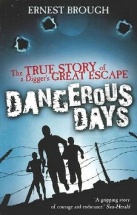
Dangerous days - The true story of a digger's great escape by Ernest Brough
Angus and Robertson, 2010. ISBN 9780732287511.
Recommended for secondary boys (and girls) who would enjoy this true
story of Ernest Brough's experience in North Africa and Europe in
World War Two. This book has been adapted from his adult novel Dangerous
days: A Diggers Great Escape, published in 2009. Aged 89 when
he co-authored this version, Ernest remembers it all vividly. He was
a nineteen year old country boy from Drouin in Victoria's Gippsland
when he enlisted in the Second Australian Imperial Force. He was
sent to Libya in North Africa, where he became one of the famous
Rats of Tobruk. These were Australians who withstood the German
siege of the town for 242 days giving the Allies time to rebuild
strength to confront Rommel, the German Commander, in the battles of
El Alamein. This was possibly the last war where the 'rules' of war,
eg not shooting an unarmed prisoner, were observed. It was just
before the allied victory here that Ernest was taken prisoner by the
Germans and ended up in a Stalag prisoner of war camp in Austria.
The story of his escape with two others and their hair-raising
journey on foot to Croatia is indeed a thrilling story. They
experienced life on the road with the Yugoslav partisans before
pulling a plane out of the mud to fly to Italy. That he survived so
much is more than lucky - it was a miracle. Boys today would be
amazed to learn of the hardships, bravery, resourcefulness, mateship
and stoic endurance of Ernest and his compatriots. Ernest is honest
about living with the legacy of the war and he ends with his
reflections on war and its effects.
There is also a very useful Readers' Notes containing information on
World War Two, Australia's role in it, the structure of the AIF, the
North African campaign, major figures of the war, the Yugoslav
partisans and a Timeline of World War Two.
Kevyna Gardner
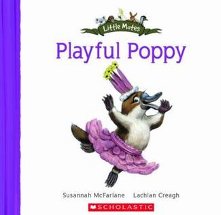
Playful Poppy by Susannah McFarlane
Ill. by Lachlan Creagh. Scholastic, 2012. ISBN 978 1 74283 050 6.
Organised Oliver by Susannah McFarlane
Ill. by Lachlan Creagh. Scholastic, 2012. ISBN 978 174283 049 0
(Ages 4+)Little Mates series. Alphabet books, Australian animals.
Poppy the platypus and her four friends, each named, Pete,
Penny, Patrick and Piper all spend their time lazing by the pond,
but not Poppy, she likes to spend her time pretending. All the
things she likes start with 'p', so the young reader and listener
can have a great time thinking up more 'p' words to include in the
story as well as using the illustrations to predict the 'p' word on
the page. The party at the end is full of 'p' things to do: pin the
tail on the potoroo, pass the parcel and so on, inviting the readers
again to work out how many 'p' words they can think of. This is yet
another in the series of Little Mates, offering a little,
hand sized book of simple stories of Australian animals from A to Z. Organised Oliver is another in the series, with Oliver
Octopus as the main character. Ordering objects is his passion and
he ropes in his friends, Oona, Orlando, Oscar and Olivia to help
with with this immense task.
Small children will love this series of Australian animals, and join
in with finding things which begin with the nominated letter as well
as follow the bright illustrations with glee.
Fran Knight