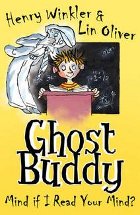
Ghost buddy: mind if I read your mind? by Henry Winkler and Lin Oliver
Scholastic, 2012. ISBN 978 1 407132 28 7.
(Age: 10+) Humour. Ghost. A highly amusing little romp with
Billy having moved school and home when Mum remarries, finds a ghost
already taken up residence in his bedroom. Hoover Porterhouse, or
the Hoove, as he likes to be known, cannot help but interfere in
Billy's life. He often speaks to Billy, giving him unsolicited
advice, for which Billy has no answer, but seen by the nosey next
door neighbour, Rod to be talking to himself. At school it is no
different as the Hoove is often there, egging him on, giving advice,
especially when the teacher asks the students to prepare a talk for
the next week. Billy is bereft, he loathes standing up in front of
his class, and cannot think of anything to talk about. His
stepfather recommends he talk about flossing, and Billy happens upon
a skill he learn many years before, saying the alphabet backwards.
The Hoove cannot believe he is serious and so gets him to pretend to
be mind reading with the Hoove's help. But things never go as we
want them to go, so some very funny things happen to upset Billy's
life even more.
This is an easy to read story redolent of the ups and downs of
school life and life with a new parent and sibling. The ghost does
not help Billy in his attempts to fit in, and the hilarious events
roll along taking the reader with them.
Winkler, known for his portrayal of the character, the Fonze in
Happy Days, has written a series of books called, Hank Zipper, and
this is the first of a series about Billy called Ghost buddy.
Fran Knight
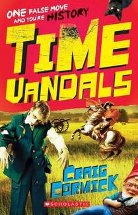
Time Vandals by Craig Cormick
Omnibus Books, 2012. ISBN 978-1-86291-947-1.
Recommended for 11 to 15 year olds. In an action packed opening,
kidnapped teens Mei and Jack begin a time adventure that has them
meeting famous historical characters such as Napoleon and Stalin.
Due to their unique set of genes, Jack and Mei are recruited by a
secret agency to travel back in time to fix historical errors. At
present, Australia is a French colonized country and this is all
because Napoleon didn't have hemorrhoids. You'll have to read the
novel for this to make sense.
This is a crazy, fun story that jumps between times, has plots that
continually twist and turn as well as a bizarre collection of
characters. Ixi is their guide and a garden gnome, a gargoyle is
also on the loose with its own agenda and there are scary flesh
eating Zombies as well.
You'll need to have your wits about you as the time jumping can be
confusing but don't take anything too seriously and you will have an
entertaining and original reading experience.
This novel might work best in the primary classroom with teacher
support as students may not be aware of the historical references in
the text. There are teacher
notes available.
Jane Moore
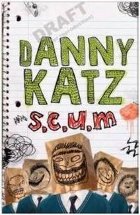
S.C.U.M. by Danny Katz
Allen and Unwin, 2012. ISBN 978-1-74237-924-1.
S.C.U.M. stands for Students Combined Underground Movement and is
the name for a group of 'outcasts, weirdos and massive losers'
at high school. Tom Zurbo-Goldblatt is the teenage narrator of this
story and Tom certainly tells it how he sees it.
This is not a politically correct book and his observations on
different characters show how easily students are judged by gossip,
looks (especially females ) and whether they are in the main group.
Anti bullying policies have obviously no affect in this school, but
even Tom realizes he has at times gone too far and alienates his own
S.C.U.M. group.
It's hard to feel any sympathy for Tom who is as much a bully and as
judgmental as the students he fears. I'm glad I don't have to go to
this school as either a student or a teacher.
Tom provides illustrations throughout the story.
Not suitable for primary school and is aimed directly at secondary
boys.
Jane Moore
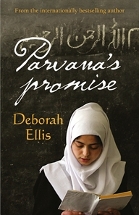
Parvana's promise by Deborah Ellis
Allen and Unwin, 2012. ISBN 9781743312988.
(Ages 11+) Recommended. War. Afghanistan. People will welcome the
latest book in the group of books about Afghani Parvana, wrenched
from her home through war, surviving in the desert and then a
refugee camp, keeping several children younger than herself safe.
But when she is found by the Americans in the rubble of a school
where explosives have been buried, she refuses to answer any
questions. They believe the worst and incarcerate her. In her cell,
she roams back in her mind exposing for the reader the grim life she
has led and her indomitable belief that she will survive.
Ellis does not hold back in her contempt for the Taliban and those
still adhering to their medieval beliefs and the American soldiers
who see everything around them in black and white. It is these
soldiers who make Parvana stand for hours on end, deride, intimidate
shout, and threaten her, eat in front of her not offering any food,
all to try and elicit a response, as they believe that she is a
terrorist
In alternate chapters we hear of Parvana's time at her mother's
school, learning herself but also teaching others, with growing
awareness of the threats being made against the teachers, the
students and the school. When the school is bombed, Parvana is taken
by the Americans and refuses to talk, but when she hears an American
soldier crying beneath her cell window, she writes a poem she has
learnt and drops it down for him to read. The bombing of the
encampment sees her at last being able to escape, but a badly
wounded soldier demands her first aid skills.
A page turner as all the books in this series are, this one will
endear a new generation of readers to the story of Parvana and
Shauzia, as well as educate the readers about the situation in
Afghanistan, where the Taliban can still threaten, kidnap, torture
and kill. Many schools will be happy to have this as a class set.
Fran Knight
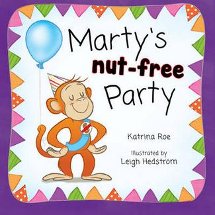
Marty's Nut-free Party by Katrina Roe and Leigh Hedstrom
Wombat Books, 2012. Hbk., RRP $A19.95. ISBN 978-1-921633-36-2.
Marty the monkey loved to party - he was always the first to arrive
and the last to leave. He even counted down the sleeps till the next
one! UNTIL . . . one day, at his cousin's birthday party he was
tempted by a l-a-r-g-e bowl of peanuts. But as soon as he ate it,
things began to happen. His mouth felt funny, his throat swelled up
and that's all he knew until the next day when he woke up in
hospital. Marty was allergic to peanuts!
So, at the next party he went to, his mummy told him not to have
even one peanut - no matter how yummy they looked and who offered
them to him. It was so hard to have fun when everyone else was
enjoying eating them. So he decided to have just one . . . after
all, mum would never know . . .
Marty had a very tough lesson to learn and his mum had to take some
very tough measures to teach him. He couldn't go to Lion Luke's
party and he missed Zac the Zebra's Easter Egg hunt! And even though
he thought he hadn't eaten one single peanut at Gemma Giraffe's
party, he still ended up in hospital. Poor Marty. Would he ever be
able to have a party again?? And what about his birthday? Could he
have a party? Luckily for him, his mum had a brilliant solution and
Marty had a party that didn't land him in hospital!!
Marty's message is delivered in a most delightful story that helps
our youngest students understand why nuts are so often banned from
the places they go to. It also helps those with a nut allergy
understand what could happen but there is a solution that means
everyone can still have fun! It is essential reading for all
preschool to Year 2 classes so everyone can understand the dangers.
I like that Wombat
Books are prepared to take a risk with the titles they
publish and support authors who write about topics that are not
necessarily 'mainstream'. Sharon McGuinness' Coming Home
deals with depression; this one nut allergies - both more common
than we realise and yet so hard to find information about that is at
the child's level. Both books have important information at the back
of them with links to support agencies. For these reasons alone,
regardless of both being excellent stories, these books deserve a
place on your shelves. And check out Wombat's catalogue to see what
else they have that might help your special students understand that
they're not in it on their own.
Barbara Braxton
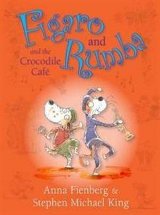
Figaro and Rumba and the Crocodile Cafe by Anna Fienberg
Ill. by Stephen Michael King. Allen and Unwin, 2012. ISBN 978 1
74237 311 9.
(Age: 7+) Early chapter book. Humour. Good friends Figaro the dog
and Rumba the cat plan to catch the Very Fast Train to the beach.
But their friend, Rat says he has lost his friend, Nate last seen
paddling a canoe. The first two chapters show their plans for the
beach go awry, but by chapter three they are travelling with Mrs
Foozy on her motorbike, at least headed in the right direction.
King's marvellously wry illustrations set the scene perfectly,
adding a level of humour and anticipation which readers will adore.
This six chapter picture book for newly independent readers will
enthrall and delight as they read of this wonderful pair of
characters and their friends. Each chapter reiterates their
friendship, trust and care of each other's feelings. Chapter four
sees them on the train at long last, but in the carriage of a very
shady character, a crocodile. With his easy charm and wonderful
waistcoat, he invites them to this cafe, redolent of the Cuba where
Rumba was born. Figaro, with some suspicion of the crocodile decides
not to take his offer of staying in the cafe, but goes off to
explore. He finds some cats locked in a small shed and ringing the
police, learns that the crocodile is a cat-napper, ready to add
Rumba to his captives.
A lovely story, neatly resolved, it is full of things to take note
of: invitations from strangers, friendship, holidays with friends on
a train, learning to swim and taking risks for a friend while
learning a little about Cuba and the Spanish language. An astute
teacher or parent will find a lot to discuss with a child or a
class. But the main thing is the story of friends helping each
other, and along with the lively illustrations, will be sought
after, with a hint from Fienbeerg that there may be another story
about these two, adding to its pleasure.
Fran Knight
Black Mountain by Venero Armanno
University of Queensland Press, 2012. ISBN 9780702239151. This eerie tale recounts the horrors of the Sicilian sulphur mines
while imagining the future of scientific exploits into genetic
engineering.
When twenty-two year old Mark Alter inadvertently plagiarises from
the novel Black Mountain by Cesare Montenero, he begins a
journey to find the old author and eventually finds himself. The
story within a story follows Cesare Montenero from his earliest
memories as an abandoned child through his exploitation as a child
labourer in a tile factory to his time as a child slave in the
horrific sulphur mines, his escape and eventual rescue by Domenico
Amati. Cesare's saviour harbours secrets, which Cesare instinctively
feels have something to do with him and he is right. Both men
are products of genetic engineering, experiments that have been
carried out in secret and were started by the Amati family with
their wealth accumulated from their sulphur mines. In reading
Cesare's story, Mark realises that he also belongs to this group of
engineered people.
The author evokes sympathy for the victims of this experimentation
and a questioning of the ethical and moral responsibility of the
people in control. These current and contemporary ethical dilemmas
will engage students, although the detail in recounting Cesare's and
Domenico's experiences makes this novel more suitable for senior
students, Year 10 and up. Although very different stories, Black
Mountain and Kazuo Ishiguro's Never Let Me Go would
make an excellent pair for senior English students.
Linda Koopman
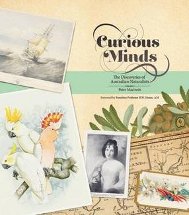
Curious Minds: The Discoveries of Australian Naturalists by Peter Macinnis
National Library of Australia, 2012. Pbk., RRP SA39.99. ISBN
9780642277541.
Australia's unique flora and fauna fascinated our early European
visitors who took home tales of strange and curious creatures that
could surely only be the product of an over-active imagination or
too many days at sea under an unfamiliar hot sun. Perhaps being down
under did something strange to their eyes and brains! So naturalists
became an essential part of the passenger lists of explorers so
these weird and wonderful things could be documented through
drawings, descriptions and specimens. Names like Banks, Dampier and
Darwin appear as prominent people in our history, almost as well
known as the explorers they travelled with.
In his latest book for the NLA, Curious Minds (which could
well describe the author's as well), Peter Macinnis examines the
contribution made by these naturalists to the understanding and
conservation of our plants and animals, introducing us to a host of
people including a number of women who made significant discoveries.
In typical Macinnis style, everything is thoroughly researched and
verified and because of this we learn not only the important and
interesting but also the quirky and quaint.
Also in typical Macinnis style, the text is not dull and boring but
written to tell a story and absorb the reader. This is a book for
ordinary people - although it might be about 'the first geeks', it
is not necessarily for them - and the myriad of illustrations from
the National Library's collections not only help us understand but
leave us in awe of the skill of these people who did not have the
advantages of photography and technology. This is a book that is
enhanced by the print format as you flip through it, see a picture
that catches your eye and then your curious mind takes over.
Like his other books, Curious Minds has a special place on the
shelves of your library as we help students to not only develop
their knowledge of those who developed our knowledge of our amazing
country but also to open up another dimension of the word
'scientist'. Perhaps even inspire a new Joseph Banks or Harriet or
Helena Scott.
In my opinion, if you want your students to engage with our country
and its wonders in a way that leaves them wanting more, then you
must make Peter's books available. They will be entranced and
perhaps inspired to look for the story behind the story in their own
research. Macinnis does that so well.
Barbara Braxton
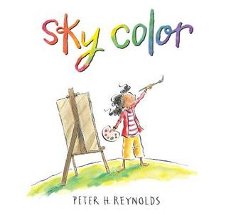
Sky color by Peter H. Reynolds
Candlewick Press, 2012. ISBN 978 0 7636 2345 6.
(Age: 4+) Picture book. Art. When the whole class is asked to create
a mural for their library, Marisol volunteers to paint the sky.
After all she is the artist in the class, the one who paints and
draws, creating her own art gallery on the fridge at home. Going
through the paint box at school, she is disappointed when she cannot
find the colour blue.
But when she takes the bus home she spies a beautiful sunset, with
no blue in sight. And the next morning when it is raining, she
notices that yet again the sky is not blue. So begins a
transformation in her thinking about what colour to paint the sky
and she surprises everyone with her final choice.
The illustrations add to the humour of Marisol's quest, and the
drawings of the girl and her class will tickle the readers' fancies
as they see themselves in the story, and can identify with the
things Marisol and the class do.
Through this book and the two others in the series, The Dot
and Ish, Reynolds aims to encourage children to be part of
the creative process, looking at things anew, with a new focus. And
in this he succeeds. What child will not be encouraged to re-look at
the sky, for a start, to see exactly what colours do make up the
panorama that they see everyday but do not really look at. Cliches
can be overturned using the approach used in this book, and its use
will encourage art lessons to be wider in their focus.
Fran Knight
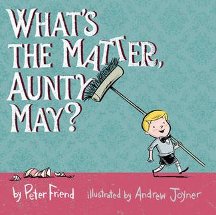
What's the Matter, Aunty May? by Peter Friend and Andrew Joyner
Little Hare, 2012. hbk, RRP $A24.95. ISBN 9781921714535.
'I have some questions, Aunty May.
Why did you shout at me today?
And why were you a little gruff?
Why did you scream, 'Enough! Enough!'
This is the hilarious story of what really happens when your wish
about
getting the kids to help with the housework comes true. It could,
perhaps,
be labelled as a 'precautionary tale', but is definitely an example
of
'Be
careful what you wish for!' It is NOT the story of a group of
out-of-control ruffians - indeed it is the opposite with our hero
dressed in
very dapper fashion, perched on as tool drinking tea as only the
most
well-bred English child might do - but it is a tale of destruction
that
brings the saying 'bull in a china shop' to mind.
Written in rhyming text and accompanied by superb illustrations that
convey
the action and atmosphere perfectly, and tell a quite different
story
to the
text - this is a great read-aloud for little ones. But, beware, it
just
may
give them the perfect excuse for NEVER helping with the housework -
EVER!
A great entertainment, but also a wonderful way to explore how
humour
can be
conveyed in a book where there are no jokes - he is perfectly
serious
with
his questions - and no canned laughter.
Barbara Braxton
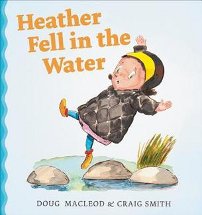
Heather fell in the water by Doug MacLeod and Craig Smith
Allen and Unwin, 2012. ISBN 978 1 74237 648 6.
(Ages: 4+) Highly recommended. Picture book. Humour. Water
safety. Heather has such difficulty staying out of the water
wherever she and her family go, that they make her wear water wings
all the time to keep her safe. Chasing the cat, a day at the farm,
visiting the Japanese gardens, even a trip to the Art Gallery, all
end in the same way, Heather falling into whatever water is to be
found.
Wearing her water wings, Heather refuses to take swimming lessons at
school, because she is convinced that the water simply does not like
her. But one day her parents take her into the pool, each holding
one of her hands, allowing her to get to know the water. She finds
that she has a special fondness for the water, removes her water
wings and develops skills. A neat ending brings all the delight in
this book together in the refrain.
The repeated refrain will have children looking for the increasingly
familiar words as the pages are turned, and they will shriek with
delight at the reworked final sentence. The illustrations will take
the readers from Heather's accidents with water to her increasing
skill, and so readers will imagine themselves in a similar
predicament with its positive ending.
With MacLeod's zany view of life, filled with gentle humour and
recognisable situations, matched again with the wonderful
illustrations by Craig Smith, this winning duo has created again a
picture book to take the fancy of anyone who opens it, be they
children, parents or teachers. All will see the faintly ridiculous,
the lessons to be learnt, the humour in the story, and the strong
family connections and the familiarity of the situation.
Published in a larger than usual hard cover edition, this book is
ready for some serious use, and will rarely be on the shelves.
And grandparents reading the story will no doubt have the refrain
from the Goon Show in their heads, 'He fell in the water', Spike
Milligan, adding another level of humour for the reader.
Fran Knight
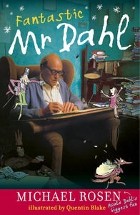
Fantastic Mr Dahl by Michael Rosen
Ill. by Quentin Blake. Puffin, 2012. ISBN 978 14132213 1
(Ages 9+) Recommended. Biography. For all those fans of Roald Dahl,
here is a biographical companion that not only lets you into the
world of Dahl, but also the author, Michael Rosen. Rosen, children's
writer and poet was the Children's Laureate in Britain from 2007 to
2009, and having met Dahl many years before is well placed to write
about this man. But this book is not your usual biography, Rosen
talks of Dahl within the framework of his own experiences and his
family, which gives the reader a glimpse into Rosen's world as well.
Divided into ten easily consumed chapters, these are then divided
into three groups, The Boy, The Man and The Writer. Each section
gives a view of Dahl from his boyhood mainly spent at a small
boarding school many miles from home and his widowed mother and
siblings, to the time as an adult he spent in the air force, then on
to how he became a writer. Each chapter is liberally sprinkled with
photos, with Blake's drawings running across the pages, snippets
from Dahl's letters and writing, as well as pages broken up with
unusual grabs of information that add to the child's knowledge of
the man. His letters are particularly fascinating, giving the reader
a glimpse into the way Dahl saw the world and wrote about it from a
young age.
For all fans young and old, this is an unusual book about Roald
Dahl, but one that will intrigue and amuse those who read it.
Fran Knight
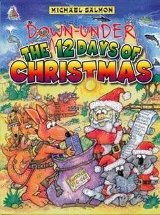
Down-under The 12 days of Christmas by Michael Salmon
Ford Street Publishing, 2012. Pbk., RRP $A12.95. ISBN
9781921665592.
On the first day of Christmas, my true love gave to me . . . no, not
a partridge in a pear tree. But a kookaburra in a gum tree!
In this quirky re-release of Michael Salmon's version of the
traditional Christmas song, Santa has landed in Australia's outback
and is checking his list. Although the kangaroos are in charge of
the presents, their koala helpers are not helping very much at all.
Are six sharks a-surfing and seven emus laying really what someone
wants to find under their tree - or anywhere?
Most of us are familiar with the bright, colourful illustrations
that are a signature of Michael Salmon's work and from the cover to
the final page which is a blackline master to be photocopied and
coloured in, they just delight the readers and put a smile on their
faces. Not only is the original song one of timeless tradition, but
this book is one of timeless quality which will bring joy to yet
another generation of little ones.
With ski-ing snakes and dancing dingoes, they are introduced to some
of Australia's most iconic creatures in situations beyond their
normal bush habitats and daily habits. And of course, the whole just
begs to be the basis of an improvisation that lets the students
demonstrate their knowledge of our fauna and alliteration. Imagine
eleven echidnas eating . . . Christmas Day in Australia IS very
different from all those snow-covered Christmas card scenes we seem
to still hang on to, and this classic proves it!
If your library copy from way back when is tired and over-loved,
this is the opportunity to renew it with a sparkling new version.
And don't forget to introduce the children to the fun and games
available in the cave at www.michaelsalmon.com.au
Barbara Braxton
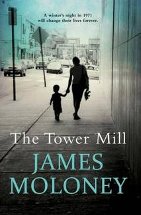
The Tower Mill by James Moloney
UQP, 2012. ISBN 9780702249327.
Set in Brisbane, James Moloney's adult novel revolves around the
political rally by young demonstrators at the Tower Mill against the
visit of the Springboks South African Rugby team to Australia in
1971.
The story begins in 2003 with Tom and his Dad on a flight back to
Brisbane from London, but as the narrative moves between Tom and his
mother, Susan Kinnane, we learn how Tom arrived at this point.
Tom is flying with his Dad to his other Dad's funeral in Brisbane
and we soon learn that the woman he calls Mum is not Susan.
There are two fathers and two mothers in Tom's life; Terry Stoddard
and Susan, his biological parents, Mike Riley and his wife Lyn, who
have brought up Tom. Susan is already pregnant with Tom in
1971 when Terry is brain damaged from injuries sustained in the
demonstration against the Springbok tour.
The rally against apartheid takes the reader back to the early 1970s
when university students were active politically and demonstrated
against such political oppression and the Vietnam War. It was
also a time of arguing for equal pay for equal work, for women's
right to choose, for decriminalisation of abortion and to choose
tertiary education and a career over motherhood. When Terry's
injuries leave him permanently disabled and incapacitated, Susan
wants an abortion but coming from a Catholic family at this time in
history, this is not a possibility. Mike Riley loves Susan and
marries her, fully aware that he is not the father. The
marriage doesn't last and when Tom is three, Susan makes the choice
to stay in Sydney to study and Mike takes Tom back to Brisbane,
where he continues to provide love, care and a home for the child he
considers his son.
The story of Tom and Susan's precarious relationship is told through
the double narrative during the long flight to Australia. We
are taken back in time and reminded of the changes, both political
and social, that have occurred in the intervening years. The
novel is beautifully written and well deserves a place on the school
library shelves, although the students may classify it as
'historical fiction'!
Linda Koopman
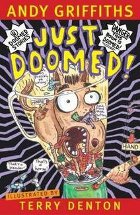
Just doomed by Andy Griffiths
Ill. by Terry Denton. Pan Australian, 2012. ISBN 9781742610924.
(Ages: 10 +) One boy, nine stories and a whole lot of bad luck! Andy
Griffiths is a boy who is doomed; there is no doubt about it!
Absolutely and most positively doomed. Andy fights his way through
yet another Just book. Along the way he loses a lovely
ice-cream, is caught stealing a purple hand bag and spends his
summer holidays at a naturists' resort. From nudists playing
volleyball to a doomed zoo trip, Just Doomed, has it all!
Filled to the brim with jokes that'll make you laugh out loud and
hilarious drawing that are both stunning and entertaining, Terry
Denton and Andy Griffiths can make even page numbers unusual and
unique.
I strongly advise people to read this book and would recommend it to
people looking for a pick-me up . . .
Lilly-Ann S. (Student)