Bloomsbury, 2013. ISBN 978 1 4088 2726 0
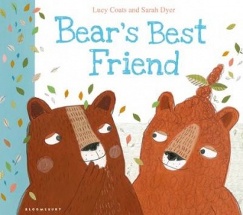
(Age: 3+) Picture book. Topiary. Animals. Friendship. Bear has many
friends, but no best friend and is concerned about this. He makes
lovely animals by clipping back trees and each of the animals is
impressed with what he has done, so much so that other animals come
along and request a tree be clipped for them as well. His tree
pictures are well known for miles around, and stand as a testament
to his hard work, but he still does not have a best friend.
His tears fall onto his snipping scissors and suddenly he hears a
voice ask why he is crying. Turning he spies another bear and they
become best fiends, doing things together just as best friends do.
The bear continues his special skill at making tree pictures and the
new word, topiary is introduced at the end of this story of
friendship. While a slight story, the book would well suit a class
looking at the theme of friendship and would be useful in a
classroom where new words are introduced, especially those that are
a little out of the ordinary, but children will have no doubt about
the meaning of the word topiary at the end of this story.
Fran Knight
A very unusual pursuit by Catherine Jinks
Allen and Unwin, 2013 ISBN. 9781 74331 306 0
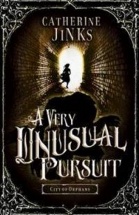
(Age: 10+) Highly recommended. Fantasy. Historical. The wonderful
Birdie is a bogler's assistant in murky Dickensian London. Her
master, the clever and brave bogler, Alfred Bunce, uses her as bait
to draw the bogles out of their lairs: sewers, fireplaces, wells and
the like, from whence they erupt to take away children to eat.
Birdie's beautifully clear voice and small size attracts their
interest and so lured, find they are surrounded by salt and as
Birdie quickly escapes, Bunce pounces. The sometimes sticky end of
the bogle will absolutely delight the readers of this delicious
story, the first in a new series (City of Orphans) by this clever
writer.
But Birdie is a little fearful of her position. Miss Eames, an
academic interested in the bogles of London, has done some research
and found that there may be other ways of capturing them, rather
than let Birdie be the bait. The possibility of losing her work
fills Birdie with dread, as the poorhouse and workhouses of London
loom large. Jinks' research is obvious as she describes these places
with malicious detail.
But it is not just Miss Eames that Birdie must be careful of, the
nasty Sarah Pickles, a female version of Fagan from Oliver Twist,
wants Birdie to join her warren, and this too Birdie views with fear
and suspicion. And one night, after breaking into a doctor's house
because of some missing children, repercussions of that night teach
Birdies that not all people around her can be trusted.
A fascinating tour of Victorian London, Catherine Jink's impeccable
research and interest in this period shines through. She beguiles us
with the sights and sounds of the back streets where bogles and
bogle hunters live, insinuating so much detail into the narrative,
that no reader can have a doubt about the evil that lurks there. The
second in this fine series cannot come soon enough.
Fran Knight
The Convent by Maureen McCarthy
Allen and Unwin, 2012. ISBN 9781742375045. 419 pages
(Ages: 15+) I was particularly attracted to this novel, as I believe
Maureen McCarthy talks to teenagers with great purpose and
understanding. Her novels highlight teenage tension and
disorientation, but they also conclude with both honesty and
optimism.
Having been educated at a Catholic girls' school, with the convent
of nuns set amongst our school buildings, and, in the light of the
recent church controversies, I was keen to see where McCarthy's
story was to take me.
The subject, and indeed the title, may not initially attract many
readers. Today there are many young people who would not
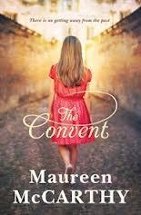
understand the term 'nun' or 'convent'. The picture of modern day
Peach, however, on the front cover, walking towards the Abbotsford
buildings works well, producing just the right amount of intrigue.
Hopefully there will be many readers who will take up the invitation
and read further.
Abbotsford becomes the centre stage for the lives of four women,
each related by generation. Sadie, mainly through poverty is driven
to give up her child to be cared for by the convent nuns. Ellen
marries a farming man and nurtures seven children and her
experiences at Abbotsford remain dear to her. Her only daughter,
Cecilia, enters the convent and stays for ten years. Peach is her
illegitimate daughter who is adopted soon after her birth. The
storyline relies considerably on coincidence but McCarthy's
realistic approach to the subject and the life she breathes into
each of these women makes for great reading. She reveals the
individual experiences of the women, highlighting the varying
perspectives on religious life throughout the decades. What is
important is that the modern day Peach is given the opportunity to
learn about the past, acknowledging the pressures and prejudices
which affected the women in her family.Choosing the religious life
is by not means mocked in this book - it is put into perspective for
the time. Ironically, Peach's friend, Det, in the modern day story
feels similar pressures experienced by Cecilia, when she finds
herself pregnant and believes that there is no one to help her.
With an interesting array of characters, a well structured set of
four stories moving from a rather bewildering past to the modern
day, and a great story line, The Convent is a good read.
Julie Wells
Meet Ruby by Penny Matthews
Ill. by Lucia Masciullo. Our Australian Girl series. Penguin, 2013.
ISBN 978 0 14330742 6.
(Age: 9+) Highly recommended. Historical novel. When Ruby goes to
the Adelaide Zoo with her parents, she notices the humpies along the
River Torrens, and men making tea and cooking food over camp fires.
This along with one of her friends disappearing from their private
school, the dismissal of their housekeeper, and her parent's beaten
expressions, alerts the reader to the facts of the Great Depression
and its impact on families in Australia.
Eventually Ruby's father, a builder, loses his business, and now
unemployed, must sell their house and the possessions they no longer
need. Ruby and her mother will be moving to the country to stay with
an aunt and uncle and the odd cousin May, while he searches for work
both in South Australia and Victoria.
Through this story of one young girl, as with the rest of the
series, readers are able to assimilate the feeling of the times with
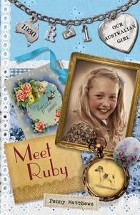
ease. The front cover tells the readers that the story is set in
1930, and images shown on the covers alert the readers to snippets
of information making the times loom large.
The very successful series, with four books in each set about one
young girl, has teacher notes on the website, and each novel has
information at the end of the book about the times, and two pages
which whets the appetite for the next story. An extensive website
accompanies this fine series.
Fran Knight
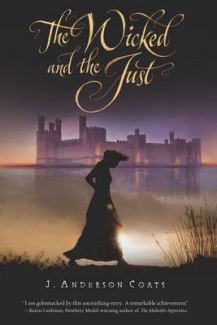
The wicked and the just by J.Anderson Coats
Harcourt, 2012. ISBN 9780547688374. Hardback.
(Age: 12+) Recommended. Historical. Middle Ages. 2013 ALA Best
Fiction for Young Adults. Kirkus Best Teen Book of 2012. Cecily's
father has taken her to Wales in search of cheap land. Gwenhwyfar
works as a servant in the house where she thought she would be lady
of the manor. Instead Cecily takes over and her treatment of Gwenny
is not kind. Indeed Gwenny describes her as a brat. Tensions are
rising as the impoverished Welsh struggle to keep alive in their
land.
Told in alternating viewpoints by Cecily and Gwenhwyfar, this is a
poignant, thought provoking examination of two characters set
against the violence of Welsh oppression in the Middle Ages. I
learnt much about each character, their needs and thoughts as I read
this book as well as the period in history. It is not a quick
escapist read, there are no mythical creatures or strong romance,
just the story of two young women who are struggling to survive,
each in her own way. Cecily is often very selfish and thoughtless,
although she does have a sense of justice. Gwenny' plight as a
servant who is struggling to keep her mother alive and look after
her brother is heart rending.
It is a wonderful piece of writing that will stay with me for a long
time. I was left wishing that I could follow Cecily and Gwenny on
the next stage of their coming of age, at the same time knowing that
the times would make it extremely difficult for both of them.
Pat Pledger
Tiddles by S. Carey
Eerie series. Puffin, 2013. ISBN: 9780143307372. Paperback, 72
pages. RRP:$9.99.
I love cats. I love my Aunty Shirley. I love little holidays away
from my family. How about you?
Brother and sister, Ben and Cathy, have to stay with their
Great-Aunt Pam for a week while their parents are busy organising a
new house and new job. Poor Aunty Pam has lost both her husband and
her much loved cat. So far, a pretty normal regular storyline you
might think.
But wait . . . Great-Aunt Pam resembles Jabba the Hutt and is twice
as nasty. She certainly does seem to miss Tiddles, and Tom as well.
But if her beloved cat is dead, then why does she still put out a
cat tray and why does the cat bowl have fresh blood around it . . .
. . . . and why, oh why, are there dead maggots all around the cat
door which keeps flapping in the night.
Trapped in Aunty Pam's house, with doors and windows chained and
bolted and no means of communicating with their parents, Ben and
Cathy are faced with a horrible realisation and even more terrifying
situation.
'They stayed huddled together, only aware of the own racing hearts
as the black, dead thing pulled itself relentlessly towards them.'
The Eerie series, written by S. Carey (just think about that
name for a moment, folks) is going to be a huge hit with independent
readers especially of the zombie-loving kind. Mister 10 is going to
eat this series up - oops, perhaps the wrong turn of phrase!
Sue Warren
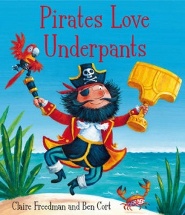
Pirates Love Underpants by Claire Freedman and Ben Cort
Simon Schuster Children's Books, 2013. ISBN 9780857072658. Paperback
32 pages.
Reading Age: 4-6 years. Themes: Pirates. Humour. Rhyming story. This
is a fun new addition to the Underpants books; pirates love
underpants just as much as Aliens, Dinosaurs and Panta Claus! The
endpapers are filled with weird and wacky y-fronts, skull and
crossbones bloomers, wooden plank undies, and ghostly briefs, quite
a talking point.
The Pirates board their ship the Black Bloomer searching for the
Pants of Gold treasure. They have to sail past sharks in fancy
underpants before landing at Big Knickers Bay. Of course there are
problems and difficulties along the way and underpants play an
important role on every page. Of course the Captain's funny idea
saves the day.
Claire Freedman has continued to follow the same rhyming patterns
with her text. Ben Cort's bright comical paintings with bold
splashes of colour add depth to the story. There are many styles of
underpants pictured throughout and these make this a humorous story.
Claire and Ben's website http://www.aliensloveunderpants.com/ is a
great resource with biographies, downloads, games and book
information.
This is a great read-aloud book for sharing with children from three
to six. Beginning readers will also enjoy the rhythm and
rhyme.
Rhyllis Bignell
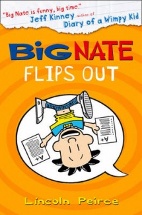
Big Nate flips out by Lincoln Peirce
Big Nate series no. 5. HarperCollins, 2013. ISBN13: 9780061996641.
216 p.
Recommended for readers from 8-11 years of age. Themes: Middle
School, Friendship, Cartooning. This is the fifth Big Nate novel
written and illustrated by cartoonist Lincoln Peirce. Big Nate has
been a syndicated newspaper cartoon since 1991. His work inspired
Jeff Kinney to write and illustrate The Diary of a Wimpy Kid.
Big Nate and his best friend Frances are once again finding middle
school life difficult. Nate's problems stem from his untidiness; his
locker, schoolwork, homework, clothes and his bedroom are always
messy. Francis however is a neatnik; Nate calls him Captain
Tidypants. He's an only child and a trivia buff. They have been best
friends since kindergarten.
This time problems escalate when the boys decide to be on the school
yearbook committee. Their aim is to make it better than last year's
because the photos were truly awful. There is a lot of fun and drama
as they take the school camera to capture candid shots of classmates
and teachers. An unfortunate event occurs with the camera and this
leads to Nate visiting Teddy's Uncle Pedro for help because he's an
inventor, magician and hypnotist. The change in Nate is truly
amazing!
This a book filled with American school life humour, friendships,
class stereotypes, overbearing teachers and bullies. The cartoons
seamlessly work with the text and add humour to the story.
This story would appeal to those students who enjoy The Diary of
a Wimpy Kid by Jeff Kinney. Reluctant readers would enjoy
these stories as they can find much of the text written in the
cartoons.
A sneak peek of the next Big Nate novel, Big Nate: In the Zone!
Is included as well.
This series is supported by the Big Nate website where
readers can find Lincoln Peirce's blog, books, games, videos and
downloads.
Rhyllis Bignell
Spark by Brigid Kemmerer
Allen and Unwin, 2012. ISBN-13: 978-1-74331-074-8
(Age: 13+) Spark is book number two in the Elementals
series by Brigid Kemmerer. This book is done in third-person and
follows a segment of both Gabriel Merrick and Layne's lives, the two
main characters of the book and like the book's prequel Storm
there is a male and female main character, their stories just as
important as the others.
Gabriel Merrick is a hot tempered teen who likes to play with fire,
he is rash and quick to get into a fight but he has the ability to
think when adrenaline comes calling.
His family life is hard enough having lost his parents a few years
ago and to be in his older brother's care along with his twin and
younger brother, but failing his classes is something that will not
be tolerated, the only reason Gabriel cares about school is for his
sport but when his grades start to slide he is very close to losing
his place on the team. This results in Layne tutoring Gabriel.
Layne is a quiet, intelligent sophomore and is in a few of Gabriel's
classes. Her whole life is wrapped in mystery and isolation; she
keeps to herself but finds it hard when she starts to tutor Gabriel.
Mysterious fires start to appear all over town and most of the
evidence points to Gabriel and his elemental ability. His brothers
suspect him and the Guides suspect but there is no proof for Gabriel
to use to stop these accusations.
The characters are realistic to relate to and the language used by
the author is very understandable and gives a good overall picture
of the story. Thoroughly enjoyable and keeps you actively enchanted
until the very end.
Sarah Filkin (Student)
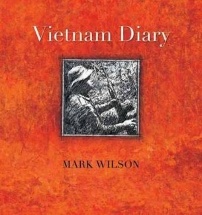
Vietnam diary by Mark Wilson
Lothian, 2013. ISBN 9780 7344 1274 4.
(Age: 8+) Recommended. Picture book. Vietnam War. Historical
story. Mark Wilson's rendering of the war in Vietnam is astonishing.
The pencil sketches, like the one on the front cover, instill in the
reader that frozen moment of war, a sketch done by a war artist
similar to those we see at the Australian War Museum in Canberra or
in books about war.
The frozen moments build to a crescendo of feeling, which explodes
on about page 30, when a young man's eyes peer out at the reader,
fearful, shocked and horrified. This full page pencil drawing is
truly momentous, and stands out amongst the other brilliant pieces
of drawing and painting that Wilson presents. His use of watercolour
and crayon, pencil drawing and other mixed media are astounding,
rendering the mix that is war often softening it with the quiet of
home.
In this book we see two stories side by side, on the one hand these
brothers are very alike, but when it comes to the Vietnam War, one,
at university, protests, while the other, still at home, is
conscripted and agrees to go to Vietnam. Through the images and
spare writing we see the two, not understanding each other, but in
the end the objector comes to see his brother's gallantry and sense
of duty in what he is doing.
All the while in the background we see and hear of the Vietnam War,
a war in which Australia was part, forty years ago, but having
repercussions today. For classes studying the Vietnam War, or war in
general, or Australia's part in the history of this region, this
book will prove to be a valuable addition to the library.
This book compliments his other books about war: My mother's eyes,
and Angel of Kokoda, and you will see other examples of his fine
illustrative techniques in the Extinction series (I saw nothing
etc), The castaways of the Charles Eaton, and Yellow-eye.
Fran Knight
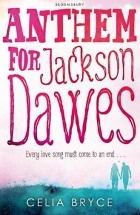
Anthem for Jackson Dawes by Celia Bryce
Bloomsbury, 2013. ISBN 9781408827116
(Age: 12+) Megan Bright is a thirteen year old facing a big
challenge. She has a brain tumour and needs several hospital
admissions for chemotherapy. Her parents and grandfather are trying
to put on a brave face and Megan feels she should do likewise, even
though the experience is frightening. The ward to which she is
admitted seems more suitable for little children with cartoon
pictures on the walls, toys and crying babies. She is relieved to
find there is at least one other teenager also having chemotherapy,
Jackson Dawes.
Every body seems to love Jackson Dawes. He charms the young children
and the nurses with his mischievous stories and rebellious disregard
for rules. At first, Megan is determined to have nothing to do with
him but it's lonely on the ward, away from friends. They share a
common bond as cancer patients who are exposed to experiences that
other teenagers never have to contemplate. Megan's world of school,
football and friends fade into the background as she undergoes
treatment and is replaced by life on the cancer ward. Gradually she
learns to appreciate Jackson and comes to rely on his friendship and
optimism.
Eventually Megan needs surgery while Jackson's cancer is so unusual
the doctors are running out of treatment options. The challenges
they face will change them forever.
This book is a sensitive and realistic portrayal of the lives of
those suffering from chronic illness and the impact on family and
friends. It is neither sugar coated nor maudlin leaving readers with
a sense of hope, despite acknowledging the inevitability of loss. A
story about first love under the most challenging circumstances, it
will suit younger teens.
Tina Cain
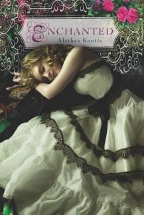
Enchanted by Alethea Kontis
Woodcutter Sisters bk 1. Harcourt, 2012. ISBN 9780547645704
(Age: 12+) Recommended. Sunday is the seventh daughter of a seventh
daughter and has to be careful what she writes as it could come
true. When she kisses a frog, it changes into Prince Rumbold, who is
despised by Sunday's family.
One of my favourite genre is that of a fairy tale retold and I was
hooked right from the beginning with this funny, witty, romantic
story of Sunday who is 'blithe and bonny and good and gay'. Of
course she has the handicap of having everything she writes down
come true so she has to be very careful. After she kisses the frog
to whom she has been telling stories, unbeknown to her he turns back
into Prince Rumbold. He is determined to woo her but his courtship
doesn't go easily and Kontis takes us through the stormy path of
true love.
Kontis is amazing, retelling many fairy stories in a fabulous mix of
complex ideas and events. The old rhyme about children who are named
after the days of the week is particularly apt and weaves its way
through the story, helping the reader understand the natures of
Sunday's seven sisters. Great characterisation and plot make this a
very readable story.
However what stood out for me was the humorous dialogue that often
brought a smile to my face. This is a feel good book that would be a
wonderful lift for anyone looking for interesting, well written
fantasy. It is worthy of the awards that it has garnered, including
an Andre Norton Award Nominee (2013) and YALSA Best Fiction for
Young Adults (Top Ten) (2013) and it looks as if there will be more
books to follow.
Pat Pledger
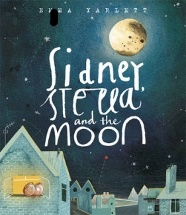
Sidney, Stella and the moon by Emma Yarlett
Lothian, 2013. ISBN 978 0 7344 1409 0.
(Age: 5+) Recommended. Picture book. Moon. Siblings. Sharing. Twins
Stella and Sidney do everything together but when it comes to
sharing, they are impossibly divided. One night fighting over a
bouncy ball, the toy slips from their grasp and bounces out of the
window, high into the sky, where is smashes into the moon, causing
it to break into a million pieces. They are distraught, the
sky has a black hole, how can the world exist without its moon?
They must work together to find a solution, trawling the house for
something yellow and round to fill the space in the sky. Readers
will love following the search for a replacement moon, spying all
the different things on each page which are roundish and yellow.
When the one thing is found to put into the sky, a catapult is
needed to propel it skywards, but the pair differ over who will
shoot the machine. An argument known only too well to both children
is neatly resolved as they work together.
The mixed media illustrations will draw the eager reader's eye to
the detail presented on each page. Each page is presented
differently, allowing the reader to be surprised as each page is
turned, particularly when they reach the centre with its pair of
doors ready to be opened to reveal the effects of the lack of a
moon. The font is that of an old styled typewriter adding another
level of interest to an already bold inviting book.
For teachers and parents looking for a book about sharing, or to
introduce the sky to a child or group of children, this this book
will be a must have.
Fran Knight
Killer App by S. Carey
Eerie Series. Puffin, 2013. ISBN: 9780143307365. Paperback, 72
pages. RRP: $9.99.
(Age: 8+) Roma and her friend are totally into their iPads and
their apps. When a sinister man called Roderick offers the group a
free app that downloads to each their own personal dream, Roma
thinks it seems too good to be true. And Roma proves right when the
five friends find themselves whirled out of their dreams and into a
dangerous and deadly nightmare.
Not only is Roderick one seriously creepy nerd, he is a deeply
disturbed one and his revenge for past rejections is about to impact
on Roma and her mates. The only way to escape Roderick's
hynoptic snare is to turn his plan back onto himself -and Roma has
just what it takes to do that.
Clearly Dead Boring, the mysterious free app, is not quite as boring
as it sounds.
Each of the Eerie series is cleverly enhanced with tiny 'flip'
animations in the page corners and a new instalment of an additional
story 'Monster Me' at the end of each book.
The series will comprise thirteen super spooky stories (Thirteen?
Coincidence? I think not!) that will delight those 8+ years readers
who savour the supernatural. There will be a rush on these
when they hit your bookshelves - stand back and let the stampede
begin!
Sue Warren
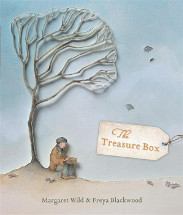
The treasure box by Margaret Wild
Ill. by Freya Blackwood. Penguin, 2013. ISBN 978 0 670 07365 8
(Age: 6+) Highly recommended. Picture book. Reading. Children in
war. From the stunning cover to the words which follow Peter's journey from his war disrupted home to a new life, returning to
retrieve the treasure box left him by his father, this book will
resonate with all readers, young and old. Shadows of stories of
people seeking refuge, of disrupted lives, of people fleeing their
homes, of leaving all they love; crowd behind this tale, as Peter
digs up the treasure box, buried for safe keeping years before.
All the while, the background begs the reader to touch each page,
wondering at the three dimensional images presented by Freya
Lockwood. Her illustrations from cut out paper, fill the pages,
giving a shadowy effect to the story, impelling the reader to look
behind the words at the people and their lives as they trudge away
from war, die on the road to safety, find refuge in a new country,
but still have ties to their homeland.
The first double page presents a bombed street, showing that the
library has been bombed. Over the page pieces of pages from books
float across the paper, as we see Peter's father has the one book
that survived, the one he loved to read. As each page is turned, the
muted colours contrast with the bright red colour of the cover of
the book, shown to the son, kept safely in a box, and then passed on
to Peter as father dies. The little figures of the refugees huddled
into their blankets along the road is just one of the many haunting
images presented in this book. In a new city, Peter grows up,
eventually returning to the town and the tree where he buried the
box containing the book. Its importance becomes clear as he places
it on the library shelves where others will be able to borrow and
read it.
Blackwood's use of smaller images against which a cut out is placed
draws the eye in to look more closely at each image: her use of the
floating pieces of paper remind us of the indiscriminate nature of
war, the sepia colours of the houses and villages passed by the
refugees underline the displacement of so many people, her
contrasting images of the town and countryside when Peter is seeking
refuge and when he returns an older man, reflect the ephemeral
nature of war and that people survive, as do stories, the developing
colour reflecting people's optimism and hope for the future.
Blackwood has used torn pages from translated versions of
Gleitzman's Once series, and Hartnett's The Silver
Donkey, to fill the endpapers, using these again as the sky
and some of the foreground in the book.
For teachers looking at the impact of war on children, of the
importance of story and books, of passing on stories form one
generation to another, of resilience and determination, then this is
a stand out contribution to the books read in the classroom.
Fran Knight