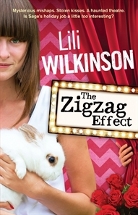
Allen and Unwin, 2013. ISBN 9781743313039.
(Age: 13+) Recommended. Mystery. Magic shows. Sage is really
happy when she gets a job working for the magician, The Great
Armand. It means that she can pay for the photography course that
she is desperate to do. The job sounds interesting and the fact that
Herb the stagehand is cute is also a positive. Then Armand
disappears and Herb and Sage get locked into a storeroom overnight,
and Sage must weave her way through secrets and magic tricks to
uncover the mystery that surrounds Armand's disappearance.
Lili Wilkinson always manages to surprise and delight with her
feisty heroines and original stories. The background to The zigzag
effect is absolutely fascinating and anyone who is interested in
magic tricks will be riveted by her research into what happens to
make magic tricks work on the stage. The petty jealousies
surrounding the secrecy of how tricks work and the effort that the
beautiful assistants put into the show form a unique background to
the mystery that Sage is faced with. Superstitions like Bianca
believing that breaking a wand on stage will bring bad luck provide
suspense and add to the eerie things that seem to be happening in
the theatre.
I love the development of characters that Wilkinson shows in this
book. Sage is a smart, clever girl who shows initiative and
intelligence. She is prepared to find a job to pay for her
photography course and looks after her little brother. Her romance
with Herb is realistic and often funny. Bianca the magician's
beautiful assistant is a well rounded character as well, and Sage's
parents are portrayed in a sympathetic light.
This is a book that will appeal to readers who want something
different, clever and suspenseful, with lots of funny dialogue
scattered throughout.
Pat Pledger
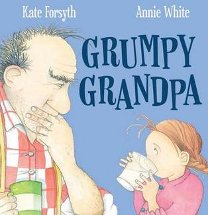
Grumpy Grandpa by Kate Forsyth
Ill. by Annie White. Scholastic, 2013. ISBN 978 1 74283 175 6
(Age: 4+) Warmly recommended. Picture book. Grandparents. Grandpa
frightens the girl when she visits the old man with her mother. He
always asks the same thing, 'are you grizzling or are you singing?'
which intimidates her even more. He takes her into the garden where
he loves to dig, but she likes to be clean and tidy, while he
prefers to dig the dirt, and get all sweaty and muddy. Once inside
he sleeps in his arm chair but the noise of his snoring rattles the
windows and causes the chimney to smoke. When he wakes he is even
grumpier but in answering 'O'm singing' to his question asked yet
again, a broad smile breaks out on his face and all is happy.
A beautifully deft rhyming story of a young girl's fears at her
Grandfather's house, of his different ways of doing things and his
invasive questioning. She takes a while to get used to this grumpy
man but once she answers his strange question, they become the best
of friends and all fear is gone. The wonderful illustrations fill
each page with soft washes of colour and the little girl is shown in
various awkward positions on each double page: blown away by his
sneeze, coughing at the smoke form the chimney, baulking a the
offered worm, shuddering at the mud on her skirt, all giving sorry
impressions of her day with Grandpa until the last pages where they
find some common ground. A wonderful tale of acceptance, of finding
an ally, of the difference between the age groups, this will be most
useful in classrooms where grandparents are being discussed.
Fran Knight
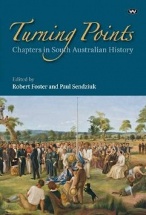
Turning points ; chapters in South Australian history edited by Robert Foster and Paul Sendziuk
Wakefield Press, 2012. ISBN 9781743051191.
What did I expect from this book before I read it? A different
opinion on South Australian history. I had read several textbooks,
fictional accounts, and even early settlers diaries. I was
pleasantly surprised when the introduction informed me that this
book was a selection of public lectures, given originally in 2011.
Each author writes addressing the theme "Turning points in South
Australian history". Thus we have chapters varying in style from
standard scholarly histories, to more free form reflections on
topics they chose. This makes this book much easier to digest, with
each piece having its own flavour.
After the introduction by the editors, each chapter follows on the
previous in time. We start with "The Adelaide district in 1836'' by
Bill Gammage. This is a well illustrated synthesis of his book "The
biggest estate on Earth" in which he argues that the Aboriginal
people managed their environment to create that parklike landscape
which the colonists found in 1836. The next chapter by Henry
Reynolds investigates the issues of the 1830s, namely the policy
towards the Indigenous people. He says 'My suggestion is that South
Australia lay, in a figurative sense, between Van Diemen's Land and
New Zealand in the way it would deal with these questions of policy
towards property rights and whether the indigenous people had human
rights in a modern sense.' The chapter by Paul Sendziuk was very
interesting in that he exposes the convict element in South
Australia, in 'No convicts here: South Australia's Foundation myth'.
Chapters 5 and 6 were very politically oriented. Chapters 7 and
8 were the authors' personal histories about their families and where
they lived. Chapter 9 About the Don Dunstan era made me think back
to that time of social democracy with some fondness. The last
chapter by John Hirst is a reflection on South Australia. He ends
with 'I began with South Australia as a distinctive colony and ended
by describing it as a small state. But under the leadership of
Playford and Dunstan South Australia punched well above its weight.
I hope it can find ways to keep that tradition alive.' A book to be
dipped into if the topic interests the reader.
Giselda Grunwald
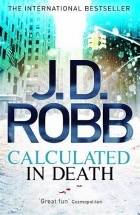
Calculated in death by J.D. Robb
In death series. Piatkus, 2013. ISBN 9780749959357.
(Age: Adult) In the 34th book in this series, a woman is found
dead at the bottom of a flight of stairs. It looks like a mugging
gone wrong but Eve Dallas knows better. The victim is an accountant,
Marta Dickenson, and she doesn't seem to be the type to be murdered
for her personal life so it looks as if it has something to do with
the accounting work that she was doing. Eve, helped by partner Peabody and
her husband Roake, delve into the seamy life of crooked accountants.
I had missed quite a few in this series and was pleasantly surprised
to find that I managed to pick up the background to past events
without too much bother. Robb has created a very smart, likeable
main character in Eve Dallas. Her partner Peabody is a perfect foil
for her and of course Roarke is not only gorgeous but very rich.
However it is the mystery, which is compelling and which kept me reading this to the end. I
enjoyed the ins and outs of the operations of an accountancy
firm as it at first appeared to be an unlikely place for a hired
killer to be operating from, and it was fun trying to work out who
the villain was.
This is a very enjoyable read and fans of this series will not be
disappointed.
Pat Pledger
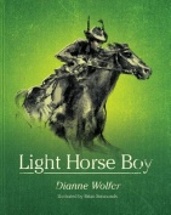
Light Horse boy by Dianne Wolfer
Ill. by Brian Simmonds. Fremantle Press, 2013 ISBN 978 1922 089 137.
(Age: 9+) Warmly recommended. World War One. ANZAC. Animals. In a
handsomely produced hard cover book with a large number of photos
from WW1, Wolfer tells the tale of young Jim, joining his older
friend, Charlie on the big adventure overseas, taking their horses
along with them. Australia's involvement in the European war has
been declared and the two present themselves to the local
recruitment tent for the medical.
With stunning illustrations by Simmonds, each page is a treat. Many
pages are presented in the form of pages torn from a diary or pages
of letters from family, each shown as carefully folded and worn to
give a better impression to the reader of what war was like for the
ordinary man and his family, opening and closing the few treasured
letters many times. Numbers of photos show the range of
animals kept by the soldiers as mascots, while others reflect the
plight of the horses taken from Australia to the Middle East in
particular.
Jim and Charlie are part of the 4th Light Horse Brigade, and so the
story follows their actions, showcasing for the reader a small part
of the whole war, enabling younger readers to get some sense of the
conditions in which they lived, the constant fear, the privations,
the loneliness amid the friedndships.
There has been a bag full of books published in the past twelve
months or so on Australia's involvement in the wars since the Boer
War. Each has taken a different perspective, be it a young boy
signing up in Alan Tucker's Gallipoli, or Jackie French's The girl
from Snowy River showing the impact of war on a rural community, or
The horses didn't come home by Pamela Rushby, the tale of the fate
of the 130,000 Walers sent to war, and To brave the seas by David
McRobbie, about the men who served on the Merchant Navy during WW2,
each has a different tale to tell, impelling our younger readers to
think more deeply about war and its impact.
This book is hard to put down, its illustrations and spare prose
will grab the readers and keep them reading. Information at the
start of the book verifies the tale of the one horse that did make
it back to Australia, and the map and acknowledgments at the end
show where some of the photos have come from, making the book most
useful if looking at war in the classroom. With the centenary of
World War One looming in 1914, and the centenary of the landing at
Anzac Cove the following year, these books are the first of many,
offering a perspective which will appeal to a wide range of readers.
Fran Knight
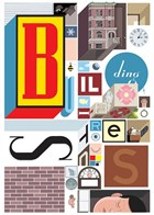
Building stories by Chris Ware
Random House, 2012. ISBN 9780224078122.
(Age; Senior secondary) 'Books' are no longer books; groups of words and sentences arranged
in a usually pleasing fashion on a set of papers bound together in a
neat package. This is an era of ebooks, graphic novels, audio books,
and books as pdfs, kindle and various other arrangements. The
bottom-line is that in a book the words, phrases and sentences work
together to tell a story, to inform or to educate. This 'book', Building
Stories by cartoonist, Chris Ware, breaks many moulds. To
begin with it is a box; a large, colourful box with intriguing
images and lettering showing clever and careful design. On opening
the satisfyingly solid box one encounters an even more intriguing
assortment of books, pamphlets and papers of different sizes, weight
and organisation covered with detailed and intriguing graphics.
Through this medium this impressive work tells the stories of
residents of an apartment block in Chicago.
As the residents go through their daily lives we are made privy to
their thoughts, dreams, actions and most intimate activities. Every
graphic is part of the larger story and leads the reader to make
connections across the 'text'. The book is part puzzle, part
graphic, part narrative and always engaging. It brings to mind the
classic movie Rear Window, where James Stewart spends his
wheelchair bound days watching his neighbours, discovering their
secrets.
Chris Ware is highly talented cartoonist who shows a Dickensian feel
for the minutiae (and misery) of ordinary life. Much of this book is
about loss - loss of ideals and dreams, youth, partners and even
body parts. For me, it is this which ultimately made the book so
depressing. The voyeurism of this type of text reveals the
intimacies between couples which many will feel belongs solely
within a trusting relationship. These qualities lead me to recommend
this book only to senior secondary students with the maturity to
understand the complexity of people's motives and actions.
Diana Warwick
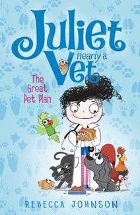
The great pet plan by Rebecca Johnson
Juliet, Nearly a Vet series. Puffin Books, 2013. ISBN
978-0-14-330704-4.
(Age: 8-10) Recommended. Juliet is a 10 year old girl who
knows her mind. She wants to be a vet just like her Mum. So eager is
she to study veterinary skills, she keeps a Vet Diary.
You can often read her diary notes throughout the book. They are
informative, reporting facts about different animals such as their
care and behavior.
With the help of her best friend Chelsea, Juliet decides it would be
a good idea to have a 'Pet Sleepover', offering a free health check
and grooming session as well. Of course this has to be a secret from
their parents. What could go wrong?
This is an easy to read smaller novel with less than 90 pages and is
interspersed with small drawings and diary entries.
The story is both humorous and educational and will appeal to 8 to
10 year olds.
The next is this series is entitled At the Show.
Jane Moore
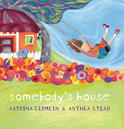
Somebody's house by Katrina Germein
Ill. by Anthea Stead. Walker Books, 2013. ISBN 978
(Age: 4+) Picture book. Families. Houses. Neighbourhood.With
rhythmical flowing lines, Katrina Germein creates a refrain of 'Who
do you think is inside?' on each double page, adding a level of
mystery to her powerful introduction to the neighbourhood and the
occupants of the houses in the long looping street at the bottom of
the town. Each double page shows a different house, orange, green,
yellow, blue and red with the following double page showing the
people living inside and some of the things that they do. So the
yellow house, for example, has a bright yellow exterior, with
animals living in the branches of the tree outside, while inside we
see yellow carpet and dad and the children, along with sheep and a
cow. Children will love picking out the yellow things in this house,
and watching the sheep knit a scarf from its wool, and wonder at the
number of animals that reside in the yellow house. Each house is
markedly different, underscoring the range of people and places that
live in one neighbourhood, expressing the uniqueness as well as the
similarities of all who reside there.
The illustrations entice the reader to look critically at each page,
picking out the things offered by Anthea Stead, recognising everyday
objects, and seeing some things anew, enjoying the hidden depths on
each page as they read it again.
For any child the story is most satisfying, relishing in the warmth
of the house that is theirs, knowing their neighbours and the street
in which they live, learning their colours and the names of animals
along the way. A treat to be shared.
Fran Knight
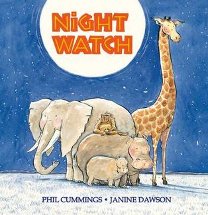
Night watch by Phil Cummings
Ill. by Janine Dawson. Working Title Press, 2013. ISBN
9781921504365.
(Age: 3-6) Recommended. Animals. Cooperation. Courage. Giraffe,
Hippo and Baboon live happily by a lake. They are not friends, but
they do co-exist happily. One day Giraffe spots the shadow of a lion
in the mountain and knows that their peaceful existence is
threatened. He tells the other animals and Baboon comes up with a
cunning plan to bamboozle the lion and keep their territory safe.
This story just begs to be read out loud. The beautiful language
with its rhyme, rhythm and repetition ensures that young children
will respond to the story with glee. I loved the alliteration
(Spish, Spash! Burp!) with its touches of humour and I especially
loved the picture of the lion that the words 'Prowling ... creeping
.. stalking ... sneaking' created in my head. The simple message of
cooperation, even if it means working with people who are not your
best friends, is one that young children will be able to understand.
Children too will understand that it takes courage to stand up to a
lion, even if Baboon has come up with a very clever idea.
Janine Dawson's soft watercolours bring the countryside to life.
Each animal has a distinctive personality and her pictures add depth
to the story as well as enhancing much of the humour. Beginning
readers will also appreciate that the pictures give wonderful clues
to the written word.
This is a book that I will be giving to my granddaughter, who is
soon to start school. It is a fabulous story, has illustrations that
children will love, print that could help a beginning reader as well
as a subtle message about bravery and people working together.
Pat Pledger
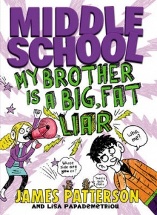
Middle School: My Brother is a Big Fat Liar by James Patterson and Lisa Papademetriou
Young Arrow, 2013. ISBN 978-0-099-56786-8.
Recommended for 10 to 13 year olds. Georgia Khatchadorian is
following in her brother Rafe's footsteps by attending Hills Village
Middle School.
Rafe was not the most successful student; in fact he made a lot of
enemies. Georgia wants to prove she is not like him and plans to be
a huge success. Unfortunately her plans are continually thwarted by
Rafe's reputation.
Her problems are greater than the negative preconceived opinions of
the teachers. She has to contend with 'the Princess Patrol' a group
of perfect but judgmental girls, an unusual new friend Rhonda who
has problems of her own and her new role as a guitarist in a girl
band.
To top it all off Rafe has secretly arranged for the band to play at
the next school dance.
This latest book in the Middle School series deals with the issues of
being different and wanting to fit in, a common problem for young
adolescents.
James Patterson has collaborated with Lisa Papademetriou to write a
female perspective to his Middle School stories.
Humorous drawings, scattered throughout the pages add to the appeal
of the book.
A small book trailer is available at http://www.youtube.com/watch?v=BgREGn8y-X4
Jane Moore
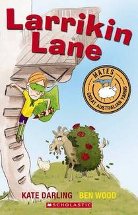
Larrikin lane by Kate Darling
Ill. by Ben Wood. Mates series. Scholastic, 2013. ISBN 978 1 86291
989 1.
(Age: 5+) Recommended. Australian stories. Another in the Omnibus
series, Mates: Great Australian Yarns, will immediately
appeal to those who are looking for a short chapter book with
illustrations that will engage their minds and delight their eyes.
This series has proved popular and are often found bunched together
in a box in the library for easy access, if they are not already
checked out. For teachers wanting a set of reliable stories,
illustrated by witty and erudite artists, then this is a great
series to have in the classroom, providing a group of books for kids
to read, a series to promote or a group to show parents some of the
most recent literature for their offspring.
Using themes set in the past or in a rural setting, with words some
kids may not have come across before, the books showcase some of the
things which may not be readily accessed by our city bound kids,
growing up in suburbs which have little open space.
So with Larrikin Lane, the illustration on the opening page
contrasts markedly with the illustration on the next. The first
shows a farmhouse with animals and sheds, and a dead end road out
front. Over the page we see the farmhouse today, surrounded by
houses that look all the same, the sheds, windmill and dead end
road, gone, the only vestige left are the magnificent trees. In Larrikin
Lane, the next door neighbour does not like the family in the
old farmhouse keeping goats and sheep. He is meticulous about his
garden but the goat nibbles the rose bushes. His complaint to the
local council means that an ultimatum is given, but events occur
which change everyone's mind. A neat resolution rounds off a wry
look at suburbs today.
Fran Knight
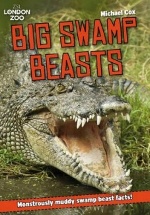
Big swamp beasts - Monstrously muddy swamp beasts facts by Michael Cox and Chuck Whelon
Bloomsbury, 2013. ISBN9781408835760. Paperback. 96p.
Highly recommended for 8-10 year olds. Themes: Swamps, Water
animals, river habitats. This information book convincingly connects
the reader with a plethora of scary, slimy, slithering swamp
creatures living in the Amazon, Africa, America and Asia.From
exploding toads, crushing anacondas, sizzling electric eels to
bodacious bullfrogs the young student is able to access a myriad of
facts. The introduction invites the reader to come in to the scary,
mysterious and treacherous swamps to meet the most awesome beasts!
Shorty punchy paragraphs, lists of funny facts and comments directed
to the reader are engaging and thrilling. Michael Cox's writing
style draws the reader into the scary world of swamp creatures, the
use of alliterative phrases add to the excitement. Punchy headings
and captions - Africa's Most Notorious Serial Killer -The Hippo adds
richness to the narrative writing style. Each double-page spread is
appealing with the bold lime green background, fascinating photos,
fun captions, cartoons (a crocodile hitching a ride home) and
cutaway illustrations.This fast-paced read includes animal
statistics, maps, habitats, diet, lifecycles even bite power.
This book focuses on both animals in the wild and from zoos. It
includes facts about their conservation. The Zoological Society of
London has teamed with Bloomsbury Publishing to produce this
exciting, informative book about the strange and amazing creatures
that live in the world's muddy swamps.
A great classroom resource for Science, habitats and conservation
and writing animal reports.
Rhyllis Bignell
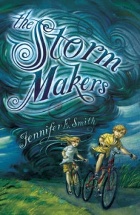
The Storm Makers by Jennifer E Smith
Headline, 2013. ISBN 978-1-4722-0144-7.
Recommended for 10 to 13 year olds. Ruby is the first of the twins
to see the mysterious stranger at their farm. His secret arrival
heralds the beginning of an amazing adventure for both her and twin
brother Simon.
Their life on a farm, far away from their city past heralds a new
beginning for their family. Dad wants to invent and Mum paint but
the farm is struggling because of the persistent drought. This whole
book is centered on weather and as the title suggests, with humans
who have a special gift that can control it.
Simon discovers he is one the youngest Storm Makers but there are
others who can help and guide him. He must decide who he can trust
as his special powers could be deadly.
Ruby tries to guide Simon to make the right choices and together
they embark on an unbelievable journey into an unknown world where
people have both extraordinary powers as well as human frailties.
This story, set in Wisconsin, takes some time to develop but is well
worth the investment. I feel independent, motivated readers will
enjoy this novel. Recommended for 10 to 13 year olds.
Jane Moore
Best books for primary compiled and edited by Pat Pledger
Pledger Consulting, 2013. ISBN 9781876678371.
If you have ever thought to yourself I wonder what new quality books
I'm missing or I wonder what's available that I can use with my
class, then this may be the book for you. From the stable of Pledger
Consulting comes another useful bibliography; Best books for
Primary contains a list of books reviewed and recommended by
Australian teachers and teacher librarians on Pledger's Readplus site. Award winning titles
are included from the Children's Book Council, Guardian Children's
Book Prize, Newbery Awards and the Roald Dahl Funny Prize. Titles
comprise four categories- Picture books; Middle Primary; Older
Primary and Non Fiction. Best books for Primary is not a complete set of reviews, but
an annotated alphabetical list, with a sentence or two giving a very
brief overview of the story. By choosing an age level readers can
check interesting titles. The brief annotation gives enough of an
idea to encourage you to look into the title further. In some cases
these reviews on the website are complete with lesson notes. The
list of non-fiction titles is particularly useful. An index adds to
the usefulness of this aid to busy teachers and teacher-librarians.
Diana Warwick
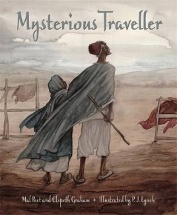
Mysterious traveller by Mal Peet and Elspeth Graham
Ill. by P J Lynch. Walker Books, 2013. ISBN 9781 4063 3707 5.
(Age: 8+) Highly recommended. African story. Responsibility. When an
old desert guide, Issa, finds a baby protected from the sand storm
by a camel, he takes her home, raising her as a gift from the
desert, and later when he becomes blind, she repays him by being the
guide for him, describing for him where they are, enabling him to
continue guiding people across the vastness ahead.
But one day a stranger with two servants asks him to guide them
across the Bitter Mountains. This is not the usual route, and one
that is dangerous, but they need to go quickly. On realising he is
blind, they disparage him and storm off, deciding to find their own
way. But Issa knows they will get into trouble so he and the girl
set off to find them. saving them from the fierce sandstorm. This
sees the young man return to Issa's house alone, to apologise and
offer money for being saved. But seeing the girl's pendant, pieces
fall into place about Mariama's background.
This beautiful story, wonderfully illustrated by Lynch, will
encourage readers to read it over again, as they ponder just how the
girl got to be in the desert and why the camel was so brave. The
acceptance by Issa of the baby he finds in the desert, his
responsibility in caring for her and then her being able to repay
his kindness is a theme that carries the story along and remains
with the reader.
The background to this small family, of Issa saying his prayers, of
their kindness to strangers, of not wanting payment for saving the
lives of the three, all point to a strong value system, and
underpins their basic humanity, regardless of which religion they
belong to. This is a wonderful tale, one that could be read and
retold for its own sake, one that could be the springboard for
discussions about responsibility, or about Africa where the story is
set, the descriptions and illustrations giving an unforgettable
background to the events as they unfold.
Fran Knight