Literature to Support General Capabilities by Fran Knight and Pat Pledger
Pledger Consulting, 2013. ISBN: 9781876678395.
Recommended. Subtitled 'Personal and social capability, Ethical
behaviour, Intercultural understanding, Numeracy'. This title
contains annotated lists of novels to support the General
capabilities strand of the Australian Curriculum. In addition to the
topics listed in the title, literacy and ICT are also included.
Lists cater for students from Reception or Foundation right through
to those in Year 10. Materials listed are predominantly those which
can be deemed more recent releases as well as some which libraries
probably hold as part of their collections already.
Personally, I much prefer lists such as this collection to those I
find online. Invariably, a large proportion of the titles which I
find in digital lists either contain predominantly American voices
or out-dated titles which can no longer even be sourced except from
overseas. Given that we are teaching the 'Australian curriculum', I
appreciate having access to literature with a genuine Australian
voice, direct from Australian publishers and therefore of greater
relevance to our students. I would recommend this title as an
essential for every library due to the time it saves in gathering
together titles on a particular capability and the quality of the
literature listed in this resource. Thanks again for assisting all
teachers and librarians through the content of this book!
Jo Schenkel
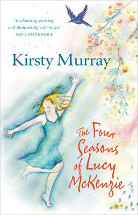
The four seasons of Lucy McKenzie by Kirsty Murray
Allen and Unwin, 2013. ISBN 9781743317020.
(Age: (9-12) Highly recommended. When her sister falls ill and her
mother has to go to Paris, Lucy McKenzie is sent to the country to
stay with her Great Aunt Big, who lives in Avendale, an old house in
a hidden valley. She is very unhappy about being there but then she
discovers that the old house is full of mysteries. One night she
hears a voice calling from inside a painting on the wall and
entering the scene becomes friends with three children on the other
side of the painting. There she has many adventures, fighting a
bushfire, battling a flood and riding horses through the bush. But
why has Lucy been taken to the 1930's and why does she need to
befriend April, Tom and Jimmy Tiger?
This is a very engaging time-slip novel, bringing to life what it
was like to live in the country in the 1930's and contrasting it
with life today. Murray keeps up the suspense about what is
happening and who the children are as Lucy gradually becomes friends
with them and learns that she has abilities to help in times of
danger. It is the knowledge that Lucy brings from the 21st century
that helps to put out a bushfire and save the family's house. The
mystery surrounding the children is beautifully realised as Lucy
begins to grow and mature.
Murray also subtly looks at the role of women in the 1930's. As Lucy
gradually begins to appreciate her aunt's eccentric personality and
stops hating being at Avendale, she finds Big has had to sacrifice
her own career to look after father. However she is not a bitter
person, but one who appreciates the beauty of the countryside and
her paintings of it. Lucy discovers from her friendship with Lucy
that regardless of age, you are still the same person inside.
Lucy also has to think about what would happen if she changed the
future through her actions in the past. Even though she tries to
warn Tom not to go to war she realises the consequences of her
actions.
True to life characters, a beautiful bush setting, and a look at
life in the 1930s make this a fascinating and worthwhile read.
Pat Pledger
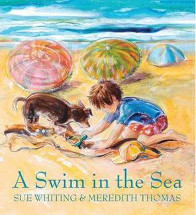
A swim in the sea by Sue Whiting and Meredith Thomas
Walker Books, Australia, 2013. ISBN 9781921150494.
(Age: 4+) Recommended. Picture book. Sea. Fear. Family. Bruno is
eager to get to the sea with his family and see it for the first
time. They pack the car, drive there and see the sea peeping over
the horizon. Bruno is ecstatic. He and his dog run along the sand,
jumping and splashing in the water's edge, until a big wave comes
rolling in, pounding the beach and following closely behind as he
runs away from the water's edge. He is terrified. His day at the
beach ruined, so he sits under his beach towel and refuses all
attempts to entice him out.
Little by little his family encourage him to appear. They build a
castle near by with a moat, encouraging him to be part of the
activity. They build a wall around the castle, filling it with
seaweed and shells, and he takes a tentative step inside and sees it
is not much different from his wading pool at home, and so feels
safe. All ends happily.
A charming story of feeling safe, or overcoming a fear of the sea,
this will have wide appeal to young children, particularly when going
to the beach. The overcoming of fears, the strength of the family
unit, the family on holiday, are all themes which could be explored using
this book with illustrations that immediately appeal with their
strong colours and flowing images of the sea.
Fran Knight
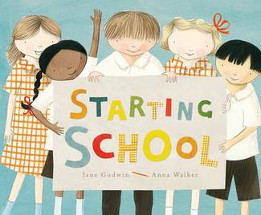
Starting school by Jane Godwin and Anna Walker
Penguin, 2013. ISBN 9780670076765.
Tim, Hannah, Sunita, Joe and Polly are starting school and while
each of them is having a unique experience, each experience is that
of every other child who makes that big step to independence.
Each double spread focuses on a different aspect - getting ready,
meeting the teacher, making friends, finding their way around the
school - all those things that loom large in the minds of littlies
and which can be really daunting. But putting a personal face
on them somehow makes them more manageable and not such a big deal.
From being strangers at the start of the day, each has a new friend
and plenty to tell their parents at the end of the day.
Anna Walker's gentle illustrations, especially those which run along
the bottom of the pages, are the perfect accompaniment to a book
that every child should experience before they start school.
Apart from anything else, it will help them understand that the BIG
problem that they are wrestling with is one that is shared by others
and that there is a solution for it. Even if they follow a
beetle at lunchtime and don't hear the bell, someone will miss them
and find them and show them the way to where they should be.
As this school year winds down and transition visits from preschools
begin, this is a perfect book to help the children prepare for this
next step in their lives. Perhaps it could even be a model for
the class to start its own book, documenting the adventures and
emotions of those first few days. The children will look back
on it twelve months from now and see how far they have come, and
perhaps even share it with the new class!
Barbara Braxton
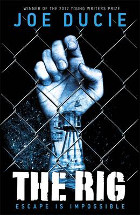
The rig by Joe Ducie
Hot Key Books, 2013. ISBN 978147140219.
(Age: 13+) Highly recommended. Science fiction. Dystopian. Thriller.
Reluctant readers. Guardian/HotKey Books Young Writers Prize 2012.
Will Drake is the ultimate Houdini. He has been able to escape from
every high-security prison that he has been detained in, until he is
sent to The Rig, a specialist juvenile detention centre in the
middle of the Arctic Ocean. As he scopes out the prison, trying to
work out how he can escape, he begins to realise that things are not
what they seem to be. Some of the detainees seem to have weird
powers and disappear off to 'Advanced' classes.
This is a fast paced thriller that locks you into reading right from
the first page. As the story progress the reader comes to understand
Will and the blind determination that drives him to escape his
prison. He is cool, strong and self-sufficient but finds that he
needs Tristan, his nerdy cell mate and Irene, a feisty girl, to join
with him in his exploration of The Rig. Filled with breath-taking
moments as the trio creep through tunnels and scale down elevator
holes, the action is non-stop and kept me reading this story in one
sitting. Even the games the prisoners play are full of thrills. Rig
ball is one scary game. The scenes are easy to imagine and the book
would make a great TV series or movie.
The evil Warden, the guard Brand and the bully Gray and his cronies
provide a satisfying contrast to Will, Tristan and Irene as they go
about their deadly business with no conscience at all. The
difference between their lack of morality and that of big business
and the reason that Will has been sent to prison is thought
provoking. Ducie subtly questions the ethics of imprisoning
violent young offenders with teens on lesser charges.
Both boys and girls will enjoy this action packed book and it should
appeal to reluctant readers, especially boys. Although the novel
reads as a stand-alone there is scope for a sequel, so it will be
interesting to see what happens next.
Pat Pledger
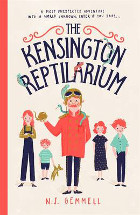
The Kensington Reptilarium by N.J. Gemmell
Random House Australia Children's, 2013. ISBN 9780857980502.
(Age: 10+) Nikki Gemmell has published five adult novels and two
works of non-fiction with great success under her full name. Now she
has turned her hand to a children's novel which, according to a
letter introducing the book, she wrote to hook her own sons into
reading.
The madcap adventure which is The Kensington Reptilarium
incorporates some elements of fact into a crazy scenario of feral
bush kids transplanted to post WWII London and a very unwelcoming
uncle, who prefers his reptiles to humans of any description, but
particularly children.
The Caddy children - Kick, Scruff, Bert and Pin (officially
Thomasina, Ralph, Albertina and Phineas) - have been fending for
themselves on their outback property since their father took off on
one of his regular expeditions. The trouble is that this time, he
hasn't returned. The arrival of police and a very elegant London
lawyer, Horatio, spells the end of their wild existence and within
hours they are whisked off to London and deposited in the creepy
house of their uncle Basti (Sebastian). Basti's plan had been for
the children to go to an orphanage and certainly not into the midst
of his eccentric and solitary life surrounded by reptiles of all
varieties, so from the very moment the colonial Caddy kids arrive,
pandemonium erupts!
As kids and uncle slowly begin to create a familial relationship,
other characters come into play to help the process. A Christmas
like no other is in store for this bunch - and after much strife all
is resolved in a happy ending for a very unusual family.
The larger than life characters, the fast moving plot and the
addition of special attractions such as Perdita the hooded cobra
will engage readers, both boys and girls, from 10 years up.
Sue Warren
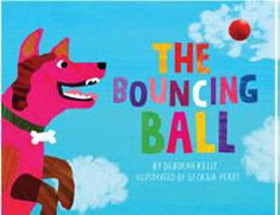
The bouncing ball by Deborah Kelly
Ill. by Georgia Perry. Random House, 2013. ISBN 9780857980045.
(Age: 4+) Recommended. Picture book. Humour. A boy finds a small red
ball. He plays with it, bouncing it, hitting it against a wall, and
throwing it up into the air. But it bounces away between two cars,
into the gutter and through the pipes and into the sea. There it
washes up onto the sand where a girl picks it up, and the same thing
happens all over again. And then again, and at the end of the book,
the reader is asked to predict what may happen next.
This is a charming tale of finding something then losing it. But the
loss means someone will find the item and then lose it as well, the
tale becoming circular. Children will love reading the story,
watching the ball come to different owners, reflecting on their own
possessions and how they have lost objects, and pondering about what
may have happened to them. The end invites the reader to predict
what may happen and describe their own scenarios for the lost ball.
I could imagine a teacher or parent making up a template similar to
the book's outline which is repeated, having the children drawing up
their own storyboard for the ball's next adventure and using their
imaginations to describe the most outlandish of possibilities. These
could be displayed in the classroom adding another layer to the
wonderful text.
Fran Knight
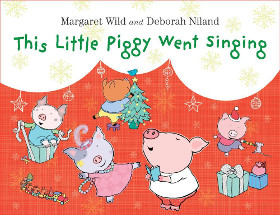
This little piggy went dancing by Margaret Wild
Ill. by Deborah Niland. Allen and Unwin, 2013. ISBN 9781743315118.
(Age: 3-6) Recommended. Picture book. Rhymes. Margaret Wild has used
the old favourite nursery rhyme, This little piggy went to
market, as the basic pattern for her new read a loud picture
book for pre-school children. Any mum or dad, brother or sister,
aunt or uncle will get a thrill out of reading this to a younger
child, giving all the inflections needed, making sound use of the
repetition and the last lines of each double page, inviting the
child to join in. As each pig goes dancing, or swimming or splashing
amongst other activities, the other four pigs make their presence
felt. The second pig always stays home, while the third does
something usually involving food, and the fourth has none, while the
fifth gets back home somehow (usually noisily).
Great fun is had by all five pigs on each page, and the chirpy,
active illustrations accompanying the words will be a treat for all
who read the book. The little pig who stays home does a variety of
activities, making it no less active than the others, so readers
will love working out what it is doing while the others play, eat
and walk home. The joy of reading the book out loud, watching what
each little pig does, joining in with the lines repeated, predicting
what may happen next, along with the charming illustrations make
this a must read for pre-schoolers.
Fran Knight
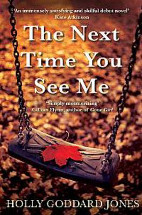
The next time you see me by Holly Goddard Jones
Corvus, 2013. ISBN 9781782390831.
(Age: Older teens) When 13 year old misfit Emily Houchens finds a
body in the woods on one of her solitary walks after being bullied
at school, she decides to keep the information to herself, making
repeated visits observing the decay in the manner of a scientific
experiment. It soon becomes apparent that the body is that of the
schoolteacher Susannah's wild sister Ronnie who goes missing after a
night out and it is fairly obvious early on who might have been
responsible. The real matter of the novel is an intense scrutiny of
the lives and psychological motivation of those drawn together by
the crime in this small, depressed, southern town. All of the many
character seem to be lonely and unfulfilled, and there is a lot of
cruelty and prejudice. What is interesting from an Australian point
of view is the glimpse into this small Kentucky town, its obsession
with college sport and body image and the legacy of racism and
prohibition. This is the first novel for Holly Goddard Jones, she
previously published some short stories and this really works better
on that level, more of a documentary than a thriller. Although one
of the central characters is thirteen this is really only suitable
for older readers.
Sue Speck
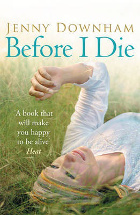
Before I die by Jenny Downham
David Fickling Books, 2010. ISBN 9781849920452.
(Age: 14+) Highly recommended. Death. Cancer. The story of Tessa's
last few months alive is told with earth shattering honesty as this
young adult fights all the way to the end. Determined not to leave
some of life's milestones unexplored she makes a list with her
friend Zooey of things to do before she dies, including sex, drugs,
fame and love.
Living with her father and brother, Cal, has its own problems as her
father strives to find another way for her, after she refuses some
of the medical intervention received in the past. Separated form the
woman he still loves, he trawls the internet for alternative therapy
of any kind, rejoicing when his wife reappears to support their
daughter.
In and out of hospital when showing an increasing number of symptoms
of this cruel disease, Tessa's relationship with Zooey falters, but
when Zooey admits that she is pregnant, Tessa supports her friend in
her decision whether or not to have an abortion. Dark humour dots
the pages, particularly so when friends and medical staff mouth
platitudes which sharpen the readers' sense of the absurd. One
nurse, Philippa, cares more deeply than the others and one doctor,
James, answers the questions no one else will answer.
In meeting the boy next door, romance develops despite misgivings
from both sides. He becomes a significant anchor in Tessa's life as
they work around her deterioration.
In opting to leave hospital she wants to die at home, where her
boyfriend can hold her, where she can see the flowers blooming over
the fence, where Zooey can talk to her about the baby, Cal can tell
her about his school day and Dad can continue his fight to keep her
alive. It is all so real, the shorter sentences leading the reader
to the end where her breathe stops.
At times a beautifully played out romance, at times a difficult to
read progress of her illness, this book is outstanding in its
dealing with the death of a young adult. All the questions people
want to ask, but cannot, are answered, with detail of her physical
decline given. The inability of her parents, particularly her
father, to let her go and do as she wishes, is sympathetically
shown, the coolness of the medical staff, the curiosity of people at
school and in the neighbourhood, are all shown in the background,
giving a biting reality to the story.
Her voice is intoxicating, her struggle to achieve some things
before she dies makes engrossing reading.
Fran Knight
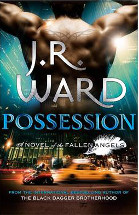
Possession: a Novel of the Fallen Angels by J.R.Ward
Piatkus, 2013. ISBN 9780749957209.
(Age: Adult) A supernatural action paranormal romance thriller -
angels vs demons, literally - this book is set in modern urban
America. There is lots of in-your-face swearing, explicit sexual
descriptions, and hard and fast action. This is number five in a
series. The basic premise is that God has tired of the interminable
wranglings of the human race, and has set the stage for a final
fight between Heaven and Hell, winner take all. Skip all the
long-winded matches, and go for the best out of seven, using a human
protagonist who, at least initially, is agreed upon by both sides as
equal in his share of good and evil characteristics.
Each book centres on saving a soul, where the reluctant hero, Jim
Heron, battles a demon. Titles like Covet, Crave, Envy...
make up the series. Possession is not one for a school library due to the adult
content. If the swearing and explicit sexual descriptions don't
debar the book, then maybe religious people might take offence!
While not lyrical, poetic and beautifully crafted, the novel is very
readable, pacey and good escapist fiction.
Anne Veitch
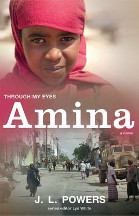
Amina by J. L. Powers
Through My Eyes series. Allen & Unwin, 2013. ISBN
9781743312490.
Highly Recommended. Amina's young life has only known civil war but
in the Mogadishu of 2011 things have taken a turn for the worse.
Amina is a Muslim school girl growing up in Somalia and as required
by law, she is accompanied at all times by her older brother Roble.
Amina's father (Aabbe) is an artist but the ruling fundamentalists
have just banned such forms of social commentary. Amina has
inherited her father's talent but the teenager prefers to practice
public art which she knows is far more dangerous. Often Roble and
Amina's love interest, Keinan, keep watch while she draws her street
art. Unfortunately, her father is arrested by Al-Shabaab so Amina
leaves school to support her pregnant mother, Hooyo and grandmother,
Ayeeyo, to survive a new famine in addition to ongoing physical
danger.
This little work of faction would inspire fertile discussion of many
themes - there's even a reference to the issue of female
circumcision. Allen & Unwin have published a 40 page Teaching
and Learning Guide online. Readers will admire the heroine of
Book Two in the Through my Eyes series for her ongoing
passion for art and poetry despite overwhelming grief and adversity.
Deborah Robins
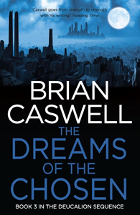
The dreams of the chosen by Brian Caswell
Deucalion sequence, bk 3. University of Queensland Press,
2013. ISBN 9780702236051.
(Age: Teenagers+) Recommended. 'It was fear. Of what we might find
there. Or might not find . . .'
The colonists of Deucalion have had no contact with mother earth for
centuries, but now that is about to change. Using new and untried
technology, an intrepid group of explorers will return to earth and
discover what exactly went wrong.
Brian Caswell has written a plethora of brilliant books and the
third book in the Deucalion sequence The dreams of the chosen
is no exception. Caswell's books are wonderfully descriptive and
draw the reader into his world of words. The crew of the Cortez, a
faster-than-light spaceship, embark on a journey from the colony
world of Deucalion to Earth to discover why there has been no
contact for centuries and what exactly happened to the most advance
civilisation ever.
When the Cortez arrives in orbit around earth, the only trace of
human civilisation visible is a scattering of Feudal age settlements
amid the ruins of ancient cities. When the crew land, they discover
a world of superstition and fear, ruled over by a group of
tyrannical 'families' who maintain power with an iron fist. With the
help of a group of outcasts the crew set out to find what caused the
post apocalyptic civilisation.
All in all, The dreams of the chosen is an excellent example
of a well written piece of science fiction, one that provides the
reader with an in-depth setting and characters. Though this book is
primarily intended for teenagers I would recommend it to any lover
of science fiction.
Alex Leuenberger (Student)
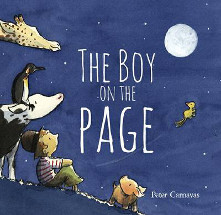
The boy on the page by Peter Carnavas
New Frontier, 2013. ISBN 9781921928468.
(Age: 4+) Warmly recommended. Picture book, Books and reading, Age.
A loving tribute to the power of books and story, Carnavas has the
hero of the book fall onto a page, from where he discovers the
world. He meets many animals, sees many different things, all the
while wondering why he is here. He then experiences a range of
things, rolling down the hill, playing an accordion, catching a
fish, planting a tree. As he is doing all these things, he is
growing too, and meets someone with whom he builds a house, has a
family, keeps a dog, still wondering why he is here.
He tries to jump off the page, but only succeeds in falling back
onto the page where he sees all the things he has done and
experienced and been involved in - his life.
This is a smart humorous tale of one man's life, from the time he
begins to see things around him, to his older age, where he can
place everything in the context of his life. All through the years
of looking and seeing and being involved, he discovers the wonders
of life, the things which make it worth living. And it is this that
children reading the book will understand when reading the tale and
looking at the appealing illustrations. Readers will identify with
the young man starting out on his life's journey and recognise the
boy growing into a man and doing things more adult, then growing
older and questioning his life's journey.
But it not only shows the passage of time and how people age but
also shows the importance of books in one's life journey, as each
book can show something different, encourage new experiences, and be
a companion on that journey.
Fran Knight
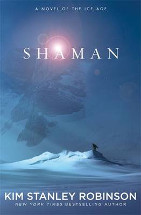
Shaman by Kim Stanley Robinson
Orbit, 2013. ISBN 9780356500447.
(Age: Senior secondary - Adult) Shaman is a lengthy novel, set in
the last Ice Age, at a time when the Neanderthals are dying out (the
Old Ones), and the Cro-Magnons, our ancestors, are well and truly on
the road to success. This is the story of Loon, a young Cro-Magnon
set to become the shaman of his pack, and the struggle he has coming
to terms with his place in the world.
Essentially, Shaman is a coming-of-age story. The author
paints a very detailed world, with much description and little
dialogue. We follow Loon's initiation into manhood, his difficulties
accepting the path that has been chosen for him, and then his
various adventures which inevitably lead to his maturation and
acceptance of his place in the scheme of things as he grows in
wisdom and responsibility.
This is an interesting novel, well written, certainly gripping in
parts, and quite thought-provoking. It has been well researched, and
interestingly, self-styled by the author as a science fiction with
the rationale that it stems from the study of a science -
archaeology. You can draw your own conclusions about a speculative
work of fiction set 30,000 years in the past. To me, it calls The
Clan of the Cave Bear series by Jean Auel to mind. Another
text to compare it with might be the documentary film Cave of
Forgotten Dreams (2010) about the Chauvet caves, as there is a
lot of painting described in Shaman, based on these very caves. Shaman would not work as a classroom text, but as an addition
to a school library it may appeal to competent senior students.
Anne Veitch