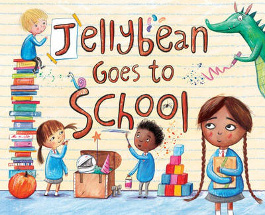
Jellybean goes to school by Margaret Roc and Laura Hughes
Random House 2013. ISBN 9781848530751.
It is the most exciting time in a young child's life and Jellybean
is no exception - taking that big leap and starting school. She
wants to read by herself and write by herself and find out why
clouds are fluffy and spiders spin webs. But most of all she wants
to find a friend, because while she has a baby brother, he's not big
enough for her yet.
Finally the BIG day arrives and, in her new uniform, she's ready,
although her tummy is so jittery that she can't eat her breakfast.
She is SO excited, until she sees the size of the school and the
noise of the playground. Overwhelmed, like many on the same
adventure, she thinks she might stay with her mum and brother after
all. But Miss Benson is used to children with first-day nerves and
introduces Jellybean to Alex, who is also not as confident. It's
easier to meet the world with a friend. Miss Benson also knows how
to engage and enthuse the children for this new experience, easing
them into all that is on offer in a way that the best Foundation
teachers do.
Author, Margaret Roc has tapped into Jellybean's feelings of
apprehension perfectly and so has illustrator, Laura Hughes. At
first, when they use the building blocks, Jellybean's imagination
has her far, far away in Rapunzel's tower but as she and Alex and
the other children explore what is on offer, she gradually moves
into the here and now and imagines the possibilities of what this
new place itself, can offer. The bright colours and familiar
backgrounds will enable other Jellybeans to take the journey with
her and gain security and comfort from knowing that all the other
children are feeling the same.
This is such a lifelike book dealing with such a familiar subject,
and one that is coming closer and closer for many that it is sure to
have a wide appeal. Many schools are having transition programs as
preschoolers learn what big school is really about, and having a
library of these sorts of books so parents can borrow them to share
with their child or preschool and Foundation teachers can use them
to show that nerves are part of the deal, is one way the library can
be involved in these programs as well as starting a productive
relationship with the parents. Jellybean goes to school
deserves its place in that collection.
Barbara Braxton
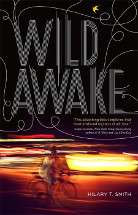
Wild awake by Hilary T. Smith
Hardie Grant Egmont, 2013. ISBN 9781742977706.
(Age: 16+) Recommended for an older audience as it contains material
including drugs and sexual content. While her parents are away on a
cruise, 17 year old Kiri receives a strange phone call and discovers
that her sister didn't die in a car accident, but had been murdered.
Going to meet Doug, the man who had phoned, Kiri begins to uncover
the mystery surrounding Sukey, the sister that her parents had
kicked out of home. Her carefully regulated life begins to break
down as she discovers the lies that her parents had told her and has
to rethink her memories of her sister. Then she meets Skunk, a
large, tattooed boy who repairs her bike and who is strange.
The reader is taken on a roller coaster ride with Kiri as she speeds
on her bike, sometimes high on drugs, through the neighbourhood where
her sister had last lived. From the obsessive teen, who has a
practice timetable taped on the lid of her piano, organising for the
International Young Pianist's Showcase, and who plays in Sonic Youth
for the Battle of the Bands, we watch her exhilarating spiral down
into what Lukas' social worker mother calls monomania. There are
thrilling bike rides in the middle of the night, drug taking, music
of both the classical and popular and discussions of life - 'The way
cannot be cut, knotted, dimmed or stilled' - Skunk's and her
favourite line from the Tao. Kiri's life is a mess and so is
Skunk's, but together they move forward.
More serious issues of mental health, paranoia and murder are also
themes, with questions of what is normality an undertone to the
book. It is beautifully written with many striking images and
dialogue. It is sure to appeal to reluctant readers and will
engender much discussion around drug taking and honesty between
family members.
Pat Pledger
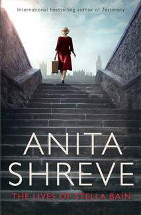
The lives of Stella Bain by Anita Shreve
Little, Brown, 2013. ISBN 9781408702970.
(Age: Senior secondary - adult) The lives of Stella Bain
chronicles the life of a woman who wakes up in an army hospital in
France, during World War 1, with no idea who she is, other than a
sinister feeling that she may have a past to be ashamed of. What
follows is first her quest to recover her memory, and then her
attempt to put her life back together.
The novel takes the reader through wartime France, England and the
United States and can, perhaps, offer a little insight into the
history and early psychiatric practices of the time. Thematically it
covers a lot of ground, encompassing issues such as war, memory
loss, family and child custody, domestic abuse and a search for
identity.
Structurally the novel can be hard to follow, but is an interesting
example of different text forms within the one piece of work. There
are no chapters, but sections are divided by years and locations,
though these are not always chronological. Most of the novel is
written in the present tense narrative form, though there are
sections of recount narratives (also in present tense, like a dream
sequence), letters, and also short, seemingly hurried paragraphs
used to communicate a lot of information and the passing of time.
In my opinion, despite having created an interesting plot line,
Anita Shreve's latest novel has left a lot to be desired. I found it
hard to sympathise with the main female protagonist, finding her a
bit one-dimensional and lacking in moral fibre. The novel seems to
have been marketed in a somewhat Jason Bourne style, in
which the reader expects that the protagonist's amnesia masks some
kind of thrilling back story. In reality, the resolution of her
identity comes fairly early in the novel, as a bit of an
anti-climax, and the story that follows, while interesting enough,
is not one that I found riveting.
This novel may be of interest to secondary students, though it seems
to have been written for a more adult audience. It is a pleasant
enough read, with some interesting themes, but not one that I'd be
rushing to read again.
Sarah Rose
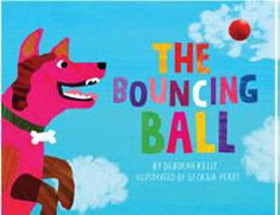
The bouncing ball by Deborah Kelly and Georgia Perry
Random House, 2013. ISBN 9780857980045.
A little boy finds a bouncing ball, and like all little boys he
begins to bounce it - against a wall, along the street. But then he
drops it and it bounces onto the road, between the cars, into a
gutter and down the drain... Then a little girl finds it and she
begins to bounce it, until she too drops it and its adventures
continue.
This is Deborah Kelly's debut picture book and while the premise
seems simple, there is huge scope for lots of those comments and
conversations that are so precious in a shared reading experience,
either in the classroom or the bedroom. Accompanied by
engaging, bright illustrations which bring the words to life - is
there anything better than a hot pink dog or a yellow and purple
cow? - this charming story delighted the little ones I shared it
with, particularly as it is perfect for them to make up the final
adventure. Each one had a different idea and there were enough
stories that we could have written a new book. We also had fun playing
around with position words, looking for where the ball might gone
over, down, through, between, off, into, around, if we were inside or
outside. Teaching riches indeed.
Neil Gaiman said recently that we have 'an obligation to imagine'
and this is perfect for doing just that.
Barbara Braxton
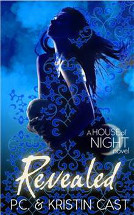
A House of Night novel: Revealed by P.C. & Kristin Cast
Atom, 2013. ISBN 9780349001739.
Popular paranormal romance series A House of Night continues
with its eleventh instalment Revealed. Written in
alternating view points P.C and Kristen Cast continue from where
they left off in Hidden and showcase the main antagonist's
(Neferet) return to power. Major themes include the importance of
unity, friendship and trust. Teenage fans of paranormal romance may
enjoy this novel.
Defeated by Zoey and her circle, Neferet manages to manifest her
consciousness into spiders. Power hungry and immortal Neferet gives
herself over to her vampyre hunger and drains the Mayor of Tulsa
(who happens to be Aphrodite's father) of his lifeblood leaving his
body devoid of life before fleeing the scene. Uncovered by his wife,
the mayor's death brings the House of Night to a standstill and
their already tenuous alliance with the humans of Tulsa wavers once
more. Lessons suspended until further notice, every vampyre and
fledgling is a suspect to murder. Unfortunately Zoey and her circle
know better, the work of Neferet is all too familiar but there is no
evidence for the Tulsa community. Zoey is stressing over the murder
while her circle is disrupted by the constant threat of Dallas and
his school yard cronies who are all the more dangerous now that
Erin, Dallas' girlfriend rejected the change. The drama continues
for Zoey when she begins to see more and more of Heath's soul in
Aurox (Heath was the lost lover) and Stark is becoming jealous of
Aurox/Heath and demands that Zoey stay well away. With all the
stresses of being an unusually gifted High Priestess Zoey is bound
to crack. But when she does, what will the repercussions be?
Kayla Gaskell (Student)
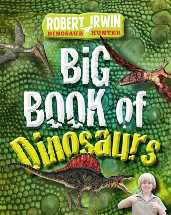
Big Book of Dinosaurs
Robert Irwin Dinosaur Hunter series. Random House, 2013. ISBN
9781742750958.
(Age: 6-12) In this lavishly illustrated book, Robert Irwin has put
together a wealth of facts and figures and other fascinating tidbits
about his favourite things - dinosaurs. Son of well-known
conservationists Steve and Terri Irwin, Robert is continuing their
legacy even though he is not yet 10 years old, and that, in itself,
is enough to inspire younger readers to look more closely at their
surroundings.
This is not an impersonal, all-you-want-to-know-about book, like so
many others with a similar title. We start by meeting Robert, who
despite his extraordinary circumstances, has had a love of dinosaurs
from a very young age - just as many of our young students do - but
it is those extraordinary circumstances that have enabled him to
pursue that love in a way that our young students cannot and now he
shares that with his readers. While his first visit to a dinosaur
museum was the Paris Natural History Museum, he recommends others
that would be a starting place for others such as The Lark Dinosaur
Trackway in Winton in Queensland, and interspersed throughout the
book is a travel diary of the world's leading dinosaur museums. For
those not able to travel to Paris, London or New York, perhaps the
National Dinosaur Museum in Canberra would be more accessible.
Wherever, your students start their journey, dinosaurs are a
perennial favourite with the young and the 567.9 section is well
patronised.
Robert introduces his Top 10 Dinosaurs, none of them not as
well-known as those such as Tyrannosaurs Rex, so the reader is
introduced to a wider variety of these creatures (including some
unique to Australia) through a fascinating description, a fact file
and graphics as well as an inset note from Robert. There are also
the Dinosaur Hunter Awards and we learn which ones have the longest
claws, the most teeth and so on, including the one made most famous
by Hollywood.
All in all, this is a great addition to your collection that will
appeal not only to those who love the Dinosaur Hunter series
but also those who are aspiring to read them as their skills
develop. The text is just right for that 6-12 year old market,
whether as a read-along, read-aloud or read-alone, with an appealing
layout with much to be learned just discussing from the pictures. A
must for anyone with dinosaur lovers in their lives, both those who
know and those who want to know.
Barbara Braxton
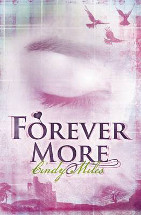
Forevermore by Cindy Miles
Chicken House, 2013. ISBN 9781908435927.
(Age: 12+) Romance. Ghosts. Scotland. Ivy Calhoun has moved to a
cold castle in Scotland. Her mother has married the local laird and
she is beset with unfamiliar things, not the least a gorgeous ghost,
Logan, who has haunted the castle grounds for a long time. Ivy is
haunted by the beautiful flute music that he plays but danger seems
to surround her. Ivy begins to hear a voice telling her to leave and
strange things begin to happen. Is Logan responsible for her near
death experiences and how can she stop herself falling in love with
a ghost?
This is a very easy to read ghost story that girls in particular
will enjoy. I was not surprised to learn that the author has written
romances for adults. She has chosen a familiar setting for her teen
romance, a dark castle in the Scottish highlands, complete with
thick walls, ruins, servants and extensive gardens. It is inhabited
by her stepfather's grandmother, Lady Elizabeth, an elderly woman
who appears to hate her.
Ivy is a strong character who will appeal to readers. She makes
friends readily at her new school, and is aiming to continue her
violin playing and enter a local contest. She is determined to
uncover the mystery surrounding Logan and enlists the help of her
friends and the local author, who writes highland romances - and
here Miles introduces characters from her adult books.
There is enough mystery and romance to make for a light entertaining
read, especially for lovers of romance stories.
Pat Pledger
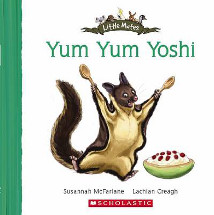
Yum Yum Yoshi by Susannah McFarlane
Ill. by Lachlan Creagh. Scholastic, 2013. ISBN 9781742837420. Zippy Zoe by Susannah McFarlane
Ill. by Lachlan Creagh. Scholastic, 2013. ISBN 9781742838847.
(Ages 4+)Little Mates series. Alphabet books, Australian
animals. Yum Yum Yoshi, the yellow bellied glider and his friends
are in the bush collecting their food. Everything Yum Yum Yoshi sees
is terrific, all yum yum, and he eats it with relish. From yams to
yum cha and yellow peppers, he eats it all down. That is until one
day he begins to feel a little ill. Decidedly ill. So ill in fact
that he no longer feels like eating anything. HIs friends, Yang,
Yolanda, Yasmine and Yuri all suggest things to combat his illness.
Things like yoga and yodelling help not a jot, but when they suggest
yoghurt, all comes well again.
Zippy Zoe the zebra finch is well known for her zippy habits and she
flies from zero to a zillion so quickly that eventually she must
have a sleep. Between the covers of this book, we see the z letter
used in a multitude of ways, until the inevitable, ZZZZ as she
sleeps.
These two little books are in the series of Little Mates,
offering a little, hand sized book of simple stories of Australian
animals from A to Z. Small children will love this series of
Australian animals, and join in with finding things which begin with
the nominated letter as well as follow the bright illustrations with
glee.
Fran Knight
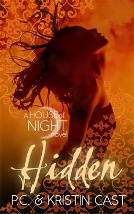
A House of Night Novel: Hidden by P.C. & Kristin Cast
Atom, 2012. ISBN: 9781907411120.
Written in first person in alternating view points this tenth
instalment in popular paranormal romance series A House of Night
is packed with all the drama that comes with being a teenager and
more! Confusing without background, this novel is written as you
would speak and centres less on the supernatural then on the teenage
drama. Vampyres, witches, seers and goddesses incite the events and
fans of the paranormal romance genre may enjoy this novel.
Continuing on from where its predecessor left off (Destined)
the book encompasses the days following the loss of Zoey's mother
and the exposure of Neferet's dark nature. Zoey and her group are in
mourning after the death of their sword master Dragon Lankford to
the vessel of The White Bull. The school is in upheaval as both
staff and students come to terms with the betrayal of their High
Priestess Neferet, who sacrificed Dragon's cat in order to command
the death of a son of immortal, Kalona. Breaking with the Tulsa
House of Night Neferet seeks the help of humans to reap havoc on her
vampyre counterparts, however she doesn't count on, high priestess
Zoey's continual interference. All the while, cracked vessel,
created by darkness, Aurox (who Zoey suspects may host the soul of
her beloved Heath) begins to fight his dark beginnings and rebel
against the White Bull. Betrayal, death, darkness and in spite of it
all hope, the novel demonstrates the importance of unity, friendship
and trust in a fanciful interpretation of our world.
Kayla Gaskell (Student)
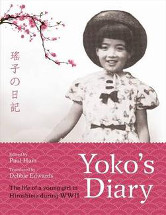
Yoko's diary ed. by Paul Ham
ABC Books,2013. ISBN 9780733331176.
(Age: Suitable for Middle School students aged 10-15 years) Highly
recommended particularly for students of History and Japanese.
Yoko's diary was first published in Japan in 1996, but this is the
first English translation. Yoko wrote her diary each day from
6.4.1945 to 5.8.1945 - a period of 4 months - from her commencement
in Year 7 at the prestigious 'Kenjo' high school in Hiroshima. Yoko
relates the detail of her days in 2 sections - 'School' and 'Home' -
with lots of detail about domestic arrangements and the education
system.
Yoko tells us at what time she wakes and at what time she goes to
bed. She tells us if/what she studies and what chores she does. She
details everyday life in Hiroshima in the last days of World War
II.We experience Yoko's ups and downs, her joys and frustrations,
her commitment to hard work, her compassion for the Japanese troops,
her loyalty to family, school and country, her rare opportunities
for play with friends, her long days travelling to and from school
and visiting family members and her attempts at growing food. We can
see how readily she, her family and teachers accepted the Japanese
war propaganda. Japan's war efforts were in dire straits, but Yoko
believed that victory was not far away. Yoko diary finishes on
5.8.1945, the day on which the atomic bomb was dropped on Hiroshima.
She died later that day from the effects of the bombing.
Yoko's diary is edited by Australian author Paul Ham and he has
added numerous information pages eg shrine maidens, rationing,
religion in Japan in the 1940s. It has been beautifully designed.
Many pages are adorned with cherry blossom decorative scrolls. There
are black and white photos, maps and Yoko's family tree. In addition
there are recent contributions by Yoko's older brother, Kohji, her
niece, Miki,her nephew, Yo, her sister-in-law, Kazuko, her school
friend, Kazuko, and Hatsue, who attended Yoko as she died apart from
her family in a relief centre. The details of Yoko's injuries and
last hours are heart-breaking, but sensitively handled.
Margaret Strickland
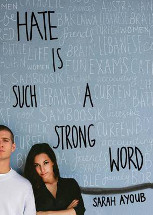
Hate is such a strong word by Sarah Ayoub
Harper Collins, 2013. ISBN: 9780732296841.
(Age: Secondary) Sarah Ayoub has created an engaging plot line that
speaks to relevant issues in the lives of Australian
Teenagers. This was a quick read, which I didn't want to put
down.
Written in the first person, seventeen year old Sophie takes us
through her final year of high school as a Lebanese-Australian,
living in a predominantly Lebanese district of Sydney. Like many
teenagers, Sophie struggles with fitting in at school, dealing with
an over-protective father at home, reconciling her two cultures and
trying to find her place in the world.
Ayoub covers a lot of ground in this debut novel. Racial Tension,
bullying, family, relationships and identity are just a few of the
themes that she explores, and she does so in a manner that quickly
draws the reader to empathise with the well-constructed female
protagonist.
The novel presents a vivid picture of what it is to live as the
child of a migrant family within a cultural minority in Australia.
While I cannot personally vouch for the accuracy of this depiction,
I believe it is a novel that will open the eyes of the average
Australian teenager to the broad diversity that resides within our
country.
While the language is not challenging, and this novel should be a
fairly easy read for most high school students, the themes are
particularly relevant to more senior students who are making the
transition into the adult world.
This is a coming of age novel, with a good dose of social commentary
and a hint of chick-lit. Hate is Such a Strong Word could be studied in conjunction
with other text such as My Big Fat Greek Wedding, or Looking
for Alabrandi, though I would recommend it more as a wider
reading novel than a class shared text.
Sarah Rose
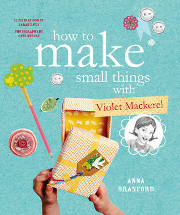
How to make small things with Violet Mackerel by Anna Branford
Ill. by Sarah Davis. Photographer Cath Muscat. Walker Books, 2013.
(Age: 6-10) Highly recommended for crafters from 6-10 years. Themes:
handicraft, collections, sewing, gifts, recycling, up-cycling. This
absolutely gorgeous craft book is a companion volume to the
wonderful Violet Mackerel novels. Violet loves collecting small and
appealing things and in this how to book the reader can engage with
some exciting craft projects. This book is beautifully laid out with
three chapters - Small things to Wear, Small things to Use and Small
things to Give. There are four projects within each section suitable
for children from six years of age with supervision and for
independent crafters.
These activities are introduced by Violet and connect with her
family, friends and her stories. Each project contains a list of all
the things needed and has clear easy to read step by step
instructions accompanied by a photograph or illustration. To add
interest, Violet suggests additional ideas in the Thinking Outside
the Square section, turning the beautiful bird hair-slide into a
brooch, changing the look with different materials or making
different animals.
Some of the projects involve recycling old socks or t-shirts into
wrist warmers and tubular scarves then adding personalised
embellishments. There are beautiful crowns made with small buttons
and charms to give to friends, small felt pouches for treasures,
shining sun rings and handmade gift tags to make.
Sarah Davis' emotive pencil sketches of Violet are cut and placed
attractively on a variety of soft pastel backgrounds. They are
complemented by Cath Muscat's full page colour photos and smaller
images that show the project steps. This is a visually engaging book
that would make a wonderful present.
Rhyllis Bignell
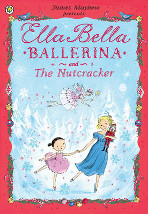
Ella Bella Ballerina and the Nutcracker by James Mayhew
Ella Bella ballerina series. Orchard Books, 2012. ISBN
9781408314081.
(Age: 4-6) Ella Bella is really excited about the surprise party
that her ballet teacher, Madame Rosa has prepared for the class.
There is a large Christmas tree on the stage beside Madame Rosas
special music box and when Ella Bella opens it up it begins to play
music. She is transported into the wonderful world of The
Nutcracker ballet, where she meets Clara and the little wooden
nutcracker. Together they battle the evil Mouse King and when he is
vanquished, the spell binding the nutcracker is broken and he turns
into a handsome prince who takes them to a magic forest. They all
dance to the music of The Nutcracker ballet, and in the
Marzipan Palace the Sugar Plum Fairy claps her hands and they are
surrounded by sweets.
This is a delightful imaginative story that will thrill little girls
who are learning to dance or who would like to learn how to do
ballet. The story of the The Nutcracker is told beautifully
and the illustrations complement the story and will help young
readers work out what is happening. They are light and airy and I
particularly liked the Sugar Plum Fairy with her gorgeous wings and
pink and white dress.
On the back page is an explanation of the origins of The
Nutcracker ballet, and the music that was written by
Tchaikovsky for Russia's famous Imperial Ballet.
This is a book that will have young readers and adults clamouring to
hear The Nutcracker music and if they are very lucky, being
taken to see a production of the ballet.
Pat Pledger
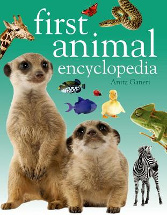
First animal encyclopedia by Anita Gameri
Bloomsbury, 2013. ISBN 9781408842522.
(Age: 5+) Recommended. Animals. Non fiction. An attractively bound
large hard back book presents information about a range of animals
sure to whet the appetites of younger readers. The opening double
page explains what is meant by some specific terms. It explains how
scientists have divided all animals into specific groups such as
reptiles, birds and mammals, each group having something in common.
It then explains how these are further divided into vertebrates and
invertebrates with a reference to warm and cool blooded animals. All
is done succinctly and uses magnificent photographic illustrations
to make the point. After that chapters on each double page
give explanations of various animal groups, large and small,
mammals, animals at the poles and so on, then it concentrates on
various attributes, like surviving or regions where the animals
live. It seems an unusual mix of topics, but I am sure that younger
readers will love to dip in and out of this handsomely illustrated
book, as I did, letting the page fall open, and gobbling up what is
presented. A sound index will help children learn the significance
of using that tool to gain more information, and the large glossary
expands on the knowledge given in the text. A box on the last page
contains references to other books and websites, adding to its
usefulness in the classroom.
Fran Knight
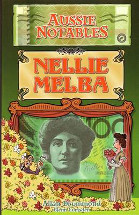
Nellie Melba by Allan Drummond
Aussie Notables series. Green Barrow Publishing, 2013. ISBN
9781876460471.
(Age: 10+) Dame Nellie Melba's success transcended the
confines of the world of opera. Like Dame Joan Sutherland, her name
was known to most Australians regardless of their musical tastes
because they recognised that despite her international fame, she
always identified with her country of birth.
Allan Drummond has used a tongue-in-cheek style to tell the story of
how Helen Mitchell became the phenomenon Nellie Melba. This is a
demanding subject for young readers, many of whom may not be aware
of opera as a performing art, and few of whom will have seen a live
performance. The author has overcome this by beginning with a
reference to the Sydney Opera House, a familiar landmark, and then
broadening his scope to the great opera houses of the world in which
Melba sang. The influence of the singer's parents, details of her
childhood, her difficult personal life as an adult and remarkable
career are all explained, as are the plots of some of the operas in
which she appeared. Chatty asides, references to modern popular
culture and cartoons scattered throughout the text, may appeal to
those readers who also enjoy the Horrible Histories. The use of
cultural stereotypes as a source of humour might now be regarded as
dated. The final chapter about Melba's death and legacy are written
with sensitivity and skill. Nellie Melba is a title in the Aussie Notables series, which
provides brief biographies of the high achievers depicted on our
currency. Allan Drummond's decision to tell their stories will help
younger children to understand the gifts and determination of
Australians whose contribution is so 'notable' that their faces have
been chosen to become part of our daily lives.
Elizabeth Bor