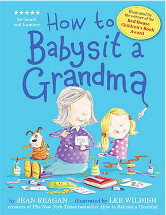
Ill. by Lee Wildish. Hachette Children's Books, 2014. ISBN
9781444918120.
(Age: 4-6) Picture book. Grandmothers. Babysitting. Family. If a
child has any concerns going to stay overnight with Grandma, then
this book will ensure they are all dissolved as the task is turned
on its head with the child babysitting Grandma, showcasing a close
and companionable relationship between the girl and her grandmother,
as well as the parents as they leave the girl to look after the
older woman.
The pair engages in a range of different activities including going
to the park, feeding the ducks, cooking together, watching for the
first evening star, using charades to tell the woman how much she is
loved, then going to bed after making sure the front light is on.
Each activity is one which grandparents do with their grandchildren,
but done the other way allows for some very funny lines as well as
humorous illustrations in which the child is the leader.
A companion for the New York Times bestseller How to babysit a
granddad, this one will also win hearts as the young girl allays all
her fears of being away from her parents by helping her grandmother
fill in her time with a basket of activities.
Children will easily recognise situations where they have a
babysitter and involve themselves in the things the two do together,
comparing them with what they do when staying with someone else, and
look forward to doing them themselves. The close ties of the family
are stressed all through with the child saying I love you to her
grandmother several times, with the illustrations reflecting all the
good things that make up a happy and close relationship.
Fran Knight
The astrologer's daughter by Rebecca Lim
Text Publishing, 2014. ISBN 9781922182005.
(Age: 14+) Recommended. Avicenna never wanted to become an astrologer
as her mother, Joanne, was. Avicenna knew the trade, understood it,
but never wanted to be one herself. However, when her mother
disappears she is forced to follow in her mother's footsteps to
uncover the truth. When one of her mother's clients seeks out
Avicenna's help to find the truth behind a cold-case murder, she
discovers a connection to Joanne's disappearance. With the help of
Simon, her rival for the R. M. Tichborne Prize, she pieces together
the facts. The astrologer's daughter was not what I was expecting in any
way. A compelling read, one that hooked me from the beginning, I was
taken straight into the story and felt compelled to complete
Avicenna's story with her. Mesmerized by the way Rebecca Lim wrote
the novel, I could not put the book down. The chapters flowed on in
a way that keeps the reader captivated, wanting to help Avicenna
with her mystery. I love that Avicenna is strong-willed throughout
the novel, even after her mother's disappearance. While the ending
was vague, it left thoughts of how Avicenna will now continue on and
allows the reader to create their own thoughts of what will come
next in her life. A wonderful 'coming of age' novel set in
Melbourne, Australia.
Cecilia Richards
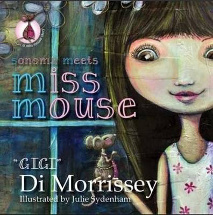
Sonoma meets Miss Mouse by Di Morrissey
Ill. by Julie Sydenham. Harbour Publishing, 2014. ISBN 9781922134400.
This is the first children's book written by popular Australian
author Di Morrissey. With experience spanning over two decades in
publishing, Morrissey is known for her adult fiction that covers
themes including personal relationships, the environment, Aboriginal
reconciliation, identity and Australia's relationship with its South
East Asian and Pacific neighbours. Dedicated to her granddaughter,
Morrissey's first foray into children's literature tells a tale of
friendship and compassion. The main character, Sonoma, is a brave
young girl who is not fearful of darkness or being alone at night.
As she awakens one night, she hears the sound of a soft and sad
whimper. Sonoma hears the whimper turn to crying, and she is
concerned because she does not like anyone to be sad. When she
discovers that the source of the crying is a little mouse, Sonoma is
surprised but she is quick to befriend young Miss Mouse. The story
continues as Sonoma goes out of her way to help small Miss Mouse
find food.
The way that Sonoma shows empathy towards Miss Mouse and is able to
consider the world from Miss Mouse's viewpoint would prove to be a
good discussion point for young readers. The theme of friendship is
strong throughout as Sonoma offers her friendship unconditionally
but is greatly rewarded in return by Miss Mouse.
The illustrator, Julie Sydenham, displays her strength in working
with colour and texture through the beautiful illustrations that
accompany the text. The dark colour palette features rich purples
and blues with pops of orange and pastel highlights.
Children will enjoy this book being read aloud to them and will fall
in love with kind Sonoma and whimsical Miss Mouse. It is a good
prompt for discussions about being caring to others as well as
giving and receiving help. I can imagine this becoming a favourite
at bed time.
Stephanie Bell
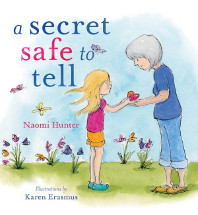
A secret safe to tell by Naomi Hunter
Ill. by Karen Erasmus. JoJo Publishing, 2014. ISBN 9780987587916.
'He said I would get into BIG TROUBLE if I told anyone... I never
wanted to be bad.'
'He said I would UPSET a lot of people if they knew what I had done... I didn't want to make anyone cry'
'He made hurts in places where Band-Aids could not reach... '
'I tried to heal the pain but I wasn't strong enough.'
'I thought about TELLING... but he said I'd be a LIAR... and
no one would ever believe me.
One in five children will be sexually assaulted in some way before
their 18th birthday.
I remember being told that stark fact at a staff meeting in 1990
and, like many of my colleagues, didn't really understand it, let
alone grasp its reality. That sort of thing didn't happen to kids at
our school, to kids we knew. But as we undertook courses in
protective behaviours and mandatory reporting the reality started to
hit. Sadly, it would seem that nearly 25 years later the statistics
haven't changed according to Bravehearts but the
awareness has. Sadly, given the Royal Commission and the prosecution
of some high profile personalities, it is clear that this does
happen to kids in our school and kids we know. But, because of that
Royal Commission and those prosecutions, there is a greater
awareness of the problem and children are finding the courage to
tell and adults are taking the time to listen. A secret safe to tell, written by someone whose dedication
makes it plain that she was a victim, is a step in helping empower
young children to tell, and if the first person doesn't listen then
keep on telling until someone does. Tenderly capturing the thoughts
and emotions of someone who has been abused - 'My heart felt BROKEN.
... I think it started to CHANGE COLOUR' - this story will speak to
the child and perhaps give them the courage to speak too, so they
too can break his power and swing HIGH into the sky where his hands
cannot reach. At the end of the book there is a list of numbers a
child can call and know there is someone who will listen and act on
what they have to say.
On September 12, Bravehearts will host its annual White Balloon Day
and is asking the question, 'Who are you protecting?'
(#whoRUprotecting) and encouraging each of us to snap a
#whoRUprotecting selfie: Answer the question 'who are you
protecting' by writing a name on your palm and display the answer in
a photograph.
When Tom from Int Books
sent me this book to review, I read it and put it aside knowing
there would be a perfect time to share it. This is that time.
Difficult though this subject may be and difficult though this
review has been, the children in your school deserve to have access
to this book - you just never know whose life it might change.
Barbara Braxton
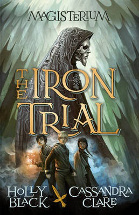
Magisterium: The Iron Trial by Cassandra Clare and Holly Black
Doubleday, 2014. ISBN 9780857532503.
(Ages: 11+) Themes: Magic, Family, Boarding Schools, Disability,
Orphans, Grief/Loss, Good v Evil. The Iron Trial is the
first book in a new series which will appeal to middle school
readers who love Harry Potter. Unfortunately, some reviewers are
already casting it in a negative light because of its similarity to
the Rowling books, however, it does have enough differences to make
it worth a read.
Callum Hunt is a broken boy. Physically, as a baby his leg was
twisted beyond repair, so now at 12, he limps and is considered weak
by his peers and his teachers. But there is also damage to his
psyche. He's been traumatised by his mother's death, which happened
at the same time as his leg was ruined. His father has raised him to
hide his magical ability, and even as he is about to sit for the
examination that will allow him to enter The Magisterium, he knows
his father's expectations - Cal must fail.
All this is set up in the first few chapters. It's clearly aimed at
middle graders, but since we know there is a plan for five books,
each one following Cal through a year at the school, we can predict
a couple of things: Cal will grow up and age, and developmentally so
too will his readers. And I am betting the books will progress into
darker territory.
There is a range of supporting characters, and we don't know who to
trust. The narrative moves at a reasonable pace. There are clues
left scattered so readers can foreshadow horrible masters, jealous
peers and potential love interests. Due to his impairment, Cal is
used to being treated badly and left alone. But he never uses his
limp as an excuse. He wants to be given the same opportunities as
everyone else, and it is gratifying to see him find some friends and
start to feel a part of a group.
There are a couple of unexpected, but welcome plot twists. They are
probably signposted a little too obviously, but for readers who
simply get caught up in the story, and don't question motives or
hints, the story does play out unpredictably.
Okay, back to Harry Potter. I know people bemoan how derivative some
books are, but I have to say I have kids in my library who still
call Harry their favourite read, and are searching out for something
similar. The Iron Trial might just fill that void.
I found it absorbing and tense, especially the concluding chapters.
Trisha Buckley
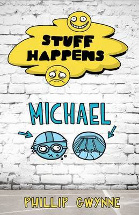
Stuff happens series by various authors
Penguin Australia, 2014. Michael by Phillip Gwynne. ISBN 9780143308102 Sean by Will Kostakis. ISBN 9780143308119
Highly recommended for boys from 7-11. Stuff happens is an
exciting new series written specifically for boys aged from seven to
eleven, that explores everyday life, family relationships, mates,
school problems and fitting in. Written by popular authors such as
Phillip Gwynne and Will Kostakis, these novels are great additions
for school libraries and for engaging reluctant boy readers. They
are set in the fictional Monvale Primary School and each story
focusses on a main character who has a struggle or challenge to
overcome. Each first person narrative is simply written in an
empathetic voice with real feelings explored and emotions displayed.
In Sean, Sean Summers has relocated from Bunbury, Western
Australia, leaving behind his best friends Eddie and Christian and
his familiar way of life. The first day at Monvale Primary School is
difficult, everything is different, his new teacher is strict, he
doesn't want to join with the soccer game at recess and he's
forgotten his hat. In the No Hat, No Play area, he meets Karlie and
cartoonist Angelo and life at school begins to change. He confronts
his classmate about copying his maths, has his mobile phone
confiscated and works hard to prove he's a good friend and
classmate.
In Michael, Michael is a champion swimmer, his whole life
revolves around practices and competitions. His father has given up
his job as a sanitary inspector to support Michael and transport him
to the pool. Dad now works from home selling sports memorabilia on
ebay. On the drive to the Aquatic Centre, Michael enviously watches
Skate Dude fly down the steep hill on a skateboard with absolute
freedom and skill. Will the choices the young swimmer makes affect
his swimming?
Rhyllis Bignell
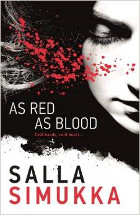
As red as blood by Salla Simukka
Hot Keys Publishing, 2014. ISBN 9781471402463.
(Age: 13+ secondary). Highly recommended. Salla Simukka's As red
as blood ticked all the boxes with me. I instantly fell in
love with Lumikki, the heroine in the tale and her sharp mind, witty
humour and brain power. Simukka has intertwined a compelling
storyline with much loved fairytales and hardcore criminal action.
In just a few hundred pages, the author brings to light that
unpredictable teenagers can indeed outsmart well-connected
criminals. The element of alternate POVs (point of views) in the
novel gave an extra twist on the story and also provided a thorough
understanding of each character.
The novel is narrated by Lumikki, a sharp and wise seventeen
year-old who navigates life under one simple rule: to mind nobody's
business but her own. So when she comes across 500 euro bills
hanging in her school's darkroom and discovers that they were found
by three unlikely teenagers, she doesn't know what to expect. But
what's more surprising to Lumikki is the realisation that the money
is connected to an international drug trade happening in her very
own Tampere. Ensnared in a tangled web of deceit, corruption and
falsehood, Lumikki and her friends work together to bring down the
dark underbelly of Tampere and bring to light the truth.
From page one I was trapped in Lumikki's world. The brutal action
and intense dialogue were some of the ingredients that kept me
coming back for more. Sumikki created a beautifully rich backdrop
for this tale and absolutely has the potential for growing into a
coming-of-age story that sits atop every reader's bookshelf.
The author bestows us characters that we love to hate or simply
adore as she presents us with a tale like no other. A book like this
can be well compared to Robert Galbraith's The cuckoo's calling as
it features crime and a complex mystery.
Samantha May (Student)
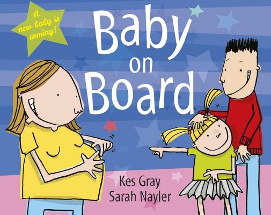
Baby on board by Kes Gray
Ill. by Sarah Mayer. Hachette, 2014. ISBN 9781444920901.
(Age: Preschool) Picture book. Pregnancy and birth. Family. Mum's
pregnancy involves the whole family as the narrator shows us the
procedure of the pregnancy from the first month to the last.
Each double page tells us what happens in that month, from each of
the family's perspective. Mum has morning sickness, needs a larger
bra and knickers, feels the baby move inside. The husband keeps
suggesting names for the child and packs the case for hospital,
while the narrator wonders what sort of sibling she will get. At
each stage the size of the growing infant is given along with major
changes in its appearance.
This is a perfect book with which to introduce the topic in schools
or at home. The reader can see for themselves the development of the
baby and its impact upon the family. The pictorial presentation
makes it easy to see the stages of its development and will enhance
the child's idea of what will happen within each family.
For children who have been involved in the progress of the pregnancy
at home, or have a new baby in the house, or classes where pregnancy
is under discussion, or where the impact of a new sibling is being
talked about, then this is a useful book to share. I did like the
indented pages going from one to nine months making it easy to look
up what happens in that month and the drawings will be enticing and
instructive for younger readers.
Fran Knight
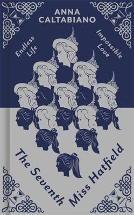
The seventh Miss Hatfield by Anna Caltabiano
Gollancz Publishing Group, 2014. ISBN 9781473200395.
Recommended for readers ages 12+ (middle school). Caltibiano's The
seventh Miss Hatfield intertwines an original concept of
time-travel and the endeavours of immortality into one tale. As I
had heard of this novel in the past, I was eager to start reading
and hoped it lived up to my expectations. When I came to the
conclusion of the novel, I planned to never read it again. It just
didn't hit the spot for me unfortunately. I wasn't fully enthralled
in the novel despite the amicable characters and imaginative plot. The seventh Miss Hatfield sparks a tale of fictitious
history and irrevocable love at first sight. The story takes place
in 1954 where flower wallpaper and mismatching furniture are what
you call 'hip'. We meet eleven year old Cynthia who only has one
thing on her mind: to impress her mother by becoming an independent
lady. So when the postman leaves the neighbour's mail on her lawn,
Cynthia is met with a mission that will hopefully make an impression
on her tough mother. When she knocks on her neighbour, Miss
Hatfield's door, she has no idea what's going to happen next. Met
with a disastrous fate that she can't change and a task that takes a
toll on her, Cynthia travels back in time to retrieve a painting
that isn't what it seems.
Although the book didn't make my toes curl with anticipation and my
heart stop with excitement, the concept of the book was
well-delivered. I really enjoyed the experience of reading from
Cynthia's point of view as the character was likeable and
entertaining.
Samantha May (Student)
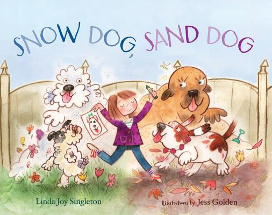
Snow dog, sand dog by Linda Joy Singleton
Jess Golden. Albert Whitman & Co., 2014. ISBN 9780807575369
What do you do when you desperately want a dog of your own, but real
ones make you sneeze? Well, you can do what Ally does
initially and draw pictures of them or you can go a step further and
make one, using your imagination and a bit of magic. When it
snowed and the other kids were making snowmen, Ally made a snow dog.
She gave him pebble eyes, a pinecone collar and a crooked icicle
tail. And even though her friends laughed at her, that snow
dog followed Ally home and they had such fun together. But
when spring came, the snow melted and so did snow dog so Ally made a
flower dog. Then in summer she made a sand dog and in Autumn,
a leaf dog, each giving her great fun and companionship.
This is a lovely story about a girl and her imagination with the
edges of reality being blurred by the charming artworks which add
something special to this delightful story. As an added bonus,
for those children who can't have their own dogs because of their
own allergies, there are instructions on how to make one - without
snow, sand, leaves or flowers!
Barbara Braxton
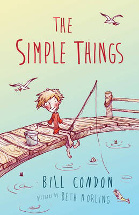
The simple things by Bill Condon
Allen & Unwin, 2014. ISBN 9781743317242.
For every Christmas and birthday of his ten years, Aunt Lola has
sent Stephen $10.00 and, at his mother's insistence, he has
dutifully written to thank her. But he has never met her and
doesn't want to - what would a ten year-old city boy and an old
spinster aunt have in common? But as her 80th birthday
approaches, Stephen's parents take him for a holiday with her - and
she is all that he is expected: crotchety, pedantic, set in
her ways and a bit scary. How long can three weeks last? Like
many of today's children, because of scattered families he hasn't
had much to do with the elderly and he's a little afraid of what to
expect - not made any easier by his shyness. But as the days go by,
both begin to learn about each other and themselves, and the joys
the simple things of life can bring. Through Stephen's innocent
questions and observations, Aunt Lola learns to let go and Stephen
learns some surprising life lessons through simple things like
finally catching a fish and his discovery that Aunt Lola has kept
every one of those thank-you letters!
Tempered by dad-humour (a close relative to dad-dancing), this is a
gentle story written with compassion and understanding from both
points of view. Aunt Lola has kept a secret for over 60 years
that has tempered her view of the world, particularly trusting
others like her neighbour Norm, while Stephen learns to look beyond
his fears and begins to develop understanding and empathy. It is a
story of hope and joy that touches on some important issues about
relationships and acceptance by focusing on characters that are so
ordinary and real they bring the story to life. They
could be someone the reader knows.
Beth Norling's quirky line drawings at the beginning of each chapter
add an extra layer to what appears to be a simple book but really is
one of some complexity. It is skilfully crafted by an experienced
author (Condon says there were several complete rewrites of it
before he was satisfied) to help our younger readers realise that
older people are just another generation, not another race. As
our parents and grandparents live longer than they ever have, our
children are going to experience their ageing in a way that previous
generations have not, and so anything that builds a bridge of
understanding and acceptance (from both ends) has to be welcomed.
Old age is a privilege not a right, and there are many who don't get
to enjoy it, so there are many children who don't get to experience
the love and warmth that a great-grandma or great-grandpa can
offer. Having had the most loving grandparents and now being
one, I know the riches grandparents give and receive. Stephen
is lucky that he learns to love Aunt Lola and that love is
reciprocated. Would that all our kids could experience such a
special relationship.
This would be a perfect accompaniment to a study of family history
and the continuum of life.
Barbara Braxton
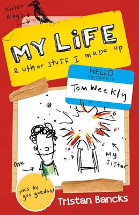
My life (series) by Tristan Bancks
Ill. by Gus Gordon. Random House, 2014. My life and other stuff I made up ISBN 9780857983190 My life and other stuff that went wrong ISBN 9780857980373
Tom Weekly likes to write stories about his life because even though
some things go wrong, he still gets to be the hero in his own book.
In a collection of short stories reminiscent of his own hero Paul
Jennings, Tristan Bancks has breathed new life into that gross
humour that boys of a certain age, particularly, revel in. Whether
he's writing about a birthmark on his back that others tell him
looks like a poo, or defending himself against a killer magpie Tom
Weekly tells the tale with ease as he weaves in and out of trouble,
taking the most mundane and innocuous situations and crafting them
into an event as only a true storyteller can do.
Accompanied by the exquisite 'no frills' line drawings by Gus Gordon
which delve straight to the point (compare Jack's nan with Tom's
nan), these stories will engage younger independent readers who are
looking for a reason to read for pleasure. They are perfect
read-alouds of just the right length - read one or two stories and
then offer the books for lending and not only will there be a
reserve list but you will be able to satisfy the need while they
wait by introducing Jennings (as popular as ever), Milne, Kinney and
Griffiths, showing that there is not only something entertaining
about this reading thing but also that the library's shelves have
plenty to offer. (It's called reaching the long tail - those who
don't visit because they believe there is nothing relevant to their
needs.) But, as Tom warns them, if they borrow it and don't like it
then they need to return it to the library because 'librarians get
kind of upset about that. Believe me.'
But because the technology is available and accessible, there is a
host of online stuff including ebook versions of each title as well
as an invitation for readers to send their own ideas for a story to
TheTomWeekly@gmail.com. Check out www.tristanbancks.com/2013/11/my-life-other-stuff-that-went-wrong.html
There's a lot of reading just on that site alone!
Barbara Braxton
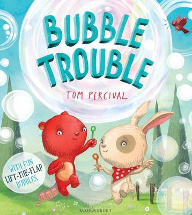
Bubble trouble by Tom Percival
Bloomsbury, 2014. ISBN 9781408838778.
(Age: 3-7) Lift the flap book. Picture book. Friendship. When two
friends decide to have a bubble blowing competition, trouble follows
as they try to outdo each other, making machines to help them blow
the biggest bubble ever. The story begins by showing them as best
friends: they are the same age and height, live next door to each
other and love blowing bubbles. The similarities will enthuse
younger readers as they relate their similarities with their friends
and recognise the things they do together. But in making a
competition between the two friends, trouble ensues as the machines
get more elaborate, ending with an explosion. Along the way small
children will love opening the bubbles on each page to follow the
story, the flaps adding a fun level of interest in the story. The
amusing illustrations too will add to the excitement of the story as
the friends come to realise that perhaps friendship is more
important than competition, as they get all their friends together
to have one big blow to make a bubble which outshines everything
else.
And all is forgiven between the two as they realise that doing
things together is more important, until one says 'I can jump higher
than you'.
A funny, fast paced story with marvelous eye popping illustrations,
this story will be a treat in early childhood classes or at home,
where friendship is being discussed. Teachers and parents alike will
be able to use the story to defuse some antagonism between friends,
developing the idea that working together is more fun and certainly
more satisfying than competing. Themes of winning and cooperation,
machines and bubble making could all be developed using this book.
Fran Knight
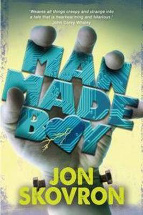
Man made boy by Jon Skovron
Allen & Unwin, 2013. ISBN 9781743315132.
(Age: 14+) This is a coming-of-age novel with a difference, described as
'hilarious, romantic and wildly imaginative' and it is all that
indeed. Boy is the son of Frankenstein's Monster and his Bride and
as you can imagine this is not a family that could easily fit into a
normal human suburban life. Instead they live in a community of
magical creatures in a labyrinth underneath a Broadway theatre which
continually runs a magical show featuring all the assorted societal
misfits of the commune: the Diva (Medusa), troll dancers, Charon
the ferryman who acts as stage hand, the Siren whose act befuddles
every adult audience, and led by the redoubtable undead Ruthven.
Boy's only interaction with the world of humans is through the
Internet where he hangs out with other geeks and pursues his passion
for creating coding. Like all teenagers he chafes at the
restrictions of his life and yearns to escape the rigidity of his
confined existence. When conflict with his parents escalates Boy
takes off and attempts to fit into the human world, banking on his
newly created super code to fund his adventure. But something goes
seriously wrong. His code evolves itself into a powerful Artificial
Intelligence which begins to stalk him with disastrous results.
As Boy attempts to dodge and destroy VI (Virtual Intelligence), his
own creation, he is led to other magical enclaves where he meets up
with more mythical misfits and embarks on a bizarre road trip with
the granddaughter/s of infamous Dr Jekyll/Mr Hyde. Their cross
country trek introduces Boy to country diners, shopping malls,
undisguised curiosity by strangers, danger, love and heartbreak.
However, no matter how he tries to escape his own creation, the time
comes when he must face it down and rescue his family.
A wonderful story of wild adventures, acceptance and tolerance, the
importance of family support and being true to oneself, this was a
real page turner and fun to read. Both male and female young adults,
from around 14 up would find it immensely appealing. Some strong
language and sexual references would lead me to suggest that your
older readers would be the most suitable audience.
Visit the author's website here .
Sue Warren
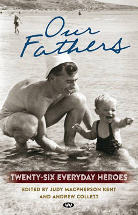
Our fathers edited by Judy Macpherson Kent and Andrew Collett
Wakefield Press, 2014. ISBN 9781743053133.
Recommended. Fatherhood. Family history. South Australia's social
history. Work in Australia (post War focus). World War II. Suburban
life. A school reunion led to the reflections of a collection of
former Linden Park Primary students about their fathers. This
could have been a somewhat self-indulgent collection of anecdotes;
instead it is an amazing look into post-war life in Adelaide when
the homes in the inner leafy eastern suburbs around Linden Park were
being built and settled by hard-working and 'ordinary' Australian
families. The jigsaw puzzle insight into war experiences (as shared
with their families) and the impact of the early experiences of
these fathers and then their own relationships with their children
(born mostly in 1950) slowly reveals a broader picture of social
life. I delighted in seeing glimpses of the changes in work
and social expectations and the make-do attitudes of those who were
rearing children during the 1950's. Children of today will
have their own stories to tell of social change through their
childhood, but this book shares snapshots through the lens of those
who lived this period of South Australian growth and change. I loved
revisiting the period when children played freely in their
neighbourhoods with classmates, climbing trees, exploring mines and
bushland without an adult in sight; riding billycarts and bikes
without helmets; being taught to drive by their fathers on dirt
roads, and fixing cars in the back yard and going to Rowley Park
Speedway; and being delighted with the occasional simple treat from
a hard-working man who was often a self-made expert in new
technologies. All of this with the rule to be home by 6pm for tea!
This is unapologetically a book about fathers, some of them born
overseas, and the war experiences of many of these men adds a wider
global history. The silence of some in sharing their own war
history speaks loudly of the personal cost of participation in
conflict. As the introduction suggests there could equally be a book
to follow about the mothers. Obviously a book of this nature
is always fraught with the difficulties of distorted memories,
however they are our South Australian memories, and it is not told
as a history, but as an insight into the ordinary lives of ordinary
heroes.
(Note: School students may not connect with this book as a whole,
but the individual stories could be used by students of History to
connect with South Australia's past.)
Carolyn Hull