New Frontier Publishing, 2014. ISBN 9781921928574
(Ages 4-6) Highly recommended. School Life, Integration, Family,
Friendship. Peter Carnavas has worked with the Cerebal Palsy
Alliance to recreate his award winning picture book Jessica's
Box.
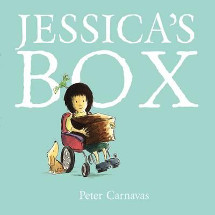
Jessica is a creative little girl who is encouraged by her family to
enjoy her first days of school. She looks forward to making new
friends. Every morning she sets off in her wheelchair with a
cardboard box on her lap, hidden inside are her special treasures.
When her teddy bear doesn't impress her classmates, she tries
delicious iced cupcakes, then her dog Doris, but she is
disheartened. When Jessica brings her empty box to school and sits
with it on her head, she discovers that others are interested in
playing with her. All she needs is to be herself.
Peter Carnavas's sensitive watercolour and black pencil outlined
illustrations portray Jessica's different emotions. Several pages
use shades of dark blue or sepia tones to focus on her sad feelings.
The surrounding white spaces portray her sense of loneliness, whilst
bright, bold colours highlight her happiness. Her wheelchair is
simply part of her life and she moves through the pages unaffected
by her physical limitations.
The key messages of this highly recommended story are valuing your
self worth, the importance of an encouraging family and friendship.
Rhyllis Bignell
Sally Snicker's knickers by Lynn Ward
Ill. by Anthea Stead. Walker, 2014. ISBN 9781921720499
(Age: 4+) Recommended. Verse, Underwear, Humour, Difference. Sally
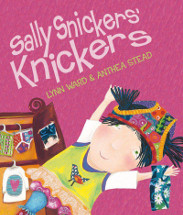
is unusual and likes to wear her knickers on her head in preference
to a hat. The first half of the book shows her in her knicker
wearing guise, with vibrant images showing a broad range of undies;
boxer shorts, Y-fronts, long johns, cottontails, lycra, all placed
on Sally's grinning head. But not everyone accepts her oddity,
particularly not her teacher who reminds her of the school hat rule.
But the rest of her class make the teacher change her decision and
all is resolved very neatly.
This is a lovely tale of difference, of not obeying rules, of having
your friends support the decision you have made. Sally tries on all
of her knickers as well as a few from other people on her head.
Readers will laugh out loud at Sally and her preference for frilly
knickers or floral knickers, with all shades between, until she
arrives at school to find some opposition.
The four line verses are fluid and easy to read out loud, filling
out Sally's other traits, enabling readers to feel empathy for the
girl who likes to wear knickers on her head, as well as odd socks,
and sometimes no shoes. The colourful illustrations add to the scope
and humour of the story as readers will love recognising the
different sorts of knickers shown.
Fran Knight
No stars to wish on by Zana Fraillon
Allen & Unwin, 2014. ISBN 9781743315149
(Age: 12+) This is a strange and disturbing story. For a number of
reasons I hesitate to recommend this book to a wide audience. It is
clear that the author wishes to convey to the reader an
understanding of the torturous lives led by many 'forgotten
Australians', who grew up in Australian orphanages, children's
homes, foster care and other institutions. However the grim nature
of this story, along with the cruelty described and the futile hopes
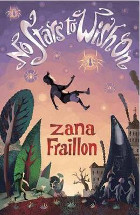
expressed, make it a book for older readers. The cover could suggest
otherwise. Author, Zana Fraillon, has read the personal accounts of
many, accessing information from The Care Leavers Australia Network
and the Alliance for Forgotten Australians, and these stories are
horrifying. Seven-year-old Jack, who is deaf, and his younger
sister, are taken from their home to an orphanage, followed later by
his older sister, where they are subsequently separated and
allocated dormitory beds. Conditions are dreadful but Jack tries to
lighten the oppression with jokes and plans to return home. Through
Jack's eyes we learn of the strict daily routines, the authoritarian
rule and the controlling spirit of the place; there is an air of
unreality as we read of Jack's plight, and our discomfort grows as
the shock of the situation is realised. Such a story should be told,
and Fraillon makes it somewhat illusory in its content and style to
soften the impact of the subject matter. Perhaps this technique
makes the reality difficult to grasp. Regardless, this book will
promote much discussion and soul searching.
Julie Wells
Grandma, the baby and me by Emma Allen
Ill. by Hannah Sommerville. Scholastic, 2014. ISBN 9781862918733
(Age: 4+) Siblings, Babies, Grandparents. The confusion of an older
sibling at the introduction of a new baby into a household is given
a fresh approach in this story. Henry's grandmother has warned there
will be trouble and it follows like night follows day. The baby
screams and takes up his parents' time. When Mum has put out the
washing, it rains so that Henry's favourite dinosaur pyjamas are too
wet to wear, so he must wear his sister's frilly pink ones. This
embarrassment is compounded when she shows their friends what Henry
had worn. When Henry splashes in the bath he is told he is splashing
the baby, when he accidentally pushes Fergus, he goes to his room
but has a pain in this tummy. All is relieved when Grandam arrives
the next day to hug him.
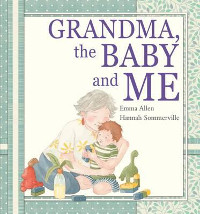
This is a sympathetic story of the changes afoot in a family when a
baby arrives. Each of the subdued illustrations shows the family in
some sort of disarray as the baby's presence upsets the normal
routine. The wash of pale watercolour within the soft pencil
outlines gives a gentleness to the illustrations that engages the
reader in seeing the intrusion of the baby from Henry's point of
view and we are pleased with him when Grandma arrives to save
Henry's day.
Fran Knight
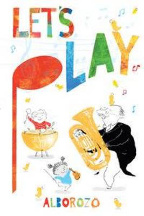
Let's Play by Gabriel Alborozo
Allen & Unwin, 2014. ISBN 9781743316283.
(Age: Early childhood) It's been a strange week - one of those ones
where something you rarely think about keeps popping up in front of
you. No one on this planet could ever describe me as musical - when
that talent was given out I was definitely behind the door - but for
the third time in three days there has been something significant
about music that has caught my attention. Firstly, this poster
from The Orlando Philharmonic Orchestra about the importance of
music in a child's life came through my FB feed and I had to share
it with my teaching colleagues, all of whom are talented enough to
act on it. Photo:
The importance of music education! Then there was a news
report about research about the effect of music on literacy
learning and the review book on top of my pile is called Let's
Play and is a delightful introduction to the instruments of
the orchestra by Gabriel Alborozo. I'm certain the elves were in my
office last night and moved it up because clearly it was meant to be
the next one!
In Let's Play a group of very young children are introduced
to the orchestra by a man who looks like the epitome of a stern
conductor but who actually is much gentler than that as he isn't
bothered by the children moving and clinging to him as he takes them
on a journey through the percussion section, the brass, strings and
woodwind, and, finally, the piano and harp. His love and passion is
clear and the children are just as fascinated as each gets to try
one of the instruments. However, this is not a dry, factual,
encyclopaedic explanation. As they go to each section, there's a
comment to each musician that adds an element of humour and
individuality and the superb illustrations which tell the real story
and lift it into the realm of the special and unique. While the
conductor and the children are line drawings, the instrument is in
colour and each page has the sound it makes interpreted in shape and
colour, until the whole becomes joined in a celebration of both
colour and sound which is 'Magnifico!' There are so many reasons
this book should be in your collection - it's the perfect textual
extension to Tchaikovsky's Peter and the Wolf as well as the many
online sites which enable students to hear the sounds as they see
the instruments. (My favourite has always been Energy
in the Air: Sounds of the Orchestra created by two young boys
for the Thinkquest Jr project but there are many others.) It is also
the perfect stimulus to having the students interpret the sounds of
the instruments and musical pieces into their own art pieces, which
might then lead on to their thinking about the sorts of instruments
or compositions which might accompany pieces of literature.
While it's clear the target audience for the text is early
childhood, in the hands of an imaginative teacher it could be used
throughout the school. A treasure indeed.
Barbara Braxton
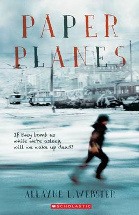
Paper planes by Allayne Webster
Scholastic, 2014. ISBN 9781742990699
(Age: 11+) Recommended. War, Serbia, Yugoslavia. Huddled in their
bombed apartment, collecting water from a council pipe, and burning
everything they find to make fuel to cook their sparse amount of
food, Niko and his family come to a decision to try and escape. They
have stayed in the hope that the war known as the Bosnian War would
cease and peace restored, but this is not happening. Niko and his
mother are kept hiding in rubble for a whole day by snipers, two of
their children have been conscripted and random men force their way
into the apartment looking for food, money an jewels, eyeing the
women with hungry eyes.
Webster gives an immediacy to their plight, reminiscent of
Christobel Mattingley's Asmir series published twenty years
ago.
We feel for each member of the family, father making tough
decisions, Mum struggling to keep food in their mouths, one day
going out to collect nettles, Jarko being called up to fight and
their daughter called to work as a nurse, while next door a
frightened Muslim family lives, fearful that they will be killed,
and wondering how their neighbours see them.
Sarajevo is under siege, people are dying of starvation as well as
being killed, and no one seems willing to help those caught in the
middle. Using any contacts the family has, Niko is able to leave
using the underground, but must go alone, his parents not having the
money to escape as well. His life as a refugee begins.
A story for our time, the plight of ordinary people caught between
armed invading forces is seen everyday on the news and in the
papers, so this book brings an intimate view of the effect conflicts
such as these have on everyday lives. Wonderful as a read for
understanding and a good story to boot, it will also be a great
novel for study in middle school, with teacher
notes available on the author's website.
Fran Knight
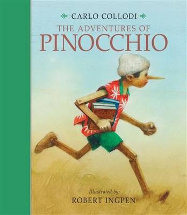
The Adventures of Pinocchio by Carlo Collodi
Ill. by Robert Ingpen. Walker Books, 2014. ISBN: 9781922244048
Highly recommended for ages 8 and above. Having never previously
read Collodi's Pinocchio but relied only on the Disney version; this
book came as something of a surprise. Pinocchio, from his beginnings
as a lump of wood, was a totally unlikeable character, selfish, rude
and demanding who did little to improve his lot throughout the tale,
until the very end.
Written by Collodi as a serialisation, beginning in 1881, and only
later published as a book in 1883, the author intended it 'to be
read by both adults and children, and through Pinocchio's adventures
he seemed to be suggesting a method of educating young boys,
particularly those who might not have seemed deserving of an
education.' Apparently, the author had planned to conclude the story
at the end of the fifteenth chapter and only public feedback
prompted him to provide a more positive ending. As stated in the
notes about the author, 'The enduring popularity of Pinocchio may be
due to the fact that the story presents a symbolic narrative of
boyhood that speaks to both young and old across the world about how
even a mischievous rogue has the potential to be a good, intelligent
and useful member of society.'
This edition is an elegantly produced book which would make a
perfect gift. The paper is of a heavy nature and feels expensive,
perfectly supporting Ingpen's delightfully detailed illustrations,
with even the pages of text having a slightly speckled finish
reminiscent of high quality writing paper. The endpapers contain
many images of the marionette on a sepia background which looks old
fashioned and in keeping with the age of the story.
I believe this will be a popular book for teachers to read aloud to
students and for grandparents to purchase and leave as a treasure
for their grandchildren.
Jo Schenkel
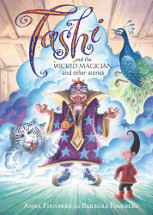
Tashi and the wicked magician by Anna Fienberg and Barbara J Fienberg
Ill. by Geoff Kelly and Kim Gamble. Allen & Unwin, 2014. ISBN
9781743315088
(Age: 6+) Highly recommended. Tashi, Friendship, Adventure.
The classic tales of Tashi are continued in this volume of four
stories, designed to augment the store of these wonderful stories
for those people who have mastered chapter books. Each story is
complete in itself, offering a delight to both newcomers to these
tales as well as old hands. Each will intrigue as the known format
is followed with Jack telling the story of his friend, Tashi, that
magical being with a truckload of adventures to relate.
In the title story, the residents are very excited when the magician
comes to town, Tashi included. Watching as his Aunt is put into a
trance, Tashi feels uneasy about this man's powers and follows him
to the home of the Baron, where he is staying. Through the window he
sees the magician hypnotise the Baron, getting him to put all his
gold and jewels into a box. Tashi reveals the man's trickery but not
before he is suspected himself.
Each of the four stories is short, delightfully illustrated and adds
to the stories about the amiable Tashi. The last story is divided
into two parts, ensuring the newly skilled reader can adapt to a
longer story.
The courageous Tashi is a character to savour, and the mix of magic,
adventure and fantasy will satisfy all readers that they have read a
story which reflects an admirable inner strength.
Fran Knight
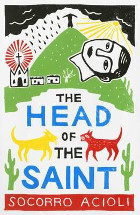
The Head of the Saint by Socorro Acioli
Translated by Daniel Hahn. Hot Key Books, 2014. ISBN 9781471402906
(Age: Adolescents - Adults) Highly recommended. The cover and title
both suggest the unusual content of this novel, and the reader is
not disappointed. The story begins with a young boy who is
desperately trying to get to an address he clutches in his hand,
stumbling along a rough country road with no food, or drink or
companions, somewhere it seems, in South America. Acioli is
Brazilian and began this work at a writer's workshop.
After a long walk from town to town, and finding himself ostracized
from the community where his only relative, an old grandmother
lives, Samuel takes to the mountain where he finds shelter and some
solace curling up in the 'head' of the title, the head from a large
statue of a saint that has fallen and left on the ground. Samuel's
story is simple and at times confusing to the reader, told as it is
in translation in a story-telling mode that is circular and embedded
deeply in the culture from which it comes. Yet it is delightfully
simple and charming, even when time is convoluted and dead people
seem to be alive again.
When characters in the novel are revealed as having died years
before, we are positioned to accept this time-warp, as Samuel's
grandmother is depicted, early in the story, as not interested in
saving the life of her grandson, yet we find out later that she died
years before. When Samuel reveals that he 'hears' things when he is
in the head of the saint, he becomes a modern celebrity, and the
town is changed.
Not all people are good, we discover, and, drawn into the
repetitive, circular narrative, we have to work to trace the real
story line as the past and present become interwoven, statues of
saints talk to characters, and sing, and dead people are sometimes
alive and sometimes just bodies on a bed.
Dedicating her story to Gabriel Garcia Marquez and others, Acioli's
narrative is preceded by two quotations that suggest time as more
fluid than it is usually depicted in the western world, 'time as a
place', and that we ought to let go of our expectations if we are to
be involved, indeed to relish, being in such a tale as this one,
which is, ultimately, about simple human kindness.
Suitable for adolescent readers, and adults, who are happy to be
taken out of their comfort zone, and to see the world depicted in a
different light.
Liz Bondar
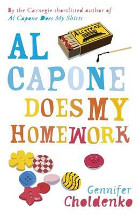
Al Capone does my homework by Gennifer Choldenko
Hot Key Books, 2014. ISBN 9781471402869
(Age: 10+)Recommended. In 1935 Matthew 'Moose' Flanagan's family
move to Alcatraz Island so that his father can work as a guard and
his older sister, Natalie, who has autism, can attend a special
school in San Francisco. Alcatraz is a very different place back in
the 30's and Al Capone is obviously one of its prison inmates.Life
is rather complicated, for numerous reasons, and Moose seems to get
himself into trouble very easily. Dad is always busy and Mum is
constantly helping Natalie, and there is never enough money. Moose
wants to help but his efforts often backfire. Moose has been
introduced in two previous books, Al Capone Does My Shirts
(Newbery Honour Book) and Al Capone Shines My Shoes, and the
series is proving very popular. Apart from the fact that the reader
gains insight into life on Alcatraz at the time, and Choldenko has
researched this well, the characters play out a great story with
wonderful humour.Poignant moments with Natalie and her family (the
author's sibling had autism), relationship wrangles with Moose and
his friends, spy games at the prison and work worries with Moose's
parents, are situations which hold the readers' attention. To a
large extent the young ones are dealing with the adult problems and
it is interesting to note the general ignorance in the community
about Natalie's special needs. A fire burns down much of the family
home and it is Moose who sets about proving Natalie's innocence when
other families are convinced that she is dangerous and better taken
off the island. This is a great and clever book, quirky and so
enjoyable to read.
Julie Wells
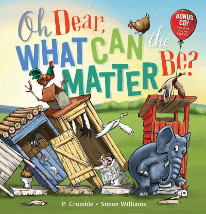
Oh dear, what can the matter be? by P. Crumble
Ill. by Simon Williams. Scholastic, 2014. ISBN 9781743622377
For readers from 4-6 years of age. P. Crumble's back again with an
Aussie take on an old song - Oh dear, what can the matter be?
Instead of old ladies locked in the lavatory, the author's set this
story on the farm. With a count down from ten old ducks, through
nine cranky bulls, eight plump chooks, seven blind mice down to one
big elephant squashed in a limousine, this is another amusing
rhyming story from a popular author.
Simon William's bright, humorous illustrations capture the young
readers' interest, take the time to look at the six bulldog
whirlwinds biting their fleas and the two fun flies skating on the
jelly.
There's more fun for the readers, as they can sing along with Jay
Laga'aia's bonus CD recording!
Rhyllis Bignell
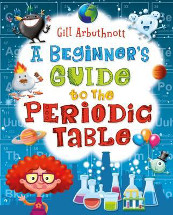
A beginner's guide to the periodic table by Gill Arbuthnott
Bloomsbury, 2014. ISBN 9781472908858
(Age: 10+) Recommended. Non fiction, Science, Periodic table. From
atoms and neutrons to elements, the big bang and all things between,
this detailed book gives all ninety two elements a place. With all
of them listed along with their name, symbol and atomic wight,
children will be able to use this as a research tool with ease. On
each page are usually several elements listed with loads of
interesting facts, plus some funny drawings illustrating the theme.
One page that intrigued me was the page on Iron. This is spread over
a double page, and includes not only its atomic number (26) and
symbol (Fe) but also information about the Iron Age and how
blacksmiths were considered almost magical as they could smelt iron
out of rock. Also on the page is a funny account of King Arthur
drawing the sword from the stone, and a paragraph about rust, and
then blood. Did you know that iron is important in our blood,
because it makes sure the oxygen is carried by the blood. It is all
described on the page on iron. Similarly, the information about
silver, atomic weight (47) and symbol (Ag) has a tale about how the
expression silver lining of a cloud came about, as well as
information about silver and mirrors. Or thalium, atomic number
(81), symbol (Ti), once able to be purchased across the counter as a
rat poison, was used to kill people, and Agatha Christie used it as
a plot device in one of her books. A book to dip into and surprise
people with your fount of knowledge or something to read when
swatting for a test, or simply a research tool, then this book has a
place in school libraries, classroom or home bookshelf. I enjoyed it
- not something I'd expected to say with a book such as this.
Fran Knight
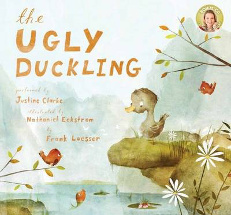
The ugly duckling by Frank Loesser
Ill. by Nathaniel Eckstrom, performed by Justine Clarke. Scholastic,
2014. ISBN 9781742836447
(Age: 4+) Picture book, Folk tale, Performance With a CD inside the
front cover, this version of Hans Christian Anderson's Ugly
duckling, gives a fresh approach for use in the classroom. The
duckling is taunted by its peers for being ugly with its stubby
brown feathers, and so hides away all winter long. But come spring
when the swans on the lake appear, they see that the duckling is one
of them and has now shed its stunted brown feathers to reveal glossy
white feathers, gleaming in the sunlight. As such the duckling is
now accepted eagerly by all the others.
This story of not judging a book by its cover, of not rejecting
something because it doesn't look like all the others, will find
resonance amongst children discussing appearance, bullying, judging
and so on. In an astute teacher's hands this book will be able to be
used as part of discussions within the class where problems have
occurred about someone's appearance. The moral of the tale is
obvious to all, and children will rejoice at the duckling's eventual
acceptance.
Eckstrom's illustrations are richly detailed using a variety of
media to achieve his finished work. He uses oil paint on canvas as
well as pencil drawings which he fills with colour, while adding
images which are digitally created to produce mixed media images
which will ensure children will look at every detail. Again a reader
will have fun working out just what he has used and why, in creating
his pictures. It adds another level of interest for the reader to
contemplate the choices an illustrator has made in producing the
work that he does.
Fran Knight
Siblings: Brothers and sisters of children with disability by Kate Strohm
Wakefield Press, 2014. ISBN 9781743052334
(Age: For adults) Highly recommended. As with any Wakefield Press publication, the
standard of production is excellent and the subject matter is
relevant and interesting. This book makes an important contribution
to the discussion of siblings who grow up with a brother or a sister
with a disability. Often their circumstances are overlooked as
families struggle together to cope with many daily challenges. This
is a revised edition of Kate Strohm's self-help book, first
published in 2002. The author comes from such a family situation and
her personal story along with the stories of others makes for a
reassuring and informative read. She has apparently given workshops,
incorporating her experiences and suggested strategies for
supporting these individuals, around Australian and overseas.
The book is considered an aid for both families and professionals.
Following 'sibling stories' Kate addresses future strategies,
providing a sense of connection with others in the same situation,
and discussing ongoing support needs.
One forgets how many adjustments have to be made in life when you
are a sibling of a person with a disability, a chronic illness or a
mental health issue. The stresses can last a lifetime. So this book
is valuable in recognising the problem and helping to narrow the gap
for many who have struggled without adequate support, perhaps not
realising that the support is there. As founder of the organisation
Siblings Australia Strohm advocates for continued support services
and greater government recognition.
The book concludes with a valuable resource list, which has
obviously been updated for this revised edition. Readable and highly
recommended.
Further information is available here.
Julie Wells
Crooked Leg Road by Jennifer Walsh
Allen & Unwin, 2014. ISBN 9781743316931
(Ages: 12+) The four friends in this adventure have met previously
in Jennifer Walsh's earlier book, The Tunnels of Tarcoola.
The formula is sure to be a winner for young readers; there is
plenty of action, the setting is local and distinctly Australian,
the friends have a great rapport with each other, the villains are
quite disagreeable and the atmosphere is decidedly frightening and
mysterious. Walsh's writing style keeps the reader guessing and
anticipating. The lives of four friends become veiled in secrecy and
fear as one of them, David, is apparently kidnapped from the back
lane of his house.
A few days previously, Andrea had witnessed a strange van parked in
the same spot and she suspects a drug deal. A new boy to their
school seems to be connected to all this as well. Numerous
presumptions and risky decision-making follow, taking the four
friends to an isolated part of the bush, where their loyalties are
tested under dangerous circumstances. Crooked Leg Road is a fast paced and enjoyable read and an
excellent action story published at a time when young teenagers are
looking for good crime and mystery stories.
Julie Wells