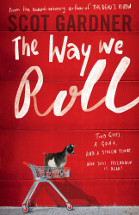
Allen and Unwin, 2016. ISBN 9781760290399
(Age: 14+) Highly recommended. Drugs, Friendship, Family, Shopping
centres. Will has run away and now lives beneath a bowling alley,
surviving on the money he earns collecting trolleys at the local
shopping centre. Here he meets a variety of other young men, all
rough and tough 'Westies', taken aback at the well mannered,
privately educated person in their midst. One trolley boy, Julian is
intrigued and looks more closely, eventually taking him back home
where his mother and girlfriend welcome him. Julian is an amazing
character, solicitous, undemanding and accepting of his new friend,
but equally incredulous that Will wears a Rolex watch and collects
trolleys.
Will is unused to such acceptance and initially on edge, but
gradually reveals the reason he has left home. His father, a
charismatic TV sports guru has been sleeping with his girlfriend,
Claire, and Will has taken footage of their relationship on her
mobile phone. Distraught at their betrayal, Will has left, taking
the mobile phone with him, but his father and girlfriend want it
back.
Gardner always writes an intelligent, soul searching story, layered
with incidents and characters at once familiar and yet just out of
reach. In this case, he presents a group of young men seen by us
all, but ignored and often dismissed by the shopping centre users.
Gardner gives them a voice, confronting us with their stories,
taking us into their world. Gradually we see Will opening up to his
new family, his impeccable manners a source of constant amusement.
But Julian wants a different life to being a 'Westie', and asks the
homeless Will for advice. He is taken aback, with his posh accent,
finely tuned manners and private school background he promises to
help. But it is Julian who helps Will more, as we see his common
sense often come to the fore when Will reveals his predicament. When
Will's father appears at their door, Julian encourages Will to 'grow
some balls' and resolve the situation but this happens only after a series of
very funny events involving Julian's father, Sandy and the people
sent by Will's father to get the phone, along with a goat and much
chasing around the suburbs.
Meanwhile, the boys' boss at the shopping centre Joanne has to move
away and so offers her job to one of the boys, with Julian as his
offsider, but she tells both Will and Julian that they should do
something else, not just trolley collecting. She encourages them
both to see an alternate path.
I loved this story as I do all that Gardner writes. His characters
are always sharply observed, the setting most credible and real, the
situations tangible. While not patronising those he writes about he
presents them with a dignity and humanity that is breath taking. The
themes of family and friendship run deeply through this most
fascinating story of two young men from diverse backgrounds finding
common ground.
Fran Knight
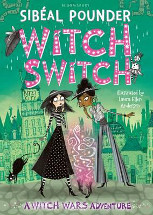
Witch Switch by Sibeal Pounder
Bloomsbury, 2016. ISBN 9781408852675
(Age: 9+) Highly recommended. Witch Switch is book 2 in the
Witch Wars Adventure series. It starts with a recap of the
previous stores so readers who are new to the series can catch up.
In book 2, readers will find the main characters, Tiga and
Fluffanora, holidaying until they hear about Peggy, the ruling
witch, leaving her position and leaving two gruesome witches in
charge instead. Surely Peggy would not abandon her witch friends.
Did she really go away with the fairies? Tiga and Fluffanora try to
sneak into the capital city but due to unforseen circumstances and
the appearance of gruesome witches, they are discovered. As the
witches find shelter, they discover other witches are also starting
to disappear. Why are these witches disappearing? Who would need
them? It is up to Tiga and Fluffanora to discover the truth. Witch Switch is a quirky novel about an amazing make believe
world of witches. It is highly recommended for girls aged 9+. They
will giggle at the spells and behaviours of Fluffanora and enjoy the
adventure as the truth is uncovered. The text is descriptive and
easy to read, encouraging readers who are new to novels. The
chapters are also short and quick moving and the black and white
cartoon-style illustrations only add to the quirkiness of the
characters in this witch world.
Kylie Kempster
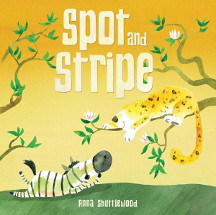
Spot and stripe by Anna Shuttlewood
Five Mile Press, 2016. ISBN 9781760401405
(Age: 4+) Recommended. Friendship, Difference. Spot and Stripe are
the best of friends and do lots of things together: looking at the
stars, picking flowers, lying on their backs at night looking at the
moon, and making up stories out of the clouds they see. Stripe is a
zebra and Spot is a leopard, giving a lovely opportunity for parents
and teachers to talk about these animals and their differences,
where they live and their lifestyles. But they do wonder what it
would be like if each was same as the other. They spend the next day
teaching each other how to live like they do. So Spot shows Stripe
how to chase birds, and Stripe shows Spot how to eat the berries
form the bushes, Spot shows Stripe how to swim, and then how to
climb a tree to rest for the night.
Each watercolour illustration adds to the story as it shows a
variation fo the story being told. Stripe climbing a tree ends in
disaster, while Spot eating berries is not what he can do easily.
Each picture underlines their differences to the reader. The two
happily conclude that their efforts have resulted in them being the
same, but when they stop for a drink and see their reflections in
the river, they are shocked to see they are still the same as
before. An idea is played out by both, but when they realise that
they miss the stripes and spots, they conclude that they can still
be friends while being different. The message will not be lost on
the reader and will encourage class discussions of difference and
acceptance of difference.
Fran Knight
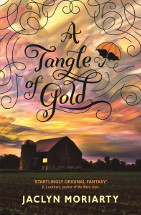
A tangle of gold by Jaclyn Moriarty
The Colours of Madeleine bk 3. Pan Macmillan, 2016. ISBN
9781743533239
(Age: 12+) Highly recommended. Fantasy. Magic. Colour. Coming of
age. After a short stay of only two weeks in Cambridge, Elliot is
swept back into the Kingdom of Cello with his father. He is taken
prisoner by the Hostiles and Princess Ko and Samuel and Sergio have
been arrested and face execution. Cello is facing a crisis and
bitter colour storms are raging through the land.
Back in Cambridge, Madeleine is increasingly lonely. Her nose bleeds
often and her mother is not well. She has lost communication with
Elliot and fears that when the remaining Royals are sent back to
Cello she will lose him forever.
This is a stunning conclusion to a truly unique, clever and
memorable trilogy. There are many unexpected surprises and twists
and turns as Madeleine and Elliot try to work out the mysteries in
Cello and bring back equilibrium to their country. Ably assisted by
Keira, Princess Ko and the other fully realised protagonists, the
reader is swept along on a mighty adventure that is sprinkled with
references to Isaac Newton, the science of colour and the poetry of
Lord Byron. Some philosophical ideas and some heartbreak all made an
appearance to complete a wonderful story.
This is an outstanding series with a superb final book that weaves
all the tangles together in a creative, complex and utterly
satisfying way. I highly recommend all three books for both upper
primary and secondary readers and all who love fantasy.
Pat Pledger
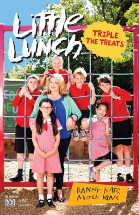
Little lunch: triple the treats by Danny Katz
Ill. by Mitch Vane. Black Dog Books, 2016. ISBN 9781925126907
(Age: 7+) Highly recommended. Humour, School, Recess time. Three
stories in one volume is what awaits those kids hooked on the
television series, Little lunch, along with those already
familiar with the books released since 2001.
This volume includes The milk bar, The cake stall
and The grandparents day, all concerned with the six
students in Mrs Gonsha's class pictured on the cover. The hilarious
stories will bring gales of laughter as recognition sets in. Each is
simply based around everyday happenings of children at school:
forgetting to pack your lunch, having to invite your grandparents to
school or being concerned about homeless animals. Each story is easy
to read, about forty pages long and copiously illustrated by Mitch
Vane and designed to bring a smile and laugh to every reader.
Photographs of each of the students and teacher at various positions
around the school add to the fun of reading the tales. The milk bar
across the road from the school beckons when Atticus again, forgets
to pack his lunch. Of course the milk bar is out of bounds but he
and his friends develop ingenious methods of getting there
un-noticed, that is unless Deborah the dobber doesn't dob. Grandparents day is an annual day in the life of this school,
one that last year turned out to be a disaster. This year Battie has
a huge problem. His grandfather is not coming but Mrs Gonsha has
knitted the man a lime green scarf. He devises a series of plans all
of which come to nothing and he must confess. The cake stall shows Melanie baking cakes for a cake stall to
raise money and awareness of the plight of homeless puppies. Each
story is well illustrated and uses different fonts and print size to
emphasise main points, while the stories, although brief always have
a neat resolution which can teach the readers something about how
they interact with other people. All in all a very satisfying group
of stories, nicely presented which will have wide appeal.
Fran Knight
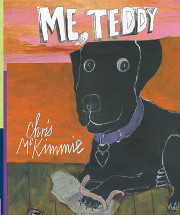
Me, Teddy by Chris McKimmie
Allen and Unwin, 2016. ISBN 9781760291334
(Age: 4+) Highly recommended. Family, Dogs. A delightfully eclectic
picture book from McKimmie will readily engage all those animal
lovers and owners and those who would wish to be from the first
page.
Teddy introduces himself to the reader when a pup, one which gets
into all sorts of trouble chewing up the wrong things: flip flops,
top of the range sandals (but only one!) and a chocolate cake. He
has as a result, become a large dog of forty kilos and the pictures
of him sprawled across the pages will be readily identified by those
who have had a labrador, a chewing machine, a vacuum of all he sees.
The wonderful illustrations, full of intriguingly different styles,
colours and medium, cause the eyes to wander the pages, checking out
the differences, looking for things known and unknown.
The range of illustrators and contributors adds to the eclectic
nature of the text, making it a treat for the reader to pick out
which is by Chris and which by members of his family. What fun they
must have had choosing which bits to add, and the whole forms a
model for classes to follow when they complete the book.
Teddy's days are fun filled, right down to an exhausted climb up his
mattress into his king sized bed. But when the suitcases appear,
Teddy knows he will be left, but a page of instructions for the
live-in carer will delight the readers.
The large sized publication is easy on the eye, attractive in its
depiction of Teddy eating a flip flop on the cover, enticing readers
of all ages to open the book. The dog's expressions are delightful,
particularly the pained look on the last page when his family
returns from holidays. This is a most accessible story of the place
of a dog in one family's home.
Fran Knight
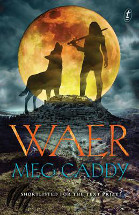
Waer by Meg Caddy
Text Publishing, 2016. ISBN 9781922182210
(Age: 12+ ) Highly recommended. Fantasy. Quests. Coming of age.
Werewolves. Good and evil. Loyalty. Loss. Love. Shortlist Text
Prize. Lowell Sencha is out in the forest when he discovers a young
woman almost dead on the riverbank. She is human but she is also
waer - able to take on the form of a wolf. Lycaea has run from the
cruel tyrant Daeman Leldh, who has tortured her and who despises
anyone with waer blood. Lowell's family takes her in, tending her
wounds and helping her to recover, but Daeman is determined to find
her, and his arrival in the valley leads to death and destruction.
Lycea and Lowell, helped by the healer, Moth and her husband Dodge
Derry, embark on a quest to bring down the tyrant and regain the
Valley.
With a dramatic introduction, sure to grab any reader's interest,
Caddy vividly describes a world where a young woman is hunted by
ruthless soldiers and where waers exist. In the Valley, the waers
have lead a peaceful life, worshipping their gods and helping each
other. Daeman brings that to a terrible end and Lowell finds himself
leaving with Lycaea, who is struggling with her past and her
unwanted waer blood. She is determined to get to the city of Luthan,
where she believes she will find help in bringing the tyrant down.
Told in alternating chapters, the reader sees the journey through
the eyes of Lycaea and Lowell, but also Kaebha, who was the one who
tortured people when commanded to do it by Daeman. Lycaea has many
hard decisions to make and for her, this is a coming of age story.
Lowell has to be one of my favourite male characters in young adult
fiction - sensitive, caring and strong and is a perfect foil for
Lycaea.
Both young people, Lycaea and Lowell, overcome many obstacles on
their path to right the wrongs that Daeman has inflicted on the
land. There are major themes of good versus evil, peace versus
warfare, loss, grief, loyalty and the betrayal of trust, all of
which are handled sensitively by Caddy, and give much for the reader
to ponder on. There is also plenty of action as the party travels
across the land evading danger.
This would make a good class novel or literature circle novel, with
many themes to discuss. Teacher
notes are available at the publisher's website.
Pat Pledger
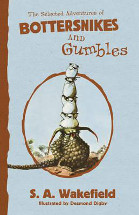
The selected adventures of Bottersnikes and Gumbles by S. A. Wakefield
Ill. by Desmond Digby. HarperCollins, 2016. ISBN 9781460751923
Deep in the Australian bush, in rubbish heaps along dusty roadsides
live the Bottersnikes. They are extremely lazy and so rather than
building nests, digging burrows or even looking for hollows in trees
for shelter, they just cover up with the detritus of the rubbish
heaps that are so often found along country roads. Much of the time
they just sleep, blending into the landscape with their green
wrinkly skin, cheese-grater noses and long pointed ears that go red
when they are angry. But should something need doing, they would
rather spend their time trying to catch the cheerful Gumbles to do
it for them than do it themselves.
The Gumbles are polite, always ready to lend a hand but also rather
naive so they are perfect prey for the indolent Bottersnikes. The
adventures begin when one morning when a thistle growing through his
watering can wakes the King of the Bottersnikes but instead of just
pulling it out, he roars for someone to open the door of a nearby
rusting car so he can move into that. Being who they are the Gumbles
who were passing by agree to help, and the King realises that they
could be very useful servants in the future. So he orders the other
Bottersnikes, who have been woken by his roaring to grab them. And
when they do, they discover that Gumbles can be squashed into any
shape without being hurt, even flattened to pancake thinness, but
they can't return to their regular shape without help. By squishing
them into the empty cans that are lying around, they can be kept as
slaves, on hand for whenever there is something that needs doing!
Trapped and forced to work for these odious creatures was not what
the Gumbles had planned but unable to get out of the cans, their
future looks sealed. But the King did not see a little Gumble -
Tinkingumble, a wise little creature who has 'tinks' which come to
him with the sound of a spoon tapping a glass, who was fiddling with
a can-opener and worked out how to free his friends. So when the
Bottersnikes went to sleep for the night, the Gumbles escaped
although their giggling nearly thwarted their plans.
While they do escape successfully and free themselves of the cans,
which they neatly put in an official rubbish bin, the Bottersnikes
are now aware of them and their potential and so the book comprises
a series of discrete, complete stories of Bottersnikes vs Gumbles
that have delighted the children I've read them to over the years.
The stories are a wonderful springboard for environmental studies
focusing on understanding the effect of our actions on the
environment and how we manage and protect resources as well as an
excellent basis for collaborative mural-making project as the
children create their own Bottersnikes using Wakefield's description
and junk materials and Gumbles by stuffing and stitching pieces of
old stockings. Each day we collected the rubbish scattered in the
playground and added it to the mural and after just one week we had
a powerful statement to present to the rest of the school that had a
significant impact on the litter problem. With a recent television
series and movie (sneak peek)
which give great scope for exploring the interpretation of the same
story through different media, this story, which has been out of
print for some time, is now firmly back into the lives of our
younger readers.
Barbara Braxton
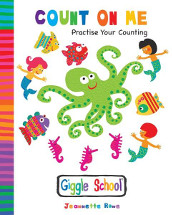
Count on me: Practise your counting by Jeannette Rowe
The Five Mile Press, 2016. ISBN 9781760068844
(Ages: 3-6) This is part of a Giggle School range of
preschool and early learning activity books for parents to use with
young children. This is one of the first in the series - the other
is Animal Alphabet. The books contain big, bright
distinctive illustrations by Jeannette Rowe and were developed in
consultation with an international education consultant. In the back
of each book are some fantastic quick tips for parents about ways to
support their child's early learning. There is a lot of variety in
the activities throughout the book, which will help to keep children
interested. It starts by explaining in appropriately simple language
what numbers are for ('Numbers are for counting') and what they look
like ('Numbers are both digits and words'). This is followed by lots
of activities involving counting, recording, number recognition and
counting in mixed groups. There is a page about digit formation
where children are asked to trace over the numbers with their finger
and then practise writing them but it seems inappropriately placed
close to the back of the book rather than earlier on.
Most children will love the 'I Spy' type pages that have a full-page
colour illustration and list things to be found within (eg. 3
striped fish, 1 octopus). A marketing point of these activity books
is that they are full-colour, but this seems somewhat wasteful for
books that may be used once and then discarded. However, if used
well by parents, this could be a worthwhile tool (able to be used
more than once), especially for basic counting skills and number
recognition.
Nicole Nelson
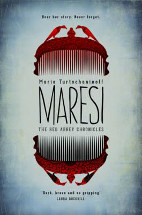
Maresi by Maria Turtschaninoff
Trans. by Annie Prime. The Red Abbey Chronicles bk 1.
Pushkin Children's Books, 2016. ISBN 9781782690917
(Age: 13+) Recommended. Finlandia Junior Award 2014. Fantasy. Women.
Nuns. Abbeys. After the Hunger Winter, Maresi came to the Red Abbey
to escape death from malnutrition. In the Red Abbey she is safe and
has ample food to eat and a treasure chamber of books to learn from.
Then Jai arrives on a ship. She has scars on her back and has been
cruelly treated by a father who considers his wives and daughters to
be worthless. Jai knows that his honour has been threatened by her
escape and believes that he will pursue her, harming everyone at the
Abbey. Maresi and the other women must call on the powers of the
Mother in all her forms to save Jai and the other women and
children.
This is a gripping story in many ways. The setting of the Red Abbey,
where men are forbidden and women grow strong in body and mind is
beautifully described as are the inhabitants of the island. Maresi
is a wonderfully caring young girl, who looks after the youngest
children, and takes the terror stricken Jai under her wing, helping
her to heal and gain confidence. Sister O looks on Maresi as her
protege and teaches her how to read the stories of the seven women
who originally came to the island. Mother, the nun in charge is wise
and tolerant and other characters are also fully developed so the
the reader gets a great sense of the community spirit that pervades
the Abbey.
Jai's ordeal and the way that women are treated in the society that
she flees has a familiar feel, reminiscent of some modern day
countries. There is a calm sense of underlying feminism, with women
and girls being empowered at the Red Abbey, but it is never
strident, and the themes of friendship, of sacrifice and of terror
and magic are the ones that captivate the reader as the tale of
whether Jai and Maresi can survive the wrath of Jai's father takes
over.
Maresi's story seems complete and comes to a satisfying conclusion,
so it will be interesting to see where the next in the series, Naodel,
takes the reader. Maresi is a book that will appeal to
lovers of fantasy, who want something a little more than a dystopian
quest. Its themes of coming of age, women's rights and community
living could make for a interesting book to discuss in a literature
circle.
Pat Pledger
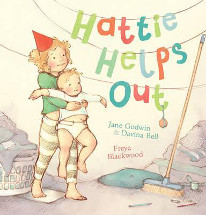
Hattie helps out by Jane Godwin and Davina Bell
Ill. by Freya Blackwood. Allen and Unwin, 2016. ISBN 9781743435434
(Ages: 3-7) Highly recommended. The first things that jump out of Hattie
Helps Out are the distinctive and wonderful illustrations of
Freya Blackwood. However, there is much more to commend this book
for than just aesthetics. Children and parents alike will be able to
relate to its warm, gentle and humourous tale. The house is a mess,
there is washing piled up everywhere, the baby is asleep in the
washing basket, mum is exhausted and there are lots of jobs to get
done before Dad's birthday party tonight. Lucky mum has Hattie to
help out. She manages to make place cards and help mum bake the cake
before it is time for her afternoon rest. Mama still has lots to do
but Hattie convinces her to lie down with her for a little while
('Get right in, so we can snuggle up', 'I told you it would be nice.
Just you and me'). Hattie closes her eyes, but sleep doesn't come .
. . Mama however is sound asleep so Hattie decides to get up and
finish all the jobs that need to be done for the party. Needless to
say, Hattie's heart is in the right place but sticky-taping the
biscuits together and decorating the toilet bowl with flowers wasn't
quite what Mama had in mind! When everyone arrives Daddy is most
surprised and when Mama wakes she is so grateful for Hattie's help
('What would I have done without my little girl?')
While this portrays a busy day in Hattie's house there is a very
calm and gentle feel to the story and everything is perfect because
they are all together, despite the messy house. Hattie's character
and dialogue is funny ('I don't have time for a crying baby today .
. . You'll have to sit quietly and wear your party hat') but
believable of children her age who often say the most extraordinary
things!
Nicole Nelson
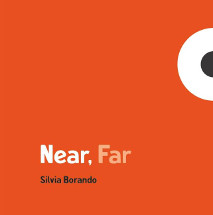
Near, far by Silvia Borando
Walker Books, 2016. ISBN 9781406363180
(Ages: 3-7) Wordless, Perspective, Near and Far, Animals,
Imagination. This is an English translation of a 2013 Italian
publication and part of the Minibombo series (little book
buzzing with a big idea). The website www.minibombo.com has
information, activities and games related to the books that could be
used or adapted for the classroom. The big idea in this book is
perspective. We see bits of an animal from close up: two green
mounds. Children might start guessing now what it is they are
seeing, (grassy hills or the ears of a frog?), then we get another
view zoomed out a little more and we see many spiky ridges. Then it
zooms right out and we see that it is a crocodile and we were
looking at the spiky ridges of its back. Children will love trying
to guess which animal is being shown before they see it in its
entirety and it will encourage and stimulate imagination. It will
also be a challenge for many children to work out which zoomed in
part of the animal was being shown. One of the concepts of the
minibombo books is using simple shapes to create animals and the
books in the series use the same animals (a lot of the animals in
this title are the same as in Now You See Me, Now You Don't).
While the book may have limited scope and children might not want to
go back for repeated readings, it is a useful concept book for
teachers working on perspective and near/far. It could be used as a
starting point for perspective activities and artwork and to kick
start discussions about how different people can see different
things when looking at the same thing.
Nicole Nelson
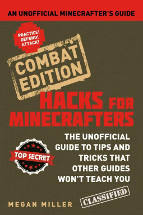
Hacks for Minecrafters series by Megan Miller
Bloomsbury, 2015 Hacks For Minecrafters: Combat/Builder. ISBN 9781408869635 Hacks for minecrafters: Master builder. ISBN 9781408869628 Hacks for Minecrafters: The Unofficial Guide to Tips and Tricks
That Other Guides Won't Teach You. ISBN 9781632204400
(Age: 9-12) Recommended. Themes: Gaming, Survival, Building. These
books would be enjoyed by all people who enjoy playing computer
games and in particular Minecraft. The three books are about 'Hacks
and Tips', 'Combat' and 'Building' in Minecraft. The books have tips
from: how to build glass domes, to how many times you have to hit a
creeper with an iron sword to kill it.
The books are titled Hacks For Minecrafters yet after
reading all three I discovered that there is only one hack between
all the books, and that hack is common knowledge to most PC
Minecrafters. Although there are no hacks in the books almost every
piece of information they contain is very helpful. I may not be an
avid Minecrafter but I found the books very interesting. These books
would not make very good gifts but for people new to Minecraft they
would be very helpful given the amount of information they contain.
I would recommend the books for people who play Minecraft at about
9-12 year olds. For those who struggle to read, they may be a little
difficult as they contain a few complex words.
Reuben Schumacher (Student, aged 13)
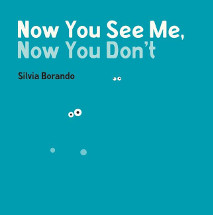
Now you see me, now you don't by Silvia Borando
Walker Books, 2016. ISBN 9781406364217
(Ages: 2-7) Wordless, Camouflage/Visibility, Colour, Animals. This
is an English translation of a 2013 Italian publication and part of
the Minibombo series (little book buzzing with a big idea).
The website has information,
activities and games related to the books that could be used or
adapted for the classroom. The big idea in this book is colour and
camouflage/visibility. There are the same animals and configuration
on each page, with the landscape and colour of the background
changing each time (green grass, orange autumn leaves, blue sky,
etc.). So on each page one or more of the animals is camouflaged
with the background (blue bird blends in with the blue sky, grey
mouse with the stony ground, etc.) and only their eyes or other
differently coloured features can be seen. The animals are not all
naturally coloured and life-like or this concept wouldn't work. They
are all block colours and there is a purple elephant and a pink
rabbit. Most of the others are their general colour (eg. green
crocodile, brown bear and grey mouse). The book will encourage
conversations about what animal cannot be seen on each page and why.
There is no other text so it relies on children and parents to talk
about and interact with the book. This is a useful resource for
teachers to use when discussing colour and the concept of
camouflage. It could be used as a starting point for camouflage
activities and artwork. The last spread also provides for great
discussion as the background is black and now none of the animals
(except for their eyes) can be seen. There is also a chameleon that
is only seen on the first page.
Nicole Nelson
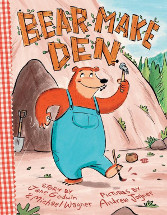
Bear make den by Jane Godwin and Michael Wagner
Ill. by Andrew Joyner. Allen and Unwin, 2016. ISBN 9781760110017
(Ages: 3-6) Recommended. Andrew Joyner's superb illustrations make
this immediately appealing and the story does not disappoint. The
bear on the cover immediately comes across as loveable and
hardworking, depicted working away in his blue overalls with a
satisfied grin. He sure is a competent DIY bear - painting, sewing,
building, baking, he can do it all. The country feel of the book,
owing to the red and white check cloth of the spine, the forest
setting and the simplistic 'caveman' language used throughout the
book ('Bear make den, den good, den done') works perfectly with this
gentle, simple story. It all starts with bear reading a book called
'How Make Den'. He finds a cave, shovels out some dirt and is pretty
satisfied . . . until he realises he is sitting on the ground! 'Den
not done.' So he constructs a table and some chairs out of a log.
Again, he is chuffed until he realises the dining chairs are
uncomfortable for sleeping on. And so it continues . . . .a bed, a
lamp, an oven, a game to play, art, and finally . . . friends! At
its heart, this is a simple and fun story about what truly makes a
house a home. The whole story is leading up to this as bear makes a
bunk bed, a two seater couch with lamps on either side, two dining
chairs, a huge cake too big for one, a chess game for two, etc.
The simplistic language is perfect; it sets the speed of the book as
bear quickly works to build things for his den and is all that is
required to tell the story. In fact, you could just as easily read
the story from the pictures alone, as bear's mannerisms and facial
expressions perfectly portray what he is thinking and feeling. This
is perfect for sharing and independent reading. Children will also
love guessing what bear is going to do next.
Nicole Nelson