Ill. by Ambelin Kwaymullina. Omnibus Books, 2016. ISBN 9781742991368
(Age: 4+) Highly recommended, Australian animals, Aboriginal themes,
Parents, and parenting, Kookaburra
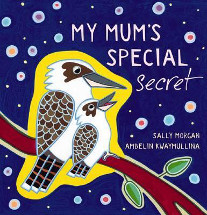
An absolutely delightful rhythmical story of the love between a baby
bird and its mother is told with bright gouache illustrations
reinvesting the special bond between mother and child with a
singular importance. Each page has the baby bird asking his mother a
question, one which is answered on the next page. Children will love
listening to the warm-hearted story being read to them and learn to
predict the questions and answers as each uses the same format.
'Will we see the stars? Mum'
for example, is followed by
'My mum shows me the stars
through the leaves,
Twinkle, twinkle, twinkle'
Each one line question of five or six words is ended with the word,
Mum, and the response is always one long sentence followed by three
words describing the object, begging the child to repeat those words
as they are read out. In this way the repetition becomes easy for
children to follow and practice for themselves.
The communication between mother and her offspring, reinforce the
maternal bond with a child, and reflect what parenting is about to
the listener and reader. The last four pages add a little piquant to
the mix as the format changes, encouraging the child to see the
deeply reciprocal nature of the relationship between mother and
child.
And of course the luminous illustrations teach the reader about the
life of the kookaburra: where it lives, what it eats and how it
survives in the Australian bush, giving another level of learning to
this lovely book.
Fran Knight
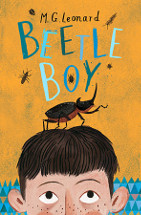
Beetle Boy by M.G. Leonard
Chicken House, 2016. ISBN 9781910002704
(Age: 10+) Highly recommended. Darkus Cuttle's dad is missing. He
has to live with his uncle, change schools, make new friends and
work out why he can understand a huge rhinoceros beetle who has
become his friend by chance. Thanks to this beetle (he names him
Baxter) rescuing Darkus from some bullies, Darkus becomes Beetle
Boy. Darkus knows his dad would never leave him so sets out with
some help from his uncle and a lot of help from his new friends,
Virginia and Bertolt, to find out what happened. Who knew it would
lead to some amazing bugs and an amazing adventure.
Darkus encounters Lucretia Cutter, an avid bug collector and fashion
designer as well as the antagonist for this story. She is willing to
pay for the deaths of the amazing bugs Darkus has found and while he
is trying to save them, uncovers another secret or two. Who is this
Lucretia Cutter and does she know Darkus's dad? Was that a claw
instead of a foot? Did Lucretia just try and shoot him? Does
Lucretia hold the key to his dad's disappearance? Beetle Boy is a wonderful story full of hope, adventure and
total belief in one's father as well as oneself. The author has
captured the everyday issues of a young boy who dares to be
different and not conform to the expectations of the bullies while
creating a wonderful mystery and adventure for any reader who loves
bugs. It is highly recommended for readers aged 10+ but will
especially appeal to boys.
Kylie Kempster
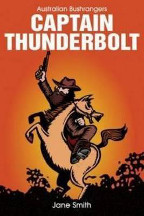
Australian Bushrangers series by Jane Smith
Big Sky Publishing, 2014 Captain Thunderbolt. ISBN 9781922132574 Ben Hall. ISBN 9781922132697 Captain Starlight. ISBN 9781922132710 Frank Gardiner. ISBN 9781922132673 Captain Moonlite. ISBN 9781922132581
Themes: Bushrangers; Australian History. This series is written in a
simple style with some sidebar excerpts to fill in detail. The index
would enable the text to be used by young students for research, but
the books in this series are easy to read from cover to cover and
could even become teacher-shared texts during a unit of work on
early Australian History during the mid-1800s. Inferences about what
life was like during this period could also be made (in connection
with Year 5 Australian Curriculum History content.) Captain Thunderbolt
This short biography and detail of the exploits of 'Captain
Thunderbolt' (Frederick Wordsworth Ward) gives an overview of his
life and his career on the wrong side of the law. Thunderbolt is
represented as a 'gentleman' rogue who enjoyed support from the
wider public despite his attempts to improve his own circumstances
by thieving. Smith gives brief accounts of the chronology of his
life and deeds and the book includes some evidence of Primary
sources for the historical account. Ben Hall
Ben Hall, another 'gentleman' bushranger, who despite being the
child of ex-convicts, appeared to have a more promising future until
he met up with the notorious bushranger Frank Gardiner. This book
details the robberies of Ben Hall and the changing faces in his gang
in the 1860s. The circumstances that led to his notoriety and the
ultimate outcome of his life of crime are well detailed by the
author, with sketches, primary sources and photographs used to
illustrate the text. Captain Starlight
This book focuses on two bushrangers, Frank Pearson and Harry
Readford, who might potentially have inspired the character Captain
Starlight from the Rolf Boldrewood book Robbery Under Arms
(published in 1888 after first appearing as a serial in a Sydney
newspaper). Both bushrangers were well read, and may have been
successful if they had not sought an 'easier' route by breaking the
law and attempting to make easy money via criminal means. Although
the author does not speculate about society at the time, it is
apparent from their crimes, that the two 'Captain Starlight'
characters sought to exploit the wide and poorly policed areas of
New South Wales and Queensland in the 1800s. The legal system also
was well exploited by these lawbreakers. The author has made brief
comparisons between Pearson and Readford, but has also indicated how
they pursued their crime path in some detail. Frank Gardiner
Frank Gardiner was notorious, leading a life of crime that involved
theft, highway robbery and attacks on the police who came to arrest
him. Mid-19th century life was tough in the rural regions of NSW,
and even those who were attempting to live honestly were tempted to
make their way by illegal means. The police were not well-respected
because they represented the authority of the government which was a
target for many who had come to hate taxes and their impoverished
existence, and the added influence of convict heritage may have had
its own impacts. Into this environment, the well-spoken and affable
Gardiner (aka Christie) was easily able to draw a collection of the
disaffected and pursue a career of crime. This book details his
pursuits and explores why he was respected and protected by many of
the local citizens of NSW despite his illegal activities. This is an
interesting stand-alone book, but together with the rest of the
series gives an insight into early life in the colony. Captain Moonlite
Andrew George Scott became known as 'Captain Moonlite', who despite
coming from a good family and having a religious background, ended
up on the wrong side of the law. Scott was educated and had
prospects for a career in the developing colony (after migrating
from Ireland via New Zealand). A hold-up in the local bank
implicated Scott and a pathway of lies and deceit revealed Scott as
a complicated man with a tendency to performance. The web of
intrigue tightened around him and his prison experiences impacted
his life. He had a complicated and high view of his own opinions (he
would defend himself in court with dramatic fervour and went on a
speaking tour to promote prison reform) and was also able to
convince others to follow his instructions. Although a 'gentleman',
he was not as amiable in his approach as other bushrangers in this
series and there could also be some conjecture about his mental
stability and his possible homosexuality. The fact that jobs were
hard to find for those who had served jail sentences created a
desperation that led to his short-lived bushranging career which
ended on the gallows. This book reveals a complex character and a
complicated set of circumstances and although the social context is
not examined in detail, gives hints about how bushranging became a
choice for Captain Moonlite and his less well-known companions. This
is perhaps less likely to be used as a read-aloud text for Year 5
students as part of the Australian Curriculum - the behaviour of
Captain Moonlite is harder to fathom for a younger audience.
Carolyn Hull
Where's the starfish? by Barroux
Egmont, 2016. ISBN 9781405280082
(Age: 3+) Highly recommended. Hide and seek. Oceans. Fish.
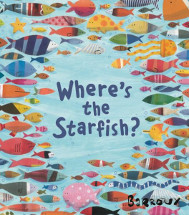
Pollution. A seemingly simple game of find the starfish, the
clownfish and the jellyfish amongst the double pages bright with
different colours, shapes and varieties of fish, soon turns into a
subtle look at the pollution in our oceans as the fish, big and
small, find that their habitat is being crowded out by the litter
clogging their world. It starts small, with a bottle and can on the
sea floor, but as each page is turned the mound of discarded rubbish
grows, the number of fish lessens, until finally most of the fish
have gone. Children will laugh at the ingenious solution reached by
the whale to rid the sea floor of human rubbish, putting it back in
their corner of the world, leaving their environment free. And they
will be made more aware of the sort of rubbish that is tipped into
the sea, or finds its way there through unthinking human activity.
They will love spotting the fish, especially the three mentioned, as
they keep turning up on most pages, and they will like looking at
the variety and scope of the rubbish found in the sea.
Barroux found inspiration for the story when on one of his dives, he
saw a plastic bag that he thought was a jellyfish. His illustrations
will enthrall younger readers, using the Where's Wally style
of search to get them hooked. A teacher could use this technique
asking the children to find the three fish, starfish, jellyfish and
clownfish, then spread the search wider to search for a telephone, a
TV set, a washing machine and so on. And what a wonderful mobile
could be made in the class using this story as its base.
Fran Knight
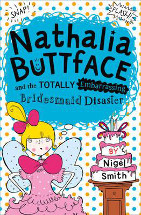
Nathalia Buttface and the totally embarrassing bridesmaid disaster by Nigel Smith
HarperCollins, 2016. ISBN 9780008167097
(Age: 9+) Highly recommended. If the title Nathalia Buttface and
the totally embarrassing bridesmaid disaster doesn't make you
laugh then the hilarious events in the first 50 pages will! Nathalia
doesn't want to be a bridesmaid in her stupid cousin's, who she
really doesn't know, wedding and is trying hard to be removed as a
bridesmaid. The humungous fairy dress is only one terrible part of
the whole thing but worse is yet to come - meeting the other
bridesmaids, going to the day spa, someone losing their hairpiece
and getting a promotion to 2nd bridesmaid! Nathalia Buttface is as hilarious as it is descriptive.
Highly recommended for girls aged 9+. Every word leaves a funny
image in your mind as you read about Nathalia's antics. Meet the
bridegroom and his big personality. Watch Dad, the unorganised,
organise a wedding. Can Nathalia, as the 2nd bridesmaid, uninvite
uncle Ernie without hurting his feelings? How will Darius,
Nathalia's best friend, get her out of this crazy wedding? Will
Nathalia make it to the big day?
Kylie Kempster
The butcher's hook by Janet Ellis
Two Roads Books, 2016. ISBN 9781473625129
(Age: Adult - Mature readers) Georgian England. Gender roles.
Sexual maturation. Violence. Murder. Grief.
This is not a Jane Austen-style gentle and romantic exploration of
life in Georgian England, but the voice of the central character
Anne is full of the pain of a young and intelligent girl who lives
in a patriarchal world and lives with limited opportunity - except
that offered by a man. The 'butcher's hook' catches her, whichever
way it, or she, is turned, and as we read we feel the slow and
inexpressible pain of powerlessness at the hands of others. Anne's
early family life is scarred by the repeated loss of her siblings,
either in miscarriage or early death, and there is a heaviness that
pervades her family life. In a world before good medical knowledge
and care, and even less psychological support for the grieving, we
are led into a series of overwhelming situations and potential
problems as Anne matures into a woman of marriageable age and
attempts to independently explore her growing interests. Her
intelligence was at one time fostered by a family 'friend', who
displayed interesting methods of arousing her curiosity about the
world, but his means of explaining her questions about life and
birth change her direction for the future and awaken more than
understanding. A connection to the local butcher's apprentice
rapidly escalates, and her means of clearing her path to enable her
desires to be fed reveals more than just her lust for the young lad.
The story is tragic and macabre, and displays none of the lightness
of an Austen tale.
The background of the Georgian world, with its distinct social and
gender class separations and the mire of poverty always in the
background, is a fascinating setting for this absorbing tale of the
unfolding carnal and worldly sensibilities of an adolescent woman
who transforms in a way that we wish we could halt. This is not a
gentle coming-of-age book for teenagers. And for those who might be
squeamish and a little uncomfortable in a 21st century butcher's
shop, there is a raw and visceral unpleasantness in imagining the
equivalent literary dismembering of life in the 1760s. The quality
of the prose will keep you reading though, despite some
unpleasantness along the route.
Recommended for Mature readers only. (Adult text)
Carolyn Hull
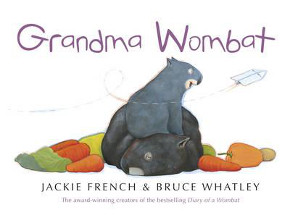
Grandma wombat by Jackie French and Bruce Whatley
Wombat series. Angus and Robertson, 2016. ISBN 9780732299590
(Age: 3+) Highly recommended. Wombats. Grandparents. Each day sees
similar things happening in the lives of grandma and her grandson
wombat. Sleeping makes up much of each day, but some days there are
carrots to be had, or small naps to be made, or itches to scratch.
While grandma sleeps more soundly her grandson watches the world go
by. The kangaroo that hops over the pair sometimes wakes grandma
wombat, but one day as grandma lies sleeping, the kangaroo's joey is
replaced by the smaller wombat. He bounces away, taking a ride in
the ute on top of the bales of hay, then onto the back of a motor
bike, then into a parcel truck which delivers baby wombat to the
airport. There he joins a rather startled looking group of skydivers
and sits on one as they sail to the earth.
Once again he is back with grandma, sleeping, scratching and eating
but with a little eye that looks out at the reader, sharing what he
has done with the audience.
Grandma is impervious to her grandson's outing, saying what a well
behaved grandson she has, but the audience knows what he has done,
and laughs along with him and his loving grandma.
French's pared back text gives all that is needed, and the
illustrations by Bruce Whatley add another level of humour to an
already funny tale. This is the fifth in the series of books about
wombats by these two and will be very welcome in all libraries.
Fran Knight
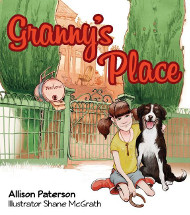
Granny's Place by Allison Paterson
Ill. by Shane McGrath. Big Sky Publishing. ISBN 9781925275636
(Age: 4-6) Highly recommended. Themes: Grandparents; Family Life;
Australia - Social Life and Customs - Twentieth Century. Granny's
Place is a nostalgic story that celebrates the loving relationship
between a young girl and her grandparents. Memorable visits to the
family farm are beautifully described; the simple joys of bouncing
on the springy beds, sharing freshly baked bickies and cakes around
the wooden kitchen table and stamping through carpets of pine
needles. Packing up the farm and moving to the city after Pa's
passing, brings new challenges. When Granny's welcomes the family to
her purpose-built red brick bungalow, the mood changes, no pine
needles, ducks, hens or geese, no shrieking metal gates. Granny's
love is constant, she still bakes for her family and welcomes her
grandchildren.
Shane McGrath's engaging illustrations encapsulate rural and city
life in the 1960's. The evocative narrative is enlivened by the
earthy palette of greens, reds and browns, energetic characters,
detailed vignettes and large sweeps of white space that focus the
eye. Take time to explore in the old mudbrick farmhouse, there's
Pa's World War 1 memorabilia, the old pump organ ready to be played
and treasures hidden in old suitcases.
Alison Paterson's sensory descriptions bring these warm memories to
life. This is a delightful picture book to share with grandparents
and great grandparents. A great resource for the Early Years History
and Social Sciences, comparing how family life and places change
over time.
Rhyllis Bignell
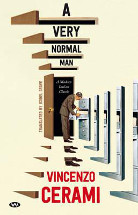
A very normal man by Vincenzo Cerami
Translated by Isobel Grave. Wakefield Press, 2015. This is an
English translation of Un Borghese piccolo piccolo, 1976. ISBN
9781743053713
(Age: 17+) Highly recommended. Themes: Revenge; Italian Society;
Purpose; Hope and hopelessness. A Very Normal Man is a translation of the first novel of
Vincenzo Cerami who is also renowned for his co-authorship of the
screenplay for Life is Beautiful (La vita e bella)
with Roberto Benigni. With the same deft touch, he lightly deals
with a harsh topic as he tiptoes through the tragedy of a normal
life that sinks to extreme measures to grasp at retribution for a
terrible family disaster. At the beginning of this carefully crafted
story we enter the humble circumstances of the central character and
his less than stellar career as a civil servant. His pre-retirement
drudgery is brightened by the prospect of providing more for his son
than was possible in his own life. In order to facilitate this rise
above drudgery and relative working servitude he is enticed to
explore a position within the local Masonic charter and the reader
sees the implicit corruption that follows. On the brink of hope for
his son, tragedy falls and the 'Normal man' sinks into functioning
despondency and a whirlpool of despair that drags him down and
plants the smallest of seeds of revenge into the heart of the simple
man. From this point the black tragedy of the normal life takes on a
secret existence that is almost quirkily humourous, and yet is in
essence, darkly evil. The heart of this story is to reveal the very
easy path that a normal or average man might take in becoming the
worst kind of man. There is irony in the title that this is not a
'normal man'; even though to the world he is a small, insignificant,
'good' man. To the reader who is capable of self-examination, there
is an opportunity to consider their own hidden potential. The
characterisation within this text is subtly revealed, but incredibly
powerful.
The translation of this text has brought this cleverly crafted story
to our attention and this is worthy of study, despite its macabre
aspects, and the journey into Italy in the period post- 1969, with
its potential for corruption at even the most basic level is
intriguing.
Highly recommended for Mature readers aged 17+ (predominantly an
adult novel, but accessible by younger readers.) Note: some macabre
detail included - a 'black' text!
Carolyn Hull
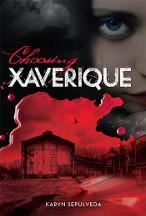
Choosing Xaverique by Karyn Sepulveda
Vivid, 2016. ISBN 9781925442281
(Ages: 11+) Fifteen year old Gabby Valis has an ordinary life, just
like any other. Until she is catastrophically hit by a swerving van,
and her heart stops beating . . . at least, it does for several
minutes. Gabby is a Xaverique, a non-human species who are bestowed
with powerful abilities. A Xaverique's powers can be used for good
or for evil, and it just so happens that the most powerful Xaverique
to have ever lived, Zlanythe, is concocting a hideously evil plan
that Gabby finds herself (and her newly awakened powers) tangled up
in.
Gabby, and the love interest, Noah's relationship is unfortunately,
completely insta-love. After knowing each other for only a few
weeks, they are professing their love for each other. Yes, they are
both teenagers but even teenagers do not fall in love that quickly.
After their very first meeting, Gabby thought she was in love with
Noah. This definitely impacted on my enjoyment of the novel.
A second issue I had with the novel was the length. At only 149
pages, insta-love is going to be imminent and the climax of the
story seemed both rushed and anti-climactic. Choosing Xaverique
definitely would have benefitted from being a longer novel and
therefore having more time to explore the relationships of the
characters and strengthen the storyline.
Unfortunately, the novel also proved to be predictable in some
aspects. However, the ending, whilst it did not surprise me, left me
interested to know what would happen next. Overall, Choosing
Xaverique is an easy, quick and light read that young
teenagers (who can handle mature content including descriptions of
blood and injuries) can enjoy.
Breanne F. (Student)
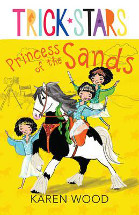
Princess of the Sands by Karen Wood
TrickStars series, bk 6. Allen and Unwin, 2015. ISBN
9781743319093
(Age: 7+) Highly recommended. Themes: Courage; Overcoming
difficulties; Horse-riding; Television acting.
In this next instalment in the life of the TrickStar triplets -
Ruby, Lexie and Kit, the girls become Television extras in an
episode of Princess of the Stars. With the wonderful ponies who
allow them to demonstrate their trick-riding skills (and their
slightly magical) personal characteristics they also solve the
problems of the main child star whose horse is causing problems in
the shooting schedule. While this is a story about all the triplets,
it focuses on Lexie's battles with overcoming her fears as well.
This is a gentle, easy chapter book for a young female audience who
enjoy reading about horses, trick-riding and girls as they express
themselves within a supportive family. The series is worthy of a
place in a school library.
Highly recommended for aged 7+.
Carolyn Hull
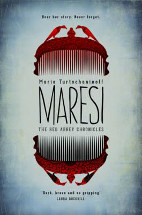
Maresi by Maria Turtschaninoff
Red Abbey Chronicles. Pushkin Children's Books, 2016. ISBN
9781782690917
(Age: 12+) Highly recommended. Fantasy, Dystopian story, Women.
Maresi is sent to the Abbey when her sister dies during the
HungerWinter, her parents no longer able to feed her. Here her
thirst for knowledge comes to the fore as she is able to go to the
Knowledge House after she finishes her chores. Here she learns of
the place where she lives, the Red Abbey, first settled by the
sisters many generations ago, to protect them from the violent male
dominated world outside. And she learns of the ancient skills and
feels the power of the Crone, one of the three that make up the core
of the Abbey, the Crone, the Rose and the Mother.
Her idyllic life is interrupted by Jai, a waif brought to the Abbey
for protection, after a brutal father kills her sister. Her mother
has risked death herself to get the girl away, and she finds peace
within the walls, with Maresi to guide her.
But Jai's position within the walls attracts her father's revenge
and he and his friends come to get her back, forcing the women to
use the ancient skills to keep them all safe.
Allegorical in tone, the first in the The Red Abbey Chronicles
impels readers to see parallels in their own world, the brutal
nature of the world outside the walls similar to any regime which
aims to keep women subservient, using brute power and fear to keep
them repressed. The religious basis of the Abbey is fascinating
again encouraging readers to see parallels with religions within
their own communities. The island keeps out invaders, the walls and
gates make impregnable with magic but Jai's father is more
determined than most and the women must take greater risks in
defending their island.
This is one of those reads that grabs you and drags you along,
wondering what will happen next, all the while hoping they will
survive. The background from the arrival of the First Sisters,
setting up the Abbey and the way they live earning money from
harvesting the bloodsnails, develops a strong base for the story.
Translated from Finnish, there are two more books to be published:
one a prequel telling how the First Sisters set up the Red Abbey and
the next, a sequel, showing Maresi out in the world. The Red
Abbey Chronicles has been sold to thirteen countries, while an
American publishing house has brought the rights to the trilogy for
a six figure sum. The book has been awarded the Swedish YLE
Literature prize for Young Adult works by a Swedish-Finnish author.
Fran Knight
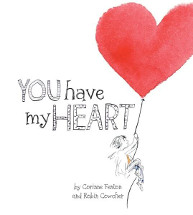
You have my heart by Corinne Fenton
Ill. by Robin Cowcher. Five Mile Press, 2016. ISBN 9781760401917
(Age: 3+) Family. Love. Mental health. Mothers' Day. Based around
Parrot's classification of the six emotions, joy, sadness, fear,
anger, surprise and love, this charming book will give a range of
language to young children to describe their feelings. The words
used by Fenton have immediate appeal as they describe in short
phrases exactly what it feels like to be joyous or angry, fearful,
sad, surprised and loved. The tripping lines of words will be a
treat to read a loud to a child or class, and will encourage
children to read it for themselves. Each child listening will be
able to talk about those days when they are happy or sad, but
knowing that in the end they are loved, there is someone there to
make them overcome those days that might not be the best, there is
someone there who has their heart. This is a book to read and
reread, encouraging young children to see that there are days where
things might not be as good as they hoped they would be, that
everyone has 'tears-tumbling down days' and 'the world doesn't like
me days', days when they need a hug and be reminded that there is
always someone there that will make them stronger and has their
heart. For discussing mental health issues with a younger class this
would be an admirable introduction to talking about good days and
bad days, encouraging children to see that they are not alone.
Originally conceived as a Mother's Day message, the book has much
wider appeal, showing children that they are not alone in times of
need. The illustrations with limited colour compliment the words
beautifully, using line drawings, greys and red to show the six
different emotions felt by the girl, and using a red balloon to
reflect the way the child is feeling.
Fran Knight
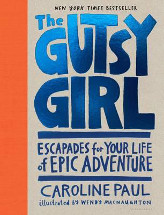
The gutsy girl: Escapades for your life of epic adventure by Caroline Paul
Bloomsbury, 2016. ISBN 9781632861238
(Age: 9+) Highly recommended. The gutsy girl: Escapades for your
life of epic adventure is an amazing book for all readers. The
author, Caroline Paul, describes her adventures from milk carton
making to climbing the Golden Gate Bridge, showing all readers that
their life can be an adventure. Throughout the book are quotes from
a variety of female adventurers and heroes to help promote
adventurous thinking and remind readers they can think, do and achieve
anything.
The stories are descriptive and inspiring as well as a variety of
other texts; from procedures showing readers how to tie different
knots to explanations and diagrams about clouds and tools. There are
blank journal pages for readers to add their own adventures,
procedures and favourite quotes.
This book is highly recommended to readers aged 9+. Each chapter is a
different story which means it can be picked up at anytime and read
in any order. There is also something quite appealing about the
solid and exposed cardboard cover with the orange spine and shiny
blue text. It reminds me of a journal or memoir and adds to the
overall appeal of the book
Kylie Kempster
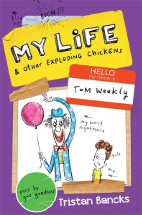
My life and other exploding chickens by Tristan Bancks
Random House, 2016. ISBN 9780857985316
(Age: 9+) Highly recommended. My life and other exploding
chickens is about the life of our main character, Tom Weekly,
and is written from his viewpoint. Tom recounts hilarious stories of
his life, from a crazy dentist visit to funny dot points about his
cat. We find out about the crazy girl who has a crush on Tom as well
as the girl he is crushing on. Read about Tom's friend who had a
knitting needle stuck in her bum cheek and how Tom fears the library
ninjas!
This is a hilarious novel aimed at and highly recommended for boys
aged 9+. Each chapter is a short story in itself so even the most
reluctant readers will find themselves engaged in each descriptive
and 'giggle' moment! There are even a few gross moments - like the
nits that grow and grow because of tomato sauce! What child won't
like to read about that!
Kylie Kempster