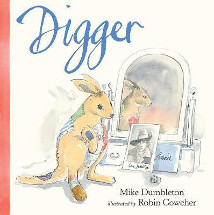
Ill. by Robin Cowther. Allen and Unwin, 2018. ISBN 9781760296735
(Age: 5+) Highly recommended. Themes: World War One, Kangaroos,
Children in war, Villers-Bretonneux. A link between Australia and
France is created in Dumbleton's stunning picture book concentrating
on the battle around the village of Villers-Bretonneaux in 1918. It
is a reminder of the people behind the armies, the child back home,
wondering about her older brother, the young girl in France, doing
something for one of the soldiers who saved her village.
When James leaves Australia to fight in France, his sister, Annie
makes him a present of her scrap material kangaroo, which she
renames Digger. The little kangaroo is tucked into James' pocket and
letters home to his sister tell of their time getting to France,
then being in the trenches. When he is wounded he recuperates with a
French family and their little girl, Colette, mends Digger for him.
Again the little mascot is tucked into James' pocket and goes back
to war, but this time, the kangaroo is returned to Colette alone,
hardly recognisable in James' slouch hat.
Again Colette repairs the little animal, and the mascot is sent back
to Annie with a name tag and slouch hat added, along with a letter
from James' friend.
It is at the village that Colette leaves flowers on James' grave,
and in Australia, Digger takes pride of place in the family's
remembering James and the little girl in France who cared for the
animal just as she cared for her brother.
This is a fresh look at the links between war sites and the people
who fought and died there. As 2018 commemorates the battle of
Villers-Bretonneaux, this picture book serves to give younger
children a feel for the links that bind Australia and France through
this battle and many like it. The book depicts a small moment but
one that exemplifies the strong attachment many Australians felt for
those they fought for, and for those back home.
The soft water colour illustrations draw the eyes to the images on
each page, faithfully recreating James' involvement in war. We feel
his expectation as he looks out to sea over the side of the ship on
the way to France, the uniformed men trying to survive as the night
sky lights up with gunfire and they hunker down into trenches and
dugouts. Happy times recuperating at the French house are replaced
by the sadder moments articulated simply by a much damaged Digger
lying in his owner's slouch hat, being given to the girl, and the
last four double page spreads shows each girl caring for the
kangaroo in Australia and the grave site in France. The paralleling
of each child strongly reinforces the sacrifices each country made
for the other, as each girl goes about her life with the memories of
James not far from their thoughts.
A memorable picture book with which to acquaint readers with the
sacrifices of those behind the scenes, and the battle at
Villers-Bretonneaux. Scroll down for Teacher's
tips on the publisher's website.
Fran Knight
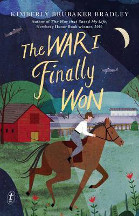
The war I finally won by Kimberly Brubaker Bradley
Text, 2017. ISBN 9781925498851
Highly recommended. Sequel to the award winning The war
that saved my life. "When Ada's clubfoot is surgically fixed
at last, she knows for certain that she's not what her mother said
she was - damaged, deranged, crippled mentally as well as
physically. She's not a daughter anymore, either. What is she? World
War II continues, and Ada and her brother, Jamie, are living with
their loving legal guardian, Susan, in a borrowed cottage on the
estate of the formidable Lady Thorton - along with Lady Thorton
herself and her daughter, Maggie. Life in the crowded cottage is
tense enough, and then, quite suddenly, Ruth, a Jewish girl from
Germany, moves in. A German? The occupants of the house are
horrified. But other impacts of the war become far more frightening.
As death creeps closer to their door, life and morality during
wartime grow more complex. Who is Ada now? How can she keep
fighting? And who will she struggle to save?" Publisher
I absolutely loved this book. I found myself wanting to read it any
spare moment I had. Although I had not read the other books about
Ada I did not have any trouble following the storyline - although I
will be seeking out the first book! The characters are so lifelike
and it is extremely easy to make emotional connections with each and
every one of them. The story touches on persistence, love,
friendship and ignorance.
It would make a fantastic read aloud although it would need to be
for upper primary students as there are references to the abuse and
neglect Ada faced prior to being evacuated from London. It provides
a fantastic insight into the hardships that affected all during the
war - from the very poor to the wealthy. A must have for the library
collection. Teacher's
notes are available.
Kathryn Schumacher
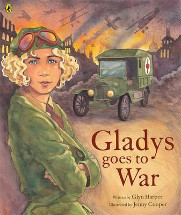
Gladys goes to war by Glyn Harper
Ill. by Jenny Cooper. Picture Puffin, 2016. ISBN 9780143507208
Auckland, New Zealand in the very early 20th century when girls were
still supposed to be seen and not heard, despite having had voting
rights since 1893 - still very much an English colonial mentality
where they busied themselves with music, needlework and other
"feminine" tasks. However, unlike her sisters, Gladys was not good
at such things, preferring instead to spend her time under the
bonnet of her brothers' cars and those of their friends.
"No one will want to marry a mechanic" her mother told her, echoing
the feelings and the culture of the times. But her mother was wrong
and in 1912 she met and married William Henning who taught her to
drive and then set up a car sales business in Auckland. Being
competent and comfortable in this "men's world" meant that it was no
surprise that when her husband and brothers enlisted when World War
I broke out that Gladys wanted to go too. But her efforts were met
with the typical chauvinistic response of the times . . . "If you
want to help the war effort, you should stay at home and knit socks
and balaclavas."
But they had underestimated Gladys's determination and in 1916 with
the assistance of the New
Zealand Volunteer Sisterhood she was reunited with her husband
in Egypt becoming an ambulance driver, and when he was sent to
France she went to England. But again male-dominated bureaucracy
determined her place was in the hospital scrubbing floors not
driving ambulances. Until one evening, there was a shortage of
drivers . . .
This is the story of just one of the many
women who played an active part in World War I as doctors,
nurses, ambulance drivers and so much more, rather than being the
stereotype wife/mother/ sister/ daughter who 'kept the home fires
burning'. Despite their important contribution throughout history,
so many women have been written out of it and when a request through
a local network for a book for younger readers about World War I
from a female perspective there was a paucity of replies. Yet there
are so many stories
that could be told from both New Zealand and Australia.
Gladys was a pioneer in so many fields - in 1927, having survived
both the war and Spanish flu, she and her friend Stella Christie
became the first women to transverse Australia east to west and
north to south in a car - and so bringing her wartime service to
light is just the beginning of the stories that could be told about
this remarkable woman. But as well as her personal chronicle, this
could be a springboard for having students investigate and retell
the stories of other women whose contributions have been
overshadowed by those of their male counterparts. Searching the Australian War Memorial's site
for "women in war" is a good starting point.
However, even if Gladys's story is just shared as a standalone, it
is a sound representation of #nevertheless,shepersisted
Barbara Braxton
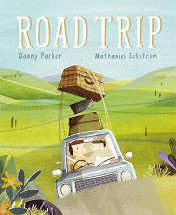
Road Trip by Danny Parker
Ill. by Nathaniel Eckstrom. Little Hare, 2017. ISBN 9781760127404
It's a familiar scene on Australian roads - cars packed to
overflowing as the family heads out on a road trip. And, inside, the
conversation is just as familiar . . . "How long till we get there,
Dad?" "About an hour." "How long is an hour?"
Clearly, for this father and son that's the start of this new
adventure because in clever rhyming verse Dad lists all the things
that take an hour.
It's sixty short minutes, not one moment more.
A bike ride,
A boat trip,
Ice cream by the shore.
It's a hammock in summer; or the park with the dogs.
It's a snuggle in winter; hot chocolate with rugs . . .
But as the drive continues from the city through magnificent
countryside his son gets more and more frustrated urging his dad to
go faster.
But Dad is quite content to stick to the speed limit and enjoy the
journey as the scenery unfolds. Until finally . . .
This story will be familiar to most families who have ever
undertaken a journey that goes beyond the regular routine of shops,
schools and sportsgrounds. Parents will relate to the joy of just
getting away from those clogged, crowded roads and breathing the
country air, while their children will be full of the excitement and
anticipation of the destination and couldn't care about the journey.
And why does it always take longer to get there than it does to get
home? And how long is an hour anyway? What are the fun things that a
family does that fill in an hour?
Apart from the charming illustrations which bring the journey to
life for the adult reader but which tend to show the countryside as
somewhat bland and featureless as a child sees it, illustrator
Nathaniel Eckstrom has cleverly added some ideas in the endpages
which suggest ways that child passengers might like to engage with
the journey - making maps, writing a journey, recording a diary
(although the concept of a cassette tape might baffle). Anything
other than "I Spy" or playing video games.
This grandma who lives 90 minutes through the countryside from her
granddaughters just might have to get creative. Perhaps a scavenger
hunt looking through the car windows, or a count-the-clouds
competition.
A CBCA Notable for 2018, it is worthy of that honour.
Barbara Braxton
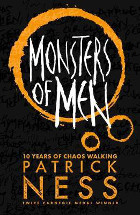
Monsters of men by Patrick Ness
Chaos walking, book 3. Walker Books, 2018. ISBN 9781406379181
(Age: 14+) Highly recommended. Winner Carnegie Medal 2011. Themes:
Dystopian fiction. Survival. Warfare. Stereotypes. "Three armies
march on New Prentisstown, each one intent on destroying the others.
Todd and Viola are caught in the middle, with no chance of escape.
As the battles commence, how can they hope to stop the fighting? How
can there ever be peace when they're so hopelessly outnumbered? And
if war makes monsters of men, what terrible choices await?"
(Publisher) Monsters of men brings to a close the stunning Chaos walking
series. Amid the warfare, violence and despair, Todd and Viola's
love for each other stands out as a beacon, and keeps the reader
hopeful of some type of resolution. There is also the glimmer of
hope for redemption and that not even monsters are wholly evil, even
the mayor Prentiss.
This is a tense, electrifying book that requires much resilience
from its reader and the conclusion is stunning. There is a book
trailer for the book on Patrick Ness' website,
where he also reads from Monsters of men and has a
conversation.
Pat Pledger
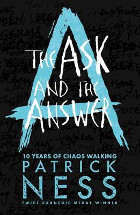
The ask and the answer by Patrick Ness
Chaos walking, book 2. Walker Books, 2009. ISBN 9781406379174
(Age: 14+) Highly recommended. After the relentless suspense and an
incredible cliff hanger ending in The knife of letting go, I
wasn't sure if the sequel could live up to that Guardian Children's
Fiction Prize winning book. However I was not disappointed! Ness has
written another wonderful book full of action and issues that made
me think long after I finished the book. Todd has taken the dying
Viola into Haven but it has been made into the stronghold of his
enemy Mayor Prentiss. Imprisoned, Todd is forced to fit into the new
order and carries out Prentiss' awful orders. Not knowing what has
happened to Viola, he follows directions, putting bands on the
Spackle who are herded into a labour camp. He also bands the women.
There are secrets, resistance movements and dire times for Todd and
Viola, who are separated but still care for each other.
I can't reveal too much except to say that the action is non-stop,
the dialogue is as fabulous as the first book and the theme of what
people will do in times of war and how they act under duress will
stay with me. The manipulation over people's minds by Mayor Prentiss
is described so vividly that I finished the book with a clearer
understanding of how a powerful personality can sway all before him. Chaos walking is an engrossing series and I can't wait for
the next instalment, after another cliffhanger ending.
Pat Pledger
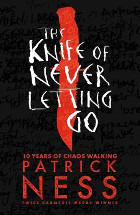
The knife of never letting go by Patrick Ness
Chaos walking, Book 1. Walker, 2008. Reprint. ISBN
9781406379167
(Age: 14+) Highly recommended. This is a stunning, unforgettable
book with a totally original plot that completely captures the
imagination of the reader. Todd Hewitt lives in Prentisstown, where
he is constantly battling against the jabber of The Noise. As a
result of a virus, everyone in Prentisstown can hear not only each
other's thoughts but those of animals. All the women and girls have
died so it is a male dominated society. When Todd finds a pool of
silence, he discovers to his amazement that it is a girl and he
cannot hear her thoughts. Pursued by Aaron, a religious zealot, and
the men of Prentisstown, Todd and Viola try to escape and the
resulting chase is fraught with danger and adventure.
The Noise is a wonderful ploy that pushes the action packed plot
along and brings alive the main characters. One of the most engaging
is Manchee, Todd's dog. Ness has managed to give an animal a really
credible voice. When Todd and Viola are being pursued, the thrill of
the chase is magnified by not only by being able to hear the noise
that the men make but their thoughts as well.
The story is much more than an exciting chase. Ness explores a
society where women are banned and a fundamentalist religion
dominates. Todd faces the moral dilemma of whether or not he can
kill a man and the ethics of murdering the Spackle, an indigenous
race, are examined.
Pat Pledger
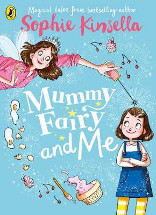
Mummy Fairy and me by Sophie Kinsella
Puffin, 2018. ISBN 9780141377889
(Age: 5-8) "Hello. I'm called Ella Brook... My mummy looks normal,
like any other mummy... but she's not. Because she can turn into
fairy."
Ella tells four stories about her life with her mother or "Mummy
Fairy" as she calls her.
Ella comes from a long line of fairies and knows that she too will
be a fairy in the future and practise magic herself.
Young Ella keeps an eye on mummy's magic because her spells can get
very confused resulting in bizarre and funny situations.
"Fixeridoo!" shows Mummy Fairy using a magical spell to skip the
queue at the supermarket checkout ensuing a food frenzy and in
"Cupcakeridoo!" magical cupcake-making results in kitchen chaos.
Mummy Fairy is up to date with modern technology and uses her
"Computawand" and apps to generate her magic.
Sophie Kinsella (real name Madeleine Wickham) is well known for her
chick-lit novels such as the Shopaholic series so this is a
change of direction for her.
A larger sized font is used and the text is peppered with many black
and white illustrations by Marta Kissi. The appealing blue and pink
cover shows Ella with Mummy Fairy in full fairy mode. The books ends
with games and activities as well as a recipe to make your own fairy
cakes.
This book will charm 5-8 year olds.
Jane Moore
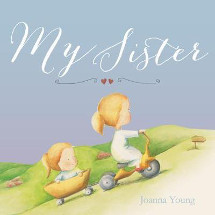
My sister by Joanna Young
New Frontier Press, 2018. ISBN 9781925594041
(Age: 3-5) Themes: Sisters. Family. Friendship. London based author
illustrator, Joanna Young, writes a lovingly conceived tale of
sisters, based on her own experiences growing up with a sister who
was very close. Deceptively simple warmly coloured illustrations
cover each page as the bold print outlines the relationship between
the two girls. They grow up together, sharing jokes and play time,
telling each other secrets and keeping them safe, keeping them up
when they are down, walking with them, being a close and supportive
sister.
The soft-edged illustrations complement the text on each page,
displaying what the sisters do for each other, underlining their
closeness and reciprocal delight in each other.
This would work well in a class where families are being discussed
as it shows the importance of closeness and support within a family.
Children will be able to reflect on the relationships within their
own families and see them as part of the wider emphasis on how each
member of family has a role in supporting each other.
Fran Knight
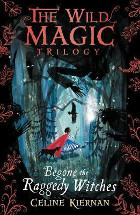
Begone the raggedy witches by Celine Kiernan
The wild magic Trilogy: Book 1 Walker Books, 2018. ISBN
9781406366020
(Age: 10-14) Highly recommended. Themes: Fantasy. Witches. Good and
evil. Strong female character. On their way home from the hospital,
where Mup's great aunt lies dying, Mup sees the raggedy witches
flying along, leaping from tree to tree and following their car.
When they fail to persuade Mup's Mam to go with them, they kidnap
her father and the family is forced to try and rescue him. On the
other side of the border the land is strange and Mam is powerful and
strong. Mup realises that she too has witch's powers and is caught
up in the struggle of the land between the evil Queen and those who
oppose her.
Lyrical prose and wonderful characters made this a story that is
hard to put down. The world of the witches is described in detail,
and the magic that happens there is unique, frightening and
fascinating. There are people who can turn into birds, Mup's little
brother is turned into a dog who speaks so that he can keep up on
their swift journey and Crow the boy that Mup befriends is a raven
who must talk in rhyme.
Mup is an outstanding character, thoughtful, caring and brave, and
her courage and moral conviction about good and evil, shines out in
the book. As well as many exciting adventures that drag the reader
along at break-neck speed, there are dilemmas too that must be
considered by the reader. Did Aunty make the right decision in
keeping her niece away from the land where she had magical skills
and could have been a good leader? Should Crow's mother been more
loving and caring? Should people stand up against a tyrannical
leader?
This is an exciting and compelling read that will appeal to all
lovers of fantasy. It was so original and interesting that I
finished it in one sitting and look forward to the next in the
series.
Pat Pledger
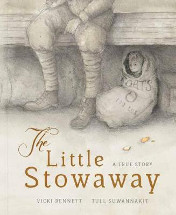
The little stowaway by Vicki Bennett and Tully Suwannakit
Scholastic Press, 2018. ISBN 9781742993072
Highly recommended. Themes: War. This is a touching story about the
human spirit.
It is a well written story that can be used to talk about the
subject of war and that good things can come out of war.
Honore is lost in the snow, hungry and cold. He finds the Australian
flying Corps and this changes his life for the better.
The illustrations in this book are tied well with historical photos
which highlights the true story in this book, and what one man did
to change the life of a child forever. This book highlights the
human spirit and courage.
This book is an easy to read story about war that can engage readers
of a wide range of ages.
I highly recommend this book.
Karen Colliver
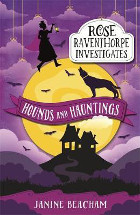
Rose Raventhorpe investigates: Hounds and hauntings by Janine Beacham
Little Brown Books for Children, 2018. ISBN 9781510201323
(Age: 9+) Recommended. Themes: Detectives. Criminal investigation.
Secret societies. A huge ghost dog wanders the streets of Yorke
frightening the superstitious townsfolk. Is Barghest the
sharp-toothed, red-eyed hound responsible for the death of young
Moll a pickpocket in Mad Meg Lane? It's time for young Rose
Raventhorpe, her friend Orpheus, and Heddsworth, Rose's butler, to
investigate a new crime and find the culprit.
After an early morning fencing practice on top of the city wall, the
trio head towards a new chocolate emporium. On the way they discover
the crime scene and Rose quietly starts to look at the surroundings
for clues the police have missed. Authoress Miss Wildcliffe and her
large dog Wolf also happen upon the scene and become falsely accused
of the crime. Rose, Orpheus and the secret society of Silvercrest
Butlers begin their own investigation as the police try to convince
everyone Miss Wildcliffe's dog is to blame. As the action moves
through the city there are confrontations, consequences for actions
and plenty of drama throughout. The children take on the Lord
Mayor's Wakemen who patrol the town bullying and threatening those
who stand in their way. With Rose's parents away, she is able to
explore the Victorian city, the alleyways, visit Miss Wildcliffe's
home on the moors and gather the vital information needed to solve
the mystery.
Janine Beacham's third novel in the Rose Raventhorpe
investigates series is filled with the colourful characters,
atmospheric settings and action-filled scenes that keep the reader
wanting more. Hounds and hauntings is a great novel to add
to the popular genre of historical mysteries.
Rhyllis Bignell
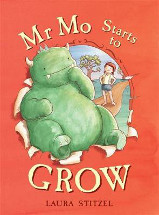
Mr Mo starts to grow by Laura Stitzel
Lothian, 2018. ISBN 9780734417718
(Age: 4+) Themes: Humour. Monsters. Growing up. Friendship. Change.
Toys. Jane and her squishy soft toy, Mr Mo, do everything together.
They play together and run outside, take risks, make mischief, make
up songs, play a little magic, in fact spend all day long together.
That is until Mr Mo starts to grow. One day he notices that he has
become quite large, and so hides away. Jane looks everywhere for
him, in the lane, by the woods, under the bed, in the kitchen
cupboard, but he is very well hidden and very sad.
Children will instantly recognise the toy as he tries to hide,
calling out with glee, alerting Jane to his hiding place. The warm
illustrations show a variety of poses for the soft toy, endearing
the animal to the readers.
But one night during a thundery storm, Jane misses her soft toy. She
hears the door creak open and footsteps cross the room and head for
the space beneath her bed. She peers under her bed and finds Mr Mo,
shivering and quaking in fright. Jane is elated to see him and knows
just what to do to alleviate his fears, and they go on to make some
mischief, making sure they are always together.
This is an allegorical look at children growing up, of losing the
need for a soft toy to be with them when they go to bed or are
frightened. Many children will equate the story to some toy they had
in the past, now no longer around, or given to a younger sibling,
sitting in a cupboard or just thrown away.
But whatever happens that toy is always there, even if only in a
memory, ready to offer comfort when the child is frightened or in
need of a friend. The reading of the book will lead on to many
discussions about the role of toys in a child's life, and would be
an impetus for children bringing their soft toys in to develop a
display in the library.
Fran Knight
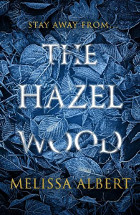
The Hazel Wood by Melissa Albert
Penguin, 2018. ISBN 9780141388663
(Age: 16+) Recommended. Themes: European Fairytales, Supernatural,
Fantasy, Young Adult. The Hazel Wood is a terrifying look at
Fairy tales that turns the happy ever after notion that is often
presented to readers on its head. With this book you are encouraged
to fear the fairy tale world and in the immortal words of Frank L.
Baum "you are not in Kansas anymore".
We follow 17-year-old Alice and her Mother through what appears to
be a relatively normal existence (well for them anyway) where they
are always on the move - it leaves the reader intrigued as to what
they are running from. Alice is the main protagonist and you feel
for her a few pages in. There is also a mysterious Grandmother who
has been writing a series of books regarding Hazel Wood which have
reached cult status.
It is beautifully written but haunting to the core. It left me both
wanting to put it away in the dark place it came from to wanting to
keep reading it - not a book I recommend reading on a dark windy
night that is for sure. It is truly mesmerising and so dark that it
won't be for everyone. Melissa Albert has perfectly written a story
for teenagers that will truly speak their language.
Alice's mother is stolen by a character from Hazel Wood and even
though she is warned not to come to Hazel Wood if Alice wants to see
her Mother again she must. I must admit that pace to start with is
slow and you are left wanting more to happen. But as you progress in
the story and encounter the characters that are not always to my
liking that the true genius of the writing comes to the fore.
Melissa Albert's world is twisted, and frightening and very, very
unnerving. It reminds me of Stephen King and Dean Koontz where what
makes their stories truly terrifying is the element of truth that is
present. I am a great lover of horror stories but this one left its
indelible mark on me and it one for older readers.
If you like books from Holly Black (Doll Bones) or Maggie
Stiefvater (Shiver series) then this is the book for you. The
conclusion was great and it could have finished the story there but
I am glad to say that there are more planned. I am hoping that they
are as dark and disturbing as this one. It certainly stays with you
for quite some time after the book is finished and put down.
Elaine Grottick
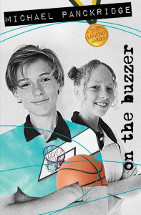
On the buzzer by Michael Panckridge
The legends series. Ford Street Publishing, 2018. ISBN
9781925272932
(Ages 9-12) Recommended. Themes: Basketball, Team competitions,
Sportsmanship. Michael Panckridge was inspired to write fast-paced
sporting books for reluctant readers. His popular The Legends
series has been republished with updated covers, ready to be enjoyed
by a new group of per-adolescent readers. Each book explores,
friendship, school life and is centred on a different sport with
fierce competition, rivalry and plenty of skills and tactics added.
At the end of the fifth round, the coveted football trophy
mysteriously disappeared from the Sandhurst School library. Friends
and team-mates, Bryce and Bubba are on the case, uncovering a secret
tunnel that connects their school to their rival's college. Former
team-mate Jack has moved house and school, he's now at Ascot; where
will his loyalty lie?
There are underhanded tactics, and the assistance of the boys' coach
Mrs Cartwright is less than stellar so Jack and his friends are
forced to develop their own game-lay techniques as they learn to
rely on each other. Lucy, Beck, Jack, Bryce and Bubba enjoy being
friends even undertaking scary trips under the school to solve the
trophy's disappearance. They work well together against the bullies,
balancing schoolwork, family life and honing their basketball
skills. The girls' team respond well to their coaching, however
there is something very fishy about the boys' coach, why is she
sabotaging their efforts? On the buzzer is an exciting easy-read novel just right for
sporting fans. Basketball stats, competition ladders, progress
scores and a quiz add to the excitement of reading the sixth book in
The Legends series.
Rhyllis Bignell