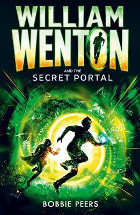
William Wenton and the Secret Portal by Bobbie Peers
Walker, 2018. ISBN 9781406371710
(Age: 9-12) Themes: Science Fiction, Adventures, Codes and
ciphers, Secrecy. Norwegian film director Bobbie Peers' "William
Wenton and the Secret Portal", the second novel is darker and
slower-paced than "William
Wenton and the luridium thief". He takes us back to familiar
surroundings at a more hostile and locked in Institute for
Post-Human Research. William's body is filled with a metallic
substance, 49% liridium which enables him to solve the world's most
difficult puzzles. There are evil forces at play, and a mysterious
women with a mechanical hand who needs William's powers to open a
special cryptoportal in the Himalayas.
When William appears on television ready for a competition to solve
The Difficulty puzzle, he suddenly experiences a powerful seizure
and is unable to continue. Sent home, he is crushed by his loss.
When his grandfather, a master cryptographer, collects him and
deposits him at the Institute, only to leave again, William's
worries continue. The Institute has changed dramatically, more like
a jail than a vibrant research facility. His room is a prison, with
steel bars on the windows and he must be accompanied everywhere by a
porter-bot. Guard-bots carry passivators to stop William from
searching the buildings and grounds for clues to his illness and
reasons for the changes at the now hostile environment. Even his
friend Iscia now a field assistant has altered; she even works with
his enemy Freddy.
When the mysterious woman appears in his room and tries to kidnap
William, he determines to find answers. Stealthy forays into the
basement where he discovers a mysterious man encased in a steel slab
and into the gardens to a secret underground space leave William
with more questions than answers. With Ischia's help and Freddy's
interference William sets consequences in motion when he handles a
powerful orb that destroys many artefacts stored in The Depository.
His actions open a cryptoportal in the Himalayas allowing for the
evil woman Cornelia Strangler to steal an entire cryonic storage
unit. Can William save the earth from the return of vast quantities
of luridium that will infect all human and destroy life on Earth?
Bobbie Peer's second science-fiction novel has a darker quality to
the plot and setting that makes it difficult at times to make sense
of William's struggles and his decisions. His sense of loneliness
and constant struggles are confronting, more darkness than
lightness. More code-breaking and cyphers would have helped as well.
"William Wenton and the Secret Portal" is suitable for readers who
enjoy futuristic fiction filled with gadgetry and alternate forms of
travel.
Rhyllis Bignell
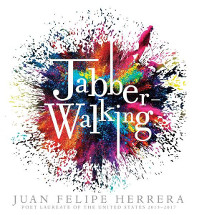
Jabberwalking by Juan Felipe Herrera
Candlewick, 2018. ISBN 9781536201406
"Can you walk and talk at the same time? How about Jabberwalk? Can
you write and draw and walk and journal all at the same time? If
not, you're in luck: exuberant, blue-cheesy cilantro man Juan Felipe
Herrera, Poet Laureate of the United States, is here to teach you
everything he knows about being a real-life, bonified, Jabberwalking
poet!
Jabberwalkers write and speak for themselves and others no matter
where their feet may take them - to Jabberwalk is to be a poet on
the move. And there's no stopping once you're a Jabberwalker,
writing fast, fast, fast, scribble-poem-burbles-on-the-run. Scribble
what you see! Scribble what you hear! It's all out there - vamonos!"
(Publisher)
Juan Felipe Herrera is the first Mexican-American Poet Laureate in
the USA. For people that like poetry and nonsense words, then
this book is for you. It is part story, part handbook and
packed with nonsensical words and phrases - which loosely reminded
me of the made up words featured in Roald Dahl books. It
allows readers to see that words can be written down anywhere - they
can be completely random and interesting at the same time.
Lessons learnt could include listening, expressing and tailoring
one's ideas and thoughts about writing. An interesting read.
Kathryn Schumacher
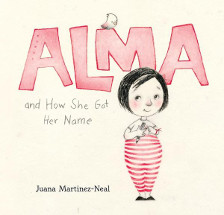
Alma and how she got her name by Juana Martinez-Neal
Candlewick Press, 2018. ISBN 9780763693558
(Age: 4+) Highly recommended. Alma is a little girl who believes her name is far too
long, until the day her dad explains to her where her name came
from. She then realized that her name had meaning and that each bit
of it did fit her just right. In the end she worked out that her
name was perfect.
The story talks about each of her individual names and where they
came from and what was important about that particular person and
which of these traits Alma has inherited.
She then learns that Alma was chosen just for her and she is the
first person in the family to have that name and she can now make
her own story to go with her name.
The illustrations in this book tie in perfectly with the story that
is being told.
I would highly recommend this book for 4+.
Karen Colliver
Waves by Donna Rawlins
Ill. by Heather Potter and Mark Jackson. Black Dog Books, 2018. ISBN
9781925381641
(Age: 4+) Highly recommended. Themes: Migration, Australian history,
Refugees, Convicts, Boat people. A thought provoking overview of the
waves of immigration which make up this country, is told by an award
winning storyteller in a way that is informative, attractive and
emotional.
When doing research prior to reading this book, I looked up My
Place, Donna Rawlins' and Nadia Wheatley's book, a book
republished many times since 1987 holding a revered place within
libraries and on readers' bookshelves around Australia.
Now thirty years later a book with a similar theme, about who we are
as Australians, is presented by Rawlins.
Divided into fifteen stories, each double page tells the tale of one
child coming to Australia to live. Each of their stories is
representative of one of the waves of people making their way to our
shores on often dangerous seas.
The first group, shows an Aboriginal child on a raft 50,000 years
ago. Becoming separated he eventually sees a line of green on the
horizon. Next a child is on a ship searching for a rich cargo to
take back to Europe which thunders upon a reef, and then a child
comes south on a perahu searching with his family for trepang.
The second group takes in those people who came after 1788, when
Australia became a British colony. We see a child huddled with his
family, leaving England for the colony to make his fortune, then
another child, arrested for theft, finds her way onto a prison ship
bound for hell. Each story aches with emotion, as the child leaves
the familiar to set out for Australia. Being blown off course, being
wrecked on the western coast, sent as a convict, finding work or
searching for a prized delicacy, each story is different and reveals
part of our history in an easily digested format.
From the convict lass, we move on to a third group, those who
arrived in the nineteenth century. We read of people on an assisted
passage, then a Chinese child coming out to work on the Victorian
goldfields, an Afghan boy with his camel, ready to explore, a girl
on a ship where measles has broken out, orphan boys sent out to help
build the empire.
A fourth group, those who arrived after World War Two begins with a
group of Jewish orphans, then a family of Italian migrants, and an
English family.
Between the seventies and now, is a fifth group, those who have
arrived in the most desperate of circumstances, fleeing their homes
in Vietnam and the Middle East because of war.
Each page is full of information, giving a background to the lives
of the children and their circumstances, filling in the reasons for
their arrival here.
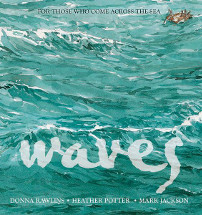
Each page has soft edged gouache paintings with a predominance of
blue as if underscoring the 'how' these children arrived, and each
child is given a name, a name by which readers can identify each
wave of immigration.
The diversity that is Australia is given a breathe of life for
younger readers in tis excellent book, and I can imagine its being
widely used and read.
Check out Walker's site
for more information about the book and Donna Rawlins, with a link
to teacher
notes.
The marvelous endpapers show the form of transport each child used,
and a timeline of when these groups arrived on these shores. This is
a wonderful read for any age.
Fran Knight
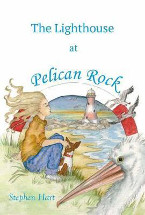
The Lighthouse at Pelican Rock by Stephen Hart
Christmas Press, 2018. ISBN 9780994528056
(Age: 11+) Recommended. "After 12-year-old Megan Evans almost dies,
she is packed off to the tiny, remote coastal village of Pelican
Rock to recover. Sure she is going to be bored in a place which
doesn't even have the internet, she discovers there is much more to
Pelican Rock that she expected. Are the pelicans really magic? What
is the secret of the ruined lighthouse? Has she found the place
where she belongs? And, perhaps, not just a place..." (Publisher)
This book really intrigued me. I am not usually a fan of time travel
but this book was certainly a winner. Hart has cleverly woven the
past with the present and allows Megan to move effortlessly between
the two worlds. She develops a beautiful relationship with her aunt
and finally finds the love that she has craved. Megan connects with
a number of characters in the small town, all for various reasons.
This allows her to make strong connections to the town and its
goings on. Themes such as friendship, family dynamics and mystery
are delved into. There are lots of smaller story lines that are
interwoven in the story and it is intriguing to try and match them
all together. It certainly kept me turning the pages. I would
recommend this book for children 11 and up as some of the storyline
can be quite complex. A welcome addition to the collection.
Kathryn Schumacher
Genesis by Brendan Riechs
Project Nemesis 2. Pan Macmillan, 2018. ISBN 9781509869992
(Age: 13+) Recommended. Genesis is a whirlwind of a story full of
thrilling experiences and mind boggling scenarios that will have you
questioning your own existence. It's the sequel to Riechs' first
book Nemesis, which was equally amazing, and is able to keep
you up till 3am reading. It follows Min, a feisty girl who stands up
for what she believes in, and Noah, a natural born leader who's
grown from the spineless character he was in book one. Together they
fight in a struggle to survive against their year level's cohort -
the only people left 'alive', trapped in an unground computer on an
apocalyptic earth.
The plots dives into themes of not only mystery but relationships as
the characters deal with the emotional stress of love and hate. This
story is a scary possibility, mashing Hunger Games and Lord
of the Flies with astounding technology to surprise you with
every chapter.
Riechs goes into incredible detail making you almost forget it's
fiction and thankful to be in the safety of your own bed. Genesis
is a stirring read that you won't regret and I can't wait to see
what's in store for this series.
Grace S. (Student)
Lady Mary by Lucy Worsley
Bloomsbury, 2018. ISBN 9781408869444
(Age: 13+) Recommended. "By turns thrilling, dramatic and touching,
this is the story of Henry the Eighth and Catherine of Aragon's
divorce as you've never heard it before - from the eyes of their
daughter, Princess Mary.
More than anything Mary just wants her family to stay together; for
her mother and her father - and for her - to all be in the same
place at once. But when her father announces that his marriage to
her mother was void and by turns that Mary doesn't really count as
his child, she realises things will never be as she hoped.
Things only get worse when her father marries again. Separated from
her mother and forced to work as a servant for her new sister, Mary
must dig deep to find the strength to stand up against those who
wish to bring her down. Despite what anyone says, she will always be
a princess. She has the blood of a princess and she is ready to
fight for what is rightfully hers." (Publisher)
I have read a number of historical fiction based on these times -
adult, YA and the younger reader. I thoroughly loved this book and
it allowed me to further develop my knowledge about Princess Mary.
It is cleverly written from the child's perspective and Worsley does
an excellent job of allowing the reader to empathise with the strong
lead character as she moves from a young lonely girl to a determined
young lady, determined to return to court and reclaim her crown.
Themes such as determination, isolation, the desire to be loved,
persistence and acceptance. I think this certainly fits into the YA
category as it touches on virginity and bastards and at times the
content is a tad too old for the older students in a primary school.
I would recommend it to children from 13 and up who are historical
fiction readers and who will love this book.
Kathryn Schumacher
Miniwings - Firestorm's musical muck-up by Sally Sutton
Scholastic New Zealand Limited, 2018. ISBN 9781775434863
(Age: 7+) Imagine having six gorgeous little winged toy horses that
come to life when the adults aren't looking! Firestorm is the hero -
or chief troublemaker - in this fourth book in the series.
Clara and Sophia are preparing for their performance in the school
orchestra, but those sneaky little Miniwings stow away in their
instrument cases. Surely, they won't press the fire alarm . . .
This is a delightful series by Sally Sutton that is a must read for
fans of the Ella Diaries and Go Girl. Each Miniwings
has its own adventure. It will appeal to girls who are challenging
themselves with reading chapter books. The storyline is simple and
easy to follow, allowing even the reluctant reader to be successful
tracking the text and being able to understand the plot. The print
is relatively large and the gorgeous illustrations throughout the
book will be a hit with the girliest of girls. This book would be
suitable for readers aged 7 and up.
Kathryn Schumacher
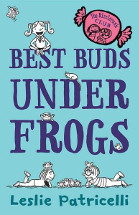
Best buds under frogs by Leslie Patricelli
Candlewick Press, 2018. ISBN 9780763651046
(Age: 10+)Recommended. "For Lily, it's the worst first day of school ever. Who
would want to be friends with the new girl, whose debut act is to
throw up on the playground (on somebody's shoes!)? Fortunately,
quirky Darby comes to the rescue. Darby likes frogs and candy and
oddball stuff, and soon she and Lily have formed their own club -
the Rizzlerunk Club. But before you can say "BFF," Darby's former
best friend, mean-spirited Jill - who had moved to London - returns
unexpectedly. Can Lily and Darby's friendship survive the British
invasion? Peppered with charming illustrations and hilarious mishaps
involving "conjoined" frogs, accidentally shaved eyebrows, and
school pranks gone awry, this engaging tale of fourth-grade life
will have readers wishing they could join the Rizzlerunk Club for
real." (Publisher)
I was pleasantly surprised by this book. I found it to be a
fantastic account of the challenges that children face, particularly
when moving to a new school. This is Patricelli's first novel and it
is sure to be a winner. The book would be suitable for students 10
years and up - although the text is relatively large and there are
gorgeous little illustrations throughout the story, the book does
contain some themes towards the end of the book that are suitable
for the older age. It touches on themes such as choices, peer
pressure, friendship and differences. It touches on exclusion of
others and has some powerful lessons for those that may be
experiencing the same issues. All in all, a heart-warming tale.
Kathryn Schumacher
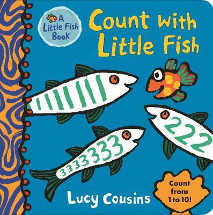
Count with little fish by Lucy Cousins
Walker Books, 2018. ISBN 9781406374193
(Age: 2+) Highly recommended. Board book. This is a colorful
counting book that has both the numerals and the number word and a
little rhyme to go with each number.
This is a fun counting book from 1 to 10.
The bright colors engage the reader and the slightly tactile
pictures of the fish make it fun to find them on the page.
The numerals are nice and big to be able to trace over with small
fingers.
I highly recommend this book for 2+
Karen Colliver
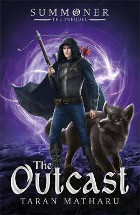
The outcast by Taran Matharu
Summoner series: the prequel. Hachette, 2018. ISBN
9781444939095
Recommended. The outcast instantly had me hooked, taking me
through parallels between Fletcher and Arcturus virtually from the
beginning. It explained and fleshed out most of what fans of the Summoner
series already knew, while throwing in exciting twists and turns.
The foreshadowing for the rest of the series was perfectly paced.
The events didn't seem forced and made sense in the story. As a
prequel, it is intriguing to see the character development it brings
to the series, and makes you want to read the whole series again
with the new information in mind, with new eyes. I wouldn't mind
doing exactly that.
The Summoner series is reminiscent of the Ranger's
Apprentice series, of which I am a fan. In fact, I enjoy
almost all fantasy novels, with some notable failures. Anyway, as an
avid fantasy fan, and a lover of dragons, I appreciate the way the
demons are described, the unique way they act. They don't feel like
mere pets, but exotic demon companions. The rarer demons that I've
never heard of have prompted me to research more exotic demons, and
I've found many that are a great fit with my own story writing. The
outcast brought its own unique touch to the fantasy genre,
with etching, summoning levels and infusion.
Overall, it's a fantastic read. I would recommend it to all fantasy,
video game and general novel lovers.
Rachel Bauer (Year 11 student)
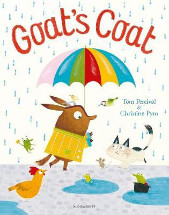
Goat's coat by Tom Percival
Ill. by Christine Pym. Bloomsbury, 2018. ISBN 9781408881019
(Age: 3-6) Themes: Goats. Coats. Helpfulness. 'Let me tell you the
tale of Alfonzo the goat, who was terribly proud of his lovely new
coat.'
Tom Percival's charming rhyming story begins with a rather proud
goat Alfonzo, admiring his handsome coat with glass buttons. He
enjoys the comments of others as they admire his new piece of
clothing and skips and prances out of town. This little goat has a
caring heart as he meets different creatures who need his help, he's
willing to assist them. With a little creativity the homeless frog
family sail away in a blue boat made from his coat cuffs.
A trembling pale cat with a sore tail, is also helped. Alonzo's uses
the hem of his not so beautiful coat to comfort and bandage the
wounded animal. After clip-clopping through the woods whistling a
happy tune, Alonzo then helps rescue a little chick. As the weather
turns to snow, the young goat solves more problems with parts of his
coat, until there only a few threads left. Lost in a blizzard, he's
forced to shelter under a boulder, until all his new friends arrive
to assist him.
Tom Percival's delightful story celebrates the generosity of spirit,
the joy of sharing and thinking of others before yourself. Christine
Pym's whimsical watercolour, gouache and pencil illustrations bring
the characters to life. Her delightful forest scenes combine natural
shadings of green and brown backdrops with bold brushstroke leaves.
Preschoolers will enjoy watching Alonzo's bold yellow and green
check coat disappear and become repurposed. Goat's coat is
just right to share with a young audience and they will enjoy
discussing Alonzo's creative problem solving and commenting on his
helpful character.
Rhyllis Bignell
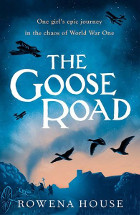
The Goose Road by Rowena House
Walker Books, 2018. ISBN 9781406371673
(Age: 12 and up) Highly recommended. "France 1916. Angelique Lacroix
is haymaking when the postman delivers the news: her father is dead,
killed on a distant battlefield. She makes herself a promise: the
farm will remain exactly the same until her beloved older brother
comes home from the Front. "I think of it like a magical spell. If I
can stop time, if nothing ever changes, then maybe he won't change
either." But a storm ruins the harvest, her mother falls ill and
then the requisition appears... In a last-ditch attempt to save
the farm from bankruptcy, Angelique embarks on a journey across
France with her brother's flock of magnificent Toulouse geese."
Publisher
It does not take a lot to convince me to read any novel about World
War 1 and this was no exception. I found it really hard to put down.
House did a fantastic job in developing Angelique and I found myself
turning each page hoping only the best for her. As she begins to
unravel more and more secrets about her abusive father, the girl is
torn between hatred for him and a sense of guilt that he did not
survive the war. Set in France in 1916, fourteen year old Angelique
takes it upon herself to save the family farm for the long awaited
return of her brother who is serving in the army.
The reader is drawn into the atrocities of war and the guilt felt by
so many who were not actually away fighting, as well as the hardships
and hunger faced by so many and the different roles that people had
to take on. Disaster after disaster strikes including the
requisition of animals, gossip, unpaid gambling debts and the
breakdown of her mother all contribute to a difficult journey
experienced by Angelique. Themes such as hardship, anger,
determination, resilience and friendship are discovered throughout
the story. A must have to add to the library collection.
Kathryn Schumacher
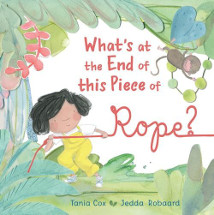
What's at the end of this piece of rope? by Tania Cox
Ill. by Jedda Robaard. Hachette, 2018. ISBN 9780734418012
(Age: 2-6) Themes: Problem solving. Collaboration. Co-operation. In
What's at the end of this piece of rope? Tania Cox uses this
simple repeated refrain in her enjoyable and engaging picture book.
She explores the concepts of working together and cooperation. Young
children will enjoy repeating the question, predicting which animal
will help and what is at the end of this rope.
A little girl's imagination creates a lush green jungle where her
animal toys come to life and a little thread becomes a long, tight
rope that needs to be investigated. First a monkey steps up to help,
then a mother kangaroo pulls as well, next gorilla and then hippo
assists with a big heave. There's a scary surprise and a delightful
ending.
Jedda Robaard's enchanting pastel watercolour and pencil scenes are
playful and imaginative, helping create the cumulative journey and
building the excitement of the reveal. Even the front cover with the
raised sections is a tactile entry into the book. Tania Cox's easy
to read story shows key concepts suitable for preschool and
child-care children. Read aloud and discuss the reasons for
collaborating and helping others, spend time making predictions and
wondering, even using manners by saying please and thank you is
shown. With colourful large and small size text, fun placement and
expressive sounds as they pull, humph and heave, this is a
delightful story just right for viewing and sharing.
Rhyllis Bignell
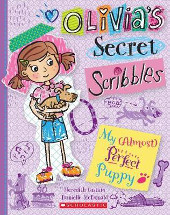
My (almost) perfect puppy by Meredith Costain and Danielle McDonald
Olivia's secret scribbles. Scholastic, 2018. ISBN 9781760277079
(Age: 6-8) Recommended. Themes: Pets. Friendship. Therapy pets.
Diaries. Olivia likes to record important things in her Big Book of
Private Secrets. But they are not so secret... because we get to
read them! In this book, Ella's younger sister Olivia shares about
her friendship with her 'across the back fence' friend Matilda, her
struggles with her siblings (especially Ella), and all about her
not-so-perfect pet puppy, Bob. Bob gets into rubbish bins, is too
energetic and makes life very difficult when he visits Great-Nanna
Peggy in her home at Golden Gardens (a 'golden oldies' home). Bob
does eventually redeem himself, but not without first creating
havoc.
This book will be enjoyed by young female readers as Olivia branches
out on her own away from her sister Ella. This is an easy chapter
book with naive cartoon-style drawings (with pink highlights) and a
simple view of life and problems.
Recommended for readers aged 6-8.
Carolyn Hull