Big Sky Publishing, 2018. ISBN 9781925675344
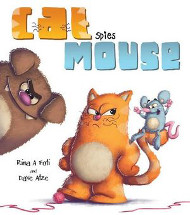
(Age: 4+) Highly recommended. Themes: Tolerance. Respect. "In this
picture book Cat spies Mouse is a fun and interactive story about an
arrogant and impatient cat who comes head-to-head with a humble and
patient mouse. Mouse, although small, is a game-changer who asks big
questions. With each of her thought-provoking questions, Mouse is
taking small but powerful steps to make the world a better place.
Fun and entertaining illustrations from Dave Atze provide additional
depth and cheeky humour to this simple story with a big message."
(Publisher)
This is a lovely story about a stuck-up cat and a humble mouse. It
has easy to read text. The book challenges norms; just because that
is the way thing have always been it does not mean that is the way
they should be or that is the way they are meant to be. Mouse is not
afraid to question the norms and ask why. Mouse is able to change
dog and cat's thinking about what is normal through asking
questions. This book fosters discussions about tolerance, acceptance
and respect. It also encourages children to ask question about the
world around them and how it works.
I highly recommend this book for 4+
Karen Colliver
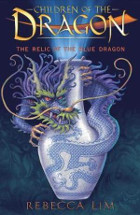
The relic of the blue dragon by Rebecca Lim
Children of the Dragon bk1, Allen & Unwin, 2018, ISBN
9781760297367
(Ages: 9-12) Themes: Dragons. Magic. Thirteen-year-old Harley
Spark's decision to take an old Chinese vase left outside the
neighbouring auction house is life-changing, the catalyst for magic,
mystery and fast-paced adventure. His ordinary safe life with mum
Delia, a Chinese Australian whose ancestors came over for the Gold
Rush is about to change. Harley's father Ray Spark left the family
when he was five because of his international business interests
linked to criminal activities.
When Delia smashes the vase to release it from Harley's frozen
grasp, Qing, a Chinese girl, is awakened and a feud that crosses
continents and centuries is reignited. Delia's smattering of Chinese
helps them communicate with Qing and they begin to understand her
desperate need to find her lost sisters. A midnight foray to the
State Library and a stolen nineteenth century Chinese-English
phrasebook further assists in their communication with their visitor
who can shape-shift into a beautiful dragon. Harley soon realises
that they need his father's special skills, contacts and global
transportation to assist Qing.
Harley and Qing are quickly drawn into kung fu fights with evil
villains who desperately want the pieces of the rare Chinese vase.
Qing's quick-thinking powers, her own martial arts' skills and her
ability to summon lightning aid in their escape. Their travels take
them to Singapore in search of the second vase secured in a stately
mansion. Ingenuity, cunning and stealth are needed to find this
treasure. An epic fight ensues, more mystery creatures unleashed as
Ray begins to learn more about his father. Qing directs the next
phase of their journey, they need to travel on to the Wudang
Mountains to rescue her sisters and stop the evil Second Son of the
Second Dragon before he destroys their vases. The relic of the blue dragon is a fantastic, fast-paced action
venture, filled with Chinese myths, humour and family dramas.
Rebecca Lim's exciting infusion of her Chinese heritage and her
understanding of Ancient Chinese history, culture and mythology adds
to the excitement. Harley and Qing are given a large amount of
freedom, ably supported by Ray Spark and his associates. What an
incredible junior novel, perfect for readers who enjoy modern
fantasy adventures! What's next for Harley and Qing?
Rhyllis Bignell
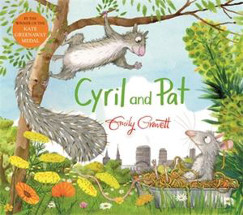
Cyril and Pat by Emily Gravett
Two Hoots Books (Macmillan), 2018. ISBN 9781509857272
(Ages: 4+) Recommended. Themes: Animals. Squirrels. Friendship. I
love Kate Greenaway award winner, Emily Gravett's look at the world.
Old hat (2018) shows a variance of the expression old hat as
Harbert tries to please his friends not himself, while Again!
(2016) had me in stitches with the child asking for the story to be
read over and over again. Her perspective on life is delightful,
drawing in the readers to a new way of looking.
And Cyril and Pat is no exception. Cyril is the only
squirrel in Lake Park, and is lonely. That is until he meets Pat.
Readers will quickly see that Cyril and Pat are not the same sort of
animal, and will be delighted as the story progresses, other animals
trying to tell Cyril of his mistake. But they do everything
together: riding the skateboard, frightening the pigeons, hide and
seek under the coffee cups littering the park, until one day a child
tells his Mum about the rat. Cyril is dismayed and all the other
animals reiterate that he should not be friends with a dirty,
thieving rat. Cyril is alone and his games are not as interesting
any more. One day he is chased by Slim the dog. He is chased out of
the park, across the road and into the dark alleyway. Here the dog
taunts him, but looking up sees that Pat has returned with a horde
of his relatives. The situation is saved and Pat and Cyril resume
their strong friendship in the park.
A delightful read aloud, Cyril and Pat has a lot to say about
appearance and advice from friends, a big issue amongst smaller
people. The funny book will led to many discussions about friendship
and what makes a good friend and why we are hampered by thinking
about appearance.
Many books offer a similar theme, but few with the humour and fun of
Cyril and Pat.
Fran Knight
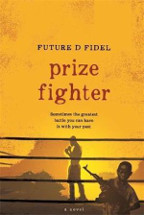
Prize fighter, a novel by Future D. Fidel
Hachette, 2018. ISBN 9780733639050
(Age: 16+) Highly recommended. The first two 'Acts' of this book
include the most shocking things I have read for a while. Not that
the writing is graphic or extreme, the author avoids giving us
details, just as his protagonist wants to avoid the memories, but
the story of the depravity to which human beings can descend is
truly disturbing. Fidel writes about the forced conscription of
child soldiers by Congolese rebels on the rampage, forcing them to
rape, hatchet and kill even family and friends. Isa is only in grade
4 when he sees his parents and his sister killed; he and his elder
brother Moise become weapons for the rebels, their mission is to
kill everyone under the age of eight and over fifteen, and they have
to recruit others into the same brutality. In a moment of
desperation Moise urges Isa to run, and Isa does, not knowing whether
the gunshots he hears have taken his brother's life.
Travelling alone across country Isa ends up yet another child beggar
on the streets of Nairobi. But a good deed sees him rescued by a
kindly old woman, who helps him register with the United Nations as
a refugee.
Eventually Isa is accepted for settlement in Australia, but that is
not the end of his loneliness and torment. The boxing skills he
learnt from his brother, see him gain notoriety in the boxing ring,
but he has to learn how to restrain the violence that remains within
him, violence that continues to threaten his relationships with
others.
Whilst Fidel's novel is not autobiographical it is obviously based
on first-hand knowledge of the horrors of the Congolese civil war.
In an ABC
podcast, available online, he tells of how he was orphaned as
a child and escaped as a stowaway to Tanzania, then after 8 years in
a camp, he was accepted as a refugee to Australia. In Australia he
has become active in the arts, supporting others from refugee
backgrounds. Prize fighter started as a stage play and now is
presented as a novel. Prize fighter rings with authenticity and is a gripping tale of one
child's survival through the worst horrors, and his struggle as an
adult to break free from memories and make a new life. We can only
hope that other refugees are able to achieve the same thing.
Helen Eddy
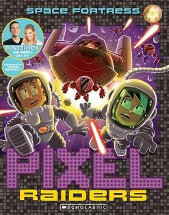
Pixel raiders: Space fortress by Bu Bajo and Hex
Ill. by Chris Kennett. Pixel Raiders book 4. Scholastic
Australia, 2018. ISBN 9781760275686
(Age: 8+) Recommended. Read book 1, 2 and 3 before number 4. They
have ten challenges to complete each section. Each book has a
different section. Pixel raiders: Space fortress is a book that
the main characters have to complete challenges to survive, and they
battle all types of aliens. The main characters are Rip and Mei.
They have to defeat megalave so they can go home to the real world.
They start in a space ship, then they have to use the ship in some
parts of the books. The ship's called the Space Gum and is a cargo
ship that has gum as ammo for all the weapons that the ship has. Rip
and Mei make a friend that has already been stuck in the game and he
remembers what it was like in the real world. Every thousand points
they level up.
The book keeps you interested as each objective is different but
builds on from the one before.
The illustrations in the book are really cool. I liked the way the
top of each page looks like a computer game screen.
I highly recommend this book to readers 8+
Heath Colliver, Year 7 student
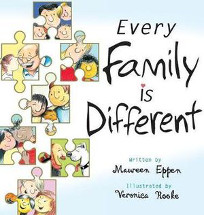
Every family is different by Maureen Eppen
Ill. by Veronica Rooke. Serenity Press, 2018. ISBN 9780648230465
(Age: 4+) Highly recommended. Themes: Families. Difference. "Who's
in your family? Some children live with their mum and dad, others
live with their grandparents or foster parents. Some live in a big
house, others live in a tiny apartment. With captivating
illustrations, Every family is different celebrates what it
means to be part of a family, and reminds us that there's something
that's always the same in every family." (Publisher)
This picture book talks about the differences between families and
that every family is different but that is ok. It is written in a
very positive manner. The illustrations in this book work well with
the text. The illustrations are bold and they help make this book a
good book to use with young children to start talking about the
different families people live in and that there is no one right
type of family.
I highly recommend this book for any family. A student
resource is available from the publisher.
Karen Colliver
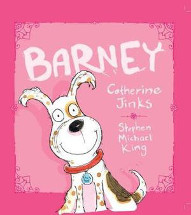
Barney by Catherine Jinks
Ill. Stephen Michael King, Scholastic, 2018. ISBN 9781742996226
(Ages: 3+) Highly recommended. Themes: Dogs. Family. Humour. Verse.
Cheeky Barney loves everything about the house. He loves the cat
food, the greens secretly pushed down to him under the table, bacon,
beans, biscuits, cake, candle and just about anything that can be
found in the kitchen. He loves bibs, especially the one around the
bay's neck, covered in squashed banana. He loves rice and peas
spread across the floor. He even loves chilli, although it makes him
sneeze.
A delightful rhyming story of Barney and his special place in the
family is revealed in this wonderful read aloud, encouraging
children to predict what word will rhyme with the end of the
previous line, while laughing at Barney's tastes. And the last
rhyme, begging a word that sounds like 'tea' will have all readers
and listeners sigh happily with the knowledge that every child is
the centre of a dog's attention within the family.
Family life is comfortingly displayed throughout the marvellous
illustrations by King. Family life from a dog's perspective consists
of legs of adults, children, things on the floor and under the
table. Barney spots food whenever it falls within his range, and
quickly scavenges it into his mouth. King shows an array of things
that families and particularly the children do, from walking the
dog, cycling, finding your way out of a maze, a family bbq, cooking,
watching TV and playing in the garden. The whole wonderfully
reiterates family life, underlining the things a family does
together, supporting the theme of families for the readers.
Each page is full of household mayhem that a dog creates, filling
each page with details to look at and talk about, things that will
promote recollections of pets in their own homes and how they
affected the family.
This is a wonderfully warm and loving story of family life, sure to
intrigue all readers, especially those with a dog.
Fran Knight
The loyalty of chickens by Jenny Blackford
Pitt Street Poetry, 2017. ISBN 9781922080745
(Ages: 12+) Poetry.
Anyone who has had chickens knows the fickle loyalty of chickens,
how they will press around 'She Who Brings the Grain' whoever it may
be, and the challenge of stepping forward without crushing
'worshippers'. Blackford captures the scene perfectly in her poem
'The loyalty of chickens'. Other feathered dinosaur siblings also
feature in this book of poems - currawong, magpies, waterbirds, and
the breakfast visitor that steals the tomatoes. But birds are not
the only creatures that she describes so well, there are also the
tattered cat, the ninja cats, the One True Cat, and the total
control fur kid, the polar bear terrier, the lap dogs of Paris, and
the rat lodger in the walk-in robe.
Child readers will love 'A brief guide to Australian fauna' -
'koalas have no feathers; dolphins have no fur' etc - the images the
poem conjures would make a fun drawing, and could inspire further
inventive animal descriptions. Another fun example is the
multi-bottomed hoist centipede conjured from the washing on the
line.
Adults will find more serious reflections on the creeping dementia
of ageing parents, lost love, and the army of farm boys sent to war.
I loved 'Polenta memories' - a lunchtime meal offered to a handyman
draws out stories from his past in a displaced children's camp after
the war, finally coming to Australia, the 'golden dream of peace'.
Blackford has brought together an interesting collection of poems
that would appeal to many ages.
Helen Eddy
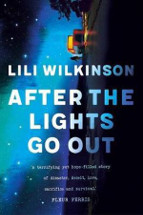
After the lights go out by Lili Wilkinson
Allen and Unwin, 2018. ISBN 9781760297299
(Ages: secondary) Highly recommended. Themes: Armageddon, Dystopian
novel, Preppers. When Pru rides into town, to see if others in the
small community of Jubilee have also lost their power, she does so
with trepidation. Dad is at work, a mine some ten hours drive away,
her two younger sisters are left alone at their house fifteen kms
from town, and they have all been drilled in their emergency
procedure, run to the bunker and lock themselves in.
She must get to Dad, and remembers an old restored Holden in a shed
and takes it to drive to the mine. With her is Mateo, sone of the
woman contracted to talk about mine safety. Pru must be cautious, he
keeps making cracks about preppers, and Pru is one. They find an
explosion has ripped much of the mine apart, and that NASA warned of
a solar storm which could knock out power. Pru knows this will lead
to an EMP (electromagnetic pulse) which will render anything
electronic useless. Stuck at the mine with fifteen or so wounded
men, Mateo and his mother, and no sign of her missing father, Pru
can only think of home where her two younger sisters wait for word,
while a young man wanting to get closer to Grace, is riding out
there.
Once in their bunker, the three sisters cycle each day to the town
to help, not telling anyone of the goods they have stockpiled. But
as each day passes, the moral imperative looms large for Pru as she
realises that their medicine would help, but her sisters refuse to
stray from their father's dictum, that family comes first.
Eventually discovered, Pru has a lot of ground to make up to regain
people's trust, and just when she appears to be redeeming herself,
her father reappears.
This is a riveting read, a page turning thriller which will satisfy
all readers. The idea of the prepper has added a variant to post
apocalyptic stories such as "Lord of the Flies". There is a facebook
page for Adelaide preppers, as well as lots of internet pages
selling equipment to those who think the end is nigh.
This book puts into perspective the moral choices that these people
will need to make, and on a wider front, the efforts of the west in
having access to resources denied the Third World.
I kept thinking about its implications along time after I closed the
book.
Fran Knight
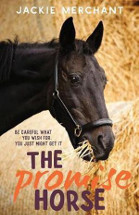
The promise horse by Jackie Merchant
Walker Books Australia, 2018. ISBN 9781760650568
(Age: 9+) Recommended. If you are a horse-lover you will relate to
the story of Harry. Evocative moments of a growing relationship
between a patient horse and a heart sore girl are shown as a
grieving family try to ford the emotions left by the death of
Harry's sister, Sissy.
Harry's mother is understandably not coping with the loss of her
daughter from leukaemia and her maternal guilt at her helplessness
is all-consuming. This protectiveness has been transferred to her
surviving daughter, as she struggles, sometimes aggressively, with
the promise she made.
Now they have moved back to the country where her parents grew up,
Harry is eager to own a horse, but the best they can do is borrow a
horse from the local horse trainer. Marksman is gentle and patient,
a temperament perfect for an inexperienced rider; but at over 15
hands high, he is huge! Harry might be exceptionally tall herself
and with her red hair and freckles is agonizingly self-conscious
about standing out. On Marksman she will sit higher than other
riders her age, so standing out will be even harder to avoid.
Hiding Sissy's voice chastising her and seeing the negativity and
fear from her mother, Harry constantly apologises to Marksman for
her own feelings of insecurity. With the help of Gran and Pa,
Marksman's rider, Lizzie Blackburn, and even the school bully, Billy
Johnston, Harry works hard to improve her riding skills so her
mother will allow her to participate in the gymkhana.
"The promise horse" is not just a story about the therapeutic affect
of animals, it is a cleverly blended story of two powerful emotions,
loss and insecurity, in both children and adults. It is an example
of the overwhelming challenges we may face and how we can overcome
our hardships in many different ways. The promise horse will leave a
radiating warmth in your heart.
Recommended to readers 9yrs+. And you might also like similar books
such as "The Thunderbolt Pony" by Stacy Gregg, "Dirt" by Denise
Orenstein and the series "Horses of the Dawn" by Kathryn Lasky.
Reviewed by Sharon Smith
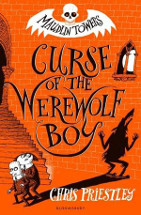
Maudlin Towers: Curse of the werewolf boy by Chris Priestley
Bloomsbury, 2017. ISBN 9781408873083
(Age: 8+) Highly recommended. Themes: Horror, Werewolves, Teachers,
Time travel. "Mildew and Sponge don't think much of Maudlin Towers,
the blackened, gloom-laden, gargoyle-infested monstrosity that is
their school. But when somebody steals the School Spoon and the
teachers threaten to cancel the Christmas holidays until the culprit
is found, our heroes must spring into action and solve the crime!
But what starts out as a classic bit of detectivating quickly
becomes weirder than they could have imagined. Who is the ghost in
the attic? What's their history teacher doing with a time machine?
And why do a crazy bunch of Vikings seem to think Mildew is a
werewolf?" (Publisher)
This is a well written story. When two young boys Mildew and Sponge
find themselves in a school for the not so bright in a gloomy part
of England with strange things happening around them they are forced
to investigate. The main characters are interesting and funny. They
manage to stumble onto a great number of events without meaning to
and see things that they don't understand at first. As the story
progresses you start to piece together all the happenings and how
they fit together. Mildew and Sponge draw you into the story and
keep you wondering what they will get up to next, and how they will
get out of some of the situations they get themselves into.
The boys find out what happens when they learn that there is a time
machine in the school and how time travel is not always what it's
cracked up to be.
I highly recommend this book to boys 8+.
Karen Colliver
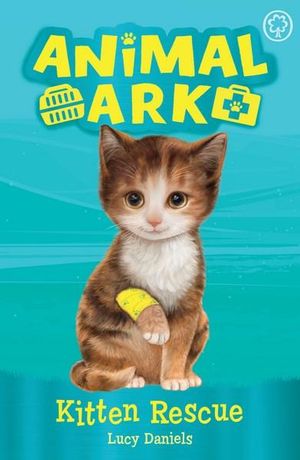
Animal Ark: Kitten Rescue by Lucy Daniels
Orchard Books, 2018. ISBN 9781408354148
(Age: 6+) Recommended. Amelia has just moved with her mum into
Welford and she doesn't know anyone except her gran, who they are
living with. Can she overcome her homesickness and help her new
friend Sam to save the kittens with a little help from others in the
village, who they meet throughout their search?
This is a great small book with big text. The pictures add a nice
element to the story, they are well designed and makes the story a
lot more interesting and visual.
I recommend this book for animal lovers just like Amelia and Sam,
age 6+. If you enjoy this book you will enjoy the others
in the series.
(Grace Colliver, Year 7 student)
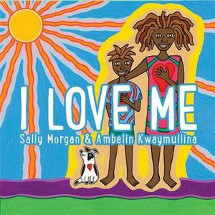
I love me by Sally Morgan and Ambelin Kwaymullina
Fremantle Press, 2018. ISBN 9781925591637
(Age: Pre-school) Highly recommended. Board book. Themes:
Individuality, Self-esteem. "I love the way my heart knows best. I
am me. Who else would I be? I love me! A celebration of
individuality and joyous self-esteem, in bouncy, rhythmic prose and
riotous colour". (Publisher)
This is a beautifully written and illustrated book. This book is
about loving yourself for being you. It is a lovely book to read
with small children to teach them that we should all love ourselves
just the way we are. It is important to love ourselves and this book
promotes positive self-esteem.
I highly recommend any parent to share this book with their
children.
Karen Colliver
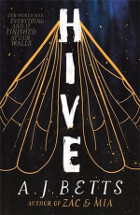
Hive by AJ Betts
Fremantle Press, 2018. ISBN 9781760556433
(Ages: Secondary) Highly recommended. Themes: Future. Dystopia.
Bees. Survival. The community is like a beehive, everyone has a
role, no one knows what outside is like, and they all worship God,
from whom water comes every day. The hierarchy is strict and a judge
and her council rule the three hundred occupants.
But one day Hayley sees a drip. She is afraid. Water only comes from
God and yet it is coming from the ceiling in the way between living
spaces, a place she is forbidden to enter unless a bee has escaped.
She is frightened, things in her world are not as assured as before,
she notices things. Chasing a bee, she runs into Geoffrey, one of
the uncles and he seems to die from the bee sting. Questions are
raised about the bees and their place within the community.
Told that God gathers the dead and takes them to heaven, she sees an
aunt butchered and thrown into the hub, the place their meat comes
from.
Her best friend Celia is about to be married, a cause for great
celebration within the community as it heralds another baby. Hayley
has befriended Luka, one of the netters who seems to question as she
does, and when Celia is refused marriage as her body has been
examined and found wanting, Hayley is put in her place, and she
chooses Luka as her bridegroom in the hope they can have three
nights of talking without interruption and work out what is going on
in the place they live. But someone else knows she is questioning
and rather than be deemed mad, he takes action to save her.
This is a riveting read of a place where people have taken refuge
after an event which has killed many. But their sanctuary has been
severely reduced and stories evolved to explain their survival,
stories which justify why they live in such a place, and why God is
merciful. But when someone questions, steps must be taken to remove
her. Not your usual post apocalypse story, Hive is a stunning read,
raising all sorts of issues about survival and the role of story in
keeping people compliant.
Amanda Betts is a well known Western Australian author, writer of
several of my favourite YA novels, Wavelength,
Zac
and Mia and Shutterspeed, all engrossing reads
with a totally different perspective on life for post millennials.
Fran Knight
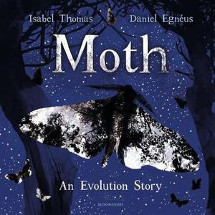
Moth by Isabel Thomas
Ill. by Daniel Egneus. Bloomsbury, 2018. ISBN 9781408889756
(Age: All) Highly recommended. Themes: Moths. Evolution. Adaptation.
Camouflage. STEM. Industrial Revolution. Survival. Pollution. Hope.
This amazing book shows within easily understood language supported
by the most powerful of illustrations, the ability of an insect to
adapt to the blight of man's impact upon the world. A small moth,
called a peppered moth because of its black and white speckled
appearance, lives near trees where it can hide amongst the patchy
lichen from its predators. During the Industrial Revolution,
factories spurted out coal dust, ash and soot, covering the trees
with black smoke. The peppered moth was no longer able to survive
because it had nowhere to hide, but the darker ones did survive,
and a shift in their numbers occurred, with more dark ones being
born, while lighter ones were rarely seen.
Children reading this book will easily absorb the ideas presented:
evolution, predators, camouflage, adaptation, Industrial Revolution,
pollution, while marveling at the ability of this small insect to
adapt to a rapid change in its environment.
Egneus' illustrations are wonderful, evoking the peace of the
environment in which the moths lived, showing them flitting amongst
the trees, taking shelter on the lichen covered trees, a hungry fox
or owl taking some for their meal. Contrast this with the blacks,
greys and browns of the same area covered with the detritus of the
Industrial Revolution. No reader can be in doubt about the effect
this change had on the moth population.
And within the text, the reader is told about how this little insect
adapted to that change, while the illustrations show the larger
number of black moths filling the pages.
When people realised what damage had been done, efforts were made to
clean up the environment, and so there are many more speckled winged
moths appearing - another change, this time signifying hope.
Isabel's words sing with truth, reflecting her background in
genetics and evolution at Oxford University, while Daniel's
illustrations display a confidence with illustrative techniques
which can be seen across a variety of fields.
Fran Knight