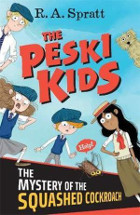
The mystery of the squashed cockroach by R. A. Spratt
The Peski Kids series. Penguin, 2018, ISBN 9780143788812
(Ages: 8-12) Recommended. Themes: Spies. Brothers and sisters.
Country life. Missing persons. When a gun-wielding masked woman
kicks in the front door, siblings Joe, Fin and April's lives change
dramatically. Their palaeontologist mother is missing, caught at an
Eastern European border crossing with a USB hidden inside the ulna
of a stegosaurus. Professor Maynard, their mother's boss needs to
quickly move the children to safety away from the clutches of the
evil Kolectiv hit team. There's no going back when the Professor
blows up their suburban house.
Their horticulturalist father who left the family when April was a
baby lives in a tiny country town called Currawong. The quirky
townsfolk are obsessed with cockroaches, holding the annual
cockroach race. Given a new surname, the Peski kids are left with a
father they don't know, a lifestyle unfamiliar to them and a town
filled with cockroach obsessed people.
After a disastrous first day of school, except for Joe's surprising
aptitude for lawn bowls, the children decide to try and fit in.
Searching for cockroaches to enter into the race, involves breaking
into a neighbour's house with the help of a teenage whirlwind
Loretta Viswanathan. When Loretta's expensive Madagascan cockroach
is found dead in its aquarium, the Peski kids set out to solve the
mystery. When the competitors for the annual race start dying off as
well, Joe, Fin and April accompanied by Pumpkin the ankle-biting dog
become detectives searching for clues. The mystery of the squashed cockroach captures the reader from the
prologue. Joe, April and Fin argue, bicker and generally get on each
other's nerves, however they pull together in times of crisis. Each
of their skills is needed to uncover the villain. Currawong's cast
of characters are unique and unusual adding humour to this
fast-paced adventure. R. A. Spratt's witty writing style and
fast-paced plot make this an exciting new series. Life will never be
the same, what adventures await in the next Peski Kids' adventure?
An exciting class novel for middle primary students.
Rhyllis Bignell
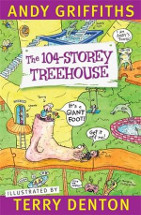
The 104-storey treehouse by Andy Griffiths
Ill. by Terry Denton. Pan Macmillan, 2018. ISBN 9781760554170
(Age: 6+) Highly recommended. Themes: Humour. Join Andy and Terry in
their wonderfully wild and wacky 104-storey
treehouse. Andy and Terry and friend Jill return for another wacky
adventure as they add another storey to their treehouse, making it
104 storeys tall and full of fantastical inventions and creatures.
The storey is introduced at the beginning of the book, with all its
wonderful inventions. A money making machine is sure to appeal to
all, except when Terry hits the wrong button and it turns into a
honey making machine, and the drawings of the trio climbing the
never ending staircase will have readers giggling. Poor Andy has a
terrible toothache and the different remedies to pull the tooth
suggested by Terry will resonate with young and old alike as they
recall losing a tooth. There are bears, joke writing pens and Mr Big
Nose who expects the latest book to be delivered on time.
As popular as the previous ones in the series, I had to wait in line
to read The 104-storey treehouse, as both grandchildren and
visitors to the house devoured it and had no trouble recounting the
plot lines in detail. The jokes at the bottom of the page were
funny, and often groan-worthy, and make a wonderful addition to a
family's joke repertoire.
This is sure to be a hit at home and in classrooms, with young and
old, and will be welcomed by all the creators' many fans.
Pat Pledger
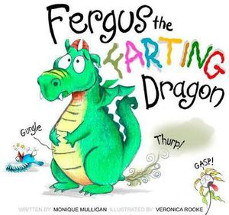
Fergus the farting dragon by Monique Mulligan
Ill. by Veronica Rooke. Serenity Press, 2017. ISBN 9780995410435
(Age: All) Highly recommended. Themes: Dragons. Similarity.
Stealing. Humour. "Fergus is different to other dragons. But when
people make fun of him, he has an ear-splitting, eye-watering,
toe-curling, stink-making response. He farts! When a cheeky knight
in a fire-proof suit steals a precious dragon egg, the other dragons
are at a loss. It's left to Fergus to get the egg back from the
thieving knight." (Publisher)
Fergus is a very unfortunate dragon. Because he can't breathe fire
like all of the other dragons, they tease him. Even though Fergus
can't breathe fire he is really good at farting. Fergus shows the
other dragon that being different is not always a bad thing. When
all of the other dragons fail to save the golden egg, Fergus is the
one who saves the day.
This book has a great message in it, that it is ok to be different.
Just because someone is different does not mean they are not as good
as everyone else.
I highly recommend this book. I think it will appeal to both
children and adults with the fart humour. Activities
to complement the book are available from the publisher.
Karen Colliver
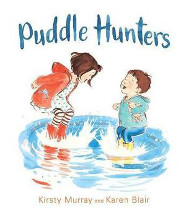
Puddle hunters by Kirsty Murray
Ill. by Karen Blair. Allen and Unwin, 2018. ISBN 9781760296742
(Age: 4+) Highly recommended. Themes: Rain. Puddles. Family. After a
rainy morning, the family goes out puddle hunting. The sky has
almost cleared as Ruby and Banjo find their boots and set off with
mum to find some puddles. There are no puddles to be found in their
garden as the flowers have soaked up all the rain. There are no
puddles on the glistening footpath and once in the park, they hunt
under bushes, beside the path and on the hillside, still without any
success. But walking over the bridge to the river flats they find
all the puddles they need.
Each of the children, sometimes together sometimes alone, jumps into
the puddles they find, making a splash, and squelching in the mud.
What fun!
Perth freelance illustrator, Karen Blair has impressed with her
wonderful illustrations. I loved Granny Gromet and me, all
of her pictures redolent of the great outdoors, reflect her
childhood on a farm.
Her illustrations for Puddle hunters are delicious, showing
two small children and a quick thinking mum taking their walk
through the puddles in the park. Full of movement, each picture
reflects the love and familiarity between the three as they do
something which in the end renders them all wet and muddy,
necessitating a bath when they get home.
This engrossing story will be fun to read aloud and act out. Its
repetition will engage, its movement both in the story and in the
illustrations on each page will delight all the readers, young and
old.
Fran Knight
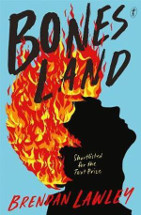
Bonesland by Brendan Lawley
Text Publishing, 2018. ISBN 9781925603583
(Age: 15+) Highly recommended. Explicit content. Shortlisted, The Text Prize, 2017. A multi-layered
coming of age story about family, mates, bullies and maybe hooking
up with the hot American exchange student. Set in country Victoria,
Banarang is a fictional town.
But it's not pretty when you live in it every day. If you don't
escape Banarang straight after Year Twelve, you've got two options -
you make a bunch of kids with your high-school girlfriend or you
smoke ice all day and start pub fights at night. There are plenty of
guys who manage to juggle both.
In the first chapter Bones demonstrates that Banarang is a short
commute to Melbourne. Bones is suffering from OCD, likely because
his mother left. Given his oversexed mates with whom he shares the
exact same urges, this inner monologue is hilarious. The boys don't
pull any punches and the misogynistic dialogue and euphemisms are
very explicit. But that's not the reason readers can't put it down.
Every character is capable of redemption - even Dad, the loser and
Shitty, the bully.
By contrast, Naya, the UNICEF "do-gooder" exchange student, seems to
have more going on in her top paddock, as does the Muslim girl,
Aaleyah. Despite his problems, Bones is soon fantasising about the
cosmopolitan yet altruistic Naya. Jimmy is a leader by virtue of his
confidence and cash but is intent on breaking into pop culture by
imitating African American rappers - doubtless, girls will be
offended by his lyrics. All the boys have problems, Leon is Gay and
Bones' brother Trav is tangled up with the town bully, yet the
friends tolerate Bones despite his nerdy obsessions. Tension builds
as Bones is targeted in and out of school. The coward's punch climax
is cathartic for Bones and his family.
"Bonesland" is the most consistently explicit YA title I've sampled;
but somehow the language isn't gratuitous because we all know these
Aussie males at the end of schooling, for whom the only meaningful
education they have garnered is both the best and worst of each
other. An eBook is available and Text Publishing link
to Lawley's playlist while you read a sample chapter.
Deborah Robins
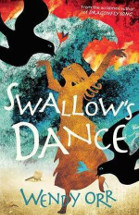
Swallow's Dance by Wendy Orr
Allen and Unwin, 2018. ISBN 9781760297879
(Age: 12+) Highly recommended. Themes: Disasters, Crete - History,
Survival, Ancient Civilisation. This is a very touching story about
one girl's inner strength, and how when faced with life-changing
problems she was able to overcome the odds to keep her family alive.
Leira who was born to be a priestess finds herself in a situation
that was beyond anything she could imagine.
Her home is hit by a huge earthquake that leaves everything she
knows in pieces, including her mother. She is forced to do what she
can to keep her mother alive while waiting for help. Leira then
finds that she needs to take charge and do something otherwise
neither of them will survive.
Leira is reunited with her father and brother who take her, her
mother and elderly nurse on their ship across the sea to the land
where her other brother lives. When they arrive they find things are
not as they seem. When Leira's father and brother set off on their
trading mission she is left to look after her injured mother and
elderly nurse.
Again another earthquake and again things change for Leira.
Throughout the story Leira learns that she is stronger than she ever
realized and she is able to survive against what the goddess can
throw at her.
This book is written in a way that draws you in and you just want to
keep reading to see what will happen next. There are a number of
twists to the story that you will not see coming.
I highly recommend this book 12+. Teacher's
notes are available on the publisher's website.
Karen Colliver
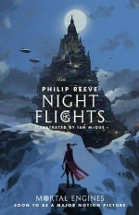
Night Flights by Philip Reeve
Ill. by Ian McQue. The Hungry City Chronicles book 5.
Scholastic, 2018. ISBN 9781742997674
(Age: 12+) Highly recommended. Themes: Science fiction, Steampunk.
Good versus evil. Slavery. In "Night Flights" Philip Reeve returns
to the world of "Mortal Engines", to provide readers with three
short stories about Anna Fang, aviatrix and spy, who is a secondary
figure in the series. Anna Fang's story is fascinating. In "Frozen
Heart", her beginnings are described, first as a happy child on
board her parents' ship, then captured by the traction city
"Arkangel", where she is held as a slave working to dismantle scrap
metal from the ships that the city captures and eats up. Determined
to be free again she catches the eye of the son of the owner and
helps him build a plane and in a daring bid for freedom uses her
wits and intelligence to escape. In "Traction City Blues" an
adolescent Anna lands on London, another traction city and here
faces a Stalker who she wants to recruit as a weapon against the
slaver ship. Finally in "Teeth of the Sea" Anna goes to Pulau
Pinang, where she uncovers a mystery about the disappearance of raft
boats and in the final chapter meets the two children who will be
the main characters in the Chronicles.
All three stories are compulsive reading and would serve as a
fascinating introduction to the "Hungry City Chronicles", although
she is a minor character in those books. Anna is determined and uses
her fine mind to work out strategies for escape and on a practical
level, uses her engineering skills to build an aircraft. She is
faced with disappointment on a personal level and learns to be very
careful of the people that she can trust.
The illustrations by Ian McQue are fabulous, and the reader gets a
wonderful picture of the personality of Anna, as well as the
destructive nature of the predator traction ship "Arkangel".
With "Mortal Engines" soon to be a major film directed by Peter
Jackson of "Hobbit" fame, it won't be difficult to find new fans of
this excellent, challenging and exciting series.
Pat Pledger
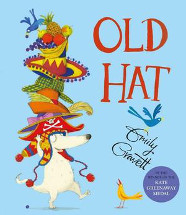
Old hat by Emily Gravett
Two Hoots Books (Macmillan), 2018. ISBN 9781447274001
(Ages: 4+) Highly recommended. Themes: Hats, Appearance, Confidence,
Fashion. Harbet had a hat that he loved. It was knitted for him by
his grandmother and he always wore it. That is until his friends
laughed, telling him it was an old hat. He set about to find a new
hat, one like the ones his friends were wearing. He bought on and
paraded it. It had all the features necessary for a new hat: but it
became rather bedraggled and old. His friends by then had changed
their old hats for the new look, and laughed at Harbet in his old
hat. He went out and bought a new one. But still they laughed. He
camped outside the hat shop making sure that he was first in line
for the latest hat in fashion, but still he was laughed at.
By now readers will have understood what the book is about and
sympathise with Harbet on his quest to be 'with it' and fashionable.
They will laugh out loud at the pile of hats that he has tried
without success.
And the ending will make them laugh out loud even more, as Harbet
reveals why he wears a hat in the first place, now setting a trend
that his friends cannot follow.
The simple lesson of being yourself, will not be lost on the readers
as they will come across examples every day of peers trying to
conform with the latest fashion, be it in clothing, the latest phone
or film, language, car or holiday.
And the expression 'old hat' could be a useful lesson in sayings and
idioms for a class.
I love the illustrations depicting Harbet's whimsical look as he
tries to please his friends, not himself, or the references to hats
in the pages, or the different hats shown. Each page has a different
image to pore over. I love the references to Grandma's hat on
several pages, the endpapers showing an array of hats and the last
page which uses the story to promote another of Gravett's books.
Fran Knight
Mirror Mirror by Cara Delevigne (with Rowan Coleman)
Trapeze, 2017. ISBN 9781409172758
(Age: 16+) Highly recommended. Red, Naomi, Leo and Rose are four
misfits who become the closest of friends upon the formation of
their band, Mirror Mirror. Band rehearsal is an escape for all four,
giving them momentary freedom for the hardships they face in their
regular lives. Red has an alcoholic mother and often absent father,
Leo's criminal brother encourages him to follow in his footsteps,
Rose uses alcohol and boys to numb her painful past and Naomi runs
away from home to finally be free. Just as the band are coming to
terms with their group-identity and feel as close as a family, Naomi
goes missing and subsequently turns up half dead in the Thames. The
police believe that she did this to herself but Red begins to find
clues suggesting that things are not as they seem. The trio decide
that they must take matters into their own hands to truly find out
what happened to Naomi.
A tale of determination, mystery and friendship in the face of
adversity, this novel reminds its reader that they are stronger than
they know and can make a difference in this world. In her debut
novel, Delevigne presents realistic characters, deep emotional
twists and an all-around inspiring story. Through Red, the reader is
brought on a journey of self-discovery while learning some powerful
messages along the way. A beautiful yet sorrowful story that truly
captures the turbulence that is our teenage years.
Daniella Chiarolli
Fart monster and me : The new school by Tim Miller and Matt Stanton
ABC Books, 2018. ISBN 9780733338939
This book is about Ben and Fart monster going to a new school called
Stone Beach Primary.
I thought this book was funny because it's all about farts. The two
main characters were Ben And Fart Monster, they do everything
together. At Stone Beach Primary Fart Monster will only eat baked
beans, cabbage or fried eggs which always makes him fart. I wonder
if he will fart in Ben's new classroom?
I give it 5 out of 5 because it is a funny book.
Aston (aged 8)
The art of taxidermy by Sharon Kernot
Text, Melbourne, 2018. ISBN 9781925603743
(Age: Middle secondary) Highly recommended. Aged eleven, Lotte falls
in love with death. She admires the beauty of a dead gecko, and
keeps it. She and her soulmate Annie find beauty and death linked as
they ramble through the country surrounding their home. Lotte soon
has a collection of bones, skins and feathers in her bedroom. Her
father is tolerant but her aunt, their housekeeper, is appalled by
the smell and the unusual nature of the hobby. As the novel
progresses the reader learns that death has laid a heavy hand on the
family, and that Lotte's interest in death is about preserving both
memories and objects. Lotte's mother died some time ago after the
birth of a stillborn child. Lotte's grandmother is still mourning
the loss of her German-born husband after his internment during the
war in the Loveday camp. There is another grave in the cemetery,
that of Annie, who the reader learns died aged six in a local dam.
Lotte's father has preserved his wife's clothes just as they were
and Lottie's imagined adventures with Annie are an attempt to keep
her memory alive. Lotte's concerned relatives give her a kitten and
a camera as distractions. Lotte's love for the kitten is a
life-affirming emotion; her love for the camera is both
life-affirming and an expression of her need to preserve what she
has. The time comes for her to make choices about a career, but her
aunt is appalled by her interest in taxidermy and suggests that
being a teacher or nurse would be more suitable. However, Lotte's
father takes her to a museum where a taxidermist explains his art.
Lotte is more firmly intrigued and convinced that this will be her
career. She believes that taxidermy is a celebration of life and a
preservation of beauty.
This is a simply written verse novel which covers many issues
without seeming didactic. The attitudes to emigre Germans during
World War II, the difficulties of the Stolen Generation and beliefs
about the role of women in society are minor themes while the main
one is the effect of death and grief. The story evolves quite
dramatically and holds the reader's attention. The poems are easily
read and the descriptions of the natural world are evocative, the
writer having a keen eye for details of shape and colour.
The novel is highly recommended for Middle School readers.
Jenny Hamilton
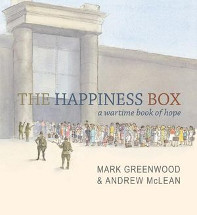
The happiness box by Mark Greenwood
Ill. Andrew MacLean, Walker Books, 2018. ISBN 9781925081381
(Ages: 6+) Highly Recommended. Themes: War. Prisoners of war.
Children in war. World War Two. Changi Prison (Singapore). Sgt
Griffiths (Griff) was a prisoner of war, detained by the Japanese
for three years in Selarang Barracks and then the notorious Changi
Prison on Singapore Island, the aftermath of a terrible defeat for
the Australian Imperial Force in 1942.
Here he watched the children and women of Singapore marched into the
prison and as Christmas approached he wondered what sort of
Christmas these children would have. He and other prisoners than
used every scrap they could find to make presents for the children,
and Griff began to write a story, one that encapsulated hope and
happiness. The story revolved around three animals and another of
his peers, Captain Greener, illustrated the book. But when it was
inspected by the Japanese General, he rejected it saying it held
secret messages. It was to be destroyed. Another of the prisoners
took it to get rid of it, instead burying it and at the end of the
war it was dug up, a little worse for wear, but impressive in its
hope for peace and happiness for the imprisoned children.
It was published in 1947 and again in 1991, the original now held at
the State Library of New South Wales, where it was part of a touring
exhibition in 2007.
Greenwood's story of this book is inspirational, showing the
survival mechanisms of people entrapped by war. Despite their
appalling situation, the men were involved in helping the children
of the camp, offering them solace and hope in the midst of
unimaginable suffering and despair. That the book survived is
another story that resonates hope, and it has become an icon in its
own right.
MacLean's pen and watercolour illustrations rely on a palette of
browns and greys, ochres and greens to reflect the sombre, dreary
nature of everyday life in the prison. There is no variance, no
colour, no hope, except for the toys being made and the colours used
to illustrate the book. The contrast is outstanding and underscores
the belief that life will go on, that colour will return.
Behind the story of the book, readers will see the life led by the
POW's and the women and children within these walls. MacLeans'
illustrations realistically evoke the times with drawings of the men
lying on their bamboo bunks, or watching over the walls towards the
barracks, or being taken away to assured death working on the Burma
Railway. Biographies of the author and the illustrator of The
happiness box are given at the end, alongside a brief history
of the book itself, and a bibliography encouraging readers to
further research the story.
This book offers a fresh approach for classes to look at Australia's
involvement in World War Two and the affects of war on children.
Fran Knight
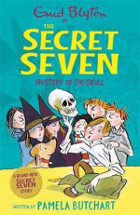
Secret Seven: Mystery of the skull by Pamela Butchart
Hachette, 2018. ISBN 9781444941531
(Age: 7+) "When Peter discovers an old skull hidden in his bedroom,
it's time for an urgent meeting of the Secret Seven. Setting off to
investigate, the friends see a gigantic hole in the grounds of a
local hotel. Could there be any connection between the two strange
events? The Secret Seven are determined to solve the mystery. It's
time to look behind the green door of the Secret Seven's shed
again." (Publisher)
I was so excited to be given this book to review - a much loved
author and series from my childhood! Pamela Butchart does not
disappoint with her take on the series and I am sure a whole new
generation will discover them. Surprisingly the series is set in the
same world and time as the original but it has intertwined new
mysteries. The addition of the illustrations by the very talented
Tony Ross will be sure to please the reader. Of course things such
as sandwiches, cake and midnight adventures feature heavily
throughout the book and it took me right back to my childhood. The
book does not feel the least bit dated in our modern world and I was
impressed to see that the author stuck to the 50s and 60s - the time
of the original series. Fans of Enid Blyton, mystery, adventure and
stepping back in time will love this book. Ages 7 and up will
rediscover or discover their own love of a truly classic series. The
new cover will ensure it attracts the attention of a new generation.
Kathryn Schumacher
The fierce country by Stephen Orr
Wakefield Press, 2018. ISBN 9781743055748
(Age: 14+) Recommended. True stories.
Forget the spiders, snakes and crocodiles, the true danger of
Australia is its fierce heart, the harsh country that has
continually challenged those who dare venture here. Stephen Orr's
collection of stories are all true, some will be familiar to readers
from past newspaper reports, others less known or forgotten, from
the 1830s to the present day. He calls it Australia's unsettled
heart, evoking not just the scarcity of people but also the sense of
unease, and of something disturbed, beginning with the intrusion of
white settlers and explorers, intent on conquering the land and
dispersing the Aboriginal people. He tells of the black line in
Tasmania, the Myall Creek massacre in New South Wales and the
resistance of Jandamarra in the Kimberleys. But the stories reveal
not just a frontier conflict with the people, it is a conflict with
the land itself. People venture into a land that they have no
understanding of, no appreciation of its power - so there are the
stories of men, women, children and families who perish in the
desert - the Calvert expedition of the 1890s, Lasseter in the 1930s,
Nicholas Bannon in 1959, the Page family on the Birdsville Track in
1963, the jackeroos Simon Amos and James Annetts in 1986, Austrian
tourist Caroline Grossmueller in 1998, and so on.
And then there are the stories of the murderers and felons who roam
the interior - the stories of the Gatton murders, the Murchison
murders, the disappearance of Peter Falconio, the murder of Imran
Zilic. Australian cinema has drawn on this horror with films such as
'Wake in Fright', 'Picnic at Hanging Rock', and 'Wolf Creek'.
As Stephen Orr says, these are just a few of the stories, there are
hundreds more. He writes
"...the legacy of the last 200 years will be hard to shake. We are
still tempted to see our country as some sort of marauding monster...
Then there is the realisation we are the aliens...
The Fierce Country holds no malice, but neither pity. It just sits,
and bakes, and waits. We do the rest. We provoke it... Misunderstand
it... Resent it..."
I recommend this book for students of Australian history, for
readers of non-fiction, for readers of murder and mystery stories,
for anyone who just enjoys a good collection of short stories.
Helen Eddy
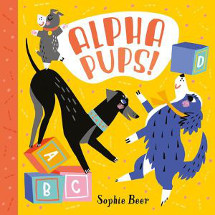
Alpha pups! and Pup and down by Sophie Beer
Little Hare Books, 2018, ISBN 9781760501952, 9781760501808
(Ages: 2+) Themes: Dogs. Dog Breeds. Opposites. Sophie Beer's fun
board books focus on all things canine. With a bright bold palette,
her lively puppy characters and everyday settings are just right to
share with toddlers and pre-schoolers. Alpha pups stretches the imagination with a dog breed for every
letter of the alphabet from Afghan Hound to Zuchon. She includes
everything from the unusual breeds - the Xoloitzcuintli - Mexican
Hairless Dog to the more familiar Pug and Fox Terrier. Each puppy is
dressed to impress and the additional props also start with the same
letter, there's the Border Collie in a baseball shirt with his bat
and ball and the Irish Wolfhound emerging from his icy igloo. The
bold backgrounds and anthropomorphic characters flying kites,
dancing, even riding scooters, add to enjoyment. Pup and down introduces the concept of opposites with a puppy focus.
While grandma is helped by her slow-walking dog, a young
skateboarder zooms past with her dog balanced on her foot - fast and
slow. Over and under go the two dogs that have stolen sausages from
the butcher's shop, At the groomer's one dog has a curly do while
the others had her hair straightened and her toe nails polished. At
the library, there's a stereotypical shushing librarian silencing
the loud dog while another reads quietly in the arm chair.
Sophie Beer's quirky digital illustrations are delightful, these
puppy board books are bold and bright and lots of fun to share with
youngsters.
Rhyllis Bignell