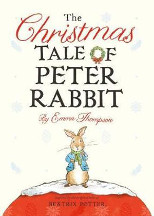
The Christmas tale of Peter Rabbit by Emma Thompson
Ill. by Eleanor Taylor. Frederick Warne, 2018. ISBN
9780241352885
(Age: 4+) Recommended. Themes: Christmas, Poultry. Emma Thompson,
the renowned actress, has written another tale about Peter Rabbit in
this board book, beautifully illustrated by Eleanor Taylor. Peter is
very excited about Christmas and can't contain himself in the
kitchen, upsetting three bowls of mincemeat. Mrs Rabbit sends him
off on an errand to get him out of the way, and then he bumps into
Benjamin Bunny and William the turkey, who confides in the pair that
the McGregors "say that on Christmas Day they are to have me for
dinner!"
Peter and Benjamin are determined to save their friend and come up
with many ingenious ways to hide him from the McGregors, including
under a rhubarb-forcer by the compost-heap and in the coal shuttle,
but his magnificent tail-feathers always gave him away. Finally they
came up with a solution - and children will have fun suggesting ways
of hiding a turkey with a very full set of tail-feathers.
Thompson has succeeded in writing a narrative that reads aloud very
well and will be enjoyed by children, as they follow the dilemma of
William and his two friends. Parents and teachers should be aware
that younger children may need to be introduced gently to the idea
that turkeys are killed and then roasted for Christmas dinner.
The illustrations are done in the vein of the original Peter Rabbit
drawings, and are charming and often humorous.
Overall, a delightful addition to the Peter Rabbit tales.
Pat Pledger
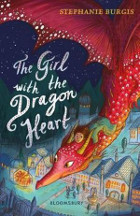
The girl with the dragon heart by Stephanie Burgis
Bloomsbury, 2018. ISBN 9781408880777
(Age: 8-12) Recommended. Themes: Fantasy, Dragons, Fairies, Good and
Evil.
"Once upon a time in a beautiful, dirty, exciting city full of
people and chocolate and possibilities, there was a girl so fearless
and so daring that. . "
Stephanie Burgis weaves another magical fantasy in The Girl with
the Dragon Heart. Following The
dragon with the chocolate heart, thirteen-year-old
Silke, storyteller and worldly-wise orphan is the focus of this
second story, that is filled with castle intrigue and an evil plot.
The royal court of Elfenwald, the feared fairy kingdom, is coming to
visit the royal family at the Drachenberg palace. Princess Katrin
asks Silke to become a palace spy, disguised as a lady-in-waiting to
find out their real motives.
We learn more Silke's past and discover why she loves to spin tall
tales, why she is quick-witted and has developed excellent survival
skills. She is an orphan: her parents disappeared in the evil fairy
kingdom of Elfenwald and with her older brother Dieter, live a
simple existence in Drachenburg, selling second-hand clothes on the
riverbank. Her handbills advertising the chocolate shop are
fabricated with stories of royal patronage, and this captures the
princess's attention.
Silke's initiation into palace life is humorous, as she wears
corsets and fancy dresses, learning to curtsy and following all the
rules. Young Princess Sofia's jealousy of Silke's special assignment
also causes problems. Night time forays into the secret tunnels and
passageways, listening to secret conversations add to the excitement
and danger. Silke finds comfort with her friends the chocolate
makers as they prepare delicious confections in the palace.
Stephanie Burgis understands the fantasy realm; she builds an
exciting world filled with relatable characters, adding magic, a
fight of good and evil, exciting fairy characters, goblins and of
course dragons. The Girl with the Dragon Heart champions
girls taking charge of their own destiny and surviving in difficult
circumstances by using their skills and wits. A fantastic adventure
novel to share with Middle Primary students.
Rhyllis Bignell
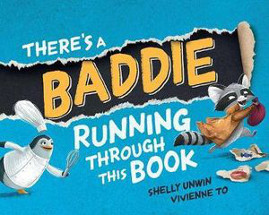
There's a baddie running through this book by Shelly Unwin and Vivienne To
Allen and Unwin, 2018. ISBN 9781760630614
(Age: Preschool+) Recommended. Themes: Humour, Books, Robbers and
outlaws, Theft. There's a baddie running through this book,
Turn the pages; have a look.
There he goes, did you see?
Sound your siren, chase with me. (Publisher) There's a baddie running through this book is a fun story:
you can follow the path of destruction left by the baddie in the
book, as he makes his way through the book stealing different items.
He left a trail of nuts behind him as he made his way through the
book, and in the end this was his undoing. He ends up caught and
everyone gets their things back. He is locked up, but will he stay
that way?
The illustrations are lots of fun and children will enjoy picking
out the baddie in his mask and carrying a sack over his shoulder,
while enjoying the havoc that he leaves behind.
It uses language that can be used to support concept development
such as "up and down", "left or right".
I recommend this book especially for preschool age children to
support the development of the concepts used in the book.
Karen Colliver
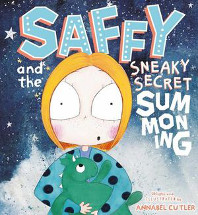
Saffy and the sneaky secret summoning by Annabel Cutler
Little Steps, 2018. ISBN 9781925545029
(Age: 3+) "Join Little Saffy as she goes about her sneaky secret
mission. She is determined to summon the almighty dragon and she
will most certainly not let anything stand in her way." (Publisher)
This is a delightful story about Saffy, who tries every night to
summon a dragon. She persistently tries again and again but instead
finds herself face to face with creatures including a chook, dog and
a skunk. Despite no initial success Saffy is determined.
I loved the bright illustrations throughout the book and found it
easy to identify themes such as persistence and self belief. Dotted
throughout is Saffy's vivid imagination. Without giving the ending
away, it is fair to say that she goes on an incredible adventure and
it has a happy ending.
Suitable for children aged 3 and up.
Kathryn Schumacher
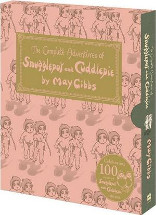
The Complete Adventures of Snugglepot and Cuddlepie: 100th Anniversary Edition by May Gibbs
HarperCollins, 2018. ISBN 9781460756218
A century ago, as the war that had shaken the world and shattered so
many families was finally drawing to a close, an Australian artist
who specialised in satirical cartoons and social commentary gave the
world her now-iconic work about Snugglepot and Cuddlepie, the two
little gumnut brothers who set off on an adventure to see a human.
May Gibbs had completely changed her focus from her earlier work and
because of ill-health moved to Sydney where she fell in love with
the natural bushland of the Blue Mountains. In 1914 the Gumnut
Babies made their first appearance and quickly became popular with
Australians at home and in the trenches as her range of works were
included in Red Cross parcels, bringing sentimental reminders of
home to the troops.
Now a committed conservationist, Gibbs brought the world of the
Australian bush alive for those who were far from it as she tells
the tale of how Cuddlepie is rescued by Nut from the spiderweb and
taken home to meet Snugglepot and they became foster brothers and
lived together side by side until they became "strong and fat as you
see them in the pictures." Enthralled by the stories of Mr
Kookaburra about humans and their ways, Snugglepot and Cuddlepie
determine that these strange creatures are something they want to
see and so one very hot night, "when the Cicadas were singing so
loudly that Snugglepot couldn't hear his father's snoring, he and
Cuddlepie crept out of bed and out of the house." Decking themselves
in in feathers from an old nest to look like birds and fly, by
sunrise they were far from home. And so the adventures began . . .
And a century later, little ones are still captivated by the stories
and the characters who helped them on their way like Mr Lizard, Mrs
Fantail, Little Ragged blossom, Little Obelia, the evil Mrs Snake
and, of course, the big bad Banksia Men. The Complete Adventures of Snugglepot and Cuddlepie has never
been out of print since it was first published and this new
centenary edition is an heirloom to be treasured, and certainly the
perfect gift for any baby born this year. All of her original
artwork has been sourced and re-scanned and it features a fresh new
design in full colour that is true to the original editions of these
stories.
Included is a biography of May Gibbs that reveals her remarkable
life and talent and how deserving she is to be regarded as one of
Australia's most treasured illustrators, artists and children's
authors.
In her will, May Gibbs left the copyright of her works jointly to
The NSW Society for Crippled Children (now known as Northcott) and
the Spastic Centre of NSW (now known as Cerebral Palsy Alliance)
with payments for the rights to use her designs going to these
charities and so her legacy continues in a practical way. Nutcote,
her harbourside home in Neutral Bay, Sydney is now a house museum
that can be visited by the general public. There is also a
travelling exhibition celebrating her life and work with a selection
of original and reproduction artwork from her children's books and
other works from the State Library of NSW that is currently on tour.
As teacher librarians we talk about finding THAT book for each child
that will transform them into a lifelong reader - THAT book for me
was Snugglepot and Cuddlepie shared with me as a little one
recovering from the mumps by a loving grandmother. Over 60 years on
and the magic has not faded! Who would ever have imagined I'd be
reviewing the centenary edition!!! #fanforlife
Barbara Braxton
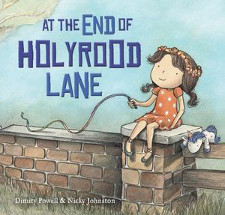
At the end of Holyrood Lane by Dimity Powell
Ill. by Nicky Johnston. EK Books, 2018. ISBN 9781925335767
Flick lives at the End of Holyrood Lane in a little house beneath
the beech woods, spending most of her days in the sunshine dancing
with the butterflies and playing with her unicorn toy and long,
rainbow ribbon. But sometimes a storm hits - storms so violent and
loud and scary that she has to hide because even her rainbow ribbon
and her unicorn cannot give her comfort. She is very good at hiding
but the storms make her feel very small and they are so loud her
ears hurt and her heart throbs.
; One day, the storm is so fearsome and last so long that there is
nowhere for Flick to hide and so she flees. But it follows her,
almost swallowing her in its fury, until "sodden and shaken" she
stops, gathers all her courage and asks for help. She is gathered
into the arms of someone with a large umbrella and even though it
rumbles and grumbles for a while, finally the storm leaves. And the
sun comes out.
Flick is still scared of storms and flinches if the rumbling starts,
but while it might rain a bit the storms have gone for good.
While a fear of thunderstorms is common for many children, and even
telling them it's just the clouds bashing together doesn't soothe,
in this case the thunderstorm is a clever metaphor for what is
happening in the house under the beech trees. Dimity Powell and
Nicky Johnson, the couple behind the poignant story of The Fix-It
Man, have teamed up again to bring us a book that uses the analogy
of weather to explore the issue of domestic violence and its impact
on the children in the family who are so often invisible as the
storm's fury strikes, often without warning. Sadly, this is an
all-too common happening in the lives of those in our care but so
rarely touched on in children's literature, particularly picture
books for the young. While we often hear the phrase that school is a
"safe haven" for many children, there is much that goes on beyond
school hours that we are not privy to, and unless a situation
directly impacts a child in the class such as being removed into
foster care, we really do not know the extent of the problem or the
damage it causes.
Sharing At the End of Holyrood Lane as a class story may
offer an opportunity to allow children to discuss those things they
are scared of, their own personal "storms" and perhaps Flick's
courage in asking for help might inspire another little one to
disclose something that will bring them respite too. Children need
to know they are not alone and it's OK to ask for help - that there
is hope for the sun to shine again and there will be a chance to
dance with the butterflies.
With its soft, supportive illustrations that encapsulate and extend
the sensitive, subtle text superbly, and endorsed by a number of
agencies concerned about the children caught in the middle of
domestic violence such as Act
for Kids, RizeUp, Paradise
Kids, and Think Equal,
this is a conversation starter that may bring a lot of comfort, help
and hope to the children in our care.
Barbara Braxton
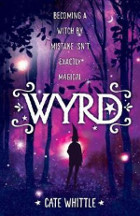
Wyrd by Cate Whittle
Scholastic Australia, 2018. ISBN 9781742994321
(Age: 11+) Highly recommended. Themes: Blended families,
Stepchildren, Families, Supernatural. When two people in love marry,
their thoughts are not always about the others who will be affected
by their union, and in this novel, the three children, Julie's two
children, Pip and Squeak, and Dan's daughter, Emma are very much
aggrieved.
Emma and Pip, short for Philippa already know each other at school.
In the same year group, 5/6, they hate each other with a vengeance.
Now that they are to become a blended family, their hostility
increases. Once the marriage takes place and they are to share one
house, Pip and Emma are given bedrooms next to each other in the
attic, and the parents blithely expect the two girls to become
sisters overnight. They do not see the enmity which exists between
them, each blaming their own child for a lack of patience with the
other. But one night at a sleepover Pip's friends come along with a
witches book they have found in a secondhand bookshop. Casting
spells, things go very wrong indeed, and when Emma tells Pip to
lighten up, she does, spectacularly.
A very readable story of blended families and their initial
misunderstandings, once Emma becomes a witch and finds she has
powers she doesn't want, the two must come to some mutual if cool
understanding to set things right. Emma does not like being a witch
and is very careful about what she says, but when she thinks about a
storm and one appears, throwing Squeak with enough force to break
his arm, she is racked by guilt. The five girls come back together
to try to find the spell they were working on when the unexpected
happened. But every time they find words that may help in the book,
they disappear.
Fast moving, funny with astute observations about blended families
and the issues that surround their making, about friendships and
siblings, the book will appeal to upper primary people, particularly
those absorbed by the idea of witches, spells and the vaguely
supernatural.
Fran Knight
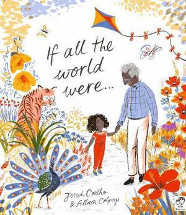
If all the world were . . . by Joseph Coelho
Ill. by Alison Colpoys. Frances Lincoln Children's Books, 2018. ISBN
9781786030597
(Age: picture book) Recommended. Themes: Love, Family, Grandparents.
A beautifully understated story of love between a child and her
grandfather begins with the pair exploring their world, holding
hands as they walk amongst the colours of spring. She wishes the
world was always springtime so that her grandfather's birthdays
could be replanted and he never grow old. Later in summer she wishes
that they could fly in deep space with their laughs like shooting
stars. In autumn he gives her a lovely note book that he has created
with hand made paper, bound with Indian leather string in which to
write and draw all her dreams. She wishes that the world was made of
dreams and that she could paint her grandfather's happiness over all
the sad places.
Until this point the child and her grandfather have been doing
things together, some outside, some inside, but sharing things
together. Now it is winter and we see the old man sitting in a comfy
chair by the fire, a knee rug on his lap. Their interaction is more
muted, quieter, calmer as she listens to his tales, wishing that by
listening to all his stories he could become better. And over the
page we see the fire has gone out and the chair empty.
Helping her parents clean out his room, she finds the things he
spoke about, reminding her of his stories, and on his chair she
finds another notebook with her name on the front. She uses this to
write in all the stories about her grandfather, filling the pages
with the stories that he told her and of their life together.
This is a charming story of loss and grief, of remembering the one
who has died through memories of what they did together, so keeping
the love they had together, alive and thriving. The young girl
records all she remembers in her notebook, recalling the things they
did through the four seasons. The background with large areas of
white space shows younger readers the sorts of things that a child
and grandfather do together, reinforcing the place that grandparents
have in a child's life and reminding children of the four seasons
and what to expect as each season comes by.
Fran Knight
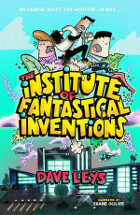
The Institute of Fantastical Inventions by Dave Leys
Ill. by Shane Ogilvie. Harbour Publishing, 2018. ISBN 9781922134936
(Ages: 9+) Themes: Inventions, Mystery, Science, Good and Evil,
Espionage. Dave Leys' The Institute of Fantastical Inventions
combines science, fantasy, creativity and humour in his slightly
zany debut novel. Shane Ogilvie's digital cartoons showcase the
weird fantasies and amazing inventions created by the technical
officers and researchers at the Institute.
Chief Technical Officer Leo McGuffin loves his work fulfilling
people's fantasies at the Institute of Fantastical Inventions. He's
happiest working in his laboratory fulfilling people's requests,
inventing potions and pills for flying, less freckles or floating
around the house at midnight. His working relationship with Dr
Andrea Allsop leaves a lot to be desired however, he pours out her
special formula, leaves her floating and can't make her laugh with
his terrible jokes and puns.
When ten-year-old boy genius Edward becomes Leo's intern, they work
together to achieve boring Mr Mumble's desire to become an
'international man of mystery.' Leo and Edward seek help at Psychic
Suzie's show, but unfortunately they anger the audience and leave
with the understanding of the power of fantasies. During an
excursion to a furniture shop, they discover an undercover spy
wearing a Negaviz Harness. Leo and Edward uncover a devious plan to
steal all the Institute's inventions and cause the ruin of Leo and
his colleagues' workplace.
David Leys mixes up a crazy world of adventure and espionage in his
middle school novel. He adds elements of danger - both human and
animal - tanks full of threatening sea creatures and animal spies -
squirrels wearing spy cameras and robotic rodents. Leo and Edward,
ably assisted by the innovative Mr Mumble are ready to solve the
Institute's worst nightmare. The Institute of Fantastical Inventions delivers humour,
celebrates science, magic, creativity and the power of imagination.
Rhyllis Bignell
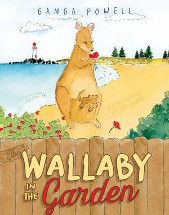
The wallaby in the garden by Ganga Powell
Little Steps, 2018. ISBN 9781925545722
(Age: 4-7) "A wallaby and her joey are causing chaos in the garden!
A big family of cousins, aunts, uncles, parents and grandparents
must find a way to keep her out before she causes too much damage.
But in the end, do they really want her to go?" (Publisher)
This is an interesting picture book with an Australian focus. It
would make a great gift for someone overseas. Children will be
engaged with the rhyming text scattered throughout the book.
The wallaby was loved by all until she started eating all of the
plants in the gardens. With heavy hearts the children design signs
"Wallabies not wanted". They are filled with mixed emotions. They
love the fact they have a wallaby living in their garden, but they
can also see the destruction it is causing.
I think the book has an interesting link to sustainability where
people need to learn how to coexist with nature when humans are
constantly encroaching on the native habitat of creatures.
This book would be suitable for children aged 4 and up.
Kathryn Schumacher
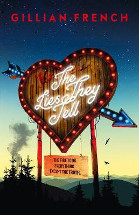
The lies they tell by Gillian French
HarperCollins Publishers, 2018. ISBN 978146075580
(Age: 14+) Highly recommended. Themes: Summer vacation, Murder.
Tenney's Harbor, Maine during the summer break sees the rich kids
coming to stay in their parents' million dollar mansions, playing
tennis, racing their yachts, eating at the Country Club, where
eighteen year old Pearl works, earning money to keep herself and her
father going, waiting until she can go to the local college next
year. Her caretaker father lost many of his part time jobs when one
of the houses in the Millionaire Row burnt down, revealing the
owners, the Garrisons, and two of their children, Cassidy and Joe,
shot and killed. The crime was never solved, with some of the blame
thrown at Pearl's father who now spends more time than he should at
the tavern.
But this summer, Pearl wants her father exonerated, and seeing
Tristan Garrison and his entourage arrive, becomes involved in their
lives as they while away the summer, Pearl watching Tristan and the
others for any clues which might lead her to find out who murdered
the family and set the fire. She finds Cassidy's memory stick hidden
in a compartment on the Garrison yacht and watching it, becomes
aware that the household was not what it seemed. Cassidy was a
prodigious pianist but the footage on the USB shows another aspect
of her life, while passing talk by the group exposes Cassidy's
fractious relationship with her father. Pearl digs even further,
despite her friends giving her the cold shoulder for associating
with the rich kids, and some of Tristan's group treating her will
ill disguised contempt. Her friend, Reece ignores her until she
tells him why she is associating with them, and he becomes an ally
in her detective work.
This is a gripping read as Pearl gathers evidence. She watches the
group and defends her father against the slander she hears, aware
that her hold on her job is becoming tenuous, with only half her
mind on he work.
The chasm between the rich and poor is exemplified by the rich kids'
casual takeover of the quiet village where they moor their yachts
and their cavalier attitude to the locals, particularly the town
girls befriended for the summer. Their arrogant disregard of how
dependent the locals are on them patronage gives a strong layer of
moral outrage as events develop.
Each of the characters is wrought with hidden depths, exposing a
view of themselves to the world which belies what is underneath.
Pearl needs to keep her wits about her to defuse the interest being
shown by Tristan, and her interest in his friend, Bridges is a
hurdle to seeing things clearly. Just as she begins to unravel the
complex interrelationships of the group Pearl puts herself into
harm's way as she works out, almost too late who killed the family.
Gillian French is the author of YA novels, Grit and The
Door to January, and lives in Maine.
Fran Knight
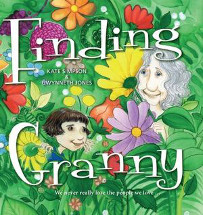
Finding Granny by Kate Simpson and Gwynneth Jones
EK Books, 2018. ISBN 9781925335699
Edie's Granny is "a playtime Granny, a bedtime, story-time pantomime
granny, as I'm not afraid of some slime Granny." She loves Edie and
Edie loves her. But when she has a stroke and has to spend a long
time in hospital, Edie is confused by her 'new' Granny. Her Granny
doesn't need help eating her dinner!
Gradually, Edie discovers that even though this Granny is a bit
different in some ways, at her heart she is still the same - a love
as fierce as a lion Granny.
With stroke being the third leading cause of death in Australia and
one of the top 10 leading causes of death among people aged 45 and
over, Edie's predicament is one that is faced by so many of the
children in our care and so this is a really important book that has
to be in the collection. It's superbly chosen text describes Edie's
and Granny's relationship perfectly in a unique way so that the
reader automatically sees that this is a close and loving
relationship; the wordless page that just shows the ambulance with
its lights flashing; and the simple explanation by the doctor that
Granny's "brain isn't working the way it used to" are all that is
needed to set the scenario for the big changes and challenges Edie
is going to have to face. Coupled with illustrations that show the
emotions that don't need words, this could be any child who is
confronted by this situation - any one of them could be Edie.
I know from recent experience how confronting and difficult it is to
see the impact of age and illness on a loved one and to come to
terms with this 'different' person, establish a new relationship and
burrow down to the love that is still there albeit not so evident at
times - and that is as a mature adult. So it is even trickier for a
child, although, again from experience, they seem so much more able
to cut to the chase and work with what they are presented with, just
as Edie does. Nevertheless, there can be some confusion about
feelings - "That's not my Granny," says Edie when she first sees hers
in hospital - and so to learn that these are natural, acceptable and
shared by other children will bring comfort and together, like Edie,
they can move forward and develop a valuable, if different,
relationship that still has love at its core.
A book that should spark conversations and bring comfort . . .
Barbara Braxton
Impostors by Scott Westerfeld
Allen and Unwin, 2018. ISBN 9781760528249
(Age: 13+) Highly recommended. Themes: Dystopian fiction. Good and
evil. Rebellions. Coming of age. Adventure. Scott Westerfeld has
returned to the world of his very popular and engrossing series, Uglies.
It is the first of four books and sure to make his many fans very
happy and will introduce a world to new readers.
Frey has always lived an isolated life. Brought up to be the body
double for her twin sister Rafia, by her tyrant father, her
existence has been kept a deep secret. She has been trained
exhaustively and painfully to ensure that her twin isn't
assassinated or in any danger, while Rafia has been taught the
skills necessary for the much loved heir to the first family of
Shreve.
When the Palafox family, leaders of a rival city, negotiate for
Rafia to stay with them as a guarantee of her father's goodwill, it
is Frey who is sent to impersonate her sister. There she meets Col
Palafox, and gradually he gets close enough to her to see some of
the real person behind the mask that she has to assume. When her
father goes on the attack, leaving her for dead, she has to decide
whether she will fight against him in the rebellion that ensues.
This is compelling reading, the world building is fantastic and it
is easy to imagine a world where scrap metal is valuable and city
states closely watch the lives of their citizens. The characters are
fully fleshed out and Frey's father is so horrible that the reader
can empathise with Frey's desire to kill him. There is a slight
romance between Frey and Col but this is not the main plot (although enough for romance lovers), rather
it is the action and underlying value systems of the city states
that keep the reader's interest.
With a tantalising cliff-hanger on the last page, readers will be
clamouring for the next book in the series.
Pat Pledger
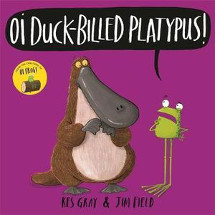
Oi duck-billed platypus! by Kes Gray
Ill. by Jim Field. Hodder Children's Books, 2018. ISBN
9781444937329
(Age: 4+) Highly recommended. Themes: Animals, Verse, Word play,
Alliteration, Humour. Following on from the success of the zany fun
filled humour of the "Oi" books (Oi Frog (2015) Oi Dog
(2016), and Oi Cat (2016)) this one follows a slightly
different variation as the frog finds it difficult to find a rhyme
for some of the animals that appear before him, waiting to be
seated. What do you rhyme with a duck billed platypus or a
hippopotamus, an ostrich or a meerkat. Frog, cat and dog are puzzled
and platypus is not very patient, reminding the trio that he is
waiting, as he points out the queue behind him of other animals also
waiting for their rhyme before being seated.
Eventually the Frog asks for their first names and they find it much
easier to use their first names rather than their second to find a
rhyme that fits. So Dolly the duck-billed platypus sits on a brolly,
Kate kookaburra sits on a gate and Lemony lobster sits on an
anemone. Everyone is satisfied, the alliterative names of the
animals used to make a nice rhyming seat until a kangaroo happens to
come along, with the fearful name, Amelia Esmerelda Honeydew
HigginbottomPinkleponk-Johnson. The resolution will have children
trying vainly to find a rhyme and like frog, telling the kangaroo to
sit where she likes.
Full of humour, reflected in the appealing illustrations, the tale
will bring laughter from all readers, recognising the alliteration
and how it teams with the animal's name, seeing the rhyme that frog
comes up with, perhaps offering an alternative, all the while
looking closely at the expressions on the faces to see what a
quandary frog is in. In a class emphasis could be the word play,
rhyme and alliteration, while discussion with younger readers about
first and last names would be appropriate.
All readers will love looking out for the seat of each of the
animals and delight in the end papers with Field's platypus
panorama.
Fran Knight
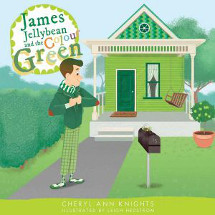
James Jellybean and the colour green by Cheryl Ann Knights
Ill. by Leigh Hedstrom. Little Steps, 2018. ISBN 9780648267300
(Age: 3+) Recommended. James Jellybean likes everything that is
green. He lives in a green house, has green hair and even his pet is
green.
The illustrations in this book are clear and bold, and they tie with
the story beautifully.
This is a fun book about the colour green. It can be used to support
teaching colours. It can also be used to talk with children about
their favorite colour.
There are also other similar books such as Mrs
Mavis Marshmallow and the colour yellow that can be used
in conjunction with this book. I recommend this book for children
aged 3+.
Karen Colliver