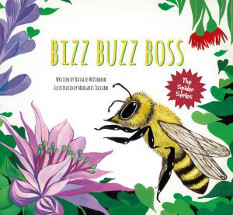
Ill. by Margaret Tolland. Starfish Bay Children's Books, 2018. ISBN:
9781760360566.
(Age: 4+) Themes: Insects, Gardens, Bees, Cautionary tales. This is
a fascinating look at the role of each of a number of insects and
other creatures in the garden (ladybird (bug), spider, bee, worm and
skink). This cautionary tale reminds readers not to be insular and
self absorbed, to check what is happening around them and certainly
not to brag about their abilities. The spider in the garden, curled
up in her leaf, watches the bee as it darts and buzzes around the
flowers, collecting pollen for the hive.
As she goes about her work, she repeats a similar refrain, 'My work
is important you see. I collect pollen to take to my hive. No one
works as hard as me.' Several of the other creatures in the garden
come nearby but she brushes them aside using the same lines but with
a second line that reflects the work she does. So when interrupted
by the worm she tells him that she collects pollen: when it is the
ladybird who interrupts she tells her that she sprinkles pollen on
each flower: with the skink, she reminds him that the pollen helps
the fruit grow. Each time the bee is showing the reader what the
work of a bee is in every garden, and how important it is to our
survival.
But the other creatures are a little tired of her; she is
condescending in her retorts that she is the one working, seemingly
the only one! and the creatures seek help from the little spider.
She uses her skills in the most appropriate way to let the bee know
how useful every member of the garden community is.
A cunning tale about inclusivity and interdependence, children will
love the climax of the story as the bee learns more about her
surroundings, and sees she is not alone in her usefulness to the
garden.
Starfish Bay Children's Books began in Adelaide in 2014 and more
information about this publisher can be found here.
Fran Knight
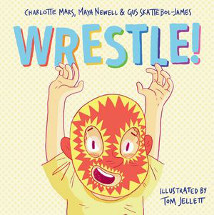
Wrestle! by Charlotte Mars, Maya Newell and Gus Skatterbol-James
Ill. by Tom Jellett. Allen and Unwin, 2019. ISBN 9781760296810
(Age: 4+) Highly recommended. Themes: Families. LGBT. Toys. Mardi
Gras. Sydney. What does a parent do when their child takes up a
hobby or interest they dislike? In this funny take on a well known
family situation, the three authors and the illustrator are able to
show a resolution for this perennial source of disharmony, one that
involves all members of their family resolving the issue to
everyone's satisfaction.
Gus can't wait for Mardi Gras when he and his sister, Rory, get to
dress up. This year, Gus wants to dress up as a wrestler. His mums
are a little taken aback; they worry that he thinks that this is
what it is to be a man, a popular man, a smart man. They offer
alternatives but Gus is determined, clutching his wrestling hero
dolls. He play wrestles with Rory which ends in tears, his mums
again concerned that he is developing some thoughts that they do not
like. But that night, Gus dreams of wrestlers wrestling each other
to the ground and hurting each other. This is not what he wants to
do at all! So he comes up with a resolution, discussing it with his
mums and sister, Rory, so that by Mardi Gras they have developed an
altogether different style of wrestling and march together at the
Mardi Gras with the crowds.
A delightful tale of a boy developing his image of what it is to be
male, supported by his parents, to see that there is another side to
the idea of wrestling, that it can be done with love and humour,
with all the family involved.
Jellett's wonderful illustrations show a warm involved family, full
of love and care, discussing and resolving issues, being together.
Children will love looking at the details he includes in his
pictures, picking out the nods to Sydney, all the people at the
Mardi Gras, and the array of toys in the back garden.
Fran Knight
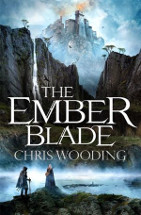
The ember blade by Chris Wooding
Gollancz, 2018. 824 pages. Paperback. ISBN 9781473214859.
(Age: 15+) Recommended for advanced young adult readers. Two young boys
living in an occupied Kingdom, are fighting to recover a stolen
treasure of their people. The ember blade follows Aren and
Cade, two young boys who are swept from their home village and sent
to work as slaves in the prison mine. In a moment, their entire
world is brought crashing down around them. Still, it isn't until
they escape into the world beyond the prison walls that their epic
adventure truly begins.
The strongest theme of this story is that of the brotherly bond
between the two friends, shown through their lively banter and the
actions that they take to protect one another. There is a strong
sense of disbelief portrayed by Aren. Aren has always seen himself
as the hero of the story and struggles to come to terms with how he can
be wronged, even when he believes that he has done everything right.
Cade has always been resentful of the Krodan people, but it is Aren
who is affected most.
Wooding's writing is suspenseful and detailed, constructing
beautiful mountainous landscapes, filled with medieval terrors and
the cruel and unjust rulers of the occupying Krodan people. The
story is filled with edge-of-your-seat action, and excellent,
humorous dialogue between the characters. The magic in the story was
the use of druidic arts, founded on faith in the Aspects (the Gods
of the Ossian people) and an understanding of nature. It was an
interesting twist on magic, and one that I found to be well
constructed. The ember blade reads like an Arthurian
classic, which as huge fan of Arthurian legend, I certainly enjoyed.
A brilliant start to the trilogy.
Jake Morgan, Unley Libraries
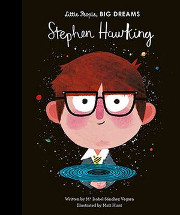
Stephen Hawking by Maria Isabel Sanchez Vagara
Ill. by Matt Hunt. Little people, big dreams series.
Frances Lincoln, 2019. ISBN 9781786037329.
(Ages: 6-10) Recommended. Themes: Physicists. Biographies. 'However
difficult life may, there is always something that you can do and
succeed at.' Stephen Hawking's life was truly amazing and this Little
people, big dreams biography opens up his life and scientific
endeavours to a younger generation. Vagara presents the key facts,
milestones, accomplishments and personal struggles in an enjoyable
and relatable style. 'Children are sponges absorbing the world
around them,' is her impetus for writing these biographies.
Hawking's life is pleasingly portrayed by Matt Hunt's crisp, linear
digital illustrations where dark skies shimmer with stars, dark and
lighter tones shape the setting and simple stylised characters show
stages of life.
Young Stephen was born during World Ward II in Oxford, England, to a
family who loved science and encouraged education. His nickname at
school was Einstein, he even built a computer from clock workings
and an old telephone. His passion was studying the universe and he
studied cosmology at Oxford University. When diagnosed with ALS, a
neurodegenerative disease he determined to study the stars rather
than be limited by his condition. Vagara presents this information
with a simplicity suited to younger readers.
Hawking's brilliant mind turned to the study of black holes, where
he discovered tiny lights escaping from them, named 'Hawking
radiation' in his honour. Utilising a robotic voice, he dictated his
scientific books and helped the world understand the universe. A
comprehensive biography concludes this picture book, just right for
students to begin researching. Vagara's Little people, big
dreams series opens up children's eyes to inspirational,
authentic and unique world changers.
Rhyllis Bignell
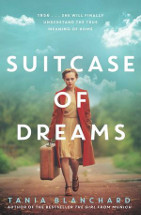
Suitcase of dreams by Tania Blanchard
Simon & Schuster, 2018. ISBN 9781925596168.
(Age: Adolescents - Adults) Themes: Immigration. Germans in
Australia. Sydney. In 1956 a young couple arrive in Australia by
ship, ready to begin a new life together, far away from their own
country, Germany, that has been suffering the woes of the post-war
period, the deprivation, loss of hope and lack of opportunity.
This is Erich's second marriage and he is determined to make his new
wife, Lotte, happy, by moving to a new country to begin their lives
together in the 'new' world. The story reflects the European
experience of the post-war period, the idea of fleeing one's country
to begin a new life and to make a fresh start in a safe place.
This intriguing story tells us a narrative of a young family with an
earnest desire to make a new life in a country far away from their
own tired, devastated homeland. We are made aware of the
deepest desires and hopes of the couple, and we gain a sense of
being so caught up in their story that we are embraced by their
little world. Uplifting and honest, this narrative places us
firmly in the time and place of Australia in the 1950s as it
recovers from the war years, coping with the needs of the returned
soldiers, many of whom are psychologically damaged, and welcoming
the refugees from the 'old world'. Arriving full of hope, but
fearful of acceptance, having to learn a new language, and to settle
without their own wider families, the new arrivals are determined to
put aside the tragedy, the terrible memories and the prejudices of
the old world, wishing to rebuild their lives.
There are many setbacks, and nothing is easy for this young couple,
but their love and devotion to one another, and their children,
enables them to cope. They experience some terrible things and
go through hard times, but eventually it all seems to be coming
together. Life begins to look good, and their positive outlook
seems to support them and their family. When tragedy strikes,
however, they are devastated, barely able to cope and terrified of
everything collapsing around them. They survive, but things
change and they find that they have to adjust, and they find the
strength to do so.
In this story the characters are vividly depicted, the story is
fresh and vibrant, the narrative drawing us into the lives of the
characters, their hopes, dreams, achievements and their
tragedies. Suitable for adults and adolescents, this fine book
embraces the historical events of the Second World War and its
aftermath, and celebrates Australia's welcoming of the new citizens
with friendliness and support, defining what it is to be Australian
then and now. It is most suitable for young adults and adults,
particularly recreating the world of that time for older readers. It
is the sequel to The girl from Munich.
Elizabeth Bondar
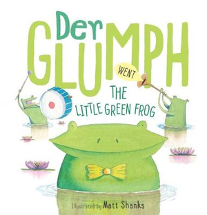
Der glumph went the little green frog ill. by Matt Shanks
Scholastic, 2019. ISBN 9781742993676.
(Age: 4+) Recommended. Themes: Frogs. Humour. Australian animals. A
version of the song on which this picture book is based showing the
noise made by a frog can be found on Youtube.
Scholastic takes it one step further, including an array of
Australian animals and the imagined noises they make when
unobserved. The echidna makes the sound of scritch scratch, snuggy
snug hug go the penguins, the roo, hop hop hop and the little pink
bird (galah) goes squwark squwark. Each animal is shown doing what
it does enabling readers to recognise the characteristics of that
animal as they sing along.
The simple tune is well known and children will easily adapt the new
lines to the song, although several may need tweaking, and readers
will learn them quickly to sing along with the teacher. Actions will
be added, making this a book full of fun and laughter in the
classroom. Shanks' illustrations add to the merriment, despite the
girl's face being out of alignment (I thought her eye was
permanently closed until I realised it was her nose I was looking
at.
Readers will love spotting the Australian flora and fauna well
depicted by Shanks, and laugh out loud at the humorous touches
included in his illustrations: the echidnas being used as bowling
balls and the galah appearing on each page, and being wooed on the
last page, while the sounds they make in the book invites discussion
in the classroom about the noises really made by these animals.
Fran Knight
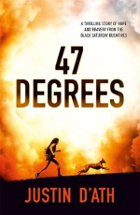
47 degrees by Justin D'Ath
Puffin, 2019. ISBN: 9780143789079.
(Age: 10+) Highly recommended. Themes: Bushfire, Victoria, Survival,
Disaster. Justin D'Ath lost his house and possessions in the fatal
bushfire now known as Black Saturday which tore through Victoria in
January 2009.
He has recreated this appalling event with incredible clarity and
tells the story through the eyes of Zeelie, a twelve year old
working with her father to try and save their house and land. Stay
and Defend is his catch cry and he has many things in place to help
him do that but when the wind changes direction and the temperature
climbs to 47, the fire comes without warning forcing them to leave.
All morning we see Dan attaching pipes, setting up the generator,
cleaning gutters and clearing the area around the house. Zeelie
helps but is concerned for her horse and dogs as well as her mother
and brother, gone to Melbourne to the emergency hospital after he
fell and hurt his arm. Leaving her mobile at home they cannot talk
to her, and when the networks fall over all contact is gone. Power
outages means Dan and Zeelie must rely on the few people they meet
on the road for information.
The absolute chaos of the day is well told, bringing the readers
into the fear, flames and smell of the day, the smoke making their
view of the surrounds impossible, police blocking their way as the
roads are now impassable, and not knowing where mum and her brother
are. The fear is palpable.
Leaving their home and Zeelie's horse, they end up at Yea with loads
of other people they do not know, refugees in their own community.
They are surprised at the generosity of the people of Yea, and when
the army turns up to erect a tent city, they find their family.
D'Ath enfolds us all in the gravity of the day; we yearn with Zeelie
the need for news of her mother and brother, hoping they did not
leave the city to try and get home, we ache for her horse left
behind, scan the faces of those milling on the Yea oval, hoping for
news of their homes. A map at the beginning of the book shows the
reader just how close to Melbourne the fires raged, and an afterword
gives us more information about what happened. Dan's fire plan, like
D'Ath's, prepared for a fire event, but nothing prepared anyone for
that day, with those temperatures and winds.
In this the tenth anniversary of Black Saturday this cautionary
tale, will impel readers look at their own fire plans, making sure
there is an escape route wherever they are.
Fran Knight
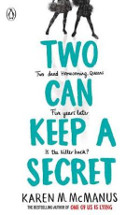
Two can keep a secret by Karen M. McManus
Penguin Books, 2019. ISBN: 9780141375656.
(Age: 15+) Recommended. Themes: Mystery, Diversity. McManus shows a
masterly hand at the mystery genre with this easy to read, dark tale
of secrets in a small town. Ellery and her twin brother Ezra return
to Echo Ridge to live with their grandmother, after their mother was
sent to rehab for driving into a jewellery shop. It is the town
where their aunt went missing years ago and where a Homecoming Queen
was murdered. No one knows what happened to these girls and it has
affected everyone in the town, especially Malcolm whose older
brother was the prime suspect. When his brother returns to town and
another girl disappears Ellery and Malcolm know that they have to
unravel the secrets in the town.
This is a gripping murder mystery which kept me guessing until the
end about who committed the murders and what the motivation could
possibly be. Narrated in two voices, that of Ellery and Malcolm, the
author gradually informs the reader about the past mysteries, while
increasing the tension about the present disappearance and who might
be behind it.
Fans of McManus' first book One of
us is lying and fans of the mystery genre like me will find
much to love about this book. The suspense builds up very
effectively, there are some very scary moments, the characters
portrayed are believable and the tension lasts until the very end.
Pat Pledger
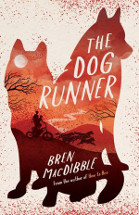
The dog runner by Bren MacDibble
Allen and Unwin, 2018. ISBN 9781760523572.
(Age: Middle school) Highly recommended. Themes: Dystopia, Future,
Global warming, Climate change, Survival. In a bleak future where
the earth has run out of food and people are starving, Emery and his
little sister, Ella, hook their five dogs to a home made cart, like
a sled on wheels and set off for his mother's place where they
expect to be safe. Avoiding roads and other people, hiding when they
hear the approach of cars or bikes, they stumble on through the
heat, stopping to water the dogs and open another tin of fish, their
only food source. At a farm miles from the city a couple gives them
fruit and potatoes, but returning the next morning they find them
dead and their house burnt to the ground.
Their haste to leave sees them shot at by bikers and Emery is hit.
Ella gets away taking a gun with her and goes back to find Emery.
She hauls her wounded brother onto the cart and with the remaining
four dogs gets as far away as possible. Next day Wolf returns but
stays away from the group until Ella notices that the bikers have
put a tracker on him.
Once again they move off in a hurry determined to ride the next two
hundred kilometres before they are found. But one night the bikers
return and it is when Ella hears her mother's voice that she
realises that they are looking for them. But Mum is a captive of
these men and in helping them escape their clutches, leaves them
again to search for her husband.
This is a an exciting, heart in the mouth read as the two young
people try to find a place of refuge. Besieged by the ravages of
climate change, the novel could be about any refugee: fleeing war,
or violence or abuse or weather event - the impulse is the same, to
find shelter, a place where you feel safe. The cautionary tale
behind the survival story of Ella and Emery, that of the results of
our society, bent on using everything on the planet despite the
warnings, is made very real with its paddocks of brown earth where
crops once stood, walls between suburbs, suspicion and wariness,
reliance on guns and groups only out for themselves.
This novel would be a great class novel as it lends itself to a
range of discussion points with classes: refugees, cities, survival,
climate change, seed banks, over cropping, dogs and family.
Fran Knight
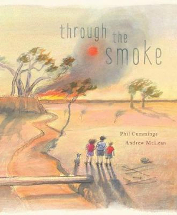
Through the smoke by Phil Cummings
Ill. by Andrew McLean. Scholastic Press, 2019. ISBN: 9781760274702.
(Age: 4+) Highly recommended. Themes: Fire, Survival, Firefighters.
Three children play on a hot blustery day; the wind feels like
dragon's breath. They roam the paddocks around their home, waving
their swords, making their way through the wheat fields to their
castle, Everdell, a cave in the riverbank. Here they continue their
game, watching the cockies screech overhead, splashing water at each
other, jousting and playing with their swords. But as they play the
sleeping dragon wakes and they become aware that the wind and smoke
has intensified, the dragon roaring around them. Riley panics and
the older brother takes both their hands racing back to their cave,
a measure of safety. Here they sit surrounded by the wind and the
fire, and just when the branch of the nearby tree seems to want to
fall, out of the smoke voices can be heard and a fire engine and
group of firefighters arrive. These knights use their sabres of
water to fight the dragon, and push him back. The children are
saved.
Phil Cummings surrounds his story of children trapped in a firestorm
with the metaphor of playing at knights and castles: each of his
wonderfully evocative textual images parallels the games that the
children play: castles and knights, dragons and swords, and when the
fire appears, a dragon wakes, stalking them across the wheat fields.
The arrival of the firefighters continues this image; they are
knights rescuing the children from an ancient scourge.
This imagery is paralleled in McLean's equally evocative watercolour
and charcoal illustrations. With end papers full of smoke, McLean
builds the approaching bushfire from the first pages; the dragon's
claws on the cliff wall, the dusty, blustery wind giving the nod to
the approaching bushfire. When it arrives, his illustrations take on
the colour, swirl, heat and fear that a bushfire evokes, ensuring
the readers will understand how the children are feeling. They will
sweat with them in their hidey hole, all too aware that some people
do not survive these events.
Phil Cummings wrote this story when he was unable to leave his house
for several days during the Sampson Flat bushfires, north of
Adelaide, in January 2015.
He recreates the fear that fire engenders, making it accessible to
younger readers as they play with the trio on the pages, and then
shelter with them as they are surrounded by fire.
His book's dedication to the firefighters tells of the service these
men and women do in our communities, eliciting our gratitude.
Fran Knight
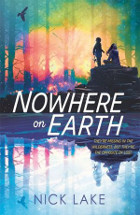
Nowhere on Earth by Nick Lake
Hodder Children's Books, 2019. ISBN: 9781444940459.
(Age: 12+) Highly recommended. Themes: Adventure, Coming of age,
Survival, Alaska, Family relations, Dance. The blurb says it all, to
add to it would include spoilers: It starts with a plane crash.
There are survivors: a teenage girl and her little brother. They
are running from something. But what?
Then the men arrive. They are hunting the girl and boy. And -
And that's all we can tell you . . . (Publisher) Nowhere on earth is an exciting page turner which will
engross any fan of the survival genre as Emily, her brother Aidan
and the pilot Bob, try to overcome the perils of the cold in Alaska
after their plane crash. The big question for the reader is: why are
they being chased by men in black who are hunting them with guns?
Readers will love the action and adventure - it's another book that
would make a fantastic movie. Emily is a wonderful heroine who
manages to survive using the skills that her parents have given her,
even though they are ones that she didn't want - all she wanted was
to dance. The novel is not just a survival story, though; it
explores some big philosophical questions like the nature of love in
families and the future being what an individual makes of it.
Between the adrenaline rushes of the chase there are poignant
moments especially when Emily's parents track her down in the
wilderness and she realises how much they love her.
Readers who liked Not If
I Save You First by Ally Carter will enjoy this.
Pat Pledger
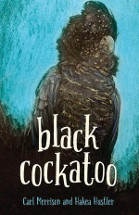
Black cockatoo by Carl Merrison and Hakea Hustler
Magabala Books, 2018. ISBN 9781925360707.
(Age: 10+) Highly recommended. Themes: Aboriginal themes, Kimberley,
Cockatoos, Rite of passage, Growing up. When thirteen year old Mia
rescues a black cockatoo injured by her brother's slingshot, she is
at a loss to stand up to him. But determined to help the wounded
bird, her totem, a dirrarn, she hides it in her room and goes to a
neighbour's house to borrow a birdcage. She puts this in a safe
place in her back yard and feeds and waters it. But she must still
protect it from her brother and his friends, a group of young teens
distancing themselves from the family.
But as the story unfolds Mia develops some strength of purpose,
wanting to protect the bird and see it fly, and aware all the time
that she must defend it against her brother which goes against the
customs of her community where she must defer to him.
She develops skills through the stories told by her family, her
mother, grandmother and aunts who come to the house, and one night
dreams of flying. She realises that she must let the bird free to
live again, just as she must learn to be strong.
I loved this little book, redolent of customs and way of life of
people living in the Kimberley. In the background we see the way the
family helps all of its members, and when the teenage boys are
becoming too cheeky, they are taken off by the older men to become
men in the bush. Incidental stories around the kitchen table tell of
the stolen generations, of land taken away, of families disjointed,
but overwhelmingly the spirit is of the future, of strength of
purpose, of families being together and of finding your voice.
The illustrations by David Leffler add a wonderful layer of interest
and appeal, and the glossary at the end of the book is most useful.
Teacher's
notes are available.
Fran Knight
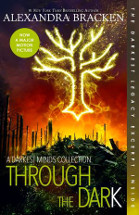
A Darkest Minds collection: Through the dark by Alexandra Bracken
HarperCollins 2019. ISBN 9781460756447.
(Age: 15+) Highly recommended. Consisting of three novellas, Through
the dark, portrays the world of Darkest Minds by focusing on a
set of fringe characters including Zu, Sam, Lucas, and Mia. In time follows a would-be skip-tracer as he searches for his
first 'freak'. Stumbling into a trap set by other bounty-hunters, he
comes across Zu, a mute girl whose expressions more than make up for
her lack of speech. She's a yellow - dangerous but not as dangerous
as a red. To qualify as a skip-tracer and claim her bounty he needs
to reach a collection point, however, he's not a skip tracer yet and
how can he be sure that this 'thing' isn't human? Sparks rise follows Sam's imprisonment at Thurmond. As a
green she has a certain amount of freedom, her memory hasn't
manifested as a direct threat but that doesn't mean her independent
streak is hidden. Targeted by a PSF it is only chance that reunites
her with her childhood best friend, Lucas, a red who happened to
resist their training. Lucas is looking for his sister but with Sam
in Thurmond, his plans must adapt. Beyond the night follows Sam and Mia as they face one of the
biggest challenges of their lives. Lucas gave everything for them
and now it is time to reward that sacrifice. Could they save Lucas
from the limbo his life is held in?
Interrogating the system and the aftermath of Darkest Minds, Through
the dark is a very down-to-earth portrayal of dystopia.
Without sugar-coating outcomes, this collection presents realistic
and torturous endings. Bracken's characterisation is impressive,
presenting believable characters in bizarre dystopian situations. I
would highly recommend to fans of the series and fans of the
dystopian genre.
Kayla Gaskell
A Darkest Minds collection: Through the dark by Alexandra Bracken
HarperCollins 2019. ISBN 9781460756447.
(Age: 15+) Highly recommended. Consisting of three novellas, Through
the dark, portrays the world of Darkest Minds by focusing on a
set of fringe characters including Zu, Sam, Lucas, and Mia. In time follows a would-be skip-tracer as he searches for his
first 'freak'. Stumbling into a trap set by other bounty-hunters, he
comes across Zu, a mute girl whose expressions more than make up for
her lack of speech. She's a yellow - dangerous but not as dangerous
as a red. To qualify as a skip-tracer and claim her bounty he needs
to reach a collection point, however, he's not a skip tracer yet and
how can he be sure that this 'thing' isn't human? Sparks rise follows Sam's imprisonment at Thurmond. As a
green she has a certain amount of freedom, her memory hasn't
manifested as a direct threat but that doesn't mean her independent
streak is hidden. Targeted by a PSF it is only chance that reunites
her with her childhood best friend, Lucas, a red who happened to
resist their training. Lucas is looking for his sister but with Sam
in Thurmond, his plans must adapt. Beyond the night follows Sam and Mia as they face one of the
biggest challenges of their lives. Lucas gave everything for them
and now it is time to reward that sacrifice. Could they save Lucas
from the limbo his life is held in?
Interrogating the system and the aftermath of Darkest Minds, Through
the dark is a very down-to-earth portrayal of dystopia.
Without sugar-coating outcomes, this collection presents realistic
and torturous endings. Bracken's characterisation is impressive,
presenting believable characters in bizarre dystopian situations. I
would highly recommend to fans of the series and fans of the
dystopian genre.
Kayla Gaskell
Rise: the Sam Thaiday story by Sam Thaiday with James Colley
Penguin Random House, 2019. ISBN 9780143790419.
(Age: 11+) Recommended. Sam Thaiday's autobiography will be a
favourite from middle school to lower secondary, given his own
popularity and the popularity of the Brisbane Bronco's in the NRL.
There are a few surprises, beginning with the fact that Thaiday was
actually born in Sydney!
Whilst basically a travelogue of match highlights during his 16 year
career in the Broncos and in representational footy, it shouldn't be
the only source chosen if needing material for a biography
assignment. Rightly or wrongly, there are apparently no negatives
about the NRL, referees, coaches, players, fans or the media in
Sam's fairytale. However, aimed at younger readers, that isn't
surprising.
Thaiday does push the message that hard work will be rewarded and is
proud of his long term contributions to both State of Origin and
international football teams. He is very much a team player and does
not count himself among the NRL greats, Lockyer, Smith and Thurston,
whom he rates as the legends of his era.
While he is clearly remorseful, it is a shame that he supplies no
context for one 'storm cloud' in 2017, nor mentions being officially
stripped of an ambassadorship for indigenous health. Without a
little backstory regarding 'a community' he offended, followed by
platitudes about thinking first, acknowledging hurt and doing your
best to make it right, we can't share this life lesson meaningfully.
While Thaiday need not have divulged the contents of an offensive
joke told on national television, he could have stated that he told
a racist joke and this misjudgement cost him a new opportunity and
the respect of the community - at least temporarily. Ironically,
humour is his strength. His self-depreciating recounts add to our
enjoyment of the book. Thaiday's first Origin try is typical of this
endearing Queensland Rugby League identity: Now, looking back, you'd think that a lot of the credit for this
one should probably go to Johnathan Thurston. He was the one who
met the opposition fullback as he was returning a kick into his
corner. He was the one who stripped the ball like a pickpocket and
put it onto my chest with five metres to run and daylight between
me and the posts. But really, it was my idea to run those five
metres and score, so we both deserve credit, I reckon.
No school library in the Eastern states would be complete without
this paperback autobiography complete with glossy photos and a Fast
Facts section.
Deborah Robins