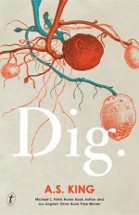
The Text Publishing Co., 2019. ISBN: 9781925773521. 391p.
(Age: 15+) Highly recommended. Themes: Bildungsroman/Family. The
Shoveler moves to town with his drifter mother. He begins the
familiar process of grappling with a new school, making friends and
finding a part-time job. In order to deal with ongoing domestic
violence, Loretta constructs a scripted fantasy world centring
around her Flea Circus. Malcom spends weekends off-shore with his
dying father as his anxiety mounts. CanIHelpYou is a drive-thru
attendant and local drug dealer tortured by her mother's racism.
Throughout the book, our delight in unearthing how the characters
are entwined is palpable. Dig begins as a play with a cast but quickly changes into a
novel - a postmodern feast of cumulative scenes mostly written in
the first person by alternating characters. Only The Freak, Jake and
Bill, and Malcom's grandparents Marla and Gottfried, are chronicled
by an all-seeing narrator. The Freak has the ability to astral
travel anywhere, frequently to be of assistance to the other
characters. Brothers, Jake and Bill have a strained relationship as
do Marla and Gottfried. Jake and Gottfried never meet but are linked
by a twisted subservience and loyalty towards their respective
'partners'.
The lack of nomenclature and ambiguity seems unsettling at first but
as separate lives progress, we know they are converging and we are
utterly fascinated. The amusing technique of not naming characters
explicitly is reminiscent of Anna Burns' Milkman, which won
the 2018 Man Booker, however King's chapters are tantalizingly brief
scenes or flashes in a fast moving montage.
A shared history of the ancestral potato farm, is a sustained
metaphor which connects all the estranged family members. Sebold's,
The Lovely Bones, will come to mind as we approach the final
scenes. Family patriarch, Gottfried, delivers one final epiphany of
complacency and regret. We ponder how often do our children become
our teachers? Dig represents the counter-intuitiveness of
the best of the YA genre in being an ingeniously choreographed
cautionary tale for all ages.
Deborah Robins
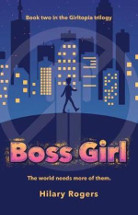
Boss Girl by Hilary Rogers
Girltopia Trilogy, book 2. Scholastic, 2019. ISBN:
9781742994598.
(Age: 10+) Recommended. Themes: Female Empowerment; Viruses; Science
Fiction. Set in Melbourne after a vicious virus has debilitated all
the males in the city leaving them unresponsive and needing constant
care. This story follows on from the first book in the series, Girltopia,
which saw 12 year-old Clara come to the fore as a well-known
identity after her exploits to rescue her father. In Boss Girl,
Clara is displaying her 'good girl' traits again, looking after the
sick, running activities for young girls, supporting her friends and
following the directions of her mother, who works as a scientist
searching for the cure to the virus. But Clara hides a big secret -
a hidden healthy male. This is a secret that she needs to keep from
her mother, she doesn't want Jack to become a scientist's 'guinea
pig'.
As this story unfolds, we see the developing society under female
rule, the entire community responding to the shift in the balance of
power. Some things seem to be moving forward smoothly, and yet a
visit to Clara's mother's work place leaves her with questions. Big
questions! Clara's role and notoriety also places her at the centre
of attention wherever she goes, and she is starting to wonder
whether there is a conspiracy at the heart of the viral attack. Who
can she trust? This book ends with a cliff-hanger - readers will not
be satisfied until the third part of this trilogy reveals what will
happen to all the male Melburnians, and whether there is a solution
and author of this major attack on society.
Written with a light touch, so the horrors of ill-health are merely
the backstory, rather than in the forefront for young readers, this
almost feels more like a Baby-sitters Club story at the
start. Clara is a character who is a 'good girl' role model who
struggles with her parent's separation, fame and even disobeying her
mother's instructions. As the story progresses, we do see more of a
social commentary and there are issues to ponder as the 'female
rule' is played out. Consequently, this book could stimulate
thinking for young readers and therefore is worth recommending.
Carolyn Hull
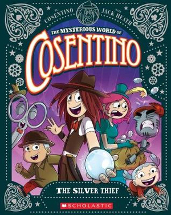
The Silver Thief by Cosentino and Jack Heath
Illus. by James Hart. The Mysterious World of Cosentino book 4. Scholastic, 2019.
ISBN: 9781742999326.
(Age: 7-9) Themes: Magicians, Adventure. Cosentino, the Grand
Illusionist returns in his fourth entertaining story, once again,
filled with magic, illusions, underwater adventure and daring
escapes. The Silver Thief steps off immediately after the
previous novel The Lost Treasure and these junior
illustrated novels need to be read in order.
Cosentino is excitedly preparing to open his new Coppertown magic
theatre and is practising an escape from a big block of ice. While
the dummy in the ice fools the crowd, the disguised illusionist
takes a walk in the park and has a chance encounter with a
mysterious figure. Cosentino is told about the evil King of Diamonds
who has slaves working in his silver mine and is keeping the profits
out of Coppertown.
With friends Ace and Princess Priscilla, Cosentino adopts a creative
disguise to fool the Svengali guards and enter the mine. Is it a
trap? Who does the King have slaving away in his mines? With the
help of some clever tricks Cosentino rescues the slaves, just in
time for his opening performance.
Jack Heath and Cosentino have created a cast of interesting
characters, added plenty of adventure and some exciting tricks.
James Hart's black, white and turquoise cartoon illustrations add
drama to this easy-to-read novel for ages 7-9. For the budding
magician, there are step-by-step instructions to make a vision box.
Rhyllis Bignell
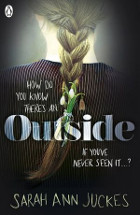
Outside by Sarah Ann Juckes
Penguin Books, 2019. ISBN: 9780241330753.
(Age: 14+) Recommended. Since she was little, Ele was held in a cell
like room by a man called 'Him'. Her twin brother, Zeb, was also in
the cell with her. With nearly nothing to do, Ele started to imagine
things. Gradually, her imagination became so real that she thinks
that they're real. Including thinking that there are 'Others' in the
room with her, and there was simply no 'Outside'.
Juckes painted an intriguing picture of the 'Inside' and was
constantly asking the question 'Would you think there is an outside
if you haven't seen it?' Ele was initially a scared, fearful
character. She liked the inside and didn't want to escape. But over
time she developed bravery and determination. She became curious and
kept asking questions.
The style of the book was mainly imagery, with wonders and
imaginative chapters. Juckes' description of the inside world was
initially hard to understand, and I initially thought that the
characters were animals. But gradually the book became easier to
grasp.
Overall, the events were engaging, the setting is intriguing, the
storyline is well developed, and I would recommend the book.
Kaibing Qi, (Student)
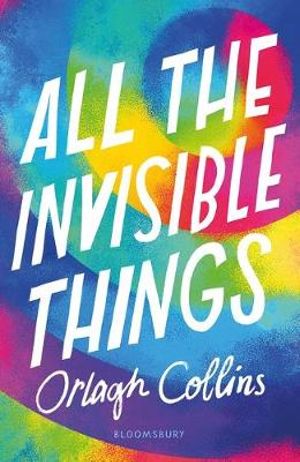
All the invisible things by Orlagh Collins
Bloomsbury, 2019. ISBN: 9781408888339.
(Age: 13+) Highly recommended. Vetty's world changes dramatically
when her mother dies, and her father takes her and her sister to
live closer to their aunt to make life a little easier for them all
while they come to terms with their loss. Aunt Wendy lives with her
partner Fran and the family are welcomed with open arms and what is
supposed to be a short stay ends up being a few years. Vetty is
devastated to leave behind her best friend Pez as they are
inseparable, and no one knows her as well as he does. They live
across the road from each other and spend all their spare time
together.
Unfortunately, they drift apart while she is away and when the time
comes to move back home Vetty hopes that despite this they will be
able to pick up from where they left off. At her farewell get
together with her friends, they are all joking about boys and who
they'd secretly love to kiss and Vetty lets it slip that she might
enjoy kissing a girl in their friendship group. The girls laugh it
off as if she is joking because they know she is good friends with
Pez her childhood friend and are convinced she and him will be
boyfriend/girlfriend. Vetty is mortified that she revealed, albeit
accidently, being attracted to both girls and boys but as she is
moving back to her old home, she is glad she won't have to be
embarrassed in front of her friends if the topic comes up again.
When Pez and Vetty finally catch up again things are a little
different to the way they were before. Vetty feels Pez has changed
in so many ways and is keeping things from her but despite this they
fall back into hanging out together again, even if things can feel
awkward at times. Vetty isn't sure how she feels when she learns Pez
has a girlfriend. Is she jealous as a friend or as a love interest?
Pez introduces her to his friends and one of them, Rob, shows
interest in her and they date. When Vetty meets March, Pez's
girlfriend she finds herself attracted to her. March and Vetty
become close friends and after spending a lot of time together Vetty
again questions her sexuality. She tries to talk to Aunt Wendy about
being bisexual, but Wendy thinks she's trying to tell her she's gay
and Vetty becomes despondent and confused, especially after March
kissed her.
Pez reveals a secret to Vetty and things come to a head during a
party. There is an accident involving Pez and during this tumultuous
and frightening time Vetty becomes more and more despondent. What
will happen to Pez and how will Vetty tell March she is attracted to
her?
This book explores coming of age, bisexuality, sexuality, friendship
and grief. I really enjoyed reading it and would highly recommend
it.
Gerri Mills
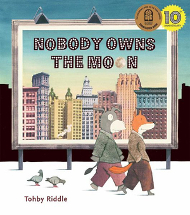
Nobody owns the moon by Tohby Riddle
Berbay Publishing, 2019. ISBN: 9780994384195.
(Age: 4+) Recommended. Themes: Friendship, Cities, Adaptation. The
quick witted fox has adapted well to life in the city. He has
changed his name to Clive Prendergast, and has leant to eat a
variety of foods, living in a one roomed apartment in a busy part of
the town. He works by day in a factory putting things together, and
at night goes out into the streets to look at the sights. He seeks
out his friend, Humphrey and finds him sitting disconsolately in a
doorway. Humphrey is a donkey and has not adapted as well as Clive
to life in the city. He has tried several jobs, but as readers will
be able to see, these positions have not proven to be successful.
They sit together in the park and Clive notices that Humphrey has a
blue envelope in his bag. Opening it he realises that it is an
invitation to an exclusive theatre opening night. They attend and
are treated to drinks and nibbles beforehand, and find themselves in
the most luxurious of seats to watch the play, Nobody Owns the
Moon. They laugh and cry during the performance and again find
themselves treated to coffee and cake afterwards. Returning home,
they are ecstatic about their town and hug each other before going
their separate ways.
First published in 2008, this is a wonderful treatise on friendship
- of being together, the illustrations detailing the life led by the
two animals in the city. The background will delight the readers,
and they will be concerned for Humphrey as he does not quite fit in
as Clive does. From this readers will perhaps ponder the move to the
city by the world's population, looking at how we adapt to life in
the city and the problem of homelessness which has followed. Quirky,
endlessly fascinating, Riddle always presents a challenge to his
readers, making them think outside the box, muse on what makes us
human, and look at one of the basic tenets of our existence, the
companionship of others.
Fran Knight
Charlie changes into a chicken by Sam Copeland
Illus. by Sarah Horne. Penguin, 2019, ISBN: 9780241346211.
(Age: 8-10 Themes: Family stories, School stories, Humour.
Nine-year-old Charlie McGuffin's life is stressful, his older
brother Smooth Move is seriously ill in hospital and his parents are
extremely worried about him. At school the school bully is focussed
on his target, Charlie.
When Charlie becomes 'sweatily, heart-poundingly, stressed' he
starts to panic, which unfortunately leads to some life-changing
problems: he morphs into an animal. With an unusual electric
feeling, Charlie changes into an eight-legged eight-eyed hairy
spider chased by their cat Chairman Mao.
The school play is coming up soon and Charlie's worries increase as
he's been cast as Sad Potato Number 1. Unfortunately, his on-stage
partner is Duncan his arch-nemesis. What happens if he turns into a
naked mole rat or a fish in front of the audience? He turns to his
friends for help to assist him with this life-changing issue.
Sam Copeland writes in a humorous style, with plenty of comments,
asides to the reader, laugh-out-loud situations like Charlie the
rhinoceros pooping out of his bedroom window onto his parents. The
animal antics and silly situations that occur when Charlie is a
flea, a spider or a pigeon are creatively illustrated by Sarah
Horne. With plenty of grossness, impossibly funny scenes and narrow
escapes, along side some special family moments Charlie changes
into a chicken is just right for readers from eight to ten to
enjoy. Teacher's
notes are available.
Rhyllis Bignell
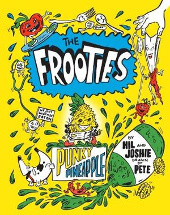
Punky Pineapple by Hilary Rogers and Josh Lefers
Illus. by Pete Petrovic. The Frooties book 3. Scholastic,
2019. ISBN: 9781742765983.
(Age:7-9) Themes: Fruit, Missing persons. The Frooties
series is jam-packed with crazy fruit, creative and quirky
characters and plenty of action in the kitchen. In this third book,
Punky Pineapple steps up as the bodyguard of Miss Starfruit. He's a
tough character outfitted in his punky jacket, torn t-shirt, tough
boots with a stylish tropical mohawk and prickly skin. He's really
sweet, perfect on a pizza, amazing as a morning juice and great in a
fruit salad.
On the opening night of 'Starfruit Wars', the whole fruit bowl of
characters comes out to watch movie star Miss Starfruit's acting.
Cue, the Star Wars spoofs, the opening scenes rewritten, Darth
Farter and Princess Yummy Bum are main characters. Just before
midnight the theatre lights darken and Miss Starfruit disappears.
Punky Pineapple recruits Little Chilli, the Cherry Twins, and Banana
Dog to help him as 'Frootie Detectives.' They overcome the perils of
the Electric Waterfall, the dreaded Bottom Drawer, and the deathly
slopes of the Freezy Freezer on their search for the missing star.
Pete Petrovic's amusing cartoon illustrations bring the Frooties to
life. What craziness ensues as they dash across the kitchen as they
land inside the Electric Waterfall that burns Punky's skin, then
being chased by the mad vacuum cleaner and landing amongst the
strange creatures that lurk in the Bottom Drawer. Punky Pineapple has easy to read text, bold text, catchy
captions and in your face humour just right for young readers and
for reluctant readers. Hil and Joshie explore the importance of
helping friends, making choices to do the right thing and also
standing up for yourself. A little twisted is the promotion of the
healthy benefits of eating fruit!
Rhyllis Bignell
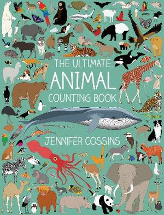
The ultimate animal counting book by Jennifer Cossins
Hachette Australia, 2019. ISBN: 9780734418852.
(Ages: 4+) Highly recommended. Themes: Animals, Counting Book. This
is not called the 'Ultimate' counting book for no reason - it really
does count animals from 1 to 100, beginning with 1 blue whale and
finishing with 100 fairy flies. This is Cossin's fourth book about
animals (others are A-Z
of endangered animals, 101
collective nouns, The baby animal book and
A-Z
of Australian animals), with each having a slightly
different focus. Not only is this a counting book but the animals
are ordered from biggest to smallest. In addition, there are several
short facts included about each animal. Cossins' illustrative style
is unique: realistic yet playful, featuring true colours and
incredible detail. The research that has gone into each page may not
be immediately recognisable, but is hidden within the very precise
illustrations. For example, many pages depict different species of
the one animal (the sea turtle page features leatherback sea
turtles, green sea turtles and the Olive Ridley sea turtle). This is
a book for children to dip in and out of, flick through alone or
share with an adult. It is a superb celebration of the world of
animals and the diversity of life on our planet. In her note at the
back of the book Cossins says that her goal was to 'inspire children
to learn more about the natural world' and to act as a 'reminder of
how beautiful and interesting the world around us truly is'. Her
dedication to her work, the love that she puts into everything she
does and her incredible talent make this a really special
publication.
Nicole Nelson
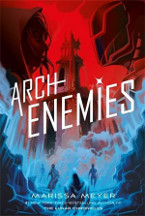
Archenemies by Marissa Meyer
Renegades trilogy, book 2. Pan Macmillan, 2018. ISBN:
9781760559526.
(Age: 12+) Highly recommended. Archenemies by Marissa Meyer
is the second book of the Renegades trilogy. This is a
continuation of Renegades,
the previous book in the series and takes place shortly after the
conclusion of the first book. Much like the first book Renegades,
Archenemies also has aspects of an Action/Romance novel which
takes place in a world of superheroes and supervillains. The two
main characters Nova and Adrian are friends and each have a romantic
interest with the other, however unbeknownst to each other they are
each other's worst nightmares; Adrian as the Sentinel and Nova as
Nightmare. After the ending of the first book Nova is trusted by the
Renegades even more after she saved many of them from an explosive
death. Nova however is struggling to hide her feelings for Adrian
while she attempts to destroy the Renegades, the so-called heroes
who failed her in her time of need.
Much like the first book this was an enjoyable read and a great
continuation of the series. From the beginning I was immersed with
the story as I knew the characters, and I wanted to know what
happened next. Compared to the previous book, Archenemies is
very action packed and there are numerous fighting scenes described
in the book. The characters are also developed more and become more
of their own persona and feel more real, as if they were a real
person. I would recommend Archenemies to people who have
read the previous book Renegades
and who have a love for superheroes and comics.
Hoop P. (Student)
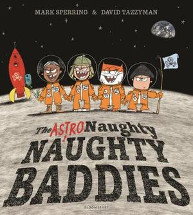
The astro naughty naughty Baddies by Mark Sperring
Illus. by David Tazzyman. Bloomsbury, 2019. ISBN: 9781408897782.
(Ages: 5-9) Themes: Humorous Stories. This is a follow-up to 2017's
The
naughty naughty Baddies, in which four diabolically dreadful
children attempt to steal all the spots off the Queen's Little Doggy
Woof-Woof. In this instalment the Baddies are about to blast off to
the moon. Why? To capture some aliens of course and win a toy-tastic
reward of course. But taking off into space and bringing back aliens
isn't naughty, is it? Why not pretend to be aliens and HOODWINK the
President into giving them the reward?!
Mark Sperring is probably best known for his Dino series (Dino-Mummy,
Dino-Daddy,
etc.) and David Tazzyman for his illustrative work in the
bestselling You
can't take an elephant on the bus. Tazzyman's cartoonish,
scribbly illustrations work perfectly with this madcap tale
featuring four intelligent but horrid children and humorous details
abound within each picture. The text reads incredibly well aloud and
has perfect pace, rhythm and suggested expression ('In three clicks
of a knitting needle the DASTARDLY plan was underway and, at EXACTLY
four minutes past snack time, the Naughty, Naughty Baddies landed in
the President's bedroom'). This is silly and fun with an
uncomplicated storyline and school-age children will love it. Adults
might not want to be encouraging naughty behaviour but their
behaviour is ridiculous rather than naughty (and they don't actually
get away with the reward) and the President is also a laughable
person, far too easily tricked by these children and their makeshift
alien costumes!
Nicole Nelson
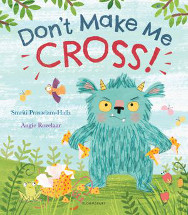
Don't make me cross by Smriti Prasadam-Halls
Ill. by Angie Rozelaar. Bloomsbury, 2019. ISBN 9781408885611
(Age: 4+) Recommended. Themes: Selfishness, Sharing, Anger, Birthday
parties, Friendship, Family. Little Monster is very unhappy. It is
his birthday and although he has invited his friends, they do not
seem to revel in his winning all the games or eating all the best
food. He likes to win, and when he does not, he becomes very cross,
displaying his bad temper for all to see. Sitting at the table he
takes all the best food, after all it is his birthday, much to the
chagrin of his guests. When the group plays hide and seek, the
disgruntled guests take the game at its word, and hide so that
Little Monster cannot find them.
Told in four line rhyming stanzas, children will laugh out loud at
the antics of Little Monster, displaying his bad temper and selfish
behaviour for all to see. Children will love anticipating the last
word of each verse, learning some of the verses to repeat with the
reader, or say out loud to their friends. They will easily recognise
the bad behaviour of the monster, and learn that perhaps his
behaviour is not the kind of behaviour that wins friends. They will
laugh out loud at the results of his selfishness as he falls over
the table laden with all the food, but smile as his friends forgive
him when he realises the folly of his behaviour.
A neatly drawn cautionary tale, children will recognise the moral,
and be enchanted with the funny illustrations, making the most of
the behaviour tantrums put on by Little Monster. The looks on the
faces will brings tears of laughter, while the things the monster
does in wrecking his own party will cause readers to talk about the
things he should have done in welcoming people to his party.
Fran Knight
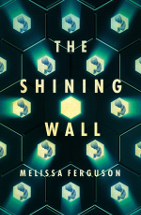
The shining wall by Melissa Ferguson
Transit Lounge Publishing; 2019. 295p; pbk. ISBN: 9781925760187.
(Age: Senior secondary) The novel is set in a distant future, where
the elite lock themselves in a mega city and clone Neanderthals to
do their dirty work, while the disadvantaged struggle to survive
outside the walls. Impoverished 'Demi-Citizen' Alida is trying to
survive while providing for her ill sister, while Neanderthal clone
Shuqba questions her beliefs when faced with prejudice and
injustice.
And that's all that happens for hundreds of pages. The pacing leaves
something to be desired, with much of the novel's early chapters
just setting up character relationships and how terribly grim the
world is. The sisters spend longer together than apart, where their
separation is supposed to be the driving conflict once events
finally start moving.
The use of slang was also distracting - words like 'sleep', 'see'
and 'money' just don't exist in this world, which could easily
confuse a non-native speaker.
In general, The shining wall does a poor job of engaging the
reader, and does not seem to have much to say besides the stale
message about classism its entire genre shades.
Due to the high mature audience themes including drug abuse and
prostitution evident throughout, this book is not recommended for
readers younger than upper high school (Years 10-12).
Vincent Hermann
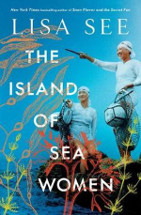
The island of sea women by Lisa See
Simon and Schuster, 2019. ISBN: 9781471183850.
(Age: 16+) Highly recommended. 'A woman is not meant for the
household!' Did you know that on the island of Jeju in Korea, it was
the tradition in the 1930s for women to go to work, diving for
abalone, octopus, sea urchins, crabs and sea slugs, bringing in
their sea harvest to support their families? It was the men who
stayed home, cooked the meals and tended to the children. The
haenyeo, women divers, were expert at capturing their breath and
diving deep, taking what they needed and living in harmony with
their environment.
Young-sook and Mi-ja are two haenyeo friends, diving together.
Young-sook is continuing her family tradition, diving with her
mother, whilst Mi-ja is the daughter of a despised Japanese
collaborator living with an abusive uncle and aunt, never knowing
the love of a mother. Young-sook's mother takes Mi-ja into the
diving collective, and trains her along with her daughter. The two
girls become the closest of friends.
From the first chapter, we know that something has happened between
the two girls. It is 2008 and Young-sook, as an old woman, is
collecting algae along the shore when she is approached by an
American tourist asking about her grandmother Mi-ja. Young-sook
denies ever knowing her. Why does Young-sook lie, and why does she
refuse to have anything to do with the visitors?
Whilst telling the story of Japanese and American conflict in Korea,
during the 1930s, 1940s, World War II and the Korean War, Lisa See
explores what it means to be close friends, the shared secrets, the
jealousies, and the heart-breaking betrayals - for only a loved
friend knows how to inflict the deepest wound. I think most readers
would identify with that situation - when someone they cared about
lets them down or hurts them in some way. But the mystery of what it
was that divided the two young women carries the reader breathlessly
to the very last chapter.
This is a really interesting book, combining a well-researched
history of the period, with a thought-provoking exploration of
friendship, and the bitter after-effects of being unable to forgive.
Helen Eddy
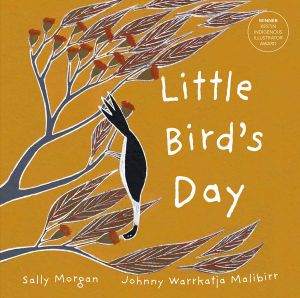
Little Bird's day by Sally Morgan
Ill. by Johnny Warrkatja Malibiir. Magabala Books, 2019. ISBN:
9781925768923.
(Age: 4+) Highly recommended. Themes: Aboriginal themes, Birds,
Humour. Little Bird welcomes the day as the sun rises, ready to
'sing the world alive' as he watches those that have not risen with
the sun, is buffeted by the wind blowing the trees and leaves, flies
with the clouds up high, joins other feathery friends, opens his
wings to the rain to wash his body, then flies into the dusk. With
night falling, Little Bird sits on a branch ready to roost with the
other birds, worn out from their day of activity.
The seemingly simple text allows children to see the way the day
unfolds, teaching them the words for many parts of their environment
and for the parts of the day. Little Bird's Day teaches young children about the morning
sun, the time to wake up, the day where you frolic with friends, but
must wash at some time, the dusk when things start to slow down, the
evening when sleep comes.
This charming story will captivate all readers, watching and
learning of Little Bird's day, recognising their own participation
as the day unfolds.
Malibirr's glorious illustrations are spell binding as he uses
traditional colours (red, brown, ochre, black and white) as well as
motifs (closely packed lines and large panels of white outlined
colour) to show the Little Bird at his tasks during the day. Readers
will love looking at the humour in the illustrations, highlighting
the bird's interaction with the other animals and rest with him when
he falls asleep on the branch with the other birds.
Malibirr is the inaugural winner of the Kestin Indigenous
Illustrator's Award.
Fran Knight