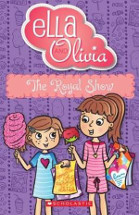
Illus. by Danielle McDonald. Ella and Olivia book 23,
Scholastic, 2019. ISBN: 9781742999784.
(Ages 5-7) Recommended. Themes: The Royal Show, Families. Yvette
Poshoglian captures the special moments in Ella and Olivia's family
life. It's time for The Royal Show and both sisters are busy earning
money to spend on showbags and carnival games. Ella and Olivia are
in the middle of a cleaning frenzy, 'their bedrooms shine and the
living room sparkles!' Everyone's excited, Dad's entering his scones
in the baking competition and Mum's created a beautiful quilt to
participate in the craft show.
There's a real buzz of excitement as the day finally arrives,
they're eager to buy their favourite showbags and watch the wood
chopping. When Ella scans her ticket at the gates, bells ring, she's
a winner and her prize is a special showbag. Olivia begins to feel a
bit let down when Mum and Dad also receive special news about their
baking and sewing. How will young Olivia's show day end, will there
be a special surprise for her at the evening's events in the Grand
Arena?
Yvette Poshoglian's delightful stories are written specifically for
early readers who enjoy simple fun plots and relatable characters.
She celebrates the special relationship sisters Ella and Olivia
share and the simple joys of special events. Danielle McDonald's
cute drawings support the transition from picture book to beginning
novel. The Royal Show is another charming story just right
for young fans.
Rhyllis Bignell
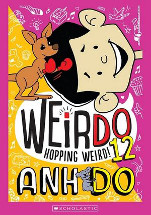
Hopping weird by Ahn Do
Illus. by Jules Faber. Weirdo book 13. Scholastic, 2019.
ISBN: 9781742997926.
(Ages: 7-9) Themes: Kangaroos, Animals - care and health. Step
straight into the crazy world of Weir Do and his family as Mum's new
job impacts on their home life. She's working as a nurse at the
animal hospital and she brings some of the sick animals home. Weir
shows Kenny the koala how to chew gum leaves, of course they are
toxic and unpleasant tasting and he spits them out! Fun and games
happen when they dress the koala in little brother Roger's overalls.
At school, Weir and Bella struggle with their movie-making
assignment on friendship. Miss Franklin their teacher wants everyone
to make a short movie, but both children can't decide on what to
film. Mum's brought home a baby kangaroo for the family to care for
and Weir and Sally begin to document Joey's recovery. They capture
Joey eating the Fido's food and sleeping in his bed while Grandpa
makes a special apron with a pouch for the baby roo to snuggle in.
Dad provides plenty of silly jokes while Mum teaches Joey how to
survive in the bush.
They even venture into the bush, using the triangle tag tracker to
find Joey's mother and return her youngster back to her. Weir and
Bella film the search, with a few false starts, finally locating the
kangaroo. Back at school they realise the true meaning of
friendship, when they share Joey's journey with the class. Hopping weird is illustrated with Jules Faber's funny
cartoons of the joey's antics and the family's responses. Hot pink
is the colour focus from the fun lenticular cover to the accents and
creative font sizes and styles. Ahn Do's amusing and entertaining
story includes plenty of laugh-out-loud moments as well as exploring
the theme of friendship. The Weirdo series are just right
for beginning chapter books and for reluctant readers. This is
another winner for Ahn Do; fans of the Weirdo series will
find Hopping weird entertaining.
Rhyllis Bignell
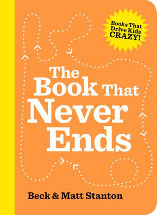
The book that never ends by Beck and Matt Stanton
HarperCollins Children's Books, 2018. ISBN: 9780733337994.
(Age: 4+) Themes: Humour, Choose your own adventure. This is the
final book in the unique Books that drive kids crazy series.
It is a choose-your-own type adventure for younger children to be
navigated through either with an adult or on their own if they are
reading. A simple explanation may be necessary so children
understand that this book does not follow the usual way you read a
book. On each page you are asked a question and then that will lead
you to another page. You may be going backwards and forwards
throughout the book, never getting to the end. As an adult this book
did drive me crazy! However the large text and bright simple
illustrations will appeal to a child's sense of humour. A great
ending to the series.
Kathryn Beilby
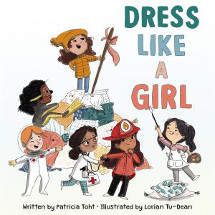
Dress like a girl by Patricia Toht
Illus. by Lorian Tu-Dean. HarperCollins, 2019. ISBN: 9780062798923.
32pp., hbk.
Time for a sleepover and the guests have been instructed to 'dress
like a girl'. But what does that mean?
Does it really mean dresses and high heels, buttons and bows? Or
could it mean a space suit, a wetsuit, a medico's coat or something
entirely original?
Told in rhyme, the opening stanza sums up the focus and purpose of
this book perfectly . . . What does it mean to dress like a girl
Many will tell you in this big, wide world
that there are strict rules that must be addressed,
rules you will need when looking your best.
But when you are given these rules to obey,
the secret is heeding them - in your own way. The strong message is that we are each individuals and we
should be dressing to suit ourselves rather than what others might
say about our appearance, or what 'fashion' dictates or other
external influences. Written for the young girl who is becoming more
aware of the world around her, what others are doing and wearing and
starting to shape her own tastes and preferences, this is a timely
release that should spark lots of discussions not just about what is
'acceptable' but also self-acceptance and the influence of peer
pressure. Do 'clothes maketh the man'?
While Tu-Dean has depicted a diverse range of ethnicities and
origins in the illustrations, there is a strong theme of events like
slumber parties being about the friendships and fun that are common
desires of everyone, rather than differences that divide or separate
or having to conform to a given look to be accepted. Great for the
mindfulness collection.
Barbara Braxton
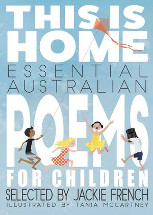
This is home: essential Australian poems for children selected by Jackie French
Illus. by Tania McCartney. NLA, 2019. ISBN: 9780642279385.
(Age: 8+) Recommended. Themes: Poetry. In her introduction, French
tells us that she has selected a group of poems that tell of our
country for readers from eight years old. In selecting she has
included some old favourites, some newer and some never before
published, many humorous and all to reflect the diverse background,
culture and history of this country.
Beginning with a page which gives some information about the sorts
of poems included, the reader must then turn to the index to find
the poem. I missed having a contents page but the index provided my
source of where to find things.
And what a coverage; from The man from Snowy River (Banjo
Paterson) to Grass trees (Jackie Hosking) Dog days
(Elaine Harris) Puddin' song (Norman Lindsay) Ward
((Shaun Tan) the list includes many old favourites by Paterson,
Henry Lawson, Odgeroo Noonuccal, but also newer poems by Meredith
Costain, Christopher Cheng, Steven Herrick, Leigh Hobbs and Janeen
Brian to name a few. Supported by McCartney's very funny
illustrations, each page is lifted by the visual story which
accompanies the poems, be it a nostalgic rural scene, Uluru, a group
of children playing, a coastal vista, or a city panorama. All filled
with a warm humour, each drawing is recognisable and endearing.
It is a book to dip into, to reread known poems and those not seen
before, to delight in the sweep of the classic Australian way of
life to one more attuned to today's world, to laugh out loud, to be
still and sad, to be aroused and be made thoughtful. But in the end,
poems are written to be read out loud, to share, to marvel at a
poet's ability to say so much in so few words, to create so much
passion in a phrase, to tell a story that will stay with you. And
this collection is full of poems that will do just that.
Fran Knight
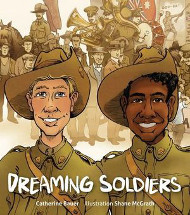
Dreaming Soldiers by Catherine Bauer
Illus. by Shane McGrath. Big Sky Publishing, 2018. ISBN:
9781925675528.
(Age: 7-13 years) Highly recommended. Themes: World War 1, ANZAC
Day, Indigenous soldiers, War Veterans, Dreaming, Friendship,
Australian History, Outback South Australia. Jimmy and Johno have
shared everything growing up in outback South Australia. Life on an
outback station meant they were free to do as they pleased. As they
grew up Johnno went off to school and university in the city but
always came home to his family and great mate, Jimmy. The two lads
eventually signed up and went off to fight in World War 1. They
served together and loyally looked after each other.
This is an excellent story to share with students about the meaning
of ANZAC Day and the theme of mateship. The illustrations support
the text beautifully. This simply written story sensitively provides
an historical perspective of the racism and discrimination endured
by Indigenous people and returning soldiers. It would be a wonderful
starting point for a discussion with older primary-aged students
looking at Indigenous History in Australia.
Indigenous soldiers returning home from the horrors of World War I
were plunged headlong into another long-running battle. Read the
full story in a timely article the link to which is provided: 'They
were back to being black': The land withheld from returning
Indigenous soldiers. Teacher's
notes are available.
Kathryn Beilby
A dog's journey by W. Bruce Cameron
Pan Macmillan, 2019. ISBN: 9781760786052.
Some of us look after dogs and see to their welfare. What we
don't know is that dogs are born with a dedication to look after
humans and, having relatively short lives in comparison, are re-born
periodically to reengage with their human.
The system is revealed in this story where Buddy is still alive
after his human Ethan (an old man who the dog has served and
protected from childhood) has died. Growing old himself, Buddy is
still protective of Ethan's partner and their grand daughter Charity
until the moment he passes peacefully.
When Charity finds herself lost and vulnerable in her teenage years,
it is clear that a dog must take charge and the former Buddy is
rebirthed as a female dog Molly. Without giving the story away, the
same dog has the capacity to reappear as a different breed or gender
after dying, if their human needs them at some stage of their life.
The former Buddy is surprised to have been reborn, having assumed
that his own life journey would be complete given that his human was
no longer alive. Even as tiny puppies, dogs will have memories of
their former lives, when they were bonded to their human.
This is an unashamedly sappy story but anyone who has owned or spent
time with dogs will recognise the premise and will secretly want to
believe. The story definitely prompts the reader to think deeply
about the amazing loyalty and love shown by dogs, even when their
owners neglect or mistreat them. The ceaseless desire to please
their human, to protect them from harm and to try to soothe their
pain is beautifully depicted in this novel. What struck me deeply is
that dogs have no power to determine their own fate and can only
trust in the goodness of humankind. Sadly, all too often these
innocent creatures will suffer because individuals or human systems
don't recognise the purpose of dogs.
Any person who has ever recognised a dog's silly grin, observed the
tail wag of affection, or felt the press of a loving canine against
their leg should read this book to better understand these
creatures. Those who have not experienced dog moments should read
the book for the same reason.
Rob Welsh
I love my Mum because by Petra James
Illus. by Alissa Dinallo. Macmillan Australia, 2019. ISBN:
9781760784386.
(Age: 3-8 years) Themes: Mothers, Mother's Day, Family, Interactive,
Shared reading. This is a simple book that a child could give to
their mum for a special occasion such as Mother's Day or a birthday
. . . or just because they love their mum. The naive style
interactive activities include drawing, colouring in, decorating,
counting and making things. The child can either complete the
activities before giving it to their mum or share the tasks together
in a quiet moment. A lovely idea for upcoming Mother's Day.
Kathryn Beilby
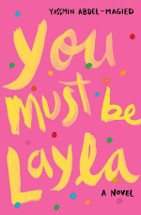
You must be Layla by Yassmin Abdel-Magied
Penguin Books, 2019. ISBN: 9780143788515.
(Age: 13+) Highly recommended. Themes: Diversity, Multicultural
Australia, Muslims, Migrants, Humour, Schools. How refreshing to
hear an authentic voice telling of her experiences as part of a
group in today's Australia. The whole point of the book is that
people are judged not by who they are but how they appear, what they
wear and what they believe, and this causes distrust on both sides.
The title says it all: You must be Layla, an assumption
based around her clothing, not the welcome to the new school that
Layla was expecting, especially after an ignorant school chairman
warns her that putting one step wrong will have her scholarship
terminated. From there her first day in this highly regarded private
school sees Layla suspended after headbutting a boy, Peter, who
repeatedly pushes her and calls her names. But the supportive Tech
teacher steers her towards a competition which she could enter,
using her highly developed skills to make a robot. She puts her
effort into this scheme, hoping to vindicate herself in the eyes of
the school and furthering her aim to be an inventor.
Meanwhile making friends in her new school is tricky and she hangs
out with several boys who are very funny, take her as she is, loud
and forthright, nicknaming her Queen Layla.
At home her parents are most supportive, although her brother has
some issues finding a job when no one will give him a start. And her
mother advises that the trick to resolving the differences with
someone who headbutted you is to ask forgiveness. Forgiveness must
be given on both sides and this advice comes in handy at the climax
of the book.
Layla is a smart, sometime headstrong young woman, sure of herself
and her abilities, ready to prove to everyone at her new school that
she has a place there. She works away at her project, worried that
her friend Ethan seems to be upset, but at the competition she must
make some compromises to remain in as part of Peter's team.
This is a generous book, woven throughout we see a working Muslim
family and their beliefs, Layla's clothing and their customs.
Without realising it, the reader will come away with more
information than they expected, learning along the way that Layla
and her family are an Australian family like all of us, part of our
unique migrant experience.
Fran Knight
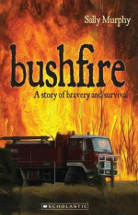
Bushfire by Sally Murphy
My Australian Story. Scholastic, 2019. ISBN: 9781742994307.
(Age: 9-12) Themes: Bushfires, Climate Change. The My Australian
Story series focuses on different historical events that have
impacted and shaped our nation. Sally Murphy's fictional account of
the 2009 Black Saturday bushfires commemorates the 10th anniversary
of this disaster. She draws from real-life accounts, creating an
important message about the effect natural disasters can have on
communities. Between the chapter's summaries of bushfire and other
catastrophic events are included to open the readers' eyes to
importance of planning and the way people rally to support after
these tragic events.
In Bushfire we encounter school girl Amy, her older brother
Aaron who's leaving home for a gap year, her mother who is a climate
change scientist and park ranger and volunteer fire fighter father.
They live in the Victorian town of Healesville. Her Grandma who lost
her home in the Canberra bushfires now lives nearby in Marysville.
Discussions with her family often turn to being bushfire ready and
the science of climate change. Over the summer holidays, Amy visits
her grandma and forms a friendship with a local lad Jackson and they
enjoy swimming at the local pool and lunches from the bakery. Amy
loves collecting information about natural disasters, plane crashes
and rescues. When the bushfire sweeps through the town both
youngsters play a vital role in saving grandma.
Sally Murphy's carefully crafted novel presents an authentic picture
about the reality, the unpredictability and the devastation of
bushfires. Even though the community and family are prepared,
nothing can stop the powerful and overwhelming catastrophe. Central
to Murphy's emotional story is the resilience of the community, the
support of the state and the nation in rallying together to help in
the aftermath. Bushfire is a useful resource for Year 5-6
classrooms, exploring the themes of climate change and practical
preparation in the Australian bushfire.
Rhyllis Bignell
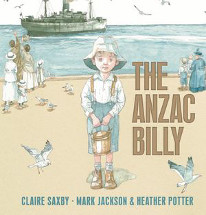
The Anzac Billy by Claire Saxby, Mark Jackson and Heather Potter
Black Dog Books, 2019. ISBN: 9781925126815.
(Age: 5+) Highly recommended. Themes: Anzac Day, World War,
1914-1918. During World War 1, soldiers From Australia and New
Zealand were sent carefully wrapped gifts in a tin billy for
Christmas. Even though the care package could not be sent to an
individual soldier, the little boy in The ANZAC billy, chooses
things that he knows that his father would like and concludes with a
letter: If by chance this billy
Reaches you and not my dad,
I hope you enjoy these treats, sir,
But please send my letter on.
Happy Christmas!
Claire Saxby's prose is lyrical and full of emotion. A little boy
narrates the story, telling the reader what he is adding to the
billy day by day. Butterscotch goes in on Monday, yucky fish on
Tuesday, walnuts on Wednesday, chocolate on Thursday, socks on
Friday and on Saturday and Sunday Mum and Nanna add some essentials
like a razor, soap and handkerchiefs.
The water colour illustrations by Mark Jackson and Heather Potter
are stunning and filled with authentic details of life during World
War 1. They will provide the reader with an in-depth understanding
of the historical period. When the reader first sees the billy being
filled, the background is of a kitchen, with a wood burning stove,
canisters on the shelf, a wooden safe to keep food cool and a
kerosene burning lamp. The photograph of the little boy's father
shows a very young man, and this will tug at the heart strings of
any adult reading it, knowing how young the soldiers were and how
many lost their lives. The shop where the little boy buys the
chocolate bar is full of shelves stocked with the most interesting
produce and outside in the street, the reader can see a new
automobile, the pram that the bay is in and the clothes of the
times. Little details like the family cat that appears in most
pictures and the Christmas decorations add to the loving atmosphere
that pervades the story.
Read aloud in the classroom or at home, this would make a poignant
and heart-warming story to commemorate Anzac Day and an excellent
reference book for life in the early 20th century. Teacher's
notes are available from the publisher.
Pat Pledger
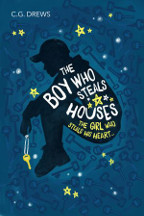
The boy who steals houses by C.G. Drews
Hachette Books Australia, 2019. ISBN: 9781408349922. 346p
(Age: 14+) Highly recommended. Themes: Family/Bildungsroman. Sam and
Avery have been fending for themselves for nearly two years.
Gradually, we establish that their emotionally distant aunt cared
for the two teenage brothers after their abusive father abandoned
them. Sam will do anything to protect his older brother Avery, who
has autism, which has led to Sam's own anger management issues at
school and beyond. In order for them to survive, Sam perfects the
art of temporarily inhabiting the homes of families on vacation. For
money, they work as a team to pick pockets.
But Avery is unhappy and seeking independence. A mechanical savant,
he finds a job in a garage and moves into a crack house. Sam fears
for Avery, who is vulnerable but cannot convince him to continue to
break into empty houses together. Distracted and alone, Sam chooses
a house and in the manner of Goldilocks, falls asleep in a big
armchair in a disused room. When the De Lainey family return
unexpectedly, Sam is trapped. In the course of making his escape,
each sibling mistakes him for the friend of one of the others. In a
comedy of errors, Sam is welcomed into a real family - one he has
always dreamed of belonging to.
When the jig is finally up, the mess is spectacular but not before
Sam falls in love with Moxie, after spending the summer surrounded
by her gorgeous, loving family.
Dysfunctional families and making it out the other side, is C.G.
Drews' forte. This story is every bit as harrowing but more nuanced
than her earlier novel, A
Thousand Perfect Notes. The number of resonant issues
affecting the major characters and the burgeoning romance between
Sam and Moxie, guarantee another page turner for this rousing young
author.
Deborah Robins
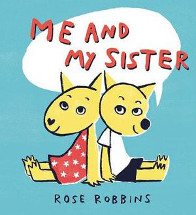
Me and my sister by Rose Robbins
Allen and Unwin, 2019. ISBN: 9781760524456.
(Age: all) Highly recommended. Themes: Autism, Difference,
Disability, Family, Siblings. What an amazing book. The narrator
explains that he and his sister like doing the same things, although
sometimes at different times, they like different foods, his sister
makes him laugh and she is sometimes rude to Nanna, but Nanna
understands. They go to different schools, and learn different
things.
From the first few pages readers are aware that his sister has a
disability and watch as he copes with a sister who is different.
Readers will applaud him as he waves good bye to his sister on her
school bus, and helps his sister when she is upset, knowing that she
does not like to be hugged, using a high five instead. Readers will
be embarrassed along with him as people in the street are rude, and
thankful that Nanna understands his sister, when sometime he does
not.
All the way through this wonderfully understated book, clues are
given as to how children should react to a child who is different;
being gentle and kind, not touching them, comforting them when they
are upset, recognising signs that they wish to be alone and so on.
The boldly outlined illustrations replete with swathes of primary
colours, enhance the lives of these two children, making them
central to the story, without any distractions on each page. The boy
tells his tale in capital letters, reflecting the life he leads with
his sister. Things are never calm or on an even keel, the whole
family is aware that their family is different and must react to
their daughter's difference.
The author cleverly shows a child wanting to be the best he can be
to help his sister, but also aware that sometimes he may do the
wrong thing or not quite understand. She calmly tells the readers
that it is alright to feel frustrated sometimes, to be upset when
you are told off but not your sister, to want to be by yourself
sometimes without her. A wonderful awareness raising book, first
published in England, this will find a place in all classrooms where
diversity is encouraged and accepted. Teacher
notes are available.
Fran Knight
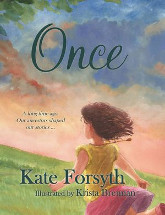
Once by Kate Forsyth
Illus. by Krista Brennan. Wombat Books, 2019. ISBN: 9781925563566.
(Age: 5+) Recommended. Themes: Australia - History, Storytelling,
Women. On the cover are the words 'A long time ago, Our ancestors
shaped our stories . . . ' and in this evocative picture book, Kate
Forsyth traces the impact that her ancestors' storytelling has had
on her and the influence that stories can have on everyone. Starting
with her great-great-great grandmother who 'grew up in the shadow of
a cursed castle' she writes of the stories that were told at the
knees of successive women. Her great-great grandmother 'Travelled
far, far across the seas', with 'a head full of stories' and settled
in Australia. Her great grandmother listened to those stories and in
turn passed them on, culminating in Kate Holding high a flaming torch
Lit long, long ago
When words were first shaped.
This is an inspiring book that will be a joy for children to read
and think about. The power of story comes across vividly as the
journeys of Kate's ancestors are depicted across the ages. We see
the immigrant sailing in a ship, the pioneer searching for gold and
fighting fires, the young woman living through war, another young
woman marching for peace and equal rights, and finally a young child
growing up in the space age and collecting stories to pass on too.
It is not difficult to see how important stories have been to Kate's
family and to realise how important they are in all families.
The illustrations convey an authentic feeling to each key historical
period, each picture showing the dress and living conditions of the
times. The young woman fighting a fire in a tent during the gold
rush was particularly evocative as she tried to put it out with a
baby's blanket. These images could lead to discussion about how
people lived in different eras and a class could make a time line of
Australian history by following the text and pictures.
This is a lovely tribute to the women who have been so influential
in the author's writing life and could encourage children and adults
to find out stories of their own ancestors. Teacher's
notes are available.
Pat Pledger
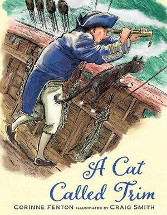
A cat called Trim by Corinne Fenton
Ill. by Craig Smith. Allen and Unwin, 2019. ISBN: 9781760631840.
(Age: 4 - Adult) Highly recommended. Themes: Matthew Flinders,
Exploration, Life at sea, Sailing, Companion animals, Australian
history. Matthew Flinders' cat, Trim takes centre stage in this
appealing book of his life alongside one of the world's outstanding
explorers. A kitten born aboard the HMS Reliance in 1799, he
was taken in by Flinders noticing his courage and lack of timidity.
He prowled the ship, killing mice, joining Flinders at the Captain's
table, then going below to join the crew for any tidbits. Saved by
Flinders when he fell overboard, Trim was with Flinders aboard HMS
Investigator as he sailed around parts of Australia, coming to grief
on the Great Barrier Reef.
Sailing across the Indian Ocean in 1804 Flinders had to call in for
repairs and supplies at Isle de France only to be seized as a spy
and imprisoned. Trim would venture out at night but one night he
failed to return, and when Flinders was released in 1810, he sailed
home alone.
Statues of Captain Flinders and his cat have been erected in Port
Lincoln and Lincolnshire, while a small statue of Trim has been
erected behind that of Flinders outside the Mitchell Library in
Sydney, which houses many of his papers. Trim: being the true story of a brave, seafaring cat by
Matthew Flinders was published in 1977 after Flinders wrote a
biographical sketch of his cat in 1809 while he was imprisoned in
Isle de France (Mauritius).
This wonderful book relates the story of Trim and his life with
Flinders, giving readers a great deal of information about Flinders'
explorative work and why he is so important to Australia. It details
the ships he sailed after Trim's arrival, and Craig Smith includes
drawings of these in his detailed and engrossing illustrations as
well as enticing endpapers with maps of Flinders' voyages. Smith
breathes life into the crew's years on board ship detailing the
perils of life at sea for all to wonder at. From falling overboard,
to sewing up the sails, being wrecked on the Great Barrier Reef and
having to wait for your captain to return, sometimes months later,
or putting up with the vermin that inhabited the ship, all is shown
in this glorious book.
Fenton tells the story of the night in 1804 when Trim did not return
from one of his night's escapades and muses that perhaps he was off
on another adventure, although the story goes that someone ate him!
This wonderful book will encourage younger children to find out more
about Captain Flinders and his mercurial cat, delving into the
exploration that Flinders undertook, naming Australia, and mapping
the continent, so realising why there are so many statures of him
around the world, with and without Trim.
Fran Knight