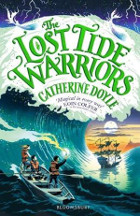
Bloomsbury, 2019. ISBN: 9781408896907.
Recommended for lovers of fantasy, aged 10+. Fionn is the anointed
'Stormkeeper', but it seems that his magic is not like other
Stormkeepers and his island is depending on him to protect them from
the return of the awful Morrigan and her supporters, the
Soulstalkers. The uncertainty and self-doubt that surrounds Fionn,
under the pressure of a deadline, places pressure on the young man .
. . but he must carry on, the island of Arronmore needs him. His
Grandfather, the previous Stormkeeper, is losing his hold on his own
magic and his memory, and Fionn must rely on his close friends and
mother and sister to create a plan to turn back the tide of evil
that is encroaching. With a long history of magical events and
intra-island rivalry there is drama at every turn and the
approaching 'storm' of conflict needs the outside help of the
merrows - ocean-based fantasy creatures. But how will they get word
to these creatures in time?
This is the sequel to The
Stormkeeper's Island and although it could be read as a
stand-alone book, it is best read in sequence so the understanding
of the magic, the time shifts and the candles that store memories
would be clear. The book is a delight as the internal self-doubt of
the young Fionn drives the tension as the islanders face the threat
of annihilation at the hands of the advancing evil 'army'. This
series deserves to be recommended to young readers who love fantasy
adventure. In no way is it like Harry Potter, but the reticent
central hero is akin to Harry in being intensely likeable and
supported by loyal friends. The magic is different, but the
atmospheric adventure is worth following. Catherine Boyle also
manages to capture the atmosphere of the small Irish island with its
storms, fogs and swells. It almost takes on a personality of its
own.
And there is another book in the series to come!
Themes: Magic; Fantasy; Adventure; Good vs Evil.
Carolyn Hull
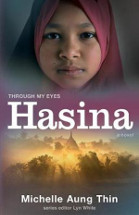
Hasina by Michelle Aung Thin
Through My Eyes series. Allen and Unwin, 2019. ISBN:
9781760637286. pbk., 215pgs.
(Age: Upper pimary) Oh wow, what a gripping a story of one child's
experience of persecution in Myanmar (Burma). Hasina is the
latest book out in the Through My Eyes series. Each book in
the series is written by a different author writing to help us
understand about the courage and plight of forced migration and
refugee situations seen through the eyes of a child.
As a teacher who works with children from Myanmar, I was hooked from
the start and could not put the book Hasina down. My eyes
were opened to the innocence of children living in Myanmar and how
their families and world was torn apart. My heart goes out to
everyone over there and other places around the world. Hasina
is one book that I would share with my students. You can also find
teachers notes on the Through My Eyes books' website.
Hasina was a happy teenager when overnight everything changed. Her
father and aunt yell to her to get up and run and not to stop.
Hasina, her little brother Araf and her cousin Ghadiya run into the
Rakine forest. When they emerge from the forest their world has
changed. With no food, no family, their fight for survival starts.
Their lives are under constant threat from the natural elements,
people they know and meet and of cause the soldiers.
I did like how the author described how Hasina's numal, her head
scarf did not make her feel dignified or modest anymore and it felt
like it was making her a target that drew attention to her for being
Muslim. This is also something that happens in Australia.
Hasina is another story in the Through My Eyes series for
upper primary. It shows, once again, that although we may live in
different parts of the world and face different struggles some
things remain the same. Family, survival and belief in peace are
strong themes in this book. The main characters are believable and
their various responses to their situation authentically written.
A great addition to a bookshelf that includes stories about children
from around the world that tell stories of young people living in
conflict zones around the world.
Maria Komninos
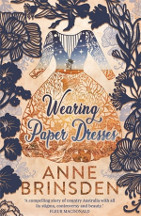
Wearing paper dresses by Anne Brinsden
Macmillan, 2019. ISBN: 9781760784850.
(Age: Adult - Adolescent) Highly recommended. This stunning work, a
story of love and terrible loss, and of the struggle to survive,
tells the story of a family who live in on a farm in the Mallee in
the 1950s. The narrative is set in this dry, hard country of
northern Victoria, an area that is so often starved for rain, where
people, Brinsden writes, found survival 'precarious'. When his wife
dies, Pa asks his son and family to move back to the family farm.
While this region of Australia experiences frequent droughts, and
the earth is difficult to farm, Bill is determined to help his
father. It is clear from the start of the story that his wife,
Elise, is not at ease, and her mental state fluctuates wildly, yet
she loves her family and tries to understand the culture of the
countryside. She is angry with the girls, Marjorie and Ruby, whom
she sees as becoming rough and unladylike. Yet we are positioned to
see that her struggle to fit in, to understand the alien culture, is
clearly weakening her mind.
Told from the point of view of Marjorie, one of the daughters, the
narrative creates a world of growing stress, as the family struggle
with the climate, the terrible lack of water, and the tempestuous
nature of the mother's illness. Yet creating and wearing paper
dresses (albeit extraordinarily beautiful ones), even planting
plastic flowers and fake greenery so that at least there is some
colour in the garden, only places her in the 'odd' basket where the
locals are concerned.
We cannot help but be completely drawn into the tragic world of this
family and its heart-rending times, the disasters and the recovery.
When Brinsden writes of the wind, the 'willy-willy feeding on
itself', lurching and swaying in the dust and the heat, crazy and
wild and ruinous and beautiful', her words so reflect so aptly both
the weather and Elise. Her word choice elicits our empathy and
indeed a sense of deep sadness for this family and the world of the
text. She stirs the soul, lifts the emotions and the spirit, yet
enables us to empathise, to feel a deep sense of the heartbreak of
the place and people, and of the triumph of surviving.
Utterly captivating, lyrical and tender, this is storytelling at its
best, and this book is an exciting new narrative that depicts
Australia and its changing culture. Suitable for adolescent and
adult reading.
Elizabeth Bondar
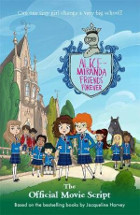
Alice-Miranda friends forever movie tie in books by Jacqueline Harvey
Penguin, 2019. Alice-Miranda friends forever official movie script. ISBN:
9781760896867. Alice-Miranda friends forever : The most positively perfect
journal! ISBN: 9781760896874. Alice-Miranda friends forever activity book. ISBN:
9781760896881. Alice-Miranda 3 in 1. ISBN: 9781760894962.
(Age: 7-10) Highly recommended. Fans of the highly popular Alice-Miranda
series will be thrilled to hear that Alice-Miranda is coming to the
big screen as 'an 80-minute animated movie
with a treasure trove of marvellous mysteries, midnight feasts,
ponies and pyjama parties'. Penguin Books has released a group of
fabulous books to coincide with the movie's release. Alice-Miranda
friends forever official movie script will be a boon for
children as they get the opportunity to actually read a real movie
script with their favourite characters. The book also contains
colour pictures of the characters, Alice-Miranda and Millie's
bedroom, horse-riding, The Winchesterfield-Downsfordvale grounds and
inside Fayle School for Boys. The Alice-Miranda friends forever activity book will provide
hours of fun with quizzes, colouring, drawing faces and word
searches, while the Alice-Miranda friends forever : The most
positively perfect journal! is a beautifully bound, hard-back
journal, with illustrations of the friends on each page just waiting
for eager young authors to write their thoughts, poems, stories and
draw their own illustrations. Alice-Miranda 3 in 1 combines three of the favourite books, Alice-Miranda
at school,Alice-Miranda
on Holiday and Alice-Miranda
Takes the Lead. All three books have been
recommended by ReadPlus reviewers in the past. As one reviewer
writes, 'As much as this little girl is too good to be true, she is
an utterly loveable character, able to endear herself to all with
whom she comes in contact. She proves to be totally unselfish,
thoughtful and equally as engaging a character as was Pollyanna in
my childhood reading.'
This group of books will be a wonderful gift to young children,
while the movie script and Alice-Miranda 3 in 1 should prove
to be very popular in libraries. And the movie is sure to delight
kids as well.
Pat Pledger
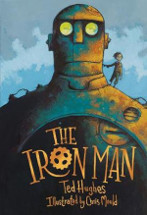
The iron man by Ted Hughes
Illus. by Chris Mould. Faber and Faber, 2019 (c1968) ISBN:
9780571348862.
(age: 6+) Highly recommended. Themes: Cautionary tale, Modern fable,
STEM, Recycling. This outstanding new publication of The Iron
Man will thrill new readers as well as ones who already know
the tale, reminding them of not judging a book by its cover, as they
hear the tale of an outsider at first derided by the village but
then proving his worth beyond comprehension.
In this beautiful edition, Faber presents a book aching to be picked
up and held, its tactile cover enticing all readers to open the
first page.
In the first of five chapters, the Iron Man finds himself in the
sea, bits of him spread over the sea floor. He puts himself together
again, piece by piece and walks to the village, eating the barbed
wire fences along the way, scaring the residents. They build a pit
to trap him and when he falls in, cover him with soil, making a
small hill. But a family sitting to have a picnic finds their family
outing disrupted as the Iron Man rises from below, forcing them to
flee. He has returned. The village calls out the army to rid
themselves of the monster, but Hogarth has a different idea, and
chapter three ends with the monster happily residing at the scrap
metal dump in the village.
But an alien in the form of a space-bat-angel-dragon drops onto
Australia, covering the whole continent. Here it demands food and
military from over the world try to deal with it, without success.
Prompted by Hogarth, the Iron Man has an idea and chapter five
brings the whole to a satisfying conclusion, promoting world peace,
demilitarisation and harmony through music.
Ted Hughes' classic tale, first released in 1968 and rarely out of
print, is presented here with stunning new illustrations. Mould
invests the Iron Man with human characteristics, his mouth and eyes
revealing a host of emotions all children will recognise and love. I
love the intricacies of the Iron Man's body with its cogs and
wheels, nuts and bolts, derricks and winches, steel plate of all
shapes and sizes. Readers will love zeroing in on the make up of the
Iron Man marvelling its duplication on the end papers.
Cautionary in warning readers not to judge people by their
appearance, the story resonates with humour as it is the child in
the village who shows his elders the usefulness of their visitor.
And our audience will thrill at the alien landing in Australia, its
body covering our whole island.
Readers will love the way the story is resolved, the Iron Man
pitting himself against the alien, taken apart and reassembled bit
by bit on the northern beaches of Australia, bringing the world
together with a peaceful conclusion, a modern fable about working
together to promote enduring peace.
Fran Knight
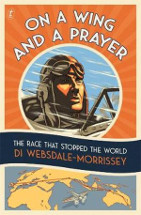
On a wing and a prayer: The race that stopped the world by Di Websdale-Morrissey
Text, 2019. ISBN: 9781925773989. pbk., 320 pages.
(Age: 12+) A must read for anyone interested in aviation history. Di
Websdale-Morrissey's extensive research on the great London to
Melbourne race has truly made On a Wing and A Prayer a true
factual page turning adventure that I had to keep reading. I had to
know what was going to happen next. On A Wing and A Prayer is the story of the 1934 air race from
London to Melbourne which was conceived by Melbourne's Lord Mayor to
celebrate the centenary of the city and also to put Melbourne on the
map of the world, which it did very well. The race had all types of
media focused on the race.
We read the highs and lows of flying, and all about the men and
women who completed in the race, while also hearing about those who
helped along the way on the ground as well. The townsfolk in Albury
must get a big mention, what they did towards the end of the race
was truly amazing.
Not only did the race encounter storms, lightning, mountains,
submarines, lions, dodgy fuel, monkeys there was jail time for some
competitors. We also learnt about the origins of the black box
flight recorder and the unfairness of women pilots and downfall of
Ansett Airlines. On A Wing and A Prayer is a great aviation history book that
any plane buff would love to read.
Maria Komninos
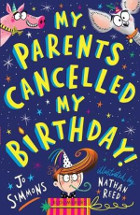
My parents cancelled my birthday by Jo Simmons
Illus. by Nathan Reed. Bloomsbury, 2019. ISBN: 9781526606587.
(Age: 9 - 12) Recommended. Themes: Birthdays; Family; Humorous
stories. Tom is looking forward to his birthday but several
dilemmas, including the pet pig falling off the roof and squashing
his Grandmother's chihuahua, leads to the decision to cancel his
'special' birthday acknowledgement. Tom's father is unsuccessfully
attempting to finish his book, his mother is stressed and working
too hard, his Grandmother decides to hold a seance to 'speak' to the
now dead pet and his sister's missing tooth and the curse of the
tooth fairy all work against Tom and his attempts to restore the
birthday celebration. Fortunately, he finds that friends can help
him, and even chickens listen to him to enable him to plan his own
festivity to acknowledge his birthday.
Jo Simmons has written a silly litany of disasters that young
readers will find amusing. At every turn everything goes wrong, and
there are some impossible moments that are extremely eccentric.
Young readers will be entertained, and the suspension of disbelief
required to accept some of the quirks in the plot will not cause
them distress.
Carolyn Hull
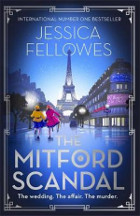
The Mitford scandal by Jessica Fellowes
Sphere, London, 2019. ISBN: 9780751573930.
(Age: Secondary) Themes: Set in the late 1920s and early 1930s
London, this historically correct mystery is narrated from Louisa's
(lady's maid to Diana Mitford) perspective.
The book denotes the author's deep knowledge of the historical
figures and events of the period (she has written for the Downton
Abbey TV series).
The actual mystery is woven around the life and events of
aristocratic Diana Mitford's life as a young married mother and
society woman.
The mystery incorporates drugs, homosexuality, poisoning and a
surprise ending with religious mania. I found the pace slow until
the last chapter since the life of the Mitfords and friends is
prominent with a love interest for Louisa also woven into the story.
While I enjoyed reading the book, readers who do not have much
knowledge of (or interest in) the Mitfords may not find the book as
interesting.
The book has a Historical Note and Bibliography sections at the end. The Mitford scandal is the third of the Mitford Murder series
by Jessica Fellowes but can be read as a stand alone mystery.
Ann Griffin
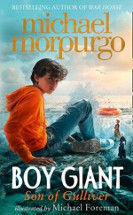
Boy giant by Michael Morpurgo
Illus. by Michael Foreman. HarperCollins, 2019. ISBN: 9780008347925
(Age 10+). Highly recommended. Themes: Refugees, Gulliver's travels,
Hope, Afghanistan. When Omar and his mother flee for their lives
after their village has been bombed and Omar's father killed, they
tramp over vast regions until they get to the sea, suffering
privation, hunger and thirst. Here Omar's mother makes a
heartbreaking sacrifice pushing her son onto the boat while she
stays behind, promising that they will meet again in England,
reminding him of the address he must repeat to himself. This address
becomes a mantra to Omar, as he sits alone in the bottom of the
boat, watching others as they are washed overboard, waiting for the
rising water to claim him.
But he wakes on an island, surrounded by little people dressed in
costumes from two hundred years before. With the few English words
he knows from playing cricket, he makes connections with the
Lilliputians, who call him Son of Gulliver, when they recall the
stories of the giant who visited their shores generations before.
Omar learns English, helping the people with their problem with the
next door island, just as his predecessor did, eventually building a
boat to leave.
Packed into its 280 pages, Morpurgo gives readers a modern look at
the classic Gulliver's travels. Enough of the story is told
within Omar's story for readers to gain a solid grasp of the tale.
Morpurgo's telling, a story within a story within a story weaves
together the tale of Omar and his mother fleeing from war, the
classic Gulliver's travels, Omar working with the
Lilliputians to stop the war with their neighbouring island, and
then leaving Lilliput.
Omar is found by a passing rower and in telling her his story while
the two little people he has with him tell theirs, we have a
multi-layered feast. With Foreman's wonderful illustrations and
different fonts used to indicate each story teller, the book will
have wide appeal. An adventure with a strong anti-war theme, the
plight of all refugees is told through the tale of Omar and his
mother, two people caught in a circle of violence outside their own
making, as news breaks of a truck containing 39 dead refugees has
been discovered in England (October 2019). Morpurgo's book resonates
with meaning as the plight of refugees the world over makes front
page news. The generation reading this book will gain some
understanding and sympathy with those seeking refuge.
Fran Knight
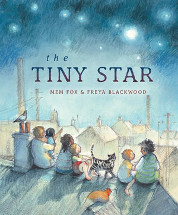
The tiny star by Mem Fox
Illus. by Freya Blackwood. Puffin, 2019. ISBN: 9780670078127.
(Age: 6-13 years). Highly Recommended. Themes: Family, Death,
Grieving, Cycle of life, Community. The tiny star written by
celebrated Adelaide author Mem Fox is a unique and touching story
that describes the cycle of life in a beautifully illustrated
picture book. The analogy of the star falling to earth and over the
course of the story moving through life stages until its passing,
provides a gentle and heart-warming look at life and death. Many
families explain the passing of loved ones to children by telling
them that they are always with us as a star above in the heavens.
At each stage of life, family is always present and the love and joy
shines through. The clever muted tones of the illustrations by
renowned Australian illustrator Freya Blackwood add to the
flickering memories of the story as the cycle of life progresses.
The use of the star end papers image throughout the story as a baby
wrap, a cape, a shawl, a scarf and a blanket connects the journey
from beginning to end. The subdued yet detailed illustrations on
each page entice you to explore them again and again as you are
drawn to reread the text.
Mem Fox and Freya Blackwood have sensitively shared the story of the
passing of time and the memories created through simple text and
illustrations that will capture the interest of readers time and
time again.
Kathryn Beilby
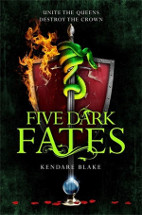
Five dark fates by Kendare Blake
Macmillan Children's Press 2019. ISBN: 9781509899135.
(Age: YA) Recommended. Five dark fates is the long-awaited
conclusion to the Three dark crowns series. Following the
triplet queens Mirabella, Katherine, and Arsinoe, and the revolution
of the Legion Queen, Jules - a war gifted naturalist - the girls
must face off in an epic battle against supernatural forces and each
other for the crown and island.
With Jules's legion curse out of control Arsinoe has no choice but
to bind and drug her friend while hoping to find a cure. Meanwhile
in the capital Katherine is at a loss. With Pieter unconscious she
has no one but Genevieve to advise her - a poisoner she has never
had any love for. The dead queens are growing restless inside of
her, they want more freedom. With the Mist rising Katherine must
find a way to counter it. She sends for Mirabella, her sister and
the most powerful elemental the island has. At Katherine's request
Mirabella travels to the capital to join her little sister, her mind
filled with the girl she once was rather than the terror who is now
the queen crowned. But Mirabella isn't there just to banish the
mist, she wants to know what Madrigal Malone meant when she said
Katherine was filled with the dead. With conflict at every side, the
sisters must decide what is right not only for the people of
Fennbirn but for the island itself. Is it time to do away with the
tradition of the triplet queens?
Dealing with familial conflict, the struggle for the greater good,
and the ultimate importance of friendship, I would recommend Five
dark fates for fans of the series, and the series to those
interested in YA fantasy.
Kayla Gaskell
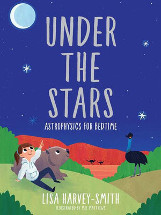
Under the stars: astrophysics for bedtime by Lisa Harvey-Smith
Illus. by Mel Mathews. Melbourne University Press, 2019. ISBN:
9780522876086.
(Age: Children/Teenage) Recommended. Professor Lisa Harvey-Smith was
appointed in 2018 as the Australian Government's Ambassador for
Women in Science, Technology, Engineering and Mathematics (STEM).
She has written a book that demonstrates both her expertise in STEM
and her ability to communicate with children and teens in a fun way.
Mel Matthews' fun and colorful illustrations complement the text
beautifully. Under the stars invites us to explore the night sky,
especially our solar system and includes interesting and unusual
facts about life on earth. It poses questions that will intrigue and
captivate readers, e.g. did you know that a day on Venus is longer
than a year on Venus? Questions are posed and sometimes answered in
every chapter, involving the reader in some lateral thinking.
I love the chapter headings that are sure to draw readers into the
book, e.g.'Comets - the hairy stars of doom'; 'The wonky reasons
for seasons'; 'How your eyes make stargazing extraordinary', etc.
Whilst the book is great to read aloud some children will be
absorbed and read straight through by themselves and others will
browse and just take the information they need. An index would have
been useful but the chapter headings will take readers where they
need to go. Under the stars abounds with knowledge but also engenders
feelings of wonder at the amazing universe in which we live. A good
book on so many levels.
Jan Barwick
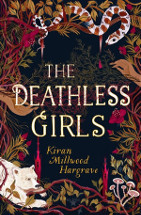
The deathless girls by Kiran Millwood Hargrave
Orion Children's Books, 2019. ISBN: 9781510106918.
(Age: Senior secondary) This novel is about Bram Stoker's 'dark
sisters.' First person narrator Lillai tells a linear, past tense
story. She journeys through medieval settings filled with
challenges. Soldiers and marauders pillage and people fight with
stakes and knives. There is a Gothic sense of hidden menaces and
forbidding castles. Millwood Hargrave's style is descriptive,
sometimes florid. Rapid fire similes and metaphors are initially
distracting, but many students listening to me read liked the style
and the author's tricks of foreshadowing.
This novel is suitable for independent study in senior school and
for intertextual analysis. Millwood Hargrave raises several ideas
and affirms that women can take control in harsh situations. In the
beginning, demonic men kill adult Travellers, burn their homes and
capture young Travellers out foraging. We are alerted to women's
agency when Lillai says of her twin, 'I was especially proud of the
injuries Kizzy inflicted'. The sisters are sold and appraised by a
Mistess Malovski, who takes them to a castle owned by Boyar Valcar.
His Cook tells their futures, keeping us interested to see if her
prophesy, 'I can find no death for you', comes true.
Defiant, the twins are confined in solitary cells for a time,
fulfilling our sense of Gothic entrapment. 'I didn't know these
places were real', says Lillai. Preparing them for their meeting
with Valcar, Malovski shows the sisters how to make bite wine - wine
infused with snake venom to improve men's virility. We meet many
grotesque men and wonder who Dracula might be.
Cook helps Lillia escape with Mira, whom she starts to love. Lillia
and Mira are reunited with other young people, and they try to
rescue Kizzy.
As the melodrama unfolds, it's hard to stop reading. While the
imperative is to read, not to reflect, there is plenty to say about
the ways in which the author presents the strength of female
characters and the choices they make at the end.
Chris Bourlioufas
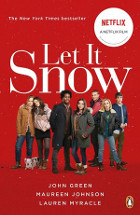
Let it snow by John Green, Maureen Johnson, and Lauren Myracle
Penguin, 2019. ISBN: 9780141371207.
(Age: 13+) Recommended. Short stories. Winter. Romance. Christmas. A
reprint of the 2015 book, Let it snow is out in conjunction
with the Netflix film with a new cover and will be loved by fans of
the three authors. A blizzard stops a train carrying Jubilee to her
grandparents in Florida and results in her walking through the snow
to a Waffle House where she meets a stranger who gives her a
delicious kiss. Meanwhile, three friends struggle through the snow
to the Waffle House to see the cheerleaders who have also alighted
from the train and this results in old friends discovering that they
are more than friends. Addie's early morning shift at Starbucks is
the beginning of her realisation that not everything is about her
and brings her back to her true love.
These three highly popular and skilled authors ensure that these
stories are not only very readable - I finished the book in a couple
of sittings - but also give insights into the meaning of love and
friendship. Maureen Johnson's The Jubilee Express provides
the initial winter setting of a blizzard that is so bad that the
train has to stop. It also introduces Jubilee Dougal, who finally
comes to terms with the fact that her boyfriend is not especially
caring when she meets Stuart who takes her home to make sure she is
OK during the storm. On the train, Jubilee also meets Jeb who is
desperately trying to make a meeting with his girlfriend, Addie and
his story is told through Addie's eyes in The patron saint of
pigs by Lauren Myracle. Of course, fans of John Green will
immediately pick up this book, just to read a story by him and A
Cheertastic Christmas Miracle is funny and touching and very
memorable.
This is a heart-warming and thoughtful collection of short stories
about teen love. While each story can be read as a stand-alone the
interweaving moments add to its appeal. The strong characters,
humour and touching moments make it a great read and a lovely
prelude to the Christmas season.
Pat Pledger
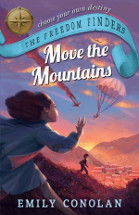
Move the Mountains by Emily Conolan
The Freedom Fighters series. Allen and Unwin, 2019. ISBN:
9781760294946.
(Age: 9-13) Recommended. This novel is the third in the series and
combines the 'Choose your own adventure' style of writing with
historical fiction. The main character discovers ways to find
freedom and escape life threatening situations, they are 'Freedom
Finders', hence the name of the series. The reader becomes the main
character and makes the decisions that can lead to success or death.
It is 1943 during WW2 in Italy and an Australian airman has crashed
into the German occupied Italian mountains. 'You' and your cousin
hide the airman who befriends you both, teaching you maths and
providing an insight into life in Australia.
Impetuously, you take a family lucky charm and give it Charlie the
airman to help him escape and from then on only bad luck ensues for
your mother and siblings.
Will the airman manage to return to Australia unhurt? Will you be
able to join him? Can you ever return the lucky charm and improve
the family's fortune?
Can you deal with corruption, sexism and injury?
These and many other questions will confront you and you make
decisions that will drastically affect your life.
This novel provides an insight into the famous Australian Snowy
Mountains Scheme and the problems that are faced by women in the
1950's who want to step out of the 'acceptable' role of wife and
mother.
I have read and reviewed the 2 other novels in this series,
Break Your Chains and Touch the Sun and all books
follow the same format with extra information in the back of the
book to help the reader understand the historical background of the
story.
Primary school students enjoy the interactive choices of 'Choose
your own' books and I recommend these books for students aged 9 to
13 years.
Jane Moore