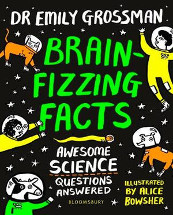
Illus. by Alice Bowsher. Bloomsbury Children's Books, 2019. ISBN:
9781408899175.
(Age: 5-12 years) Highly recommended. On her website Emily Grossman says 'My
aim is to show people just how exciting science is, and to make it
more accessible by explaining complex concepts in a fun and engaging
way.' Her book, Brian-fizzing facts, meets this aim
extremely well, answering those questions many children ask but that
adults do not know how to answer, e.g., could thinking make you
stronger; which animal has the strongest bite; why does dog urine
glow under UV light; and everything you probably never wanted to
know about farting but that most kids would love to discover. Her
question and answer format is written in very accessible language
and is interesting to read and easy to understand. Every page of
this book has interesting and fun facts complemented by the amusing
illustrations of Alice Bowsher. The format of cartoon-type drawings
in greyscale invites the reader to browse the questions and
multiple-choice answers that pepper the book. One example I enjoyed
gives possible answers to the question Where would you find the
strongest muscle in your body? a. Your heart, b. your jaw, c. your
calf or d. your bottom. Complete answers to each of these
possibilities fill the following five pages with a multitude of
facts in a way that draws the reader into the text.
This book would be a great addition to personal as well as classroom
libraries. It is a useful reference tool and a good book to pick up
and browse at any time.
Jan Barwick
Top Koala by Jackie French
Illus. by Matt Shanks. HarperCollins, 2019. ISBN: 9781460754818.
(Age: 5+) Recommended. Themes: Koalas, Australian animals,
Australian landmarks, Rhyming stories, Geography/Mapping. Top
Koala is written by celebrated Australian author Jackie
French. In this enjoyable early years/junior primary read, Koala
proves that he is the only animal that can climb higher than a
number of other animals. His journey to prove his ability to always
be at the top takes him to places like Uluru, Coober Pedy, MCG, Big
Pineapple, Tasmania, Sydney and Canberra. The animals he out climbs
are both uniquely Australian and familiar to children i.e. the
quokka, wombat, Tasmanian Devil and kangaroo to name a few.
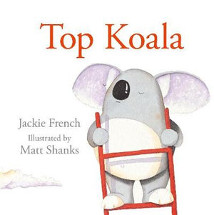
The illustrations by Matt Shanks are beautifully drawn in water
colour and are both detailed and entertaining. They complement the
simple yet clever rhyming text where emphasis is placed on a
significant word or two on each page. Jackie French and Matt Shanks
have combined to create another picture book in the Koala
series which will entertain younger readers. The story also provides
junior to middle primary students with some information about the
landmarks of Australia and lends itself to a mapping activity where
they could plot Koala's journey on a map of Australia.
Kathryn Beilby
Fantail's quilt by Gay Hay and Margaret Tolland
Starfish Bay Children's Books, 2019. ISBN: 9781760360719.
(Age: 4+) Recommended. Themes: Birds, Fantails, New Zealand,
Survival. When a pair of Fantails, a common New Zealand bird, build
a nest and deposit three eggs in there ready to hatch into new
chicks, the forest is alive with danger. The pair must protect their
eggs at all cost, but a marauding rat spies the eggs and eats them.
Undeterred, the pair tries again, building a nest of grass and
leaves, soft moss and spiders' webs.
The three new eggs are burrowed into the soft feathers of the nest,
and the Fantails are watchful.
A rat can be spied coming towards the nest again, but this time an
owl has spotted the rat, so the nest is left unsullied. Readers will
breathe a sigh of relief that this time, the Fantails are able to
raise their chicks without losing them.
This neat story, well rounded and telling of danger and survival in
the forest, will intrigue younger readers as they spy the various
things within the forest, alluded to on the endpapers. The strong
environmental message is reiterated in the glorious illustrations.
Eager eyes will watch out for the ferns that grow in the forest, the
Totara, Kowhaie and Waterfall fern, and the owl, butterflies, and
Weta, along with the fuschias, nightshade, and Lancewood. The last
few pages give more information about the Fantail, as well as images
of the two other books published by this pair, Go
green gecko and Watch
out snail, strikingly illustrated and telling an environmental
story easily read and understood by children.
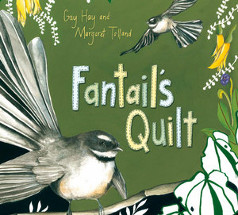
The bold illustrations are delightful, markedly different from the
soft edged, pink and romantic drawings seen in many recent picture
books. This boldness using just a few colours, makes the forest a
striking place and invites inquisitive eyes to look more closely at
what is hidden in the undergrowth. A real pleasure to see a
differently presented illustrative technique which pushes the reader
to think about and question what they are seeing.
Fran Knight
Beneath the Sugar Sky by Seanan McGuire
Wayward Children book 3. St Martin's Press, 2018. ISBN:
9780765393586. 176p.
(Age: 15+) Recommended for fantasy lovers. Anyone who loves baking
and the idea of a world called Confection and made of sweets, will
delight in this whimsical and unique story. Rini comes from the land
of Confection to Eleanor West's Home for Wayward Children searching
for her mother Sumi, and is appalled to find that she died years
before she was conceived. Reality doesn't get in the way and with
Cora, Kade and Nadya she goes on a quest to find her mother.
The first two books in the series, Every
heart a doorway and Down
among the sticks and bones, were very dark but McGuire strikes
a lighter tone in Beneath the sugar sky, as perhaps could be
expected with the land of Confection being a star in the story.
McGuire also explores how Cora feels about the way people treat her
for being fat and makes some pertinent and telling comments about
that.
At 176 pages, this was a quick but complex read. It is advertised as
a stand alone and can be read as such, but familiarity with some of
the characters and the Home for Wayward Children would enhance the
enjoyment of the story. With a raft of award nominations (Hugo Award
Nominee for Best Novella (2019), World Fantasy Award Nominee for
Best Novella (2019), Goodreads Choice Award Nominee for Fantasy
(2018)), it is one to pick up, with two more in the series to
follow, In an Absent Dream (2019) and Come Tumbling Down
(2020).
Fans will have a feast reading about the strange and unusual worlds
that McGuire creates.
Pat Pledger
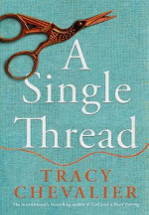
A single thread by Tracy Chevalier
HarperCollins, 2019. ISBN: 9780008153823.
(Age: Senior secondary - Adult) Highly recommended. It is 1932 and
Violet Speedwell, whose fiance and brother were killed in the Great
War, has become a 'surplus woman', doomed to be a spinster because
of the demise of a generation of young men. In an effort to become
independent she leaves her family home and goes to Winchester where
she joins a society of broderers who are embroidering kneelers and
cushions for Winchester Cathedral. It is here that she makes friends
and begins to make a new life.
I am a great fan of Tracy Chevalier's stories and her wonderful
ability to describe the lives of women, while giving a snapshot of
the history of the time. In A single thread, Chevalier
weaves the story of how the fictional Violet becomes independent,
twining it with the real life of Louisa Pesel, who was asked to
design the cushions and runners that can still be seen in the
Cathedral today. The group of broderers becomes Violet's mainstay,
fending off loneliness with the friendship of Gilda and Dorothy and
the calm helpfulness of Louisa Pesel.
I loved the descriptions of the embroidery and was fascinated to
learn of the fylfots that were a border on the vestments of the
effigy of 14th century Bishop Wodeloke, and how the Nazis took the
fylfot symbol as their own swastika. Chevalier writes about Louisa
Pesel and embroidery on the author's
website.
The details of the art of bell ringing were so graphic that a reader
could almost hear the bells pealing. And it was the understated way
that Chevalier describes how women were treated in the 1930's that
is most poignant and memorable, as she tells of the struggle
of Violet to find love and make a family of her own and of Gilda and
Dorothy's love for each other. Family life and the loss of a child
and the devastation it leaves behind are also described in a very
moving way.
A quote from Geraldine Brooks on the back cover sums it up:
'Chevalier is a master at foregrounding the small, dramatic stories
of overlooked people from the past.' An interview with Chevalier is
available on the NPR
website.
This is a gentle and engrossing novel that nevertheless touches on
complex themes, that of women's sexuality, the plight of the
unmarried mother and the importance and difficulties of family life.
It is one too that celebrates the beauty of Winchester Cathedral's
embroidered cushions and runners and the talent of the women artists
who designed and made them.
Pat Pledger
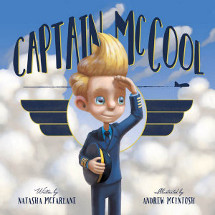
Captain McCool by Natasha McFarlane
Illus. by Andrew McIntosh. Little Steps Publishing, 2019. ISBN:
9781925839319.
(Age: 4-8) Highly recommended. Themes: Pilots, Flying, Aviation
Industry, Friends. Captain McCool is written by first time
Adelaide children's author, Natasha McFarlane. Natasha worked in the
aviation industry for many years and felt there was a need for young
children and adults to have their fascination for planes and flight
recorded in an easy to read picture book. Captain McCool is
the first in a series that will allow readers to gain an insight
into an industry which is a part of our everyday lives.
Josh McCool has always dreamt of being a pilot. Right from an early
age, he has attempted to fly - often not with success. However he
joins the junior flying cadets where he learns about many of the
roles people have at an airport. Josh and the friends he made in
cadet school support each other throughout their pilot training and
all achieve their long held dream.
The entertaining and clever rhyming text with emphasis placed on a
significant word or two on each page holds the reader's interest and
adds to the enjoyment of story. The illustrations by Andrew McIntosh
are beautifully drawn and visually appealing.
An excellent book to have in a school or public library as it is a
perfect read-aloud for younger students.
Kathryn Beilby
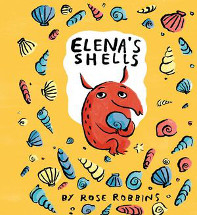
Elena's shells by Rose Robbins
Starfish Bay Children's Books, 2019. ISBN: 9781760360573.
(Age: 4+) Recommended. Themes: Sharing, Possession, Shells, Empathy.
Elena loves to collect shells. And she has a large pile of them. But
one day, one of her shells starts to run away. She is distressed and
follows the shell over the sand and the rocks to the water's edge.
She has an idea and calls out 'Shark' making the shell stop in its
tracks. Elena shakes the shell, asking why it would want to run away
and a small hermit crabs falls out.
The crab explains to Elena, the tapir, that the shell is its home and
he needs to change his home now and again when he grows. But Elena
says that it is her shell and walks back to her pile of shells to
place it with the others. But that night she has second thoughts and
in the morning goes in search of the crab, worrying that she may
have left him homeless.
She finds the crab and returns the shell, the effort giving her an
idea of what to do with her shells, and a neat resolution comes
about making all readers and the hermit crab most satisfied.
A bold colourful illustrative technique will encourage all readers
to look at the details presented on the page, ponder why Emma is a
tapir, look more closely at shells and shell collecting, tapirs and
hermit crabs, and try to draw some shells themselves, using the
sparkling endpapers as a guide.
Fran Knight
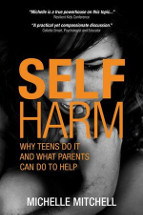
Self harm by Michelle Mitchell
Big Sky, 2019. ISBN: 9781925675573
Recommended book for parents and counsellors. Subtitled Why
teens do it and what parents can do to help. 'In this book,
award-winning speaker, author and educator Michelle Mitchell has
combined her 20 years' experience, with the latest research,
interviews with experts and stories from professionals and everyday
families, to give parents and teachers fresh insights into how to
prevent, understand and respond to self-harm.
Full of evidence-based strategies, this unique resource will provide
parents with the facts, practical help and comfort they need.'
(Publisher)
Recommended reading perhaps even as teacher reference. Big
Sky Publishing's page on the book contains a link to an
interview with Mitchell by the ABC Radio, and a link to a video
about teens' self harm. It also contains several very positive
reviews and comments about the usefulness of the book.
Vincent Hermann
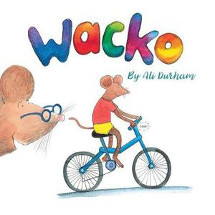
Wacko by Ali Durham
Starfish Bay Children's Books, 2019. ISBN: 9781760360733.
(Age: 3+) Rhyming story, Grandparents, Growing up. In four line
rhyming stanzas the story is told of a young boy growing up showing
the stages he goes through from a toddler to school age. Each
milestone is punctuated by a comment to Grandpa Look Grandpa, Look
I grew in the night!
My head is up here
and my shoes are too tight!
The same unvarying format is used on every page, making it easy for
younger children to recognise the rhythm, and join in, predicting
the rhyming words.
Grandpa then responds Wacko, said Grandpa.
'You really have grown! Such a big lad
Who would have known?
The word, 'wacko' appears in every second stanza, indicating it is
the grandfather speaking, using an old Australian expression not
often used today which recognises delight and pleasure.
Young children will delight in the new found word, repeating the
stanzas after the reader, learning them for themselves, following
the interaction between the older man and the child, recognising the
humour that lies in the words.
But they will also recognise the developmental stages of children
before going to school, as the boy learns to stand, use a spoon, or
jump up and down. Potty training comes along with learning to use
underpants, learning to swim, learning rules about bedtime, reading
together and finally going to school.
A fixed layout is pursued on every double page and the colours are
bright and breezy.
Fran Knight
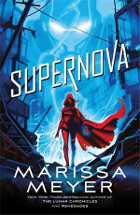
Supernova by Marissa Meyer
Renegades series. Pan Macmillan, 2019. ISBN: 9781760787394.
(Age: 12+) Highly recommended. Supernova is the long-awaited
conclusion of the Renegades series. Set in a world where
prodigies are rife and the war between good and evil is continuing
to rage; Supernova follows the problematic romance between
an anarchist and a renegade as they try and negotiate a way peaceful
way forward and out of the wars of the past.
Having stolen Ace Anarchy's helmet from the Renegades in the
previous novel, Nightmare's Renegade disguise as Insomnia is growing
increasingly precarious. Unsure how much longer she has as her
good-girl alias, Nova dreads the moment when Adrian will see her for
who she truly is - a villain. Her time with the Renegades is
starting to make her question her own beliefs. Previously a staunch
Anarchist, Nova starts to question if Anarchy is really the solution
to the problems in Galton City.
Adrian's little brother was badly injured during the break-in at
Renegade headquarters and despite his innovative tattoos Adrian
can't let his Dad know he's been to see Max without revealing his
identity as The Sentential. Switching between identities, Adrian is
struggling to keep his secret but knows better than to reveal
himself as the vigilante super-hero. Having idolised the Renegades
his entire life, Adrian finds himself questioning if they are the
great force of good they present themselves as. Supernova is the perfect combination of superheroes and
star-crossed lovers. An enjoyable novel, I would highly recommend to
lovers of superheroes and dystopian novels. Inevitable dealing with
questions of right and wrong, Marissa Meyer presents arguments for
and against the need for order and leads the reader towards the need
for peaceful non-violent solutions.
Kayla Gaskell
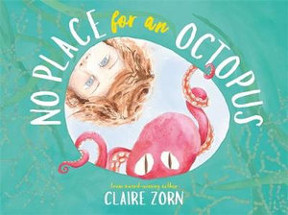
No place for an octopus by Claire Zorn
UQP, 2019. ISBN: 9780702262609.
(Age: 4+) Recommended. Themes: Octopus, Sea creatures, Environment.
When a boy finds an octopus in a rock pool on the beach, he imagines
what it would be like if the creature were his friend. The octopus
is all alone in the rock pool and has no friends there with him, he
is hiding behind the seaweed and looks hungry. They could do all
sorts of things together: the animal could bathe in his bath, eat
his food, read a book with him, go on the roller coaster, travel and
be very quiet.
The boy watches the animal in the rock pool, pondering its
environment and sees the array of things children can find in a rock
pool: seaweed and shells, small fish, sea urchins, crabs and
limpets, ledges and shallow water in which animals can hide. The
octopus peers at the boy from behind his seaweed and the boy decides
that the rock pool is the best place for the creature and leaves him
alone.
This lovely story, full of information about a rock pool and its
inhabitants, will appeal to every reader as they peruse the
illustrations for signs of life in the rock pool, listing the
various things they spot. The pencil and water colour illustrations
are marvellously informative, allowing the reader to pick things out
for themselves, and giving a subtle message about conservation at
the same time.
The hole in the cover will encourage readers to pick up the book to
read, and the faces peeping through at the reader are an extra
inducement guaranteeing a lot of enjoyment. The book will stimulate
discussion about why things are in a particular place, why creatures
are linked to the environment in which they live and the hazards of
removing them from their environment. Classes will get a buzz
reading about the possibilities of an octopus sharing their bedroom
and going on trips with them, seeing the inappropriateness of such
an action, underscoring again the link between an animal and its
environment. Teacher's
notes are available.
Fran Knight
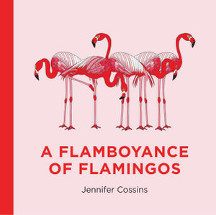
A flamboyance of flamingos by Jennifer Cossins
Hachette, Lothian Children's Books, 2019. ISBN: 9780734419859.
(Age: 5 -12 years). Themes: English Language, Collective Nouns,
Animals, Birds, Sea Creatures. Tasmanian artist Jennifer Cossins is
the author of the bestselling 101
Collective Nouns that has entertained both teachers and
students with its vibrant drawings and easy to read collective
nouns. Her newest publication, A Flamboyance of Flamingos,
provides a snapshot of some popular creatures of the Animal Kingdom
and their more unusual collective nouns, for example: a tiding of
magpies, a paddle of platypuses, an aurora of polar bears, an
ostentation of peacocks. A Flamboyance of Flamingos is a small illustrated hardback
compendium that would make a perfect gift for those readers who are
fascinated by the use of the English language combined with simple
yet colourful illustrations. It is a delightful book that would be a
welcome addition to any young person's home or classroom library.
Kathryn Beilby
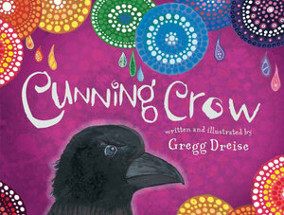
Cunning crow by Gregg Dreise
Magabala Books, 2019. ISBN: 9781925768862.
(Age: 4+). Highly recommended. Themes: Crows, Aboriginal themes,
Cautionary tales, Australian folklore. Author illustrator Gregg
Dreise a descendent of the Kamilaroi tribe, from south-west
Queensland and north-west New South Wales, was born and raised in St
George, Queensland, in a family that loved sport, art, music and
poetry. He has published several books with Magabala Books, Silly
birds, Kookoo
kookaburra and Mad
magpie, and My
culture and me(Penguin). He uses didgeridoos, guitars,
laughter and physical performance to pass on his culture to a wide
audience, and through his educational talks and storytelling,
promotes the environment and interaction with other people.
His cautionary tales are full of humour, and dazzle with bright,
colourful illustrations, making a point about morality to the
readers.
Cunning crow watched the other birds get their magnificent colours
from the rainbow. Lightning, fire and rain preceded the appearance
of the rainbow and once there, the birds thrust parts of their
bodies into the streams of colour, changing their white feathers to
other shades. So the white cockatoo became a sulphur crested
cockatoo, the lorikeets became multi-coloured, the budgies, blue.
Waan the crow became orange and red but was dissatisfied. He envied
the other brighter birds and resolved to change his colours to
something more dramatic. When next a rainbow appeared he ducked into
it but nothing happened. He thought that perhaps he needed fire as a
part of the change so built a ring of fire. This time he burnt his
feathers becoming black all over.
Today Waan the black crow reminds us to be happy with our
differences, to be satisfied with what we are, that we are all
beautiful. This fitting cautionary tale about appearance will appeal
to the younger reader, and the bright eye-catching illustrations
bring an extra layer of interest and learning for the readers.
Fran Knight
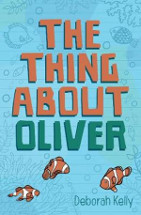
The thing about Oliver by Deborah Kelly
Wombat Books, 2019. ISBN: 9781925563818.
(Ages 10-16) Highly recommended. Themes: Autism, Disability,
Siblings, Family. This book is dedicated to the 'glass children'.
These are the children whose lives are almost invisible because they
have a sibling with special needs. In The thing about Oliver,
Deborah Kelly has revealed a heart-wrenching story about the
difficulties for Tilly as she lives as the 'ignored' capable child
because her single-mother's attention must so often be directed to
her autistic and non-verbal younger brother, Oliver. From the first
page, the struggles are evident. When Tilly's mother decides to
relocate to Townsville in order to be near her sister, Tilly suffers
the normal change and separation dilemmas. However, Oliver's
inability to deal with change of any sort, and his loud reactive
tantrums escalate in the new environment. The distress for everyone
is palpable in the story, but the distress that Tilly feels goes to
another level when Oliver destroys her Aqua journal - the precious
and personal recording of all the aquatic things she loves. Her
response to this dilemma leads to even more drama, when Oliver goes
missing. Her inability to swim becomes a metaphor for the way that
circumstances are flooding her life, with no hope of escape. The
story does not end with a 'cure' for all the struggles of Tilly's
life, but there is some light ahead.
The dramatic story-line is incredibly powerful and the complexities
of life with a mute autistic sibling make for an emotional story.
This is a story that leaves the reader heart-broken for the young
Tilly and her mother, but also for the boy Oliver. Because of the
content and the maturity needed to handle the emotional dilemmas,
this book could be read by older readers (older than Primary-aged
Tilly) even though it is relatively simply written. There were many
moments when I was nearly in tears as I felt the pain and distress
of the young girl (and her tired and distraught mother), and I am
sure that an empathic response would be the result from reading this
book.
(Note: Readers who have enjoyed Wonder by R. J. Palacio
could read this book as it also addresses a sibling response to
disability.)
Carolyn Hull
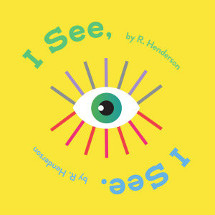
I see, I see by R. Henderson
Allen and Unwin, 2019. ISBN: 9781760524746.
(Age: 4+) Highly recommended. Themes: Perspective, Senses, Sight.
Two or more people sharing this book will gain a lot of pleasure
working together. The book asks them to sit opposite each other and
read the book in a particular way, so giving each reader a different
perspective of what is on the page. The author has very cleverly
used words and images that when turned upside down, mean the
opposite. So when one view says, I see full, when the page is turned
the text says, I see empty, while the image of a glass of liquid
looks full or empty depending on which way it is viewed.
It is most enlightening, looking at the same thing from a different
perspective, and will encourage children to share their points of
view to help them understand that how you see something is entirely
your own perspective and others will differ. It is full of fun and
whimsy, and will encourage sharing and discussion as the book is
read.
From the endpapers with their green or is that blue arrows, to the
last page which to some is the last but to some is the first, the idea
of perspective will intrigue and delight younger readers.
Fran Knight