Puffin Books, 2020. ISBN: 9780143792918. 32pp.
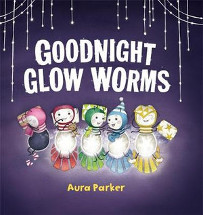
(Age: 3+) Recommended. What happens when glow worms must go to
sleep? These glow worms, the yellow, red, green, blue and pink glow
worms just cannot turn off their glow and lie awake in their beds.
In rhyming pairs of lines, Parker tells the story of a group of glow
worms going to bed. They lie down, but simply cannot wind down. They
try counting to three to no avail, so they call in mum for a
goodnight kiss. She kisses their noses, cheeks and toes and off they
go to sleep. But yellow glow worm cannot find his blankie so a
search is on until it is found and he can quietly go to sleep with
his sisters and brothers.
A bedtime story to quieten even the most irascible of would be
sleepers, the gentle coaxing rhymes will help with last minute
attempts to get them to sleep. The storyline is one that will
intrigue but the tale of the timeline to bedtime is
universal, ending with mum's kisses and a final hold on to a
blankie. The calming, quiet words envelop the listener, helping them
in their trip to snuggling down into their bed for sleep.
Along the path to sleep, Parker includes colours and numbers, subtly
introducing basic information at a young age, reinforcing learning
these concepts, while the rhyming phrases impel the listener to
predict the rhyming word.
Parker's use of mixed media, pencil, watercolour and digital
composition will delight the young as they see the humour in the
illustrations, carefully watching the little glow worms as they wind
down to sleep. The detail will intrigue and the endpapers
particularly will engage the readers, following the maps of the glow
worm caves. Themes: Glow worms, Bedtime, Humour, Verse.
Fran Knight
The crumbling castle by Brenda Gurr
The fabulous cakes of Zinnia Jakes series. New Frontier
Publishing, 2020. ISBN: 9781925594973. 88pp.
(Age: 7-10) Zoe Jones (alias Zinnia Jakes) is a nine year old girl
who lives with her Aunt Jam. Her mother, who was a famous pastry
chef, has died, and her father, a renowned restaurant critic, is
always travelling the world. Since a young age Zoe has had a flair
for cake baking and runs a very successful secret cake making
business under the eye of her Aunt. Zoe's best friend Addie is in on
the secret. Addie is a great gymnast and very good at STEM
activities. Zoe is emailed a special order to make a medieval cake
for a woman at a medieval fair. The cake will be raffled and the
money will go to a worthy cause. Her aunt and her aunt's boyfriend
are also learning medieval instruments, to play at the fair. Zoe's
cat Coco has special ways of communicating with her, such as paw
tapping and tail flicking, and lets Zoe know that her original idea
of building a castle from chocolate cake isn't authentic. Zoe does
some research and finds a very interesting original recipe. Addie,
being a STEM whiz, helps with the design of the castle. However, in
order to deliver the cake to her client and remain a mystery, Zoe
has to engage in some subterfuge. It isn't all plain sailing for Zoe
with an unpleasant teacher and boy bully but in the main it is an
upbeat though somewhat contrived story.
The author has included the medieval recipe Zoe uses which is quite
a good ploy. This novel has short sentences and is aimed at young
independent girl readers. Given the interest we have in celebrity
cooking it will certainly have an audience. The main characters are
all smart and resourceful, so are good role models for girls. The
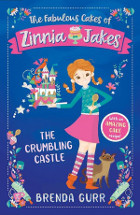
sparkly colourful cover is attractive. Another book is coming in the
Zinnia Jakes series.
Jo Marshall
Bear was there by Sally Anne Garland
New Frontier Publishing, 2020. ISBN: 9781925594935.
(Age: 3+) When Mouse is born, mother looks after him, showing him
how to survive in the forest, warning him of things to avoid.
She shows him the flowers, the tall grass and insects. He feels the
breezes and the sun's warmth, but always she reminds him of the
danger lurking. When he sees the shadow of Bear in the distance, he
rushes back to their home in the nook of the tree. But eventually he
grows and must go off to make his own home. He plays in the grass
and suddenly Bear is there. But he seems harmless as he only looks
and then pads away. Mouse thinks that maybe he is not as scary as he
thought.
Winter approaches with its strong winds and icy storm.
Bear crashes through the cold winds to his shelter and Mouse
follows. Bear curls up to sleep for the winter, and Mouse curls up
near his head, safe and loved.
A story of overcoming your fears, of testing stories told you as a
child, this charming tale of the bond between two totally different
animals will appeal to younger readers.
While reminding children that there are concerning things to be
aware of in their environment, it also tells them to be open to
friendship that is offered.
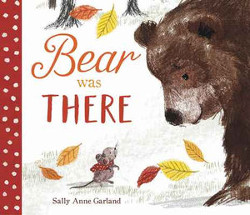
The soft illustrations will charm younger readers, looking for the
detail in the background of each page and the way Garland has drawn
the bear's fur and the mouse's coat. Teacher's
notes are available. Themes: Bears, Mice, Trust, Love,
Friendship.
Fran Knight
Winterborne Home for Vengeance and Valour by Ally Carter
Lothian Children's Book, 2020. ISBN: 9780734419163. 256pp.
(Ages 8-12) Highly recommended. April was left by her mother with a
note saying she would be back to collect April as soon as she could,
and April has been waiting patiently in foster care for 10 years.
April's mother also gave her a mysterious key that April always
wears around her neck.
While on excursion in a museum April notices the key matches the
crest of the infamous Winterborne family. So, when April accidently
sets fire to the exhibit it sets in motion a series of events that
sees her living in their mansion called Winterborne House with 4
other orphans. She is desperate to know what her key unlocks and
starts a quest to search the house from top to bottom. In her search
she unearths the secret of the missing (and presumed dead)
billionaire, Gabriel Winterborne, who was the sole survivor of a
family tragedy which killed his entire family. She finds the
billionaire living below the house and now she is determined to get
him to help her solve the mystery of her key and reclaim his
inheritance before nasty Uncle Evert makes sure he is dead and
claims the fortune for himself.
This is the first book in a series, and this is made obvious as we
only get sketchy details of each character in this first story. Each
orphan in the book has a special talent that April uses to help her
solve her mystery and bring about a positive result for the very
uncooperative billionaire. The mansion is peopled with the usual
trusty butler, a caring Ms Nelson who runs the Winterborne House and
has a long association with the family and a shadowy super-hero who
may or may not be an urban legend.
Some threads of the story were left hanging in the end. The
disappearance of Ms Nelson at the end of the book is puzzling. Also,
the key around April's neck was dealt with in the story and we get
to know what it opens, but we are left with no idea why April wore
it or why her mother had it in the first place.
It was quite a fast-paced story that moved along well most of the
time and I am sure it will leave middle primary readers waiting for
the next installment. Themes: Orphans and orphanages, Foster care,
Missing persons, Revenge, Mysteries, Friendship.
Gabrielle Anderson
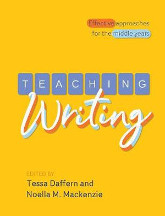
Teaching writing ed. by Tessa Daffern and Noela M. Mackenzie
Allen and Unwin, 2020. ISBN: 9781760528928.
Highly recommended. Subtitled Effective approaches for the
middle years this new book would appear to be the ultimate
repository of everything needed in the teaching of English, i.e.
English as a language, its critical appraisal, construction and
deconstruction of texts, writing in English, and the analysis of,
and responses to, many different kinds of texts. Its richness lies
in the work of the 16 contributors, supported by two editors, and
would assist any teacher working with the English language in terms
of understanding the language in its multifaceted dimensions,
building curriculum that would cover all possible aspects of the
English language and the examples that would assist the classroom
teacher. It is a stunning new work, a text book that is a serious
consideration of English as language and communication. I would
highly recommend it for any English teacher of both young and older
students.
Elizabeth Bondar
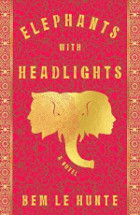
Elephants with headlights by Bem Le Hunte
Transit Lounge, 2020. ISBN: 9781925760484. 304pp.
(Age: Adult) Highly recommended. When blonde Australian girl Mae
meets handsome Indian boy Neel on a beach in India, it is instant
romance, leading to a shared life together in Australia, only
returning to India for their special Indian wedding. But as Mae
steps foot in the family home, there is the inevitable clash of
cultures. For this reader, having once had an Indian mother-in-law,
the explosive scenes are all too familiar, and very funny. From what
she wears, to where she goes, to what she says, everything Mae does
is wrong, and Neel is caught in the middle of the battle of wills
between his mother and his future wife.
At the same time, another conflict brews between mother Tota and
daughter Savitri - for Savitri refuses to consider marriage
proposals from any of the suitors suggested for her. Finding a
husband for her is not a simple matter as she was born under a
cursed sign. But Savitri will have none of it and is intent on
making her own life.
India is revealed in all its complexities and chaos - from the
headlights for elephants in the traffic, to the contemplation of
driverless cars. And of course there is a mystical element, no book
about India could be without it - from the mathematical astrologer
to the 200 hundred year old guru who looks in his fifties. The
curses, the traditions, and the astrological charts all have their
place, and somehow infuse the modern world - and eventually people
do find love, fulfilment and understanding.
One of the nice things about this story, is the respect for the
grandmother or female elder in each family, Dadi in the Indian
family, and Dolly in the Australian family. Each of them is the wise
woman and peacemaker, the heart of the family. Mae and Savitri,
whilst very modern independent young women, each learn from their
beloved elder.
There is lots to like about this story. The characters are realistic
and familiar, the conflict of generations and cultures is told with
a subtle humour, and the mystical entwines with the modern in a
willing suspension of disbelief, leading to a heart-warming and
satisfying conclusion. Themes: India, Feminism, Destiny, Conflict,
Modern vs Traditional.
Helen Eddy
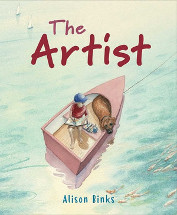
The artist by Alison Binks
Berbay Publishing, 2020. ISBN: 9780648397380. 32pp.
(Age: 4+) Recommended. The young boy likes to get up before
breakfast while the world is still sleeping. Then he can mix his
paints and paint what he sees, the darkness and light, shadows and
edges. But this morning it doesn't turn out to his liking, so he
puts it aside, calls Young Dog and walks off down the beach,
shedding his displeasure. They return to the boat and Young Dog
curls up asleep as if knowing the rain is about to come in. When it
does the boy can get down to inside painting, copying the bird
pictures from his bird book. Sometime Grandma comes to visit and he
plays for her on his little electric organ and later goes into town
where he takes piano lessons. But he is only thinking of being on
the water, painting. He hurries back home and sails to a nearby cove
where he squeezes out the paint from its tube and paints a small
bird on the beach. He sleeps in his sleeping bag and when he wakes
he looks at the picture he drew the day before, and knows today is a
new day to paint.
This is a warm and evocative tale of the need to paint, the desire
to get what you see down onto paper, of the internal push to capture
that moment. With dreamy watercolour images, the story Binks has
produced reflects the lives of many
artists, often withdrawing from the world and its distractions,
finding a place and a time to be themselves, to work unhindered. In
this way Binks celebrates the child who is free of restrictions, who
is able to go off at will, taking his paints and paper with him,
looking at the natural world around him to find inspiration and
love.
Young readers will dream along with the boy of a time when this is
possible, of taking off by themselves to muse and create, wonder and
adore the environment in which we live. Themes: Art and artists,
Sea, Feelings.
Fran Knight
Mars by Shauna Edson and Giles Sparrow
Illus. by Mark Ruffle. Dorling Kindersley, 2020. ISBN:
9780241409589. 80pp.
(Age: 9+) Recommended for Science-interested readers. Mars is always
interesting. As our closet planetary neighbour, it is worth knowing
a little more. This book covers all the important detail about the
planet and human exploration of this part of our Solar System. With
a section about what we now know as the result of relatively recent
visits to Mars, and also detail about what visiting Mars might be
like in the future, this is a comprehensive look at the Red Planet.
Because this is a Dorling Kindersley book, it can be relied on for
presenting the information in language for young readers that is
easily comprehensible. The illustrations include photographs and
modern graphic representations in clear formatting that is visually
appealing. STEM and astronomy interested young readers will enjoy
this journey beyond our own planet. Themes: Mars; Space travel;
Astronomy.
Carolyn Hull
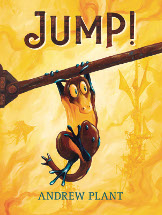
Jump! by Andrew Plant
Ford St Publishing, 2020. ISBN: 9781925804461.
(Age: 4+) Highly recommended. When little Quig is born into that
great city with its overhanging cables and towers of steel, he
watches as his siblings jump and dart, leaping off the towers,
fanning out their wings to glide downwards, using their tails to
hang from, steering with their powerful fins. But little Quig hides
from the challenge: his tail is short and stumpy, his fins thinner
than the others, and he is frightened by the towers. He climbs up
ready to jump but being called Stumpy by the others does nothing to
improve his confidence, so he climbs back down again. But one day
spurred on by their derision, he takes the plunge and jumps from the
highest beam of the Cloud Towers.
A wonderful story about achieving one's destiny, about overcoming
obstacles, about proving the bullies wrong, Plant's tale will be a
starting point for many discussions at school and at home about
bullying and how it impedes the victim.
Plant has created a little animal that children will relate to: he
is smaller than the others, less well developed, with fewer
abilities. His little face peers out at the reader, his large eyes
reflecting the fear he feels. Children will instantly recognise the
emotions the little animal is feeling and sympathise with him,
willing him to do well.
The wonderful illustrations remind readers of a dystopian world, a
world of cables and steel towers, of overhanging beams and rivets,
peopled by an array of animals that will cause children to laugh out
loud and look more closely at the attributes of these creatures. I
love the intricacy of the beams and cables, their intertwining
leading to goodness knows where, the creatures with a strange
collection of eyes and legs, the bright sunburst looking more like
molten steel at a steelworks, than the sun we see every day. The
harsh yellow makes an outstanding background for the story of a
little creature finding his wings. Teacher's
notes are available. Themes: Risk taking, Overcoming fear,
Disability.
Fran Knight
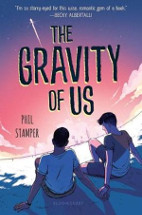
The gravity of us by Phil Stamper
Bloomsbury, 2020. ISBN: 9781526619945.
Seventeen year old Cal is certain of his path in life, he wants to
be a journalist and makes regular online video journals from his
Brooklyn home via the 'FlashFame' app. He has gained a
substantial following after reporting on elections and has been
offered an internship at BuzzFeed News. Home life is often disrupted
by his parent's tense relationship and his mother's anxiety so he is
shocked when his pilot father announces he has won a place on
Orpheus Project, training astronauts for a mission to Mars. The
family is required to immediately relocate to Clear Lake Texas and
live in a retro styled estate nostalgically modelled on the early
Sixties astronaut village. As soon as they arrive they are filmed
for the reality show 'Shooting Stars', conceived of to raise
awareness about the Orpheus program with the American public to
ensure continued funding for the project. Cal retrieves something
from the disruption by continuing to post video updates for his half
a million followers, interviewing scientists and providing an
insight into the background workings of the project rather than
seeking out the sensational personal conflicts of the reality show
footage. Another plus is that he falls headlong in love with Leon,
the son of one of the other astronauts. When a tragedy occurs in the
Orpheus project, the 'Shooting Stars' producers try to
capitalise on the ensuing grief and suffering, prompting Cal to
expose them, highlighting the show's intrusion into their lives.
Working through all the various challenges thrust upon him Cal
learns about himself and others, he acknowledges his obsessiveness
and need to "fix" things. He learns respect for difference in his
relationship with Leon and to try not to depend on others to be
happy or sad. He also develops respect for his parents,
acknowledging their special skills and abilities. In his personal
journey Cal realises his strength in communicating real information
honestly to his followers and his continuing success suggests that
it is a need felt strongly in today's world.
The first person narration feels authentic as do the social media
references. The relationship between the two boys is sensitively
portrayed and the brave and intelligent way Cal faces multiple
challenges will appeal to senior secondary students. Themes: Mental
health, Space, Love, Social media.
Sue Speck
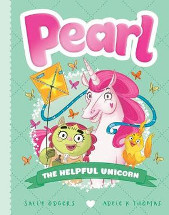
Pearl the helpful unicorn by Sally Odgers and Adele K Thomas
Scholastic, 2020. ISBN: 9781760669287. 121pp.
(Age: 5-8) Pearl the unicorn and her friends Olive the ogre and
Tweet the bird have several misadventures in this short illustrated
novel. Firstly they try to problem solve together and retrieve a
kite from a cliff. Next they try to save a dragon from a bog and
prevent themselves from being eaten by gobble-uns. Pearl's efforts
to use her magic in tricky situations don't always work and they
create humorous mistakes. They are good loyal friends who use their
special abilities and cooperate.
This book is unashamedly aiming for a young audience of mainly girls
who are currently besotted with unicorns and the colour pink. The
digitally created illustrations dominate the page and are in black,
white and pink. Some pages only have a few sentences and the large
font also has random pink words. Chapters make the book very
appealing to emerging independent readers. Also short sentences and
the simple repetitious text make this very accessible for them.
There will be further Pearl books in the series, which means
children will be keen to read them.
Jo Marshall
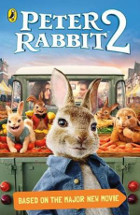
Peter Rabbit 2 movie novelisation
Penguin, 2020. ISBN: 9780241415290. 152pp.
(Age: 8-12) Peter Rabbit 2 is a novelisation of the film Peter
Rabbit 2. The adventure is set in contemporary countryside
England and is loosely based on the famous Beatrix Potter
characters. The animals cannot talk to humans but all understand
them and the story is mainly from their point of view. Peter Rabbit
has been sidelined from author/illustrator Bea's life when she
marries Thomas McGregor. Thomas clashes with Peter, who he finds
mischievous and annoying. Peter is unable to convince Thomas that he
is well intentioned. When Peter meets a roguish friend of his late
deceased father, he leaves home for a life of naughtiness. Peter
involves his friends and family in a crazy operation to steal food
from the town's market and unwittingly puts his animal friends in
peril. At the same time Bea is being encouraged by her publisher to
make her stories about the animals more saleable, with scenarios
involving hoodies, surfing and space travel. She is enticed by the
wealth and glamour that big sales may bring but Thomas disagrees
with her new direction.
The film is packed full of slap stick, non-stop action and some
quite adult jokes, as many children's films are. This doesn't always
transfer well into the written word and I wonder if children will be
engaged in the story if they haven't seen the film. This perfunctory
retelling has occasions where the author has forgotten the child
audience. Will they understand phrases like "conflate reality"?
Readers who are faithful to the original stories may be horrified by
the liberties taken with those dear little animals of Beatrix
Potter's books. Ironically the film/book's message regarding the
need to be faithful to the author's authentic representation of
animals and not sell out to commercialism, is what the film is in
fact doing. Film merchandise makes a lot of money and this book is
one of many products created for the film's release.
Jo Marshall
Amnesty by Aravind Adiga
Picador, 2020. ISBN: 9781509879045.
(Age: Senior secondary - Adult) Highly recommended. Forever on edge,
scared of being caught, Danny is an illegal immigrant living in
Sydney. Not a boat person seeking refuge, the usual stereotype
Australians associate with the term 'illegal immigrant', Danny is
one of the others - coming from Sri Lanka by plane, on a student
visa, then realising his course was a "ripoff", he dropped out, and
disappeared. So now he is illegal, a man without rights. He lives in
the
storeroom above a shop, paying Tommo, the exploitative shop owner,
half the money he makes cleaning apartments as the Legendary
Cleaner, carrying his vacuum cleaner on his back.
We gradually learn there is a reason Danny fled Sri Lanka - it is to
do with the lump on his arm and the memory of an interrogating
police officer holding a cigarette. The fear of being sent back
keeps him always wary, intent on mastering
Australianness, golden streaks in his hair, and Aussie slang on his
lips. But things start to go horribly wrong when there is a murder
in one of the apartments he cleans and he is the only one with any
idea of who the murderer could be.
Thus he faces a dilemma: should he contact the police and tell them
what he knows about the secret affair between the murdered woman and
the 'Doctor'? But then the police will work out that he is illegal,
and he will get deported, back to the danger that he never wants to
face again.
The events of the book all take place within one day; the clock
ticks as Danny and the murderer draw closer together and Danny
vacillates between making the call or making a run for it.
With little descriptions of people and places, the white people
watching him, the knowing looks that pass between the legal brown
person and the illegal one, the nervous twitch that the cleaner
finds hard to control, the dreams and memories that come into his
mind, and his constant state of tension are all masterfully and
vividly created by the author Adiga. It is a tension that carries
the reader from one moment to the next, and in the process a whole
other world is revealed to us, the underworld of the person with no
identity card, no passport, no rights.
The title Amnesty comes from the knowledge Danny has that
there was once a politician, Malcolm Fraser, who, on Australia Day
1976, offered amnesty to prohibited immigrants who had overstayed
their visa. Maybe there is a chance
that he might be offered amnesty in exchange for dobbing in a
killer? What do you think?
Helen Eddy
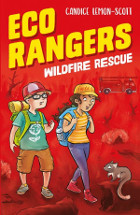
Wildfire Rescue by Candice Lemon-Scott
Eco Rangers book 3. New Frontier, 2020. ISBN: 9781925594904.
(Age: 7+ years) Highly recommended. Eco Rangers Wildfire Rescue
by Candice Lemon-Scott is the third book in the well written Eco
Rangers series. Given the 2019-2020 summer Australia endured
with fires in every state, the book is very topical re the dangers
faced by Australian wildlife to survive the peril of bushfires. For
younger readers this is an insight into the threats faced by
wildlife with burn injuries, breathing in too much smoke, losing
their habitat and being unable to find food.
The Eco Rangers, Ebony and Jay, are best friends and neighbours who
are helping out local vets Dr Tan and Dr Bat with finding injured
animals that need immediate care. While searching for injured
wildlife they discover a possum covered in ash and with burnt feet.
As they prepare to take the possum back to the clinic they stumble
upon signs that there are campers in an area that is not open for
camping. After settling Mira the now-named possum with the vets, the
two Eco Rangers are keen to discover who is camping in the burnt
bush and why. While collecting foliage to feed Mira they stumble
upon a rock cave where two young campers are hiding out. Eventually
the four meet up and face more danger when they themselves are
threatened by a wildfire near the campgrounds.
This book is an exciting and very readable story that will entertain
young readers as well as older more reluctant readers. In the story
there are all the elements that appeal to children: independence,
nature, animals, danger and mysteries to be solved as well as
parents who support and encourage the Eco Rangers in their
environmental pursuits. Themes: Themes: Conservation, Friendship,
Environment, Wildfires, Mystery, Australian wildlife, Adventure.
Kathryn Beilby
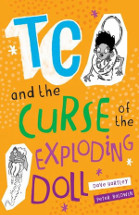
TC and the Curse of the Exploding Doll by Dave Hartley
Illus. by Peter Baldwin. Omnibus Books, 2020. ISBN: 9781742991887.
(Age: 7+ years) Recommended. TC and the Curse of the Exploding
Doll by Dave Hartley is the second novel featuring TC and his
best mate Lockie. The boys live in Warner Creek, a small country
town in Australia, and spend their days either accidentally creating
mischief or trying remedy the mischief they have made. Added to this
mix is a gang led by a Year 6 boy Mason who constantly bully TC and
Lockie and make their life difficult. After the first three pages of
TC and the Curse of the Exploding Doll, the reader knows the
setting, the characters and the plot and is in for an action-packed
adventure featuring a Chloe Doll, an angry sister, a forbidden
waterhole and a mysterious bunyip. When the local paper reports on
the possible sighting of a bunyip at the waterhole, TC asks Nan and
Pa about the sighting. They are genuinely afraid of the bunyip and
order TC to stay away from the waterhole.
The author gives a detailed explanation of bunyips to his readers
and Pa tells TC "they are part of our land and should be left alone
in peace." Of course Nan and Pa do not realize that TC and Lockie
have already lost a doll in the waterhole after completing a science
experiment and there are severe and embarrassing consequences for
Lockie if the doll is not replaced by the end of the week. The boys
begin collecting tyres to earn a significant amount of money to buy
a new doll and stumble upon a secret that Mason and his gang are
putting together. Needless to say TC with the best of intentions
falls prey to a dangerous situation and is rescued by Pa and Uncle
Albert.
The illustrations by Peter Baldwin complement the text perfectly.
This is a humorous and enjoyable read that boys in particular will
relate to. Themes: Boys, Friendship, Bunyips, Aboriginal Culture,
Danger, Bullies, Humour.
Kathryn Beilby