Illus. by Carlo Beranek. Busy Books. Campbell Books, 2020. ISBN:
9781529017700.
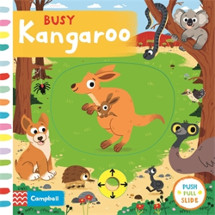
(Age: 1-3) Push, pull and slide with Busy Kangaroo as she hops
around looking at all the Australian animals and bush. She jumps up
high to see a cockatoo, hops to make the quokkas smile and watches
out for the crocodile. She sees the wombats burrow deep "and when
it's nearly time for bed, out pops her baby's fluffy head."
This is an exceptionally sturdy board book that will stand a lot of
heavy handling. The pull, push and slide tags are all marked with a
yellow circle with black arrows to indicate the way that the tab
works and are made of heavy cardboard.
The rhyming text will be enjoyed by the young children who are the
book's audience and makes it a good read aloud and its ending will
make it a very suitable bedtime story too. The little speech bubbles
with a question to be answered on each double page spread add to the
enjoyment of the text and pictures. Children will have fun counting
the shark fins and spiders on different pages. The illustrations are
cute and will appeal to kids as will the humorous little details on
each page.
Pat Pledger
How to grow a family tree by Eliza Henry-Jones
Angus & Robertson, 2020. ISBN: 9781460754955. 331pp.
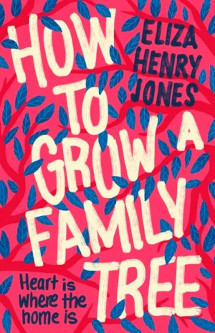
(Age: 14+) Highly recommended. Stella's world is turned upside down
when her Dad's addiction sees them evicted from their modest home,
where the sister's stuff may occasionally go missing - also down to
Dad's gambling. Exiled to the Fairyland Caravan Park with her
parents and short, delinquent step-sister Taylor, Stella tells
no-one in her friendship circle - not even Clem, her best friend.
For an odd girl who reads nothing but self-help books, she has a
small but supportive group of friends. Taylor seems a misfit by
comparison but fixing people isn't Stella's only fixation. Her
natural mother has requested a meet-up. Too many chapters later, she
still hasn't opened the envelope or confided in anyone.
The Fairyland Park, is a close-knit community of fringe dwellers.
The park manager mistreats his son Michael, Taylor sleepwalks, Mum
(Judy) cries for her old home . . . everybody has problems -
even those who don't complain. Stella strives to put her how-to
information into practice with limited success but it helps her, to
give her life direction.
When Stella's real mother, Kelly, invites her to stay, the apartment
is luxurious compared to the cramped caravan, but Kelly is distant -
stunted by her past experiences. Kelly's sister Mary, makes up for
her birth mother's silence, introduces her to her curmudgeonly
grandfather and slowly Stella learns why she was given up for
adoption. Charlie, her placid step dad, saves the park mascot and
'therapy' dog, from a snake bite, but he is unable to heal himself.
When a flood threatens the caravan park, Stella knows where she
wants to be.
Stella is an eclectic young woman on the brink of leaving school and
her friends are lively and believable. Clem will be adored for his
constancy and restraint. Will his love remain unrequited? Typically,
home is where the heart is and How to Grow a Family Tree
will fill your heart and mind from the small seed of a girl's birth
spreading outward into the community - some natural, some adopted
and thankfully a heady mix of friends and neighbours. Themes:
Bildungsroman.
Deborah Robins
Littlelight by Kelly Canby
Fremantle Press, 2020. ISBN: 9781925815764.
(Age: 4+) Highly recommended. When the Mayor of a walled city
notices that some bricks are missing, he is very cross, thinking
that a thief has stolen the bricks. The wall keeps other people out,
and protects his city from things that are different. He calls the
attention of his fellow citizens to the theft, and they are equally
angry that this should happen. They are all concerned that something
different should get into their city and help him to find the thief.
They look at all corners of the town. The walls to the south protect
them from people who look a little different and grow unusual food,
those to the north grow unusual food, act a little differently and
speak different words. To the east the people grow unusual food,
speak different words, look a little different and have upbeat
music, while to the west, they are different in all the ways that
the others are different, but on top of all that difference, they
read unfamiliar books. The Mayor cannot be more furious. He and the
people double their efforts at finding the culprit and eventually
find that it is a young girl. Just as the Mayor is about to admonish
her, the populace realise that the smell of new food, the sound of
new words, the beat of new music and the promise of new stories was
not something to be feared. And they realised the the little girl
had not taken anything from them, but had given them a gift, a gift
of seeing something different. Through the gaps in the wall they
could see how others lived, they had windows and now doors and then
bridges.
A modern fable, readers be entranced by the backward looking mayor,
and the possibilities that have opened up for the populace of his
city.
They will readily see the parallels to walls being built and those
torn down, those that have stood for centuries and those that have
lasted less than a few decades. They will recognise that his book is
about welcoming difference: difference in how we look, what we eat,
how we sing and what we read. The book will open up a range of
discussions, opinions and thoughts. All augmented by the wonderful
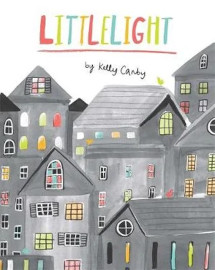
illustrations, the few colours peeping through redolent of the
possibilities offered by difference. The greys give way to more
colour as the book proceeds, the people realising the richness that
light brings.
Themes: Colour, Difference, Multiculturalism, Tyranny, Walls.
Fran Knight
Tashi series by Anna and Barbara Fienberg
Illus. by Kim Gamble. Allen & Unwin, 2020. Tashi: The book of spells and secrets. ISBN: 9781760525149. Tashi: The book of magnificent monsters. ISBN: 9781760525217.
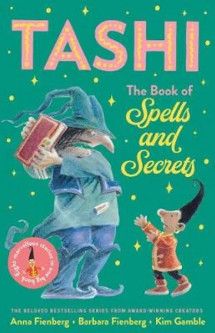
(Age: 7-9) Highly recommended. Allen & Unwin have republished
many of the Tashi stories written between 1995 and 2009 in four
volumes, richly illustrated by Gamble. Selling over a million copies
worldwide, Tashi is now a TV series and there have been many other
books featuring this wonderful character.
Republished in volumes of eight stories compiled under titles such
as The book of spells and secrets and The book of
magnificent monsters, younger readers will have the thrill of
reading about Tashi for the first time, while older readers will
pick up a volume to be reacquainted with an old friend.
Each of these two volumes contain a clutch of stories, all about
thirty pages long accompanied by Gamble's readily recognised
illustrations of the tall hatted hero. Each is followed by its
companion story. In The book of spells and secrets can be
found Tashi lost in the city, published with another story, On
the way home, in 2004.
In The book of magnificent monsters appears the tale, Tashi
and the phoenix, followed by An unexpected letter,
published together in 2006.
Tashi and the Baba Yaga as with many other stories begins with Jack
telling his family about his friend, Tashi and the wonderful
adventures he has. In this one, Tashi tells Jack about the time he
finds a house that has arrived in the woods near his home after a
fearful storm. Invited in he realises that he is to become dinner
and cleverly gets himself out of the pot, by tricking the young
girl. Gone follows telling of the chickens being lost from
the hen coup in the garden.
Each of the stories tells an adventure and also gives a precept for
life: being kind, being careful of strangers, helping others, being
kind to your friends and so on.
With their bright new covers, the stories will be wonderful read
alouds as well as being most attractive for younger readers to pick
up. Themes: Tashi, Adventure.
Fran Knight
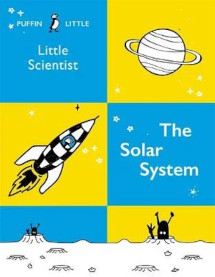
Puffin Little Scientist : The Solar System
Penguin Random House Australia, 2020. ISBN: 9781760897031. 96pp.
(Age: 6+) Highly recommended. The Puffin Little series look
at the solar system is sure to enthuse young readers who are
interested in science and prove to be a valuable easy to read
reference book in a library. There is a Contents page that has the
following headings and subtitles within many: Introduction, The
solar system, The sun, The Rocky planets, The Asteroid Belt, The gas
giants, The dwarf planets, Byond. There is also a Fast Facts
section, a glossary and a Puffin quiz.
Set against a blue and white background, the print is large with
good headings to assist a young reader. The planets have a fast
facts page and then more pages describing unique features. Diagrams
are well labelled and the little puffin who lurks throughout the
book will fascinate children. Illustrations are often humorous as
well as informative.
The book comes in a small format and will prove to be a valuable
addition to a home library, school library and classroom.
Pat Pledger
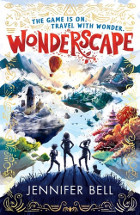
Wonderscape by Jennifer Bell
Walker Books, 2020. ISBN: 9781406391725.
(Ages: 10+). Highly recommended. Wonderscape author,
Jennifer Bell, has written an exciting and intriguing gaming
adventure set primarily in the future. Her three main characters,
Arthur, Ren and Cecily, are all thirteen years old and from the 21st
century. They are all very different, have no real connection to
each other except attending the same high school and bring their own
special qualities to the eventual quest they must undertake. An
explosion in Peacepoint Estate leads to the three being transported
through a Wonderway (portal) to a wooden ship, Principia, where they
meet the first of the many historical figures, Isaac Newton. They
also are exposed to the mimics (robots) which play a pivotal role
throughout the story. On the ship the children are given
Wondercloaks which have amazing attributes that assist them on their
complex and dangerous journey. Wonderscape is actually an
I-RAG - an in-reality adventure game where players known as
wanderers complete challenges for rewards and to be able to progress
to another realm. Every realm is themed around a different hero from
History and there is a riddle to be solved. The realms are hazardous
and in order to find their way back to the 21st Century, the three
travellers must go through a number of them to search for a missing
person and the time-key that will unlock the Wonderway to home - all
within fifty six hours or they will become in Arthur's words
"slime". Travelling with the three children is a dog named Cloud who
is full of surprises and is crucial to the overall outcome of the
quest. The Wonderscape game was designed by three adopted
siblings, Tiburon Nox, Valeria Mal'fey and Milo Hertz, who each took
on different roles. There is conflict within the family which has
led to a change of the initial principles of the game which is now
on a self-destructive path.
The amazing plot and story-telling in Wonderscape keeps the
reader wanting more. Those who are gamers will readily identify with
many of the terms and concepts in the story and those who are not
gamers will learn a little bit more about this 21st century
phenomenon. Themes: Gaming, Time travel, Danger, History, Mystery,
STEM, Friendship, Trust, Problem solving.
Kathryn Beilby
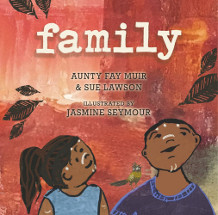
Family by Aunty Fay Muir and Sue Lawson
Illus. by Jasmine Seymour. Magabala Books, 2020. ISBN:
9781925936285.
(Age: 3+) Highly recommended. Boonwurrung Elder, Aunty Fay Muir has
written two books with Sue Lawson: Nganga,
and picture book, Respect, illustrated by Lisa Kennedy. Now
comes a third collaboration, Family, just as impressive,
showing readers what family means to Aboriginal children. It is part
of their heritage, a sense of family and community, of home and
country, of deep understanding and love, all tied together with one
word, Family. A universal concept, the many facets of the theme are
shown in this book as the children work through their days, playing
games, making things for the community, yarning with old people,
singing songs, looking after the environment, fishing in the sea,
listening to aunties and uncles, dancing and drawing. Each double
page shows the children pursuing an activity which involves their
family, learning from their community, listening to the ways their
community works, listening to their extended family. Each spread has
only a few phrases but each is redolent of the connection between
the country and family, the connection between heart and home.
The words have been pared down to a basic tenet; the simplicity of
these few words a springboard to a galaxy of meanings and responses,
ensuring that children reading the words will see much more,
enlivening their reading.
Alongside the words are bright, vivacious illustrations, done in a
naive style, equally layered and full of meaning, pushing the reader
to see more than is in front of them. I love the endpapers with
their rock art symbols, the ochre colours reflecting the pale
etchings across the pages, while many of the pages depict children
talking, dancing, singing, working with family groups. The family is
where ideas are passed on, lessons taught, beliefs recognised,
but at its heart, it is home, a place of safety, love and caring.
Themes: Aboriginal themes, Families, Love, Culture.
Fran Knight
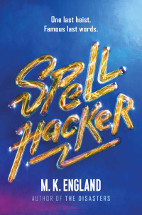
Spellhacker by M.K. England
Harper Teen, 2020. ISBN: 9780062657701. 402p.
(Age: 14+) Fans of high fantasy thrillers will think they have died
and gone to heaven - or at least Kyrkarta. The action starts almost
immediately with an earthquake. Brave spell weavers and tech witches
spontaneously assemble in the street to minimise the damage and it's
wickedly intense.
Kyrkarta has a history of such disasters - the last quake unleashed
something. Maz or magic used to be plentiful, but since the
earthquakes released the spellplague killing thousands, Maz is no
longer common. Maz takes many forms and a Periodic Table of Maz
prefaces Chapter One. We aren't given the atomic weights so the list
is basically a ready reference or glossary of terms. There are three
categories of Maz strains - Core, Perceptual and Augmenting.
Categorised under these strains are the 14 types of Spells. Wataz
Maz is "Core" and produces water and flowing effects, while Magnaz
is used for amplification or "Augmenting".
Maz has become so expensive that Diz and her three friends created
their own black market for Maz - illegally siphoning it off and
selling it. Ania is a Techwitch, Remi a Spellweaver and Jaesin,
Diz's "ex", is a Mundie like Diz. They've planned one last heist,
but they become mixed up in a dangerous conspiracy.
Diz's love interest, Remi, is referred to in gender-neutral pronouns
providing us with recognisable reference points, welcomed because
the level of fantasy is difficult to delve into at first. Thanks to
the group of L.G.B.T.Q.I.A. teens who are very likeable, sarcastic
and flirty, the appeal of Spellhacker is characterisation in
addition to the novelty, which breaks with traditional expectations
of books about magic. If you like Sci-Fi mixed with fantasy and
action, you'll get more than you can handle in the future realm of
Kyrkarta. Spellhacker is available as a downloadable audio.
Themes: High fantasy. Magic.
Deborah Robins
League of Llamas: Rogue Llama by Aleesah Darlison
Puffin Books, 2020. ISBN: 9781760894207.
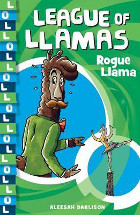
(Ages: 7+ years) League of Llamas: Rogue Llama by Aleesah
Darlison is the fourth and final book in the popular and humorous League
of Llama series. Secret Agent 0011 Phillipe Llamar is in
hiding and on the run after being blamed for a terrible crime he did
not commit. He is in disguise and on the hunt for the real
perpetrator, Ratrick Tailbiter - a rat with attitude, as well as
evil supportive companions who continually try to out-manoeuvre
Phillipe. Meanwhile Phillipe is being is being pursued by Agents
Elloise and Lloyd who have been sent by Mama Llama to bring in their
rogue colleague. Phillip travels far and wide to prove his innocence
and eventually Lloyd joins forces with him to solve the
investigation.
Being the final book in the series the ending provides the readers
with a very satisfying conclusion. Younger readers will enjoy the
humour spread throughout the book and the fast paced action packed
events which happen frequently. Being one of a series League of
Llamas: Rogue Llama will continue to support middle grade
readers who may struggle with more difficult text as the repetition
of words will enhance their understanding and reading skills. This
is a light and entertaining story and will be popular with children
who can relate to animals as the lead characters. Themes: Secret
agents, Spies, Adventure, Humour, Crime, Animals, Disguises.
Kathryn Beilby
Matthew Flinders: Adventures on leaky boats by Carole Wilkinson
Illus. by Prue Pittock. Wild Dog Books 2020. ISBN: 9781742034935.
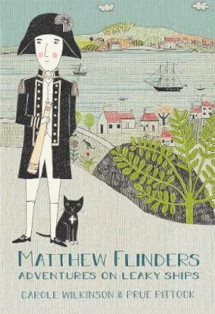
(Age: 6+) Highly recommended. Stylishly presented, this book of
Flinders' journeys will delight younger readers as they travel with
him, marvelling at the journeys he undertakes and the places he
visits, the maps he draws. And in the main accompanied by his cat,
Trim.
Flinders joined the British Royal Navy, sailing with Bligh, dreaming
of expeditions like those of Captain Cook. Sent to Australia, he met
George Bass also bent on adventure and the two arrived in Botany Bay
in 1795. They sailed in two expeditions along the southern coast of
New South Wales in the Tom Thumb. Later the pair proved that
Van Diemen's Land was not attached to the mainland and when Flinders
sailed back to England, he wrote to Sir Joseph Banks asking for his
backing for an expedition to sail around Australia and map it. With
England at war with France, things could be tricky, and during his
expedition he met Nicolas Baudin off the coast of South Australia,
mapping from the opposite direction. His mapping of the continent
was an amazing feat, with his crew ordered to eat fresh fruit and
vegetables to avoid scurvy.
Many leaky boats later, Flinders survived being shipwrecked,
captaining a small boat back to Botany Bay for help with his
marooned sailors. But another leaking boat in the Indian Ocean saw
him arrested as a spy and imprisoned for six years at Mauritius.
His maps have endured, used until very recently as a standard, and
it is his statue outside the library in Sydney with his cat Trim
which attracts much attention. Statues can also be found in Port
Lincoln and Melbourne, while South Australia has an abundance of
places named after this man.
A glossary and timeline augment this already fascinating book, a
story well told and spectacularly illustrated by Melbourne artist,
Prue Pittock for younger readers to appreciate the lengths early
explorers went to map this continent. Prue's ink and coloured
pencils light up each page as Flinders' travels unfold, her soft
understated style augmenting the text, but so detailed, young
readers will gain more insight from closer examination. An easy to
follow map of his exploits around Australia end the text, and the
story of how Australia was named is told.
This is a wonderful addition to any school or home library.
Fran Knight
A knock at the door by Tom Wood (writing as T. W. Ellis)
Hachette, 2020. ISBN: 9780751575934.
(Age: Senior secondary/adult) Highly recommended. When two
government agents knock at Jem Talhoffer's door her life is turned
upside down. They ask for her husband Leo and suggest he is involved
in organised crime. She cannot believe that her handsome perfect
partner would have anything to do with such things. While the agents
are questioning and searching she receives a call from an Agent
Carlson, which casts doubt on the identity of the Feds. She is urged
to leave her home and make a run for it.
Jem and Leo have moved from the city for the peace and calm of small
town America. They have found the perfect house isolated from its
neighbours but not too far from the town's amenities. Jem takes yoga
classes, but tends to keep to herself while Leo a wine merchant
takes care of business and often travels overseas.
Jem takes off through the woods, but hasn't thought through her
escape. She is bare footed and has bought nothing with her. She
makes it to the road, feet cut, scratched, bruised and flags down an
old man in a pickup truck. It seems as if luck has changed, Trevor
the driver, is straight as the day is long. He is one of the many in
the USA that has no trust in the government or people in suits, he
has no phone and is self reliant.
They head into town where Jem decides she will confide in the local
police chief, Rusty, an eminently sensible and trustworthy woman.
However when she arrives she is dismayed to find the two agents are
already at the police building. She makes a move to leave when a car
pulls up with Agent Carlson at the wheel; he urges her to get in and
he assures her she will be safe. But Jem doesn't know who to trust
and heads for the police building. She ends up being driven back to
her home by the two agents, but things then really take a turn for
the worse.
Tom Woods is writing here as T. W. Ellis, and has the narrative
delivered by Jem and Rusty (the police chief). The reader is
naturally sympathetic with Jem's story and the dilemma in which she
finds herself. The question is always: what would you do if you
found yourself in the same situation? The narrative provided by
Rusty is very different. The reader is allowed into her life, a
strange mixture of the very private and the very public, but there
is a feeling of dependability and trust.
There are many twists in the plot and you are left feeling very much
like Jem. Who do you believe, who can you trust. There are also
moments of shock when the most unforeseen actions take place. Whilst
not always quite believable Ellis provides a roller coaster ride,
that has perceptions overturned and personalities questioned. A
thoroughly recommended read.
Themes. USA, Crime, Thriller, Conspiracy.
Mark Knight
Robots by Charles Hope
Wild Dog Books, 2020. ISBN: 9781742034799.
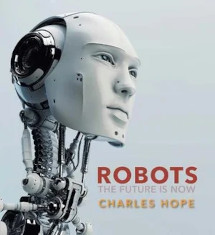
(Age: 6+) Highly recommended. This non fiction book about robots,
subtitled The Future is Now, will rarely be left on the
shelves as it informs, interests, entertains, delights and
encourages readers to think beyond. Divided into fifteen succinct
chapters, with lots of visual material to pore over, each page
contains a brief outline encouraging readers to think about the
terms expressed. The bites of information are put together in a way
that younger readers can absorb, terms are expressed in such a way
that their context tells the reader what they mean and each page
develops a new idea. A definition of a robot is a good place to
start, and from there the author tells us of the earliest robots:
the story of Pygmalion, the golem, Frankenstein's monster and the
more recent forays into the world of science fiction. Most readers
will have heard of R2D2, Wall-E, HAL and K-9, and the book goes on
to look at automatons and then discuss the difference between
robots, cyborgs and androids. With these differences firmly in
place, the book continues to discuss the use made of such robots and
what the future may hold. A page is devoted to AI, and then Nanobots
and Cobots, terms new to me.
Readers will be enthralled at the range of information given with
wonderfully apt illustrations to behold and longer over. A terrific
index is presented at the end for those curious minds to further
explore the book.
This is one of a series of books being published by Wild Dog, the
first two were Artificial Intelligence, and 3D Printing,
while three more are in the pipeline: Chips, Phones
and Virtual Reality.
Themes: STEM, Robots, AI, Science fiction, Future, Science.
Fran Knight
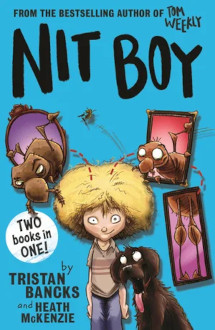
Nit Boy by Tristan Bancks
Illus. by Heath McKenzie. Puffin, ISBN: 9781760896300. 276pp.
(Age: 11+) Highly recommended. Nit Boy claims to be two
books in one but it's just two different heads of hair. The
narrative of both books oscillates between the forest of Lewis' hair
and the universe surrounding the hapless Lewis, who is something of
a freak to his fellow humans. Unlike Bancks' usual antiheroes, Ned
has a short life to solve his identity crisis. In Part 1, Lift
Off, Ned grapples with his identity as opposed to Lewis' human
confidence that he is fine just the way he is, with his Dad's long
hair complete with pets. The father-son relationship concerns both
Lewis and Ned in their journeys of self-discovery. Lewis wants to be
like his Dad who is absent a lot of the time and Ned wants to be
nothing like his dad, who uses Ned to fulfil his own ambitions. Ms
Herrick emits shades of Miss Trunchbowl, blaming Lewis for the
headlice outbreak and making him miserable - but it's all Keith's
fault, for forcing Ned to marry and have babies who can jump, yes
jump - like fleas.
In part 2, cathartic secrets are brought to light as Ned leaves
Lewis to live amongst the fleas on Dad's dog. Huck and his chocolate
Labrador Boston, have returned from their field work - an absence
that divides his family. Lewis struggles with veganism in the same
way that Ned can't stand the taste of human blood. Pages cannot help
being turned following their concurrent search for answers.
This is often a descriptively gross book of life-cycle diagrams and
pop quizzes about fleas and head-lice, but amusingly the big picture
issues abound - the environment, eating meat, morality, family,
education and genetics. Illustrated by Heath McKenzie, these
fantastic adventures are founded firmly in facts - an engaging
discourse about change and epigenetics through which mankind is
evolving. The frivolous subject matter, belies a layered line-up of
characters worthy of fan or book club debate. Themes: School,
Humour.
Deborah Robins
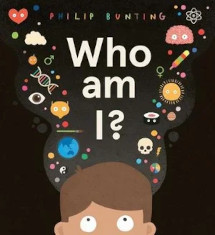
Who am I? by Philip Bunting
Scholastic Australia, 2020. ISBN: 9781743835043.
(Age: 5-10) Highly recommended. Philip Bunting likes to tackle some
of the big questions in life (How did I get here?) and this is no
exception. Who Am I? doesn't just look at human existence
from a physical point of view, instead explaining to children all
the things that contribute to building identity. The illustrations
are done in Bunting's signature style: simple but eye-catching and
highly effective. The book is structured using a series of questions
(Am I my name?, where I'm from?, my stuff?, my gender?, the colour
of my skin?, my muscles?, my bones?, my guts and stuff? my senses?,
my thoughts?, my feelings?), that are then explored, with the
message that most of these are important makings of our body but
don't really make us who we are. 'Your true self is so much greater
than any of these bits and pieces . . . Pootling around, somewhere
behind your eyes, is the thing that makes you, you. Your truest self
. . . this is the part of you that sees what you see, wonders what
you wonder, and feels what you feel'.
There is an overarching and quite explicit message here that we are
not our outer body and that all humans around the planet are deeply
connected. We are all from the same place, made of the same stuff
and sharing the same feelings. Philip Bunting has the most exquisite
way of putting huge ideas into simple words. The Bill Hicks quote
that he has included in the back of the book is "We are all one
consciousness experiencing itself subjectively". In Who Am I?
Bunting has masterfully explored this deeply philosophical idea in a
way that makes it accessible to the youngest of readers. Themes:
Identity, Philosophy.
Nicole Nelson
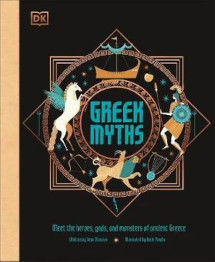
Greek Myths by Jean Menzies
Illus. by Katie Ponder. Dorling Kindersley, 2020. ISBN:
9780241397459. 160pp.
(Ages: 8 - 12) Recommended. Greek Myths is a beautifully
presented, simply written, thorough compendium. Although it is
non-fiction, with an index, it helps to begin reading it from the
beginning. In this way you understand how Gaia created the world and
then subsequent Olympian Gods and Goddesses such as Zeus, Hera,
Hades and Poseidon came to be. This section is followed by nine
myths of Gods and Humans such as the myth of Pandora's Jar. Nine
well known tales of heroes such as Jason and the Argonauts follow.
There's much treachery, trickery and violence amongst the Gods and
you realize the extent to which we refer to these characters and
tales in everyday life, e.g. The Trojan War, Icarus and Midas.
Throughout these sections are single fact pages devoted to each of
the main Gods and Goddesses. This helps the reader consolidate who
is who. A reference section has further useful pages explaining how
we know about this Ancient History, more information about mythical
creatures and monsters and how the Greek names were used to name
planets, animals and plants. There is a particularly useful
pronunciation guide as well.
Katie Ponder's many digitally created illustrations are well suited
to the myths. The whole design of the book, with quality buff paper
in a large hard covered volume, is very appealing. This book will be
useful in schools where Ancient History is part of the Australian
Curriculum in the middle years. It will also be of interest to young
readers who love books like Rick Riordan's Percy Jackson
series. There have been many anthologies of Greek Myths over the
years but I think the design, large font and easy to read style will
help connect these myths with today's audience.
Jo Marshall