Illus. by Danny Snell. Aussie Kids.Puffin Books, 2020. ISBN:
9781760893668.
(Age: 6+) Highly recommended. A new series of eight books, each set
in a different state or territory of Australia with eight different
characters and themes is a welcome addition to the library of books
available for the newly emerging reader. Each contains a map of
Australia to pinpoint its setting, a postcard at the start to
introduce the main character and several pages at the end to explain
things which have appeared in the text. Short chapters, copious
illustrations, good spacing and easy on the eye font, all packaged
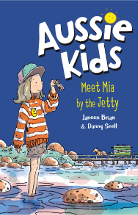
in a smaller book size make this series most useful. Meet Mia at the jetty is a gentle seaside story by South
Australian, Janeen Brian, reflecting the sights and sounds of Victor
Harbor, south of Adelaide. Here two sisters, Mia and Alice are told
that they will have a boy, Jim, staying with them while his mother is
in hospital. Mia is delighted thinking she will be able to show him
around their town, and makes herself a tour guide badge. Alice is
somewhat dismissive as is the want for an older sister, but as the
story develops the two girls learn to be positive about each other.
Mia shows Jim around her town, pointing out features as they go.
Luckily they live across the road from the beach and Mia collects
things to have in her bedroom. They wander along the beachfront,
have a sandcastle competition, go out to Granite Island on the horse
tram, see a fairy penguin's home and then visit the Whale Centre.
Here they are hopeful of seeing a whale and climb to the lookout.
Mia thinks she sees one but it turns out to be a boat, until another
tourist does notice a whale, thanking Mia for pointing in that
direction.
A lovely story, Alice comes over to her sister's way of thinking,
even adjusting the badge on her sister's shirt. Danny Snell's
illustrations evoke all the fun of the seaside and holidays by the
beach. Younger readers will be introduced to what to expect in a day
at the beach and specifically what they will see when visiting
Victor Harbor, and have some environmental messages given about
fairy penguins, with more information about these animals given at the
end of the story.
Theme: Sea, Beach, Whales, Penguins, Victor Harbor, Family, Humour.
Fran Knight
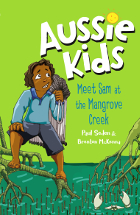
Meet Sam at the Mangrove Creek by Paul Seden and Brenton McKenna
Aussie Kids. Puffin Books, 2020. ISBN: 9781760894122.
(Age: 6+) Highly recommended. One of a series of eight books called
Aussie Kids designed for newly emerging readers this lovely
story set in the Northern Territory takes the children to a mangrove
creek with a new throw net to fish.
A postcard introduces the main character, Sam, and we follow him
getting out of bed excited for the weekend that has finally come
around. He and his friend Peter, along with the dog Bazza, are to go
down to the creek to fish. Sam is hopeful that they will catch a
barramundi. He packs a water bottle and pack of chips, grabs his
bike and cycles off to collect Peter. Together they ride to the
creek, mindful of Sam's father's advice to throw the net in the
creek's mouth. But Peter has brought banana lollies. Sam is
disgusted as you never take anything banana on a fishing trip. The
boys throw the net but wherever they throw it, no fish are caught.
Sam is convinced that the banana lollies have brought bad luck. An
older man who they saw at the shelter by the creek comes along to
them and suggests a better way of using the net. They take his
advice and are amazed at the two large fish they catch. Walking back
to their bikes they thank the old man but notice that his bedding is
in the shelter, so offer him the fish.
This charming story not only tells a good tale of two boys catching
fish it models life skills such as sharing information, being kind
to the elderly and sharing what you catch.
For early emerging readers this short story will enhance their
ability, as it is told in six short chapters enlivened with
illustrations on most pages, along with the introductory postcard
and two pages of information at the end of the story, while a map of
Australia shows the readers which state the story is set in.
Theme: Sharing, Northern Territory, Fishing.
Fran Knight
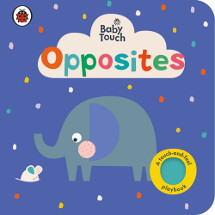
Baby touch : Opposites by Ladybird
Illus. by Lemon Ribbon Studio. Ladybird, 2020. ISBN: 9780241427408.
10pp.
(Age: 0+) A bright colourful touch-and-feel book, Opposites
is sure to make any baby happy as they explore the vivid pictures
and find the areas that they can touch and feel. Right from
the front cover, which has a touch-and-feel pale blue felt circle,
the young child will have a sensory experience. They will be able to
feel the fur on the dog and giraffe, the cut-outs and corrugated
cardboard on the balloon and car, the soft texture on the elephant,
the rough on the snail and feel and see the iridescent purple
of the fish. At the same time, they will begin to learn new words:
short and tall, up and down, big and small, above and below, slow
and fast.
The colours of this very sturdy board book are gorgeous; the animals
all have smiles on their faces, and I loved the little baby soaring
up in a balloon, while a monkey drives a car.
Babies are going to love exploring the textures and parents will
have fun talking about the things that are opposite to each other.
Pat Pledger
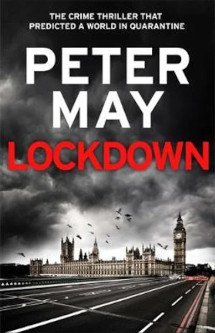
Lockdown by Peter May
Riverrun, 2020. ISBN: 9781529411690.
(Age: Senior secondary - adult) Highly recommended. D.I. Jack
MacNeil treads on many toes in his investigation into the discovery
of a child's skeletal remains. In normal times this crime would have
hit the head lines, however, this is London under martial law,
dealing with an epidemic of a deadly virus.The discovery of a bag
and its contents mean that the excavations for a new emergency
centre in Lambeth is a crime scene and work must stop, which upsets
the government and the workers, who are getting good money to get
the job done.
The bones of a small child have been stripped of flesh and cleaned
and are quite fresh.They also reveal she has had the virus but one
which has been developed in a laboratory. She also has,
surprisingly, a severely cleft palate that has had no corrective
surgery.
Amy Wu, a forensic odontologist, is called in to give her opinion on
the remains and she feels a bond with the child that may well have
shared her ethnicity. She makes the decision to do a facial
reconstruction. She names the child Lyn and her empathy grows for
this 10 year old with her terrible deformity.
Meanwhile as MacNeil begins his investigation, based on the most
basic evidence he finds he has a guardian angel. When following a
lead, he heads into an ageing housing estate where he encounters a
gang of youths armed with baseball bats and lengths of pipes and
only escapes with his life when two of the gang are shot. This
recurs when he finally tracks down his lead, a worker in the old
Battersea Power Station which has now become a crematorium on an
industrial scale. During his confrontation he is attacked and again
is saved by the anonymous sniper. It would seem the shooter is not
protecting MacNeil but eliminating any links to the young girl.
As the investigation proceeds it becomes evident that a large
pharmaceutical company Stein-Franks is involved. They were the
producers of an anti-viral drug, Flu-Kill, in which they had
invested huge capital and built manufacturing centres, but which in
the end had not proved effective against the virus and orders had
dried up leaving the company financially vulnerable.
Peter May began researching and writing Lockdown in 2005 but
the story was consigned to a folder in his dropbox. His publishers
didn't believe his version of London in lockdown could possibly
happen, and as some of his other novels were published the story was
shelved. How prophetic it was to become.
May has woven his murder mystery around the fear and apprehension
created by a deadly virus, and the race to develop and market a cure
by the major pharmaceuticals a story all so believable with
the on going pandemic at present. Lockdown is a great read
which also provides plenty of food for thought. I most heartily
recommend it.
Themes: Pandemic, Fear, London, Pharmaceutical companies.
Mark Knight
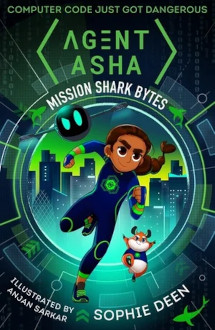
Agent Asha : Mission Shark Bytes by Sophie Deen
Illus. by Anjan Sarkar. Walker Books, 2020. ISBN: 9781406382723.
240pp.
(Ages: 10 - 12) Recommended. It isn't long until we learn 11 year
old Londoner, Asha, has been recruited by CSA, Children's Spy
Agency, and her mission is to save the internet. Asha's ability to
hack and upgrade her nannybot Drone and enhance Tumble, her hamster
robot, have alerted CSA to her amazing talents. Sharks have been
chewing through undersea cables which provide vital internet
connections between continents. Simple everyday things we rely on
like mobile phones and instant news, stop working. Her boss Hedy (a
hologram!) sends her to uncover essential data from ShellyInc. This
company is headed up by Shelly, a 17 year old tech entrepreneur of a
globally popular IT company. However Shelly is definitely up to no
good and aims to take control of the internet and increase her vast
wealth. Asha goes above and beyond her mission in order to prevent
Shelly being successful and Drone and Tumble assist her along the
way, as well as other CSA operatives.
Needless to say this is a totally implausible but enjoyable spy
adventure. It is fast paced and quite clever with humorous spy
tropes. There are crazy inventions like the "What-a-bottle," a water
purifier with inbuilt gadgets like a laser torch and diamond glass
cutter. Asha is the Bond-like, risk-taking, main character with an
Indian cultural background. She is a good role model for young women
who may be keen on STEM. I liked the CSA motto too, "Think for
yourself. Question everything." The author may be a bit too keen to
slip in some didactic IT lessons, such as the importance of strong
passwords, algorithms and Bluetooth. The overuse of farts was an
obvious pitch to young readers but I guess it works! There are many
really fitting illustrations and fact files provide further
information. Another hook for readers is they can join CSA via a QR
code, no adults allowed.
Jo Marshall
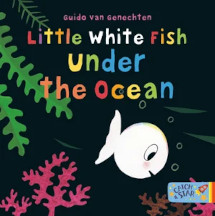
Little White Fish under the ocean by Guido Van Genechten
Catch a Star, 2020. ISBN: 9781922326102.
(Age: 2-5) Recommended. Little Fish is curious. 'How deep is the
ocean?' he asks the jellyfish, who tell him to stay away as it is
too dangerous to go down to the depths of the sea. But he really
wants to know and even though Little Goldfish tells him to be
careful, he continues his journey through the really dark water.
Despite more warnings from the Turtle and Octopus his curiosity gets
the better of him and he swims on past the coral and seaweed to
where the water is pitch black and ice cold. Fortunately, he gets
help from the anglerfish who turns on her little lamp and guides him
back to his friends. He is glad to be home!
Set against a black background the vivid sea life and bodies of the
fish stand out beautifully and will intrigue young readers as they
get to name much of the underwater life. Each little bit of marine
life has a smiling face and happy eyes and it is fun to follow
little White Fish's quest to discover how deep the ocean is. Little
White Fish is very curious and is prepared to take risks to uncover
what it is like deep down in the sea, but he has good friends who
counsel him about the dangers and one fish who helps him home.
A message of needing to have good friends, the joy of taking risks
and the happiness of coming home are ones that children will enjoy.
Pat Pledger
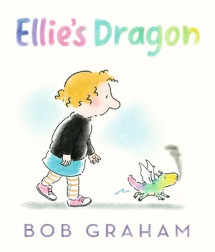
Ellie's dragon by Bob Graham
Walker Books, 2020. ISBN: 9781406387629.
(Age: 4+) Highly recommended. Ellie finds a baby dragon in the egg
carton at her supermarket. She calls him Scratch and installs him
along with his box of dragon litter, in her doll's house.
Through the years of Ellie's growing up, through kindergarten and
then school, right up into her post primary years, the dragon is
there. Scratch goes with her to see her Dad, goes to school where he
entertains the other children, curls up asleep in Ellie's room. All
of her friends can see the dragon but not her parents or the
teachers. Ellie takes Scratch to kindergarten but not to school. Now
that she is older she does not need Scratch nearly as much and
misses his first flight. But he is always there in the corner of her
room where she knows he will be. The older Ellie gets, the less
visible the dragon becomes until one day in her teens she can see
right through him, and that night he takes flight and does not
return.
Even though she is older she spies him now and again and knows that
he is with another child who needs his company, because she catches
a glimpse of his tail or a wisp of his smoke over the fence.
This wonderful tale of growing up with a close friend will appeal to
all ages. Everyone will remember the stages of their development and
how they coped with each change. And to see Ellie change from a
small child to a teenager, will heighten their recollections. Her
development is put alongside the dragon's development from a baby
dragon, through his learning to breath fire, to growing too big for
the doll's house, and then learning to fly. Each stage of the
dragon's development parallels Ellie's own stages of growth.
Ellie is lucky to have a companion such as Scratch, a warm hearted,
affectionate friend to guide her through the wonders of growing up,
and readers will recognise their own stages of growth and wonder at
the dragon who grows up alongside Ellie.
Bob Graham's beautiful illustrative technique is used to perfection
here. His use of quiet understated colours, his depiction of the
ordinary, the everyday, all done with such attention to detail,
impels the readers to look again at the things seen in their own
neighbourhood with fresh eyes. I love the supermarket and the school
bus, the people in the street with their prams and bikes, the
picture theatre and the doll's house, all drawing the eyes in to
wonder at the things we often see but again do not see. Graham
evokes in us all a greater awareness of our domestic surroundings. Teacher's
notes are available.
Themes: Imaginary friend, Humour, Friendship, Family, Growing up.
Fran Knight
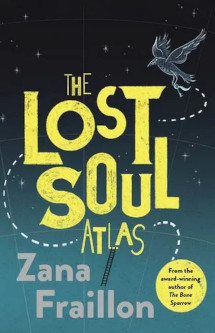
The lost soul atlas by Zana Fraillon
Hachette, 2020. ISBN: 9780734419934.
(Age: 10+) Recommended. Twig is in the Afterlife - we know that his
life ended somehow, and he is supposed to follow the path to a
blissful place without cares or memories. But something tugs at him;
he wants to know what happened to his Da and his friends. And there
is a skeleton raven, Krruk, a guardian who is willing to accompany
him back into his memories, into the world that was before, on a
quest to find his father and free the world from the evil of the
Hoblin.
Twig has a map and a bag of bones, each bone a key to a special
place on the lost soul atlas, a crossing that must be unlocked to
free past memories. In his quest he joins up with a group of street
urchins living in a graveyard, and befriends Flea, a courageous
leader of androgynous gender. Together they try to outwit the
treacherous Hoblin, and find a way to safety.
The lost soul atlas is a quest story; there are six crossings to be
opened after answering the riddle posed by each sentry. But with
each crossing Twig is sent back into his past life, and it is harder
and harder to remember the quest. He succumbs to the influence of
the Hoblin and commits a horrible betrayal, like that of Edmund in The
chronicles of Narnia.
In her 'Author note' Zaillon writes about the millions of children
living on the streets, the gangs and the struggle to find food and
shelter, the fear of police and authorities. It is this that comes
through most strongly in her book - she has created a strange
combination of mystical fantasy world and the very real day-to-day
struggles of children living on their wits.
Readers who enjoy the fantasy world of quest adventure stories will
enjoy The lost soul atlas, at the same time gaining insight
into the real lives of street children living with the fear of abuse
and persecution. It is a strange combination of the worlds of
fantasy and reality, alleviated by the humour of the hard talking
raven Krruk and the scurrying of the Meeple stick figures tugging at
Twig's sleeves. It is easy to imagine the book as an animated movie
that would capture readily children's imagination.
Themes: Quest, Fantasy, Adventure, Street children, Homeless
children.
Helen Eddy
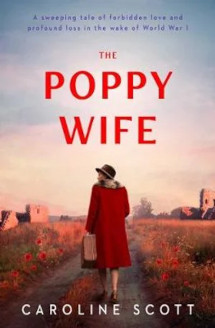
The Poppy Wife by Caroline Scott
Simon & Schuster, 2019. ISBN: 9781471187674.
(Age: 16+) Highly recommended. A poignant and emotional story of
love, loss and hope set upon the backdrop of World War I. In 1916,
Francis Blythe enlisted in the Great War, knowing that his brothers
Will and Harry would follow him anywhere. Five years later, in 1921,
Edie, Francis' wife, has accepted that Francis' status as 'missing
in action' may very well be permanent. Then she receives a
mysterious photograph of Francis in the post; reigniting her resolve
to find him. Meanwhile, Harry has been hired by grieving families to
provide what little closure he can by photographing gravesites
throughout the country where he himself fought just four years
prior. When Edie requests that he locate and photograph Francis'
grave, Harry and Edie set out to discover the truth of what happened
to Francis. When their paths converge, they uncover many startling
truths that redefine their understanding of the past and plans for
the future.
A truly beautiful story with complex, compelling and utterly
realistic characters that find their way into the heart of the
reader along the course of the story, Scott's meticulously
researched debut breathes life into the world and lives of the
characters; taking the reader on a cathartic and emotional story
that will touch their heart and stay with them long after they turn
the last page. Highly recommended for readers with an interest or
passion for historical fiction and in particular the Battle of the
Somme and World War I in general. Warnings should be heeded for
graphic, war-related violence, descriptions and references to
suicide and strong themes relating to mental health.
Daniella Chiarolli
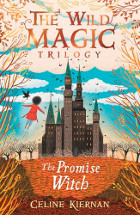
The promise witch by Celine Kiernan
The Wild Magic trilogy bk. 3. Walker Books, 2020. ISBN:
9781406373936.
(Age: 10-14) Highly recommended. Following Begone
the raggedy witches and The
little grey girl comes the striking finale to what has
been a unique and enthralling series. Witches Borough has been
struck down with a terrible drought caused by the old queen, the
rivers are drying up and there is little water in the wells. Mup's
parents are doing their best to bring peace to the land and begin a
school to educate all the children but the drought threatens
everyone's existence. Then the witch Magda comes back and sweeps Mup
and Crow off on a dangerous journey, determined to give them to
Mup's grandmother, the old queen. Mup knows that the old queen's
power must end for the good of the land and uses all her ingenuity
to try and find a way to do this.
Readers who have followed the adventures of Mup and Crow and the
little grey girl in the first two books will be enthralled with this
magical and very exciting conclusion to the series. Both Mup and
Crow grow into their powers and use them for the good of the land.
They learn that they must obtain the help of others and cooperate to
overcome evil and readers will cheer their efforts to stop the old
queen. There are some heart-breaking moments that will bring tears
to eyes as Crow desperately tries to bring his father back to life
and the fate of the little grey girl is decided.
It is the beautifully descriptive and emotive writing that keeps the
story going along at a fast pace and readers will be fully engaged
in the characters and events in Witches Borough. This is a series
that can be highly recommended for its portrayal of good and evil,
the resilience of the characters and the uniqueness of the stories.
Pat Pledger
The Silk House by Kayte Nunn
Hachette, 2020. ISBN: 9780733643255.
(Age: Adult - Adolescent) Highly recommended. Riveting, haunting,
enigmatic and gloriously evocative of the past world of England,
this narrative is fascinating and gripping. Kayte Nunn has created
three stories that interlock in theme and subject matter over time.
A young Australian woman, Thea Rust, has travelled to England to
teach in a modern English boarding school that has recently admitted
girls to the school for the first time, and we see how the
adjustment to this new world is significantly challenging. The
school has its roots in a dark past and Thea Rust is determined to
create a world for the students that is appropriate in terms of
preparing the young people for the future, in a supportive and
challenging way.
A second narrative focuses on the area in London, in 1768, where the
silk trade was an important facet of England's economy, and again,
Nunn has created a female character who challenges the world of
fabric design. Choosing a vibrant and dangerous flower as a feature,
her design is seen to both thrill and, potentially, to disturb that
world. Set in the same year, the third narrative is focused on the
notion of herbs as valuable in healing human illnesses. Both of
these older worlds present an element of danger and we are caught up
in the rather thrilling darkness of this time.
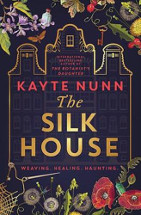
The beautiful artistic depiction of aspects of the novel on the
cover of this book subtly catch our eyes but, more importantly, they
expose elements of all three stories. This is a powerful novel, rich
in detail, time and place, entertaining in story and captivating in
the mystery that Nunn creates. It would be suitable for adolescent
and adult readers.
Elizabeth Bondar
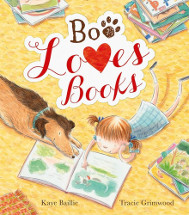
Boo loves books by Kaye Baillie
Illus. by Tracie Grimwood. New Frontier, 2020. ISBN: 9781922326027.
Recommended. Boo loves books is the most adorable story. It
follows a little girl called Phoebe who does not like to read. Her
teacher tries to encourage her but reading just makes her feel
extremely anxious as she does not want to get anything wrong.
One day, her teacher Mrs Spinelli announces that they will be
reading somewhere different tomorrow. Phoebe is even more worried!
Her mum tries to reassure her, but this feeling will not go away.
What happens next is just so lovely. The class goes to the animal
shelter and they all are given a dog to read to. With the teacher's
help, the once timid reader finds her voice and reads confidently to
her dog pal Big Boo, realising that everyone gets scared sometimes.
This book would be great for a young reluctant reader. It could show
them that they are not alone and that things will get better. I love
the idea of reading to an animal, and this could be used as an
introduction to this very idea - or even reading to a favourite soft
toy.
I read this book to my 6 year old reasonably reluctant reader, and
she thought that reading to our dog Sargent would be an awesome idea
(if only he would keep still . . . but we are working on that!). She
really liked the pictures (and so did I, the facial expressions are
so accurate) and wanted to read the book again the next night. This
book is a must for any school library, so when new and reluctant
readers are identified this could be used as a strategy for
engagement and as an idea to send home to families. Teacher's
notes are available. 4 out of 5!
Lauren Fountain
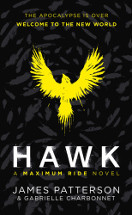
Hawk: a Maximum Ride novel by James Patterson and Gabrielle Charbonnet
Penguin, 2020. ISBN: 9781529120011.
Hawk is a skinny 15 year old with a black mohawk, multiple piercings
and a tough attitude. She has to be tough, living in the City of the
Dead, a place abandoned long ago. Now it is home to the homeless,
drug addicts and gangs so Hawk has to keep her wits about her as she
ventures out each day to find food for the small band of misfits she
calls her family. Every day for the past ten years she has turned up
to the street corner where her parents told her to wait, for a
specific time, but they have never come. Now she and her group live
in the children's home where they would starve without Hawk's
foraging and where they live in fear of being taken off to be
experimented on like other children, who never came back. Life is
brutal in this post-apocalyptic world of constant video streaming of
government propaganda and mind scrambling 'Voxvoce' sounds. Six
powerful gangs control the city. Hawk's secret weapon is that she
has wings and can fly, helping her escape difficult situations. When
a new prisoner is brought to the jail adjoining the children's home
the government broadcast declares he is a child killer, the worst of
the worst, but is he?
This is the tenth book in the Maximum Ride series but stands
alone quite well. There were a lot of characters and the members of
Hawk's family were a bit sketchy apart from Clete; the rest are
probably better developed in the other books and this might just
encourage new readers to go back and read more of the series. Hawk
is a great teen character, veering between personal angst and
responsibility to her family and she even has a rather unlikely love
interest. The book is fast paced and action packed as the Flock
fight a corrupt leader in a violent world, though I found their
willingness to join in the violence, dropping bombs regardless of
collateral damage, disturbing.
This will be snapped up by readers of the series which traces its
origins back to Patterson's 1998 novel When the wind blows
and will appeal to a new generation of younger readers looking for a
fast paced dystopian fantasy novel.
Themes: Science fiction, Fantasy, Dystopia.
Sue Speck
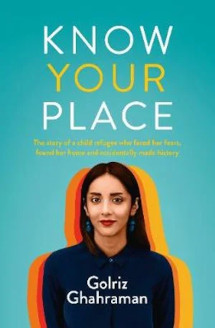
Know your place by Golriz Ghahraman
Harper Collins, 2020. ISBN: 9781775541424.
(Age: 16+) Highly recommended. What an amazing woman! Golriz
Ghahraman came to New Zealand as a nine year old with her refugee
parents from Iran. She went on to become a human rights lawyer
working on United Nations tribunals around the world, and eventually
became the first refugee to be elected to the New Zealand
parliament.
The first part of her autobiography describes the situation in Iran
that led her parents to flee. Ghahraman's mother was a psychologist,
her father an agricultural engineer; they were secular, intelligent
and progressive, political activists in the time of the Shah, but
shocked by the hijacking of the revolution by Islamic
fundamentalists. Determined that their daughter should know freedom
not oppression, they escaped, eventually seeking asylum in Auckland,
in a country where they were immediately given food, legal rights
and community support on arrival.
However her early experience of being an outsider, identification
with minority groups, a growing awareness of race issues, and later
experience of an abusive relationship, all combined to lead to a
career in human rights and political activism. It was a definite
choice - sitting down to think about what she wanted her life to be
about and how to go about achieving it.
The book includes Ghahraman's maiden speech in the NZ House of
Representatives, and her speech in response to the Christchurch
mosque terror attacks, both inspiring reading. There are coloured
photographs from her life, from the hijab-wearing little Iranian
girl, to her citizenship ceremony as a teenager, to her swearing
into Parliament as a member of the Green party, to her welcome to
refugee Behrouz Boochani in Auckland Airport following his escape
from Australia's Manus detention camp.
For students interested in politics, human rights, and social
activism, I would put this book alongside The
power of hope by Kon Karapanagiotidis and How
powerful we are by Sally Rugg - it is another truly
inspiring story of an individual with decent moral values and a
determination to make the world a better place for others.
Themes: Refugees, Human rights, Activism, Racism, Black Lives
Matter.
Helen Eddy
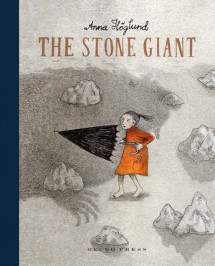
The stone giant by Anna Hoglund
Gecko Press, 2020. ISBN: 9781776572731.
(Age: 4+) Highly recommended. Swedish author, Anna Hoglund has
created a fable like story of a young girl who saves her father
using cunning and ingenuity. Translated for an English audience by
Julia Marshall, the story is wonderfully supported by copper plate
etchings with splashes of watercolour. The simplistic but never
simple drawings are evocative of the bleak landscape and the sparse
life of the girl and her father. He is a knight and must go out and
deal with a giant turning people to stone. She waits at home alone,
and as time passes she despairs that he will not return and so
decides to try and find him. She looks at her mirror and asks
herself what would happen if the giant saw himself in the mirror.
She sets out with her mirror and a knife and swims through the cold,
dark water not knowing where she is going. She stays overnight with
a woman who gives her an umbrella and she moves on to find a land
with many many stones. When the ground begins to shake and the giant
approaches, she unfurls the umbrella, and the giant looks down
through the hole he makes in it and sees himself in the mirror.
Her courage kills the giant and saves those turned to stone. She and
her father now live in a peaceful land and neither will be alone
again.
This is a lovely hand sized book which children will often return
to, reading of the girl using her courage and ingenuity to rescue
her father.
And the delightful illustrations will attract their attention as
they read the text. Gecko Press publishes 'curiously good books' and
the website tells us that one good book can spark a lifetime of
reading. The books they publish are certainly books that spark
interest and are very different to those offered by other
publishers. Read more here.
Themes: Courage, Giants, Mirror.
Fran Knight