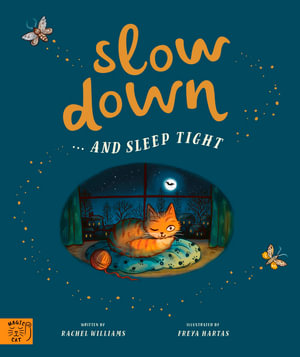
Slow Down… and Sleep Tight is a calming picture book full of gentle rhyme which would be a perfect addition to a young reader’s bedtime stories ritual. The author, Rachel Williams, has previously published Slow Down which looks at the amazing mysteries of nature that can be missed in the busyness of the day. This new book also celebrates the joy and mystery of nature and explores the end of the day, into the night and the dawning of a new day.
Each double page spread has a short verse with a brief tale about a feature of nature followed by an illustration of the focus on the same page. The corresponding page has segmented softly coloured pictures, beautifully drawn by illustrator, Freya Hartas, showing a snapshot of aspects related to the verse. The animals showcased in the story are a bee, bat, bunny, blackbird, squirrel, fox and a wolf. Not traditionally Australian animals but the clever rhyme and use of traditionally familiar creatures allows this book to be a universal read.
At the end of the book is a relaxing and mindful slow down breathing exercise that can be shared between the adult and child. This delightful book has an appealing cover with gold foil lettering and highlights. A perfect gift for a young child or parents-to-be.
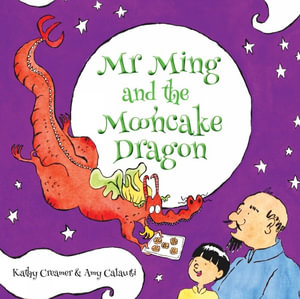
Mr Ming and the mooncake dragon by Kathy Creamer & Amy Calautti
Little Pink Dog Books, 2021. ISBN: 9780648652878. (Age:4+) Recommended.
Mr Ming and the Mooncake Dragon is a lively and entertaining read for children. Mr Ming runs a little shop which sells everything, in the bustling city of Singapore. He is famous for his mooncakes which are baked in his tiny kitchen and are sold at mooncake festival time along with painted lanterns. There is a secret though which Mr Ming will not share with anyone who asks for his mooncake recipe. He has a dragon in his kitchen who makes the mooncakes using all sorts of interesting ingredients as well as two very special ones. A greedy shop owner, Madam Moneybag, hears about these amazing mooncakes and tries to buy the recipe. When this does not happen, she creeps in during the night to steal what she can. However, the dragon saves the recipe from being stolen and teaches Madam Moneybag a lesson.
This is a story that children will enjoy as the dragon has very special powers, Mr Ming is very kind, and the evil Madam Moneybag is not happy with where her story ends. The story is quite a bit longer than the traditional picture book length and younger readers would benefit from it being read aloud. Older primary school aged children will enjoy the bright cartoon/graphic style images which complement the text perfectly. This book will be an excellent resource to share with children when the Mid-Autumn Festival, also known as the Moon Festival or Mooncake Festival is celebrated.
Themes Singapore, Mooncake Festival, Dragon, Good vs Evil, Recipes, Diversity, Greed.
Kathryn Beilby
Our sunburnt country by Anika Molesworth
Pan Macmillan Australia, 2021. ISBN: 9781760982744. (Age:Young adult, adult) Recommended.
Anika Molesworth’s family left the city when she was 12 to buy a property in NW NSW. Her younger brother had suffered years of hospitalisations with a chronic fatigue related illness which improved in the rural setting as her parents set up their sheep farm and achieved organic credentials. After a period of adjustment the city girl fell in love with the land and dreamed of continuing their work on the farm. Then came the decade-long drought which brought with it a sense of hopelessness and depression as it remorselessly stole people’s livelihoods. In 2006, at the height of the drought Anika has a life changing moment when she watches Al Gore’s film “An Inconvenient Truth” and learns about climate change. She enrols in a science degree course to find out more. “I consider the science as I move sheep between drying paddocks. I critically mull over the literature as I clean water troughs caked with salt.” P50. The science is explained in the following chapters always with examples and short case studies from other parts of the world. We are encouraged to change the way we think about food and food producers, valuing health and nutrition rather than yield per acre and calculating the true cost of production when it depletes the land. Quotes from some of the world’s leading scientists and thinkers are used effectively and chapters have titles like Life, Heartbreak, Loss, Detachment, Comfort, Collaboration, and Courage, while at each chapter end is a panel with a short “Concepts to Cultivate” summing up. The last chapter, Action, outlines what we can do to combat climate change under the headings Today, Tomorrow, This Week, This Month and This Year. Such global thinking puts into perspective how change is possible but I would have also liked to read more about how the author is acting locally on her own farm putting into practice some of the regenerative ideas she has gleaned from her activism. Senior students could find this an approachable source of climate change and food sustainability information from an Australian perspective.
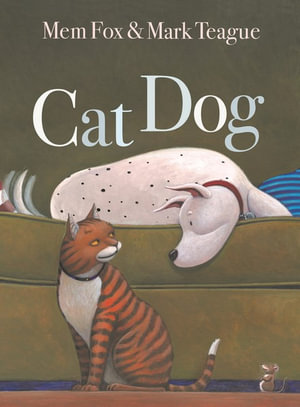
There is one word for this book, and it is stunning! Mem Fox, author of such beloved tales as Where is the green sheep and Possum magic, has written a story that will have readers puzzling over it, while Mark Teague’s illustrations are fabulous. This is a story that will have readers calling out with glee as they follow the antics of a cat and dog on a couch, interrupted by a little brown mouse. 'So there was a scary dog, right?' begins the story and the picture shows a very scary dog with ugly teeth and a spiky collar, and the reader needs to call out 'Yes' or 'No' and turn the page to see the real story – of course a mild looking dog, scratching himself. Then there is the question 'But there was a cat, right?' And the reader once again calls out the answer. The book continues in this way, introducing a mouse into the scenario, culminating in the trio being seen together with the reader having to decide whether the mouse came out to say hi or whether something else may have happened.
The illustrations are outstanding. The three characters stand out against the lilac and blue background and khaki of the couch. The contrast between the very active figures of Cat and Dog and their lounging on the sofa is fantastic, and the little mouse is very cute and will really appeal to a young audience. The expressions on the faces of the animals are priceless – the smirk on the cat’s face and the wagging tail of the dog on the front cover are sure to entice readers to open the book to see what is going on.
Cat Dog will challenge young children, and adults are certain to fall in love with this outstanding picture book as well.
Themes Cats, Dogs, Read aloud.
Pat Pledger
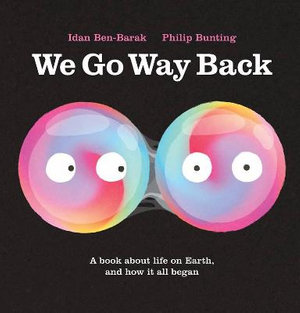
We go way back by Idan Ben-Barak and Philip Bunting
Allen & Unwin, 2021. ISBN: 9781760526085. (Age:4+) Highly recommended.
Beginning just with a small bubble, a single cell, life on earth has evolved to the infinite variety we are part of today. From that cell all animals evolved, each a little bit different. But before all this happened, Ben-Barak and Bunting take the reader back into the mists of time when our world was just water and rocks. Nobody knows what really happened but molecules appeared and these became cells which led to us and all the world around us. A breathtaking distillation is presented here for younger readers.
Barak and Bunting’s book is a wonderful read, with bright informative illustrations augmented by a brief nutty text. It answers huge questions giving a brief overview of how we got here, but leaving room for a myriad of questions and seeking out of information by the readers.
The cell which occupies many pages leads the reader through the task at hand: pondering how we got here.
There are many astonishing illustrations which will dazzle and delight readers of all ages: the double page family tree will evoke questions, the images of the planet are sure to excite readers, and the spectacular page which opens out to reveal our interconnectedness, will intrigue and inform everyone who looks closely at its variety.
This multi layered book about life on earth, will gain many thrilled admirers, keen on developing some understanding of how we got here and where we are from. And the final endpaper reminds me of the Monty Python song about how infinitesimal we are (the Galaxy Song), as the Earth is depicted as a small dot in a myriad of stars in the sky.
Themes Space, life on Earth, Evolution, Cells, Humour.
Fran Knight
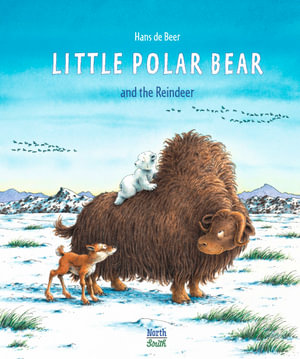
Little polar bear and the reindeer by Hans de Beer
North South, 2021. ISBN: 9780735844513. (Age:4+) Highly recommended.
First published in 2005, Little Polar Bear and the Reindeer, is one of the Little Polar Bear picture book series written by Dutch author Hans de Beer. This very popular series, first written in 1945, has been made into several animated adaptations as well as feature films and is now being republished for a new generation of readers. In this beautifully illustrated book, Lars the little polar bear, is noticing the change of seasons and the beginnings of the migration of birds and animals. He quickly finds he must move out of the way of the large herd reindeer on their way to warmer places but after frolicking in the first snowstorm of the season he discovers one young reindeer called Oliver who has been left behind. Lars comforts Oliver and promises to go with him to find his mother.
Lars and Oliver have several challenges along the journey and find safety with a herd of giant musk oxen. The musk oxen decide to accompany the young ones to keep them safe. Eventually they find the reindeer herd who have had their journey thwarted by a huge cyclone fence and large concrete pipes. Lars thoughtfully considers the reindeers’ predicament and comes up with a clever solution.
This is a very appealing book which younger readers will enjoy. It brings in aspects of environmental issues that can affect animal survival which are important to share with children. A welcome addition to a home, school or public library.
Monty and Lea run the Vale Creek Estate winery in the Clare Valley. Part of their business includes bed and breakfast accommodation and a gallery space. When their employee finds one of their guests dead near the dam on their property the police are called in to investigate. It seems the deceased, Milton Manning, was spending the weekend with Diana, a friend, and it is not clear whether his death, due to a blow on the head, was caused by a fall or murder. Investigating detectives, Louis and Sally start asking questions and find several of the many characters had a motive. Through a series of flashbacks we learn about old grudges and more than enough about things for affluent seniors to do in the Clare Valley including wineries, SALA, the Riesling Trail, Clare Gourmet weekend, Seafood Day, Marrabel Rodeo to name a few, all of which read like extracts from tourist brochures. Over the course of the investigation more characters are introduced and the timeline gets quite complicated requiring checking chapter headings to place the narrative. The detectives seem to learn more about each other than the murder, apparently seduced by the Clare Valley lifestyle, and the denouement, when it comes, seems like an afterthought. It is disappointing that a short, attractive murder mystery set in South Australia’s Clare Valley failed to sparkle but maybe readers less familiar with the region will enjoy it for the tourism content.
Themes Murder mystery, Clare Valley South Australia.
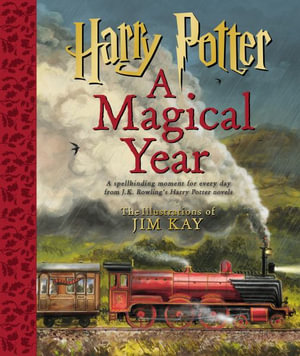
Full of illustrations, primarily colour though some in black and white, Harry Potter : A Magical Year covers every day of the year in the Wizarding World with a different quote - relating to special events, birthdays, seasonal aspects or whatever suits the date. Those who have read the series numerous times may learn something new, all while enjoying the illustrations of Jim Kay (illustrator of the illustrated Harry Potter books).
Presented in a fabulously coloured, hardcover edition, A Magical Year is perfect for Harry Potter fans. Divided into 'chapters', namely the months of the year, each new chapter has a dedicated quote to highlight the time of year or a particular season. As this is a book filled with quotes from the entire Harry Potter series, readers may find themselves confused occasionally, however context for the quotes is not required to enjoy reading this book. It is advisable that all 7 Harry Potter books have been read though, to avoid spoilers. Readers will quickly fly through the book as they will be spurred on to know what other quotes have been included, as well as to see the fabulous illustrations. The majority of the illustrations have previously been published in the illustrated editions of the Harry Potter series, however there are a few new inclusions, as well as sketches.
Themes Fantasy, Harry Potter, Wizarding World, Magic, Significant Dates in the Harry Potter series.
Melanie Pages
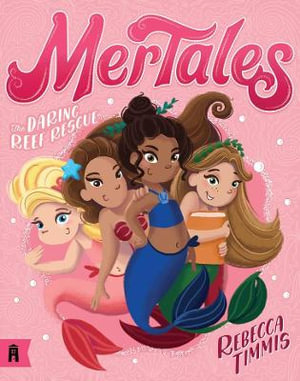
The daring reef rescue by Rebecca Timmis
MerTales : Book 2. Albert Street Books, 2021. ISBN: 9781760526566. (Age:6+) Highly recommended.
The Daring Reef Rescue is the second book in the enjoyable MerTales series written and illustrated by Rebecca Timmis. The four diverse mer-friends: Pearl, Sandy, Coral and Shell have very different personalities and always look out for each other. They have all recently discovered that they have amazing new magical powers after a meteorite zooms into the ocean and in this story they will use these unique powers to help save their reef habitat from an unexpected visitor. Disappointingly for timid Shell, her magic power takes longer to present itself but when it does it is incredible.
The primary focus of this new story is the Fancy-Fins Dress up Party. Younger readers will love the preparation of masks for the event at Mer-school and the costumes they all wear. During the party, the friends have an adventure with a large, turquoise sea turtle that has lost its way. They combine their magical powers to solve the problem and create a club for themselves called FINS - Fish In Need Society - where they will use their powers to help all sea creatures.
For those emerging readers progressing to short novels this is a perfect fit. The appealing monochrome illustrations with the addition of blue tones and the use of highlighted mermaid and descriptive words is both clever and entertaining for the reader. At the end of the book the author has thoughtfully added some fun Fin Facts about aspects of the ocean and its creatures. A very engaging series with book three, The Great Treasure Hunt, coming soon.
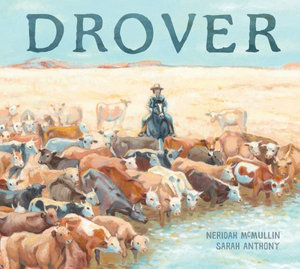
Vivid writing takes the reader along with the team droving a mob of cattle from Western Australia to Queensland in the 1950’s. The boss, Drover, leads the mob while the rest of the team keeps the cattle in check - all watching out for Shifty, a skittish animal destined to spook the herd. The first pages tell readers of the life of the drovers, riding along with the herd, making sure the cattle stay away from thorny trees, the cook and his team sent on ahead to make camp, relaxing by the campfire after a long day’s ride, listening for anything which may cause the herd to move unexpectedly.
And one night it does.
Drover wakes hearing the mob on the move, and the team rides furiously along with them, trying to turn Shifty before he takes the mob into the woodland from where they will be impossible to retrieve. But all is well, Drover and Midnight manage to turn Shifty, and once turned the mob moves in on itself, eventually slowing down. A disaster is averted.
They move on the following day making sure the mob is well watered before the next part of the journey, the team catching up on information from the bulletins left on the watertanks by other drovers. At the next town, they are cheered by the populace, welcoming them after their six month stint across the north of Australia. They are all looking forward to a hot bath and a soft bed, none more so than their boss, Drover.
The oil illustrations are masterful, drawing the eye in to the drama and detail of the Australian landscape, the look of the mob, the team astride their horses. Each page reveals something new to admire and take in - the scope of the mob, giving an impression of thousands of animals straggling away as far as the eye can see, the stunted desert trees, the night skies, the welcoming tiny country town, and the magnificent images of the mob racing across the pages, spooked by a bandicoot, running unleashed. The looks in their eyes will resonate with the reader long after the last page is turned, wondering what it must have been like to be out in the desert for half the year, only a few in your team, responsible for thousands of animals.
This is a wonderful look at a time in the not too distant past, when cattle were not trucked, but herded across country, an almost unimaginable lifestyle recreated before our eyes.
Information at the end of the books will impel people to reread the book, taking perhaps more note of the illustrations, and lead them to ask more questions, and do further research. A handy glossary finishes the book which has stunning endpapers to set the scene. Classroom ideas are available.
Themes Edna Jessup, Droving, Drovers, Outback.
Fran Knight
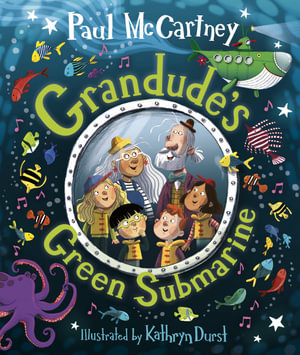
Grandude's green submarine by Paul McCartney. Illus. by Kathryn Durst
Following on from his first book Hey Grandude! Paul McCartney presents another magical adventure involving his Chillers (grandchildren). They are cooling down in Grandude’s Invention shed and see a picture of their adventurous grandmother (Nandude). Grandude suggests they use his favourite invention, the green submarine, to go in search of Nandude. The journey begins with the submarine skimming through the clouds to find their friend Ravi in a small Indian village, who may have clues as to Nandude’s location. A monsoon makes it necessary to escape with the submarine down a river and into the depths of the ocean, following the tune of Nandude’s favourite song to find her. Drama ensues when a giant octopus sends them into darkness until Nandude saves the day in her underwater sailing ship entrancing the octopus with her music and taking them home for tea. Although the book flows well there could have been some tighter editing to convey the story with less text but the illustrations do a marvelous job of supporting and enriching the story.
Some links to Beatles music are a little more evident in this book – a submarine, an octopus deep in the ocean, a friend in India; but children will just enjoy the rich visual feast in the gorgeous colourful illustrations in this book. The story could spark an interesting discussion about what children call their grandparents as a few children who read it commented that there were too many “dudes” – maybe Nandude could have been Nangal!
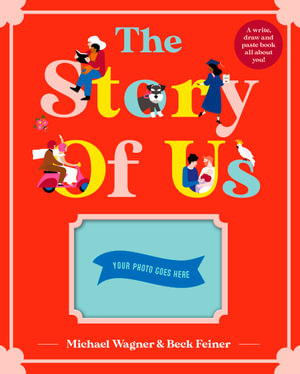
A child’s own story is so very important that this newly released book will provide them with a treasured keepsake. The Story of Us written by Michael Wagner is a brightly presented book which can be adapted for all kinds of family situations. It is not just for nuclear families but for all circumstances which children today may find themselves living in. The introduction to the book explains that the reader is about to make their own history and goes on to explain what history is about. There are many open-ended statements for all the family to share thoughts and the author has cleverly offered the reader prompts such as:
·One of the best days of my life was when...
·One of the most amazing things I ever saw was…
·Someone I really admire is…
·The best - or worst – meal I’ve ever eaten was…
The large double page spread for each statement contains one lined page and one colourful page of lively illustrations to give idea triggers. This is a book which will work best if shared with family members both young and old. It provides everyone with the opportunity to be a part of their own family history. A thoughtful birthday or Christmas gift.
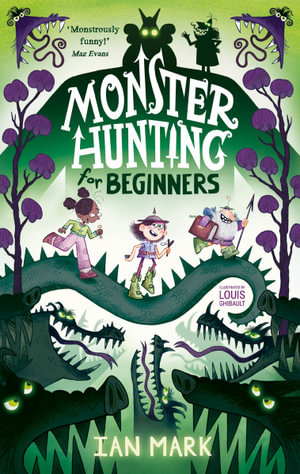
This magical book is about a boy (Jack) who is tricked into becoming a monster hunter. He has always wanted an adventure, and he has now been thrown into the deep end. To look at Jack you wouldn’t think he could make it as a monster hunter, what with being short, skinny and a kid who wears glasses and clumsy. He has believed in monsters all his life because his mum used to tell him stories about all the monsters that she encountered around the world.
With his father missing and his house destroyed, and an ogre lying dead in his yard, Jack doesn’t think he has anything to lose, or a choice – he was tricked after all! He finds himself heading off to Cornwall with Stoop, a 200-year-old monster hunter, where more ogres are causing chaos.
All he is equipped with is his catapult, and a magical book called Monster Hunting for Beginners, and Stoop of course. This is his chance to prove that he can do anything. But he wonders about this along the way. The problem gets bigger by the minute. He meets another monster hunter, Nancy, and together they face the adventures. The thought of finding his dad helps. He learns many things about ogres and monsters along the way, not always very pleasant! Jack always dreamed of seeing a dragon, but not believing it when he does.
Jack, Nancy and Stoop meet the ogre king, who has been woken up from his snooze of more than one hundred years’, and not very happy about it either! And the other ogres learn a few lessons themselves!
Does Jack find what he is looking for? Well, you will have to read the book for yourself! A great book I found hard to put down.
Themes Magic, Adventure.
Natalie Fisher
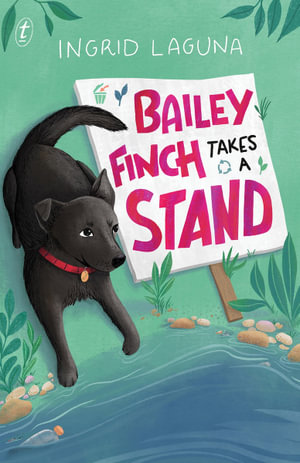
Bailey Finch takes a stand by Ingrid Laguna
Text Publishing, 2021. ISBN: 9781922330994. (Age:8-12) Highly recommended.
Bailey Finch is living an unrestricted life in the year after her mother’s death, her father so stricken with grief that he can barely get off the couch to wonder where she is or what she is doing. She roams around the local creek with her dog Sheba, her best friend in the world. Her mother, an avid birdwatcher, loved the nature that surrounds their house and Bailey recalls the wonderful way she taught Bailey to love it too.
After Sheba swallows some glass and is seriously injured internally, Bailey starts to notice how polluted the creek really is and begins to clean it up. Just as the job starts to seem overwhelming, she meets Israel, a shy boy who is passionate about the environment and begins to help her. She learns a great deal from Israel about the creatures that live in the creek and how important it is to minimise the pollution in the water. They hatch a plan to organize a Clean Up day with the local community. Underlying all this activity is the tension surrounding the fact that Sheba may not recover from her injury and the frustration Bailey feels with her father's ongoing grief and depression.
This novel incorporates the important topics of grief, environmental activism, pets, and friendship so beautifully in a novel that is both gentle and hard to put down. It would make a great class novel for middle primary grades. Teacher's notes are available.
Themes Dogs, Water pollution, Activism, Friendship, Grief.
Gabrielle Anderson
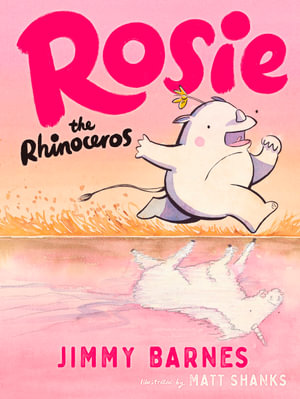
Rosie the rhinoceros by Jimmy Barnes. Illus. by Matt Shanks
A heart-warming story, readers will fall in love with Rosie the rhinoceros and the book is sure to become a family favourite. Rosie is a little rhinoceros who is convinced that she is a unicorn. She is energetic and never wants to sleep in and when she looks at her reflection in the water all she sees is a unicorn. She is such a positive little creature. She asks Mr Giraffe if he had seen the glorious sunrise; tells Mrs Lion that is a stupendous day and Mrs Elephant that it is an exquisite morning. When all the animals she meets tell her that she is a little rhinoceros, she does not believe them – because she has a pretty horn, dainty hooves and is sleek and makes friends easily. She then decides to get Mrs Elephant to gather all the animals together so that she can tell them that she is a unicorn. And because Rosie brings rainbows wherever she goes, the animals agree.
The story was inspired by rock star Jimmy Barnes’ granddaughter Rosie, who when playing with her Aunty and sister, refused to be Rosie the rhinoceros and insisted, very loudly, on being Rosie the unicorn. Really well written and flowing beautifully, the reader will fall in love with the happiness that Rosie brings and certainly will want to return to the book again and again. Its positivity makes it a must for the family and school library.
Matt Shanks’ illustrations are lovely and bring Rosie’s personality to life. I love the way he shows Rosie’s shadow as a unicorn and there are lots of little details, like a snake that looks like a rock and a little bird that follows Rosie, which will be fun for children to find. The clear black text with some words emphasised in colour and size also make it a book that emerging readers will enjoy. Teacher’s notes and activities can be found on the illustrator’s website.
Rosie the rhinoceros is a keeper for me, and a delightful and heart-warming story for everyone, encouraging all to be positive and caring.