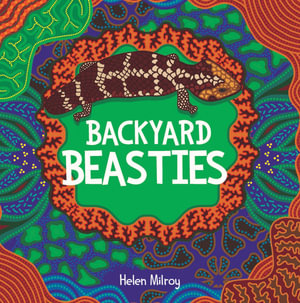
Aimed a young readers, the bright, colourful illustrations, reflecting Aboriginal motifs, will delight readers as they see the animals displayed on each page. The succinct text gives clues to small children about the animals shown, and adults reading the book with them will be able to draw out more information. The vista in the backyard takes in a hen, a dog, lizard, bats, cat, turtle, possum, quenda, gecko and frog. Children will love seeing those they know and finding out about animals they’ve not come across before. And all in their backyard! This will encourage them to look more closely at what is around them. Each line uses a word to describe the animal; turtle slips into the pond, bat hangs sleeping through the day, and then each line has a rhyming line over the pages encouraging younger readers to predict what that word might be.
llustrations are executed using techniques recognisably used by Aboriginal artists including patterns, dots and line design, reflecting the environment in which the animal lives. They are just wonderful, evoking the richly detailed designs which have become so familiar. At the end of the book is a composite page showing all the animals covered in the book, and children will enjoy reprising what they have read so far. A good memory enhancement.
The size of the book ensures it will be held in small hands and children will enjoy seeing the animals that live close by. Helen’s other books, Backyards bugs and Backyard birds were well received.
Helen Milroy, a descendant of the Palyku people of the Pilbara region of Western Australia was born and educated in Perth. Australia’s first Indigenous doctor, she has held many posts to do with children, medicine and mental health, and was recently appointed as the AFL’s first indigenous commissioner. Wombat, Mudlark and Other Stories is her first book for children and was shortlisted for several major awards.
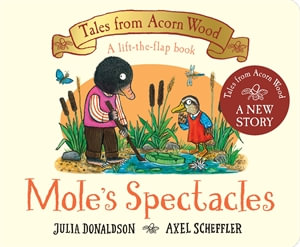
A sturdy board book with humorous verses from Julia Donaldson, will certainly please the younger audience it is aimed at. Easy to hold and fold back to make a flat book, the story will be a treat for younger readers listening to the words, looking at the detailed illustrations, predicting a rhyming word or two, and enjoying the fun of the search for the lost spectacles. Mole cannot find his glasses anywhere and here is a wonderful opportunity for older readers to talk about the low vision of moles.
He searches everywhere, in all sorts of places in the house and garden. He looks around his reading room, then searches the dresser, tries to find them in the kitchen, then looks through his desk, even the bathroom and cellar are searched. In the garden he scours the lily pond, then walks to weasel’s shop, calling on his friends to help. The glasses still cannot be found. But when he gets the teapot out to make a cup of tea for his friends, they are found. And in the most unlikely of places.
Another surprise awaits the readers on every page because as Mole searches he is able to lift flaps to reveal something inside, but not his glasses. Younger readers will have a great deal of fun with this verse book, as will the older readers helping them lift those flaps.
The bright illustrations show Mole as he searches, getting more forlorn as he goes. The detail will intrigue younger readers as they recognise things that are used in a particular room, recognise the plants and animals he sees, and rejoice with him when the spectacles are found.
Themes Search, Animals, Mole, Spectacles.
Fran Knight
The Violet Veil Mysteries: A case of misfortune by Sophie Cleverly
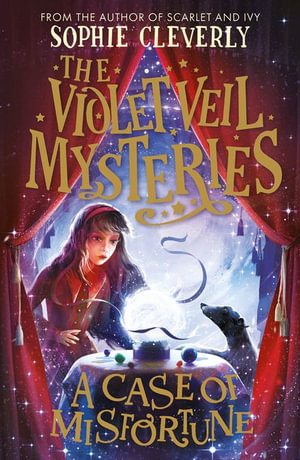
A Case of Misfortune is the 2nd book in the series, The Violet Veil Mysteries. It is a mystery/thriller set in Victorian England. Violet is the daughter of an undertaker and is aggrieved that she isn’t being considered for future work in the family business, just because she is a girl. Violet had great success solving a case in the first story, A Case of Grave Danger. So, she decides to quietly set up her own detective business and soon has a very interesting case to solve. This leads her to the Grecian Theatre which is owned by a family of Greek heritage. She and her offsider, Oliver, and dog, Bones, become friendly with the teenage children of the owners. Central to their inquiry is a fortune teller, Lady Athena, who is keeping the theatre afloat with packed audiences. But there is something very fishy about how her predictions come true.
This is a light humorous story with colourful characters and many twists, turns and even a murder. Violet has a 6th sense where she can communicate with ghosts, which enhances her ability to solve the mystery and adds interest. So does Bones' extraordinary ability to find people and places. I liked the choice of a Greek family and the way the author slipped in Greek language and customs. One of the teenagers, Eleni, had to use a wheelchair and the cheeky retorts she made when people asked her what happened to her were laugh out loud funny. Violet gets into a lot of trouble for her determination to be independent. Apart from this strong theme of ‘girls can do anything’ are themes of who can you trust, recognizing when you are wrong and the need for teamwork. It would make a great read-aloud for year 4/5 children.
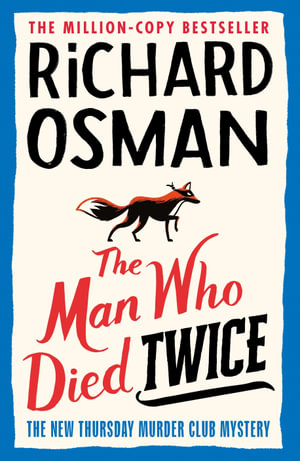
When a letter arrives for Elizabeth from one of her ex husbands, asking for a safe house to stay for a while, the reader's interest is piqued. We are about to hear more of Elizabeth’s background, the former MI5 operative, the head girl of this group of friends at Coopers Chase retirement village who came together in the Thursday Murder Club, Osman’s stunning debut novel.
The setting in a retirement home gives Osman scope for a great deal of fun with a group of retired people not yet ready to retire from the world, but equally aware of their limitations as they age. The four intrepid sleuths are on the trail again, and readers will laugh with them as their different but complimentary personalities are revealed. Joyce speaks volumes in stories from her own narrow world, each full of common sense but laced with good humour and forbearance. Elizabeth, ex MI5 is a no nonsense sort of person, able to engender fierce loyalty and get her friends to do things outside their experience. Ron the reliable is able to get the resources Elizabeth needs, while Ibrahim the retired psychologist is a calm voice amongst the group. Outside the group but attached is the village caretaker, Bogdin, a brooding deep fellow able to pitch in whenever he is needed, without question.
Douglas turns up one day with a minder, Poppy, expecting a safe haven. He tells Elizabeth of a stolen cache of diamonds worth twenty million pounds, but when a potential killer is killed by the minder, they must leave. Later Elizabeth and Joyce find their dead bodies, and when Elizabeth finds a letter dropped by Douglas for her to find, the chase is on.
Full of exciting twists and turns, copious red herrings and trails that lead somewhere but not quite where expected, the book is a wonderful read. I laughed, particularity at the wonderful portrayal of a group in a retirement village not quite ready to throw in the towel. They are alert, clever and sprightly but in the background we see others not so well.
Firereads, 2022. ISBN: 9781728257587. (Age:15+) Recommended for mature readers.
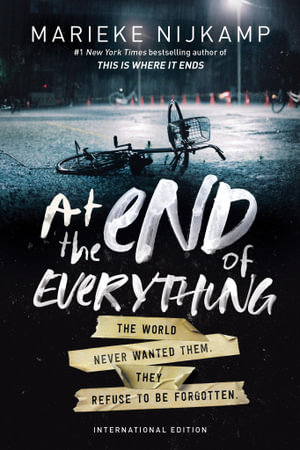
Set within the Hope Juvenile Treatment Centre, this story is for the forgotten ones in the time of a severe and catastrophic plague, but perhaps also at any time. The haemorrhagic illness (much like the pneumonic plague of the past) is wildly infectious and impacts the wider community rapidly. The incarcerated and troubled teens who are protected by guards are abandoned by their captors without notice and must survive on their own. The gates may be open, but is leaving the best option? Survival is not ensured, and food supplies will run out unless they learn to work together. Because all the young characters come with their own histories of problems, learning to work together and trust each other is a slow process. For Logan, there is the added problem because of her disability, and when her twin, Leah, becomes infected she must deal with added isolation. Emerson is transgender and is learning who they are. Grace and Casey have their own history of abandonment and struggle that led them to this ‘rehabilitation’ home, but they must set the past aside to have any hope for a future for the remnant residents.
Written almost like a dystopian story or survival tale, this story was written during Covid times so will resonate with current teen readers who have lived through their own times of pandemic. It comes with its own content warning prologue: ‘This book deals with ableism, abuse, death, illness and implied eugenics, imprisonment, and transphobia. In addition, it includes mentions of assault, blood, gunshots, racial profiling, and sexual violence.’ This is not an easy tale, but it is a powerful story of teens on the outer who need to rise above their circumstances and work together. There are moments of great poignancy as they deal with the ever-present risk of death and illness, and the loss of connection with society. I would recommend this to mature readers aged 15+ who can cope with the significant issues that it raises.
Boris goes berserk by Robert Favretto and Janice Bowles
Ford St, 2021. ISBN: 9781925804867. (Age:Junior primary students)
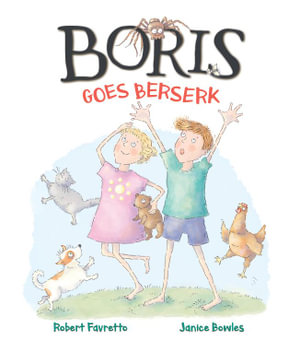
Boris is your basic Huntsman spider big, hairy and scary and when he enters the family home, his presence creates chaos on a major scale.
When Dad returns from work, Boris immediately gets inside Dad’s clothing, causing Dad to strip down to his underpants. In a comical pursuit around the home, Dad tries to capture the elusive Boris by using the vacuum cleaner … but Dad’s plan to remove Boris does not work out well.
The whole story is told in rhyme and the illustrations by Janice Bowles highlight the slapstick style scenes of Dad pursuing Boris the spider around the lounge room.
Younger children will love the fact that Dad is in his underpants for most of the story.
The ending works out well for the spider and the children are the eventual problem solvers in the story. They deal with the spider issue in a much calmer way than their father.
This book is suitable for junior primary students and would be a fun read aloud in the classroom.
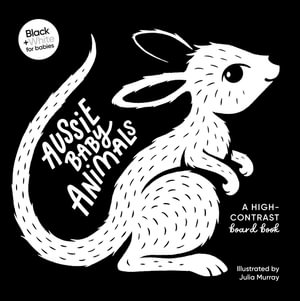
This board book using just two colours (black and white) is designed with new borns in mind. They have not yet developed their eyesight and so this book allows them to see the two basic colours, while helping along their cognitive abilities and encouraging their gross motor skills.
In Aussie baby animals we find a range of Australian animals, including a wombat, kangaroo, emu, koala and kookaburra. Each double page reveals the animal and its offspring in a loving, intimate moment, while using words which show their affiliation with each other. So an emu says, 'peck, peck, peck', a kangaroo says 'kiss, kiss, kiss' while a echidna says 'tickle, tickle, tickle', all words that describe what is happening between the animals and using repetition to engage the listener.
The two colours make the illustrations easy to see, and younger children will delight in seeing the outlines of these animals and their offspring. The love between adult and child is reiterated on every page both in the text and image presented.
All the while younger children are introduced to Australian animals, given a chance to see animals and their offspring, develop some skills and learn to love books and reading with an older sibling or adult.
Themes Australian animals, Environment, Offspring, Babies, Perception.
Fran Knight
Goodnight, little sloth by Amanda Wood. Illus. by Bec Winnel and Vikki Chu
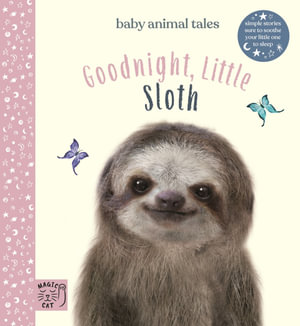
Similar in concept to the Ten Minutes to Bed... series, Goodnight, Little Sloth is one in a series of simple bedtime stories designed to send little ones off to sleep. The longish, nonemphatic text is notable for its predictable storyline and calm tone. Sweet, earthy, watercolour art is punctuated with photographic illustrations of a baby sloth watching the world pass him by.
The busy parrots in the forest try to get him moving but he likes to take life slowly and he loves looking around and seeing what he can see. "Have you ever seen any of those things" he asks the parrots after he recounts all the creatures he has seen from his branch. They admit they haven't, but they still want to hurry Little Sloth along. When Little Sloth sees something truly remarkable from right where he is the parrots are busy sleeping after all their flapping and are very disappointed to miss it. "I really think it's time I took a nap after all that excitement" says Little Sloth at the end of the story - and he does. There is a lovely message within the story about having patience and about slowing down and noticing the little things and changes in our environment. This is beautifully illustrated through the sloth being present in the very moment an orchid opened one of its petals.
This is a gentle and soothing story that ends with Little Sloth settling down for a lovely long snooze. This peaceful ending along with simple, flowing language makes it perfect for bedtime or nap time.
Themes Sloths, Bedtime, Patience.
Nicole Nelson
Cato's can can by Juliet Sampson & Katrina Fisher
Ford St, 2021. ISBN: 9781925804768. (Age:3+) Recommended.
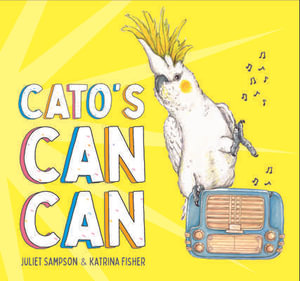
This lovely Australian book, tells the story of Cato who loves to dance! On his travels he sees humans dancing like his fellow birds - brolgas, bowerbirds and lorikeets. He eventually finds the courage to follow the dancing children into the studio and joins in.
This was a cute book that would be great for children aged 3-6 years, especially those who love to dance and move. It would also make a really nice introduction to a movement session or lesson theme. I like how the author likens the dance moves to the different Australian birds -this could carry over into a wildlife walk or general day to day outside play. The moves are simple for most children to do (bop, twist, twirl, leap and tap) and understand. This would make this story very interactive in both big or small groups.
The illustrations by Katrina Fisher are great, the watercolour and pencil provide a medium that has allowed her to bring life and expression into the faces of the dancers and beautiful colours in the birds and environment. The spacious images also allow the characters/birds to pop and are the main attraction on each page.
A great picture book that would have lots of uses in both a group situation and also as a 1:1 story. Teacher's notes and a craft activity are available from the publisher.
4 out of 5 stars.
Themes Dance, Birds, Animals, Ballet.
Lauren Fountain
Tomorrow is too late : A Youth Manifesto for Climate Justice by Grace Maddrell ed.
Tomorrow really is too late, as the contributors to this book about Climate Change and Activism highlight through their personal stories of experiencing climate change firsthand, be it environmental impacts or severe weather events, and their stories of their fight to bring awareness to those around them, as well as politicians and those who have the power to make change. Which, in reality, is all of us. Making small changes, as we are encouraged to do by the contributors in this book, making an effort to change and to talk to our friends, colleagues and families, can help in the long run. But greater change is needed to slow down the rapidly approaching disaster that is a total irreversible impact of climate change and its effects.
Written by numerous youth activists from all over the world and edited by Grace Maddrell, herself a young activist, the passion and anxiety these authors feel is conveyed through their stories. While a great book for youth to read, the people who should be reading it are those in power, those who aren't paying attention to the coming disaster that they believe is a future generation's problem. The problems are now, and should be addressed more than currently being done. An interesting fiction book that could be read alongside this is Green Rising by Lauren James (2021), where the youth are trying to be part of the solution, instead of part of the problem. I encourage those interested in Climate Change issues and those who are interested in how to participate in Climate Change activism to read this book full of essays from young people with a great heart for the world.
Themes Climate change, Activism, Youth Activists, Climate Justice, International issues.
Melanie Pages
Spike surfs by Robert Lorenzon
Wild Dog Books, 2022. ISBN: 9781742036229. (Age:5+)
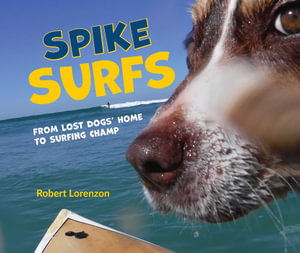
This is a true story about Spike, a Kelpie cross Rhodesian Ridgeback, rescued from a The Lost Dog’s Home by the author Robert Lorenzon, who is a lifelong surfer. This 22cm x 18cm hardcover book is a photographic record of Spike’s journey from the dog’s home to becoming a surfing champion. Named Spike for the spiky hair on his back, Spike tells his story in the first person (or dog!). Each page is a full-sized photograph with simple text in either black or white depending on the colour in the background. Spike begins his story with Rob choosing him at the dog’s home and introducing him to the beach. While surfing, Rob leaves Spike on the shore but after days of waiting patiently for Rob to return, Spike swims out to him. Fearing he might be in trouble another surfer puts him on his board and they surf back to shore. Rob then sources a new board with special grip for Spike’s four paws and they surf together. Rob and Spike enter the Vetshop Australia Dog Surfing Competition in Noosa and do well.
This book is about a devoted friendship between a man and his dog. Children will enjoy looking at the appealing photographs and following the story of Spike. Fifty percent of royalties from the sale of Spike Surfs will go to the Lost Dog’s Home.
Themes Dogs, Surfing, Friendship.
Kathryn Beilby
Bats what friends are for by Renee Treml
Allen & Unwin, 2022. ISBN: 9781666331059. (Age:6-10) Highly recommended.
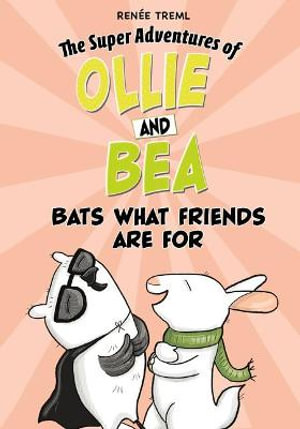
This is the fourth installment in The Super Adventures of Ollie and Bea series (It's Owl Good, Squeals on Wheels, Wise Quackers), a sensational graphic novel series for young, independent readers or for readalouds. It will appeal to fans of the Duck, Duck, Porcupine series by Salina Yoon, the Elephant and Piggie series and Renee Treml's other graphic series, Sherlock Bones. While accessible to a younger audience, its content and format will be equally appealing and relevant to an older age group.
Ollie the owl is looking for his friend Bea, but instead he finds a bat called Kimmee. Before long they are firm friends, the relationship aided greatly by Kimmee's love of jokes and Owl's quiet confidence. But when Bea the bunny finally finds them he is little jealous that Ollie has a great new friend. Is it possible for them all to be friends?
Children will love the jokes and puns that come thick and fast and the story told exclusively through sharp, fast-paced dialogue. Renee Treml's (Sleep tight, Platypup) full-colour illustrations are crisp, clear and sparse with a superb focus on the changing emotions of Ollie, Bea and Kimmee.
This is such a wonderful read that explores the real problems children have within friendship partnerships and groups and the trepidation that comes with making new friends. There is a beautiful dialogue between Kimmee and Ollie about how hard it is to make new friends, but then Ollie points out that Kimmee told him a joke and that is how they became friends. They talk openly about their feelings and the characteristics of themselves and each other. It's a beautifully honest look at those emotions that most kids have but many find it tricky to talk about. It also models wonderfully positive and uplifting ways to be a friend (and the fun of friendships) without glossing over the times when it is hard or uncomfortable.
I really enjoyed this picture book, as did my 7 year old. She loved it as was easy for her to read independently and the images were very cute!
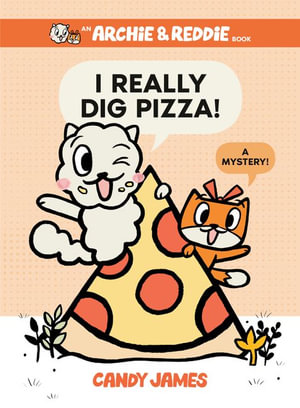
The book follows two friends Reddie and Archie and the mystery of the pizza! Each friend plays a part in the mystery, hiding something from the other. But in the end they realise that doing things together and being friends is the best. It is a simple, easy to follow story that has a few little twists then a nice ending - a good sequence to follow for younger and early readers.
I really loved the illustrations in this book, and when you read about the makers of the book Candy and James it is easy to see why they are so good. The husband and wife team are Australian toy, graphic and garden designers! What a great combination! The animals show emotion and have a spark that really draws you in to the story.
My 7 year old daughter also thought the book was very funny, using different voices for the 2 friends and re-reading it every night for a week!
After receiving this one to review I am now on the hunt for more Reddie and Archie books to see what other mischief they will get up to.
I give this book 5 stars with the hope that many more Reddie and Archie stories are written!
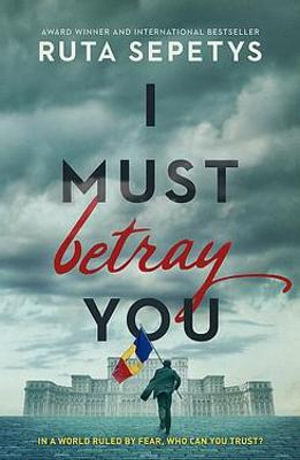
When a despot rules, the people suffer, truth suffers, and everyone feels powerless. Toward the end of 1989 the rule of Communist power under the despotic control of Nikolae Ceausescu in Romania led to an awful life for the ordinary folk. Survival was hard and everyone lived with the fear that someone else was spying on them. In this story, 17-year-old teenager, Cristian was still going to school, living with his grandfather, mother and father and his older sister in their tiny apartment, but even within the family it was hard to trust and speak out the truth about the awful regime that ruled their country. When Cristian gets recruited as an informer it is with great reluctance and incredible guilt and uncertainty. The insecurity of life is revealed with profound pathos through the eyes of this young man and the ultimate cry of ‘Freedom’ is so necessary for the whole country. But there is betrayal and violence before a future and hope can come alive.
This is a poignant tale that is compelling and worth recommending. Despite its recent history, the plight of the Romanian people under Ceausescu’s rule is probably relatively unknown for most Australian teenagers, so this engaging and powerful story is a wonderful tribute to those who suffered and spoke out for freedom despite the personal cost, and worthy of sharing to a new generation. The story is raw and painful, but brilliantly written, on the one hand highlighting the disparity between the life of a teenager in the USA (the son of the US Ambassador) and the awful circumstances of the Romanian teen and also revealing the pain of a forgotten country. Australian teenagers will be drawn too to the romance that blossoms amidst the pain of poverty. Highly recommended for mature teens aged 14+ to adult readers.
Themes Romanian history, Nikolae Ceausescu, Betrayal, Fear, Communism.
Carolyn Hull
What's new, Harper Drew? by Kathy Weeks
Hodder Children's Books, 2022. ISBN: 9781444961775. (Age:9-11) Highly recommended - Just for fun!.
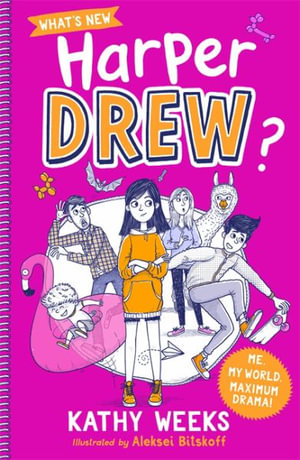
The Drew family have taken ‘catastrophe’ and ‘disaster’ to award-winning levels. Every member of the family (except perhaps young James, aka Prune) manages to rate highly on the disaster rating at every step. Harper’s mother is a compulsive Supermarket shopper, and hopelessly disorganised; her father seems to have no idea about how to avoid life-threatening situations in his attempts to entertain and solve problems; Harper’s older brother Troy is just insanely focussed on his hair, and his latest attempt at avoiding anything that resembles work. Harper herself seems to be a great friend, a great organiser and perhaps the most useful family member, however even she can slip-up often. This very funny journal recounting Harper’s family life, her catastrophic family holiday to France, her attempts to win favour of the ‘cool’ girl at school and her endeavours to raise money to support her good friend Edward are all documented with a disarming candour.
This is just a very funny story with lots of eccentric characters, bizarre happenings, accidents and extremely wacky events. Children aged 9+ will chuckle all the way through. This is the kind of story where if something can go wrong… it will. And it is all child-friendly and easy to recommend to all children. Harper is loveable and her family are cringe-worthy in their attempts to live life to the full! She is a good friend to her neighbour Priya and wheelchair-bound, Edward. This is not unlike Diary of a Wimpy Kid and Dork Diaries, catering specifically for 9-11 year olds.