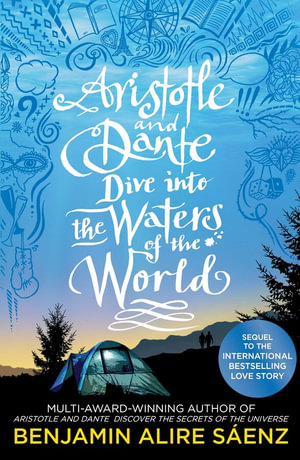
Aristotle and Dante dive into the waters of the world by Benjamin Alire Saenz
Simon & Schuster, 2021. ISBN: 9781398505278. (Age:Young Adult)
In the previous book it seems 17 year olds, Aristotle Mendoza and Dante Quintana discovered one another and have fallen in love. Here both are in their final year at different schools in El Paso Texas and must keep their relationship secret; it is enough to endure the entrenched racism towards Mexicans but they would be mercilessly bullied as homosexuals. This is particularly so as AIDS sweeps the country, polarising public opinion. Both are from loving families, Dante has no siblings but his mother is pregnant. Ari has twin older sisters, an older brother in prison for murder, and a dog. Since acknowledging he is gay, Ari is discovering more about himself and his family. He is able to grow closer to his Vietnam veteran father and talk about his imprisoned brother. But at the centre of his life is his love for Dante and the uncertainties that lie before them. Negotiating life they need to draw their own map of the world they want to live in. Told as a first person narrative though Ari’s eyes and his journal writings, this coming of age love story gives a voice to all the beautiful, thoughtful, philosophical things we might all wish we could articulate to describe our feelings. But it felt inauthentic and manipulative as if the author had an agenda of things he wanted to say and pushed the narrative around to fit. The plot seemed to lose traction as the proponents flailed their way through the last year of school and characters seemed to appear and disappear when their part of the agenda was over. The book is purportedly set in the 80s when Aids was rampant but there was no other sense of this. Some troublesome gender issues have been pointed out at length online but it will be welcomed by those who fell in love with the previous book, Aristotle and Dante Discover the Secrets of the Universe, which was very well received.
Content warnings: Gender issues, violence, death, drug death, homophobia.
A great adventure story with a mystery, Seven days is sure to thrill fans of both genres. Ben has been sent off to stay with his relatives in the country and he is counting down the minutes of the seven days that he must spend there. He is not like his sporty cousin Josh who can skateboard, abseil, and ride a motor bike. Even the family’s pet kangaroo Rooboo and Tough Goose think he is a wimp and chase him. However, Ben is curious and determined to solve the mystery of why his great grandfather was murdered by the Rhinestone brothers. When he finds an old journal written by his great grandfather which gives hints about the whereabout of the missing jewels he is determined to uncover the secrets from the past.
Much excitement follows as Ben begins to follow the trail left by his great grandfather. He also reads extracts from a journal belonging to Eunice Rhinestone’s grandmother and gradually bits of the mystery unfold. The pace is fast and readers who love adventure featuring riding motorbikes in the middle of the night, sneaking into a zoo and abseiling down a cliff, and being hunted by rhinos and crocodiles will love this fast-paced story. The twist at the end is most unexpected and Ferris also raises some ethical concerns about honesty and accepting the consequences of making bad choices that will leave readers thinking about moral and ethical issues.
A quick and easy to read story with lots of action will make this a favourite with readers.
Themes Family secrets, Diaries, Adventure, Mysteries.
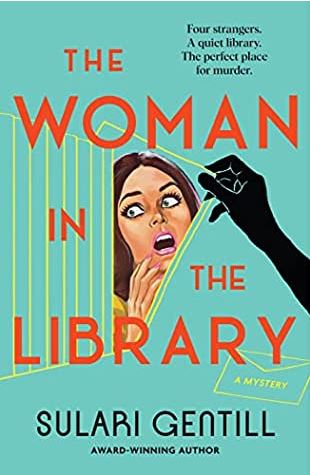
Utterly brilliant, this highly original mystery novel will have you puzzling until the end. It begins with a letter from aspiring author Leo, writing from the Boston Public Library, to bestselling Australian author Hannah, asking about how her latest novel is going. And then we have Hannah’s writing, a work in progress, about four people who actually meet in that library, drawn together when they hear a woman scream. Thus Gentill creates a story within a story. It’s a little confusing at first, but readers are encouraged to persevere, for it becomes the most fascinating brain twister, that explores all the possibilities of mystery writing. It is that extra layer that raises so many interesting questions about authorship and writing.
My preview edition of the novel came with 4 playing cards, each card a possible suspect: Winifred, Cain, Marigold and Whit. Each has their own secrets. Like a game of Cluedo, I was challenged to read the novel until page 235, then stop, and make my guess: who killed the woman in the library? Even if your edition of the book does not have the cards, it is fun to make a guess at that point. How would you solve the mystery?
There are constant reminders that we are reading a mystery story that unfolds as it is being written, and there are many possibilities that could be developed. At the same time, Hannah’s relationship with Leo seems to become darker and darker. How genuine are his offers of help, and where is it leading?
I thoroughly enjoyed this book and would recommend it to mystery lovers, and especially to readers who are also interested in the art of storytelling. It provides fascinating insight into the world of authors and writing, and is fun as well, and very very clever.
Themes Mystery, Murder, Writing, Writers.
Helen Eddy
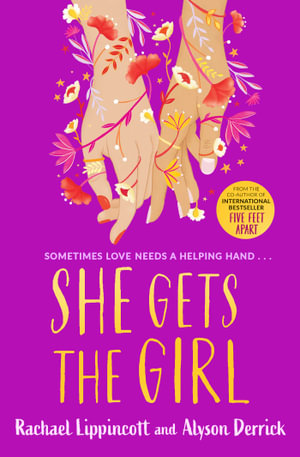
She gets the girl by Rachael Lippincott and Alyson Derrick
Simon & Schuster, 2022. ISBN: 9781398502635. (Age:13-17) Highly recommended.
'Alex is headstrong, with a dash of chaos and a lot of flirt.'
'Molly is completely in love with the impossibly cool Cora. She just....hasn't actually talked to her yet.'
An absolutely heart-filled, warm, cosy hug of a book, with always necessary and completley beautiful LGBTQIA+ rep.
Alex and Molly, polar opposites - Alex with her chaotic ways, Molly with her organised structures. Alex, always struggling to open up to the girl she loves, though trying to prove that she's not a selfish flirt, like her ex suggests (though I firmly maintain she never could've been!) Molly, head over heels for Cora, but not being sure about how to even approach her. Enter Alex, who hatches a plan to help Molly win Cora's heart, in the hopes that she'll prove to her ex that she's ready for commitment.
All that it'll take for both of them to get their girls is a five step plan.....
Oh. My. Word. This book drew me in like a big, warm embrace and I honestly did not want to let go! I loved the dual narrative between Alex and Molly, how beautiful both their alternating chapters were, Alex's especially really tugs at readers' heartstrings as we learn about (quite early on) her Mum's struggles with alcoholism. That college is meant to be a fresh start for both Alex and Molly, for Molly to make friends (she's only ever really opened up to her Mum before) and for Alex to work towards her goals of working in medicine, never having to worry about money again after having, well, not the most comfortable childhood. By the same token, it was really interesting reading about Molly's Mother's dislike of being Korean and how Molly felt bad about being Korean, at times, too, it just shows, all the more, how the characters are written as so unflinchingly real, you just want to reach into the pages and reassure both of them that everything will be okay! Without treading on the spoilery waters too much, I will say that I instantly found myself wanting Alex and Molly to get together, their spark is so electric right off the cuff!
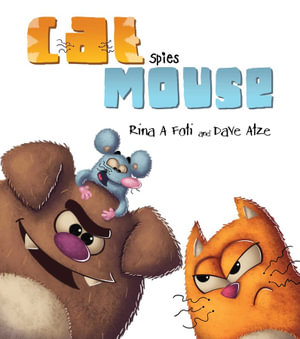
Cat Spies Mouse is a picture book for children written mostly in a simple conversation style. Cat wants to eat Mouse but of course Mouse has quite a lot to say about that. Mouse does not understand why Cat cannot be different to other cats and treat Mouse with respect and kindness. Cat is not listening to Mouse’s reasoning at all but unfortunately for Cat, Dog appears and eats Cat without hesitation. However, Mouse appeals to Dog’s kinder side and he burps up Cat.
The strong and bold graphic-style images by illustrator Dave Atze are surrounded by plenty of white space with each animal’s dialogue written in a different colour. Teachers may find this a useful text when introducing dialogue to their students to use in their writing. This story does have an important underlying message of being kind and treating each other fairly.
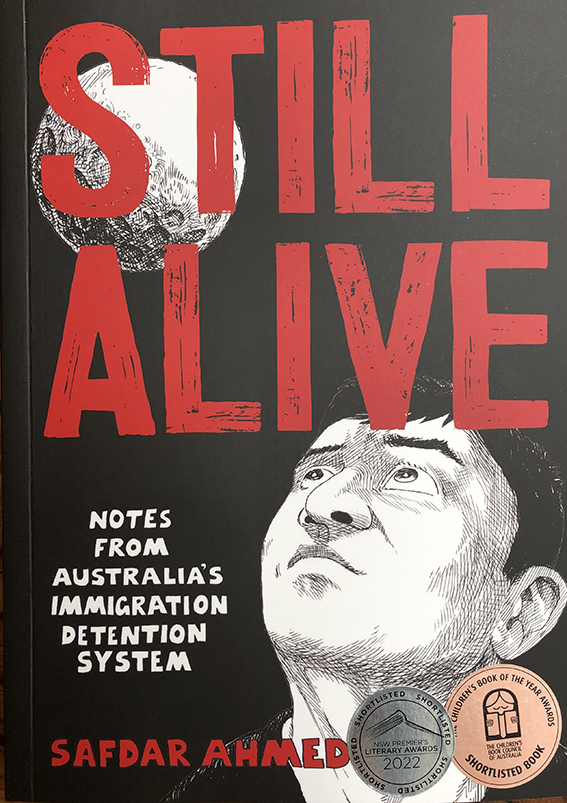
Subtitled ‘Notes from Australia’s immigration detention system’, Ahmed’s graphic novel is a dramatic and confronting expose of life in the Villawood Immigration detention centre. It began as a Walkley-winning online web-comic and has now been adapted as a print publication, shortlisted for the Eve Pownall Award in the Children’s Book Council Awards 2022, and very worthy winner of the Book of the Year and Multicultural NSW Award in the recent NSW Premier's Literary Awards 2022.
Ahmad’s book is a mix of autobiography and journalism, beginning with the author’s visit to Villawood in 2011, and his decision to start an art project with the detainees. Gradually he comes to know Haider (a pseudonym) and his escape from the Taliban in Afghanistan and his journey to Indonesia then to Australia by boat. Other refugees also tell their stories. The words are brief but the images are powerful and devastating. Ahmed’s artwork vividly captures the horror of their experiences and shows how the prison environment further compounds fear and trauma.
The book is dedicated to Ahmad Ali Jafari, the gentle 26 year old Hazara man who became the 14th person to die in Australia’s immigration detention system. His pleas for help while suffering a heart problem were mocked by the guards, and medical attention arrived too late to save him.
Interwoven with the personal stories of refugees is documentation of the ongoing political commentary about ‘boat people’ and mandatory detention. There was the story of ‘throwing children overboard’ a ‘deliberate deception motivated by political expediency’ on the part of the government. 'Temporary protection visas' are designed to block chances of gaining permanent protection. Children born to refugees in detention are ‘transitory persons’ and ‘unauthorised maritime arrivals’. The ‘Pacific solution’ is modelled after US prison base Guantanamo Bay. ‘Australia’s offshore camps are a legal black site for ensuring that asylum seekers have no access to judicial review under Australian law’.
Ahmed’s black and white artwork is outstanding; one circular image recalls 19th century artist Ford Maddox Brown’s painting ‘The Last of England’ of migrants seeking better opportunities. Another drawing of an exhausted man on the deck of a boat recalls Max Dupain’s image of the Sunbaker. Many drawings evoke German expressionist woodcuts. And then again there are the images evoking the horror genre, the heavy metal scene and teenage comics. It is an incredible volume, combining art and text, drawing attention to the cruelty perpetuated against refugees, and raising ongoing issues of justice and humanity. It’s a book suitable for mature teenagers and adults alike.
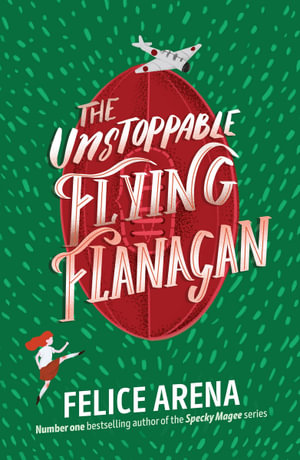
In The Unstoppable Flying Flanagan, Felice Arena writes about a favourite topic - football. Felice was inspired by a random article he discovered about women playing soccer in WW 1 in England. This information encouraged him to research women’s football in Australia and he discovered there were many popular female football games held during WW1 and WW2.
This investigation is the inspiration for football loving Maggie Flanagan, who decides to organise an all-female football game to raise funds for the troops fighting in WW2. She is enthusiastically unstoppable as the title suggests but Maggie must deal with 1940’s attitudes towards women and sport and the idea that football is unladylike.
The war seems to be coming closer to Australia, with Japanese bombings in Darwin, American soldiers in Melbourne and Maggie swears she sees a Japanese spy plane near her home, although no one believes her. Maggie is always worrying about her brother who is serving overseas. The family have not heard from him for months, but Maggie never gives up writing to him and waiting for his return. The football game is Maggie’s way of supporting him and his love of football.
Maggie’s friends also struggle with the attitudes of the times, George, a boy who is not into sport and Italian Elena who is seen more as the enemy due to WW2 loyalties.
Maggie is an appealing character with a genuine love for the sport and the reader can’t help but barrack for her to succeed.
This novel is aimed at children aged 9-12 years and will appeal to footy loving readers. The Unstoppable Flying Flanagan provides a different perspective of the sport, highlighting an historical background to the game in Australia and the attitudes of the time.
Themes Austrlain rules Football, Melbourne, Equality, World War 2.
Jane Moore
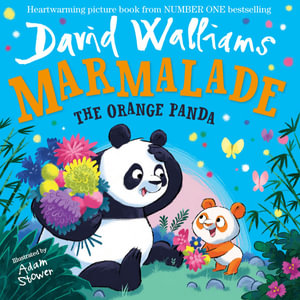
Marmalade the orange panda by David Walliams. Illus. by Adam Stower
Well-known author David Walliams has written a powerful story about celebrating and accepting difference. Marmalade The Orange Panda is a picture book about a panda who is born white and orange rather than black and white. Called Marmalade by his mother, he is not accepted by the embarrassment of pandas. Yes, the humorous collective noun for pandas is an embarrassment. So, this baby orange panda is an embarrassment to the embarrassment! Sadly, Marmalade decides to leave his mum to search for where he might belong. Along his challenging and exciting journey he meets numerous animals in shades of orange, but he is just not quite the same as them. He eventually makes his way back to his mother after falling into some mud and changing colour to be more like the others. However, Marmalade and his mother come up with a fun and ingenious plan to surprise the rest of the pandas.
The large, glossy illustrations in this book are bright, colourful and engaging, and the clever use of different-sized text draws the reader’s attention to the action taking place on the page.
This is a wonderful book that will be enjoyed by all ages and is a must-have for all libraries.
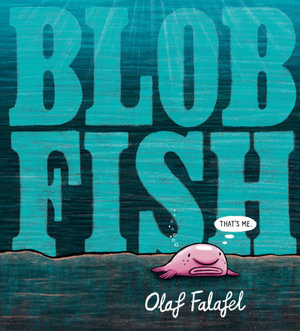
Blob Fish lives on the bottom of the ocean and he is lonely. He tells himself jokes but they are not funny to him on his own. He sees the other sea creatures with a friend, and he decides to go on an adventure in search of friendship. Above Blob Fish on the land the humans are splashing, walking, chasing, whistling, swimming, playing talking, and eating. Unfortunately, they are also being careless and throwing plastic bags into the ocean. Blob Fish discovers a floating bag and immediately thinks he has found a friend. He grabs hold and begins to dance with the plastic bag which works out well to begin with but leads Blob Fish into terrible danger. He is spotted by a hermit crab who is unable to help initially but a human who is picking up rubbish removes the plastic bag, and the hermit crab saves Blob Fish. They become friends and “live blobbily ever after”.
This humorous and appealing story with bold and striking illustrations has a strong message for its readers about the danger to sea creatures of plastic in the ocean. A great book to share for World Oceans Day.
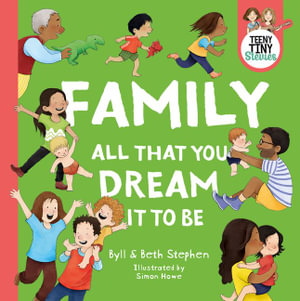
This delightful new release looks at diverse families living in a neighbourhood. Written by Byll and Beth Stephens, ABC TV musical stars known as the Teen Tiny Stevies, Family: All That You Dream it to Be, is a bright and colourful picture book which gives a snapshot of all kinds of family units. A young girl and her mum ride their bikes around the neighbourhood chatting with the families they know on their journey. There are families with two dads or two mums, a foster family, single parent families with either a dad or a mum, a family with a half sister who flies in from Mexico in her school holidays, a family where Grandma helps out as the mother has passed away, a stay-at-home dad family plus a huge extended family.
This is a joyful celebration of families and a visually appealing book to share with young children.
Themes Families, Diversity, Neighbourhoods.
Kathryn Beilby
Dreams bigger than heartbreak by Charlie Jane Anders
Titan Books, 2022. ISBN: 9781789095449. (Age:16+) Recommended only for Sci-fi devotees.
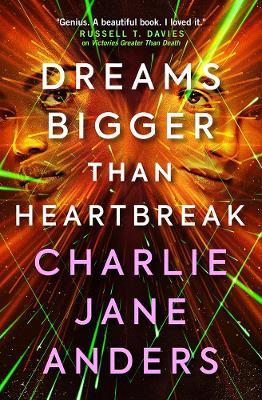
This is one for Sci-Fi lovers! With the future of the galaxy in peril, a group of young people (and some young aliens) are compelled to set aside all that they desire in order to help rescue the galaxy itself. Rachael has lost the delight of her artistic skill since being overcome by an alien force and is living with the distress and the voices in her head that add further distress. Her relationships with others have been impacted and she feels like a shadow of her former self. Tina is a student at the Royal Space Academy learning amazing things to help save the universe from destruction, while also being an amazing friend to others. Elza has the opportunity to be schooled and selected as a Princess, but will it mean that she loses her connection to her friends and can she understand the appearance of someone that fills her with dread. The interesting mix of humanoid and alien creatures, technology and space logic creates a drama with Sci-fi glory.
I confess that I am not one who loves leaving earth to discover story and drama and that Sci-fi is not on my list of ‘must-reads’ especially when it is set in space, so this book did not really warm my heart and I found it difficult to finish. But despite that, I could see that those who enjoy space-themed Sci-fi will find this appealing. The embedded emotional drama of non-conventional relationships and overcoming opposition kept me going, in amongst the alien vagaries and political intrigues, and technological quirks of space life and travel. The author has included the complexities of gendered identity, with technology revealing preferred pronoun identification that may also include variable identity and even ‘fire’ as a gender, as well as more traditional he/him, she/her and they/their. This is Book 2 of a Trilogy so the characters’ back stories would have been easier to understand having read the first book, but still was introduced adequately. The story ends with an obvious link and hint of the direction of the final instalment. So those who are keen on a sci-fi adventure should start the Trilogy with Book 1: Victories Greater than Death. There is considerable complexity in the storyline of this book and the drama of the destruction, or saving, of the Universe has many avenues of concern.
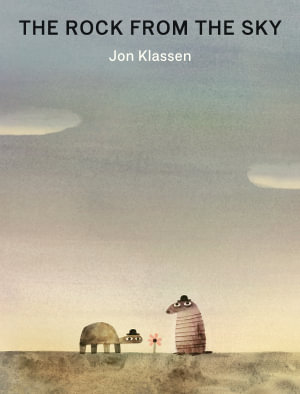
A curious tale about friendship and personal space, about being together and being alone, about things you can’t avoid and things you do not understand, Klassen’s latest book will have readers of all ages thinking about the imperfections of life while laughing out loud at the absurdity of the three friends seemingly playing out a scene reminiscent of Waiting for Godot.
The trio: Turtle, Armadillo and Snake all have a space they like to occupy. Their spot is the best and they offer their spot to their friends to come and join them. Each sings the praises of their own spot. But Armadillo is uneasy about Turtles' spot and is happy to remain where he is. Turtle after a while, joins him. Just in time as a huge rock falls onto his spot.
Chapter two, The Fall sees them looking at the rock, this interloper. Turtle defends the rock that has fallen, giving a reason for it being there, offering its shade to the others.
Chapter three, The Future, sees them imagining what the future may be like. They conjure up plants and trees around the space and are happy with what the future my hold. But into this space coms a creature that they do not understand. As it goes they decide not to try to see into the future.
Chapter four, Sunset has two watching a sunset as the sun disappears beyond the horizon. Turtle is intrigued and calls out to see what they are doing, but he cannot hear the answer and so must come closer to see what is happening. By the time he reaches them the sun has gone.
The fifth chapter, No More Room, is where Turtle is cross that the other two are sleeping comfortably by the rock. He cannot hear them and keeps moving closer until another rock falls on the place where he has been. Laughter will light up any class that reads this book, soaking up the absurdity of the situation, the incidents which occur and the responses that each displays. Readers will laugh at the discussion of who has the best spot, their discussion stopped by a falling rock, and laugh again at the conversations between them: illogical, nonsensical and going nowhere. Parallels will be recalled and shared, situations discussed and life lessons drawn out amidst the laughter.
And did I mention the illustrations! Wow.
To see Jon Klassen reading his story go here. And another about his book in which he talks about the influence of Alfred Hitchcock on his work can be found here.
Themes Humour, Future, Friendship, Imagination, Hitchcock, Theatre of the Absurd.
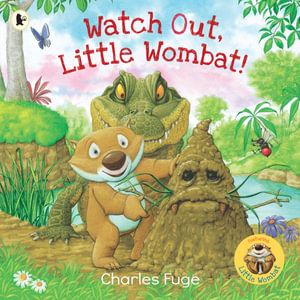
The cute little wombat of Swim, Little Wombat, swim! and Little Wombat's Easter surprise returns in another adventure that is sure to delight his fans. Little Wombat and his friends Rabbit and Koala are playing explorers when he suggests that they go hunting for a bunyip by the creek. His friends laugh and tell him that there is no such thing as a bunyip. When he cannot find one he decides to make his own to fool his friends. He piles up mud and adds pinecones for tusks and reeds for whiskers, but when his friends scare him with a great roar, he goes headfirst into his mud monster. Then to their shock a giant crocodile appears, but Wombat saves the day.
Young children will enjoy the humour of Watch out, Little Wombat and will love finding out about the mythic bunyip and producing a description or drawings for themselves. The text flows along smoothly and the colourful illustrations are delightful. The friends are all very distinctive with cute, happy faces until they are scared by the crocodile and then their fear is really expressed on their faces and body language. I loved Little Wombat’s version of a bunyip and the happy conclusion of the three friends rushing back to Mrs Wombat will leave young children with a sense of security. Minute details of things like a butterfly, a ring tail possum and little lizards appear in the drawings and will be fun to follow.
The book introduces the Australian legend of the existence of bunyips who live in rivers and swamps and will be an enjoyable read aloud for young children.
Andrew, seriously injured after falling into a bear trap in the woods struggles towards a dark cabin, desperately seeking food and rest. It is there that he meets Jamie, another solitary survivor of the drastic Superflu pandemic that has wiped out the world as we know it. Most of the world’s population has died, with bodies abandoned in the open, and the last survivors reduced to looting and pillage to find food and other necessities.
The budding friendship between Andrew and Jamie is jeopardised by Andrew’s reluctance to share a shameful secret, and while trust gradually builds between the two of them, Jamie is aware that there is always something held back. This is the story of a tentative LGBTQI relationship, set within a dystopian world. In an author’s note, Erik J Brown tells of how he was tired of not seeing ‘queer representations in post-apocalyptic stories’. So this novel is it – a post-apocalyptic novel with a love story at its heart.
It is also an adventure story, where the two set out in hope of reaching a rescue destination providing aid from EU nations that have overcome the pandemic. There is danger all along the way, with ruthless marauding gangs that loot and kill. But there are also kind people that offer help; for while some descend to savagery, others aspire to a better way of being. Love and friendship offer hope.
The description of the developing relationship between Andrew and Jamie is as tender as the friendships and relationships in the LGBQTI+ romance Here’s to us by Becky Albertalli and Adam Silvera, but Brown’s novel places its characters in a whole other world in a dark future. The combination of romance and adventure makes it a bold new novel for young adult readers.
Themes Dystopia, LGBQTI+, Quest, Pandemic.
Helen Eddy
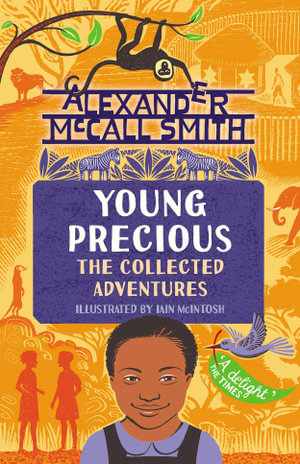
Young Precious: The collected adventures by Alexander McCall Smith
BC Books, 2021. ISBN: 9781780277417. (Age:9+) Highly recommended.
Anyone in the know, that is anyone who has read any of the international bestseller series from the late 1990's The No.1 Ladies' Detective Agency, on seeing another book written by Alexander McCall Smith, would snatch it up eagerly as I did. What is the expectation? Why warmth and humour of course, more clever little adventures in Africa and more of that wonderful Mma Ramotswe hopefully...
This beautiful hardbacked omnibus edition of Young Precious The Collected Adventures, first published in 2021, contains three stories: Precious and the monkeys, Precious and the mystery of Meercat Hall and Precious and the zebra necklace. Who is Precious? Why Mma Ramotswe when she was a child, the same age as you, asking so many questions and getting tangled up in so many adventures and escapades amongst the people and animals of Botswana. Precious is not only smart, observant and very alert, she is also very kind. She is a champion of the bullied and a rescuer of animals. She solves little problems and each of these books contains a separate problem in need of a solution.
Iain McIntosh's illustrations accompany the stories perfectly. Only red, black and white are used and the page designs are so varied that in themselves they make reading a pleasure. On turning each page the question might be - where will the illustration be... will it be a wrap around, above or below the text, whole page, tiny etc... Meercats, Hippopotamuses, lions, cobras, elephants and ostriches abound.
I did not know that Alexander McCall Smith had written books for children but I can now vouch for the fact that children love the stories included in Young Precious The Collected Adventures. There is something very warm and comforting about McCall Smith's narrative style and authorial voice and the lovely messages that shine through. And of course who does not want to hear stories from Africa (particularly Botswana) and who doesn't want to go on a safari one day!
If you have enjoyed Rudyard Kipling's How the elephant got his trunk, here is another delightful read from Africa. Look out also for McCall Smith's acclaimed School Ship Tobermory adventures (for middle years readers.)