Faber 2008.
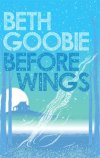
(Age 14+) 15 year old Adrien is obsessed with death. She has barely
recovered from a brain aneurysm two years before, and knows that
another one could happen at any time. When she arrives at her Aunt
Erin's camp, she sees the spirits of five young women who died
tragically long ago. What message are they trying to give her? She also
meets Paul who also is thinking about death and a close bond forms
between the two.
Gradually Adrien becomes used to the routine of the camp and begins to
notice things rather than spending all her time thinking of her
possible death. She is prepared to stand up to the camp bully, a
counsellor who wants to be the leader of the camp staff and expects her
to join in with rituals and drinking after hours. She is also aware of
the tension that surrounds her aunt, and begins to understand the
significance of the spirits who haunt her.
Adrien starts out as a thoroughly depressed character, who refuses to
communicate with her parents, doesn't want to make friends and is
always looking inwards. However she is an intelligent, independent
young woman and gradually opens herself up to the idea that life may be
worth living after all and that she does need to grow up.
The romance between Adrien and Paul is strong and tension grows with
the mystery surrounding Paul's belief that he will die on his birthday.
This is a story that grows on reflection. The themes of accepting life
rather than death, of standing up for what is right and good and the
redeeming power of love are all wrapped up in beautiful writing and
magic realism.
Pat Pledger
The boy from Bowral: the story of Sir Donald Bradman by Robert Ingpen
Walker Books, 2008.
(Age 8+) For cricket enthusiasts, 2008 marked the centenary of Don
Bradman's birth. Robert Ingpen celebrated the event by partnering his
trademark illustrations with an account of the cricketer's career and
achievements. The text concentrates on his development as a sportsman,
revealing how he refined his batting technique and providing detailed
accounts of some of his matches, complete with scores. Excursions into
Bradman's life outside cricket are brief but mention of the
encouragement of cricket-playing relatives helps to explain his
motivation and commitment.
The prose is unadorned and easy to read, in a style reminiscent of
sports journalism. Anyone not familiar with the game will search in
vain for an explanation of the rules and a glossary of cricketing
terms.
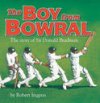
The sepia tones of the illustrations are evocative of a bygone era.
They are particularly effective in sympathetic portraits of Bradman and
nostalgic scenes of the Bowral schoolyard and cricket pitches. However
some players will not warm to muted pictures of a game they love for
its speed and precision. Despite well-defined chapters, there is no
table of contents but a limited index guides readers to career
highlights, matches and statistics. References to letters, newspaper
articles and photographs offer an introduction to the use of primary
sources in research. The text has been printed in a three column
format. Any discomfort this may cause is offset by the relatively large
font. The book is a quality hardcover picture book with a striking
study of Don Bradman in action on the cover.
'The boy from Bowral' is not so much a biography as an attempt to
explain a legend. It will appeal to readers already dedicated to
the game played by 'The Don' with such consummate skill.
Elizabeth Bor
Maralinga by Christobel Mattingley
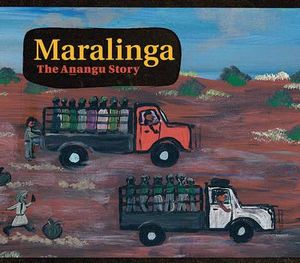
Allen and Unwin, 2012 (Ages 10 to adult) When the British planned and executed a series of bomb tests in South Australia in the 1950's, both the Australian and British governments had little time for the people who occupied that land, the Anangu. With this book, both the Anangu people and Christobel Mattingley, South Australia's award winning author, tell the story of the Anangu, from their relationship with the land, their stories and customs, the taking of their lands for the bomb tests, to its being handed back, and onto their lives today. It is a riveting story, one which evokes sympathy for a group of people alienated form their land and so their stories and history. Maralinga is full of unexpected pieces of information. Maralinga, which means loud and thunderous, is not even an Anangu word, but one used from the languages of the people near Darwin, to describe the land in western South Australia. That fact alone tells volumes about how the bureaucrats saw the people who lived there. The book, written by the Anangu people, relates the history of European explorers traversing their land, the coming of the missionaries, who derided and undermined their culture, imposing a white god, to the rations and handouts, making these people dependent upon a government organisation, all resulting in their alienation and dispossession. The final straw, the bomb tests, tore the land from their grasp, making it uninhabitable. This beautifully illustrated book will be well used in classes where indigenous stories are told, where the issues of land rights are discussed and the alienation of a minority group of people by a government organisation is looked at in detail. Teacher notes are available on Allen and Unwin website. Fran Knight
The Unlikely Voyage of Jack de Crow by A. J. McKinnon
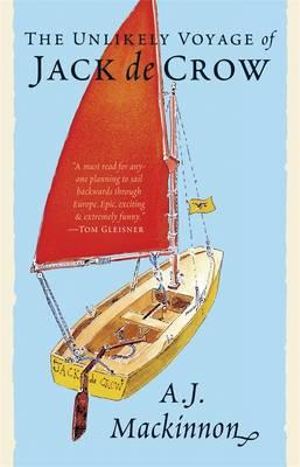
(Ages 12+ to adult) Warmly recommended.Your cheeks will ache, because of the wide, companionable smile that stays on your face while reading of the singular adventures of A J McKinnon, on a Mirror dinghy, as he sails from his erstwhile school in North Wales, to the Black Sea. Armed with a pith helmet and the most unsquashable and determined optimism, McKinnon writes this very funny tale of his sailing adventure. McKinnon's curiosity, his innocence, his unstinting belief in himself and the humour with which he tells his story makes any listener a willing accomplice in the journey he embarks upon. He meets all sorts of people, and as he often says, his meetings are full of support, food and generosity. People willingly help him, whether it be by towing him along a stretch of water, or giving him a meal and warm bath or offering him a bed for the night, people are gracious in their hospitality to this rather odd man in his red sailed boat. At first he set out to sail from his old school at Ellesmere to the Severn River, a parting gesture to his six years at Ellesmere School, but he became so entranced with the journey he went on to Bristol. The lure of the voyage along the Bristol Channel proved too much and so on he went, sailing the Thames to London, then across the English Channel, and across Europe to the Black Sea. Within the story are numerous nods to poets and writers who have written of anything to do with the sea and sailing, boats and adventures, rivers and canals, as quote after quote is used to augment McKinnon's tale. Each chapter begins with a quote that sent me scurrying to my poetry books, often a quote or nod to Tolkien, C. S. Lewis, Graham or Lewis Carol, brought back memories of other books and readings, and all of this added an extra depth to an already engrossing read. McKinnon's story has just the right amount of whimsy to make the listener laugh out loud at his antics and daring. Fran Knight
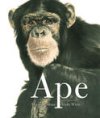
Ape by Martin Jenkins and Vicky White
Walker Books, 2009.
(Ages : Lower Primary) Recommended. A beautifully illustrated and
informative picture book for younger readers, Ape will
enthrall,
delight and inform those who open its pages. The opening lines draw the
reader into reading further to find out about the four rare apes around
the world. Each; Orag-utan, Chimp, Bonobo and Gorilla is given between
6 and 8 pages in which basic details are given about their lives. The
reader learns bout their habitat, eating habits, family groups and
where they sleep. All is told in spare sentences, in large print, with
no unnecessary words or embellishment.
The black and white illustrations reflect the words on each page, so
that younger readers can see for themselves just how closely these four
apes resemble the fifth ape, humans. The faces, postures, gestures and
expressions are all familiar to us all, as we see them everyday
reflected in our friends and families. In the last four pages, this is
reiterated, and the similarities between each of the five apes are
underlined. The last page gives information along with a map, about the
endangered nature of four of the ape families, contrasting their
declining populations with our burgeoning numbers. The whole is a
wonderful picture book introduction to younger readers about the ape
family, as well as the twin issues of conservation and overpopulation.
A small index and web addresses for further research finish the book.
Fran Knight
Atomic Testing : Woomera 1953 by Alan Tucker
Scholastic, 2009. ISBN
9781741692174
(Ages 10+) Another in the series, My Australian Story, Atomic
Testing
tells the story of the tests at Woomera and Emu in the 1950's. Anthony
and his mother have only just arrived at this dusty outpost in the
desert of South Australia, following their husband and father from
Townsville where they used to live. Anthony's mother stayed behind with
her son, nursing him through polio, a disease caught about twelve
months before. After some months in hospital, Anthony's mother, a
former nurse, took charge of his rehabilitation, making sure he
received the exercises needed to strengthen his withered legs.
In Woomera, his diary reveals his mother's disillusionment with the
small town along with her growing mistrust of the building of atomic
weapons, Anthony's budding friendship with two boys at school, his
father's work, when suddenly, Anthony and his family are under
suspicion from the Commonwealth Police. One of his friends has brought
photos of the rockets for Anthony to copy. His copies are so good,
others in the class want one, and so he has a small business, copying
and selling pictures of the rockets.
In diary form, this story recreates the suspicion and mistrust that
surrounded the people who lived in Woomera during the scary years of
the Cold War. Tucker recreates the misgivings of the mother very well,
adding to the burden of her family as it tries to cope with the
suspicion heaped upon it. It is a most engrossing read, and will
intrigue and engage students who love reading of times past.
Fran Knight
Salt by Maurice Gee
Text Publishing, 2009 (2007) ISBN 1921520082.
(Age 12+) Winner of the NZ Post Book Award for Young Adult Fiction,
Salt is a thought provoking dystopian novel that combines
hauntingly
familiar issues of big company tyranny, racism and slavery with a
futuristic twist. In the ruins of a city called Belong, starving men
are herded together by guards with whips and sent off to Salt as forced
labour. Hari is devastated when he realises that his father, Tarl, is
one of the captured men. Because of his defiance, he is sent to Deep
Salt a horrifying mine from which no one emerges. Hari, who has the
power to speak to and control animals, is determined to rescue him. On
his journey to Deep Salt he meets a young girl Pearl and her companion
Tealeaf, who are evading the Company and also can speak with their
minds. Together Hari and Pearl discover the hideous secret of what is
mined in Deep Salt and do their best to improve things for Belong.
Describing the bare bones of the narrative doesn't do justice to the
richness and complexity of this book or to the issues that linger in
the reader's mind. Gee masterfully describes his two young
protagonists. Hari is from the Burrows and starts out on his dangerous
journey with only one aim in mind - to rescue his father and kill his
capturers. Pearl has been the pampered daughter of a Company family,
and seeks to evade a marriage of slavery to Ottmar, a grasping older
man. However, issues bigger than revenge and escape overtake the pair
and they are faced with taking huge risks to ensure that the secret of
Deep Salt does not destroy the earth.
This is an adventure story that tackles big issues in a very readable
way. The reader is left to ponder the nature of big business, greed,
war and corruption and the voices in peoples' heads that allow them to
act in certain ways.
There is a tantalising peep at Gool, the next book in the
series, in a
short extract at the end of the book. Salt would appeal to
readers who
enjoy books like The knife of never letting go by Patrick Ness.
Pat Pledger
Waterslain angels by Kevin Crossley-Holland
Orion Children's Books,
2008. ISBN 9781842556917
(Age 9-14) Recommended. An intriguing mix of mystery, adventure and
history, Waterslain Angels is a compelling story. Ten year old
Annie,
an independent and risk taking young girl, joins up with Sandy, an
eleven year old asthmatic geek, on a summer quest to find the missing
carvings of angels that once adorned their Norfolk church and which
haven't been seen since Cromwell's time.
Set in the 1950's, in the salt marshes of north Norfolk, this
atmospheric story gripped my attention right from the start. One of the
beautiful wings of an angel was found in the attic of the rectory and
once Annie has seen it, she is determined to find out what happened to
the rest of the angels. She and Sandy have a series of dangerous
adventures following clues that involve learning about the history of
the Reformation and the Norfolk area. They climb up rickety stairs to
the church bell tower where they are attacked by bees, and almost drown
in an underground tunnel. They also know that someone else is on the
trail of the angels.
Crossley-Holland combines his descriptions of the children's
hair-raising adventures with fantasy-like but frightening descriptions
of the dreams that Annie has, featuring one of the angels whom calms
her fears of being pursued and tells her that the angels are waiting
for her.
Poetry and beautifully written portrayals of the landscape, as well as
the details of family life, add to the richness of the prose. This book
is a keeper.
Pat Pledger
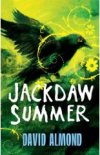
Jackdaw Summer by David Almond
Hodder, 2008.
(Ages 13+) Recommended. A thought provoking novel which
successfully depicts the no man's land between childhood and adult
life. Liam is around fourteen, enjoying a summer of freedom camping out
and running wild in the rugged Northumberland countryside. His long
standing friendship with Max is increasingly strained as Max begins to
enjoy the company of girls and to think seriously about his future.
Liam prefers to hunt for snakes and play violent war-games with the
other local lads.
During one of these endless days of summer Liam discovers an abandoned
baby in the grounds of deserted Rook Hall. His life is about to change
forever as, thanks to baby Alison, he meets members of her new foster
family.
Crystal and Oliver are damaged teenagers living in foster care.
Crystal's entire family were killed in a house fire, while Oliver, a
refugee from Liberia, witnessed unspeakable horrors when forced to work
as a child soldier. Liam is drawn into their tragic stories and so
begins a series of events that will make this an unforgettable summer. Jackdaw Summer explores the nature of human behaviour and the
impetus
that can drive anyone to commit acts of horrendous evil or immense
kindness. Almond never wastes a word and can drive the plot forward
with the simplest of sentences. During this hot dry summer you can
almost feel the parched earth sprinkling through your fingers as Almond
spins his web of magic.
This is a novel to savour with a firm sense of place, an unusual plot,
interesting characters and thoughtful answers to some very difficult
questions.
Claire Larson
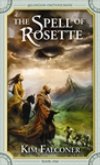
The Spell of Rosette by Kim Falconer
HarperVoyager, 2009. ISBN 9780732287719
(Age 15+) Forced to flee for her life after her family has been
murdered, Kalinda Rose takes on a new identity as Rosette and makes her
way to refuge with her aunt, where she learns magic and witchcraft.
However she is unaware that she carries a secret DNA encoded in her
blood, which is the only hope for Earth, reduced to near ruins by
climate change and pollution.
A clever mixture of fantasy and science fiction, The spell of
Rosette
is set in two worlds. Rosette, a heroine who has magic powers and can
talk to her huge cat, Drayco, was born in pristine Gaela, but discovers
that there are portals into Earth, lying in a parallel dimension.
Falconer uses quantum physics and a super intelligent, human like
machine, Jarrod, along side a traditional fantasy scenario, of good
versus evil, sword fighting, shape shifting and sorcery.
This is an engrossing story, with romance, an enigmatic queen of the
underworld and many engaging secondary characters. It is likely to be
enjoyed by people who read the works of Trudi Canavan and Sara Douglas.
Pat Pledger
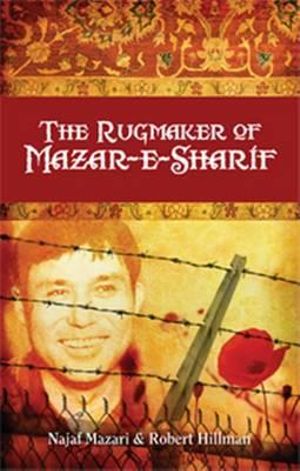
The rugmaker of Mazar-E-Sharif by Najaf Mazari and Robert Hillman
(Age 13+) Recommended. A heart rending story of Afghani Najaf Mazari, a young man who flees across the border to Pakistan, leaving behind his wife and young child, when the Taliban threaten persecution and death. It describes his early life in rural Afghanistan as a shepherd and his life in Mazar-E-Sharif living with a large and extended family and the perils of living under a violent political regime in his country. The dangers of his journey to Australia on a leaky boat, the trauma of facing suspicious officials and being sent to Woomera Detention Centre are all graphically portrayed as well as his final establishment as a legitimate refugee. Robert Hillman has used the absorbing details of one refugee's life to make a coherent and well-written narrative that Humphrey Bower has brought to life in his reading. His rich and steady tone vividly portrays the voice of Mazari, and emphasises his courage, humility and warmth. The listener is taken into the world of the detention centre as well as the world of Afghanistan and gains an insight into both worlds. This is a book that would be very valuable addition for a library. It would be an excellent source of information when studying a unit on refugees and how they were treated in detention centres as well as providing material to raise awareness about life in Afghanistan. Pat Pledger
Sky village by Monk and Nigel Ashland
Kamira Book 1. Candlewick Press, 2008. ISBN 9780763635244 hbk
(Ages 10+) In China, 12 year old Mei Long's mother has been kidnapped
by meks, strange intelligent machines. In desperation her father has
sent her to live in the Sky Village, a wonderful linked group of hot
air balloons, while he tries to track his wife. Meanwhile in the ruins
of Las Vegas, Rom struggles to find his sister who has been taken by
beast meks. The pair discovers that they share the Tree book, which
allows them to reach out to each other and tells them that they carry
the Kaimira gene, a mixture of beast, mek and human DNA.
This is an innovative first book in the Kaimira series where people,
animals and intelligent machines are at war. Mei Long and Rom are both
appealing characters and the reader will identify with Mei Long's
curiosity and sense of adventure and empathesize with the difficult
decisions that Rom has to make about his family.
The themes of genetic engineering and nature vs technology also are
absorbing and carry the plot along as the two young people have to take
on responsibility and discover how to use their amazing powers to
rescue their family members. Teacher's
notes are available and a website
has been devoted to the series.
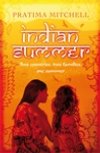
Indian Summer by Patrima Mitchell
Walker Books, 2009 ISBN 9781406308174
(Ages 13+) Sarla's mother is about to head off on an assignment where
she cannot take her daughter, so Sarla decides she will spend the
school holiday with her grandparents in India. Here she meets a totally
different world, one she is related to but has not lived. It is an eye
opening experience.
In her grandparents' house lives Bina, a mysterious young woman, bent
on becoming a doctor, spending all her waking hours studying for exams.
Sarla is derisive of this young woman, judging her by the mores of her
school friends in London, but as she gets to know the girl, it becomes
apparent that there is a secret. Not only does the girl hold secrets
close to her chest, there is an air of secrecy in the house and the
driver too appears not to be what he makes out.
A fascinating inside look at the various cultures and social levels
which make up India, Indian Summer is a page turner, although
the story
takes a while to start. The need to know Bina's background, the
relationship between Bina and Sarla, and the enigmatic Sidhartha, all
beckon the reader on. But it takes some fortitude to get to that point.
The first half of the book is slow; the author making sure the reader
has a good understanding of the background of the novel and the main
characters, which may deter some readers. During the course of the
novel, however, Mitchell reveals information about the caste system,
the British Raj as well as the fight for independence. All most
illuminating wrapped up in an interesting story set in an exotic
location. Fran Knight
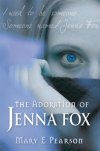
The Adoration of Jenna Fox by Mary E. Pearson
Allen and Unwin, 2009.
(Age 13+) Highly recommended. Who is Jenna Fox? Is she the miracle that
her parents call her? Why is
she hidden away? When Jenna wakes up after 18 months in a coma, she
can't remember the devastating accident that she was in, and what she
can recall about the person she was from before her accident doesn't
add up. Mary E. Pearson has written an engrossing story about medical
ethics and what it means to be human. Set in the not too distant
future, the book paints an enthralling picture of just where medical
science could take society.
Teenagers will identify with Jenna's angst. Not only is she uncertain
of who she is and how she got there, but she has parents who adore her,
but who totally control her and seem to be keeping dark secrets from
her. As Jenna gradually learns to do things and pieces of her memory
come back, she is faced with the dilemma of working out how much of a
person is needed to be human, and what makes a human. She begins to
make conscious choices about what she does and who she wants to be, and
it is this that reveals her humanity.
This is a gripping read and raises many interesting questions that
could engender lively discussion about the limits of medicine in a
world of scarce resources and where science should go. Toss this theme
in with free will and parents' right to choose to keep their child
alive, a fascinating heroine, some love interest and family tension,
and you have a rivetting read.
Pat Pledger
The thing about Georgie by Lisa Graff
HarperTrophy, 2008.
ISBN 9780060875916
(Age: 9-12 yrs.) A school story about fitting in when you
have a disability.
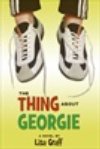
The cover of this book has two feet encased in sneakers dangling in
space. As both laces are completely undone it suggests something weird
or sinister is afoot. A strange choice for a feel good book about
what it is like to be a child dwarf. The reader is invited to
perform simple tasks, e.g. touching your left ear with your right arm,
at
random places in the book and then is reminded that Georgie can't do
these things.
Georgie is a normal child with loving, musician parents and is in the
American equivalent of upper primary school. He has a good friend but
his world is shattered when firstly he learns he will no longer be an
only child and secondly he falls out with his friend. Life becomes even
more unbearable when Jeanie the Meanie is forced to be his partner for
the class projects on American presidents.
Written in a very easy to read, fluent and nicely paced style, this
book would be enjoyed by any middle to upper primary student. It
is
very American in its 'message' ending and some terminology, e.g.
barfing for vomiting. It's pleasing to see, however, such words
are not
changed for the Australian audience as they would be in a vice versa
situation.
The characters in this book behave like real children and many children
will identify with the feelings that Georgie has. He has to deal with
abuse in the same way as many 'different' children do. The
adults are
caring without being patronizing and the themes of being accepted for
who you are and that everyone has hidden strengths, are, of
course,
relevant to all. Recommended for any primary school library.
Kevyna Gardner