The old fire by Elisa Shua Dusapin
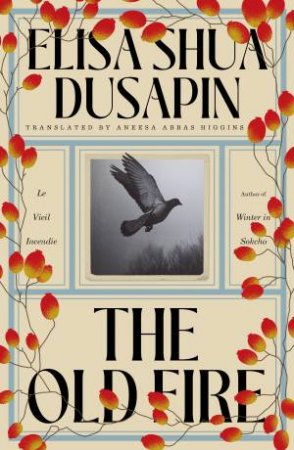
The old fire is a book this reader will reread and soon and urgently because I am drawn back into its pages. It has disturbed and left questions and discomfort. What really happened? What did I miss? What did that fire mean? What happened to the two central characters, the sisters Agathe and Vera when they were young? Why did Vera stop speaking at age six? What connections did I, as a reader, miss? The relationships and the interactions are simultaneously everyday and charged. There are anomalies - things don't quite add up; things that leave a bad taste... The author, Elisa Shua Dusapin, scatters a trail of understated, quiet and enigmatic incidents, conversations and situations and the perturbed reader must try to join dots. Regrettably, as in life, we can never see the full picture and Dusapin is not going to resolve it for us. This must be Dusapin's great skill as an author. She reveals a little... but we cannot know everything...tantalising!
Dusapin was born in France and raised in Paris, Seoul and Switzerland. Her first novel, Winter in Sochko was acclaimed and won (in its translation into English) the 2021 National Book Award for Translated Literature. Aneesa Abbas Higgins has translated again for Dusapin with The old fire. Somehow the writer and translator have worked their magic to produce a powerful and evocative book. At 165 pages, The old fire is a short novel but it packs a punch. Dusapin's writing is spare, economical...compact.
The atmospheric story absorbs and captivates the reader. New York film maker Agathe arrives in the dark in pouring rain at her old family home which used to be part of the estate of the neighbouring chateau, Le Pigeon Froid in the French countryside near the village of Perigueux close to prehistoric caves. "The building looks tired, the ivy-covered roof sagging above the brickwork, like a weary giant gasping for breath..." The house is to be knocked down and the stones are to be salvaged to restore the chateau's pigeonnier which burned down. ..."The chateau looms above us, curved in on itself like a snail, the tower and the pigeonnier its antenna." There are cluzeaux - natural galleries once used as shelters. Caves feature repeatedly in this book as do the army of ants that troop through the house and are described in minute detail. Dusapin is attuned to minutiae - the precise, the detail. And this is what Dusapin may be saying about life. We see fragments and we choose to not see fragments. We see a lot but we can't see inside someone else's persona - their interior world. We have a limited perspective and yet we see another person's actions; how they act in public, how they respond to crises, how they act privately and within the domestic family situation. Knowing the other is an abiding theme within the novel..."I was never able to let go of the suspicion that Vera had intentionally denied me access to her inner world." Ironically, Agathe cannot see the pain she causes Vera by not letting her know of her pregnancy.
Spanning from the 6th-14th November, the story describes a week when the two sisters spend time together clearing up their childhood home after their father's death. They haven't seen each other in fifteen years. They sift through a lifetime's collection of belongings and their enforced togetherness is bitter sweet. Memories bubble to the surface and neither woman can connect with the other. Worrisome memories emerge - erupting and tamped down. What happened to that kitten? Was the problem swept under the carpet? What is wrong with Vera? Is she manipulating? It seemed that her lips moved when she spoke to Swann, daughter of Octave, and Swann said that it was a secret. Is Vera playing a terrible game? What is she capable of? The narrative flashes between events in the past and the present all in the first person voice of Agathe.
Dusapin's writing is beautiful - spare and powerful, intimating the multi-layered threads that make up shared lives and histories and the misunderstandings and passions in the closest of relationships. The old fire is a very powerful but subtle, potently descriptive and elegant novel.
Themes: Time, Memory, Family, Belonging, Grief, Sisters, Disability/mental illness, Knowing another.
Wendy Jeffrey