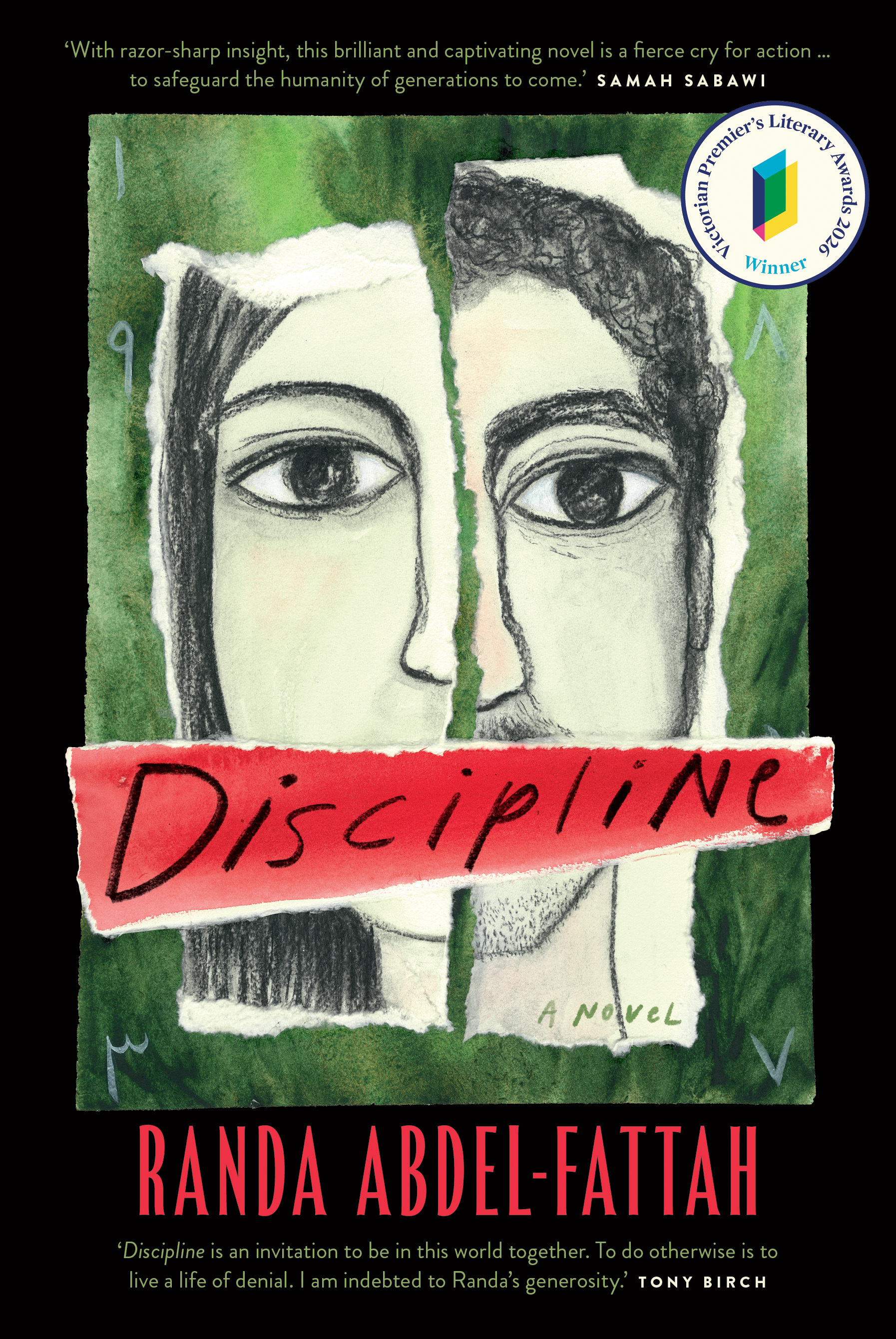
Discipline by Randa Abdel-Fattah
Randa Abdel-Fattah is the author of the glorious children’s picture book 11 words for love (2022) written in collaboration with Maxine Beneka Clarke. Her other young children’s books highlight friendship in the face of bullying: The friendship matchmaker (2011) and The friendship matchmaker goes undercover (2012).
Older students can identify with the exploration of Muslim identity in the Australian community and the sensitive handling of conflicting viewpoints in When Michael met Mina (2016) followed by the collective experience of Arab, Australian, Other edited by Randa Abdel-Fattah and Sara Saleh (2019) and Coming of age in the war on terror by Abdel-Fattah (2021) which documented the the impact of 9/11 on Muslim and non-Muslim youth.
Discipline is the book that Abdel-Fattah began in 2021 following Israel’s 11 day military offensive in Gaza during the month of Ramadan. It is dedicated to ‘all the Palestinian academics and journalists killed in Gaza who would be alive now if academics and journalists in the West had spoken and acted when they had the chance’. It is a book about the ongoing silencing of Palestinians in academia and the media.
Discipline focusses on two primary characters who struggle with different ways of existing in Australian society. Hannah is a journalist who is embraced as the diverse voice for 'The Chronicle' newspaper, sought out for her inside connections with the Muslim community, but whose viewpoint is constantly undermined. There is no respect for the integrity of her work; her stories are massaged, toned down and invalidated. When she reacts she is seen as too emotional and is pointed towards the company’s counselling service.
The academic, Ashraf, on the other hand, has learnt to keep quiet, protect his professional profile, and avoid conflict. This becomes a challenge for him as he supervises PhD candidate Jamal, Hannah’s husband, an ardent campaigner for support for Palestine. Both Jamal and Hannah become increasingly frustrated and angry, acutely aware of the devastation taking place in their home country.
Abdel-Fattah makes the argument that protests against Zionism, a political ideology, and Israel, a settler-colonial state, should not be characterised as anti-Semitic and racially vilifying. Palestinian people are confronting genocide, ethnic cleansing, occupation and apartheid. People of both Jewish and Muslim faith feel compelled to stand for human rights.
Whilst Discipline reads as a strong validating voice for Arab and Muslim journalists and academics; for the general audience it provides an illuminating clarification of issues such as anti-Semitism, anti-Zionism, and pro-Palestinian protest which are all too readily conflated in the media. In addition, there is the shared communality found in the portrayal of daily worries, the juggle of shared parenting, work conflicts, concern for relatives, all set against the constant trauma of ongoing war and aggression overseas. I particularly liked the author’s depiction of the reassuring sense of calm and peace that Hannah and Jamal draw from their faith, re-centring them both and helping them to go on. They both draw strength from daily prayer and in their hopes for humanity.
That focus on love and caring for humanity brings this reader back full circle to the message of Abdel-Fattah’s memorable picture book 11 words for love (2022). "All the words relate to someone leaving their country for another, forced to flee, but taking memories and a connection with them that will stay forever in their heart." Like all people, Palestinians continue to carry their country in their heart.
Themes: Human rights, Integrity, Palestine, Journalism, Academia, Muslims.
Helen Eddy