A tiny little world by Joel Sorrensen
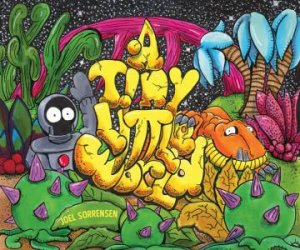
A tiny little world has a somewhat jolting storyline partially because, to read it, the reader must follow text that swirls around, moves in waves and other patterns and has to be found in different places on different pages. The spread layout is quite a thing not always providing the reader with sufficient clues about how to progress through the story. Tracking between the complex pictures and the "mostly" matching text is a challenge that some children may enjoy. Other children may find it a challenge to hold the storyline whilst simultaneously being distracted by the vibrant art. It is definitely a book that calls for high energy interactive shared reading.
The strength of A tiny little world is in its artistic layout with the author/artist Joel Sorrensen focussing more on the visual/artistic impact leaving the story line playing a subordinate role. Some effort from the reader is required to follow the text and match it to the pictures to make sense of the plot.
The cover art is bold, bright and cartoonish. Throughout the book the double page spreads cover edge to edge with very little white space. Busyness, complexity, detail, brilliant colour and energy fill the entire pages with text (like a puzzle) having to be found. The typography, like the art, is a feature of A tiny little world. Font style, sizing and placement contribute to the artistic impact of the book. Bursts of colour help with emphasis when reading. These aspects of design encourage an active and energetic interaction with the text and accompanying artwork.
The young reader is cast as a space explorer in the front matter with a box to write their name in under the text... 'This book belongs to space explorer_' Like the cover, the front and back end pages give an idea of the exotic, crazy, bright world packed with weird sights that are found in the book. The end papers at the back include a colouring page and a blank page with a request to draw your own planet or creature. Set in deep space, the pictures are populated with strange and exotic alien creatures and backdrops and the eye is drawn to action in different locations on the pages.
The central character is an endearing little lizard named Rexy. Something new burns through the atmosphere and lands in his world and the adventure begins leading to a changed life for Rexy. Sorrensen uses exclamatory language "Watch out...!", strings of adjectives..." tall ,lanky, keen, lean, glowing, green grass grazer.", alliteration... "Suddenly, some slimy, slippery sliders surrounded them.", rhyme and rythm and other forms of word play for the enjoyment of young readers.
While some readers (adults) may find A tiny little world a little contrived and the message of small consequence, others may see it as a lot of energetic fun and a very good book for children who need a lot of high energy interaction in a book in order to capture attention.
A tiny little world could lend itself well to graphic novel format. This reader can see it being used as a stimulus in the art classroom and being useful for primary aged children who enjoy drawing. By and large, the standout aspect of A tiny little world is Sorrensen's encouragement of the creative, artistic side of the child. That has to be a very good thing.
Themes: Finding a friend, Space, Aliens, Helping, Searching.
Wendy Jeffrey