Omnibus Books, 2011. ISBN: 9781862919198.
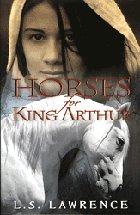
(Age 14+) Recommended. Britain, the year 475. The world is
darkening. In the darkness, there are some who dream. Artorius
dreams of victory over the barbarians who raid the night. And Alexa,
half-Roman, dreams of breeding the horses that will carry him to
victory. But Alexa's mother has very different plans for her, and
will stop at nothing to see them fulfilled. Alexa needs allies, and
finds them - her father's old groom, Syragus, and the mysterious sea
Captain, Grecca. With their help she will follow her dream, wherever
it leads her.
A beautiful story of love and loss that you immediately get lost in.
This story captivated me and I fell in love with it. But the title
confused me a bit: after I read the book I realised that there
Artorius was another word for Arthur. But other than that I loved
the book and would love to read others by this author.
Taylor Oxenham (Student)
Blood Money by J.E. Fison
Hazard River series. Ford Street, 2011. ISBN 978 1
921665 462.
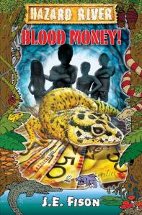
(Age 9+) You know Blood Money is going to be an adventure
when the opening pages introduce our characters - Jack and Ben - and
a fist full of $50 notes. It is only chapter 2 and the boys are
already up to no good - claiming money that is not theirs and
dreaming about how they will spend it. Throw in an encounter with a
poisonous snake and now the story involves all four friends - Jack,
Ben, Mimi and Lachlan. Working together, they hide the money and set
a trap. Who does the money belong to? Are they criminals? Will Mimi
make the boys hand the money in? Will Jack ever get a yacht or a
quad bike? Who has wrecked the shed? Are the friends safe or is
there really a curse? Blood Money is a quick moving short novel with short descriptive
chapters and lots of adventure to keep readers engaged. Boys aged 9+
will enjoy the humour and the action. It is part of a series
but this story stands alone and readers will not have to read others
in the series to understand what is going on. Of course, they will
want to check out more adventures, I am sure! The thing I love about
this book is it is Australian, exposing children to Australian
humour, animals and places - a good thing in the world of computer
games.
Kylie Kempster
Riley and the grumpy wombat by Tania McCartney
Ill. by Kieron Pratt. Ford St., 2011. ISBN 978 1921665493.
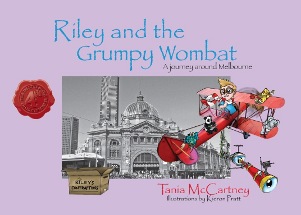
(Ages 5+) Picture book. The fourth in the Riley series, see Riley,
digging in his grandmother's garden to make mud pies, happens upon a
wombat hole. Inside is a very grumpy wombat and it soon scurries off
to find safety elsewhere. The indomitable Riley then heads off on
his contraption to find the hapless animal, thus flying over parts
of Melbourne and Victoria, giving the reader a visual tour of the
state and its attractions.
The little red plane, replete with Riley at the controls, and
accompanied by his friends, panda and koala and two toys, flies over
Melbourne searching in the strangest of places for the wombat.
Children will love telling the reader that these places could not
possibly be the places to find wombat, as they see Bourke Street
Mall, Federation Square, Flinders Street Station, South Bank amongst
others. They then go to places more likely to find a wombat, Royal
Botanic Gardens, Dandenong Ranges, and Great Ocean Road, but still
with no success.
Eventually of course the wombat is found, in of course a mud villa,
thus returning to the theme of the opening lines.
A neat introduction of the sights of Victoria, this will be well
used in classrooms where books about Australia are there for younger
children to research, particularly in light of 2012 being The
National year of Reading, and using Alison Lester's book, Are we
there yet? as its theme.
Fran Knight
Dark and hollow places by Carrie Ryan
Orion, 2011. ISBN 9780575094840.
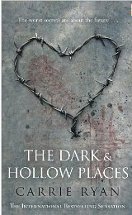
(Age 14+) Recommended. Zombie. The third in the Forest of Hands and
Teeth series stars Annah, Gabry's twin sister. Annah has a lot to be
sorry about. She and Elias lost Gabry in the forest when she just a
little girl. She has a horrific scar from the barbed wire that keeps
out the Undead. They have lived a precarious existence in the City,
with Elias protecting her and providing a reason for her existence.
Then he left to become part of the Recruits and her whole existence
has revolved around waiting for him to come home. But one day she
meets Catcher and decides that perhaps life is worth living after
all.
As in the first two books in the series, there is plenty of action
to keep the reader's interest. It takes place in the ruins of the
City, but is no less terrifying that the scenes of hands and teeth
clutching at the living through the fences in the previous two
books. The Horde swarm everywhere and the machinations of those in
command of trying to keep the living safe are horrifying as well.
Annah is a compelling character who grabbed my interest right from
the start. It was good to see her growth and bravery in this coming
of age novel. Catcher too is a fascinating character. He has dark
secrets and his future is unknown. The growing feelings between the
two are central to the plot. Ryan handled Annah's feelings for Elias
and then for Catcher in a sympathetic and believable way. I
especially liked Annah, even more than Gabry and Mary in the
previous books, as she grew to be brave and determined. Catcher too
is strong and courageous.
This series has been fast paced and engrossing: all the books are
ones that I haven't wanted to put down. If teens want horror
stories, complete with zombies, they can't go past this group of
books or Jonathan Maberry's Rot and ruin.
Pat Pledger
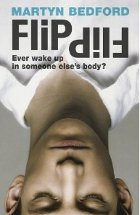
Flip by Martyn Bedford
Walker Books, 2011. ISBN: 9781406329896.
(Age 14+) Recommended. One morning 14 yr old Alex wakes up to find
himself in the wrong bedroom, in an unfamiliar house, in a different
part of the country. The family at the breakfast table are total
strangers. And when he looks in the mirror he gets the shock of his
life. How is it possible that Alex has become another boy - a boy
called Philip, or Flip? But more importantly, how will he switch
back to become himself again?
At first when I started reading this book I was a little confused
with the story but then I realise the switch was at the start of the
book and not later on. A very different approach to a story but I
really liked it because I learnt things just as he remembered them
and not in the intro to his life. Very cute, funny story with lots
of twists and bends and a lot of friend making.
Taylor Oxenham (student)
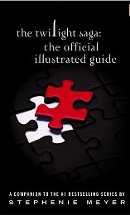
The Twilight Saga: The Official Illustrated Guide by Stephenie Meyer
Atom Books, 2011. ISBN: 9781905654437
(Age 13+) Highly Recommended. This must have edition is the
definitive encyclopaedic reference to the Twilight Saga and provides
readers with everything they need to further explore the
unforgettable world Stephenie Meyer created in Twilight, New
Moon, Eclipse, Breaking Dawn and The Short
Second Life of Bree Tanner. This comprehensive handbook -
essential for every Twilight fan - is full-colour throughout, with
nearly 100 beautiful illustrations and photographs, and with
exclusive new material, character profiles, genealogical charts,
maps, extensive cross references, an in-depth conversation between
authors Stephenie Meyer and her idol Shannon Hale, and much, much
more.
A definite must have for any Twilight fan, you get all of
the inside secrets that only Stephenie Meyer and her close friends
and workmates knew. For me getting the chance to review this book
was amazing. I am a major Twilight fan and anyone who loves
Twilight or even if they don't, should definitely get this
book to truly understand what Stephenie was thinking when she wrote
the series and how she came to write it. All in all, it is a great
informational book on a great series.
Taylor Oxenham (student)
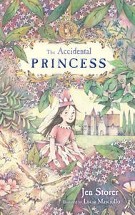
The Accidental Princess by Jen Storer
Penguin, 2011. ISBN 978 0 670 074969.
(Age 10+) The Accidental Princess brings to life the magical world
of fairies, imps and talking creatures. It brings forward the
possibility of a normal child being a princess in a magical world
and young girls being heroes, relying on their wits instead of
turning to adults.
Matilda and her older sister, Iris, are home for the school
holidays. The girls do not get along and as a result Matilda hides
Iris's lucky penny to get back at her. The consequence of this
action opens up access to the mysterious hedge - a place the girls
were always warned about. Matilda is seen as the princess who will
save the fey world and with the help of her sister and advice from
their nanny and the gardener, the girls battle nasty imps,
disgusting toads and an evil witch queen.
Will Iris succumb to the influence of the witch? Why do Nanny and
Joseph know so much about this magical world? Can Matilda be brave
enough to save the day? The Accidental Princess is aimed at girls who are independent
readers aged 10+. The text is small but the chapters are short and
descriptive and the further you read, the more interesting it
becomes. The girls meet interesting characters - my favourite
is the hedge troll who only likes it when you talk in questions -
and learn to become friends and trust each other.
Kylie Kempster
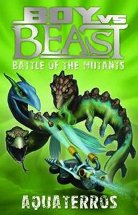
Battle of the Mutants: Aquaterros by Mac Park
Scholastic , 2011. ISBN 978 1 92168 430 2.
This story is part of the Boy vs Beast series which has been written
with large font to assist reluctant readers.
It has a science fiction flavour and is filled with technological
gadgets. There are elements of computer game playing with the way
the border guards, who are hoping to become border masters, go about
their daily tasks of guarding the border wall and keeping earth
safe. The base where the guards are is a series of secret tunnels
and passages.
Alternatively the beasts live in four main areas - rock, water, air
and land. There is a constant battle by the beasts to infiltrate the
base on earth.
The battle sequence is depicted in cartoon format. The illustrations
provide screen vision, gadget diagrams and special message pods that
enhance the story and aid the readers understanding of the battle
occurring.
Tracy Glover
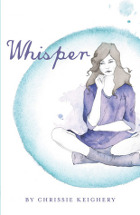
Whisper by Chrissie Keighery
Hardie Grant Egmont, 2011. ISBN 9781921759321
(Age 14 +) Highly recommended. Demi Valentino is facing the sort of
situation that many teens face: starting at a new school, trying to
make new friends, falling in love, thinking about her career.
However, Demi has an extra challenge to face, for two years ago she
lost her hearing after a serious bout of meningitis. And this is why
she has decided to change schools, moving away from her much loved
childhood friends, and against her mother's wishes. Demi believes
that if she wants to achieve at school (and get her dream job) she
needs to be able to understand what is going on around her, so in
the opening chapter of this novel, she nervously attends her first
day at a school for the deaf.
Attendance at this school introduces Demi to the broader deaf
community, and one of its fiercest advocates, Stella, a strong and
determined fellow student. Stella's singular approach brings her in
conflict with Demi, who finds she has a more delicate balancing act
to consider, given that her family and old friends come from the
hearing world. However, their battles are always woven into the
story in a realistic and engaging manner so that it does not become
an issue driven story with a message to push. The character's
journey is what drives this story and makes it an enjoyable reading
experience.
Demi is a likable young girl, a credible mix of resilience and
anxiety. She worries about her place in the world and her place in
her family. Her mother is a strong character who has fought fiercely
on her daughter's behalf and Demi must draw on her own strength to
make decisions for herself. Demi also grows in understanding as the
novel proceeds; she realises that her anxieties about her deafness
have sometimes caused her to misjudge many people, including
herself. She learns that she isn't the only one with battles to
face.
This is a compelling novel which will encourage teen readers to
reassess their own values and understanding of life's challenges. It
is sure to appeal to girls, in particular. Highly recommended.
Deborah Marshall
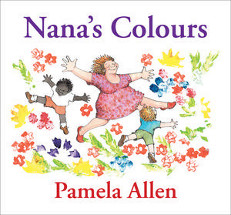
Nana's colours by Pamela Allen
Penguin/Viking, 2011. ISBN 9780670075379.
(Age 2-5) Recommended. It is Nana's birthday and the children all
have a colour to give her to celebrate. Each present is a different
colour.
In a deceptively simple picture book that on the surface could be
regarded as a teaching tool for colours, Allen has brought alive the
joy that giving a present brings to not only the person who receives
it but to the person who gives it. The love that both the children
and Nana have for each other is also evident and this book will
deepen the young reader's understanding of love and family.
With very few words and wonderful illustrations, Pamela Allen has
produced a beautiful picture book that will also teach children
about the different colours. On a two-page spread, Allen has draw
six children holding six bouquets of flowers all in different
colours. The children's faces and bodies are hidden by the flowers
and their stems making the children look a bouquet of flowers in
themselves, one that grandmothers will relate to I'm sure. The
following pages have a single word for the colour and then a picture
of the little child, who is carrying the bouquet to Nana. It
finishes off with an exuberant grandmother and her grandchildren
dancing through a sea of different coloured flowers.
A beautiful picture book that will be winging its way over to London
to my grandchildren, Nana's colours is sure to bring delight
to any grandmother's heart.
Pat Pledger
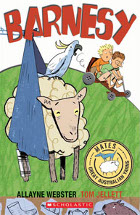
Barnesy by Allayne Webster
Ill. by Tom Jellett. Mates series. Scholastic, 2011. ISBN 978 1
66291 821 4.
Younger readers. Recommended. Another in the series of short stories
produced by Omnibus, featuring authors who have written in the main
for younger audiences, this book, Barnesy, is about a family having
some problems with their lawnmower. Into the family comes a sheep,
which having given birth has broken its back leg. The family invents
a way for the sheep to recover and mow the lawn, solving everyone's
problems. It is a neat story with a lovely resolution that will
appeal to young readers. The two sheep, the ewe and its lamb find a
new home where the ewe is able to carry on despite its loss of a
leg, and they both take care of the lawn. The illustrations by Tom
Jellett adds another layer of fun to the story, focussing the
reader's attention on the activities of the family.
This book, like the others in the series, has different fonts for
some words, attracting the reader's attention to those words. Some
are unusual words which may need the use of a dictionary, some are
words which require a stress, some are words which tell of the
family's feelings at the time. Many names are used in this story
which again may require the student to research the name to find out
why it is used. I really like the stress on the words being used in
this series of books. It is not didactic, but allows for some
further thought about why the word is used, and allows the reader
space to work it out or ask questions. And of course, the series is
unselfconsciously Australian, with a smattering of Australian words,
Hills Hoist, ute, lemon myrtle biscuits and vegemite, for example. A
series of little gems.
Fran Knight
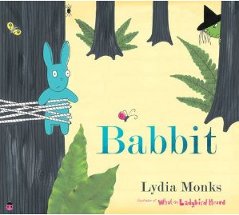
Babbit by Lydia Monks
Egmont, 2011. ISBN 9781405254236
Babbit is a rabbit - a toy one who lives with the Big One and the
Little One. Little One is supposed to look after Babbit but she's
not very good at it. One day, while having a picnic, Babbit is
grabbed, kidnapped by the Witchy One in cahoots with the Snorty One,
the Growly One and the Snappy One. But Little One doesn't even
notice. Poor Babbit has to sit tied to a tree while the fiends argue
just which bit of him they are going to eat. Will Little One
discover he's gone and find him in time? And does the story have a
happy-ever-after ending?
The story is told from Babbit's perspective and there are lots of
opportunities to have younger readers step into Babbit's shoes and
reflect on the emotions that Babbit might be feeling, enabling them
to not only start to develop empathy but also to start their journey
into being able to put themselves in another's shoes. The language
is delightful and there are some funny phrases that they will have
fun with as well as examples of onomatopoeia that could be explored.
There are even opportunities for movement activities as you
dramatise the flight
through the woods.
Even though it sounds like this might be a bit too scary for little
people, the illustrations are clear and simple with no sense of
foreboding or evil at all, and the ending is very satisfying for
all, including Babbit. I think this will quickly move from a
first-read to a favourite with Miss 5.
Barbara Braxton
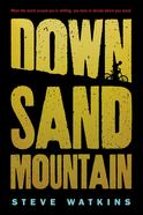
Down Sand Mountain by Steve Watkins
Candlewick Press, 2011. ISBN 978 0 7636 4835 0.
(Ages 12+) Recommended. When Dewey Turner sees Darwin play
Chattanooga Shoe Shine Boy, dressed as a minstrel, he decides that
he will take the part in the school production the following year,
and so uses black shoe polish to cover his white skin in rehearsal.
Unfortunately it will not come off, and the following day, his first
day at high school, becomes miserable, as do the following
weeks. He is bullied about being a coloured boy, called Sambo,
not allowed to use the toilet, because it is whites only, and older
boys do random acts of intimidation, like taking his lunch, during
his school days. Outside school, it is not much better as he tries
to make friends with others of his age in the neighbourhood.
The only person he is able to befriend is another outsider, Darla,
who wears her hair like Shirley Temple, and sings and dances.
Together the two become aware of bigger issues within their
neighbourhood.
An almost frightening look at middle America in the mid 1960's, when
teachers taught America versus Communism, and spoke of The Society
for Coloured People, and Martin Luther King Jr as being communists,
and fathers were called 'sir' and took off their belts to punish
their sons for misdemeanors, the background of racism is evident.
The janitor at the high school, in the all white neighbourhood of
Tampa, is black, and is about the only black person this narrow
community sees. So when Dewey and his brother are told by their
father to drop his leaflets at the homes in the poor black suburb,
their eyes are opened to the inequality and racism which exists
around them. The novel becomes a coming of age story where Dewey
eyes are opened not only to racism, but the effects of the Vietnam
War, abuse and his own sexuality, giving the reader a definitive
look at USA in the 1950's and 1960's when segregation was the norm.
Fran Knight
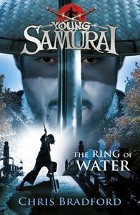
The ring of water by Chris Bradford
Penguin, 2011. ISBN 978 0 141 33254 3.
(Ages 11+) Fantasy. Recommended. The fifth in the series, Young
Samurai, begins with Jack Fletcher wakening stiff and sore, in a
wayside, inn, having lost everything including his most precious
thing, his memory. He has also lost his swords and his father's
rutter, and so he goes to try and retrieve them. In doing so he
meets up with a masterless Samurai called, Ronin, and a girl called
Hana, an outcast. Jack has been trained as a Samurai and a ninja but
because he is a gaijin, a foreigner, he is looked down upon by
everyone else. As a result, the Shogun is after him, as he has
expelled all the Europeans and Jack is just another one.
The story is at its heart a boy's own adventure, where the three
overcome all odds and retrieve Jack's swords and rutter, with lots
of fight sequences where Jack and Ronin are able to use their
prodigious skills against the Shogun's men and other outlawed gangs
trying to get them. An exciting well written read, which drags the
reader along with great action sequences and some humour, this book
will have readers eagerly awaiting the next in the series.
Mark Knight
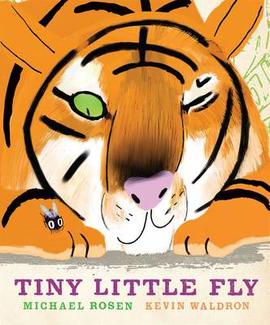
Tiny little fly by Michael Rosen
Ill. by Kevin Waldron. Walker, 2010. ISBN 9781406330977.
(Age 2-5) Recommended. Tiny little fly has great fun stirring up the
tempers of some very large animals: a tiger, elephant and hippo. The
great big elephant tries to tramp and squash the fly, the hippo
attempts to roll on him and the tiger swoops on him with his great
big paw. They are all determined to catch him but that elusive
little insect is way too quick!
As you would expect from Michael Rosen, a British Children's
Laureate, the poem in this story is catchy and memorable. With a few
sparse words, he is able to catch the teasing nature of that
annoying small fly, in a wonderful rhyme that will have children
asking for the book time and again. It is a delightful book to read
aloud and one that will linger in the memory. The rhyme and rhythm
will help emerging readers to remember words and to predict what is
coming next.
Kevin Waldron's illustrations are really wonderful. He manages to
catch the size and ability of the three dangerous predators. With a
few bold black strokes, the stripes on the tiger jump out of the
page, and his bright green eyes glare at the reader. The pink of the
hippo's mouth is a delight and brings up all sorts of images of just
what that animal could swallow, not to mention what damage the size
of the elephant's feet could inflict on that pesky fly. As Rosen
tells the tale from the fly's point of view, Waldron's illustrations
follow, showing just parts of the animals, until they emerge as a
full vivid illustration. Children have to guess what the next animal
will be and will enjoy working it out from the drawing.
Humour lifts this story as each animal takes two winks at the fly
and the funny ending will bring a smile to everyone's faces. It also
provides an opportunity to act out the actions of the animals as
they attempt to bring down the fly. This is a keeper for my
grandchildren.
Pat Pledger