Ill. by Andrew Yeo. Walker Books, 2011. ISBN 9781921529221.
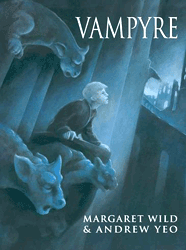
(Ages 10+) Picture book. In a few evocative and imaginative words,
Margaret Wild gives her story. A boy, the son of a vampyre family
strives for something else. He loved being young, able to ride on
his father's shoulders, talk to the deer and the birds, being part
of his family. But now he is older, the birds and deer shun him, he
cannot go into the light, the townspeople wait for him with
sharpened spears.
But he still wants the light, and so goes out, only to be dragged
back by his father, and lying ill for three days, is nursed by his
mother. This however does not deter him, and he repudiates his life
once again, to be greeted by the deer and the birds, walking into
the light.
Blue grey dominates the first few pages, giving an emotive look at
the home of the vampyre, with its lack of light, a place that is
always night. But as the youth approaches the light, the pages
soften to a reddish brown, a lighter, softer look is given. The
acrylic work of Andrew Yeo is stunning, adding to the image created
by the words, of a boy trying to escape the fear and loathing of his
past to the light of the future.
Much could be read into the words and images created by this book,
and perhaps an astute librarian could use it to introduce other
books about standing firm, believing in yourself or rejecting the
past. And there are quite a few around at the moment, notably I
am Thomas by Libby Gleeson and Armin Greder. As with I am
Thomas, I found this book to be very scary. The boy is
rejecting all that he knows and wants to follow his dream, even
though in this case it may lead to illness if not death.
Perhaps upper primary and lower secondary students could discuss
this book in the light of other vampire books which abound at the
moment, comparing it with some in which the vampire rejects his
background, striving for something better. The novel by Catherine
Jinks, The reformed vampire support group comes immediately
to mind where vampires meet together to support each other in their
quest to be normal, and not to fang. For others of this ilk, see my
article in Magpies, To fang or not to fang, in which I list
all the vampire books which show a vampire rejecting what he was
born to do.
Fran Knight
Sounds spooky by Christopher Cheng
Ill. by Sarah Davis. Random House, 2011. ISBN 978 1864718799.
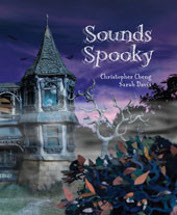
(Ages 6+) Picture book. The little ghost in the old crumbling house
is awakened by strange noises and whistling wind as three small
children brave the bleak exterior to find out what is inside. In
smart repetitive lines, each second double page spread has a series
of phrase with marvellous imagery of scary things happening. And
then each series of lines finishes with the question 'What's that
noise I hear?' It's enough to make readers tremble as they turn over
the page to find out what is happening in the ghost's house. The
repetition of 'I'm not scared', underlines the scary look on the
child's face, as the tables are turned in this haunted house.
The illustrations are wonderful, full to the brim with wonderful
images of things found in an old haunted house, falling apart, yet
still having the furniture, clothes and things of times long past.
Readers will love delving into the detail of the world created, at
once recognising things possibly in their parents or grandparents'
houses, and or seeing things new to them. The illustrations will be
the platform for many discussions of olden times in classrooms, and
the images of gargoyles, amongst other things could be used in art
lessons. The words used by Cheng on every second page are a delight
both to read aloud and to yourself, as a group or alone. The images
created will prompt much discussion about how words are used to
develop a felling of dread, and can be used as a springboard for
work in the classroom on using words to create an image or feeling.
Fran Knight
1 2 3 Count to ten with Gumnut Babies
Pictures by May Gibbs. Scholastic, 2011. ISBN 9781742830230.
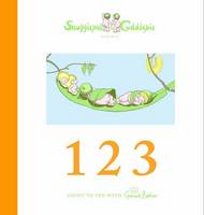
(Age 2-4) Recommended. Board book. Another beautiful book featuring
May Gibbs' classic illustrations of the gumnut babies, children will
learn to count the numbers 1 to 10 in this book. Each number has
wonderful pictures from the May Gibbs collection.
Especially delightful is the number 1, 'One special hug' which has a
lovely wattle fairy hugging a tiny baby. 'Four cuddly chicks'
perched in a nest, with their mouths wide open ready to be fed, will
engage a young reader's attention. I have a wattlebird nesting in a
hanging basket on my verandah and these little chicks look just like
the babies in the nest!
Another feature of the book is the way it is organised. Young
children will have fun counting the little gumnut babies, wattle
babies, Australian plants, insects and birds, and looking carefully
on the page to find the one that is often hiding in foliage. Each
page has both the number and the word for the number featured on the
page so that they both can be highlighted.
I love this little book and it is winging its way to London for my
grandchildren.
Pat Pledger
We can be heroes by Catherine Bruton
Egmont, 2011. ISBN 9781405256520.
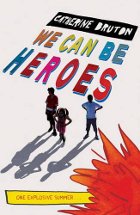
(Age: 12+) Recommended. This novel is an engaging combination of
action, adventure, humour and emotion. It describes the impact of
9/11 on modern day Britain, as seen through the eyes of a young boy.
Ben is a quiet, observant boy who copes with life's mysteries by
making lists of questions (often quite poignant) and drawing
cartoons (often quite funny). Ben's dad died in the 9/11 attacks and
his grieving mother is in hospital, so Ben is spending the summer
holidays with his father's grandparents. Here he meets Priti, who is
everything that Ben is not: loud, outspoken and fearless. She is the
youngest daughter of the Pakistani family who live next door to
Ben's grandparents. Within a few days they are joined by Ben's angry
cousin, Jed and then the fun really begins.
Soon the three youngsters are caught up in the adventure of spying
on Priti's brother, Shakeel, who they suspect (on very flimsy
evidence) of being a terrorist bomber, and trying to hide the
unsuitable romantic liaison of Priti's eldest sister, from her hot
headed brother, Mik. But what seems like a game to the children
suddenly takes a more sinister turn when adults become involved.
Only then can the true heroes emerge.
This is where the author plays a deft hand - allowing the
consequences of racism, and the fear of terrorism, to play out with
a finely balanced blend of humour, horror and high drama. The
children gradually realise that it is easy to see terror where there
is none and to use anger to hide grief.
Ben, Priti and Jed are all about 12 or 13 years of age, so the
readership of the novel is likely to be the same age. The author has
certainly given young readers plenty to think about whilst also
charming them with an action-packed adventure story. Young readers
will especially enjoy Ben's comic at the end of the novel which
helps to lessen the sombre tone of the story's end. It also allows
the children to finally be the heroes they yearned to be!
Deborah Marshall
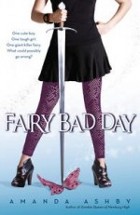
Fairy bad day by Amanda Ashby
Penguin, 2011. ISBN 9780143565772.
(Age 13+) Recommended as a light-hearted read. Emma was convinced
that her rightful designation is to slay dragons, but Curtis Green
snatched the title from under her nose and instead she is assigned
to slay fairies. To top it off fairies are not mean and menacing -
they are cute and pesky, wear hipster clothes and just love to taunt
her. But there is one giant killer fairy and it is up to Emma to
chase it down and only one person can help her - Curtis.
I really enjoyed this laugh a minute paranormal story that was
original and pacy. From the cover illustration of Emma in heels and
spiking a fairy with a sword to witty repartee between the main
characters, Ashby maintains a line of humour throughout the whole
book that is quite something to achieve.
Emma is a girl who just loves action and is quick to pursue the
dragon-like creature that can bypass the wards that surround her
school, Burtonwood Academy. To make things even more difficult for
her, no one else can see the creature and her warnings are ignored.
When she is told that she has to teach Curtis about the fairies, she
discovers that there are hidden depths to him and that he is an able
assistant in her quest to find out what is happening. All the
characters, main and secondary, are well fleshed out and very
likeable. Emma's friend Loni is amazing with computers and Trevor,
who has a pet cockroach, is a hoot.
Ashby has brought together the tried formula of a school for
talented paranormal teens, a quest to save the world from evil and
an interesting romance to make a very enjoyable, quick read. Teen
girls who are after something amusing and cheerful will enjoy this
one. I will certainly be reading anything else by this author purely
for the laughs I know I will receive from her clever dialogue.
Pat Pledger
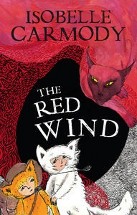
The red wind by Isobelle Carmody
Penguin/Viking. 2010. ISBN: 9780670074037.
(Ages 9+) Recommended. Fantasy. Winner CBCA Younger Readers Book of
the Year, 2011.
Brothers, Bily and Zluty, born from an egg live in a stone building
with a cellar in an unforgiving landscape. They are little furry
creatures, whose lives are bound by their need for food. Bily has a
garden at the side of the house which produces much of their needs,
but every season, he goes off to the forests to collect sap,
mushrooms and honey. This excursion takes him ten days. When he
returns, food is kept for the coming winter, and their cellar is
full of preserved food, jars of honey, ground cones, bags of wheat
and rice. But this time it is different. When Bily leaves for the
forest they both notice a red cloud hovering in the sky, seeming to
get closer. As Bily taps the trees in
the forests, stones fall from the sky and then heavy rain falls as
he has never seen before. Meanwhile back at their house, Zluty is
coping with the strange weather as well, but in taking refuge in the
cellar with the birds, a stranger enters, scaring them all. This
monster has been bitten and so Zluty cares for him, despite being
terrified of the large animal.
On Bily's return, the stone walls of their house have caved in with
the stones and rain, and the cellar is almost full of water. He is
bereft and digs frantically to find Zluty's body. But he is safe and
the three, Zluty, Bily and the monster, along with Redwing, set out
to find a safer place to live.
A charming story of courage and loyalty, of tenacity and survival,
the characters in this book will endear themselves to the readers,
as they bravely take off for places unknown. The detailed
descriptions of the landscape, along with the hints of the other
beings within their community, make this a magical read, a fantasy
yet with ramifications of a wider theme.
A wholly engrossing read, middle and older primary readers will find
much to enjoy in this, the first in the series, The Kingdom of
the Lost. It would make a marvellous readaloud.
Fran Knight
Big river, little fish by Belinda Jeffrey
UQP, 2011. Louis Braille Audio. 2011.
Read by Robert Alexander, 6 Cd's, 7 1/2 hrs.
Tom Downs, a young man born on the banks of the River Murray as his
young mother died, knows the river is rising. It is 1956 in a sleepy
community along South Australia's section of the river, where people
not really accepted into the town live in shacks along the
riverbank, where Aboriginal people are the first to be suspected of
a crime, where Tom is tutored by the mother of his best friend
Hannah as he is unable to decipher words and reading. When Tom's
real father comes back into his life things are on a knife edge, his
parents are unsure of what Tom will do, Hannah's father is suddenly
killed on the road and Tom's Harley disappears. All these incidents
are played out against the rising river, adding to the already
taught tensions within the community.
In a story which reflects a small river town of the 1950's with
humour and compassion, readers will follow Tom's story eagerly. The
setting and characters are drawn with an honesty that is palpable,
and the tale, redolent of the times is evocative, despite a few
anachronisms.
Read by Robert Alexander, the humour is given full reign and his
deliberate voice adds a resonance to the story which suits it well.
Seven hours went along very quickly as I listened to the full story
as it played out along the banks of the Murray River in 1956. For
students wanting to hear an engrossing story, well told, they can
not go past this excellent production, which I assume to be one of
the last of the Louis Braille Audio books, a publisher that
deservedly won many awards, and will be greatly missed. I'm very
glad I now have a small collection of Louis Braille Audio books,
which compliments that of my local library. For adults and students
alike, the ease of putting a CD into the home or car system makes
stories such as this easily accessible. Treasure them.
Fran Knight
The Power of Six by Pittacus Lore
Penguin, 2011. ISBN 9780141340883
(Age 13 +) Highly recommended. Guaranteed to make you want to keep
reading The Power of Six is the second book in the young
adult science fiction series The Lorien Legacies. This novel
has parallel stories of two of the nine Lorien Gardes sent from
their planet at the time of its destruction. Number Seven Marina is
hiding with her adult Cepan, Adelina, in a convent in Spain. When we
meet her she is desperately trying to convince Adelina to reveal
vital information she needs to prepare herself for the mission all
nine Garde have on Earth. The other Garde, John Smith, is on the run
after the events described in the first of the series, I am
Number Four . John is accompanied by his Earth friend Sam, a
chimera (shape shifter), called Bernie Kosar, and another powerful
female Garde, known as Number Six.
The pace is hectic as the alien teenagers develop their unique and
deadly talents and are forced to use these talents to survive
against their planet's arch enemies the Mogodorians and their
terrifying creatures. Fans of Lord of the Rings and Harry
Potter will enjoy these battles against the krauls, piken and
other vicious monsters. The fast paced narrative will have you
wondering many times how the characters are going to make it out
alive from their latest perilous position. The book ending makes it
obvious there are plenty more books to come in the series.
Using a different font for each of the first person narratives means
keeping track of the two story lines is quite simple for readers. An
entertaining thriller with memorable characters, especially Bernie
Kosar . . . There is a film of the first book in the series I am
Number Four that could be used to hook readers into the
series. Highly recommended for boys who have enjoyed Robert
Muchamore, Anthony Horowitz and Charlie Higson, but both genders
will enjoy the fast action and well developed characters.
Chris Lloyd
Fictionalising history by Goldie Alexander
When I write historical fiction I try to portray significant events
as well as keep you interested. I'm careful to only use research as
background where people move about in an everyday way. Convincing
characters, plots and structure keep us reading. Show, don't tell is
important. Characters must move about as if this is their 'today'.
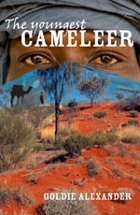
My latest historical novel The Youngest Cameleer is about
one of the lesser known explorations into the Australian interior,
led by William Gosse in 1873.The various members of this exploration
(both European and Afghan) did exist and my story is based on
Gosse's own journal now kept in the State Library of South
Australia. This expedition was the first non-indigenous group to
come across the major icon of Uluru. Without the use of camels and
Afghan cameleers they might not have survived those harsh desert
conditions. Though it is the first time any cameleer was praised for
helping open the interior, these facts are not well known. Nor that
an Australian aboriginal boy was an invaluable member of this party.
Some cameleers even lent their name to landmarks, such as Kamran's
Well and Alannah Hill. My intention was to bring this expedition to
life by creating a fictional character that was part of it. Thus I
came up with Ahmed Ackbar, a fourteen-year-old Afghan and my
'youngest cameleer'.
Dialogue and first person narrative help create characters, so Ahmed
tells his story in fluent Pashtu, but his English is limited. He is
the only surviving male in his immediate family. In late 1872 he
sails into the prosperous city of Adelaide to help look after four
camels. Yet he has other things on his mind. What if his uncle
Kamran isn't as innocent of his brother's death as he seems? As the
expedition treks into the Australian interior, Ahmed must cope with
Jemma Khan's enmity, his own homesickness, and the difficulties of
exploring unknown territory.
Readers might like to track Ahmed's journey on a map of Australia.
They can delve into how our first people behaved when they came
across these explorers, suggest reasons, and their appearance was
back then. They can research contemporary Uluru, both as an icon and
tourist attraction. They can ask: what route does the Ghan railway
take? What was there before the railway? What is the climate and
terrain around Alice Springs like? What happens to that land when it
rains.
If we don't have Aboriginal ancestors, we are all migrants. My
parents arrived in Australia in the first part of the twentieth
century and settled happily in Melbourne. Our great migrant waves
have occurred at various times: during the gold-rush, straight after
World War Two, and in the seventies when the 'boat people' arrived.
It's good to recall that Afghans have been responsible for opening
up our vast continent and that without their camels the task would
have been harder than it already was.
When I was young I always longed for a machine that would allow me
to become part of a story. I always wanted to befriend some of the
characters I read about. Then I could have had a fresh start with a
whole new set of people. Back then as a somewhat solitary child who
spent her life reading and imagining I was somewhere else with a
'nicer and far more sympathetic' family, I would have given anything
to be assured that my loneliness would surely pass. I hope that
maybe I can interest my readers into thinking the same way. I would
like to help them look beyond the immediate present to see life as
the continuum that it surely is. Goldie Alexander
Meet Letty by Alison Lloyd
Ill. by Lucia Masciullo. Our Australian Girl (series). Penguin,
2011, ISBN 978 0 14 330540 8
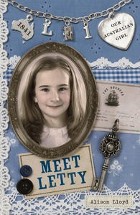
(Ages 9+) Recommended. Australian history. Letty, a young
girl in a stepfamily, is at the docks at Gravesend farewelling her
older sister, Lavinia, who has read that the new colonies have too
few women and so taken the step to migrate to the new land in search
of a better life. But there is a mix up, and Letty finds herself
sailing with her sister. Through the adventures of the two girls and
those they befriend on the ship, we see how new settlers came to
Australia, overcoming the privations aboard ships that were not
built for these voyages, and which offered cramped conditions,
disgusting food, squabbling migrants, rats and disease to those on
board.
We feel for them when they are seasick, or having to clean the
cramped squalid sleeping quarters, or sleeping 2 to a bunk, or only
having one change of clothes going from the cold of the northern
Atlantic to the sweltering heat of the tropics. When Lavinia gets
typhoid, Letty sees her new friends with clearer eyes, as she
struggles to help her sister survive, swapping some of her sister's
linen for medicine. The girls survive all sorts of things buoyed by
having found work in Sydney before they left England, but when they
arrive, this work evaporates leaving them bereft. Luckily a young
man, a sailor Letty met on the ship comes to their rescue.
The first in the quartet of stories about Letty, a young emigrant in
1841, in the series, Our Australian Girl, holds the readers'
attention as Letty nears the place that will be her home. Readers
will absorb snippets of information about Australia in the colonial
era without being aware of it, adding to their knowledge base
reading this foursome. With large clear print, and short chapters,
the story is easy to read and rattles along, adding considerably to
the reader's knowledge of Australia's past. Each of the stories has
several pages of just facts adding again to their knowledge and then
a easer for the next book in the series.
Letty and her adventures have a grim reality which is at once
engaging and informative. Letty is a most interesting young woman,
and the contrast with her sister gives the stories extra zest. The
backround is highly believable and adds a solid credible base to the
four tales.
Fran Knight
Letty and the stranger's lace by Alison Lloyd
Ill. by Lucia Masciullo. Our Australian Girl (series). Penguin,
2011, ISBN 978 0 14 330541 8.
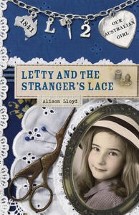
(Ages 9+). Recommended . Australian history. A charming story of
Sydney Town in the early days unfolds as newly arrived Letty and her
sister, Lavinia try to find work in the struggling colony. Lavinia
is taken on as a seamstress by a wealthy family,but there is not
room for Letty. She remains at Mrs Chisholm's establishment doing
odd chores there. One of her tasks is to fetch the bread from the
local baker, a gruff, lonely man, and Letty finds that a strange
woman resides in his back room. Letty is warned to let her be, and
receives some strong words from the woman when she tries to be
friendly. Eventually through her beautiful lace, Letty develops a
friendship with this woman, the sister of the baker, and it is not
until she is in some distress, that young Letty realises that she is
about to have a baby. All is revealed as to who the woman is and why
she is living where she is.
I found this to be one of the better stories in this series. The
feeling of Sydney Town is evident in every word, but the information
given is not forced upon the reader, as it appears in some of the
others in the series. The story is slight but real and involving and
gives a fascinating account of what life must have been like in this
place where women were few and work scant. The image of women in the
colony too is given a fresh approach in this fine tale.
One of the quartet of stories about Letty, newly arrived in Sydney
in 1841, this group of stories fills out life at that time. Within
the series, Our Australian Girl, this particular group of stories
will certainly add to the reader's knowledge of how life was led by
a young girl in the new colony.
Fran Knight
Letty on the land by Alison Lloyd
Ill. by Lucia Masciullo. Our Australian Girl (series). Penguin,
2011, ISBN 978 0 14 330542 8
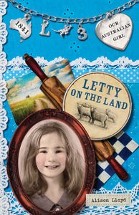
(Ages 9+). Recommended. Australian history. Letty accompanies the
baker's sister, Mary and her new born babe back to their farm. Many
days ride in a coach sees them being picked up by Mary's
husband Clem, and her taciturn son, Harry and taken back to the farm
another few days away. Through Letty we are shown what a
squatter's farm is like in early Australia, their distance from
civilisation, reliance on convict labour, and the scurge of the
unknown seasons. Letty is mistrusted by Clem and disliked openly by
Harry, and must work hard to gain their acceptance, especially after
making several mistakes upon arrival.
One of the quartet about Letty and her new life in Australia, after
coming out on the ship with her sister, Lavinia, in the series, Our
Australian Girl, this as with the others in this foursome, has a lot
going for it. Letty and the other characters are realistically drawn
and the background is firmly part of the setting, it never seems
imposed for the sake of the telling. Students reading of Letty's
life will learn a lot about the developing colony and the pepple who
came here risking much to start afresh.
Fran Knight
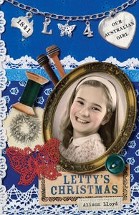
Letty's Christmas by Alison Lloyd
Ill. by Lucia Masciullo. Our Australian Girl (series).
Penguin, 2011, ISBN 978 0 14 330543 8
(Ages 9+). Recommended. Australian history. Again, Letty is working
on the Grey's farm, helping Mary with the housework and farm chores
and looking after the unlikeable Harry. But when the drought
continues, Clem and Abner must take the flock to Goulburn, where,
unable to be sold as they are, sell them cheaply and boiled down for
tallow. The two return, Clem breaking the news that they have
decided to go back to Sydney where they can stay with George and
find work. Letty and Abner no longer have work on their farm. The
group makes a forlorn trek across the Blue Mountains, the wool bales
loaded up onto a bullock wagon. The difficulties of the trip are
underscored with Harry's truculence and the worry of what lies
ahead. When Harry slides down the mountain, Letty follows him,
trying to save him.
When they get to Sydney, they find things no better there. A
depression has set in, with Lavinia losing her job as well, but not
to be down long, the girls find a way to use their skills to create
employment and all ends happily as the Greys, Abner, George and the
two girls share Christmas.
The books in this quartet of books within the Our Australian
Girl series are really impressive. The feeling of living in
1841 is very real, with the background never being imposed upon the
reader, but there all the time, adding much to the readers knowledge
and understanding of what life must have been like for our
forebears.
Fran Knight
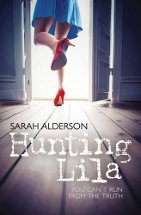
Hunting Lila by Sarah Alderson
Simon and Schuster, 2011. ISBN 9780857071958.
(Age 13+) A lighthearted thriller. Lila has a secret that she has
hidden from all eyes. She can move things just by looking at them.
When she manages to escape a mugging by using her power she knows
that she has leave before she is exposed. She runs back to
California, to the only people that she can trust, her brother and
his friend, Alex, whom she has been in love with forever. Jack and
Alex work for a secret organisation called The Unit, and are trying
to hunt down the men who had murdered her mother five years before.
As Lila tries to discover who killed her mother she uncovers secrets
that put her and those she loves in danger.
A quick read, I devoured this escapist book in one sitting. There
was plenty of action to keep me interested as Lila begins to unravel
the mystery surrounding the missions that Jack and Alex are going
undercover to do. It was necessary to suspend disbelief as the story
unfolded but the book was so fast paced that it was easy to do that.
Lila's big crush on Alex takes up quite a bit of the dialogue
because he has many swoon worthy characteristics: he is handsome,
strong, understanding, gorgeous, and girls will enjoy the romance as
well as the action. In fact he is so much more mature than
Lila, I was waiting for her to grow up so that he would even notice
her!
This is a book that allows the reader to relax and escape into a
world where you don't have to think too hard, just sit back and
enjoy the romance, humour and action.
Pat Pledger
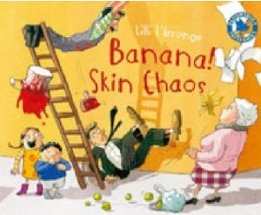
Banana skin chaos by Lilli L'Arronge
Bloomsbury, 2011. ISBN 978 1 4088 0939 6.
(Ages 5+) Recommended. Picture book. When a young boy throws
his banana skin onto the footpath in the town square, momentum
builds as one after another of passers by, people in the street and
workmen, are affected. Like the felling of a stack of dominoes
falling after the first is pushed, the pictures build up the story
with an expectation that is infectious. The readers know mayhem will
erupt and eagerly turn the page with expectation and delight.
Brimming with humour, a knockout in simplicity and subtlety, the
book will create opportunities to talk about consequences without
being obvious and sentimental.
The seemingly simple action of throwing the banana skin is shown on
the title page, introducing the reader to the initial action. Over
the page, Hubert is chided by his sister for doing this, and then
each following page outlines the series of consequences which result
from that simple action. The illustration of the consequences get
bigger and bigger on each page until it fills the whole double page
spread. Like a Where's Wally book, readers will love finding the
myriad of detail on each page, following the action which develops,
eventually affecting everyone in the town square.
A list of questions at the end may be a starting point for a class
discussion, or just a quiz amongst friends when they read the book,
but whatever it is used for, kids will have fun with this book, and
teachers may be able to use it when talking about consequences of
their behaviour.
Fran Knight