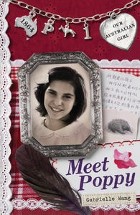
Ill. by Lucia Masciullo. Our Australian Girl series. Penguin, 2011. ISBN 978
0143305323.
(Ages 9+) Australian history. Recommended. Poppy, living in an
orphanage, a mission for children with an Aboriginal background,
happens upon a letter in the head sister's office. It says that her
brother Gus is about to be removed to another place, one where his
habit of wandering off can be curbed. Fearful, Poppy tells Gus and
he takes off that night. When the same woman then tells Poppy that
she is about to be adopted by a Christian family from Sydney, she
too, follows her brother, cutting off her hair and donning a boy's
clothes to cover her tracks. The time is 1864, and Poppy and Gus are
of Aboriginal and Chinese backgrounds, and both want to find their
parents.
A lively adventure, Poppy is the main character in a quartet of
books about this girl of Aboriginal and Chinese parents, finding her
way in the gold seeking world that is Victoria in 1864. This
character is one of the girls in the series,
Our Australian Girl,
giving modern readers a look at how girls lived in Australia's past,
an engaging addition to books which will support the new Australian
Curriculum with its emphasis on history. Much information is added
to the readers' knowledge of Australia's past through reading these
series.
Each of the books is about 100 pages long, with large clear print
and they are easy to read. The stories are gripping and characters
lively and likeable. Each book has information at the end of the
story underlining that given in the story, and has a teaser, the
first few pages of the book following this one, to get the readers
interested in the following book.
Fran Knight
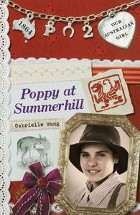
Poppy at Summerhill by Gabrielle Wang
Ill. by Lucia Masciullo. Our Australian Girl (series). Penguin,
2011. ISBN 978 0 14 330533 0.
(Ages: 9+) Australian history. After Poppy runs away from the
mission, she falls into life at Summerhill, a station where
Aboriginal stockman Tom, has a fair idea of just who she is in her
boy's disguise. He helps her as she catches her ankle in a dingo
trap and taking her back to the station, nurses her back to health,
all the while teaching her some of the bush crafts and lore of the
local Aboriginal people. At the station she is befriended by a young
girl of her own age, Noni, but her brother Joe is very suspicious
and bullying in his behaviour towards her. Poppy is a lively,
fascinating character, as are the others she meets in this story,
and although credulity is a little stretched and the incidents do
pile one on top of the other, it is eminently readable and will be
highly appealing to the middle primary audience it is aimed at.
This is the second in the quartet about Poppy, a girl living in the
gold rush era of Australia, with factual information at the end of
the book along with a teaser leading the readers to the next in the
series of four, part of the Our Australian Girl series.
Fran Knight
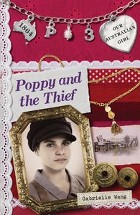
Poppy and the thief by Gabrielle Wang
Ill. by Lucia Masciullo. Our Australian Girl (series). Penguin,
2011. ISBN 978 0 14 330534 7.
(Ages: 9+) Australian history. Poppy hears about Jimmy Ah Kew from
the owner at Summerhill Station, when he spies her letter with his
seal. She leaves the place headed for Wahgunyah, the town where
Jimmy lives, again alone on the road, where many adventures befall
her. She shares a meal with a man she meets, and later finds he is
the notorious bushranger, Harry Power, and she finds a friend in
Jimmy Ah Kew, as well as a dog she calls Fisher.
The third in the quartet about Poppy, a gold rush era girl living
through the mid 1860's, a time of great change for Australia. The
perspective of an Aboriginal Chinese girl gives it a different point
of view of many other stories set in this time, and the facts given
at the end of the book will help students understand the times more
readily. As with the others in the Our Australian Girl series, there
is a teaser leading readers to the fourth book in this series within
a series.
Fran Knight
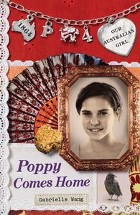
Poppy comes home by Gabrielle Wang
Ill. by Lucia Masciullo. Our Australian Girl (series). Penguin, 2011
ISBN 978 0 14 330535 4.
(Ages 9+) Australian history. In an ending which ties up all the
strands from the three before, Poppy comes home, sees our hero
finally reaching Beechworth, where she is working with a travelling
salesman and his crew, selling entertainment and then medicines to
the beguiled public. While performing she spies Blossom in the
crowd, but is distracted when the bushranger, Harry Power is brought
to justice. Talking to a man in the crowd, she finds he is the
bookshop owner who sensing her love of books, takes her on as his
assistant. She then introduces Blossom to the owner and she is
adopted by his family. Searching for her dog, Fisher, lately stolen
and sold by the professor from the travelling show, she comes across
some people who tell her that Gus is buried in the local cemetery.
But all is not lost, it is not Gus but another boy, and the family
is reunited.
An easy to read story, it gallops along with plenty of adventure,
coincidences and happenings for middles primary readers to enjoy.
Poppy is engaging, and readers will want to know that her family is
complete, while reading of this girl in the Our Australian Girl
series.
Again lots of information is given in the background of the story
adding to the readers' knowledge of Australia in the gold rush era,
and information is given at the end of the book, before two pages
showing the next two girls in the series, Nellie, 1849 and Alice,
1918.
Fran Knight
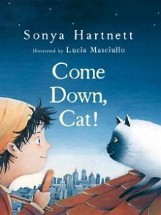
Come down, cat! by Sonya Hartnett
Ill. by Lucia Masciullo.
Penguin. Viking. 2011. ISBN978 0 670 07475 4.
(Ages: 3+) Recommended. Picture book. Just as the sun is setting,
and early evening draws near, Nicholas becomes concerned for his
cat. She is on the roof of their house, and refuses to come down for
the night. No matter what Nicholas says or does, the cat just says,
'Marl', and moves further back onto the roof. The cat, of course, is
mercurial and independent, a large white Siamese, with eyes that
shine on her owner. The 'Marl' which Hartnett puts into the cat's
mouth is just right, reminding generations of cat owners just how
their cat sounds. But Nicholas cannot sleep knowing his cat is still
on the roof and imagines all sorts of awful things happening to his
cat. He finally sleeps but is woken in the night by the sound of
rain. He leaps out of bed and climbs the tallest ladder to rescue
his cat, which this time is very willing to leap safely into
Nicholas' arms.
A charming story of bravery, the illustrations reflect the two main
characters beautifully. Nicholas is in his pyjamas, ready for bed,
he climbs the huge ladder, trying to get to the roof of this
enormous house to fetch down the cat.
The cat, so tiny for most of the book, cowers on the roof,but when
the rain falls her face fills the page with anguish until Nicholas
climbs up and she leaps happily into his arms. I love the
illustrations, from the Art Deco house, to the owls and bats flying
over in the night, to the wonderful sequence of illustrations
showing differing perspectives, that of the act on the roof, looking
down, or the boy looking up at the cat, or the owl's view of the cat
on the roof. All the different perspectives encourage the reader to
see things from another's points of view, not just to focus on the
boy and what he feels.The discussions about just who is the bravest
will keep many readers thinking for a long time after the book is
read.
Fran Knight
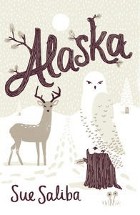
Alaska by Sue Saliba
Penguin, 2011. ISBN 9780143206118.
(Age 15+) From blurb:
mia's heart made a sound that no one heard
except for mia
late one night when she woke from dreams into darkness.
ethan was asleep beside her, and em was a forest away.
outside it was night and dark and alaska.
the sky was upside down.
Mia has left behind an alcoholic mother to live with her sister Em
in Alaska. Em had always been the older sister, the one who
protected her and helped her to survive their single parent family.
However when Mia arrives in Alaska, she finds that Em has new
priorities, her domineering husband, Terrence and baby Christian.
Beguiled by the beauty of the forest surrounding Em's house she
spends much time there and it is there that she meets a young
engineer, Ethan, who she feels she may love. But does she know what
love is?
Saliba's prose is lyrical and sparse. The omission of capital
letters for sentence beginnings and names was difficult for me at
first, but no doubt teens will have no problems with that! Once I
became used to that I found the writing wonderful. Indeed, the
forest almost became a magical entity for me. With a few words,
Saliba paints the glory of the forest landscape, the fascinating
deer and the horror that it all might be defaced by the pipeline
that a corporation wants to run through it.
Saliba delves deeply in the lives and motivations of Mia and
her sister Em. It is essentially a beautiful coming of age story as
Mia comes to grips with the fact that her sister has grown away from
her and that she too has responsibilities and challenges to face on
her own. Ethan is a shadowy character and little is known about
other secondary characters, leaving the readers to come to their own
conclusions about them. This leads to a surprising conclusion.
Older readers will find much to think about in this book. The themes
of coming of age, of responsibility, of compromise, and of
protecting the environment will linger for a long time in the minds
of thoughtful teens.
Pat Pledger
The corpse walker and other true stories of life in China by Liao Yiwu
Text, 2011. ISBN 9781921656514.
(Age: Senior school) Recommended. Liao Yiwu is a Chinese writer and
performer who was imprisoned for his poem Massacre, written
and performed in response to the suppression of the Tienanamen
Square student protests. In this collection of twenty-seven
interviews translated by Wen Huang, Liao presents a view of a
complex and multi-layered society, in which threads from the past
inform the present. Some of the interviewees, the Human Trafficker
and the Corpse Walker, were chosen because of their connections with
traditional life while others, the Rightist and the Former Red
Guard, because their lives epitomize the experiences of many during
the cataclysmic events of the last century. The Corpse Walker
describes the traditional practice of 'walking', by carrying on
one's back, a corpse back to its home and family. Corpse walking
becomes a metaphor for the burden of history carried by many of the
interviewees in this collection. Chairman Mao is a dominant figure
in the stories of these ordinary people's lives.The deprivations
suffered during the Great Leap Forward, the Cultural Revolution and
the Tienanmen Square massacre are described in a number of
interviews, The Rightist, The Former Landowner and The
Yi district Chief's Wife for example. The hunger, the loss of
family members, the destruction of personal dignity, and the waste
of years spent in unproductive activity are clearly revealed, as is
the stoical bewilderment caused by living in a society where the
political values were unpredictable. What is also clear is the
extent to which traditional life and values exist; the family is
important, and above all, a robust sense of humour that helps ensure
and sweeten survival. This collection is recommended for any reader
interested in China, and in the great events of the twentieth
century in Asia.
Jenny Hamilton
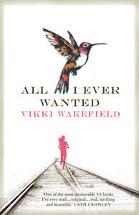
All I ever wanted by Vikki Wakefield
Text, 2011. ISBN 9781921758300.
(Age 15+) Highly recommended. Mim has a set of rules that she is
determined to live by. The first is not to be like her mother. She
lives in a down trodden suburb, her mother sits on the sofa all day
and her two brother are in prison for drug dealing. She longs to get
away from her life and see the world, but she is stuck even though
she is determined to finish school and do something. When she
retrieves a package for her mother and Jordan, the boy she has had a
crush on forever, takes it away from her, she is faced with lots of
questions and danger. How will she be able to solve her problems?
This is a compulsive read on many levels.& Wakefield has kept
the suspense quite tense for the reader as Mim struggles to get back
the package her mother sent her to obtain. There are the sinister
people who are involved with drug dealing and this thriller like
thread makes for an excellent story. But it is the interactions that
Mim has with the many characters in the street that flesh out this
story and make it stand above many other adolescent books. Tahnee,
her best friend for many years, is changing. She has discovered boys
and booze and Mim is not sure that the friendship can last. There is
a strange girl next door and she hates the elderly neighbour nearby.
Jordan, who she has worshipped from afar for years, may not be the
hero that she always thought and will the monster dog Gargoyle
attack her?
Mim makes many discoveries on the way about herself, her perceptions
of others and whether she can manage to live by a set of rigid
rules.
An ideal class set or literature circle book, one that would appeal
to reluctant readers, especially girls, All I ever wanted is sure to
become popular if promoted in the library. Vikki Wakefield has been
interviewed by Readings
and teacher
notes are available at the Text website.
Pat Pledger
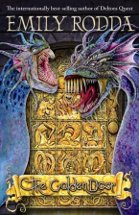
The golden door by Emily Rodda
Omnibus, 2011. ISBN 978 1 86291 912 9.
(Ages 10+) Warmly recommended. Fantasy. With the skimmers attacking
every night, getting through the heavily guarded and blocked doors
and crevices of the homes in the Weld, actually killing one family,
the Warden finally acts. A proclamation stirs the passion of Dirk
and Sholto and their friends, intent on being able to get outside of
the wall and find the source of the skimmers, so destroying them. In
so doing they will win the hand of the Warden's daughter, and be
named his heir.
In a very few chapters, Emily Rodda introduces her new world, a
world once safe behind its wall, where a myriad of rules keep people
comforted and secure, but when a few of the younger generation find
things too safe, the restrictions too cloying, and with the
opportunity provided by this recent threat, they go searching for
action. First Dirk and Sholto go off in search of the reason behind
the skimmer attacks, and fail to return, their mother receiving a
badge to wear showing that her sons have died in the line of duty.
But when the skimmers destroy their home and livelihood, Rye and his
mother must seek shelter at the Keep. Here they are separated and
Rye seizes the opportunity to also go beyond the Wall.
A fantasy series full of adventure and colour, Rye's journey into
the Fell Zone outside the Wall takes him far further than he could
have imagined. I love this new series and am looking forward to book
2, as I am sure all readers will.
Fran Knight
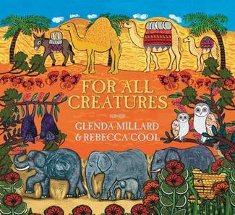
For all creatures by Glenda Millard and Rebecca Cool, illustrator
Walker Books. 2011. ISBN 978 921520 81 8
(All ages) Recommended. Picture book. The array of creatures on the
front cover impels the reader to quickly open this book to read what
is going on. The title, reminding us of the hymn, All creatures
great and small, too evokes many different memories and hints as we
turn the page. Each page gives us a stanza with four lines of
phrases, each phrase containing a group of words which describes a
set of animals. But the descriptions are not those usually found,
they are words which evoke a response from the reader, memories and
observations, rounded off by the refrain, We are thankful. Frogs,
for example, are described as a chorus of croakers, and this
evocative phrase made me immediately think of times listening to
frogs along a riverbank or pond. The words used are amazing, and
Millard does not baulk at using words which will send both reader
and teacher to the dictionary.
Each page is illustrated with animals and plants, surrounding the
words in a visually stunning way, enticing the reader to look both
at the words so framed and the illustrations complementing the
words.
The colourful pages offer a dense series of richly detailed pictures
for readers to look at over and over again. Their warmth and naiive
quality will have immediate appeal to all readers, and are a
stunning companion to the text.
Readers who enjoyed Isabella's garden by the same two will love this
prayer to thankfullness for all we have around us. A wonder filled
contribution to the array of animal picture books, this is a stand
out.
Fran Knight
Once upon a time: A pop-in-the-slot storybook by Nick Sharratt
Walker Books, 2011 (c 2002). ISBN 9781406331929.
(Age 2-5) In this imaginative and slightly irreverent take on the
traditional fairy tale where the princess makes three wishes, Nick
Sharratt has produced a fun picture book that young children will
love. It is different to the usual pop up book, in that it is a pop
in the slot book, which allows young children to choose their own
picture to complete the story, often with hilarious results. Imagine
the results when the beautiful princess has the choice of a duck,
toilet or fairy to grant her the three wishes. And what if the
wishes were a pencil case, marrying a frog or being a pop star?
The illustrations are in bright colours and the princess is cartoon
like with a range of amusing expressions. The pop in the slot idea
gives active children the opportunity to be fully involved in making
the pictures and story come alive. The pictures that go into the
slots are on sheets in a pocket in the front of the book and will
need to be carefully pressed out and perhaps put into a plastic bag
to keep them together once they are out of their sheets.
Providing lots of funny alternatives, as well as pictures for the
traditional story, this will provide children with different things
to giggle about each time they look at the book. It will appeal to
both girls and boys as there are things like a magic toilet that
will interest boys and a fairy to interest girls.
I think that this could be an amusing choice for a gift to young
children, especially if you would like a different storyline each
time it is read.
Pat Pledger
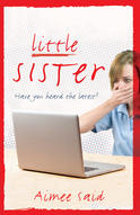
Little sister by Aimee Said
Walker Books, 2011. ISBN: 9781921529214.
(Age 14+) Highly recommended. There are just thirty-eight days until
Al's smart, pretty, popular and perfect-in-every-way sister Larrie
finishes Year 12. Thirty-eight days until everyone at Whitlam High
will stop seeing Al as Larrie's little sister and start appreciating
the real Al Miller. But when rumours about Larrie start spreading,
Al discovers that having a sister everybody is talking about is
worse than having one everyone loves.
A very real-to-life story explaining how a sibling can react to a
big secret. When I was reading this book I truly felt in the story.
Al thought she was the one going through the hard time when really
her sister was going through a harder one. Al has always been
outshone by her sister and expected to do just as well as her if not
better. Al hates always being outshone by her sister and can't wait
until her sister graduates so that she can be herself. But things
are never that easy.
A great book for anyone going through a hard time or just wanting to
sit down and read a book over and over again.
Taylor Oxenham (Student)
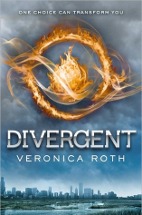
Divergent by Veronica Roth
HarperCollins, 2011. ISBN 9780007420414.
(Age 14+) Highly recommended. This is one dystopian story that I had
to finish in a day and that hasn't happened to me for quite a while.
Reminiscent of The hunger games by Suzanne Collins;
Divergent is the engrossing story of Beatrice (Tris for short) who
has to choose what faction she will live in when she turns 16. The
factions are Abnegation (selflessness), Candor (honesty), Amity
(kindness), Dauntless (bravery) and Erudite (knowledge seeking).
Each faction has placed enormous value on their own particular trait
and members live their lives completely involved in it, believing
that it keeps their world peaceful. Once a faction is chosen then
that person must abide by its way of life or become displaced with
no support and no group to belong to. When Tris makes her choice she
has no idea of what she has let herself in for or that there are
evil plans afoot to take power.
Tris is a fascinating main character. She is short, not pretty and
finds it very difficult to live the selfless life that is expected
of her in her Abnegation society. She is curious, wants to know what
is going on and yearns for something more than always looking after
others. When she is tested to see what faction she belongs to her
tests are inconclusive and she is told that she is a Divergent - a
person who has more than one trait - but her tester tells her to
keep it a secret as it is dangerous.
There is action galore as Tris is pushed to her limit both
physically and mentally in her training in her new faction. Many
exciting moments had me holding my breath as Tris struggles to learn
how to control both her mind and body and her growing attraction to
Four, her trainer. She makes friends, one of who will betray her
badly and uncovers a plot that could change her whole world. There
is violence, murder, a near rape and bloodshed to content with.
I have read a lot of novels with dystopian themes and this is up
there with the most engrossing. It wasn't difficult to place the
factions into today's society - scientists being Erudite, the risk
takers as the Dauntless and people like doctors and teachers who are
often selfless as belonging to Abnegation. It had me thinking the
roles that they play and what sort of society we would live in if,
as in Tris' world, those selfless from Abnegation were the only ones
allowed in government. But of course in any world there are the
power seekers, the greedy and the selfish.
Nominated for ALA's
Best Fiction for Teens award, this novel has every ingredient
to make it very popular with both girls and boys. Tris and Four and
secondary characters grab the reader's interest immediately, the
theme of survival of the fittest is gripping and the world making is
original.
Pat Pledger
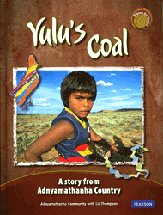
Yulu's coal : a story from Adnyamathanha country by the Adnyamathanha community with Liz Thompson
Sharing our stories (series). Pearson Australia, 2011. ISBN
978 1 4425 4690 5.
(Ages 8+) Recommended. Aboriginal folklore. Yulu's coal, a story of
how the coal came to be at Leigh Creek in South Australia's far
north, is a story told over and over again by members of the
Adnyamathanha community in explaining their heritage to their
children.
The story tells of a ceremony at Wilpena Pound in the Flinders
Ranges, where all the community was waiting for Yulu the Kingfisher
Man to begin the ceremony. When he failed to appear, Wala the Wild
Turkey Man was asked instead. But Yulu did not think that Wala could
do this and lit a fire letting people know he was on his way.But two
serpents also saw the smoke signals and came down to where Copley is
today, curling around themselves forming the mountains now seen
there. Arriving at the ceremony ground, the serpents made a lot of
dust, and then ate many of the people, becoming so ill they needed
to rest, and so formed Wilpena Pound. Yulu and Wala then formed the
ochre pits near Copley and the coal now found at Leigh Creek.
The story itself tells people how the Flinders Ranges came to be and
tells much about sites found in the mountains, Copley, Chamber's
Gorge, Leigh Creek, Wilpena Pound, as well as giving much of the
cultural detail about the Adnyamathnha people. It is a
marvellous story, and is told by Noel Wilton, and illustrated by
children from Leigh Creek Area School. At the end of the book the
story is told in Adnyamathanha language and details are given about
the elders and the children in this community. I appreciated the
double page spread at the beginning introducing the Adnyamthanha
community, detailing just where the people live, and the brief but
very useful index.
All of the books in this series are similar, taking a story from one
of the Aboriginal groups in Australia, having an elder tell the
story, with children illustrating it, then adding much information
about the community, the elders and the children. Bright, inviting
illustrations round off a visually exciting range of books, sure to
add much to the teaching of Aboriginal Dreaming stories in the
classroom. But much more can be edduced from reading this with a
class. The elders' stories give an insight into our shared history
and what has happened to many Aboriginal people in the past, making
these books an ideal springboard for class discussions not only
about Dreaming stories but also the Stolen generation,
Reconciliation and the Apology. For more about this fine series, go
to this website.
Fran Knight
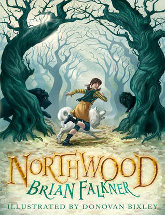
Northwood by Brian Falkner
Walker, 2011. ISBN: 978 1 921529 80 1.
Recommended for ages 9 and up. Nothing about Cecilia Undergarment's
life is ordinary. In addition to her most unusual name, she lives
with her parents in a six storey house, which looks like a bunch of
balloons, and is able to speak to and understand animals and vice
versa. When she and their maid rescue (or kidnap) Rocky, the dog
owned by Mr. Proctor from next door, she becomes involved in a major
adventure. Her attic room detaches itself from the rest of the house
and drifts off in the direction of the forests of Northwood. Once
the balloon comes to rest in the top of a tree, she and Rocky
disembark and investigate the forest. They meet the other
inhabitants of the area and attempt to rescue those who live there
and take them back to her home. Not everything goes quite according
to plan, however, and she meets with some resistance.
This title, although containing many everyday events and needs,
crosses into the realms of almost parallel universes or fantasy
worlds. Cecilia is a champion for the 'underdog' (no pun intended!)
as she tries to support the inhabitants of the forest, particularly
those who have not known any other life. She displays independence,
compassion, persistence and resourcefulness as she fights for that
in which she believes. Although she knows life is sometimes less
than perfect, she endeavours to make things better for all whom she
meets. Young children will undoubtedly enjoy reading about a girl of
their own age, able to outsmart the 'unsavoury' adults in the tale,
and be swept up in this adventure. Short chapters, double spaced
print and full page illustrations liberally scattered throughout
make this an easily accessible tale for younger, more competent
readers through to the older children who are looking for an easy
read.
Jo Schenkel