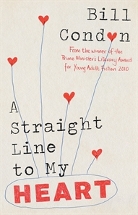
Allen and Unwin, 2011. ISBN 978 174237 730 8
(Ages 12+) Highly Recommended. Humour. Romance. I did not want to
leave this book or its characters.
Tiff has finished school, and is doing some work experience at the
local country newspaper, where she feels she is not up to the job.
The old journalist called the Shark, her supervisor is difficult,
evasive, sometimes disparaging and often distant, and she wonders
whether she will even finish the week.
She lives with her mother's sister's old friend, Reggie, and his
son, Bull, and this pair has been her family since her mother died.
Her best friend, Kayla lives with her mum and two of her siblings,
the other two being in care. Mum has just announced that she and her
new boyfriend, Colin, a much younger man, are about to marry and
move to Perth, taking Kayla with them. Tiff is distraught, she and
Kayla have been friends since time began and neither can imagine
life without the other. In the meantime, Tiff has met Davey a boy
from the next town, who is a stop and go worker with the council.
The lives of these people matter to the reader as they cope with the
stresses and strains of life. Bull has a new girlfriend and Tiff
wonders what will happen to the family if she moves in: Reggie is
ill, and Tiff is concerned about what will happen if his test
results are not good: while keeping her head above water in the
tense atmosphere of a newspaper room makes Tiff wonder about what
she will do with her life. All of these conspire to make this a
keenly felt and funny story about a very ordinary group of people,
coping with the life given them. At a time of immense changes in her
life, Tiff must work out what is important as well as who matters,
This book is a breath of fresh air. It is a story grounded in the
realities of life in Australia today, with none of the contrived
situations usually offered, and with a deft touch of humour that
underlines the relationships between all members of the different
families. It speaks of not giving up, of trying again, of not being
restricted by mistakes made in the past, it celebrates the family
and friendships, of change and permanence, a wholly satisfying read.
Fran Knight
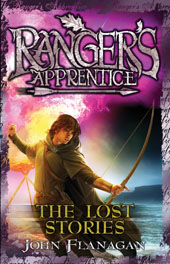
The Lost Stories by John Flanagan
Ranger's Apprentice Book 11. Random House, 2011. ISBN: 978 1 86471
818 8.
Highly recommended for ages 10+. During the opening pages in which a
team of archaeologists are excavating Castle Redmont, Audrey, one of
the team, stumbles upon the remains of a Ranger's hut. Amongst the
artifacts, she and the Professor find a bundle of manuscripts which
tell The Lost Stories of Araluen. Amongst these tales, Will
learns the full story of his heritage and the events leading to his
becoming an orphan, stories behind the battles, the breeding program
of the Ranger ponies and major celebrations and events such as
weddings are described in far greater detail.
After initially having to be cajoled by students and my son into
reading the first book of the series, I have become a major devotee
of Flanagan's work. The language used does not suit the times in
which the series is set, yet this just serves to make the book more
accessible to younger readers. Each book is engaging, easy to read,
filled with adventure but at the same time balanced by the
relationships between the characters and their personal growth and
development. Although it is predominantly boys who read these books,
the series has a great deal to offer the female reader as well.
Whilst I can see the purpose of the introduction to this story, I am
not sure that it necessarily fits with the rest of the book.
Likewise, the introduction to the new series in a similar manner
seems a tad contrived. That aside, I still enjoyed the stories
immensely and look forward to the second Brotherband title.
Jo Schenkel
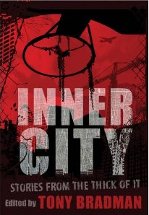
Inner city : stories from the thick of it, edited by Tony Bradman
Bloomsbury, 2011. ISBN 978 1 4081 1377 6.
(Ages 11+) Recommended. Realism. Short stories. Six short stories
about life in the city are included in this volume, telling of life
for a variety of young people living in a variety of different
places. In his introduction, Bradman says that all cities are not
vice ridden, full of drugs and thieves, but are filled with people
of all makes and sizes, bad and good, rich and poor, and many may be
living next door to each other. In the first story, A thousand
acres of sky by Joanna Nadin, Luca and Manny are going to live
with their grandmother in her London flat, after their mother has
died. They live in Cornwall and both children are worried about
moving to the city where they cannot take their pet chicken, or have
their own bedroom, or talk to their friends. Luca particularly will
miss her thousand acres of sky that she can see each day, but finds
it in the city in an unexpected way. A story of fitting in and of
change.
The second story, It's all right I have a list that helps to
make everything clear and it's real easy to follow by Ian Beck
cleverly allows us into the thoughts of a young boy going home from
school. Mum's list is simple, leave school, Walk to the station, Get
on the train, and so on, but getting to this point each time is
fraught and sometimes dangerous. The reader can see that Robbie is
different and empathise with him as her performs his tasks, ticking
them off on his list as he goes. It is a great story for getting
inside the head of another person and seeing what seems a simple
task from another perspective. Truant by T. M. Alexander, too gives us a story of life as a
truant, on the edge of going to another place entirely as he becomes
involved in things beyond his understanding. Life at school is dull
until a new drama teacher takes an interest in him and encourages
him to join the drama club. A brush with the police is enough for
him to reject his old friend and stay at school. This is a
fascinating story showing what can happen to young boys living in
proximity to illegal activities. All in all a stunning collection
for use in the classroom or just to read.
Fran Knight
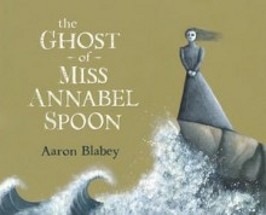
The ghost of Miss Annabel Spoon by Aaron Blabey
Penguin/Viking, 2011. ISBN 978 0 670 7474 7.
(Ages 7+) Highly recommended. Picture book. From start to finish I
was entranced with Miss Annabel Spoon and her dilemma, as she
spooked the people in her town, hopping into bed with the children,
starring into windows, and generally scaring people until they all
felt they were doomed. That is, until young Herbert Kettle happened
along, offering to solve their problem.
The glowing illustrations, reflecting stark hues of greens and
browns, yet shimmering in their appearance, are full of fun, as the
hapless Herbert prepares to battle with the ghost. The beautiful
rhyming stanzas, easily read, and inviting the listener to predict
the next words, are full of words that extend their vocabulary,
drawing them into the love of words and their meanings. The crisp
illustrations, using pen and pencil on watercolour paper, and
acrylic paint, are a visual treat. I love the looks on the faces of
the populace and Miss Spoon's hair is a focus point for me through
the book. The contrast between the gloom of the opening page and
that of the last double page spread is wonderful, and the little
groups of people again are beautifully contrasted.
As Herbert plucks up his courage and finds the ghost's house in the
woods, he enters the building only to find her in tears. A simple
reason for her ghostings is offered and a neat solution to the
problem is found. The resolution to the story is warm and agreeable
to all; her problems and those of the townspeople are solved.
This innovative author/illustrator has won awards for his other
books, Pearl Barley and Charlie Parsley, Sunday Chutney
and Stanley Paste, and this will be no exception. It is
perched on my favourites shelf for all to see and for me to read
again and again.
Fran Knight
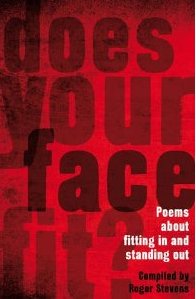
Does your face fit? compiled by Roger Stevens
A and C Black, 2011. ISBN 978 1 4081 4950 8.
Recommended. Poetry. Humour. Subtitled Poems about fitting in and
standing out, this small book of poems had me laughing out loud and
breathing a knowing sigh at the situations offered. Performance
poet, Stevens, has collected poems from kids he has worked with,
disadvantaged and overlooked in the main, but able to put words
together to form a cohesive moment. Fitting in, isolation, feeling
left out and overlooked are just some of the themes explored in this
series of poems. Who could not feel some affinity with
Feelings?
Feelings?
I don't talk about them.
I write down how I am feeling
In my Feelings Diary.
That helps.
And when I'm fine
I don't write a line.
My diary's almost full.
Bernard Young
It will make people laugh but also stop and think as do many of the
themes in this collection.
Most of the poems are short and all are easily read and digested. In
a classroom, they would all work well, being read out loud and then
used as models for the student's own writing. A website is given to follow
up more poems and what Stevens is doing. It is a busy website full
of interest about Stevens and what he is doing with students and
their poetry. It is a website where child poets can publish their
work, enter competitions and access other works. It is worth
visiting with your class.
Fran Knight
Indonesia by Carmel Reilly
This Country series. Pearson Australia, 2011. ISBN: 9781442546974.
32 page, hardcover.
This colourful non-fiction title provides a general overview of
location, history and modern life in Indonesia. The table of
contents includes the headings Environment, In the past, Government,
People, Day to day life, Unique relationship as well as including a
timeline of events, glossary, index and the URL of a website which
can be visited to seek further information. There are full page
colour photographs in each section, along with solid blocks of
information, interspersed with additional smaller photographs,
captioned maps, diagrams and fact boxes. Topics begin with
introductory paragraphs presented in bold type as well as bold
paragraph headings highlighting general subjects and the names of
the islands which make up Indonesia.
The information presented in this title contains names and events
which are likely to be familiar to young children as they are still
mentioned in the media. Amongst these are the Bali bombings and the
infamous Schapelle Corby. Although, at first glance, the text
appeared to have been too densely presented, closer investigation
reveals that, with only a paragraph or two under each heading, it is
well suited to students in both upper primary and early secondary
years. This text would be an asset to schools offering Indonesian as
their LOTE subject.
Jo Schenkel
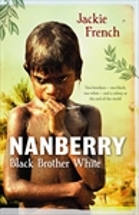
Nanberry: Black Brother White by Jackie French
Angus and Robertson, 2011. ISBN: 978 0 7322 9022 1.
Highly recommended. From a blissful childhood, where food is
plentiful and family life happy and filled with ease, Nanberry's
life changes with the arrival of 'ghost canoes' and white people.
With them come white people's diseases, to which the aboriginal
communities have no immunity and the young boy sees his immediate
family struck down with smallpox. When the Governor and Surgeon
White go to investigate the deaths, Nanberry is discovered and taken
to the hospital where he is cared for and fed. As the child is
returned to health, and shows an aptitude to quickly learn English
words and ways, the Surgeon decides to adopt him. He takes the boy
home where his maid is expected to care for both Nanberry and the
o'possum which the Doctor has also found. This is the beginning of a
strange little family, which grows and changes over time, and the
life of each of the characters as they straddle the boundaries
between the worlds of the aboriginals, convicts and the English free
settlers.
French is a prolific author, whose novels are not only easily
devoured but quality literature, often challenging the reader to
think more deeply on her chosen topics. This title is no exception.
The killings of the aboriginal people, the relationships between
Masters and servants, English and aboriginals, the inhumane
treatment of the convicts onboard the ships to Australia and the
treatment (or mistreatment) of the land are amongst the topics
covered without being sanitised. Themes of family, loyalty, honour
and the value of hard work are all included, with the title being
based on the concept of belonging. Nanberry reflects on changes he
notes in himself as he muses, 'Black brother. White father.' Based
on actual characters of the time, one can well believe this dilemma
of being 'stranded between two cultures and at times earning
contempt from both' (author's notes) as being true not only of
Bennelong but also of Nanberry.
This title would work well as a comparative text for secondary
students, alongside Geraldine Brooks' Caleb's Crossing.
Jo Schenkel
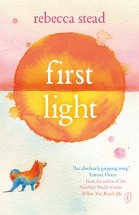
First light by Rebecca Stead
Text, 2011. ISBN 9781921758256.
(Age: 10+) Highly recommended. This novel follows two separate
narratives which eventually join together to form one story. First
there is Peter, a young boy whose father is a university professor
and travels a lot to search out solutions to global warming. He
decides to take Peter, a university friend, and Peter's mother on a
trip to the North Pole for some research. Peter has also been having
very bad migraines and strange visions, visions that lead him to a
world hidden in the ice.
The second narrative is about Thea, a girl not much older than
Peter. She lives in a lost civilisation hidden deep in the ice of
the North Pole, and she has never seen the sky. She hopes to lead
her people to freedom above the ice, but is quickly repressed by her
grandmother. This leads her to search for the reason they can't go
above the ice, and in turn this reveals the truth about her mother's
death. First Light is the sort of book that is very hard to put
down. Once the story gets going, the reader is drawn into a
fantastic world of magic, mystery, and the allure of the icy north.
It's obvious this book was written for younger readers, but for the
older ones, this will still be a treat. This book relies, not on
sheer emotion or heart-stopping action scenes, but on the simple
pleasure of a very well told story. The plot is original and
refreshing and the characters are very realistic. The writing style
will probably feel a little simple to the older readers.
One of the main reasons this story works so well is because of the
setting. The allure of the north is in its mystery and by using this
effect so much; the setting has become one of the main characters.
The way it is mentioned makes the north feel alive, and the
creativity used in the construction of Gracehope (Thea's hidden
village) is wonderful. First Light is a very well written story that most people
will enjoy, but particularly young readers. This is a solid,
enjoyable book that is sure to make you smile.
I highly recommend this book.
Rebecca Adams
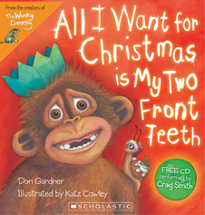
All I want for Christmas is my two front teeth by Don Gardner
Ill. by Katz Cowley, sung by Craig Smith. Scholastic Australia. 2011
ISBN 978 1 74169 784 1.
(Ages 3-6) Picture book. Humour. Christmas. The old song is given a
new face with this attractive picture book, released for the
Christmas market, having a monkey as the main character, bemoaning
the fact that his two front teeth have gone missing. He has no idea
where they are, and tells the other animals, eventually lining up
with the throng waiting to see Santa with their requests. He tells
us how incomplete he is without his front teeth, unable to say Merry
Christmas, or Sister Susie sitting on a thistle, or to whistle. Each
page has delightful illustrations, sure to please any reader as well
as the person who reads it aloud. Each page will encourage
discussion amongst the smallest of the listeners about their teeth
and why they are important, and incidentally what they want for
Christmas!
A companion CD will initiate a great deal of fun in the classroom
and at home or the local library when the children sing along.
Fran Knight
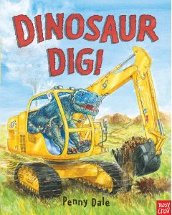
Dinosaur dig! by Penny Dale
Noisy Crow, 2011. ISBN 978 0 85763 006 3.
(Ages 6-8) Picture book. A different counting book with 10 dinosaurs
digging a hole, with 10 different pieces of machinery is presented
in this vibrant picture book. On each double page is a dinosaur and
a piece of machinery doing something which requires lots of words to
describe their actions. As each page turns, another dinosaur and
piece of machinery appears, adding up to 10. The repetitive nature
of each page makes it a shoe-in for kids joining in and predicting
what will happen next. Each page also has a series of wonderful
doing words which kids will be able to emulate and use to make
appropriate noises.
Altogether a great sharing book for a group of kids and an adult
reader. The endpapers cover each of the dinosaurs used in the book,
with their correct names and realistic drawings, while the other end
features the machinery with again the correct names and realistic
drawings. Kids will learn the correct names for both dinosaurs and
machinery from this picture book.
The climax to the story will have kids laugh out loud at the
dinosaurs and what they intend to do with the hole that they have
dug. An odd combination of things, but kids will lap it up.
Fran Knight
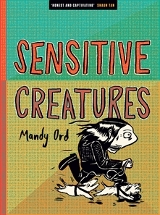
Sensitive Creatures by Mandy Ord
Allen and Unwin, 2011. ISBN 978 1 74237 216 7.
Suitable for upper secondary students and adults. At first glance
this collection of 39 short, black ink comics featuring Mandy Ord's
trademark 'one eyed girl' seems to belong in the company of those
slightly offbeat street and graffiti art books. However the
'sensitive creatures' that inhabit the stories, finding ways to live
conscientiously in a sometimes challenging urban environment,
deserve a wider readership. Mostly autobiographical, Mandy's
challenges range from finding ways to deal with aggressive thugs on
public transport and engaging disinterested students in art classes
to agonising over having almost driven her car into a pedestrian.
Simply linked with frames showing the artist struggling to find a
new idea for a story, this collection reminds us that to live with
integrity and care about the people we interact with every day is
not always easy. Orr lives and works in Melbourne so the urban
landscape has a familiar feel, one of my favourite parts is her
comment, on visiting her sister in Brussels and observing the
differences, 'I can't ever imagine there being a hard rubbish in
Brussels' p.130. Art and media students will find her comic style
interesting and accessible.
Sue Speck
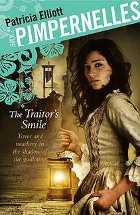
The traitor's smile by Patricia Elliott
Pimpernelles. Book 2. Hodder Children's Books, ISBN
978-0-340-95677-9.
Pimpernelles: The traitor's smile is a fantastic book which will keep
your curiosity kindled and make it very hard to put this book down.
Pimpernelles is a series of two books that are set in England and
France back in the revolution. The main characters are Eugenie, a
beautiful French aristocrat who is fleeing the horrid revolution
with her quiet and handsome French companion, Julien. Hetta,
Eugenie's English cousin who is such a tomboy, believes that the
revolution in France is fantastic as she dreams about one day being
involved in it.
As Eugenie and Julien appear in England, Julien not speaking fluent
English, things start to become intense between Hetta and Julien
when she offers to teach him the English language. Suddenly
everything changes when Guy Deschamps appears in Deal, the small
coastal town in which this book is staged. Guy had been close
friends with Armand, Eugenie's brother who is being held in a prison
awaiting trial by the guillotine due to acts against the republic.
Eugenie is astounded that something might be going between Guy and
Julien.
A truly spectacular story of: loss and love, revolution and
hardship. This book would be more appropriate/ suited to the age 15
and upwards.
Sarah Filkin (Student)
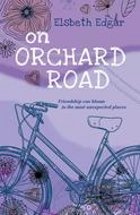
On Orchard Road by Elspeth Edgar
Walker Books, 2011. ISBN 978 1 921720 29 1.
(Ages 10+) Recommended. A gentle story of finding friends in unexpected
places, Jane moves to a country town where she knows no-one. A new
school, a smaller house, her mother and new baby sister are still in
Melbourne, where the baby is in intensive care. Jane is sullen and
sometimes uncooperative, but then immediately contrite. An incident on
her first day at school puts her off side with a group of the boys, who
when seeing her on her bike on the weekend threaten her causing her to
fall off and injure herself. She is helped by another boy from school,
Michael, and when a woman comes out of the strange dilapidated house
nearby to help, Jane feels the tension between her and the others. But
taken inside, she soon comes to see that this woman is a recluse,
picked on by the same group of boys, and very much alone.
Beautifully written, full of wonderful descriptions, this story will
win the readership of many young girls, particularly, in middle school.
The change in Jane's life is one felt by all as she must cope with not
only living with just her father as he begins his new job, but also
find new friends in a new school, and work out where she belongs. All
the time the separation of the girl and her mother is felt keenly and
the health of her baby sister hangs over them all.
The relationships between Jane and her parents and new sibling are
exquisitely told, bringing another layer of reality to the story
already overflowing with verisimilitude.
But the old woman draws her back and Jane's life becomes entwined with
hers as she learns more about her and her past while they share their
innermost thoughts, their writings and drawings. Teamed with Michael at
school, they and two others conduct a presentation about the old woman
and her garden, showing some of the drawings Jane has done and giving
life to the old garden. A lovely story of coming together, of finding
new friends, of getting along with those outside your own experience,
this story will remind many of the anxiety felt when trying to fit in.
Fran Knight
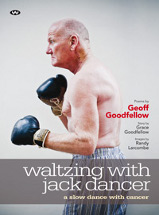
Waltzing with Jack Dancer: a slow dance with cancer by Geoff Goodfellow
Wakefield Press, 2011. ISBN: 9781862549593.
(Age 16 +) Recommended. Geoff Goodfellow is a well known South
Australian whose poetry has been studied at Senior School level for
many years. In 2008 he was diagnosed with throat cancer and in this
collection of poems he documents with humour and candour the harsh
realities of cancer and treatment. The poems work best as a
collective narrative rather than as individual poems as Geoff takes
readers on his journey through misdiagnosis, unsympathetic medical
staff and the awfulness of the treatment and its side effects.
His teenage daughter Grace also contributes to the book with a
moving prose piece that documents the effects of the cancer journey
on family members and the anguish she feels watching her strong
father battle such a formidable enemy.
Be aware there is some very strong language so it is recommended
that your copy is reserved for senior students. Teachers can contact
Geoff Goodfellow for school visits through his website. Highly
recommended to anyone who has been a cancer patient and family or
friends who have cared for someone with cancer.
Chris Lloyd
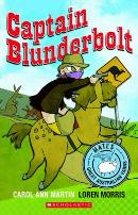
Captain Blunderbolt by Carol Ann Martin
Ill. by Loren Morris. Mates (series). Scholastic. 2011. ISBN 978 1
86291 823 8.
(Ages 6+) Recommended. Life on the goldfields is tough for Alberta,
Maudie and Tully Flannigan. Their parents work hard to get money for
the family to live, but the school lessons cost threepence a week
which they can barely afford. Father goes off to try and find work,
but often gets lost coming home. The children would prefer to wag
school, and in so doing one day, climb upon a mound of rocks near
the town and find it is the hide out for the notorious captain
Blunderbolt, the local bushranger. There they watch his antics, and
Tully, knowing that their father has gone off again in search of
work, comes to the conclusion that the bushranger, an inept rider
and thief, is their father. When the police set a trap for the
robber, things escalate and Blunderbolt escapes, but not before Alberta
works out who he really is.
A fun little story in this great range of books, Captain Blunderbolt
will be enjoyed by the early chapter book readers, looking for a
humourous tale to read. Lots of pictures reflect the action, adding
to the overall picture of what it was like to live on the gold
fields in the nineteenth century. Some words, as in the others in
this fine series, are highlighted, adding variety and interest to
the text. Short chapters ensure readers will follow what is
happening, and the whole package is inviting. A list at the end of
the book outlines the others in this series, which will be eagerly
sought out in the school library and bookshop shelves.
Fran Knight