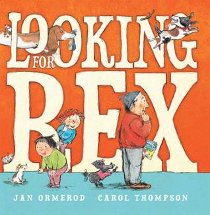
Ill. by Carol Thompson. Little Hare, 2012. ISBN 1921541482.
(Ages 5+) Highly recommended. Picture book. Animals. An absolutely
delightful story of getting a pet for Grandpa, this tale will trip
the hearts of those who read it and take in the glorious
illustrations. Grandpa's wife has died and the family is worried
that he is lonely, so the children decide that a dog would be a good
companion. The first few pages show him sitting alone in his house,
filling his time with TV, gardening, looking at the birds and just
sitting. The illustrations fill the pages with bright cheery
pictures of his family and the lonely old man sitting, lying or
walking by himself.
He initially rejects the idea, but as time goes on the idea of Rex
looms large, as he sees many dogs in his neighbourhood, in the
street, when he is out walking. All sorts of dogs are looked at and
rejected by both Grandpa and the family, and a plethora of animals
skip and jump across the pages in this endearing book.
He goes away to his caravan for the weekend, thinking about how
dangerous a dog may be for a frail old man, and wondering what would
happen to it when he becomes too old to care for it. In deciding
that Rex is not for him, he cycles to his family's house to find
that they have solved all of his questions and concerns.
A wonderful story of love and family, of loss and companionship, of
the place of animals in one's life, of loneliness and grief, this
will be read over and over again by young readers, parents and
teachers to gain a wider understanding of youth and age, and just to
appreciate a good story well told and beautifully illustrated.
Fran Knight
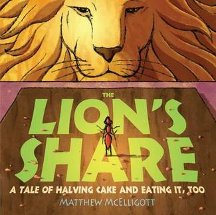
The lion's share by Matthew McElligott
A and C Black, 2012. ISBN 1408173883.
(Ages 4+) Highly recommended. Maths themes. Picture book.
When the lion, the king of the beasts, invites his friends to
dinner, the ant is rather concerned, as she has never been invited
before. After a sumptuous dinner where the animals all behave rather
badly (except for the ant), the lion brings out a large cake to eat.
Elephant takes half then pushes the rest on to the hippo, who takes
half of what is left, then pushes the rest on to the gorilla who
takes half of what is left, and so on. Each animal takes half of
what is left on the plate when it gets to him. At the end of the
line is the ant and when the cake comes to her she tries to cut what
is left in half, but succeeds in only making crumbs. She is
berated by the other animals for being greedy, so she apologises to
the lion, saying she will bake him a special cake and bring it along
the next day.
The other animals, not wanting to be outdone, promise cake to the
lion, each doubling what they offer in turn. By the time the offer
gets to the elephant, doubling each time, the elephant must bake 256
cakes.
Each of the animals is depicted in almost sepia tones, the cutting
up of the cake adding colour to the pages. The endpapers give a more
mathematical look at the cutting of the cake, something which could
be emulated in the classroom. Children will delight in the figures
of each of the animals, and ponder the fun of the subtitle, 'a tale
of halving cake and eating it too'.
This is an extremely funny look at fractions and sharing of numbers
through the cutting up of a cake, then the doubling and redoubling
of the number one. Apart from being a funny read with absolutely
delightful illustrations, the story would be a great introduction to
the idea of fractions and numbers.
Fran Knight
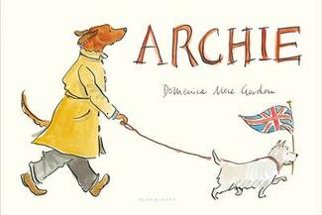
Archie by Domenica More Gordon
Bloomsbury, 2012. ISBN 978 1 4088 2862 5.
(Ages 4+) Recommended. Picture book. Pets. Warm in his
overcoat,
Archie notices his trusty pet dog, naked in the wintry day while out
walking. He rings and receives a sewing machine and then some
material
in the post, making his pet dog an overcoat as well, for when they
go
walking. On their first day out, both wearing their warm overcoats,
they meet a woman and her dog. She expresses a liking for Archie's
dog's coat, and he makes one for her dog. Later of course, all the
pet
owners want one for their dog, and Archie becomes a small business
man.
Later still, his new friend requests a dress for herself, and Archie
finds a mannequin to fit the new dress around to make the clothes.
This
leads to all the other dog owners requesting Archie make them
clothes
for them, and finally someone quite famous hears about Archie and
requests a coat for her corgi.
This is a beautiful story of friendship, of meeting new people, of
pet
ownership and the relationship between pets and their owners. The
book
gently promotes good relations between pet owners, of responsible
dog
ownership. The illustrations are just wonderful, gently amusing,
pleasurable to look at and read about. The few words added include
woof, gasp and ring, giving some background noise to this mainly
wordless book, encouraging young readers to repeat these words
aloud.
Fran Knight
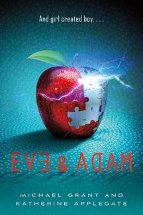
Eve and Adam by Michael Grant and Katherine Applegate
Egmont, 2012. ISBN 9781405264341.
(Age: 13+) After Evening has a horrific accident, she is taken into
intensive care in the research facility called Spiker Biopharm, run
by her mother, Terra Spiker. There she meets the mysterious Solo, a
young employee who was partially raised by her mother. To prevent
boredom, her mother gives her a task: test out a new piece of
software that creates a virtual person. Evening becomes increasingly
fascinated with creating her own man, but everything is not as it
seems . . .
Michael Grant (writer of the excellent Gone series) has a knack for
writing stories that really manage to connect with the teenage
audience. Eve and Adam is no different. It's easy to see the appeal,
from the thriller and romance elements of the plot, to the
fast-paced writing and modern style. The book is divided about
evenly between Eve's side of the story and Solo's side of the story,
enabling a good level of change to keep the story moving fluidly,
rather than having the whole novel simply revolving around one
person. It helps to keep the pace going. Having two authors co-write
this novel - Michael Grant and Katherine Applegate - was a
good idea as well. When it's from the perspective of another
character, it helps show the differences and gives each of them a
singular 'voice', so none of the characters sound exactly like the
same person. The plot is interesting, to say the least, and very
original. It's simply a very good, although not brilliant, young
adult novel.
Fast-paced, clever and original, this is a solid, interesting read
Rebecca Adams (Student)
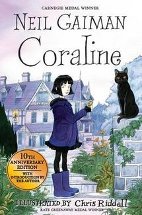
Coraline by Neil Gaiman
Ill. by Chris Riddell. Bloomsbury, 2012, 208 pgs., p/b. ISBN
9781408832400.
Recommended for readers 10+. This book is a special 10th Anniversary
edition of Neil Gaiman's modern classic with an introduction by the
author and spine-chilling illustrations by Chris Riddell, adding to
the
spookiness of the story. The lure of a locked door is too much
for Coraline, the bored young girl at the centre of this spooky
tale. Coraline and her parents have just moved into a new flat
in
the South of England and there is something strange about Coraline's
new home. After moving in, Coraline discovers an old door and
asks her mother where the door leads to. Her mother unlocks
the
door to show her it goes nowhere, opening up to a brick wall.
One
day when her mother pops out to the shops and Coraline is bored and
alone, she opens the door to find the brick wall gone so she
enters. She finds herself in what appears to be her own home,
same carpet, same wallpaper and looking at two people who look like
her
mother and father, except their skin is white as paper and they have
black-button eyes. These two people who look like her parents
want Coraline to stay forever.
I really enjoyed the main character, Coraline, because she is
curious,
intelligent and brave and uses her smarts to save herself and
others.
This is a well written short and easy to read story. It is
full
of adventure, twists and surprises. I would recommend
this
book to 10+ as there are some scary parts.
'Sometimes a door is closed for a very good reason'.
Michelle Thomson
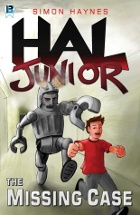
Hal Junior: The missing case by Simon Haynes
Bowman Press, 2012. ISBN 978-1-877034-25-1.
(Age: Middle to upper primary) Hal Junior returns in another space
adventure. This time he has to
entertain a visiting VIP's daughter while her father negotiates the
future of Space Station Oberon.
As usual, Hal finds himself in trouble while trying to impress Alex.
Alex has promised to look after her father's briefcase, which holds
important documents pertaining to the space station's future, but
unfortunately this finds its way into the rubbish. Hal and
Alex
become involved with the space station recycling centre and an
aggressive robot that hates to part with his recycling property.
This science fiction story is aimed at middle to upper primary
school
students. As I have stated before Hal Junior books do not have
attractive jackets and I feel that this will influence their appeal
to
children.
Jane Moore
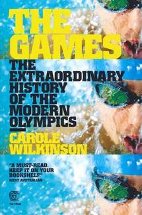
The games: The extraordinary history of the modern Olympics by Carole Wilkinson
Black Dog Books, 2012. ISBN 9781 742032 22 1
(Ages 10+) Recommended. Non fiction. Olympic games. History.
Nine fascinating and informative chapters give the reader a potted
history of the Olympic Games, and introduction breezily outlining
the beginning of the modern games. Each chapter looks at three
Olympics in turn, with an introductory fact file showing the number
of participating countries, the number of male and female athletes
involved, the number of sports played and the medal tally. The
chapter goes on to target the most interesting occurrences during
the games in that particular year, outline fascinating events and
characters and target athletes who have made a difference.
Wilkinson's always lucid style of writing invites the reader to read
for the sake of reading about the Olympics, rather than use this as
a research tool, but either is appropriate. The detailed index makes
this a good research tool for the library and classroom, and the
open chatty style makes it most accessible to any reader.
At each Olympics, events from the past are alluded to by the
journalists searching for something new and interesting to say or
write, the storming of the Jewish athletes at the Munich Games,
Jessie Owens' achievements at the Berlin Games, the breathing
problems at the Mexico City Games, all these are given an airing in
this book, making it a formidable companion read for all those
people fascinated by the games themselves, the athletes in
particular and just lovers of all sport.
And for those groups of boys who frequent the library at lunchtimes
or keep their heads stuck in the Guinness Books of Records,
this is another book from which to gain things to add to their pile
of interesting facts.
Fran Knight
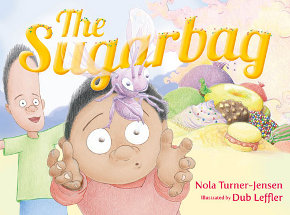
The sugarbag by Nola Turner-Jensen
Ill. by Dub Leffler. Magabala Books, 2012. ISBN 9781921248474
(Ages 4+) Recommended. Picture book. Aboriginal themes. Environment.
Jimmy and Max are out in the bush when a native bee passes by. Jimmy
catches the stingless bee and takes a little bit of stuffing from
Max's toy, attaching it to the back of the bee. He tells Max that
his grandfather has told him about doing this so that they can
follow the bee and find sugarbag or ngarruu or honey. Max thinks
that finding sugarbag is a great idea, and imagines all the sweets
that he will be able to eat. But when the bee goes into a hollow
log, and Jimmy finds some large sticks to pry the log open, many
angry bees erupt from the log. Max hides but Jimmy perseveres,
eventually finding his reward, sweet honey. This is not quite what
Max imagined, but one finger full of the honey convinces him that
this is sugarbag. The boys eat some of what they have found, then
Jimmy puts some on a flat stick and wraps it in bark to take it back
to his grandfather.
This is a lovely story based around bush tucker found by Aboriginal
people over Australia. Called sugarbag by the European settlers, it
is called ngarruu by the Widajuri people of northern New South
Wales, and the words of the book point to more than the simple story
of the boys collecting honey. There are under-stories of older
people passing on information and skills, the theme of sharing, of
bush tucker, of family and obligation. And in a country where
obesity is a growing issue, the idea of what sort of sweets are good
for you is another area of discussion which this book promotes.
Books from Magabala are always multi-layered, teaching more that
just story, giving layers of meaning and story to chew upon.
The illustrations are muted and soft, with colours reflecting the
sorts of sweets Max is imagining he will find in the bush. The two
boys are entertainingly drawn, making the eye follow their antics
across the page. The design of the book is noteworthy as the words
move across the page, emulating the trail of the bee and stressing
some of the questions Max has for Jimmy.
Fran Knight
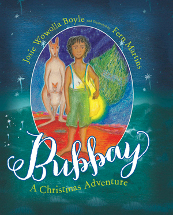
Bubbay, a Christmas adventure by Josie Wowolla Boyle
Ill. by Fern Martins. Magabala Books, 2012. ISBN 1921248726.
(Ages 5+) Recommended. Picture book. Christmas. This is one of the
loveliest Christmas stories I have read. The story is redolent of
the warmth of families and giving of yourself. Aboriginal and
European cultures and stories sit alongside each other in the tale
of a boy out tending his goats. Bubbay is alone and his wish is for
being in a home for Christmas. To this end he wishes upon the stars
on high for a Christmas tree to put presents underneath ready to
give at Christmas. The stars hear him and send down a tree which
needs five things attached for his wish to be realised. He scours
the desert for the five things, a stone, an egg, a seed, a feather
and a shell to decorate his tree. He does this eagerly, with the
help of old Gubarlee, finding that the shell is the hardest thing to
find. The conclusion of the story brings all the themes together,
the Aboriginal boy alone in the desert, Christmas Eve, the need for
family, sharing and helping. The blending of Aboriginal and European
stories is wonderful and will endear the tale to all of its readers.
The illustrations however, make the book difficult to read aloud to
a class, as the pastels blend into each other when viewed further
away. It is a shame, as the book would be well used as a read aloud,
but clever teachers will be able to get around this using technology
I am sure. The background to the naive illustrations sometimes
detracts as well, but readers will love reading about the boy and
his quest, and look for the things mentioned in the text in the
vibrant and colourful illustrations.
Fran Knight
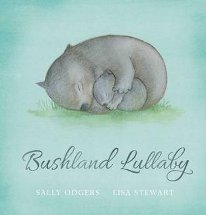
Bushland lullaby by Sally Odgers
Ill. by Lisa Stewart. Scholastic, 2012. ISBN 174283177X.
(Ages 1+) Picture book. Bedtime reading. A gentle story told in
rhyming lines within stanzas, this book is presented to be read by a
parent or sibling at bed time, easing the younger child into sleep.
Each page gives us four poetic lines telling of an Australian animal
settling down to sleep with its parents. In gentle balladic stanzas,
the story is told of the animals and their night time snuggling to
rest after a busy day. Children will love to hear of these animals,
warm in the knowledge that they too are about to go to bed to sleep,
comforted by their parent's closeness. The gentle rhymes are easy to
emulate, encouraging the listener to predict the word that comes
next, possibly offering alternatives to the one given on the page.
The descriptions offered too, underscore the environment and
habitat. The illustrations, using Japanese paper collage techniques
are soft and gentle, paralleling the story being told. They are more
useful for a one to one reading, as they tend to fade on viewing
from a distance, becoming indistinct.
Fran Knight
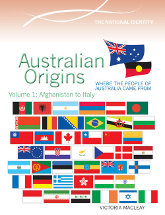
Australian Origins: Where the people of Australia came from by Victoria Macleay
Trocadero Publishing, 2012. Volume 1: Afghanistan to Italy. ISBN
9780864271266. Volume 2: Japan to Zimbabwe. ISBN 9780864271273.
Among the key inquiry questions for Year 6 in the history strand of
the Australian National Curriculum are these:
1. Who were the people who came to Australia? Why did they come?
2. What contribution have significant individuals and groups made to
the development of Australian society?
These two books from Trocadero's series The National Identity
are perfect resources for helping students research the answers to
these questions, so they not only have a sound understanding of the
multi-national makeup of our population, but also a solid basis for
the more specialised studies undertaken in history in later years.
Arranged in alphabetical order, there are clear and easily readable
details about each country, its relationship to Australia and a
brief national history which puts the immigration patterns into
context. The information is in easily readable chunks accompanied by
a map, photos and a flag. There's even a pie graph that shows the
number and proportion of each nationality within the overall
population - apparently there are currently 544,171 New Zealand-born
people here, of which I am one! Kiwis are the second largest source
for immigration after those from the UK, which is not surprising.
Because my natural instinct was to look up the stats for my origins,
it would make sense to use these resources in a similar way with
your students. Ask them, 'Were you (or your parents) the first
person from ____ to come to live in Australia?' Given the answer is
probably 'No,' this would provide an opportunity for them to
kickstart their research using these resources and then lead into a
deeper investigation of the history of their home country and why
people choose to migrate. The influence of war is powerful. From
this, a parallel study of the plight of refugees and the
contemporary issue of asylum seekers and 'boat people' could ensue,
as well as comparing how Australians have treated migrants in the
past, such as the shunning of the Chinese during the gold rush, the
White Australia policy, the impact of European immigration after the
war, the current requirements for entry and so on. It would help
students understand how the past influences the present and perhaps
help answer that perennial question about why we need to study
history. Students might then read Marsden's Home and Away
and investigate which country they might flee to, or, if they are
leaving in more convivial circumstances, which country they might go
to and its requirements for entry, work permits and so forth. Is the
grass greener? For a more mathematical slant, students could use the
stats to build a graph of the makeup of Australia's population (an
authentic task for learning pie graphs); perhaps compare it to the
makeup of the school's population and suggest reasons for any
differences such as the tendency for some groups to choose to live
near each other and the implications for this; and then investigate
the wealth of information that is available on the website of the Australian Bureau of Statistics.
Australian Origins is just one in a number of series being published
by Trocadero as it works to provide current, relevant resources to
support the history curriculum. Others include Asia-Pacific
Relations; Asia-Pacific Timelines; Australia Year by Year;
Australian Decades; Defending Australia; Linking the Nation;
and The National Identity (which would also support the Year
6 curriculum). To see the complete list (as well as what's planned)
go to http://www.trocadero.com.au/
and to find those that will meet the needs of a particular year
group go to http://www.intbooks.com.au/pdf-pages/history.php.
As the implementation of the Australian National Curriculum is
rolled out across the country, these are some excellent resources
purposely produced to support it.
Barbara Braxton
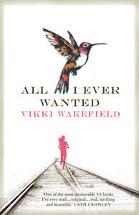
All I ever wanted by Vikki Wakefield
All I ever wanted by Vikki Wakefield
Text Publishing, 2011. ISBN 1921758309.
(Ages 13+) Recommended. Contemporary novel. Mim is a few days shy of
her 17th birthday in the last few weeks of the summer holidays
before returning to school. Her rules are in tatters. She would
never involve herself in the drug scene like her now incarcerated
brothers, and yet she has picked up a parcel for her mother, and had
it stolen from her on her way home. Stuck in a suburb where living
in a half house means you hear what goes on next door, or the
neighbours constantly fighting, avoiding the witch a few doors down
and crossing the road when nearing the large snarling dog, means
that the aspirations of her family and friends are narrow, and she
wants more. She has written her rules on the wall of the local
abandoned tower, and strives to adhere to them. But this summer, the
hot dry summer, things have changed. Her best friend, Tahnee has
lost her virginity, and taken up with a loser, willing to have sex
with him in his car, get drunk at parties in the park, and deride
her friend for her needing to finish school and go places rather
than be stuck in this suburb for the rest of her life, stuck like
her mother.
Mim must get the parcel back, and so goes to great lengths to
retrieve it, eventually enlisting the help of the local dealer, who
seems to know all about it. The person who stole it from her is the
boy from across the way, in a new development, one who would usually
not even give her the time of day. In trying to force him to give
back her package, she becomes friendly with his sister, and the two
surprisingly become friends.
A fascinating look at one girl's dreams for her future, determined
not to make the mistakes of her family, and wanting a way out of a
suburb which will, if it can, entrap her into the same cycle of
poverty, makes this is an absorbing read. Mim is a great character,
guarding her rules almost fanatically but forced to bend them
somewhat according to changed circumstances this summer. How she
does make the break and keep truthful to her rules will keep all
readers hooked. And in the end, Oscar Wilde's quote comes to the
fore, 'Who, being loved, is poor?' as Mim finds that there is more
to her family and neighbours than she has realised.
Fran Knight
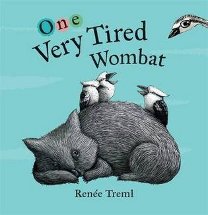
One very tired wombat by Renee Treml
Random House, 2012. ISBN 978 1 74275 578 6.
(Ages 4+) Highly recommended. Picture book. Australian animals.
Being a nocturnal animal, all wombat wants to do is sleep. But the
other animals in this environment have different ideas to him. His
peace and quiet is plundered consistently through this delightful
book, with the story following his night of efforts to sleep. This
counting book told in rhyming couplets, will enthrall younger
readers as they recognise the animals which come along keeping
wombat awake, learning to read the rhyming sentences aloud with a
teacher or parent.
The tired wombat is interrupted by two curious curlews, then three
furtive frogmouths and four peaceful pigeons and so on, until at the
end of the book, the wombat is able to disperse them all, and in
doing so, is able to curl up and go to sleep, or can he? The ending
will bring smiles to all who read this charming book full of poetry,
alliteration and fun.
The bold black and white illustrations, sometimes contrasted with
single colour backgrounds are lively and amusing, giving a cheeky
look to the well known Australian animals, including penguins,
magpies, galahs and kookaburras. Listeners will love the rhymes, so
much so that they will want to predict the final rhyming words, and
learn the rhymes themselves. The alliteration is infectious, so many
readers and listeners will add other words to the line, using the
same starting letter.
As a wonderful book simply to read or a book to introduce Australian
animals to a class, or the life of a wombat, or look at rhyme and
alliteration, this book has a wide number of uses, apart from the
obvious one of being just a great read aloud.
Fran Knight
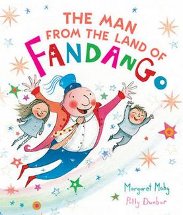
The man from the land of Fandango by Margaret Mahy and Polly Dunbar
Frances Lincoln Children's Books, 2012. ISBN 9781847802200.
(Age 4+) Recommended. A wonderful verse story from Margaret Mahy and
beautifully illustrated by Polly Dunbar, The man from the land of
Fandango is a joy to read aloud and peruse. Two young children paint
the man form the land of Fandango who comes alive bringing bingles
and bangles and bounces and coming to make a call.
The story of the man from Fandango is told with verve by Mahy, a
master at using beautifully and evocative language to stir the
imagination:
'The man from the land of Fandango
Is given to dancing and dreams,
He comes in at the door like a somersault star
And he juggles with junkets and jam in a jar
And custards and caramel creams.'
This book is a joy to read aloud and will extend both the
imagination and the vocabulary of any child who listens to it.
Dunbar's colourful illustrations have a life of their own and really
enhance and complement the story. The man from Fandango is pictured
as a jolly red cheeked plump man who skps and plays a horn. The
children have happy expressions on their faces that make the
reader smile. I especially liked the contrasts that Dunbar made in
her illustrations of the animals. The picture of the dancing bison,
who had a mythical type head and in contrast wore red high heels and
a red bow on her tail is a favourite. The dancing bears had neckties
and little hats and huge kangaroos fluttered their eyes with long
eyelashes.
Margaret Mahy has brought immense joy to children through the years
with her wonderful stories and The man from the land of Fandango
is one that is a keeper.
Pat Pledger
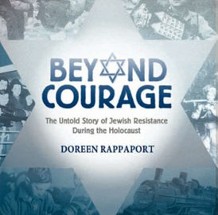
Beyond courage: The untold story of Jewish resistance during the Holocaust by Doreen Rappaport
Candlewick Press, 2012. ISBN 9780763629762.
(Age: 14+) Doreen Rappaport's themes are resistance and survival.
Despite her Jewish upbringing and numerous books and films about the
Holocaust, she felt that her knowledge of the subject was limited
and
embarked on years of research. The result may surprise those who
assume
that there is nothing new to say about this event.
The structure of the book emphasises the immense scope of the
tragedy
by relating stories of young people across Europe who resisted
entrapment, and by leaving accounts of those in concentration camps
until last. Each section begins with an explanation of one of the
machineries of genocide, from the introduction of discriminatory
laws
to the confinement and murder of Jews in ghettoes and camps. The
narrative ranges from dramatic escapes to determined attempts to
maintain meaningful lives in desperate situations. Equally moving,
are
accounts of non-Jewish people who were also targeted for elimination
and forced labour, or who risked their own lives to save the lives
of
others.
Readers are taken into the experiences of people whose names and
photographs personalise the statistics. The author's focus on
courage
ensures that her grim subject matter is also inspiring.
The extensive bibliography and meticulously recorded source notes
are
the hallmark of an accomplished historian but the sub-title
threatens
the book's credibility. Although some previously unpublished oral
histories have been included, calling the whole book 'the untold
story'
overlooks long standing records of Jewish resistance. The author's
principal premise that Jews did not go 'like sheep to the
slaughter',
remains an important issue. However, over sixty years and several
more
genocides later, her stories also highlight the terrible dilemmas
which
confront everyone living under repressive, totalitarian regimes as
well
as humanity's failure to learn from history. & Beyond courage has been written in an accessible narrative
style
by an
award winning author who understands the raw power of documentation
and
personal testimony. Readers can ponder for themselves, the insights
gained from the events it chronicles.
Elizabeth Bor