Allen & Unwin, 2013. ISBN: 9781743312469. 216pgs. (pbk.)
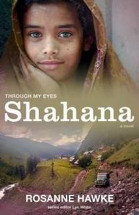
(Age 11+) Recommended. Shahana is the first title in the Through
My Eyes series, a moving series of courage and hope that
focuses on children living in conflict zones around the world.
Thirteen-year-old orphan Shahana lives alone with her younger
brother Tanveer in Pakistan-administered Kashmir, because the rest
of her family have died as a result of the war over Kashmir. They
live very close to the Line of Control, the border which divides
war-torn Kashmir in two and has Pakistani and Indian soldiers each
patrolling their side of the fence. Shahana and Tanveer see a boy
lying unconscious near the border and when the boy finally gains
consciousness, they ask the boy where he is from and Zahid says who
will you tell? Will Shahana risk everything to help a boy from the
other side of the border? He can't stay, but how can she send him
away? They both need him, Shahana is not sure she can get through
another winter without help and Tanveer looks up to Zahid as the
brother he recently lost to this war.
A beautiful, easy to read and thought provoking story by South
Australian author Roseanne Hawke the story aims to increase
awareness of the devastating effects of war on children.The book
includes a timeline outlining the conflict between India and
Pakistan over Kashmir dating from 1947 through to 2012 and a
glossary, both adding to the reading experience. Teacher
notes are also available.
I would recommend this book for ages 11+.
Michelle Thomson
Jeremy by Chris Faille
Ill. by Danny Snell. Working Title Press, 2013. ISBN 978192150440.
2.
(Age: 4-6) Highly recommended. Picture book. Australian birds.
Rescue. What a delight. I love the use of a kookaburra as the
rescued bird and the Australian suburbs illustrated in all their
glory on the second to last page as the bird finds its home.
Jeremy is a fledgling brought inside by the house cat. The tale
proceeds as the boy cares for the bird, settling him on a hot water
bottle, feeding him thorough an eye dropper, and later, insects form
the garden. We watch the little bird grow, as its feathers fill out,
its beak becomes larger and the bird practices flying. It sits in
the garden watching the other birds, and each progression is marked,
giving the readers a precise idea of just how quickly the little
bird grows. Time passes until one day Jeremy flies off with the
other kookaburras on the electricity lines nearby.
Based on a true story, the tale will remind its readers of others
with a similar theme, Bob Graham's How to heal a broken wing for
example, but this one uses a kookaburra which is not often seen in
children/s books, and the tale could be used in discussion with
children about rescuing animals, the life cycle of birds, how to
raise a bird, the nature of cats and so on, the illustrations adding
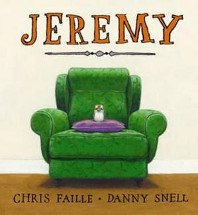
a humorous undertone to the whole. The picture of Jeremy sitting on
its purple cushion on the bright green lounge chair is magnificent
and will draw any reader in to open the book.
And the end papers are used to list a large number of facts about
kookaburras which will further endear the readers to this Australian
bird.
Fran Knight
Plague: a cross on the door by Ann Turnbull
Ill. by Akbar Ali. Bloomsbury, 2013. ISBN 978 1 4081 8687 9
(Age: 8+) Recommended. Historical novel. Plague. With younger
children in mind, Ann Turnbull has turned her historical writing to
a new group of readers. Illustrated by Akbar Ali, the drawings show
some of the features of the times: half timbered housing, a warm
kitchen, the doctor dressed as a beaked harbinger of death, the
overcrowded cemetery, the cross on the door. In eighty pages,
Turnbull gives an account of the plague in London in 1665, told
through the eyes of young Sam, adopted by the shoemaker William
Kemp, with an eye to become his apprentice. But William dies of the
plague and the house shut up with Sam and his dog inside, only to be
released after forty days have elapsed.
Through his story Turnbull gives the younger reader an overview of
the plague and its effects on the crowded city. The reader hears of
the symptoms, the home remedies, the laws imposed by the London
borough, the Bill of Mortality and so on, giving a factual account
of the plague within the thrilling story of survival. A sequel, The
great fire: a city in flames is to follow. Stories of the plague and
fire of London have always been very popular, and this book would
sit well with the recent non fiction book, Plague unclassified:
secrets of the great plague revealed (Nick Hunter, A&C
Black).
Fran Knight
Athlete vs mathlete by W.C. Mack
Bloomsbury, 2013. ISBN 978 1 599 908 58 8.
Owen and Russell are fraternal twins who have very different
interests. Owen loves basketball and Russell loves maths and
Master of the Minds. They are each happy with their role until
the new basketball coach gets Russell to try out for basketball
because of his height. After reluctantly going along with it
against his better judgment, to his own and everyone else's surprise
he gets on the team. This leads to trouble with Owen and
Russell's non basketballing friends who think he is letting them
down in their efforts to win Master of the Minds. What follows
is an exploration of the relationship between brothers as Owen
resorts to dirty tactics to retain his position.
The story also explores how we each have our own concept of our
value and self-worth. This is done subtly and is resolved in a
way that restores the relationship between the brothers as they each
appreciate their strengths and realize that together they are
stronger.
There is enough about basketball to keep the sporting reader happy
whilst the other areas add some depth to the story. I think
that primary/middle school readers would find it an enjoyable read.
David Rayner
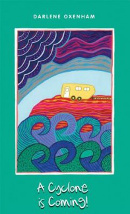
A cyclone is coming by Darlene Oxenham
Waarda series. Fremantle Press, 2013. ISBN 9781922089342.
Recommended for Year 3. This book tells of Annie, who lives with her
parents in a caravan in the north of Western Australia. Other
members of their extended Aboriginal family also live in the caravan
park, and a number of other children do as well. All the children
are great friends who do everything together in the holidays. They
swim, fish and collect shells amongst other things. One day when
they were considering going to the beach, Annie's Grandfather looked
at the sky and said it was not a good idea because a cyclone was
coming. Annie helps prepare for the cyclone including tying
the caravan to a large scraper that her father has placed next to
their van. The rest of the story covers the waiting, and then the
arrival of Cyclone Tessie, and gives an excellent picture of just
what happens in the event of a cyclone. When Annie goes back to
school, she is able to tell her class all about her adventure and
the bottle with a message which she and her friends found. When the
class asked what the message said they were told it was a story for
another time.
Rhoda Jenkin
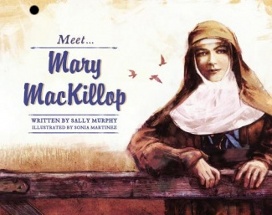
Meet Mary MacKillop by Sally Murphy and Sonia Martinez
Random House, 2013. ISBN 9781742757216.Ebook ISBN 9781742757230
hbk., col. ill., RRP $A19.95.
(Age: 6+) Mary MacKillop believed deeply in educating children,
particularly those in remote areas of Australia, and in 1866, full
of excitement and enthusiasm she left her home and all that she knew
to set up her first school in Penola, South Australia. This is
the story of the establishment of that school and Mary's insistence
that it would be for every child regardless of their parent's status
or ability to pay. With a deep belief in God, she and her
sisters put their trust in His ability to provide and enable them to
survive and flourish. During the first year Mary decided to
become a nun, Sister Mary of the Cross, and founded the order of the
Sisters of St Joseph, 'doing God's work and helping the poor
wherever we can.'
Since her beatification in 1995 and subsequent canonisation in 2010,
the life and work of Mary MacKillop has become much more widely
known, and, as Australia's first saint, the interest spreads beyond
the Catholic Church. In this beautifully illustrated picture
book, we learn how and where it all began.
This is the second in the Meet . . . series, a collection of picture
books that tell the stories of some of Australia's most significant
people. Ned Kelly was the focus of the first, Captain James
Cook the next one. Designed to complement the outcomes of the
History strand of the Australian National Curriculum, it's a great
way to get the youngest readers interested in who has shaped this
country.
Barbara Braxton
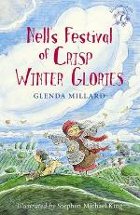
Nell's festival of crisp winter glories by Glenda Millard
Ill. by Stephen Michael King. ABC Books, 2013. ISBN 9780733329845.
(Age: 8+) Highly recommended. Family. Age. Festivals. The family
Silk, in the small community of Cameron's Creek, is again presented in
all of its warmth. The wonderful Nell, grandmother to all, Ben her
adopted son and wife Annie with their children, including Perry
Angel, their tales told in previous award winning books, come
together for one last episode.
Perry has noticed that Nell is sometimes lonely, and he has also
been aware that his personal assistant at school is in the same
boat. He plots to bring them together, knowing they both used to
like dancing, and gathers some of the other family members together
to achieve this. In Mr Kauri's shop they plan their dance, but when
Nell falls and breaks her hip, plans must be altered to suit the
situation.
This is a wonderful book, full of the love and happiness that a
strong family brings to its members, Millard recreating a warm
centered rural life with its animals, jams, sharing of food when the
need arises, knitting, and simply watching out for each other. In
her beautiful prose, full of the richness of the lives she
describes, their characters come easily through, wrapping themselves
around the reader, drawing them into the circle Millard creates.
I have only read two of the Silk family stories and will search out
the others, saddened that this is the last as I am sure the many
fans will be as well.
Fran Knight
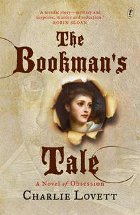
The bookman's tale by Charlie Lovett
Text, 2013. ISBN 9781922079336.
(Senior secondary readers) The bookman's tale by Charlie
Lovett is a thriller about bibliophiles, bibliopegy and greed. Books
are bound, hidden and discovered, along with the occasional body, in
this story that ranges from Shakespearean England to the 1990's.
While Shakespeare's canon is hallowed ground, the recognition of
Shakespeare as author is under threat from the anti-Stratfordians,
those who believe that Shakespeare could not have written the works
attributed to him. The main character, Peter Byerley, is an
antiquarian bookseller and book binder. He has the good fortune to
meet the beautiful Amanda, who not only falls in love with Peter but
is also very wealthy, thus allowing him to pursue his chosen
occupation. After the death of Amanda, Peter moves to England and
becomes involved with a book collector who may have a Folio edition
of Shakespeare's play Hamlet. Instead Peter finds a pamphlet
written by Robert Greene, a contemporary of Shakespeare, and
seemingly annotated with Shakespeare's marginalia. This would prove
beyond doubt that Shakespeare was the author of the plays, but is
the document a forgery? The owner of the pamphlet needs money and
Peter feels that he cannot be trusted. The author weaves a tangled
and complicated web of inter-family rivalry that stretches back to
the nineteenth century. In his investigation the mild-mannered Peter
becomes implicated in a murder, is trapped in a medieval chapel,
finds an underground tunnel, overcomes claustrophobia and outwits a
gun-toting murderer. Peter is convinced that the document he has is
a forgery, but he also believes that he knows where the original is.
In a retrospective deus ex machina, Peter himself is the rightful
owner of it.
There is a wealth of information here about books and book
restoration, about Shakespeare and his contemporaries and about
Shakespearean scholarship. This is the novel's strength. The plot
seems unbelievably Machiavellian and is quite complicated. Peter is
an unlikely hero but a convincing book lover. The novel is suitable
for older readers.
Jenny Hamilton
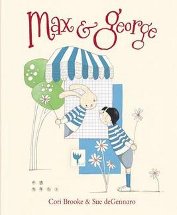
Max and George by Cori Brooke and Sue deGennaro
Penguin/Viking, 2013. ISBN 9780670076352. Hbk, RRP $A24.99
Max was never lonely. As long as there was a window, he had a
friend because George lived in windows. No matter where the window
was, Max could see George and he spent a long time looking at him.
Because they were very similar - same height, same clothes, and
whenever Max moved, so did George. They even shared the same
feelings. But then the time comes for Max to start school. And he's
nervous. Even though George was there in the school window,
Max's teacher made him sit where he couldn't see him. Will Max find
the confidence to leave George and make a real friend?
This is a delightful book, perfect for the child about to start
school and finding it hard to let go of what is known and take the
leap into the unknown. With its charming illustrations, it will
appeal to all children - those who are like Max and empathise with
him, and those like Sam who are a bit more confident and can
reassure him. Tip for parents - teach your child a joke before
they leave...
Barbara Braxton
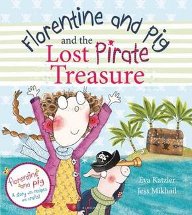
Florentine and Pig and the lost pirate treasure by Eva Katzler
Ill. by Jess Mikhail. Bloomsbury, 2013. ISBN 9781408824405.
(Age: 5+) Picture book. Pirates. Humour. Things to do. Imagination.
Florentine and Pig are back with another adventure to please the
hearts of their fans. Stuck in the house on a cold and wet, wintry
day, they search around for something to do. Out of the dress-up box
comes a range of things to wear, and each is dressed as a pirate.
Pig with his pirate hat and telescope looks just the part, and
Florentine ambles behind him with her favourite sparkling cardigan
which is missing one button. They find a pirate map, and use the
furniture in the lounge room to create a ship on which to sail to
find the treasure mentioned in the map. Fun abounds as they go on
their adventure, and the story includes a list of the things they
need to take, as well as the recipes for the food mentioned, the hat
Pig wears, and the flag flown on their ship.
An entertaining look at using one's imagination, children will
thrill at the mischief the pair gets up to. Readers will love to try
things for themselves, and then cook the recipes given at the end of
the story. For teachers, this is another book to include in the
pirate books already available, and be a neat adjunct to work done
in using imagination and play. I can imagine many students in early
childhood setting wanting to emulate Florentine and Pig on their big
adventure, so have the dress-up box ready, along with the
ingredients for making the biscuits, cakes and pasta, as well as a
pirate hat and flag.
Fran Knight
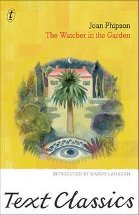
The watcher in the garden by Joan Phipson
Text Classics, 2013. ISBN 9781922147011
Recommended. The watcher in the garden (1982) by Joan Phipson has
been republished by Text Classics for a new generation of readers to
appreciate this timeless tale of adolescent angst played out against
the backdrop of its uniquely Australian background.
The cover design and the wonderful introduction by Margo Lanagan set
the mood for this remarkable tale. The Australian landscape,
its beauty and mystery, is represented by the garden which belongs to
the blind Mr Lovett and into which stumble the malevolent Terry and
the angry and confused Kitty.
Mr Lovett befriends and becomes to depend on Kitty and her
descriptions of the garden. His friendship and respect
encourages Kitty to examine her own anger and behaviour. The
garden brings her peace and tranquillity after she is welcomed by
him.
At the same time Terry bears a grudge against Mr Lovett, and watches
him as he plots his revenge for perceived slights against his
family. Terry and Kitty tread warily around each other
but their lives become entwined by the garden and its almost
supernatural presence. Both become aware that the garden has a
force which bears its influence on them.
In a powerful scene Kitty and Terry physically confront each other
and both are injured. When they come to they realise that
they have a psychic connection and can feel what the other is
thinking. When Kitty is lost and has to stay in the bush
overnight, Terry knows where to find her. Are they in a
symbiotic relationship?
This connection leads to the penultimate scene when amidst an earth
tremor Kitty struggles up the sides of the gorge in order to save Mr
Lovett; Terry is there too and the garden plays its part in the
drama as it unfolds.
I recommend this novel.
Michael Jongen
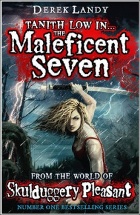
The maleficent seven by Derek Landy
Skulduggery Pleasant series. HarperCollins Children's, 2013. ISBN
9780007512386. 284 p. paperback
(Ages: 12-14) Themes: Good and evil. Skeletons. Magic. Fantasy.
Sorcery.
Irish author Derek Landy's novella departs from the usual
protagonists Skulduggery and Valkyrie, focussing on Tanith Low's
dark corrupt character who now is permanently possessed by a Remnant
spirit. Tanith recruits a team of villainous characters to search
for and steal the four God-Killer level weapons to help Darquesse in
the destruction of the world. The first weapon the team needs to
find is the dagger at the German Sanctuary. Her crew are pitted
against a secret group of Sanctuary sorcerers lead by Dexter
Vex. Billy Ray Sanguine, one of her team, is particularly
blood-thirsty, using his cut-throat razor to protect Tanith.
Tanith's back story is interspersed with the action chapters. She is
left by her parents to work with the master Quoneel and other
masters, learning the art of sorcery, killing, forgery and
wall-walking. At this stage she still has a conscience.
The battles are graphically described; the killings matter of
fact and the characters assisting Tanith are truly evil. This is
another very dark story that will be welcomed by fans of the
Skullduggery Pleasant series. Background understanding of this
fantasy world is needed to read this book.
Rhyllis Bignell
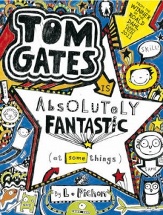
Tom Gates is absolutely fantastic (at some things) by Liz Pichon
Scholastic Children's, 2013. ISBN 9781407134512. 249 p.
(Age: 8-11 ) Highly recommended. Diary stories. Family life. School
stories. Boys. Brothers and sisters. Winner: Roald Dahl Funny Prize
2011, Blue Peter Book Award for Best Story. Tom Gates' diary is
filled with doodles, illustrations, hidden monsters and a running
commentary about school and home life. Tom has an intense dislike of
his teacher Mr. Fullerman, as well as one of his classmates Marcus
Meldrew and his rather mean older sister Delia. He spends most of
his time at school drawing in his notebook, sketching and wickedly
commenting on his class dramas. This time Tom's class is off on a
camping trip and he hands in his signed form at the last minute.
Even a trip to the supermarket with his Mum is a comedy, when the
giant packet of toilet paper splits and he has to chase two rolls
across the floor of the checkouts, landing in front of his secret
crush, Amy.
At the Activity Centre, there are lots of laughs as Tom deals with
his mother's hidden notes, Marcus Meldrew's annoying behaviour and
his bunkmate's sleep talking. Nothing in Tom's life is dull or
boring and he always finds trouble wherever he goes.
The text in this story includes handwriting, bubble writing,
emphasized words, block writing and words made out of patterns; this
makes it look handwritten. Liz Pichon's creative bold pen drawings
and doodles complement the text style. This is another in the
exciting series of Tom Gates books and I would highly
recommend it for a reading audience from 8-11.
Rhyllis Bignell
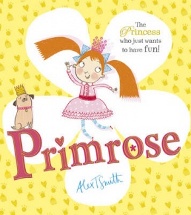
Primrose by Alex T. Smith
Scholastic, 2013. ISBN 9781407109664.
(Age: 4+) Warmly recommended. Princesses. Fun. Family. When Princess
Primrose gets out into the garden to pull vegetables, her parents
are aghast, when she goes into the kitchen to cook, the chef shoos
her out, when she climbs a tree in the orchard, her father tells her
to get down and behave like a real princess, and when she plays with
her dog, Percy, in her bedroom, Mum shrieks and makes her wear
proper princess clothes. All in all, Primrose would rather be in old
clothes, getting dirty and having fun, so her parents decide to
call Grandmama for help.
Grandmama is stiff and starched, a very proper old woman but she has
a surprise in store for the king and queen. She orders the king to
climb the tree in the orchard and there he spies the old tea house
and remembers his childhood days spent there. She orders the king
and queen to change their clothes and help pull the vegetables, to
play board games, to mess around in the kitchen, and generally to
have fun, a concept they seem to have forgotten.
This delightful turn of events will engage younger readers who
will laugh at the antics of the family in trying to get back to
their childhoods and have a good laugh instead of obeying the rules
and protocols in place in the palace.
Fran Knight
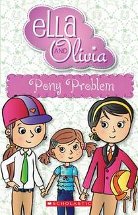
Pony problem by Yvette Poshoglian
Ella and Olivia series. Scholastic, 2013. ISBN: 9781742837987
When seven year old Ella and her younger sister Olivia accompany
Ella's friend Zoe to her pony competition, things quickly get out of
hand when Ella finds herself on a pony and is accidentally included
in the equestrian events. Who will come to the rescue when things
start to go wrong? Will this be Ella's dream come true or her worst
nightmare?
This is a slim story for emergent female readers who love horses.
Enormous font, liberally scattered illustrations and lacy patterned
edges to the pages would possibly add to the appeal of the title for
the very young child. Despite difficult words such as equestrian and
dismounts, they are minimal in number so the series would not
provide an overwhelming challenge in terms of vocabulary. Themes of
horse-riding, friendship, envy, bravery and winning and losing are
positive and age appropriate for the target audience.
Jo Schenkel