Text, 2012
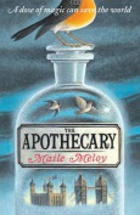
Recommended. For this reader The Apothecary is an old fashioned yarn
and quite 'old school' which is in no way intended to undermine its
charm and the sheer pleasure of the story. The story is set in
1952 and the action recalled by Janie who has had the memories of
this year in her life erased for many years.
Prompted by the return of her diary from this year she recollects
her time in London where she moves to with her parents when she is
fourteen from Los Angeles. There she meets Benjamin at her new
school, he is the son of the Apothecary and she is a little keen on
him. The action starts quickly when the Apothecary disappears
and Janie and Benjamin are left with the precious Pharmacopoeia
which a host of unsavory characters are seeking.
Magic, spells and spies are involved and a cast of eccentrics, as
Benjamin and Janie seek the truth and begin their journey which
takes them to the wild seas off the Arctic Circle where the Russians
are about to ignite a nuclear bomb. Using the powers from the
Pharmacopoeia and showing great bravery Benjamin and Janie fight the
spies above the wild seas, the action being worthy of any Hollywood
blockbuster.
There are many bases covered in this 'fish out of water' story which
features a blossoming romance between Janie and Ben, some great
eccentric characters and is a wonderful adventure with a twist of
fantasy. The reader needs to take care reading the 'note to
the reader' and like me go back and read it again when they have
finished this very enjoyable story.
While it may need some promotion I recommend this title for those
who enjoy a good adventure story with a twist of young romance.
Michael Jongen
Editor's note: The Apothecary was a ALA Best Fiction for Young
Adults 2012, CILIP Carnegie longlist 2013, E.B. White Read-Aloud
Award - Middle Reader
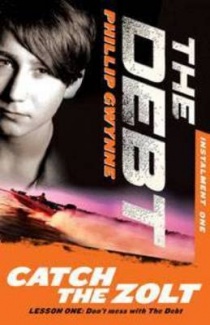
The Debt. Instalment one: Catch the Zolt by Phillip Gwynne
Allen & Unwin, 2013.
At last - an exciting, adventure series for teenage boys, set in
Australia. Phillip Gwynne would have to be considered as one of
Australia's pre-eminent authors for young adults. He experienced
enormous success with Deadly Unna in 1998, which was made
into a landmark movie Australian Rules. He has subsequently
written a number of books which have been similarly well received,
with 'a confetti of prizes'falling his way.
In this new series of 6 titles, Dom Silvangni, an elite athlete with
dreams of success in running marathons, discovers a sinister family
secret that dogs the male members of his family. It is, in fact, a
debt to a secret Calabrian society 'like the Mafia, but not as
nice,' and this debt requires six payments. As Dom learns his family
history on attaining the age of 15, he discovers the reason for his
grandfather's prosthetic leg - failure to complete his 'debt
repayments'. It is now up to Dom to maintain his family's honour -
and both his legs.
This series is a roller coaster of impossible tasks and improbable
situations with many twists and turns. With some skill, more luck
and the help of a few friends, Dom builds friendships and completes
his task, but never in the manner anticipated. Cleverly written,
with heavy doses of irony to keep readers amused, Phillip Gwynne
creates a very authentic voice for his main character in a
recognisably modern setting. Dom's sister is a teenage-hacker and
his target uses Facebook to send coded messages. Evil characters are
satisfyingly mysterious and evil and the young characters are nicely
rounded and complex. This book is fresh, entertaining and very
current. It is sure to be a hit particularly with young,
particularly male, readers who are already reporting online that
they are hooked early on and find it difficult to put down.
Diana Warwick
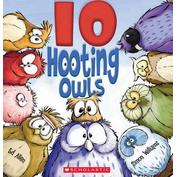
10 hooting owls by Ed Allen
Ill. by Simon Williams. Scholastic, 2013. ISBN 9781 74283 698
0.
10 silly wombats by Ed Allen,
Il. by Simon Williams. Scholastic, 2013. ISBN 9781 74283 638 6.
(Age: 4+) Picture book. Verse. Numbers. Humour. You feel like
singing along with both these books, modelled on 10 green bottles,
as the owls and wombats are counted from ten to one, with lots
of silly things happening along the way to keep the readers amused
and engaged.
10 hooting owls are reduced as one eats a smoothie while watching a
movie, another gets chicken pox while knitting winter socks, one
goes down the wrong trail while delivering the mail, and so on until
only one is left. The humour is infectious and I am sure the person
reading the book to a younger audience will be able to get them to
sing along as well. The strongly coloured illustrations too will
intrigue the readers as they ponder just where the owls might be in
some of the pages.
10 silly wombats are reduced in the same way with each wombat doing
something silly. One makes a fuss getting on the bus, another has
too much fun eating his bun, while another forgets to peek while
playing hide and seek, counting down until only one wombat is left.
For teachers and parents introducing the idea of counting one to ten
and back again then these little books will be useful. And the
emphasis on Australian themes and animals is good to see. Fran
Knight
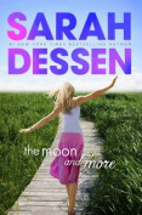
The moon and more by Sarah Dessen
Penguin, 2013.
(Age: 14+) Recommended. Luke and Emaline have been together all
through high school and Emaline knows that not only is Luke
gorgeous, he is kind as well. But when Theo arrives in town with a
documentary film maker, she starts to wonder if Luke is the perfect
boyfriend. Theo is different and sophisticated and understands just
how smart Emaline is. Her absentee father too believes that Emaline
should have a larger life than Colby, a seaside town, offers.
However she is deeply attached to her mother, stepfather and sisters
and somehow must find a balance between the familiar and the
inevitable change that going away to college will bring.
Dessen consistently writes stories that are appealing and
interesting to read but which explore issues that are very important
to her teen protagonists and to her teen readers. In The moon
and more Emaline is trying to work out who is the perfect
boyfriend - someone that she has known forever, or someone who has
seen and done much more than she has. She also has to come to terms
with the behaviour of her absentee father, who promised to finance
her to a prestigious university but changed his mind without telling
her why. Emaline is clever and astute but she has a lot of issues to
work through as she uses her organisational skills in the family
business.
A keen exploration of the family ties that keep people together,
whether it is overbearing siblings or a loving mother and the messy
nastiness of divorce and its effects on children provide the
background to Emaline's coming of age against a background of small
town politics and employment.
Dessen's characters are wholly believable, each with strengths and
weaknesses. Her descriptions of Emaline's father and his awful
behaviour paint a picture of a man who can only communicate through
emails. Her little half brother Benji comes alive on the page, and
her best friends, Morris and Daisy are wonderful characters. Theo
has moments of real empathy and others of being crass and unfeeling.
However it is Emaline's voice that come through really strongly and
kept me engrossed in this story set in one summer.
Pat Pledger
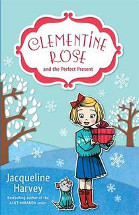
Clementine Rose and the perfect present by Jacqueline Harvey
Random House, 2013. ISBN 9781742755458
Recommended. Children's fiction. Fresh and original. Clementine Rose
is a 7 year old girl and is extremely curious about everything. So
when an immense tent appears in her backyard she just has to know
why it is there. When she finds out that there is going to be a
wedding, Clemmie is thrilled because a wedding is just the thing her
mother needs to help pay for a much needed roof for their house. She
wants to help the workers but she is not allowed, so she goes and
watches them, she even sings to them! But amidst the excitement, her
Uncle Digby falls ill and an invitation goes astray. To everyone's
horror (especially Clemmie's), Aunt Violet is left in charge. All
the presents gave Clemmie an idea, but will she find the perfect
present in time? Clementine Rose and the Perfect Present is a finely written
story. Jacqueline Harvey's fable illustrates Clementine and her pet
pig Lavender as two lively friends always on the lookout for
mysteries. Clemmie's Aunt Violet does not approve of such
excitement, but when Uncle Digby falls ill and an invitation goes
astray Aunt Violet simply gives in and lets Clemmie figure out the
puzzling mystery. Over all I think that Clementine Rose and the
Perfect Present is a fantastic story and every school in South
Australia should have a copy of this book in their library.
Amelie Meinel (student)
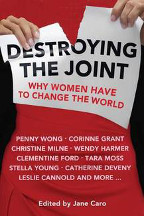
Destroying the joint edited by Jane Caro
UQP, 2013. ISBN: 978 0 7022 4990 7. Paperback, 295 pps.
RRP: $29.95
Highly recommended. Jane Caro has gathered a thought-provoking
assembly of Australian women's responses to Alan Jones's comment on
August 31, 2012 that 'women are destroying the joint'. The
collection consists of essays, analysis, social comment, memoir and
fiction combined with a healthy dose of humour.
Carmen Lawrence takes issue with destruction of the environment,
arguing that it is fair to file responsibility with the 'privileged,
powerful, Western white males' who across history have made crucial
economic and societal management decisions.
Entertaining and engaging examples includes Jenna Price highlighting
that Destroy the Joint put feminism on the front page,
Catherine Fox protesting against the paucity of women in executive
roles and Wendy Harmer's short and scathing description of how women
are excluded from the radio industry joint. Other contributors
present the perspectives of a teenage girl, parenting in a
patriarchal society, and a nine year old trying to understand the
abortion debate.
Covering double standards, oppression, a letter to a feminist (from
a man who knows better) and the misogyny debate with the sombre
words of Penny Wong, 'my realisation yet again that we still have so
much more to do', this book provides much socio-political commentary
for Women's Studies students to discuss and analyse. Highly
recommended.
Cate Telfer
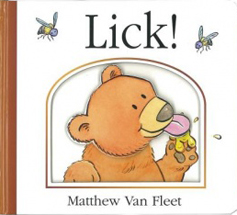
Lick by Matthew Van Fleet
Simon & Schuster, 2013. IS 9781471116254.
(Age 2-5) Recommended. Board book. Read aloud. Matthew Van Fleet has
created a fun interactive book that is perfect for young children.
All sorts of tongues and what they can do are explored in this very
sturdy board book that is sure to please toddlers and amuse the
adult who is reading to them.
Starting with the front cover, the book grabs the interest of the
child with its easy-to-grip pull tab that has a bear with a pink
tongue enthusiastically licking honey. From then on there are
tactile experiences like a scratchy tiger tongue and a sticky frog
tongue, as well as more pull tabs, culminating in a final one where
a baby tiger's tongue makes a razz with an accompanying sound.
The language is great to read aloud, with lots of alliteration and
humour interspersed throughout:
'Daddy tongue tickles,
Teasing tongue Nyah!'.
Cartoon like characters, coloured in warm tones, have a range of
funny expressions that will delight the child who likes to examine
details as well as manipulate tabs. Not only will young children
experience the senses of taste and feel when reading this book they
will also learn about the very different tongues that animals have.
Pat Pledger
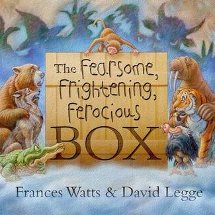
The fearsome, frightening, ferocious box by Frances Watts and David Legge
ABC Books, 2013. ISBN 9780733328916.
(Age: 4+) Warmly recommended. Picture book. Humour. Poetry. A box
falls fromm a truck and is left on the roadside, where a variety of
animals comes and inspects the box, saying that they would look
inside. But as each animal comes by, bragging that they will not be
frightened, they are. First a monkey looks inside and hears the thing
inside moan and tell a little tale of its life. The following double
page shows the area in which it lives, and the reader is invited to
search for the six things hidden on the two pages. Then a crocodile
happens along and he hears the thing inside groan with a similar
poem over the page inviting the reader to find the six things hidden
this time in an arctic landscape. And on it goes, each animal being
scared off by the thing inside and the reader invited to find six
things in a different environment, until finally the lid of the box
is lifted.
This fun involving story, with things for the reader to do on each page,
will entertain those who pick up the book. Legge has successfully
shown each animal in distress as it peers inside and the
environments shown with their hidden animals will entice younger
readers to be involved.
Fran Knight
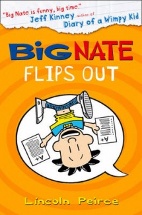
Big Nate flips out by Lincoln Peirce
Harper Collins, 2013. ISBN 9780007478279.
(Ages: 10+) Highly recommended. Big Nate flips out is a
funny, comic-style novel featuring two friends, Nate and Francis. It
includes text and comics to tell the story and is funny and
engaging. Reminiscent of the popular Diary of a Wimpy Kid,
Nate tells his story with a lot of humour and the author uses
descriptive language to help engage the reader. I would highly
recommend it for boys aged 10+.
Nate and Francis take over the Yearbook Committee and as usual,
Nate, the messy one, gets his best mate, Francis, the organised one,
in trouble. Nate has lost the camera? Nate needs to fix it and to
fix it he needs to change. How? With hypnotism of course! Nate
becomes a tidy freak overnight while another friend investigates the
missing camera. But, is being neat all the time going to help him
get his friendship with Francis back on track? Who knew being so
neat could be so boring!
Kylie Kempster
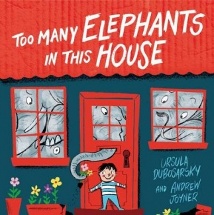
Too many elephants in this house by Ursula Dubosarsky
Ill. by Andrew Joyner. Penguin, 2012. ISBN 9780670075461
(Age: 4+) Warmly recommended. Picture book. Humour. Problem solving.
Eric has simply too many elephants in his house. There are some in
the kitchen, some in the hallway, the bathroom and his bedroom. He
plays hide and seek with them, the one in the bathroom helps him
brush his teeth at night, and the one in the kitchen is an excellent
toast maker. One night Mum tells him that there are too many
elephants in this house and that they must go. So Eric has the
problem of moving his friends out of the house, and he tries a few
different methods to do just that.
The joyous illustrations will make readers smile as they recognise
the friendship between Eric and his playmates. The elephants peering
out of the windows on the cover are enough to entice any reader to
open the book and look inside, and then the parade of elephants will
keep their interest as Eric's problem is finally solved.
The idea of imaginary friends will take hold of the readers as they
recognise the ideas behind the story and puzzle with Eric on just
how to consolidate the elephants in the house. His neat solution
will appeal to the readers. A great book to read aloud, I would
imagine that some teachers and parents will be able to use the idea
to begin discussions with their charges about imaginary friends.
Fran Knight
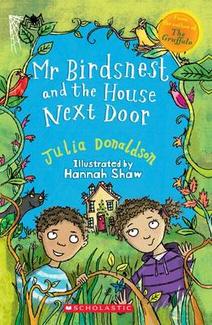
Mr Birdsnest and the house next door by Julia Donaldson
Scholastic Australia, 2013. Paperback 74 p. ISBN: 9781742837109
(Age: 5-8) Highly recommended for lower school children, both boys
and girls. UK Children's Laureate and author of the much-loved The
Gruffalo, Julia Donaldson has produced a terrific read for the
newly independent readers of around 5-8 years. When Elmo and his
sister have to move house because Granny is moving in with them,
they really want their parents to buy the 'jungle house' with its
wild overgrown garden, lion door knocker, monkey patterned wallpaper
and resident big black spider. But sadly their parents choose the
much less exciting neighbouring place, which Elmo calls the
'flowerpot' house. The children look longingly over the fence at the
far more desirable next door residence until the temptation becomes
too much and they begin playing in the wild back garden - after all,
the house is still empty and nobody cares. When they find a rusty
old key in the yard, Elmo and his sister are elated to find it opens
the back door of the jungle house and they can roam to their hearts'
content, pretending the house is their very own. But oh oh, when Mr
Birdsnest decides to buy their house, they are discovered and
banished to their own pristine and boring home - until Granny needs
rescuing and they discover that perhaps having a neighbour in the
jungle house isn't so bad after all.
Younger readers growing in their confidence will love this story
with its fast pace and short chapters. Hannah Shaw's amusing
illustrations break up the text to present an easy-to-read layout.
Sue Warren
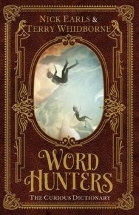
Word Hunters: The Curious Dictionary by Nick Earls and Terry Whidborne
UQP, August 2012. ISBN: 978 0 7022 4945 7. Paperback, 240 pp. RRP:
$14.95
Highly recommended for readers 10 and up who relish a well-paced
exciting story. As a long time fan of Nick Earls' works (often
laughing helplessly when reading them), and a total word nerd, I was
eager to read the first instalment of the Word Hunters
series - a collaboration between Nick and Terry Whidborne.
Al and Lexie are twins from Fig Tree Pocket in Brisbane and as
different as twins could possibly be. Al is a history 'freak' as
described by his sister Lexie, who apparently acquires all her
knowledge from reality tv shows. When Al's pet rat escapes in the
school library and scoots into a hole in the wall amidst the 'out of
bounds' renovations, Al retrieves him but also finds a very strange,
very old book called Walker & Fuller's Curious Dictionary.
Much to the twins' surprise, and indeed dismay, the book
mysteriously and magically transports them back in time where they
find themselves dressed in period clothing in 19th century Menlo
Park, New Jersey - in close proximity to Thomas Edison's laboratory.
It becomes apparent to the twins that they are firstly on the trail
of the history of the word 'hello' and their quest leads them in
turn to a 19th century whaling ship, the Battle of Hastings, the
library at Alexandria and more. From tracing the stable lineage of
one of the oldest words in the world to learning about the origins
of family names, the twins realise they must work together to
survive all manner of sometimes dangerous situations.
Along the way the twins are introduced some very strange characters,
particularly Caractacus, and come to realise that they are not the
only 'word hunters'. Could the mysterious disappearance of their
grandfather somehow be connected with word hunting? Who are the 'H'
characters who have left their initials carved throughout time,
along with tantalising anachronistic clues.
This adventure mystery is lively, funny and enlightening and Terry
Whidborne's steampunk-ish illustrations wonderfully match the style
and pace of the story. Etymology has never been so much fun!
The second in the series The Lost Hunters is now out and the
third in the series War of the Word Hunters is on its way.
Sue Warren
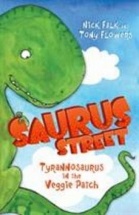
Saurus Street series by Nick Falk and Tony Flowers
Random House, 2013. pbk., ill., RRP $A12.95
Saurus Street 1: Tyrannosaurus in the Veggie Patch. ISBN
9781742756554.
Saurus Street 2: A Pterodactyl Stole My Homework, ISBN9781742756561.
Saurus Street 3: The Very Naughty Velociraptor,ISBN 9781742756578.
Saurus Street 4: An Allosaurus Ate My Uncle, ISBN 9781742756585.
(Age 5-70) Children love dinosaurs. The dinosaur collection was the
largest of my nonfiction section when I was library-based, and it
was the section most visited by my youngest readers. It took very
few visits for them to know where it was and search it
independently. A recent visit to the National Dinosaur
Museum with Miss 6 and 60 Year 1 classmates showed that
the interest has not waned, (and the theft of one of the dinosaurs
overnight just added to the excitement). They were able to get their
tongues around all those names without a hitch - even the
second-youngest little person in my life can point to a picture and
say, T-Rex. Of course, this is not new - we know that students
constantly ask for books about dinosaurs so to be able to offer them
a whole series of them that not only satisfy their interests but
also supports their developing reading skills is bliss-on-a-stick!
This could be the trigger that moves the reluctant reader along to
independence because they WANT to read the stories for themselves.
In the first book, Tyrannosaurus in the Veggie Patch, Jack wishes
for his own dinosaur but you can imagine his surprise when a live
one turns up in his vegetable patch! Much as he would like to keep
it, this soon proves impossible so he and his friend Toby build a
time machine to send it back to the Cretaceous period. Trouble is,
they end up going too! And so the adventures start... In the other
books in the series, Sam, Susie, Tom and Tam all have their very own
encounters that would be the envy of the readers, as well as
teaching them a little at the same time.
The humour is perfect for this age and speaks of an author that
knows just what appeals. The format of these books is perfect for
that 5-8 year old group with a large font which is interspersed with
other interesting fonts that really help that inner voice develop
expression and interest. Short sentences help carry the story along
at a fast clip and the vocabulary is really well-chosen. The speech
of the characters is age-appropriate but there are still technical
words used as well as figurative language that will really appeal.
The story is accompanied by engaging illustrations which contain a
lot of movement and humour and really support the text - there has
been a lot of thought put into their design and placement. Even
though each book is over 100 pages long, the choice and balance of
fonts, illustrations, and chapter lengths make them very accessible
to their target age of K-3. I have three six-year-olds in my life
and I know what is going to be the in-demand bedtime story when they
come to stay these holidays.
Barbara Braxton
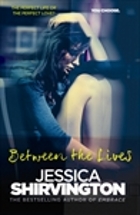
Between the lives by Jessica Shirvington
HarperCollins, 2013. ISBN 9780732296261
Every 24 hours, seventeen year old Sabine lives in either Wellesley,
Massachusetts, or in Roxbury, Boston. How? She doesn't really know
but it has been her reality for as long as she can remember.
In Wellesley she has two brothers whom she prefers to ignore while
in Roxbury she has a little sister that she worships and who
worships her in return. In Wellesley she has money, lots of it, and
all that it can buy. In Roxbury she has attitude, her sister and
little else other than parents who are determined that her life will
be better, read wealthier, than theirs. Between the Lives observes Sabine's overwhelming desire to
live just one life, to be normal, as she is tired of ensuring that
the Sabine of one life doesn't leak into the life of the other. Both
of her lives are believable, her experiences those of a young woman
trying to define who she is and where she belongs, never an easy
task but, in Sabine's case, made doubly difficult.
In both lives Sabine yearns to live only one life and when she
breaks her arm all sorts of possibilities arise. Sabine realises
that she has a chance, or what she hopes is a chance, to determine
her future, to actually choose one life to live. But which life? And
if she is wrong what then?
Shirvington has created an interesting concept which she manages
with adroitness as Sabine risks all. There is just enough detail to
allow the reader to accept Sabine's two lives, her experiences in
each, and her ultimate actions.
And yet would any of us be willing to sacrifice so much, to turn our
backs on a life and everyone in it without a backward glance,
without regrets? People from all walks of life do occasionally do
this in a variety of ways. The one niggling concern is that Sabine's
option shouldn't be seen as an option for those who read her story.
Ros Lange
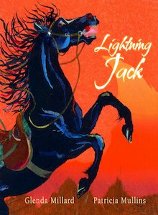
Lightning Jack by Glenda Millard
Ill. by Patricia Mullins. Scholastic, 2012.ISBN 978 1 74169 391 1.
(Age: 7+) Highly recommended. Picture book. Poetry. Horses.
Imagination. In rhyming stanzas the story is told of Lightning Jack,
a magnificent black horse, a gallant, daring and brave horse, that
Sam Tulley wants to ride. He mounts the horse and uses him to
round up the cattle, stampeding down the hillside, and seen by the
overseer, he is offered five hundred steer if he will sell his
horse. The offer is rejected as Sam tells him it is not his horse to
sell, nor the man's to buy. Sam and his horse travel far and wide,
surveying the countryside, being part of other stories, ones in
which horses have a place. So he brings rain to the parched earth
near a farmstead, leaps over Dead Man's Leap when an armour plated
outlaw wants the horse, and rides with Phar Lap as he wins a race.
Each episode in Lightning Jack's life is magnificently visualised
with Patricia Mullins' wonderful tissue paper images, using Japanese
and Indian paper to create the most striking of illustrations. Sam
is astride the horse as it rears across the pages, buffetting the
cattle as he steers them from a stampede, flying out of the clouds
as he brings rain, and winning with Phar Lap by his side.
Sam's imagination leaps as he rides his midnight horse, the
repetition of the last line becoming a refrain through the text
which is alive with imagery, alliteration, metaphor and simile, the
richness of the text and the illustration complimenting each other
to perfection.
This a wonderful book to share, reading it aloud, while the students
repeat the refrain, a book to use to talk about imagination, or
horses, or incidents in Australian history in which horses have
played a part, and reading parts of The man from Snowy River
for comparison. Students will love to look more closely at the
illustrations and see how Mullins has created the image represented
on the pages, perhaps trying the technique for themselves.
Fran Knight