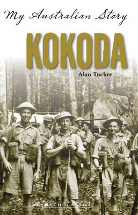
My Australian story. Scholastic, 2014. ISBN 9781743622056.
Recommended for 12 years and above. The 39th Battalion which faced
the Japanese on New Guinea's Kokoda Track in 1942 were militia,
meaning that they were civilian reservists, rather than regular
army. Poorly trained, ill equipped and under resourced, they were
disparagingly referred to as 'Chocolate soldiers' (due to the colour
of their uniforms) and were considered to be second rate.
The amazing courage and endurance displayed by these soldiers who
not only survived intolerable conditions but effectively resisted
the previously invincible Japanese army has earned them a special
place in Australian military history.
With the use of letters, diary entries and chronological narration,
Alan Tucker explains the background events and details to readers
who might be unfamiliar with the legend. Three brothers are
characters involved in masterful storytelling which presents an
authentic and plausible family drama. Oldest brother Harold is
serving with the A.I.F. in the Middle East whilst middle brother Des
has joined the Militia which was destined to be the first to face
the advancing Japanese at Kokoda. Archie, the youngest, suffers from
a stutter and has always been protected by Des but has to grow up
and fend for himself against a bully which imitates what is
happening in the political and geographical theatre of war.
The author employs realistic techniques to progress the story. Des's
reportage of events on the track could not have taken place via
letter as this was impossible under the appalling circumstances but
infrequency and military censorship would have prevented it anyway.
Instead, a blood stained, smeared diary in jaded script finds its
way to Archie who has been charged with recording the family's
wartime experiences. History shows that Prime Minister Curtin did
demand the return of the A.I.F. troops from Syria to help defend
Australia and the reader accepts that Harold and his cohort come to
reinforce Des and his mates on the track. The wounded, exhausted and
traumatised survivors from the 39th really did turn around after
being relieved by the A.I.F. to go back up the track to support the
reinforcements who were facing overwhelming attackers. These details
are well known to older generations but this novel recounts history
to younger readers in a way which reads like a work of fiction, but
it's not, it's true. This book would have great value for studying
literature and history strands simultaneously and I greatly respect
the author for weaving an engaging but educational story with such
care and attention to facts whilst avoiding glamorising conflict.
Rob Welsh
First reader series by Kerry Argent
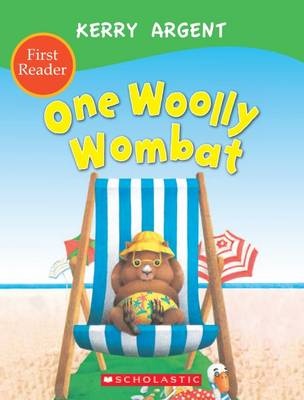
Omnibus Books, 2014. One woolly wombat. ISBN 9781742990477. Hide and seek. ISBN: 9781742990491 Best of friends. ISBN 9781742990484. At the beach. ISBN 9781742990507.
(Age: 4-7) Highly recommended. Early reader. Australian animals.
Counting.
A lovely set of four early readers showcases Wombat of One
woolly wombat fame and is ideal for young children just
beginning to read. What makes the series so outstanding is the
quality of the illustrations which make the stories come alive. Full
of humour, the entertaining stories will be a delight for any child
learning to read. There is a short line of text to each page and the
story lines are amusing and enjoyable and the settings are ones that
would be familiar to children. One woolly wombat is a counting book that goes to the number
14 and highlights Australian animals in funny situations. Argent
uses of a variety of words that do not condescend to the young
reader, who will have no trouble remembering them after the book has
been read a couple of times. The illustrations add humour to the
entertaining book. At the beach is the story of Woolly Wombat and his loveable
friends, including Bandicoot, Koala and Platypus. They have great
fun swimming, although there is a big surprise in the water, and
Wombat likes to make sand castles as well. In Hide and Seek, Wombat has lots of fun hiding from his
friends, but of course when the picnic food is brought out, he
decides that sometimes hiding is not the best option.
The complexities of friendship are explored in Best of friends.
Argent shows all the reality of being friends, like eating together
and playing together, but also the fact that sometimes best friends
fight but always make up.
Quality illustrations and superb story telling make this series
ideal for young readers.
Pat Pledger
Black Warrior by Tiffiny Hall
Harper Collins Australia, 2014. ISBN 9780732294557. Black Warrior completes the series starring Roxy Ran
following on from White Ninja and Red Samurai and is probably best
read with at least some knowledge of the content of these books. As
with the rest of the series the focus is on developing confidence
and self belief with a strong emphasis on taekwando, for which the
author has a black belt and writes about with some authority.
Roxy and sister Electra are learning to live together after Electra
emerged as a samurai, sworn enemies of the Ninja clan. Cinnamon,
Roxy's best friend is training and losing weight and planning Roxy's
fourteenth birthday party, Jackson is still as gorgeous as ever,
Hero the bully is being bullied and the school is still divided into
Gate One and Gate Two students.
Trouble begins with a fire and crater at the front of the school.
There is unrest in Lanternwood, caused by the disappearance of many
citizens and a tiger dragon with blazing blue eyes threatens Roxy.
Determined, to find out the truth about her real father, Roxy and
her mother continually clash but when Cinnamon disappears during
Roxy's party she is desperate to find her. But when she Cinnamon
returns she is far from the friend of old.
Many truths about the characters are revealed as the Ninja and
Samurai clans are forced to join forces to save Lanternwood and Roxy
comes face to face with her real father who is bent on revenge. In
an exciting climax Roxy needs to face her fears without her Ninja
powers to rely on.
As the final in the series many of the issues raised in previous
books are rounded out. Hero, often referred to as a mummy's boy, is
revealed as being the sole carer for his mother, who is suffering
from advancing dementia. Roxy's mum finally agrees to marry Art, and
Jackson talks about his brother Morgan who has Leukemia. And finally
the symbols of difference and discrimination, Gate One and Gate Two
are destroyed.
Sue Keane
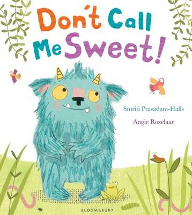
Don't Call Me Sweet by Smriti Prasadam-Halls and Angela Rozelaar
Bloomsbury Children's Books, 2014. ISBN 9781408838822.
(Age: Pre-school - 6) Recommended. Monsters. Humour. Fear. The
little monster believes that he should be called Scary not Sweet,
because he likes to stomp around, get covered in mud and become very
stinky. He also loves to cook bug eye stew, gets splattered with goo
and becomes very slimy. All good reasons to be called Scary and not
Sweet. But when he meets an ogre he decides that he not scary,
stinky or slimy but rather sweet.
This is a fabulous read aloud for young children. With its
alliteration, rhymes and rhythm it is perfect to listen to and there
is enough repetition for children to chime in with the refrain,
'Call me Scary . . . Don't call me sweet!' Some of words are in bold
upper case letters and these too are perfect for young children to
call out with the reader. All of this makes for lots of fun as a
bedtime story or for a story for children just becoming independent
readers.
The illustrations by Angela Rozelaar are very humorous. Little
Monster has one tooth sticking up in his smiley mouth, and one tooth
sticking down, giving him a cute appearance which children are sure
to love. The drawings add to the story as Little Monster reads a
book on how to be scary, and when he makes bug eye stew the bugs are
shown in jars, with a terrible mess going on as the stew is made.
Every so often the pictures are on a double page spread which the
reader has to turn around to look at and this gives variety to the
story as well as showing wonderful drawings of the monster.
Little Monster really wants to be taken seriously, especially as all
the older monsters want to pat his head and think that he is cute.
When he is faced with a bigger monster, the ogre, he has to decide
how to get himself out of danger and stand up for himself against
the bad, hairy giant.
Sure to become a favourite, Don't call me sweet is a monster
tale that is full of fun.
Pat Pledger
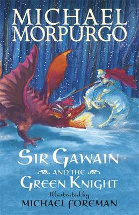
Sir Gawain and the Green Knight by Michael Morpurgo
Walker, 2013. ISBN 9781406348880.
Knights of the Round Table, amassed under the famed King Arthur's
rule, were legendary as being the finest and fiercest Knights of the
Kingdom of Britain.
Worthy Knights, to this day, wear a silken belt. Why? The answer
lies with the tale of the chivalrous and courageous nephew of King
Arthur, Sir Gawain.
Stronger in battle than any other, honest and true, Sir Gawain
stepped up to the challenge thrown down by the dreadful, murderous
green man, on his huge green steed, who dropped in on Camelot,
brandishing a gargantuan battle axe, just as their New Year's Eve
feast was about to commence.
Terrible to behold, the Green Knight challenged Sir Gawain to strike
his head from his shoulders with his weapon. But, the rules of the
'game' were such that the Knight must agree to seek out the Green
Knight of the Green Chapel twelve months and a day later, and submit
to a 'return match', this time with the Green Knight wielding the
massive axe.
As the next New Year approached Sir Gawain valiantly bid Camelot
farewell and journeyed alone in search of the Green Chapel.
Travel-weary and hungry he came upon a magnificent Castle, where he
was welcomed, feasted and entertained for several days.
The very hospitable Lord of the Castle took his men hunting on three
days, leaving the quite perplexed Gawain in the company of the
Castle's ladies.
Why did the Lord's beautiful wife try to entice Sir Gawain into a
love situation? Did the dazzling green belt really possess magical
powers? And who was the ugly old crone who seemed to be forever
watching the young Knight?
Eventually the day of his appointment with the dreaded Green Knight
dawned, and, leaving the Castle with much trepidation, Sir Gawain
rode to his rendezvous with destiny at the Green Chapel.
Who really was the Green Knight?
Joan Kerr-Smith
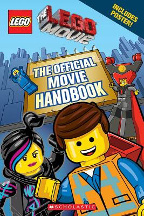
The Lego Movie: The Official Movie Handbook by Ace Landers
Scholastic, 2014. ISBN 9780545624626.
(Age: 8+) The Lego Movie: The Official Handbook introduces fans to
the characters in the movie, using comics and text to engage its
readers. It is not a novel or story but a variety of texts that
introduce us to the Lego world - Bricksburg.
Fans will meet and learn about the movie characters, find a poster
inside and a read a sneak peak about the movie.
Any Lego Movie fan will enjoy it and independent readers aged 8+
will find it a lot of fun.
Kylie Kempster
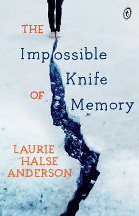
The Impossible Knife of Memory by Laurie Halse Anderson
Text, 2014. ISBN 9781922182227.
(Age: 14+) War is something which many teenagers have little
experience of. High school students in Australia are required to
study historical events relating to that violent three-letter word.
It is a distant concept for many young people in this society, but
even more foreign to young people is the lasting impact of war on
returned soldiers. The Impossible Knife of Memory is
concerned with the after-effects, providing insight into the
psychological battles returned soldiers and their families face.
Our narrator, Hayley, is familiar - a sarcastic, defensive outsider.
For eight years she has been 'un-schooled' by her single father, an
Iraq war veteran. The book maps her re-adjustment to conventional
school after this period of nomadic travel, and her struggle to
reconcile her difficult, turbulent past.
This is a strong, hard-hitting novel in many ways. The characters
are human, dynamic and relatable, the prose itself at times poetic
but always with a realistic edge. The extensive dialogue is one of
the highlights, as I find much writing fails to effectively
incorporate conversation into the narrative. The tension builds
gradually and relationships develop in a highly entertaining way
throughout the book. Of course, as hinted earlier, the psychological
impact of war lingers as an obstacle for Hayley, with her own
adolescent issues mirroring her father's post-service trauma. The
only obvious let-down is the unnecessary use of 'text-talk' early in
the story as Hayley establishes relationships with peers at her new
school - this style is inconsistent with the overall serious tone. The Impossible Knife of Memory works as both a solid piece of
writing for young adults and a meditation on the emotional side of
war not often exposed to young people in study of the topic.
Henry Vaughan (Student)
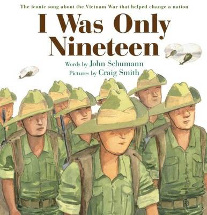
I was Only Nineteen by John Schuman
Ill. by Craig Smith. Allen & Unwin, 2014. ISBN 9781743317235.
The banner across the top of the cover of this book says, 'The
iconic song about the Vietnam War that helped change a nation' and
indeed, anyone who has heard the original with the haunting voice of
John Schuman as the lead singer of Redgum will find that echoing in
their head as they 'read' this picture book version of the song that
brought the realities of the war to a generation. If you are
unfamiliar with it, it's available on You Tube .
While, for the first time in history, war was brought into the
family living room through the immediacy of television news
programs, it was the personalising of what was happening through the
lyrics of this song that not only provided a real insight but which
has also endured. In fact, along with the picture
of the little girl running naked from her village after it had been
destroyed with napalm bombs it would be one of the most-recalled
memories of that time. It's refrain and final line, 'God help me, I
was only nineteen' encapsulates it all. Both the words and the
sensitive, evocative images of Craig Smith show that war is the
antithesis of the great adventure that these soldiers' ancestors
thought that it would be as they hastened to answer the call of 1914
and which will be in our thoughts as we move towards the
commemoration of ANZAC Day.
But this is much more than another picture book about Australia's
war effort to support the national history curriculum.
As one of those who was very much involved in the events of the time
and worked towards the big-picture objectives of not only having
Australia and New Zealand troops out of Vietnam because we were
against the 'all-the-way-with-LBJ' policies of the prevailing
governments but also against sending young men to war who, in their
own country could not vote or legally have a beer, we did not
consider or understand the effects our actions would have on those
young men when they eventually came home, mentally and physically
wounded, and to have served in Vietnam was a secret and a shame.
There were no parades or celebrations - you might talk about it with
your mates to keep you sane but that was all. There was no respect
from the public and each soldier was somehow held personally
responsible for the events which we saw each night. (If you, as an
adult, want a greater understanding, read Well Done, Those Men
by Barry Heard and Smoky Joe's Cafe by Bryce Courtenay.)
And so we have the situation today that many of our students have
grandparents who are perhaps not as they should be and cannot
explain why. They saw and did things that no 19-year-olds should
ever have to and it is their experiences, their illnesses, their
PTSD, their suicides that have changed the way we now view our
serving forces and how they are treated and supported when they come
home. The picture books and television shows always stereotype
Grandpa as being loving and jovial and every child deserves such a
person - the production of this book might help them understand why
theirs is not. It has an important role to play in helping our
little ones understand.
If just the lyrics or the clip of the original 'I was Only 19' were
the only ones used in a study of the Vietnam War, the story would
not be complete. It is through Craig Smith's final illustrations of
the young soldier now a grandfather with his grandson ducking from a
chopper, then sharing an ice cream and finally marching on ANZAC Day
together that are critical because they show that while he is still
troubled by his experiences, he has survived and 40 years on society
has moved on to a new and different attitude. For that we have to
thank the continued and sustained efforts of all those Vietnam Vets
who would not let us forget. We salute you now as we should have
then.
For those who see this as a teaching opportunity, there are
teachers' notes available.
Barbara Braxton
Editor's note: I highly recommend this for Age 6 - Adult. Pat Pledger
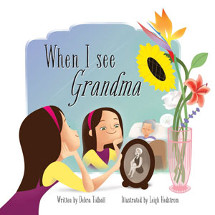
When I See Grandma by Debra Tidball
Ill. by Leigh Hedstrom. Wombat Books, 2014. ISBN 9781921632594.
(Age: 5+) Recommended. Alzheimer's. Death. Grandparents. In this
heart wrenching but uplifting story, a young girl visits her Grandma
in her nursing home with her family. While her young brother plays
antics and makes the nurses and residents laugh, she brightens
Grandma's dreams by reminiscing with her. Important events in
Grandma's life are celebrated. Grandma loved singing so the young
girl sings her a song for her to dance on. She loves to brush her
hair and so did Grandma, so she brushes her hair, 'for her dreams to
dazzle on'.
Using the joyful illustrations by Leigh Hedstrom, the reader finds
out more about Grandma's life as a young girl when she was in the
war, got married, had children and then grandchildren. Each double
page spread has a picture of what is happening in the nursing home
and on the opposite side is a loving picture of grandma enjoying
life and then finally the family kissing her goodbye and she floats
off into the light to meet her husband.
This is a very moving book dealing in a most thoughtful way events
that many young children would be going through. It offers children
a way of coping with a beloved grandparent's slide into oblivion and
a way to rejoice a full and happy life. Proceeds from the sale of
this book will be donated to the Hazel Hawke Alzheimer's Research
and Care Fund.
Pat Pledger
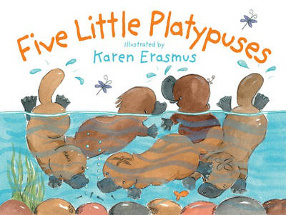
Five Little Platypuses ill. by Karen Erasmus
Hachette Australia, 2014. ISBN 9780734414908.
Pre-school children and parents will enjoy this Australianised
version of the old and familiar story of the Five Little Ducks who
go out to play but fail to return.
In this case the five little platypuses go out over a puddle, creek,
lake, river and billabong, but when their mummy platypus calls,
Come back here!' less and less appear until Mummy is left sad and
alone.
It is only when she calls 'Please come home!' that the baby
platypuses come home one by one to give her a cuddle.
The muted colours of the illustrations are reflective of the
Australian environment. The rocky river bed seen through clear water
and the cute, chubby little platypuses are sure to elicit a smile
from the reader.
The use of coloured writing to highlight the number of platypuses
and Mum's spoken language offer cues for early readers to focus on
in a choral or supported reading setting. The varying water types
also give the opportunity to discuss the differences say between a
river and creek or a lake and billabong.
Sue Keane
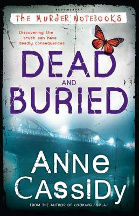
Dead and Buried by Anne Cassidy
The Murder Notebooks 4. Bloomsbury, 2014. ISBN 9781408815533.
(Age: 13+) Murder. Assassination. Thriller. After the horrible
events in Butterfly grave, the third in the Murder notebook series,
Rose is keen to get on with her life. She makes a break with Joshua,
her stepbrother, but everything is disrupted when Police Officer
Henry Thompson calls to tell her that the body of a young girl has
been found buried in the bottom of the garden where she and Joshua
once lived. With her mother Kathy and stepfather, Brendan,
implicated in the murder, Rose once again joins forces with Joshua
to clear their parent's names.
This is a thrilling finale to the series as Rose and Joshua try to
work out who has murdered the girl who was buried in the garden. As
they follow clues to this murder, they also have to work through
their own complicated feelings for each other and the quest to find
their missing parents. Cassidy raises some interesting questions
about the morality of the actions of Kathy and Brendan, and whether
they and the other members of the group should go about
assassinating people, even if they are disgusting criminals.
There is plenty of action, a mystery within a mystery, and a clever
tying up of all the details. This is a satisfying conclusion to an
interesting murder mystery series and fans of the series are sure to
enjoy how it all ended.
Pat Pledger
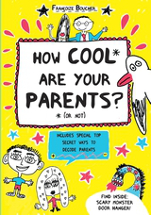
How Cool are Your Parents? (or not) by Francoize Boucher
A&C Black, 2014. ISBN: 9781472904720.
Recommended for 9-11 year olds and any teenager who needs a reality
check about their parents, or parents who need to laugh a little at
their life.
What parent would not want their child to read this book! Not only
is it easy to read, the colours are bright and eye catching and the
cartoon like illustrations highly entertaining, it is an affirmation
of all things that make parents, well parents. And as every parent
knows, they are cool, (I do have to declare some vested interest
here). It's their kids that need reminding.
From reassuring the reader that all parents are pretty similar the
message is to listen to them and seek their advice because they
offer love unconditionally and are doing everything they can to
bring you up properly. Their good points, the things they do for no
return, love, accommodation, food, taxi and banking services, are
extolled in glorious fluro colours. Poor old Santa is seen as a
conman and couch potato for his one day a year input.
The bad news is also revealed. Super-Perfect parents don't exist.
However the reasons for their annoying habits, for example the
insistence on good manners, cleanliness, healthy eating and getting
a good night's sleep are all given space with illustrated examples
of a likely alternative outcome. The terrible parent diseases of
Severe Anti-trustitis and Fedupwithbeingadultitis are explored in
full.
The suggestions on how to make parent, child relationships better
are worth taking, however presents on Mother's and Father's Days made
of pasta was a step too far for this parent.
What an engaging and fun way for all ages to explore the important
relationships between children and parents and promote some
understanding and appreciation of the hard work parenting can be.
Sue Keane
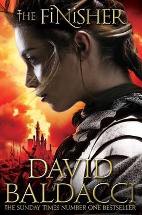
The Finisher by David Baldacci
Macmillan Children's Books, 2014. ISBN 9781447263005.
Recommended for readers 11 years +. Themes: Fantasy, Adventure. The
Finisher revolves around the life of a 14 year old girl named Vega
Jane, and her life in the small village of Wormwood. Life in
Wormwood is portrayed as bleak for most of its residents and Vega's
situation is similar to reality for girls of her age in many parts
of the world. She is considered moderately well-educated having
attended 'Learning' until she was 12 at which time she secured an
apprenticeship in one of the village's few industries. At Stacks she
works as a 'finisher' who applies the final touches to luxury goods
intended for sale to Wormwood's few affluent residents. We learn
early in the story that Vega's parents have fallen into a mysterious
coma and are in a nursing home leaving her to support her younger
brother John.
Wormwood is surrounded by a wild land known as The Quag which is
inhabited by all manner of terrifying monsters. Entry in to The Quag
has been deemed so dangerous that it is illegal and this, combined
with an overwhelming fear of the monsters within, prevents residents
from ever trying to leave Wormwood. The Finisher opens with Vega witnessing her mentor at Stacks fleeing
into The Quag, pursued by village officials. He leaves her a number
of hidden items including a map and a journal which lead her to
believe that there are worlds beyond The Quag. This story has many
twists as more of Wormwood's mysterious past is revealed. Vega is a
strong female character whose resilience and determination elevate
her from the life of mundane factory worker to village heroine.
Author, David Baldacci, has published 27 novels but is famous
primarily for his adult works, several of which have been adapted
for film and television. David is also noted for his philanthropic
activities, in particular the Wish You Well Foundation established
by he and his wife to promote family and adult literacy in the
United States. The Finisher is an excellent example of fantasy/adventure genres for
children aged 11+ and while I have been unable to find any mention
of it being the first in a series, the open ending and a number of
unanswered mysteries lead me to believe that this is the author's
intention. Fans of the children's series Monster Blood Tattoo by
D.M. Cornish are likely to be equally as intrigued by The Finisher.
Nicki Paterson
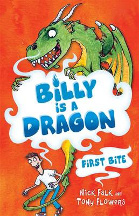
Billy is a Dragon: First Bite by Nick Falk
Ill. by Tony Flowers. Random House Australia, 2014. ISBN
9780857983053.
(Ages: 9-11) Recommended. Billy is an ordinary, nearly 10
year-old boy to whom something amazing happens with hilarious
consequences. It starts with a trip to Benny's Pet Shop, and an
irresistible desire to pat a Drag-ON lizard.
When the lizard bites him on the finger pandemonium ensues, Mum is
furious and his sister Becky thinks he will infect everyone. Only
Bertha the dog shows him any sympathy. When his finger continues to
swell the next day, Billy disguises it from the family with
gardening gloves and heads off to school.
Things go from bad to worse at school as Billy begins to change into
a Dragon. He burps and sets fire to the teacher's hair before
escaping to the toilets where his transformation is completed. He
narrowly escapes through the window with the aid of his best friend
Jeanie who takes his transformation with remarkable aplomb, and
discovers the joy of flying.
After taking shelter at home in his sisters bedroom, he is captured
by his father who decides to sell him to the zoo. Chaos continues to
follow Billy and his only option is to return to Benny's Pet Shop to
try to find a solution, predictably provided by the bite from a
Drag-OFF Lizard, and some answers provided by Benny.
The hilarious, cartoon like illustrations by Tony Flowers add much
to the enjoyment of this book. The reader can not only follow the
story through the larger illustrations, including an anatomical
explanation of a bully and complex scientific representations of a
dragon, but the small cartoons around the edges will appeal to any
aged reader.
Like many modern books, there is an extensive use of different font
and lettering styles to highlight individual words, which not only
enhances the text but also serves to break up a continuous page of
writing which supports the less confident reader.
Sue Keane
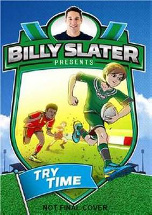
Billy Slater presents: Try Time by Patrick Loughlin
Ill. by Nahum Ziersch. Random House Australia, 2014. ISBN
9780857982469.
(Age: 9-11) In the world of Rugby League Billy Slater is a star. The
Melbourne Storm player who has played over 250 games is in the best
place to act as mentor to junior players, the role he plays in this
new series obviously aimed at 9-11 year old rugby enthusiasts.
Josh Brown is about to begin playing his first season of league for
the West Hill Ravens Under 11 side, having spent all summer
convincing his mother to let him play. His footy mad grandfather
accompanies him to his first match as mum is busy with the baby and
Dad is away working. Josh's biggest problem is a severe case of
nerves, and an overly enthusiastic and vocal grandfather who only
wants to help. When he drops a crucial pass he feels that losing the
game was his fault.
Things go from bad to worse when granddad is involved in a fight and
is evicted from the sidelines. Josh's nerves on the field continue
to grow until the butterflies are elephant sized causing him to drop
the ball. The negative comments of his teammate Corey do not help
and Josh decides to give up footy altogether.
Billy Slater, Josh's all time footy hero, is recruited by the coach
to act as team mentor. He spends time at training giving Josh extra
passing practice and advice on how to overcome his nerves during a
game and enjoy the sport.
The forward at the beginning of the book by Billy Slater herald the
themes of the story, being involved, persisting when things go wrong
and enjoying the game. Scoring and winning isn't everything. The
player profiles familiarise the reader with Josh's teammates and
Billy's tips on Tackling and Catching a Pass, support the advice
given in the story.
Rugby enthusiasts will enjoy the game details and tips, though the
general advice can apply to any team game, but all students will
understand the pressure and disappointment Josh feels when his dream
start to footy is not realised and things do not work out quite as
he planned them.
Sue Keane