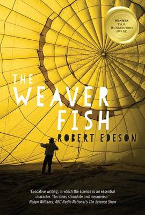
Fremantle Press, 2014. ISBN 9781922 089526.
(Age: Adult and mature secondary readers). Norwegian-British
logician, linguist and dream theorist, Edvard Tossentern disappears
when a research balloon is lost over the South China Sea. He was
investigating the weaver fish, named for their method of killing.
When he reappears, he has changed. This section of The Weaver
Fish is written as an academic mystery, with occasional
footnotes, and will also draw in readers of non-fiction.
The book becomes a thriller almost halfway through when it changes
its focus to the character of Richard Worse. Like many of the other
characters, he is quite stylised. He seems to be a spy with
exceptional technical and mathematical ability. He joins forces with
Millie Misgivingston to find her brother. The storylines merge.
Names intrigue in this novel: one character is called Spoiler,
another Walter Reckless. There are also a range of text types,
including reports and letters. The fabricated Foreword and
Acknowledgement pages set the tone for an extraordinary and
exhilarating reading experience by debut novelist Robert Edeson,
whose background in mathematics and science create a novel of
cutting-edge conception, style and structure.
Joy Lawn
Little Lou and the woolly mammoth by Paula Bowles
Bloomsbury, 2014. ISBN 9781408839669.
(Age: 4+) Picture book, Humour, Friendship. Even when surrounded by
a gaggle of toys, Little Lou is lonely and wanting a friend to play
with. Following a long piece of wool through her bundle of one time
friends, she tosses aside her toys, Olly Owl, Sock Monster and
Stripey Whale, only to find that the wool will not come to an end.
She tugs and tugs but all to no avail. She then follows it high and
low, around and around till she finds that it comes to a tangled,
messy end.
She finds a huge woolly mammoth and then must run as it follows her
around and around, zig-zagging around the room, until it starts to
unravel. Little Lou is thrilled with the small mammoth and runs to
pick it up, but this time it is the mammoth who runs from Little
Lou.
But all ends happily as the two become new best friends.
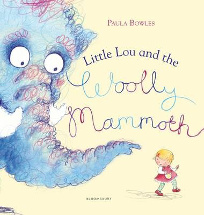
A lovely text with words in bold, begging the reader to put a stress
on these, while following the long thread of wool as it winds around
the pages in blues and mauves.
The soft watercolour and pencil illustrations suit the story well,
underlining the range of toys in Lou's bedroom, creating a huge
mammoth on the early pages and paring it down to a manageable size
as the story proceeds. I particularly liked the afternoon tea set
out on the endpapers, and the expressions on the faces of the
rejected toys.
This is a charming tale of friends and friendship, suitable for
pre-school readers in groups or alone.
Fran Knight
Aussie Kid Heroes by Dianne Bates
Ill. by Marjory Gardner. IP
Kidz , 2009. ISBN 9781921479144. ebk ISBN 9781921479779.
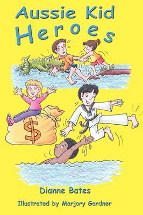
Do your students know the story of Alice Betteridge who became the
first Australian child with both hearing and sight disabilities to
learn to communicate? Or that of Jessica Hahn who won a special
achievement award in the open employee section of the Business
Enterprise Centre Business of the Year Award at the age of eight?
Perhaps the name of Jenny Turrel is more familiar - she was the
youngest Australian to win a medal at the Commonwealth Games,
winning gold for swimming at just 13 years and eight months.
Australia has a rich heritage of extraordinary children doing
amazing things and many of their stories are captured here in this
intriguing book by Dianne Bates. And each of them is just like any
child anywhere, even those in your school. Arranged under headings
such as Inventors and Designers, Caring Kids, and Enterprising Kids
each entry provides a snapshot of the child's achievement, enticing
the curious reader to find out more, perhaps even inspire them.
So often, by the time they get to middle school our students see
their lives being dominated by school and 'projects' and homework
with no end in sight, so this book is perfect for showing them that
there is a world beyond the classroom walls and it is possible for
them to have an impact on it. As the centre of a display it could be
the impetus to have your students share their lives beyond the 9-3
regimen - perhaps you have someone who cares for a parent, or is a
champion skier, or is a budding speleologist. Whatever their
passion, it is a great opportunity to let them demonstrate their
expertise, maybe become the school's go-to person and lift their
self-esteem to new heights! Combine with a research challenge to
discover more about the stars of this book and you have a very
useful resource for the collection.
Barbara Braxton
Jam for Nana by Deborah Kelly
Ill. by Lisa Stewart. Random House, 2014. ISBN 9780857980014. When Nana makes pancakes, Granddaughter spreads the jam. She smooths
it right out to the edges to make the pancake look like a giant
orange sun. But today's jam is not like the jam that Nana remembers.
That jam tasted like the sun, not just looked like it. She could
count the apricots and feel the warmth of a hundred summers.
Granddaughter really wants to give Nana that sensation again but
when it becomes clear that it's impossible to travel back to Nana's
childhood, she comes up with another idea . . .
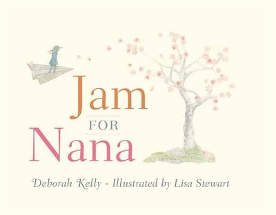
The bond between a grandmother and her granddaughter is really
special - I know because I have four of them - and this delightful
story with its gentle pastel-toned illustrations is an example of
it. It shows the love and connection that is so common but doesn't
stereotype the grandmother as an elderly lady with a bun spending
her days knitting. Coupled with other books in the library's
collection, it would add another layer of the diversity of
grandmothers, who they are and what they do, providing a great
foundation for exploring the early childhood Australian Curriculum
history concepts about family members, where they fit in the
structure of the family and their history. Today's grandmothers
might not make their own jam but this story would be a great way to
tap into what their lives were like as granddaughters and what they
recall their grandmothers doing that is not done now, as well as
those family traditions that are continued. Maybe they could
speculate on those things they do now and the memories and moments
they've had with their grandmothers that they might pass on to their
own grandchildren. Jam for Nana is about so much more than having real jam on
pancakes - it is the key to a door that will open a myriad of
memories and strengthen the bonds between the generations for those
lucky enough to have a family history that can still be told.
Barbara Braxton
Admission by Barry Jonsberg
Pandora Jones, Bk 1. Allen & Unwin, 2014. ISBN
9781743318119.
(Age: 14+) Highly recommended. Thriller. Dystopian fiction.
Pandemic. Survival. Pandora Jones wakes up in The School, weak and
disorientated. She remembers horrifying scenes of death, people
bleeding to death and Melbourne dying from a pandemic. The School is
a heavily guarded place where talented survivors have been placed
and where they are expected to hone their skills, both mental and
physical, and prepare for what will come next. Pan's special skill
is intuition, but her intuition begins to lead her to questioning
what is happening around her.
Working with a talented group of eight young people, including
Nathan a talented runner and leader, Wei-Lin, who uses her archery
skills and Cara, an introspective young woman, Pan begins to adjust
to life in The School. Haunted by terrifying nightmares of a
policeman putting a gun in his mouth, her mother and brother
coughing up blood and dying, and a chase through the streets, she is
hard pressed to work out what is a memory and what is a nightmare.
Jonsberg brings his great writing talent to good use with his vivid
descriptions of The School and the way it operates and the people
who live there. Survival is the key and the group have to work very
hard to learn how to fight and to become very fit under the
direction of seemingly uncaring instructors. After the death of one
of their team in mysterious circumstances, the group is taken to an
island where they face men with guns and have to struggle to stay
alive.
The story is action packed and very easy to visualise as a movie or
TV series. With its engaging characters, involving plot and a cliff
hanger of an ending, it is sure to appeal to its teen readers who
will be gasping for the next instalment in the trilogy. Definitely a
book for those who enjoyed The hunger games series by
Suzanne Collins or The maze runner series by James Dashner.
Pat Pledger
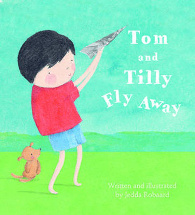
Tom and Tilly fly away by Jedda Robaard
Black Dog Books, 2014. ISBN 9781922179906.
(Age: Pre school) Warmly recommended. Friends. Adventures. Tom and
his friend Tilly have the most amazing adventure. Tom makes a paper
plane and together they fly over the roof (the sea of lost things),
the garden bed of dandelion (the roaring lions), then the hen house
(the fortified fort) as well as the haunted house and the deafening
thunderstorm, just missing the rain to be home in time for tea. Each
of the things they are involved with will be readily recognised by
the audience, and so evoke lots of fun and laughter as they see the
joke of the two on their adventure.
Young readers will love seeing the use made of the map, the familiar
things in their house and backyard as the pair flies over them all,
and be as happy as they to be home for tea.
The instructions for making a paper plane are a fitting end to the
story and will make an extended activity once the book is finished.
For classrooms or home activities this will be a boon for reading
out loud, for making the plane, and for discussions about maps and
travel. Tom and Tilly fly away is the second in the series
of books about the pair.
Fran Knight
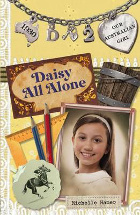
Daisy all alone by Michelle Hamer
Our Australian Girl series, Book 2. Penguin Australia, 2014. ISBN
9780143307648.
(Age: 8+) Highly recommended. The Our Australian Girl
series and characters have been extremely popular with girls 8 and
up who are looking for an exciting and adventurous read. The concept
was originally Jane Godwin's when she was dismayed that girls in the
8-12 age bracket lacked worthy books that would engage them without
the 'tween' fluff so common in most of their reading. In 2014 two
new characters have been introduced - Daisy and Pearlie. Each series
is set in a different period of Australian history and Daisy is the
1930s' girl - and not one of the fortunate ones.
Separated from her dad, and then extended family, Daisy finds
herself homeless and alone in a grimy and dangerous Melbourne far
removed from her original country home. Despite the efforts of her
two friends to find her some temporary shelter, Daisy is snatched
off to the Melbourne Orphanage (although she is not a 'real' orphan)
with dozens of other homeless Depression children. Following a
daring escape along with two other unfortunate inmates, Daisy is
returned to the grim orphanage and is left without hope of ever
being reunited with her father and sister. With two more to come in
Daisy's story and the teaser of her being adopted in the next book,
readers will want to continue with the unravelling of Daisy's
dilemma.
These books are perfect for the age of the intended audience and
whilst not sanitising the troubles of the relevant history of their
setting, keep the more graphic details out of the storytelling.
Readers will gain an understanding, in this case, of the effects of
the Great Depression as well as the population's obsession with the
mighty Phar Lap and the Melbourne Cup.
A highly successful project which has kept many young readers fully
engaged, this and others in the Our Australian Girl are highly
recommended for girls 8 plus.
Sue Warren
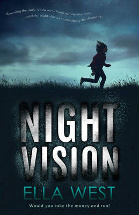
Night Vision by Ella West
Allen and Unwin, 2014. ISBN 9781743317662.
(Age: 11-14) Highly recommended. Reluctant readers. Mystery and suspense.
Thriller. Ethics. Farm life. Xeroderma Pigmentosum. Viola was born
with a deadly genetic condition, known as XP, which makes sunlight
cause irreversible damage to the body. Most sufferers don't last
until adulthood so Viola has to be very careful. Living on a remote
farm, she has the run of the property, although it is at night that
she roams into the forest. One night when wearing her night-vision
goggles she spies on a man who is disposing of a body from the back
of his car. He then buries something under one of the trees. Viola
is faced with some difficult decisions. Should she report the
murder? Should she use the buried money to save the farm? What will
happen if the murderer finds out about her?
Told in the first person by Viola, the reader is taken on a
suspenseful and thrilling journey as she sees the horrific burial of
the man. When her photo is shown in the local paper the criminal
realises that she may have seen him and taken the money. He leaves
threats and Viola has to take action.
Viola's voice is an engaging one. The reader learns about her
condition and the limits that it puts on her but she is never
negative. Instead the reader is brought into a new world that is
explored after dark. Farm life is authentically described and Viola,
despite her condition, is a useful helpmate for her father with
managing the sheep on the property. Her music too permeates the
story giving it a depth that is unusual in a novel of this size (180
pages).
The ethics of whether Viola should keep the murder secret and use
the money to help her parents is highlighted but it is left up to
the reader to make their own decision about what is the right thing
to do.
The length of the story and the tension that is maintained
throughout makes for an exciting read that would be ideal for
reluctant readers.
Pat Pledger
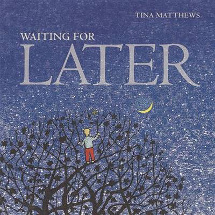
Waiting for later by Tina Matthews
Walker Books Australia, 2011. ISBN 9781922077035.
(Ages 5+) Warmly recommended. Picture book. When Nancy goes
searching for someone to play with her or read her a story, or play
cards, or give her a swing or tickle her, she is rebuffed by them
all. Mother and father are too busy, her brother is cooking, her
aunt hanging out the clothes and grandfather is busy mowing the
lawn. All tell her that they are too busy and to come back later.
'Later' is the refrain on each page as Nancy looks for
companionship. Instead she climbs a tree, finding that the leaves
tell her a story and the limbs allow her to swing from them, and the
leaves tickle her as she swings. All the things she wanted from the
others she is getting for herself in the tree.
The story promotes several messages with an underlying subtlety.
Parents and family ignore the child to the detriment of all. Many
students reading this will tell stories of how their parents have
not enough time for them, and the story asks people to re-evaluate
their time spent with their children. But Nancy finds she is able to
fend for herself, able to fill in her time by herself, able to
occupy herself without the family. This too will be a telling
discussion point with students. What is there that they can do by
themselves? Do they need an adult or older sibling with them? But
like all good stories, the family is reunited at the end, each
learning something that will enhance family life.
Each page is illustrated using a Japanese woodblock technique giving
the story a grounding in the familiar, the home and garden. Shown in
wonderful detail, the illustrations beg the reader to notice and
talk about what they see. The New Zealand author, Tina Matthews, a
passionate promoter of the Free Range Kids movement seeks to advance
her cause in the best of ways, through a simple and warm hearted
story of a family. And now in a paperback edition will be available
for all libraries.
Fran Knight
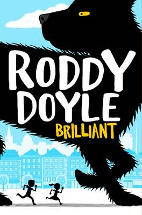
Brilliant by Roddy Doyle
Macmillan Children's Books, 2014. ISBN 9781447248804.
(Age: Middle primary) Depression. Dogs. Magic. Supernatural. The
prologue of Brilliant creates the atmosphere of this story.
The animals can talk and the sense of foreboding is established as
the 'black dog' of the recession threatens to destroy the 'funny
bone' of Dublin. That this is to be a quest to destroy the evil of
the black dog is confirmed and 'Only the city's kids could do that.'
The reader is then introduced to the Kelly family, in particular
Gloria and Rayzer (Raymond) who like to creep down at night and hide
under the kitchen table and listen to the adult chat. However when
the chatting turns to mumbling they know something is wrong,
'mumbling was different.' The coming of Uncle Ben to live with them
and his subsequent depression is the signal for the brother and
sister to act! And off they start on their quest.
The black dog comes in the shape of a menacing cloud which tries to
lure them into what they fear might be a trap, but facing their
fears they carry on anyway. Along the way they are joined by other
children of the city who also have personal reasons to eradicate the
black dog. All in one night the gang race across Dublin pursuing the
grey cloud of dog. Some suspense is created when the depression
threatens to overcome them, but through the magical use of the word
'BRILLIANT' they are able to continue their quest.
Doyle has created a simple fantasy with its feet in reality. Its
strength lies both in this simplicity and the humour of the talking
animals, which is particularly appealing as the children race
through the zoo. Brilliant may appeal to the middle primary sector but lacks
the substantial hazards which are prominent in better stories of
this genre.
Barb Rye
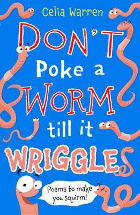
Don't poke a worm till it wiggles by Celia Warren
A&C Black, 2014. ISBN 9781472900234.
Highly recommended for readers aged 8+ and would be great to model
rhyming poetry in the classroom. Don't Poke a Worm till it
Wiggles is a poetry book full of worms. The poems describe
what they look like and how they act. There are several that follow
the same pattern as more common nursery rhymes and children will be
smiling and tongue tied as they practise their fluency.
The poems will engage all readers whether a parent/adult is reading
it to them or they are reading independently.
Kylie Kempster
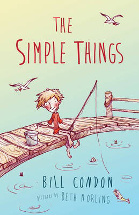
The simple things by Bill Condon
Ill. by Beth Norling. Allen & Unwin, 2014. ISBN 9781743317242.
Recommended 7-12 year olds. In this modern and busy world what are
the simple things? Bill Condon explores this through the eyes of a
shy young boy Stephen and his aged great Aunt Lola who he meets for
the first time. This is a gentle story of the amusing and at times
poignant meeting of two generations who learn to enjoy each other's
friendship.
Stephen meets his great Aunt Lola when he and his parents come to
stay for 3 weeks. Lola who turns eighty soon lives in a rundown
house in a country town a day's drive away. As Stephen's mum is her
sole living relative the family intend to spend the holidays looking
after her and celebrating her birthday.
Lola is a 'grumpy old biddy' according to Stephen's dad. After a bit
of a rocky start Stephen begins to discover that while Lola is a
little forbidding and is critical of his language, there is more and
more to learn about her. For example she is researching and
compiling the family history, what is in the private room which no
one is allowed to enter, why Lola is no longer friends with Norm
Smith, the next door neighbour and what secret is Lola hiding.
As Stephen's relationship with Lola develops and he also becomes
friendly with Allie, Mr Smith's granddaughter, and discovers the joy
of watching the sunrise, fishing, bingo, playing cricket and
climbing trees. But then Lola collapses and is taken to hospital and
Stephen is faced with the possibility of her death.
Bill Condon is a master of dialogue. The developing relationship
between Stephen and Lola is largely told through their conversations
and as their mutual love and respect grow so the tone of their
interactions, particularly on Lola's part, mellow.
While this book is written for younger readers, there are many
adults who will enjoy the story and will shed a tear or two as they
reflect on lost dreams and relationships.
Sue Keane
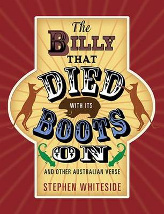
The billy that died with its boots on, and other Australian verse by Stephen Whiteside
Walker Books, 2014. ISBN 9781922077431.
(Age: 8+) Recommended. Australian poetry, Humour. With a childhood
entranced by the rollicking poetry of the bush balladists of the
like of Banjo Paterson, then finding the humour of C. J. Dennis,
Whiteside found writing poetry in the form of rhyming verse, with
stories begging to be read aloud, something which he did from a
young age.
In this compilation of some of his work, poems are grouped in
themes, such as Dinosaurs, the garden or the street, dogs and cats,
birds, at the beach or in the snow. Each grouping contains a range
of poems suited to younger people and made more pleasurable by being
read out loud.
The opening poems about dinosaurs will be a hit with one and all,
and I defy people not to hoot and giggle at the thought of a dad and
his son trying to make a kennel for a brontosaurus on their back
yard, or sympathise with the lad told to tidy his room, or wonder at
the number of coffee cups that mum can leave around the house, or
laugh at the people who leave their boots out all night in the snow,
or in reading the title poem feel just a little sorry for the billy.
There are poems which would be great models in the classroom, poems
that small groups of kids would love to read aloud, poems which
would be suited for an adult to read aloud, and I can envisage
groups of students practising different ways of reading some out
loud to the merriment of their peers.
Fran Knight
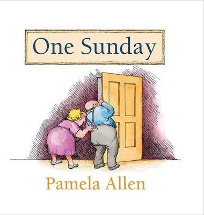
One Sunday by Pamela Allen
Penguin Australia, 2014. ISBN 9780670077656.
Recommended for young readers 3 and up. The indefatigable Pamela
Allen has a picture book to delight young readers of any age,
focusing on the simple pleasures of the warmth of home and the
ritual of family hospitality.
A little old man and a little old woman live in a little old cottage
on the edge of the woods. Every week they look forward eagerly to
their regular visitors (grandchildren) coming for a special Sunday
lunch. One Sunday the terrible weather buffets the little cottage
until it shudders and creaks. The little old man confidently begins
the usual preparations - fetching the baking dish, peeling the
potatoes, while the little old woman is equally sure that no
visitors will come on such a dreadful day. Inside the cottage it is
cosy and warm and the roast lunch fills the house with the quiet joy
of love and welcomes. No grandchildren arrive in the awful storm but
there is a surprise visitor who comes knocking on the door and
proves a delightful and appreciative guest.
As usual, Pamela makes splendid use of white space with her
distinctive illustrations - the double page spreads of the wild wind
howling outside are particularly striking.
For almost thirty years we have had the joy of Pamela's wonderful
books and this latest one will not fall short with her young
readers.
Sue Warren
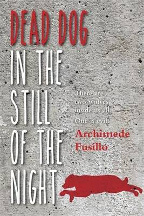
Dead dog in the still of the night by Archimede Fusillo
Ford Street Publishing, 2014. ISBN: 9781925000344.
Recommended for readers 13 years +. Highly recommended for
boys. Themes: Families, Teenage Boys. Primo Nato is struggling with
a host of personal issues in addition to his year 12 study. We learn
early in the story that Primo's father is in a nursing home with
dementia. His father had previously operated an automotive mechanics
business and Primo had always coveted his father's pride and joy - a
red Fiat Bambino. Dead Dog In The Still Of The Night starts on a
bright note with Primo having just passed his driving test and
obtained his licence. An ill-fated decision to borrow the Bambino
without permission ends badly when Primo has an argument with his
girlfriend and subsequently crashes the car.
Primo tries to conceal the accident until he can afford the repairs
but his efforts to raise the funds set in motion a series of events
which, as they unfold, reveal much about Primo's tumultuous family.
We are introduced to his long suffering mother whom his father had
cheated on numerous times; his eldest brother Santo who is 20 years
senior to his siblings and who believes he is the heir who should
inherit both the Bambino and his father's business; his brother
Adrian who is separated from his wife and young daughter after
following his father's philandering ways; and his sister Kath who
moved out of home to escape her family's past and present issues.
Set in a working class part of Fitzroy, Archimede Fusillo's book has
crafted a vivid picture of a family in hard times and the
surroundings in which they live. Ultimately the story reflects the
growth in Primo's character and although his circumstances remain
unchanged his way of looking at life does. Developing a better
understanding of his family and friends enables him to make positive
decisions about his future direction.
Nicki Paterson