Neapolitan series. Text, 2015. ISBN 9781925240511
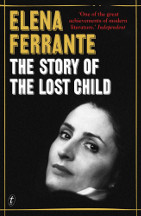
(Age: Adult - senior secondary) This is the concluding volume in
Elena Ferrante's Neapolitan series. The first three books
show Lenu and Lila growing up in a slum in Naples. Though Lila has
an audacious intelligence she leaves school early, marries a brute
and works at a demeaning job in a sausage factory while Lenu forces
herself on through university and becomes a writer about feminist
politics when she marries into a northern family with influence. In
this final volume the action returns to Naples which is as turbulent
and corrupt as ever. Lenu, now a successful writer and having an
affair with Nino, her childhood friend who is now a brilliant and
radical academic, returns to the slum district where they grew up.
She continues to have a tempestuous relationship with Lila, who now
is mastering the new technology of computing. Lenu's family and
friends initially reject her but eventually accept her new situation
and enjoy her success although they show no interest in her writing
as such. Lila is now a respected business woman, while the Fascist
gangsters the Solaro brothers are still her declared enemies. When
Lenu realizes that Nino has always been and always will be
unfaithful she rejects him and grows closer to Lila, particularly as
they are both pregnant. The babies, girls, seem destined to relive
the friendship of their mothers, especially as Tina, Lila's child,
is precocious and beautiful, as Lila always was, while Imma is more
insecure as Lenu has always been. However, Tina, aged four,
disappears from the street and is never found. The Solaro brothers
have clashed with Lila and her partner and are suspected but seem to
be determined to help. Lila's behaviour becomes more erratic while
Lenu's career continues to flourish. Lila becomes more nihilistic
and questions the value of life; she examines the history of Naples
and finds endless examples of cruelty being replaced with kindness
which is then swamped by more cruelty.
In the background of the novel the politics of Naples and Italy
repeat this pattern. The 1950's and '60's struggle between the
Communists and the Fascists is replaced by different political
allegiances but the one point of consistency is corruption which
reaches into even the most respected levels of academia as well as
politics and business. Lenu's mother-in-law, an aristocrat from an
'old' family, blames those with intelligence but with no traditions.
Lenu realizes that she herself is still an outsider in some cultural
circles, but also that all in the community condone corruption by
turning a blind eye to it. Lila, however, believes that there are no
options as the law is ineffectual. Lenu's daughters leave Italy and
she herself leaves Naples. She has her greatest success when she
writes the story of her friendship with Lila and the loss of Lila's
child, which parallels the story of the two dolls the girls lost in
childhood.
The writing is powerful and fierce in its portrayals of love,
loyalty, friendships, family relationships and politics. The themes
are most particularly female friendship, the relationships between
mothers and daughters and the influence of place. The coarse
language and attitudes of the local Neapolitans is vividly captured
as is the hypocrisy of the cultured classes. Ferrante juxtaposes the
crudeness of the local dialect with the purity of Italian to
emphasize class distinctions but while social position and morality
are not necessarily linked leaving the slums of Naples tends to be
regarded as a victory.
The novel can be read as a stand alone and is recommended for
competent readers. It powerfully deals with the issues of women's
friendships and family lives, and with the political and social
issues in Italy in the second half of the twentieth century.
Jenny Hamilton
Frog Todd by Sofia Goodsoul
Ill. by Marina Kite. Volya Press, 2015. ISBN 9780994324238
(Age: 3+) Themes: Bullying. Teasing; Names/Name-calling; Character.
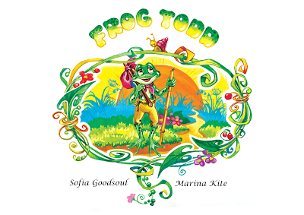
This rhyming story introduces a young frog whose name, 'Todd' causes
him to be the target of taunting by other frogs. It becomes too much
and he leaves his pond on a journey of personal discovery. The song
that he sings as he travels is rather oddly printed on a card and
held by a ribbon, to be used by the reader at prompted points in the
story. (This is quirky and a rather unusual choice.) Todd also
befriends another frog and helps other small creatures along the
way.
Rhyme handled well can be endearing, but in Frog Toad there
are times when the rhyme seems uncomfortable or the rhythm of the
text does not quite work. However the themes of bullying and
name-calling are important ones for young children to grasp..
The illustrations by Marina Kite are colourful and naively detailed
and will give a younger child something to focus on while the story
is read. Note the font used for the title does not make it easy to
discern for a young independent reader.
There are a number of colouring pages at the end of the book, which
would perhaps help its use as a gift book.
Carolyn Hull
Editor's note: There is an interview with the author here.
Grug series by Ted Prior
Simon and Schuster, 2015 Grug meets a dinosaur. ISBN 9781925030525 Grug gets lost. ISBN 9781925030518
(Age: 3+) Highly recommended. Once the top of a Burrawang tree
fell to the ground . . . and the grassy top began to change. It
became Grug. And so the adventures of Grug began.
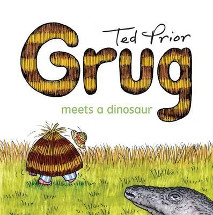
In Grug meets a dinosaur, Grug spots a strange looking
creature and thinks that it is a dinosaur. It begins to chase him as
he speeds away to the creek and follows him as he jumps into the
water. Grug is scared but of course there is a twist in the end.
In Grug gets lost, Grug ends up in a dark forest where he has never
been before and is very frightened, but also very tired. When he
wakes up, some of the food in his basket has disappeared but he
could see light through the trees and manages to make his way home.
It is wonderful to see a reprint of the books that first come out in
the 1980's and were so very popular then. Both stories are written
in easy to understand language with the occasional interesting word
thrown in, like 'slithered', 'clambered', and 'scurried' that will
add to a child's vocabulary. The stories explore common themes like
fear and becoming lost are ones will resonate with young children.
The illustrations complement the text and give clues to what is
going on. There are some whimsical additions like the little
creature that steals Grug's food that will make the reader smile,
and of course the expressions on the face of strange little Grug are
superb and will give the reader many opportunities to have a laugh.
The beginning reader is sure to love these books. They are small
enough to hold comfortably in children's hands; the subject matter
is compelling and the illustrations are charming.
They are certainly keepers for a child's personal library and a boon
for a school or classroom library.
Pat Pledger
One thing by Lauren Child
Orchard books, 2015. ISBN 9781408339008
(Age: 6+) Highly recommended. Numbers, Family. Making numbers funny
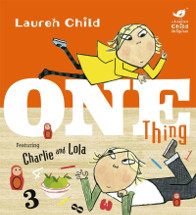
is quite a task, and Child achieves it with ease as her two
protagonists Charlie and Lola get ready to go to the shops with Mum.
She gives them ten minutes to get ready, but when Charlie works out
all the things she must do in those ten minutes and how long each
will take, she is nine minutes short. On the way to the shops, Lola
asks how many ducks are following them, and the birds are counted,
then the leaves in the tree. From single digits, one, two or three
trucks, to tens of things to millions and squillions, each number is
given a thing to be, ensuring the reader understands how big that
number is in what it represents. A wonderful way to reinforce
numbers and counting.
After their one hundred and fifty six steps to the shops, the girls
debate what they are able to buy: is it one thing or two things. Mum
gives them the choice of no thing, so one is settled. They then take
eleven minutes to make up their minds, and when home, after Lola has
used up all her stickers sticking them on a variety of numbered
things in the street, debate whether Lola will have one of three
badges from Charlie, and after being offered no thing, happily takes
one thing, the title of the book.
This is a delight, I loved the way Child shows the number in
numerical and written form, with the sequences of numbers one each
page, the smallest to the largest being represented in a way younger
readers will understand. It will be an infectious read, one children
will want to hear read out loud to them over and over again. I
laughed each time I read it, finding more things to look at, picking
out more and more detail in the enticing illustrations.
Fran Knight
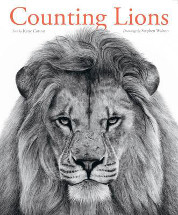
Counting lions by Katie Cotton
Ill. by Stephan Walton. Frances Lincoln Children's Books, 2015. ISBN
9781847807212
(Age: all) Highly recommended. Animals, Endangered animals,
Illustrative technique. A seemingly simple counting book with the
most engaging illustrations of animals so close hairs can be
counted, the very fact that these animals can be counted points to
many being endangered or having reduced numbers as Virginia McKenna
makes clear in her informative introduction.
Each of the animals represented reflects a different environment and
way of life, and the almost poetic text points out some of their
features which younger children will delight in, but sometimes a
question at the end of each piece of text will increase their
sensitivity to the plight of these animals.
So one lion stares at the reader, sitting in its place in the
savannah, watching his rough and tumble pride, content to watch and
wait. Then two gorillas, three giraffes, four tigers and five
elephants, followed by six Ethiopian wolves, seven penguins, eight
turtles, nine macaws and ten zebras invite the curious reader to
read the text and look more closely at the glorious pencil
illustrations. At the end of the book is a fact file about each
animal's place in the world and here the endangered or threatened
position of each is given.
What a wonderful counting book, introducing young children to the
numbers one to ten and encouraging them to count the animals on each
page. What a beautiful book to discuss illustration, but what an
informative book for the curious, the questioning, those who wonder
why these beautiful animals are threatened and question what can be
done. One child will use this as a tool to learning to count, small
groups of readers will love looking at this together, classes will
use this as an introduction to their work about endangered animals.
Fran Knight
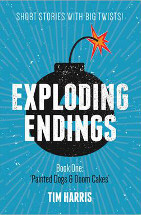
Exploding Endings: Painted Dogs & Doom Cakes by Tim Harris
Harbour Publishing, 2015. ISBN 9781922134578
(Age: 8+) Recommended. Tim Harris introduces us into a fun and crazy
world in Exploding Endings: Painted Dogs & Doom Cakes,
with short stories that showcase his wild sense of humour.
Do you need an excuse for being late to school, then try one of the
seventy-nine suggestions? Some excuses are - hitching a ride on a
rather large snail, a derailed train, frozen by a X-Men character,
stuck in an orbiting rocket or the caterpillar alarm that didn't
work! The smiley faces add the commentary, tell jokes and even the
pages engage in a duel.
Why does the whole school want to be in detention? There's a rumour
Jimmy Webb's found the mysterious Gavin's Gold and it might be
hidden in the detention room. Students are outdoing their classmates
in an effort to be sent to this classroom. All the Milford Junior
School students take over the Art Room painting everything the
walls, desks, chairs even the floor. Yes, they are off to detention!
Harris of course has an explosive ending to this story - a twist in
the tale, one that is hard to predict and of course hilarious. Boom Powder involves blasting rockets, secret scientific
experiments and results in a fuel additive with lemonade powder,
that makes Angie and her father wealthy and police vehicles powered
with Fizzy Rain. Murphy's Chocolate Cake takes a simple
recipe with a five-minute Prep Time and a forty minute bake and
turns it into a mega-marathon of improbable situations. Days, weeks
and months of crazy, comical antics occur in preparing the cake,
until Mum is forced to sell the house and they move to the beach.
Beware of this explosive ending! Painted Dogs & Doom Cakes is a fabulous class read-aloud
and a comical stimulus for creative writing. Where will Tim Harris
take us in the second Exploding Endings novel?
Rhyllis Bignell
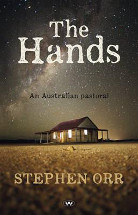
The hands by Stephen Orr
Wakefield Press, 2015. ISBN 9781743053430
(Age: 16+) On a remote cattle station in Northern South Australia,
three generations of Wilkies pass their days according to the
dictates of season, financial pressure and family expectation.
Grandfather Murray is an overbearing, self-centred man with a
bullying streak who maintains a position of control over his adult
son Trevor, his grandsons Aidan and Harry and his aged sister Fay.
Fay holds an ignominious position in the family, having been
dependent for decades upon Murray to provide a home for herself and
her intellectually disabled adult son.
A split second event results in a road accident which has a
monstrous impact upon the family. Further, the individuals affected
have no realisation that this change will gather increasing
momentum, placing greater tension on their already stressed
relationships.
When Aidan sees an alternative future through an employment
opportunity in Port Augusta, Murray's world view is shaken. The
option challenges his concept of each family member having a blind
devotion to the farm, stoically surviving increasing hardship, for
no other reason than that it is unthinkable to do anything else.
Meanwhile, Trevor is shown to be suffocating beneath monstrous
responsibility whilst prevented from making decisions or
implementing any changes by the manipulative Murray. The angst and
torment he endures before realising that he too can follow his son's
example is indicative of the very real (if entirely undeserved)
perceptions of failure and shame felt by those driven off land
handed down through the generations.
This is a realistic portrayal of family life and the events which
befall this group are entirely authentic in the sense that they
happen with similar measure and frequency to everyday people. Orr's
depiction of rural life and farming practices is refreshing as he
avoids romantic and lazy stereotypes, instead drawing recognisable
people who express credible opinions with familiar dialogue.
The author's often sardonic depiction of certain situations and
behaviours conveys a sense of his personal observations and a
sympathy for graziers struggling to make a living under almost
impossible conditions. The frailties and flaws within the characters
are all shown to be rooted in their circumstances and incapacity to
escape a rotten situation. Sadly their lot might have been so much
more successful and fulfilling if less misfortune and a little more
rain had come their way.
Rob Welsh
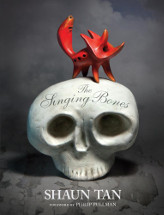
The singing bones by Shaun Tan
Foreword by Philip Pullman. Allen & Unwin, 2015. ISBN
9781760111038
(Age: 8 to adult) Highly recommended, Grimm's fairytales, Sculpture.
A foreword by Philip Pullman sets the scene. He would rather see the
stories of the Grimm Brothers presented without illustrations, than
repeat the soft and pretty images of books in the past. But seeing
Tan's sculptures of the grotesque and weird creatures, he is
satisfied that here is someone who is able to reveal these tales for
what they are.
With that forward in mind, opening this beautifully presented book
of Tan's sculptures set alongside excerpts from each of seventy five
tales, is quite mesmerising.
Dipping in I found some favourites: Brier Rose, Six
Swans, Snow White, The Juniper Tree and so on,
while I came across some I have not heard of: The Three Snake
Leaves, The Bearskin, The Lettuce Donkey to
name a few.
Each story is presented in a few paragraphs, and the facing page has
a stunning photograph of Tan's sculpture about that story.
Amongst the many which stand out for me is Rapunzel. The
brief outline tells us of this beautiful young girl having to let
her hair down for the sorceress to enter the high tower. The long
slim piece of clay stretches skyward, and only the small round face
on top shows us that this is Rapunzel, her hair falling straight
down to the ground. What sorrow and imprisonment is shown in this
tiny image. No Disneyfied young woman with luxuriating tresses
leaning out of her window for the handsome prince below, only a girl
detained without hope of escape. Bearskin was a story I had
not heard before, so I read a complete version in my Maurice Sendak
copy of Grimm's Tales (The Juniper Tree, 1973) to find out
about a soldier who while good at fighting has no way of supporting
himself during peace. Someone offers to support him for seven years
but he must not cut his hair or change his clothes nor pray. The
soldier eventually realises the devil is waiting for him to slip up
and take his soul. An amazing story of courage and resilience, of
temptation and honouring one's parents, Tan's sculpture looks like a
piece of carved wood, with the soldier's face peering out from the
enveloping bearskin. Readers will have lots to think about when
looking at the little piece, wondering why it is presented in this
way.
Grimm's Tales, so much a part of Western literature, exemplify the
basic tenets underlying life, be they sins like greed or envy, or
virtues like looking past appearance or honouring promises. These
stories are given a different aura through Tan's work: his curious
creatures will make readers think, setting aside illustrators of the
past who have seen fit to gentrify them.
An introduction by scholar, Jack Zipes, gives a potted history of
the Grimm Brothers and their work, and is followed by an extensive
bibliography with summaries of the stories and words by Shaun Tan
outlining the influences on his enigmatic work. A book to be
savoured: one that will add a difference to any study of Grimm's
Tales in the classroom.
Fran Knight
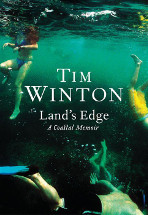
Land's Edge: a coastal memoir by Tim Winton
Penguin 2010. ISBN 9781926428284
(Age: Young adult/adult) Highly recommended. Tim Winton's deep love
of the Australian coast shines in Land's Edge: a coastal memoir.
I loved this memoir . . . Winton's writing as ever is painterly,
evocative, perfectly paced. He writes with a great love and respect
of the oceans and the creatures that live beneath the wave . . . to
read this memoir is to experience the majesty of the West Australian
coast through his eyes.
The reader is introduced to the watery world of a coastal life in
this gentle reflection of Tim Winton's formative years. He describes
how the coast anchors his life; how being on the edge of something
between the water and the outback informs his writing; how in the
memories from his childhood there is always . . . the briny smell of
the sea, and how he graduated from comic book to classic.
Tim Winton is a widely known Australian author and is the worthy
recipient of many awards. His books for adults and children have
been translated into twenty-five languages.
Narelle Autio's exquisite photographs are the perfect complement to
this work. Autio captures the essence of water, the movement, the
light.
The poetic beauty of Winton's prose draws me to his writing again
and again. I highly recommend Land's Edge: a coastal memoir
to a young adult/adult readership to appreciate the ocean in all its
raw beauty and danger, and to the poetry within this narrative.
Colleen Tuovinen
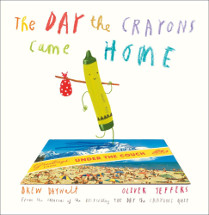
The day the crayons came home by Drew Daywalt
Ill. by Oliver Jeffers. HarperCollins, 2015. ISBN 9780008124434
(Age: 4+) Highly recommended. Humour, Postcards, Travel, Inclusivity, Friendship, Caring for others. A gently humerous look at the crayons lost and forgotten around the house, brought to the attention of their owner by the rueful postcards sent to Duncan by each of the crayons. Each is a delight. Brief words, as befit a postcard, tell a harrowing story of what has happened to the luckless crayons; joined to a sock after being put in the wash, lost down the back of a couch, left in the hands of a younger sibling, or sharpened to oblivion.
But each wants to come home, to be retrieved, to be with their owner, Duncan.
A companion to the well loved The day the crayons quit (2014) this story is very funny, offering younger readers a tilt at differing forms of humour: irony (check out the brown crayon upset that everyone thinks he has a wonderful time drawing lovely things like chocolate), parody (the series of delightful travel postcards from Neon Red crayon), slapstick (Dad sitting on the crayon left on the couch), hyperbole (Pea Green's attempt to run away), Poo jokes (Brown crayon) and scary jokes (Glow in the dark crayon left in the cellar) and more.
Each signing off on the postcards adds to the level of humour which younger readers will love, and the drawings by Oliver Jeffers will raise many laughs. All of his crayons ranging from Brown crayon, to Glow in the dark crayon, to Gold crayon are imbued with lives of their own. In a few deft blocks of colour, the personality of the crayon is exposed, underlined by the picture on their postcards.
Younger readers will squeal with delight at the scenes of the traveling crayons, those stuck at home, those wanting to go out into the big world, those belonging to the younger member of the family. Each page is a visual and textual treat, giving readers lots to take in, to look at and discuss. Smaller drawings around the edges of the pages adds fun to the mix, and the end-papers will delight readers as will Duncan's solution to the problem of the returning but somewhat diminished crayons. He takes care of them all, even if Neon Red thinks he is climbing the Great Wall of China.
I can imagine children in a class taking on the story of one of the crayons using what is told to them in the book, and expanding it to make a whole story. After they have finished laughing that is.
Fran Knight
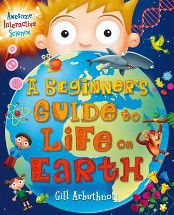
A Beginner's Guide to Life on Earth by Gill Arbuthnott
A & C Black, 2015. ISBN 9781472915733
(Age: Primary) Recommended. Themes: Biology; Classification;
Animals; Plants. This is an unpretentious, easy to read, accessible
Non-fiction introduction to basic Biology including the
classification system for younger readers. As a former Biology
teacher, I recognise its success in making the complex simple and in
introducing the most interesting life forms and their oddities to an
inquiring audience. Apart from the occasional error or
over-simplification eg Birds . . . front legs have turned into
wings, the information is clear and well-presented. It could
be read from cover to cover for an interested younger reader, or
used to provide a very simple paragraph detail for a research
request. The illustration style includes photographs and some
cartoon-like illustrations which would appeal to a younger reader
with an interest in animals or Biology. It is not a detailed in
depth Biology text, but it is a 'Beginner's guide!'
Can be recommended as a Library purchase or a gift for an interested
'Beginner'.
Carolyn Hull
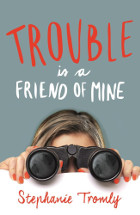
Trouble Is a Friend of Mine by Stephanie Tromly
Hot Key Books, 2015. ISBN 9781471404856
(Age: 14+) Recommended. Crime. After her parent's divorce, Zoe has
moved to a new school where she meet the weird and brilliant Philip
Digby and finds herself involved in his search for the kidnapper of
a teenage girl. Digby's sister had disappeared years before and he
is convinced that this disappearance has something to do with it.
Digby trusts Zoe because she isn't connected with anyone from the
past, and together they go on some hair raising adventures where
they uncover a criminal gynaecologist and strange cult.
Digby's behaviour is so incongruous that he manages to fascinate the
more up-tight Zoe, who is aiming to get back to an elite boarding
school and not become involved with anyone in her public school.
Digby comes and goes from school; is dressed in strange clothes
(often a suit), and is really rude to everyone. However she is a
very curious girl and can't resist being dragged on one dare-devil
stunt after another as they chase the clues to the teen's
disappearance. Any romance is played down and the action and search
are the focal point of the story.
Narrated by Zoe, this is a fast-paced thriller that is lifted from
the ordinary by very witty and sarcastic dialogue, much of which had
me laughing out loud at times. The relationship between Zoe and her
mother was also a highlight as her mother's character and interests
gradually emerged, and Zoe began to understand what it was like to
be a single parent and to leave a difficult relationship.
This is a fun, escapist story that will appeal to readers who enjoy
crime stories and off-beat characters. Although it definitely reads
as a stand-alone, there are some threads to the story that haven't
been unravelled so a sequel when it appears is sure to appeal.
Pat Pledger
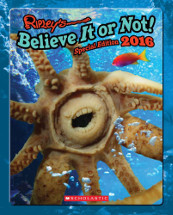
Ripley's Believe It or Not Special Edition 2016
Scholastic Australia, 2015. ISBN 9780545852791
(Age: 8+) Highly recommended. Ripley's Believe It or Not Special
Edition 2016 is the next instalment in a popular series. It is
packed with crazy facts that sometimes have to be seen to be
believed. Look inside for a close up of a chameleon's eye or see a
man who uses his hair to pull a car. How many golf balls can fit in
someone's mouth? Look on page 105 to find out. Are you a fan of
Harry Potter, Batman or Hello Kitty? Look inside to find out what
some fans have been up to. Readers will be amazed at the collection
of facts and it is a great book to share with friends.
Highly recommended for readers aged 8+. The bright photographs and
easy to read text will appeal to all readers.
Kylie Kempster
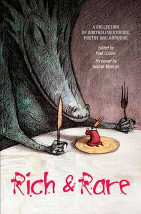
Rich & Rare: A collection of Australian Stories, Poetry and Artwork ed. by Paul Collins
Ford Street Publishing, 2015. ISBN 9781925272116
(Age: 10-14) Highly recommended. Themes: Short Stories -
Contemporary, Fantasy, Humour, Adventure, Crime, Science Fiction,
Romance, Ghost, Horror, Historical, Poetry. From the
pens/computers/wisdom of Australian YA and Children's book authors
that grace every Australian Library shelf, comes a collection of
stories that each have their own brilliance, but together make this
Anthology an absolute winner. From the very first story to the last
word in the last poem, emanate a wonderful burst of art - of the
written variety. With everything from gentle romance to ghost
stories; with reality and fantasy; serious, or twisted and funny;
with most pieces wonderful gems of the short story genre, this is a
book that every Library should buy, and would make an absolutely
wonderful gift for the 10-14 year old reader. Because it is short
stories predominantly, teachers will also love this as a resource of
short stories to read with their students. I can recommend this
anthology very highly, both for the quality of writing and also
because there is almost nothing distasteful in any of the stories.
Even the ghost and horror stories have an intrigue, although some
younger children may struggle with these stories. In most stories,
young protagonists deal with life and its twists and turns, settings
are varied and there is often the Dahl-esque 'twist in the tale'. As
the title suggests, this book is 'Rich and Rare'!
Carolyn Hull
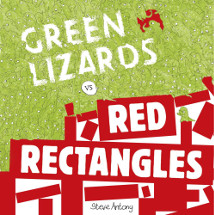
Green Lizards vs Red Rectangles by Steve Antony
Hodder Children's Books, 2015. ISBN 9781444920109
(Age: 5+) Highly recommended. Themes: War & Conflict; Picture
Book. This very simple picture book tackles a profound question -
Why does war happen? Why are we fighting? With very sparse text and
stylised red and green illustrations, the Author has addressed quite
serious issues in a very simple way, but in a way that provokes
thoughtful discussion. The green lizards are almost Escher-esque in
style, and individual lizards are unable to be identified, and the
rectangles are just red! The text is also very lean - there are no
wasted words! This simplicity leads to a solution that seems so
logical, but it is not without difficulty along the way. Lone voices
are sometimes squashed, but may also have power to change what has
always been.
This is a book worth having in every library, its unique style and
content need to be seen and read widely, and could be used as an
introductory text with an older age group in discussions about war
and conflict.
Carolyn Hull