Scholastic Australia, 2015. ISBN 9781760151539
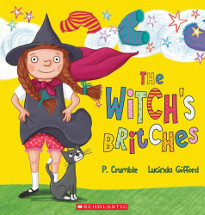
(Age: 6+) Highly recommended. The Witch's Britches is a fun
rhyming story that explains where the magic of a witch comes from -
her britches! Ethel is a new witch and her packet of britches has
arrived. Britches need to be kept clean or their magic doesn't work
so Ethel washes them. Unfortunately it is a bit windy and the
britches blow away. Can Ethel get her britches back or will mayhem
occur?
Bright images accompany each rhyming couplet and bring a sense of
fun to an already funny story. The text is simple and easy to read
and is highly recommended to readers aged 6+. Use it in the
classroom to introduce rhyming poems or recreate the story with
another piece of clothing. Enjoy reading it out loud with your
child, creating a song with the rhymes and rhythms of the language.
Kylie Kempster
Timmy Failure: Sanitized for your Protection Stephan Pastis
Walker Books, 2015. ISBN 9781406363494
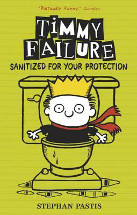
(Age: 9 yrs+) Recommended. Timmy Failure is back again, seeking
greatness and world domination as the CEO of Failure Inc., formerly
Total Failure Inc., detective agency. Whilst modesty is not part of
Timmy's nature his natural tendency to take a simple situation and
cause extraordinary havoc has not diminished. Sparkling comedic
writing combined with quirky line drawings makes Timmy a winner not
a failure.
This episode in the ever eventful life of our hero, revolves around
a road trip to Chicago during spring vacation to relocate Doorman
Dave, Timmy's mother's boyfriend. But this simple holiday is getting
in the way of Failure Inc. solving a case. The funds raised by YIP
YAP to buy books for poor Yergi Plimkin 'a boy from somewhere that
is not here' have gone missing. Timmy is of course focussed on
solving the case which takes up all his thinking and deductive
powers.
Further complications include Total, the polar bear, leaving a path
of destruction and bonbon papers behind him, The Moskin family who
travel with them, and Timmy overhearing his mum and Dave talking
about marriage.
Forced to go on the run with Mollie Moskin in an effort to finally
solve the case and hopefully confront the culprit, leads to even
more chaos and hotel staff on the verge of a breakdown. Finally
Timmy is apprehended himself and returned to his mother whilst the
case solves itself and Timmy makes someone's night 'because
detectives are tough and decent men'.
This is a delightful romp, easy to read and funny enough to laugh
out loud at. Some of the word plays and chapter headings like 'Suite
dreams are made of this' and 'Grapes and Wrath' may not resonate
with some students but certainly added to my enjoyment of the book.
Sue Keane
The fairy dancers by Natalie Jane Prior
Ill. by Cheryl Orsini. ABC Books, 2015. ISBN 9780733333576
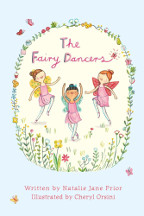
(Age: 5+) Recommended. Mia, Emma and Grace love to dance and every
Saturday morning they tie on their ballet shoes and turn into 'fairy
dancers'. The story is divided into three delightful episodes where
the three friends have fun and sparkle when dancing.
Each of the three stories take the reader into a familiar setting; a
shoe shop, a surprise birthday party and a concert. In The magic
slippers, the reader meets Miss Ashleigh, the ballet teacher,
who is beautiful and very kind as well. When one of Emma's slippers
goes 'flop, slap, flop' she tells her that she must get her mother
to buy her some new ones so the fairy dancers and their mothers
visit Eva's Dance Shop. Emma decides that she wants blue slippers
and paints them, but when the little dog Coco runs off with her bag,
the slippers are magically pink again. In The secret birthday,
the children and their mothers give Miss Ashleigh a surprise
birthday party and in The fairy concert, Mia has a brilliant
idea when her friend Grace breaks her arm.
All the stories are told with a warmth and charm that makes them
quite compelling to read. Lovers of dance will eagerly read the
book, but all children will be attracted to the kindness and
friendliness of the stories. The illustrations beautifully
complement the text and add an individuality to each of the
characters. The mothers are quite different; one reads, one likes to
bake cakes and one has the little dog Coco who is a naughty little
imp. I loved the humour when Miss Ashleigh's boyfriend, her Prince,
takes her off on a bicycle. The fathers make an appearance as well
and overall, the reader gains a feeling of familial security and
love.
This would be an idea book for readers who are just becoming
independent. The three episodes or chapters give it more depth than
a picture book and each story is a delight in itself. The fairy
dancers is a keeper.
Pat Pledger
Little Creatures series by Jedda Robaard
Five Mile Press, 2015. The little koala who lost his tree. ISBN 9781760069223 The little joey who lost her bounce. ISBN 9781760063467
(Ages: 2-5) Recommended. Board Books. Here are two new titles in the
Little Creatures series by Jedda Robaard, all of which are
about an animal who has lost something and is trying to get it back.
Others in the series include The little mouse who lost her
squeak and The little bear who lost her way. These new
titles are the first to feature native Australian animals. The
underlying concept is similar to the popular Usborne Touchy Feely That's
not my . . . series, however without the textural element.
The slightly longer and more complex narrative text and the addition
of interactive flaps make this Little Creatures series
suitable for a slightly older audience than the Usborne books.
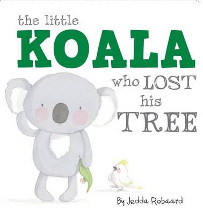
In Little Koala who lost his tree, koala wakes up not in his
own bed, but in an apple tree. Desperately tired, he tries out
different beds, including a washing basket, a television antenna and
a tent. However, there is always something not quite right . . . too
noisy, not enough room, too wobbly, too wet. He climbs the nearest
tree and bingo! He has found his bed, right where he left it! The little joey who lost her bounce Little Joey has not lost
something physical like little koala. She wakes up knowing she needs
to bounce, but she cannot remember how. She looks in the cupboard
with the bouncy balls, she tries jumping on the trampoline and tying
springs to her feet. She even tries the big bouncy bed, but nothing
brings back her bounce. Then, just as Little Joey sits down to
ponder her next move she falls backwards onto her tail . . . and her
bounce is back!
The flaps - some which open up to make double the page height - make
for an interactive reading experience for young children and the
board book format and durable flaps make them suitable for
independent exploration. The narrative, while kept short and simple,
integrates some more interesting vocabulary, such as
'uncomfortable', 'restless' and 'familiar', so is suited to its
target audience of toddlers and pre-schoolers.
The soft, watercolour illustrations by Robaard portray the cute,
cartoon style main characters. The fun typeface is large and
integrated with the illustrations, making it perfect for
pre-schoolers and their developing awareness of print.
Nicole Nelson
Guinness World Records 2016 by Guinness World Records
Guinness World Records 2016 by Guinness World Records
Guinness World Records, 2015. ISBN 9781910561010
(Age: All) Recommended. The Guinness World Records book
needs no introduction. Chock full of incredible new records, strange
trivia and interesting illustrations, it is a must for every library
and a book full of appeal for the reluctant reader.
Some of the most eye catching entries include the tallest man (251
cm. tall) and a page of incredible extreme body modifications
(tattoos and facial flesh tunnels). All are portrayed with colourful
photos that grab the imagination. New entries include waterfalls,
apps, manga, drones and pirates as well as other interesting topics.
For those who want their reading a bit more focused there is a Table
of Contents which includes headings like Sports, Science and
Engineering, Animals, Humans, Adventurers and Extreme Exploits to
name a few. An index is also available and would be helpful for
those who want to target particular records. Enthusiasts can also go
to the website,
and get extra information and background stories by reading the book
and finding the answers to questions.
Once again Guinness World Records 2016 will be sure to
astound readers as they flick through amazing records and photos, or
read in more depth about the staggering things that people can get
up to and the incredible animals that can be found. This is a must
for libraries and would make a great present for children with
inquiring minds.
Pat Pledger
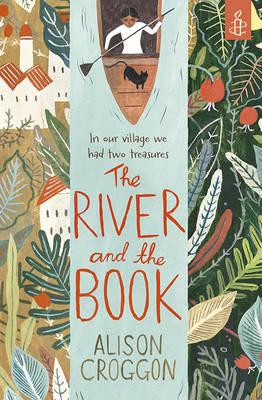
The River and the Book by Alison Croggon
Walker Books, 2015. ISBN 9781925081725
(Ages 12+) Recommended. The River and The Book has been
acknowledged by Amnesty International for addressing human rights
abuse in cultural, and economic terms. Poetically written this book
will be an asset to for its literary and thematic content. Simbala
is the Keeper of the Book and as the women in her family before her
is an important member of the village in which she lives. People
come to consult the Book for many reasons but Sim is the only one
who can touch it or read its messages. The book contains the history
and soul of the village, and like the oracle has the answers to all
the villager's questions.
The River is the life blood of the village bringing life and riches
as well as providing transport. Droughts cause the river to fail but
when developers upstream reduce the flow and begin polluting the
River, neighbouring villages are turned against each other. When
consulted the Book offers a one word answer to the problem,
'Change.' However change arrives in the unexpected form of Jane
Watson, a foreigner intent on writing about the river people, who
befriends Sim but betrays her trust, steals the Book and disappears.
Desperate to return the book to its rightful place Sim travels down
the River in search of the thief, vowing to only to return when she
has recovered the treasure. Along the way she meets a variety of
companions, and eventually settles in the city, still searching for
Jane. She finally discovers Jane is working at the University and
has published a book highlighting the plight of the River and the
people who rely on it for their living.
Why someone would assume they had the right to take a community's
most precious property is foremost in Sim's mind and could be a
stimulus for deep discussion between students in an exploration of
human rights and ethics. The divide between cultures and the assumed
rights of westerners is foremost but the book is also an
introduction to discussions surrounding development, pollution and
change.
Sue Keane
The Haunted Book by Jack Heath
Scream bk 3. Scholastic Australia, 2015. ISBN 9781760152109
(Ages: 8+) Prepare to be frightened. This easy to read series, is
reminiscent of the popular R.L. Stine books with its array of man
eating plants and ghoulish characters. In this case an old book
borrowed from the shelves of a holiday house is just the beginning.
Definitely a winner for the younger Horror fiction aficionado,
though they could be left wondering about borrowing strange books.
Dale and his parents, accompanied by his cousin Sarah, arrive at the
ski lodge his mother has booked for a holiday. With his e-reader not
working, Dale borrows an old book to read from the lounge shelves.
The book seems to have a power of its own and added to the spooky
nature of the house with its history of secret passages and basement
and the strange man only Dale saw in the woods, the scene is set.
The book is the hand written diary of a previous resident Luke
Greenway. The first line warns the reader 'Do not stop reading; my
life depends on it.' and by reading on ' . . . you will find
the secret of my immortality'. Strange things continue to happen,
but only to Dale who sees slugs in his breakfast, hears strange
noises, sees a ghost in the lake and seems to be followed around by
the book.
As he reads on he learns more about the strange Mr Greenway and his
experiments in the now boarded up secret passage way and basement.
It is up to Sarah and the stranger, Mr Sop, to save Dale from
Greenway and his mind altering chemical discovery Credence B.
This story with the 'police report' at the end filed by Dale's
father, a detective, will give some readers an argument for
e-readers being safer than books.
Sue Keane
Three dragons for Christmas by Fiona McDonald, Sophie Masson and Beattie Alvarez, Lisa Stewart and David Allan
Christmas Press, 2015. ISBN 9780992283896
(Age: 7+) Christmas, Dragons, Folk tales. These original stories by
Sophie Masson, Fiona McDonald and Beattie Alvarez add to the
plethora of Christmas stories published at the end of each year and
add a different flavour to those usually held in schools and homes.
The illustrations with their childlike, naive quality may not be as
engaging as the stories, but offer the chance for an astute teacher
to direct the children to draw their own versions of the dragons as
each story progresses.
Each story offers a different aspect of Christmas. The myth like
quality of the first, Dragon Market is charming in bringing
an old folk tale feel to the story of two poor women unable to sell
their goods at the market because of the loud, sparkling
competition, then because of their kindness being given a superior
piece of material to use the next market day resulting in many
orders for their product. The moral of the story, that kindness is
rewarded, will not be lost on the young audience.
Similarly with the second story, The Christmas dragon,
patience is rewarded when a young dragon, Fiery wants to pull
Santa's sleigh and applies for the job. He is too late but is able
to save the day with his fiery breath and so fly with Santa when he
delivers the presents.
The third offering uses The night before Christmas, as its
template and tells the tale of dragons again, waiting for Santa to
call. It is a lovely read aloud, and begs for comparing with the
original Clement C Moore poem.
Three different and unusual tales to use at Christmas.
Fran Knight
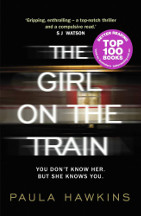
The girl on the train by Paula Hawkins
Doubleday, 2015. ISBN 9780857522320
(Age: young adult) Crime fiction, Alcoholism, Marital relationships.
After reading some fabulous reviews I bought this at Dymocks last
week and spent the rest of the week reading. It certainly grabbed me
and I wanted to piece together the jigsaw puzzle of Rachel's life as
she stumbled from one failed attempt at getting herself together
after another. One night, drunk again, she finds herself near her ex
husband's house. She sees something but is uncertain as to what it
is and struggles to remember the next day, waking bruised and
bleeding. But it is the same night that their neighbour Megan,
disappears, and Rachel is drawn into the investigation. She is sure
she knows something, but lies to get the attention of the missing
woman's husband and becomes an intrusion in the police
investigation.
She has seen this couple on the train every morning as she goes to
work. Fired for being drunk some months before, she still travels
into the city but when the train stops for a signal change she
watches the house, a few doors from her old house, and its
occupants, Megan and Scott, creating a romantic life for them. But
now Megan has gone, Rachel still haunts her old house much to the
anger of her replacement, and despite attempts by her ex husband and
the police to keep her at bay she persists, trying to remember what
she has forgotten.
The book is told through three women's voices, Rachel, Megan and
Anna, the new wife, in varying chronological order, giving the
reader the background while the story progresses. I was hooked as
many people have been, and I enjoyed the character of Rachel, trying
to overcome her alcoholism, trying to juggle aspects of her
splintered life.
This is a little potboiler, it has many twists and turns, it
certainly keeps you hooked, and the last chapter is very scary: it
is enjoyable and will make an equally enjoyable but forgettable
film. Borrow it from your library.
Fran Knight
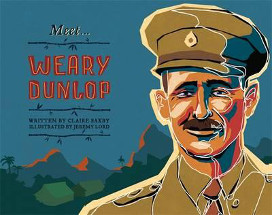
Meet Weary Dunlop by Claire Saxby
Ill. by Jeremy Lord. Random House Australia, 2015. ISBN
9780857985361
Standing in the grounds of the Australian War Memorial in Canberra
is a statue of a man in a suit, a red poppy in his lapel and a hat
in his hand. It's a statue that hundreds of thousands of children
have seen, glanced at and moved on without knowing the significance
of the man it is a tribute to. Yet this is a person who played a
very important role in helping their grandfathers and
great-grandfathers stay alive as they endured the horrors of being
held prisoners of war by the Japanese Imperial Forces in World War
II.
As a child born before the outbreak of World War I, Ernest Edward
Dunlop lived an idyllic life in the country in Victoria but he was
always going to be too big for a small country town. A smart student
and expert sportsman he earned his nickname of Weary in a convoluted
word play and while many of his companions stayed in and around the
district, the outbreak of World War II found him working as a
surgeon in London. He immediately joined the Australian Army Medical
Corps and in 1942 he was in Java in charge of a military hospital
when it fell to the Japanese and he, along with many others, was
taken prisoner. Put in charge of British and Australian prisoners
working on the notorious Burma-Thailand railway being built so
Japanese troops could be moved overland instead of by sea, he did
what he could to barter, cajole and negotiate with his captors for
food, medicine and shelter for 'his' men. Even when it meant
personal punishment he always protected his men, often taking great
risks to ensure their survival. He made do with what he had, usually
woefully inadequate, forced to be inventive and creative, and
always, always with the welfare of his fellow prisoners at heart. As
they were starved and punished, he understood the importance of
morale and organised concerts and pantomimes to lift spirits as well
as encouraging others to keep diaries, draw, paint and photograph
the camp and the conditions. They made grim reading after the war
ended.
This is the latest in the Meet series, and, in my opinion,
one of the best. Sensitively written and illustrated for those who
have not seen the film footage of what really happened, it puts a
human face on a conflict that did much to shape Australia and her
post-war attitudes. There is enough information to satisfy the
curious with two or three of Dunlop's escapades adding a lightness
to such a dark topic, yet at the same time there is enough to tempt
a more serious reader into a deeper investigation. Australia has
many war heroes apart from John Simpson Kirkpatrick. Having read
this, perhaps the children who visit the AWM will spend a little
more time at that statue, pondering the extraordinary depths and
determination of the human spirit.
There are now eight titles in this series which is a must-have in
school libraries as it brings the lives of our heroes and
history-makers to life through accessible, illustrated texts in a
way that brings the biography genre to life. They add an extra layer
to an historical study and the accompanying teachers'
notes open up new ideas for exploration. They tell a story
rather than just providing clumps of facts and figures, and are
suitable for newly-independent readers as well as for those for whom
English is a struggle. As well as supporting the history strand of
the Australian Curriculum, they also provide a model for younger
students for writing a biography providing a purpose for reading and
research.
Barbara Braxton
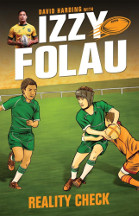
Izzy Folou: Reality Check by David Harding
Ill. by James Fosdike. Random House Australia, 2015.
ISBN 9780857986634
The Rugby World Cup is a fabulous time to introduce Izzy Folou based
books to a young audience whether they are fans or not as he is an
integral part of the Wallabies team featuring on many a news
bulletin. This series like others which feature stars from many
sports, is used as a vehicle to convey messages about life as well
as sport to a mainly young male audience. Reality Check is the second book in the series following the
journey of Daniel and Sione, two members of the Valley
Representative team coached by Izzy Folau, on their trip to the Gold
Coast to play some practice games before the State Championships.
Told in alternating chapters from the point of view of Daniel and
Sione, the events of the trip, visits to the beach, training and
matches are balanced with the feelings and personal struggles of the
main characters as they come to terms with the expectations and
responsibilities of playing and working with a team.
Sione is asked to play in an unfamiliar position, needing to quickly
learn the skills needed to win a scrum and play the role of hooker
instead of his usual position as winger. Already feeling incredible
privileged to be playing in the team he needs to work hard to be
successful. Daniel is a natural leader and very committed to the
game but has to work on his interpersonal and leadership skills to
ensure the team is able to work together with of course some advice
from Izzy.
There is enough Rugby to keep readers more interested in sport than
reading happy. The line drawings, short chapters and easy to read
text make this an ideal offering to a reluctant reader.
Sue Keane
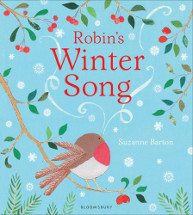
Robin's Winter Song by Suzanne Barton
Bloomsbury, 2015. ISBN 9781408859148
Picture book. Themes: Seasons - Winter. A beautifully illustrated
story of young Robin as he discovers the true meaning of 'Winter' in
the Northern hemisphere. As some animals make plans and preparations
to avoid or escape or to prepare for the privations that lie ahead,
Robin considers what he might need to do. Eventually he discovers
the joy and beauty of the winter season. Colour is used carefully in
this book, and muted tones in contrast to the Robin's red breast
make this book a visually appealing exploration of the season from
Robin's perspective. This does not contain any unusual plot twists
or unique understanding of Winter, and the hibernating bear
definitely places this story in a non-Australian setting, so it is
not a picture book that would be a 'must-have' on Australian
shelves. But it is a gentle and joyful exploration of Winter and the
changes in seasons.
Carolyn Hull
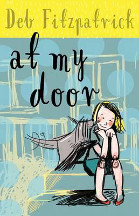
At my door by Deb Fitzpatrick
Fremantle Press, 2015. ISBN 9781925162707
(Age: 10+) Highly recommended. Family, Abandonment, Police,
Refugees. When eighteen month old Mei is left on Poppy's doorstep
late one cold night, the family works together to make the child
feel loved and wanted. Dad goes to the shop to get milk, a bottle
and nappies, Poppy dives into her box of old toys to find something
that Mei might like to play with, Mum finds a pillow for her to
snuggle into as she sleeps on the couch and next day, Harry brings
in his football to play with Mei. The police have been summoned and
Community Services alerted to the child being there. Eventually it
is decided that she stay overnight, a social worker arriving to take
her to a foster family the next day, but during the time she is in
their home, Poppy thinks about what it means to be part of a family,
and what being part of a family means to a young child.
This is a wonderfully open ended story. I can't stop thinking about
all the discussions a class may have as Poppy and her family discuss
a range of reasons that Mei has been left on their doorstep. No
judgement is given about who might have done this, only sympathy for
what may be happening in their lives and the continued hope that
they be reunited. Similarly the number of police and social workers
who turn up to the house are shown to be sympathetic and caring only
for the needs of the child, although the number of them may be a
gentle criticism.
The parting of the child from the family is a tearful moment, but
will underline the impact a family has upon a child.
Discussions with a class may take the path of discussing the obvious
issues of abandonment and fostering, leading to the more complex
issues of responsibility, not just at a family level, but at a state
and nation wide level. At my door suggests all sorts of
issues much wider than a single child as Australia and the world
struggles to help displaced families coming to our doorsteps. And
all this in 91 pages.
Fran Knight
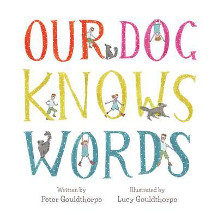
Our dog knows words by Peter Gouldthorpe
Ill. by Lucy Gouldthorpe. Hachette, 2015. ISBN 9780734416346
(Age: 4+) Warmly recommended. Dogs, Families, Dog training,
Responsibility. With charming illustrations showing a family and
their dog, this book does far more than point out the words a dog
can understand. It is a guide to how to treat a dog, how to teach it
to be part of the family, understanding words and treats, fitting in
with the lifestyle of the family which owns it and the family's
responsibilities in having a dog. The pages show the family training
their dog with treats, to sit and stay, roll over and fetch. The
illustrations show a happy family and contented dog, lying on the
bed together. All children will melt at the illustrations and the
reader too while neither the reader or listener will be able to hold
back laughter at the antics shown by both the dog and its family.
The favourite words are left to last. These are the words that
families have to spell out as the dog gets very excited hearing
them. Words like W.A.L.K. and C.A.R. are just as easily understood
by the pooch, and the last few pages are left to the last words of
the day: bed.
Children will love looking at the antics of the dog in the house,
and recognise some of the responsibilities of the family towards
their animal in training it and treating it well, feeding, washing,
taking it for walks, introducing it to other dogs and so on. A
delightful book to begin talking about pets and responsibilities.
Fran Knight
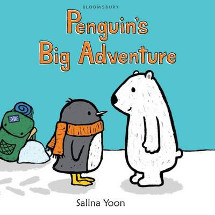
Penguin's big adventure by Salina Yoon
Penguin series. Bloomsbury, 2015. ISBN 9781408868713
(Age: 3+) Recommended. Friendship, Adventure, North Pole. When
Penguin decides to visit the North Pole, he says goodbye to several
animals who are his friends. He consults his map and loads his
backpack with things he will need. He says goodbye to Emily, busy
sewing a quilt, then Pumpkin who is busy building a basket, and
finally Bootsy, braiding a rope. On the way north he meets other
friends he has met in previous adventures. Reaching the North Pole
he is ecstatic, and turns cartwheels, throws confetti and erects a
sign. But there is no one there. Eventually a polar bear wanders by
and each is a little uncertain of the other. But becoming friends,
they explore the pole together, until Penguin's friends fly in from
further south to take him back home. After all the best part of
having an adventure is coming home.
This is a charming book in the series about Penguin. For younger
readers it will introduce them to the idea of north and south poles
and what animals live in each place; it will teach them about the
environment of the North pole, and perhaps introduce the idea of
explorers who went there. Younger readers will know that Penguin has
some very good friends, some who will do anything for him, even
traveling from one end of the world to the other, and that he has
met another friend, one who is left a map. Younger readers may be
able to predict what might happen in the next book, and sympathise
with Penguin making friends in this book. The black outlined
illustrations are clear and colour filled, making some aspects of
the North Pole easily identified for younger readers.
Fran Knight