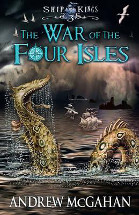
Ship Kings series, Book 3. Allen and Unwin, 2014. ISBN
9781760291693
(Age: Junior secondary) Young readers have a treat in store when
award winning author, Andrew McGahan, turns his hand to adolescent
fiction. It is a pleasure to share his skill with words, which makes
his young Admiral, Dow Amber, so convincing and appealing, and the
many twists and turns of fortune so intriguing.
In this episode of the Ship Kings saga, the legend of his
bravery grows as he and his colleagues face the anger of the sea and
the monsters of the deep.
Together, they face the dangers of battle and most of all they face
the danger of betrayal. With differing factions within the two
opposing enemies, the Ship Kings and the Twin Islanders, who can be
trusted? It is hard to unravel the truth.
After visiting the legendary home of the Twin Islanders, Amber
devises a plan to rescue Nell and the other leaders who stood
against the dominance of the Ship Kings. Amber is successful but
what has he achieved? Have innocent people died because of his
actions?
When Amber journeys to New Island to reunite with his family, he
discovers he is hated for supposedly abandoning them and his
people. After the horror he discovers there, he rejoins the battle
between the two opposing powers with new purpose, his heart set on
revenge.
Those who love a fast paced adventure will enjoy this novel and look
forward to the fourth episode to come.
Thelma Harvey
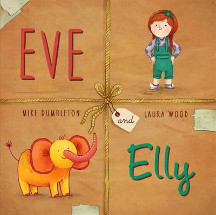
Eve and Elly by Mike Dumbleton
Ill. by Laura Wood. Random House, 2016. ISBN 9780857988515
(Age: 3+) Recommended. Loss. Toys. Family. Eve simply loves her pet
stuffed elephant, Elly. She takes him with her wherever she goes,
clutching him tightly under her arm. When they go on holiday, Elly
goes too, and sits on the beach with Eve as she builds a sandcastle.
On their return, Eve feels ill and Mum cuddles her until she falls
asleep, but the worst thing has happened, Elly has fallen from the
car unnoticed.
At home Eve searches everywhere for her elephant, all through the
house and car and in the garden. She is inconsolable and rejects
every other toy offered by her caring parents. But Dad has an idea
and shortly after a parcel arrives in the post. Eve is thrilled but
a little taken aback at the size of Elly until Dad explains Elly's
amazing journey to return home.
This is a wonderful story to read aloud, brimming with the love that
surrounds the child and her love for her toy. The loss of the toy
will be recognised by all readers and they will be on edge as the
tale unfolds, bringing the child and her toy back together with a
very cute twist. The story Dad tells is full of humour and adventure
as the elephant finds his way back home.
The illustrations reflect the loving family and the place held by
the toy elephant. I love the parcel cover, and the cheeky look on
Elly's face throughout the book. This book will have instant appeal
to younger children, and initiate discussions about the place their
toys hold in the family and what they do when something is lost.
Fran Knight
MARTians by Blythe Woolston
Walker Books, 2016. ISBN 9781406341393
(Age: 14+) Recommended. Consumerism. Dystopian fiction. Zoe
Zindleman has been abandoned by her mother and the government has
shut down her school. She is given the opportunity to start work at
ALLMART, where 'your smile is the AllMART welcome mat'. Her house is
going to be repossessed and when she meet MORTimmer, he warns her
that it is not a smart idea to live in ALLMART's dormitories.
Trusting him, she moves into the Warren, a deserted shopping centre
where a laundromat becomes her home, shared with the little boy 5er
and Timmer. Then her ordeal as an employee of ALLMART begins as she
learns the ins and outs of selling in a big store.
This is a grim but totally engrossing story about consumerism gone
wild told in the heart wrenching voice of Zoe, an intelligent girl.
As her training progresses she realises that there is no future for
her as she will always be in debt to AllMART, who charge her
enormous prices for uniforms and food. As Zoe battles her way
through learning about how to sell, the reader will find many
familiar descriptions of different store departments and how they
are set up. Equally bleak are the stories of abandoned children,
whose parents have left them behind, and the stories of repossessed
houses that are pulled apart for their metal, and a government that
has abandoned everyone.
However there is one small glimpse of hope that Timmer gives: Look
for the ones who need help and spread the good around.
This was an exceptionally thought provoking book. References were
made to Ray Bradbury's The Martian Chronicles but don't
detract for those who haven't read it, and will make them want to
pick it up.
This would make an ideal literature circle book or class novel with
the themes of consumerism gone wild, governments who cannot help
people whose homes are repossessed, unemployment, and abandoned
children making for great discussion points for their relevance for
today's society.
Pat Pledger
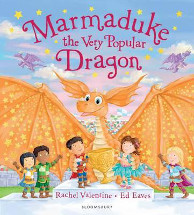
Marmaduke the very popular dragon by Rachel Valentine
Ill. by Ed Eaves. Bloomsbury, 2016. ISBN 9781408862667
(Age: 4+) Recommended. Friendship, Dragons, Medieval times. A sequel
to Marmaduke the very different dragon (2014), this one has
friendship as its core theme, as Meg and Marmaduke again do
everything together. The two are inseparable, that is until one of
the princesses, locked away in her tower asks Marmaduke if they can
play together. So popular is this new experience, all the princesses
join them, and the other dragons join in and eventually the princes
too. Meg is happy that Marmaduke has built up a large friendship
group, and all play together well. Meg reminds Marmaduke of the
forthcoming Whizz Cone Competition knowing that the two of them will
easily win the trophy. She watches the preparations uneasily
wondering where Marmaduke has got to, and eventually goes searching
for him. He is not in any of the usual places so she goes over the
hill and there she hears Marmaduke and Prince Bertie making
arrangements to compete for the trophy. She is distraught and when
the day comes, sits outside the arena listening to the accolades
received by the victorious Marmaduke and Prince Bertie. But
Marmaduke suddenly remembers Meg, and goes off to search for her. He
hears sobbing and flies down to fold her in his wings, apologising
for being such a bad friend. They both realise that there is more to
being a friend than meets the eye.
Young children will love the dragon theme, and be intrigued with the
sparkly wings, and more importantly come to see that being a friend
also involves some responsibilities. Young children will eagerly
discuss their own friendship groups and how they work out their
differences.
Fran Knight
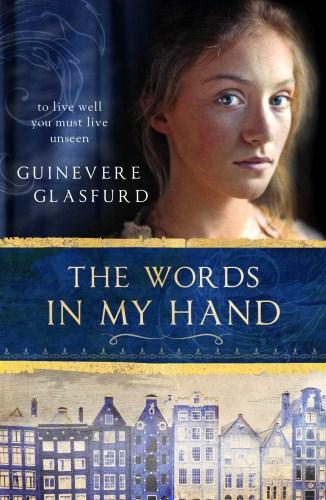
The words in my hand by Guinevere Glasfurd
Two Roads, 2016. ISBN 9781473617865 (Age: 16+) Highly recommended for mature readers. Themes:
Philosophy; Education of women; Rene Descartes; Relationships.
Weaving together the story of Rene Descartes with the young maid
with whom he has a relationship, the reader gets an insight into the
way the world has changed on so many fronts. Descartes was a French
philosopher, scientist and writer whose thinking and words were
germinal in beginning a transformation in the way the world was
understood. This was a dangerous occupation as it upset the status
quo. This very well crafted first novel by Glasfurd, enables us to
see Descartes life through the eyes of the young maid, Helena Jans
Von Strom, that he meets while lodging in the Dutch house where she
works for an English Bookseller. She is portrayed as an intelligent
woman trapped in her role because of her gender and the
intransigence of her circumstances as a maid. From the perspective
of the 21st Century reader, this level of discrimination seems so
unfair and we mourn with her as she attempts to self-educate herself
and to be respected and to be acknowledged as a woman of worth in
the highly patriarchal and socially discriminative era of the 1600's
world. She becomes Descartes' love interest and the mother of his
child and yet her position needs to remain hidden to protect
reputations and to enable her to fit into the society of the day.
Helena's love of learning and her exploration of ideas live in
parallel to the philosophical world of Descartes. We see how the
power of paper and the words that it can carry enters the world of
the young woman, and yet the words in her hands remain constrained
by her status. Her sorrows and powerlessness are potent for the
reader.
This book is not unlike The Girl with the Pearl Earring in
portraying a piece of Dutch history in a fictional way albeit a
century earlier. It will be enjoyed by Book Club readers who will
enjoy the insight into the world of the philosopher who challenges
the world in which he lives as well as comparing the role of women
from the past. (It does also portray the illicit relationship in
detail and there is a violent incident that is quite distressing, so
readers need to have some maturity.)
Carolyn Hull
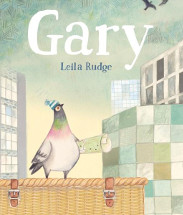
Gary by Leila Rudge
Walker Books, 2016. ISBN 9781925081695
(Age: 3+) Highly recommended. Birds. Adventure. Maps. Difference.
Gary the pigeon cannot fly, so sits at home when the others are
taken in the basket to a place far away to compete in a pigeon race
and return home. Gary loves hearing their stories and adds their
mementos to his scrapbook. This includes maps and tickets, postcards
and timetables. He adroitly uses a roll of sticky tape with his beak
to stick each of the items into his scrapbook, and listens intently
at night as they recount their adventures, adding their stories to
his collection.
But one night Gary leans a little too far, tumbling into the basket
with his scrapbook. Next day the basket is taken away with the other
pigeons for their race home. Finding himself a long way from home is
a challenge for Gary because he cannot fly and so find his own way
home. But he has his scrapbook, and opening it he is able to chart
his way using other methods of travel.
The wonderful pictures tell the story of Gary and his cohort,
dressed in their finery for the big race, with the plain Gary
looking on. His scrapbook is wonderful, with little drawings of the
mementoes that he keeps tucked away. Kids will love looking at these
and working out where the pigeons may have collected them from, and
then later how Gary uses them to get back home. His adventure will
open up all sorts of avenues for classes to discuss maps and
mapping, directories, finding your way around your area and so on.
As part of the Geography focus this book will be well used, but it
is also about someone taking the bull by the horns, about difference
and solving a problem, so having their own neat adventure.
The illustrations are wonderful, the pages full of pigeons as they
strut around in their cages, the delightful scrapbook used as the
endpapers as well, the flowing tumble of Gary into the pigeon
basket, Gary in the city using public transport. Each is very funny
and shows Gary off to the reader, as he uses his difference to solve
his problem. What a treat to reinforce the difference in us all,
that everyone has their own characteristics, that one trait is not
superior to another.
This will be one of those books in the library where children will
cluster around to hear it read out loud, thinking about how Gary can
possibly get home, or dreaming of their own big adventure.
Fran Knight
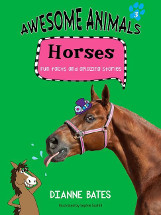
Horses: Fun facts and amazing stories by Dianne Bates
Ill. by Sophie Scahill. Awesome animals 3. Big Sky
Publishing, 2016. ISBN 9781925275858
(Age: 8+) Horses. Horsemanship. Horses: Fun facts and
amazing stories is a compendium and a celebration of all
things horse! Dianne Bates has sourced an amazing array of horse
facts, stories, daring rescues, working horses, horses in movies and
television and their historical origins. Colourful photographs of
the Horse Shepherd / Equine Sanctuary animals highlight the
importance of rescuing these animals. Playful horse caricatures
drawn by Sophie Scahill add humour to this factual book - there's a
horse king perched on a throne and a horse relaxing with his glasses
perched on the end of his nose reading a horse story.
These brave animals have led soldiers into battle, supported Spanish
conquistadors settling in new lands and moved the Barnum and Bailey
Circus across North America. In the early 1900s there were 750
horses used to haul the carriages and animal cages, to help raise
the big top and to perform acts. Walers were the horses used by the
Australian light horseman in World War 1 to mobilise the cavalry
into battle.
Smallest, tallest, biggest, fastest, and oldest horses, there's an
array of horse records to pique the interest of many animal fans.
Old Billy, an English barge horse, lived until he was 62 years old.
The text is set out in easy to read boxes, some with colourful
backgrounds, horse jokes and horse poems - nursery rhymes are also
included. Horses: Fun facts and amazing stories is suitable
for the capable reader who enjoys reading factual information.
Rhyllis Bignell
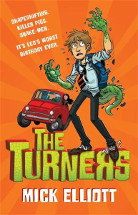
The turners by Mick Elliott
Lothian; 2015. ISBN 9780734416629
(Age: Junior secondary) Mick Elliott, award winning Nickelodeon
producer, takes us on a rollicking ride into a fantastic world of
weirdness.
Leo Lennox, a typical thirteen year old, sits in the school library,
admiring his attractive classmate, Lily. Suddenly, life changes for
ever as he turns into a komodo dragon, a very hungry one, and his
classmates scatter. Leo discovers the family secret: at night, his
father and his sister turn in to various animals with very little
warning. Leo is different in that he turns during the day as well.
His father, still mourning the loss of his wife, Leo's mother, seeks
help dealing with Leo's predicament. When he fails to return, Leo
and his sister must try to find him. Leo inadvertently impacts upon
his sister in his efforts to control his changes and these are very
funny. As they face one dangerous episode after another, they learn
to trust and respect each other.
Life as a turner all seems reasonably entertaining until Leo and his
sister, Abbie, encounter their long lost relative, a revengeful,
cruel scientist who hates turners and who has created a gruesome and
repugnant world. The weirdness factor rises as does the pace of the
story as the family faces a truly horrific death.
This is the first book in a planned trilogy. I hope Elliott will
focus more on the humour and tone down the gore. I think the ghastly
death of the villains in the story will be distressing to sensitive
students.
Thelma Harvey
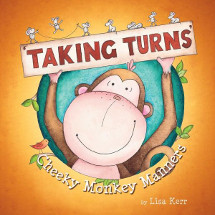
Taking turns by Lisa Kerr
Cheeky Monkey manners. The Five Mile Press, 2016. ISBN
9781760402662
(Ages: 2-5) Recommended. This is another in the Cheeky Monkey
manners series (Please, Thank you, Sorry,
Excuse me, Listening) and one of many in the Cheeky
Monkey series. The small board book format is suited to
preschool and early childhood and is a fun way to springboard
discussions about manners - what they are, and when to use them. In
this title, Cheeky Monkey hasn't learned how to take turns yet. When
he has his friends over to play and they ask to have a turn of his
bubble toy, it is lucky his mother is there to step in. She gives
him a special timer for knowing when to swap over. Later on, she
helps again, giving Cheeky Monkey a painted pebble to help the
friends take turns talking and listening. The colourful
illustrations are large without great detail; Cheeky Monkey is the
main element on each page with a secondary focus on the other
animals and their facial expressions. There are, however, many
additional small animals (frogs, birds, mice, butterflies, etc.)
which will enable younger children to retain focus, give them things
to search for and foster discussions about the illustrations.
This book is great because it doesn't just talk about the importance
of taking turns; it shows how much fun the animals all have have
when they take turns, gives simple strategies that children can use
for taking turns and encourages children to think about what it is
like for the other animals when they don't get a turn. Social skills
books such as these can often be overly didactic, but this one is
understanding of children and of how hard it is to take turns. It
lets the child know that it is okay to have trouble taking turns
sometimes, but gives strategies for improving. The text manages
successfully to tell an engaging story, get a message across and
remain concise. With only five double-page spreads this book will
keep young readers interested until the very end. Overall, it is a
fun, simple way to introduce the idea of taking turns and learn some
strategies for doing so.
Nicole Smith-Forrest
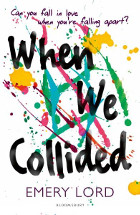
When we collided by Emery Lord
Bloomsbury, 2016. ISBN 9781408870082
(Age: Senior Secondary) Highly recommended. Extroverted Vivi,
her cheerfulness hiding her fragility and the embarrassing memories
she wants to forget, arrives with her mother to spend the summer in
Verona Cove, a tiny coastal town, its details 'so perfect that it
feels like a film set'. It is an idyllic setting and the inhabitants
are kindly, caring, considerate and gentle.
Here octogenarians enjoy a drink of coffee in Betty's Diner, their '
. . . white puffs of hair hovering like clouds over the back of the
aqua vinyl booths . . . ' and the owner greets everyone with
endearments.
Vivi has a summer job at the pottery shop and this is where she
meets Jonah and his five year old sister, Leah.
Jonah, the third oldest of six children, must share the role of
father and mother to his younger siblings following the death of his
father and his mother's inability to cope with her grief. He must
share the responsibility of keeping the family restaurant operating
to bring in income for the family. He loved and admired his father
and grieves for him and he is sure this girl 'who looks like lemon
meringue pie tastes, sunny, tangy, sweet', will refuse Leah's
impulsive invitation to dinner. But Vivi accepts and falls in love
with not only Jonah, but his siblings as well.
Vivi declares, 'I'm not much for silence: it simply doesn't suit
me', Her vitality, creativity and sense of fun, even though her
emotions are sometimes too high, sometimes too low, is like a tonic
for this family, helping them breathe more easily 'in the stiflingly
sad house'.
Vivi has found a family who needs her and this is balm to her
troubled spirit. Vivi feels that Jonah complements her 'like mint
ice cream and chocolate chips' and they draw close together with
Vivi forcing Jonah to rethink his plans for the future and to try
new ideas in the restaurant.
But Vivi's behaviour becomes more erratic. Without her mother's
knowledge, she has been throwing away one of the tablets she is
supposed to take every day to prevent another episode similar to the
painful memories she is trying to suppress.
Vivi discovers her father's identity and after facing him and his
hostility, she spins out of control and Jonah witnesses the road
accident which nearly claims her life. During her recovery, Vivi
faces up to the fact that she has bipolar disorder, and she and her
mother reassess their future and decide to return to their former
home.
These are warm, vital characters, with genuine concern for each
other. It is so easy to become involved in their story and so
refreshing to read of characters who know there will be difficult
weeks in their lives but who move on with courage and optimism. They
reach for 'happiness even in uncertainty'.
Emery Lord closes the novel with advice about dealing with bipolar
disorder. Her belief that 'maybe the path isn't perfect but you get
there' reflects the feeling of optimism that floods this book.
I highly recommend this book to teenage readers of either sex, just
as I would recommend Jandy Nelson's novel, I'll give you the sun,
for its honesty and compassion.
Thelma Harvey
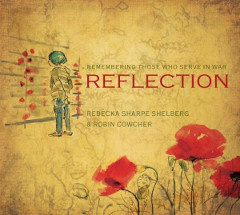
Reflection by Rebecka Sharpe Shelberg
Ill. by Robin Cowcher. Walker Books, 2016. ISBN 9781922179050
(Age: 7+) Recommended. War, Australia's involvement with war,
Memorials, Anzac Day, Remembrance. This picture book presents a
different way of looking at war in the classroom. It offers an
introduction to the many wars in which Australia has been
represented form the Boer War in 1899 through to the Second Gulf
War. It reminds students that we have been in many conflicts around
the world, and are still involved in an advisory capacity.
Each double page shows a family on Anzac Day. One page shows them
remembering what has happened, honouring those who did not return
from war, while the other side includes a picture of the war in
which Australians were involved.
The family marching to the war memorial is reflected in the marching
boots of the soldiers in the Boer War, and horses' hooves can be
seen interspersed with those of the men. The cold of the early
morning rise for the family is paralleled with the cold and wet
conditions of the soldiers hunkered down in the trenches during
World War One, while the service at the war memorial is reflected
with the soldiers burying their dead during a lull in hostilities
during World War Two. And on it goes, one page shiws the modern
family at the memorial the other page reflecting one of the wars
Australia has been part of through the years; Boer War, two World
Wars, Korean War, Vietnam War, Timor, Afghanistan, Iraq and Bosnia.
It is salutary to realise that war continues, that these wars have
not ended war, that people still resort to war to solve problems
between territories. In reflecting upon war, children will come to
see that war affects us all, that it is not only Australians who are
affected by war.
This book adds to the range of books available to remind students
about war and its cost, of the many wars Australia has been involved
in and the way we remember. And the beautiful water colour wash
illustrations reflect this theme to perfection. Cowcher has used pen
and ink outlines to render the family and those at war. Children
will be intrigued to find clues in the illustrations to work out
where the soldiers are fighting, and be aware of the number of red
poppies accumulating as they read. Haunting red splotches fill the
endpapers making a poignant reminder of this symbol of death in war.
And the last pages gives them an outline of those wars.
Fran Knight
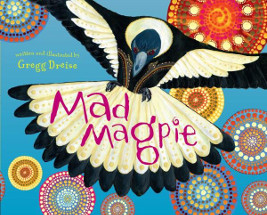
Mad Magpie by Gregg Dreise
Magabala Books, 2016. ISBN 9781925360066
(Age: 4-9) Highly recommended. Stay calm like the surface of the
water, yet strong like its current. Greg Dreise's third
morality tale Mad Magpie is dedicated to those children who
have been picked on or bullied.
In the Dreamtime, Guluu the very angry magpie would swoop down and
attack the bush animals. The magpie tries to justify his own actions
telling the Elders, he is reacting to the butcher birds teasing him.
To protect himself, he begins to act in a tough and angry manner.
Old Dinewah the wise emu offers Guluu some sage advice to stay
strong inside and ignore their bad behaviour.
Guluu attempts to ignore the naughty behaviour of the butcher birds,
even when he flies to the other river bank, but the bullies pursue
him. He stands up for himself and calms his anger with his beautiful
songs. In turn, this wisdom and life lesson help bush and all the
animals to live harmoniously again.
Gregg Driesse's paintings engage the audience with their traditional
and modern style. He incorporates the use of natural colours -
ochres, reds, browns and blacks with bird tracks and vibrant colours
in the circles of dot painting. The birds are painted with a
strength of emotions, there's angry Guluu, the taunting butcher
birds and wise cockatoos placed against the calm surface and
powerful river currents to anchor the action. Silly Birds, Kookoo Kookaburra and Mad Magpie
are motivating Dreamtime Stories. Gregg Driesse's picture books are
important resources for schools and kindergartens, useful for
lessons in English, Art, Health, Wellbeing, Music and Drama. They
provide wisdom, insight and offer keys to help deal with children's
behaviours and difficult situations faced by them.
Rhyllis Bignell
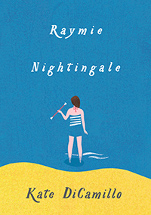
Raymie Nightingale by Kate DiCamillo
Candlewick Press, 2016. ISBN 9781406363135
(Age: 9+) Highly recommended. Friendship, Grief, Single parents,
Aged care, Competition. When her father leaves, Raymie is
distraught. She joins a baton twirling class in the hope of winning
Little Miss Central Florida Tire 1975, so having her picture in the
paper to lure him back home. She knows that doing a good deed will
sit well with the judges and tries to find one. But her soul does
not seem to be getting much bigger. At the class she meets two other
hopefuls, Louisiana and Beverly, each of whom have quite different
reasons for being there. Beverly is a take it as you see it type of
girl, no holds barred, straight talking and often abrasive, while
her cynical comments about baton twirling, cat homes, families and
the outrageous Ida Nee will have the reader laughing out loud.
Louisiana is an orphan but quietly determined and lives with a very
odd grandmother, always on the lookout for the authorities who may
take her to a children's home. All three girls are quite different
but come to work together to achieve their goals.
But the class does not turn out as it should, partly because of the
antics of the very odd teacher, Ida Nee, and Raymie decides to read
to someone at the aged centre instead of going to class, so
embroiling Louisiana and Beverly in her attempts to retrieve the
library book which she loses under one aged person's bed. Beverly
wants to sabotage the baton competition, while all Louisiana wants
is to get her cat, Archie back. Losing any possibility of winning
the money for baton twirling, the girls decide to take matters into
their own hands and go to the cat shelter to get Archie, making use
of Beverly's skills.
A very funny, darkly humorous episode at the end sees Louisiana in
hospital with an array of parents and caregivers arriving to tend to
their girls. Raymie's soul becomes larger as she develops
friendships and helps solve some of their problems, while accepting
that her father is not returning.
Beautifully written, this tale is most appealing in detailing the
lives of three young girls who do not quite fit in and are certainly
not what they seem. The story evokes understanding and pathos,
sympathy and humour as The Three Rancheros set out to right some
wrongs.
Fran Knight
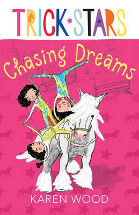
Chasing dreams by Karen Wood
Trickstars bk 5. Allen and Unwin, 2015. ISBN 9781743319109
(Age: Early chapter book readers) Themes: Dreams; Horse-riding;
Performance. The Trickstars trick-riding triplets face a new
possibility in their lives after their Aunt Zelda posts a video of
their amazing skills on the internet. Aunt Zelda, a practising
fortune-teller, creates a dream opportunity for the girls through
this publicity which is not immediately appreciated by the girl's
Grandfather. An unfortunate accident occurs that almost prevents
them showing their skills, but the girls still get to perform to a
talent scout for their favourite television show.
The skills of the girls as trick-riders are central to the story,
but their inherited 'magical' traits from their gypsy background
also influence life. The mystic factor is usually low-key in this
series, but it is inherent in the story-line. The triplets overcome
their struggles and demonstrate positive behaviours with the
occasional influence of the visions or magical gifts from their
family heritage.
Suited for girls who love horses, and enjoy a bit of daring in an
early chapter book.
Carolyn Hull
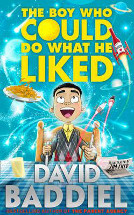
The boy who could do what he liked by David Baddiel
Ill. by Jim Field. HarperCollins, 2016. ISBN 9780008167813
(Age: 7+) Highly recommended for young readers aged 7+. (Alfie is a
little older, but the story is easily accessible for a younger
reader.) Family. Rules and routines. Children's behaviour.
Alfie lives a fairly boring life; at least his classmates tell him
so. At home he lives a fairly regulated life, with documented
routines for every aspect of life. But Alfie is not dreadfully
unhappy, or worried by this. But his normal structured existence is
ruffled a little the night his parents cannot get their normal
babysitter, and the new sitter injects a little magical spark of
mayhem when she says, 'Do what you like!' There is a little hint of
the Fairy Godmother in her ability to make significant change
without doing much at all... and she is incredibly and
breath-takingly ancient!
This is a charming story, without the syrupy inclusion of the 'moral
of the story' type ending. In fact the simplicity of the tale and
the charming way that Baddiel introduces the routines of Alfie's
life will appeal to all young readers. The amusing 'fart in the bed'
scenario will also entertain young readers.
Carolyn Hull