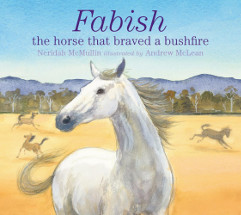
Fabish: The horse that braved a bushfire by Neridah McMullin
Ill. by Andrew McLean. Allen and Unwin, 2016. ISBN 9781925266863
(Age: 5+) Recommended. Bravery. Horses. Bushfires. Farm life. Fabish,
once a fine racehorse known for his bravery, is put out to pasture.
Here he is in charge of the yearlings, helping them understand what
is expected of them, training them to obey instructions. But one day
they smell smoke. It has been an extremely unpleasant summer,
everything is hot, the old iron roof crackles and the hot wind
blowing from the hills smells of smoke. The yearlings smell it first
and become unsettled. The owner has no choice but to let them out of
their yard, while he spends the night trying to save his stables,
keeping the other animals calm and safe. Fabish and the yearlings
are on their own.
The illustrations reflect the overwhelming nature of bushfire, with
its flames licking the roof of the stable, the roaring of the fire,
the constant embers falling to the ground, the smoke and heat all
around them as the man fights the fire all through the night.
Emerging in the morning, he finds everything is burnt and scorched,
little left of his buildings, tack house, fences and trees. The
earth is baked hard, embers still fill the sky, the smoke tears at
his throat. He drives off in anticipation of seeing worse but in
nearing his house, sees Fabish leading the seven yearlings towards
him. He has done his job of protecting the young horses and somehow
they have all survived.
Based on a true story, the trainer, Alan Evett had to let the horses
loose, presuming he would never see them again on that terrible
Black Saturday in 2009 when a firestorm rivaling the devastation of
an atomic bomb, hit Victoria.
This book not only gives readers an overwhelming feeling of being in
the bushfire but alerts them to the bravery of some animals in dire
circumstances. As with several other books about bushfire, this will
encourage discussion in the classroom of the incidence of fire in
Australia, how it happens and how people can minimise its effects.
Fran Knight
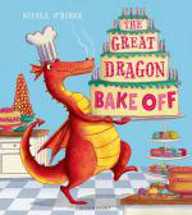
The great dragon bake off by Nicola O'Byrne
Bloomsbury, 2016. ISBN 9781408839560
(Age: 4+) Recommended. Dragons. Cooking. Friendship. Humour. When
Flamie Oliver is supposed to be practising his fire breathing dragon
skills to graduate, he'd prefer to be cooking. He just loves pastry
- all sorts of pastry, puff, rough, sweet or salty, he doesn't care.
He justs loves to cook and tries his hand at all sorts of cakes and
desserts and even a wedding cake. When the final day comes to
graduate from the Ferocious Dragon Academy, he fails but is given
one final test to prove his worth. He must kidnap a princess and eat
her. He can do the first part of the task, without a hitch but
eating her creates another problem as he cannot find a recipe which
involves a princess. The two sit down together to nut out a solution
to Flamie's problem.
A lovely story about working through a solution to a problem, and in
so doing, finding a friend, told against the well known background
of the bake off competitions which children will know well from
television, the use of the familiar names will raise laughs as the
dragon cooks his way through the book. The illustrations showing
this lovable dragon with his sly looks at the princess in deciding
how to eat her, or the looks of utter contentment when cooking and
eating his cakes, or the animal with his chef's hat apron and back
pack, are wonderful and will entreat readers to look more closely at
the detail on each page. Children will gleefully recognise the
various bits of cake and pastry illustrated as well as having fun
working out the names of the cooks the dragons parody.
Fran Knight
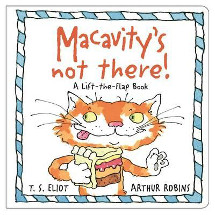
Macavity's not there by T. S. Eliot
Ill. by Arthur Robins. Faber and Faber, 2016. ISBN 9780571328635
In 1939, T.S. Eliot wrote his iconic Old
Possum's book of practical cats which became the
foundation for Andrew Lloyd Webber's musical 'Cats'. Within that
collection, is a poem which begins Macavity's a mystery cat: he's called the Hidden Paw.
For he's the master criminal who can defy the Law.
He's the bafflement of Scotland Yard, the Flying Squad's despair:
For when they reach the scene of crime - Macavity's not there!
It goes on. Macavity's a ginger cat, he's very tall and thin;
You would know him if you saw him, for his eyes are sunken in
Drawing on those two lines as the starting point and the constant
refrain of the original of 'Macavity's not there' , Arthur Robins
has again relied on the poem to create a wonderful lift-the-flap
book encouraging young children to investigate just where this
elusive cat might be. Is he in the bedroom? The bathroom? Perhaps
the kitchen? Maybe the rabbit hutch? Ahhh, there he is! Why didn't
we think of there in the first place?
Using very distinctive illustrations, Robins brings Macavity to life
just as he did in his 2014 version of the original poem by T.S.
Eliot. But as well as engaging the young listener is the fun of
discovering Macavity's whereabouts, enticing them to suggest other
places to look before turning the page, it's a wonderful opportunity
to explore language associated with cats - perhaps based on their
observations of their own. Are they always sweet, playful fluffy
kittens or can they be mischievous, cunning, aloof, even fierce?
Using the cover picture, which words would they use to describe
Macavity? Can you take a photo of a cat they know and surround it
with vocabulary? Can you do a comparison chart between their cat,
Macavity and other cats in literature?
Building their language and broadening their concepts about cats
will be a great bridge to sharing the Robins' version of the
original and then travelling on to his Mr
Mistofolees and Skimbleshanks
so they can savour the beauty of the rhyme and rhythm of Eliot's
creations, marvel at his ability to tell a story and paint a picture
in so few words and maybe even enjoy a performance of Cats. At the
very least, they will be introduced to some superb poetry that may
linger with them throughout their lives, as it has with me!
Barbara Braxton
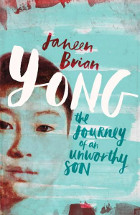
Yong the journey of an unworthy son by Janeen Brian
Walker Books, 2016. ISBN 9781925126297
(Age: 10+) Highly recommended. Migration, Chinese, Goldfields
(Australia), Prejudice, Australian History. When Yong is told by his
father, the head man in their village in China, that many men are
leaving for Australia to search for luck in the goldfields at
Ballarat, he asks to stay behind and help his grandmother care for
his two siblings. But his father is determined that he go too.
Together they will find enough gold to end their poverty and pay
back the moneylenders. Yong feels he is an unworthy son because he
questions his father's aims. Told from Yong's perspective, the story
of a group of Chinese men sailing from China to Robe in South
Australia, then walking overland to Victoria is mesmerising, as we
walk with them, tramping many miles each day, feeling overwhelmed at
the four hundred miles ahead of them. We listen to the prejudice
doled out to these men and find that many of the stories they have
been told lack substance and the group begins to blame Yong's father
for their predicament.
Janeen Brian's meticulous research gives the tale a strong base of
historical truth, against which we can judge what our actions may
have been in similar circumstances. All stories of migration
resonate with Australians, as we are all dependent upon what our
forebears did in the past to improve their lives.
When Yong finally arrives at Ballarat, after death, desertion,
starvation and derision he realises that in following his father's
dream he is indeed an honourable son. And I am sure that readers,
like me will want to know how he copes in that mining town.
There are only a few novels containing a Chinese immigrant to our
shores so this is very welcome, giving a face to some who came in
the nineteenth century along with so many others (New gold
mountain, Melting pot and Seams of gold, by
Christopher Cheng, 2005-7, Goldseekers, by Greg Bastian,
2005, Gold fever, by Susan Coleridge, 2006).
Fran Knight
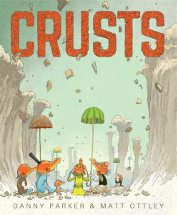
Crusts by Danny Parker
Ill. by Matt Ottley. Little Hare Books, 2016. ISBN 9781742979830
(Age: 4+) Highly recommended. Scientific endeavour, Space travel,
Aliens, Humour. Two parallel stories come together in this
breathtakingly original story with stunning complementary
illustrations sure to have readers pore over them with awe.
Each story has a different font allowing the reader to differentiate
between them as three aliens land on earth trying to find a way back
home carrying most needed bread for their planet. Jacob on the other
hand will not eat his crusts and to placate his mother keeps them in
the shed at the back of their home. He finds a map in his room and
then males plans to help the aliens return home. He works hard on
his plans, gathering crusts at school, from bins and at home, until
he has enough to build what he needs to build. The aliens daunted by
their task return home empty handed but Jacob has built the most
amazing space craft and together with his net, takes the crusts to
the crumbling planet. Here he dons his crust space suit and uses the
crusts he has collected to ensure their planet is restored.
The story is wonderfully imaginative, taking a very ordinary foible,
that of not eating your crusts, something many children will
recognise and making it into a tale of intergalactic space travel.
The story also underlines the warmth of helping others, of using
your imagination, of looking beyond appearances.
The illustrations are magical, from the wonderfully long limbed
humans to the long nosed aliens, the stand out galavanised iron of
the buildings, to the use of the crusts. I pored over the intricacy
of the crusts making up a replica of the statue of David, or the
space craft, the ladder and the space suit. And if that is not
enough, then each page is splendidly different, making use of a
variety of styles to tell the story behind the words.
Fran Knight
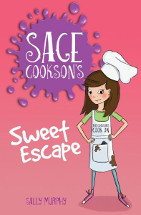
Sage Cookson's Sweet Escape by Sally Murphy
Ill. by Celeste Hulme. New Frontier, 2016. ISBN 9781925059618
(Age: 6-10) Recommended. Cooking. TV shows. Sage Cookson is thrilled
that she has finally been given her own phone. She will now be able
to keep in touch with her friend Lucy when she travels with her
parents on their trips away for their TV cooking show. This time she
is off to the west where they meet up with a chocolatier and things
go dangerously wrong.
Sage is an enterprising young girl who leads a very interesting life
travelling with her parents even though she does have to keep up
with her school work on the way. Readers will emphasise with her
happiness about finally being given her own mobile phone and she
certainly makes good use of it to help get her family out of the
bush safely in time for their job.
It is obvious that Sally Murphy loves cooking shows and mysteries
(see her article here)
and many of her young readers are sure to enjoy both as well as they
learn about what it takes to have a TV cooking show and thrill to
the suspense of trying to find their way back when the chocolatier
leaves them in the bush. And of course there are the descriptions of
chocolate and a yummy Cheat's chocolate fondant recipe at the back
of the book.
This is the first in a series, and with its short chapters,
interesting characters and touch of suspense, will have its readers
eagerly waiting for the next instalment.
Pat Pledger
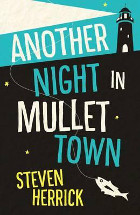
Another night in mullet town by Steven Herrick
UQP, 2016. ISBN 9780702253959
(Age: 15+) Highly recommended. Verse novel, Country town, Fishing,
Humour. A new verse novel by Herrick is always eagerly anticipated
and reading this reminded me why I like his books so much. I find
that I stop over each line, drawing breath at the wider implications
of what is written there, marveling at his economy of description,
acute characterisation and restrained emotional detail.
In this story two boys, Jonah and Manx are in year ten, able to see
beneath the veneer of their sleepy seaside town and willing to
embark on what life may offer. They spend a lot of time fishing,
drinking with the others on Friday nights, looking at the girls who
have been their constant companions since kindergarten, but seem now
out of reach.
Jonah realises that the arguments between his parents have
intensified and one night his mother packs to go and stay with her
sister at a nearby town. Jonah counts up the number in his class
with a single parent and sees he is not alone.
The other side of the river sees old houses bought up by city
people, then demolished and holiday houses built in their place.
They lie idle for a greater part of the year and contribute nothing
to the ever shrinking community. The town is on the decline,
overshadowed by a larger and more attractive seaside town some k's
north where they go to school.
But one Friday night, Manx goes back to the town by himself, Rachel
goes off with Angelo, and Jonah and Ella come together. Each
incident creates possibilities and consequences for the two boys,
ones which will see them become more at peace with who they are,
where they are living and their enduring friendship.
The small community is exquisitely drawn, with Manx's fishing line
hanging from his front verandah, the old fish and chip shop now a
coffee shop for the blow ins, the old grocery store a real estate
agency complete with black BMW. It is redolent of so many country
towns, but Herrick's funny warmhearted depiction of the place and
its inhabitants gives all readers a fresh way of looking at the
villages they pass through.
Fran Knight
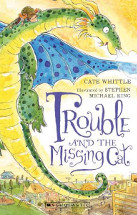
Trouble and the missing cat by Cate Whittle
Ill. by Stephen Michael King. Omnibus Books, 2016. ISBN
9781742990774
(Age: 7+) Recommended. A further adventure with Trouble the dragon
and feisty friend Georgia will delight readers and has universal
appeal. Trouble has been banned from landing on the school's
playground because he broke the asphalt, and can't land on the oval
because he is burning the grass. But riding to school and elsewhere
on Trouble's back is the only way that the family can get around.
And then there is the mystery of Mrs Jones' cat Tibbles, who has
gone missing.
This is a charming story and the reader quickly becomes involves in
the lives of Trouble and Georgia. Whittle's narrative makes it very
easy for the reader to suspend belief about having a dragon for a
friend and the adventures of the two make for an engrossing read.
Georgia is a very clever girl who really enjoys solving mysteries
and puts all her ingenuity and intelligence in solving the mystery
of what has happened to Tibbles, especially as Mrs Jones is missing
him so much. Her compassion is evident as she gives Trouble a
helping hand to overcome his loneliness and her problem solving
skills are phenomenal.
Stephen Michael King's quirky illustrations add an extra dimension
and humour to the beautifully written text.
Readers who enjoy some well written magic realism with their mystery
stories will not be disappointed.
Pat Pledger
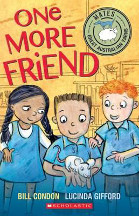
One more friend by Bill Condon
Ill. by Lucinda Gifford. Mates series. Omnibus, 2016. ISBN
9781742991184
(Age: 6+) Recommended. Friendship, Chapter book. The Mates
series (Great Australian Yarns) has produced an array of well
illustrated shorter chapter stories for those who have just mastered
reading and want something more than a picture book. As with the
others in the series, readers will be thrilled at this new offering
about making friends in a new school. Jack finds some new
acquaintances readily, but when he holds their pet mouse the animal
inexplicably dies. He is distraught, even going as far as
administering mouse to mouse resuscitation. And having one boy, Mark
pick on him, leaves a cold taste in his mouth. But he gets through
it all. Mark softens when Jack helps him with his reading at a
performance with a visiting writer and his parents take him to the
pet shop to buy a new mouse for the girls. All turns out well, and
readers will find some words printed in different fonts and styles
to encourage learning new words. Each chapter is about eight pages
long with bright breezy illustrations, so encouraging the new reader
to develop some self confidence when reading independently. I have
liked all the books in the Mates series and this is no
exception.
Fran Knight
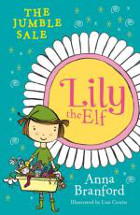
Lily the Elf: The jumble sale by Anna Branford
Ill. by Lisa Coutts. Walker Books Australia, 2016. ISBN
9781925381153
(Age: 5+) Recommended. Another in the delightful series about Lily
the elf has her getting ready for a Jumble Sale. Everyone in the
street is putting out their unwanted things and Lily really hopes
that she can find a mermaid tail amongst other people's treasures.
When her father starts to bring out things from their very crowded
shed Lily is not so certain that she wants them to be sold. How
could she let her grandmother's hats go and the fish costume that
her father has put out brings back many memories. Worse of all, her
baby cot is out there too. What will she do?
Anna Branford always manages to tell a beautiful tale that resonates
with its readers. Everyone has wanted to keep hold of old treasures
at one time or another and Lily is just the same. Even though her
father tells her that the cot would be great for a young couple who
are expecting their first child, Lily is most reluctant to let it
go. However when she meets the young couple she realises that it
would be really good to let them have it and she discovers that
doing an unselfish thing brings its own reward.
Cute black and white illustrations are scattered throughout the
book, which comprises of five short chapters, printed in large font.
This makes it perfect for the newly independent reader who is just
starting on chapter books. At the back of the book is the first
chapter of The midnight owl, to entice the reader to obtain another
in the series.
Pat Pledger
Saving Jazz by Kate McCaffrey
Fremantle Press, 2016. ISBN 9781925163582
(Age: 14+) Recommended. Sexual assault, Crime, Social media,
Cyberbullying. At a Friday night party in their small country town
south of Perth, some of the year ten friends get horribly drunk and
one girl, Annie has pictures of her naked body shared on snapchat.
Her best friend, Jazz is appalled and thinks back wondering why she
had not protected her friend. Two boys have written inflammatory
things over her body and admit to having a bit of fun but when a
video emerges showing that the boys have digitally raped her and
Jazz is complicit in this, actually sexually assaulting her friend,
then the police are involved.
Rejected by her parents she goes to stay with her aunt in Perth to
await the court case, but Annie's pictures go viral within the
community and beyond, eliciting appalling comments from those who
see them. Annie distraught about her betrayal and not able to cope
with the cyberbullying, tries to kill herself, and during the court
case her life support is turned off.
This is a cautionary tale like no other. The shock of what happened
at the party will jolt the hardiest of readers, and force them to
think about how they would have behaved in similar circumstances.
Despite Jazz's years of medical appointments and efforts to reform
her life, the impact of her dealings with Annie is never far from
her thoughts.
McCaffrey details the effects on everyone's life: Jazz's parents,
aunt and uncle, the two boys, Annie's family and the community. The
story forces the reader to think about some of the more unsavoury
aspects of our society: domestic violence, the impact of video
games, sexual assault, women's refuges, attitudes to women and
cyberbullying. Each plays a part in this tale and information is
infused within the story.
The last part of the book concerns Jazz's first year at uni where
she is harassed by one of her lecturers, a man she finds out later,
who is well known for his sexualised behaviour towards first year
female students. Although I felt this was an unnecessary addition it
does give a neat contrast to what has gone on before and again the
reader is put into the position of asking themselves what they would
have done.
McCaffrey has written a book that will be hugely popular, gaining an
audience through word of mouth, readers taking to heart this
cautionary tale comparing it with the 'what might have been' in
their own lives and questioning the role of social media in their
lives.
Fran Knight
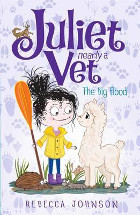
The big flood by Rebecca Johnson
Ill. by Kyla May. Juliet nearly a vet series, bk. 11.
Penguin Australia, 2016. ISBN 9780143507031
(Age: 8+) Recommended. Adventure. Floods. Humour. Animals.
Veterinarians. Another in this appealing series finds Juliet and her
family facing a flood. Juliet's mother, a veterinarian, is called
out to help move some alpacas to higher ground and Juliet, her
friend Chelsea and her brother Max, go along to help. When the
alpacas are rescued Juliet notices lots of other small animals and
insects marooned on an island and persuades her father to go in a
canoe to help bring them to the mainland.
Two things stand out in this junior novel - intriguing information
about animals and a clever cast of children. Juliet keeps a vet
diary which describes the behaviour of the animals. Readers find out
that alpacas make different sounds depending on their circumstances,
the names of different members of the alpaca family and that they
spit when they want to frighten predators away. The spitting episode
is illustrated in a very humorous drawing by Kyla May that will have
the readers laughing out loud.
Readers will also be alerted to what happens to small creatures when
there is a flood. Juliet and her friend Chelsea are very
enterprising about working out how to rescue the animals and how to
keep them safe. In addition to the information about alpacas, there
is also information about other animals, stick insects in
particular, that makes an interesting adjunct to the adventure of
actually rescuing the animals and insects. A multiple choice quiz at
the back of the book will also entertain animal lovers.
A great series to hand to the newly emerging reader or lovers of
animals.
Pat Pledger
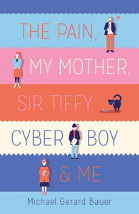
The pain, my mother, cyber boy, Sir Tiffy and me by Michael Gerard Bauer
Scholastic, 2016. ISBN 9781742991504
(Age: 12+) Highly recommended. Humour, School, Cats, Nursing home.
When The Pain comes into Maggie's life she does all she can to avoid
him. Danny is mum's new boyfriend, and loves to sing at
inappropriate moments, and makes the most outrageous jokes. He was
also the nurse on duty in the local emergency department when she
was brought in drunk following a sleepover, so her embarrassment
compounds itself. But nearing the end of year ten, Maggie has
several aims: getting a partner for the end of year dance, making a
good friend at her school and achieving an A for English. Seems
simple enough but her attempts to achieve these goals will have
readers laughing uproariously as she staggers from one disaster to
another.
Bauer uses a diary like format to achieve his aim. The text is full
of sentences in capital letters, an army of apostrophes and so much
hyperbole that each page sings with irony and sarcasm.
He makes no pretense of showing the reader what these grammatical
conventions mean and they will love him for it, learning about them
with a great dose of humour.
Maggie is an outsider at her school, and so thinks that achieving
her aim of a good A for English will be simple, but she has not
accounted for the replacement nun, Sister Evangelista, who tries to
curb Maggie's exuberance in writing while developing her editing
skills. Her Macbeth essay forms a link through the novel. But Maggie
needs to get a male person to be her partner at the dance, and
asking Jeremy Tyler-Roy elicits the most extraordinary response.
When she finds out why this happened she wreaks revenge upon some of
the girls in her year group with unsurprising results. While school
grinds on at home she must still put up with Danny and with the cat
he brings her to babysit until he finds it a permanent home. On the
night of the school dance they eventually find some shared sympathy
and almost all of her aims are achieved. This is a wonderful read,
full of humour and laughs, with some gems of observation. A stint at
the local nursing home reveals that Sister Evangelista's wry comment
about judging books by their covers has some resonance and this
spills over into many aspects of Maggie's life.
I loved reading this book and was very sad to leave these characters
behind. All of them are multi layered, with depths revealed as the
story unfolds. Bauer is an acute spectator of these people's
behaviors and it wonderful to see an author leave elements for the
reader to work out for themselves.
Fran Knight
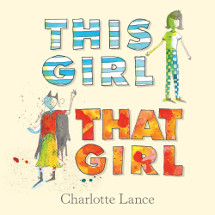
This girl, that girl by Charlotte Lance
Allen and Unwin, 2016. ISBN 9781760291709
(Ages: 5-8) Difference, Personalities. This is a unique story
inspired by the author's two children, one who is messy and the
other who is neat. Two girls live side by side; one is messy and
unorganised and does wild things like walking along a wall while
blindfolded. The other is neat and somewhat obsessive about order,
doing crazy things like vacuuming the lawn. Their respective fathers
are the exact opposite of them (the disorganised girl has an
organised father and the organised girl has a disorganised father).
Therefore, when each couple set out to build a tree house, their
respective approaches to the task see them finish up with nearly
identical products (showing elements of both order and chaos). As
the author says of the book, it shows that 'whoever we are, we
usually get to where we're going in our very own ways'. It
highlights differing personalities and emphasises that it is ok to
be unique and individual, even if it means we are different to our
own family. The repetitiveness and the use of 'this' and 'that' adds
a nice flow to the story when read aloud and the illustrations are
wonderfully detailed and intricate, perfectly portraying the
personalities of the characters. It is more suited to older
children, as younger children may not fully understand the concept
or the point of the story. They also may not understand the
outlandishness of the things the characters are doing or the nuances
of their extreme personalities, which require close analysis of the
intricate illustrations.
Nicole Nelson
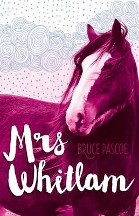
Mrs Whitlam by Bruce Pascoe
Magabala Books, 2016. ISBN 9781925360240
(Age: 8+) Highly recommended. Horses. Rescue work. A wonderful
heart-warming short novel, Mrs Whitlam has great appeal
because of its description of a bond between a girl and a horse, the
closeness of family and the courage that one girl can show. Marnie
has been given the part Clydesdale horse named Mrs Whitlam, and
Marnie's mum has told her she should be proud to have a horse named
after 'a wonderful woman'. Mrs Whitlam had belong to a girl who was
killed in a car accident and her mother couldn't bear to be reminded
so she gave the horse to Marnie.
The story is told in the first person by Marnie in her own
entertaining way. She develops a deep bond with the horse, looking
after her and using her as a sounding board for her life. When the
two are at the beach, Marnie spots a child on the verge of being
drowned, and together the pair manage to rescue the baby. When they
get him back on the beach a boy from her school, George Costa, helps
with the resuscitation and a friendship develops from there.
In Marnie, Pascoe has developed a great heroine and even though she
faces teasing about her Aboriginal background, she learns to stand
up for herself and continues to look after Mrs Whitlam. The loving
bonds found within her family are equally as appealing as the
friendship between Marnie and Mrs Whitlam, her mother standing out
as a loving and wise woman who is compassionate and helpful.
This is an uplifting short novel that ticked all the boxes for me.
Horse lovers are in for a treat and it would be an excellent read
aloud in the classroom or a literature circle book.
Pat Pledger