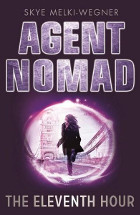
Agent Nomad: The eleventh hour by Skye Melki-Wegner
Random House Australia, 2017. ISBN 9780143780151
(Age: 14+) The eleventh hour is the first book in the new Agent
Nomad series by Skye Melki-Wegner. At 15 years old a genetic
anomaly has given Natalie Palladino the ability to manipulate a
source of power called quintessence. But Natalie is not your average
sorcerer; she is a rare and hunted witness who can see the
quintessences of other sorcerers, thus bearing witness to the magic
others have performed or are about to perform.
After spending her early years travelling the world with her mother
Natalie was sent to live with her father in the small town of
Hollingvale on the Mornington Peninsular in Victoria. Then, hauled
from an average teenage student life into the world of secret agents
known as HELIX, Natalie Palladino reinvents herself as Nomad and we
travel with Nomad on a fast paced adventure as HELIX endeavours to
protect Nomad and innocents from the Inductors.
Excitedly, I applauded the female protagonist, Natalie, who appears
to be unsure of herself to start, but her character develops into an
independent, feisty and strong individual. Drawing on Natalie's
experiences as she tries to empathise with the people around her and
anticipate what impact her choices will have on others, the author
offers insight into friendships; not only the components of what
makes a person your friend but also how to be a friend to others.
Skye Melki-Wegner makes an attempt to explore important teen issues
such as developing skills in teamwork, maintaining friendship,
valuing your own self-worth and personal sacrifice which will
encourage the reader to think about how their own perspectives and
actions can enhance and confuse their relationships.
Written in a simple yet engaging style I still felt that the
momentum of the story was forced through each key moment, hurrying
to explain history during a crucial event and skimming over
important character development.
All this being said, I was very impressed with the finale when
Natalie and her team want to prevent a sorcerous bomb from exploding
but cannot see a solution... I did not see this twist coming nor
the secrets revealed about her parents! You will have to read The
eleventh hour to find out more. For readers aged 14 and up.
Sharon Smith (Children's and Youth services Librarian Riverina
Regional Library)
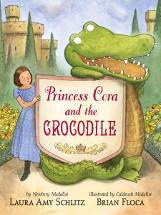
Princess Cora and the crocodile by Laura Amy Schlitz
Ill. by Brian Floca. Candlewick Press, 2017. ISBN 9780763648220
(Age: 5-8) Recommended. Princesses and royalty.
Independence. Identity. Fantasy. Childhood. Fairy tale. In a classic
fairy tale style with a princess, talking animal and a little bit of
implicit magic, combined with some grit from a frustrated princess
comes this charming tale. Princess Cora begins life impressing her
parents with her blue eyes and pink toes, but almost immediately
they are concerned for her royal role and her life is bound up with
responsibilities that are dull as dirty bathwater. Cora endures her
princess 'training' for some time until her polite frustration leads
to a letter to an unseen fairy godmother. The solution to her woes
is a crocodile!! With a little bit of 'changing places' magic,
Princess Cora discovers some freedom and the joys of childhood while
the crocodile metes out some reptilian payback for Cora's royal
training regimen. Ultimately there is some happiness for all, in the
manner of all good fairy tales. Hidden beneath the charming fairy
tale plot is a little bit of a 'moral' for the adults in a child's
life - allow children to be children before 'training' them for
their adult roles. And a child reader will see a compliant child who
learns to speak up and explore her independence, while still showing
respect.
The illustrations by Brian Floca (a Caldecott medallist) are
delightful and complement the text sympathetically. This is a lovely
transition text between a picture book and an early chapter book.
Recommended for aged 5-8 years, it would make a lovely shared
read-aloud text for an adult and child.
Carolyn Hull
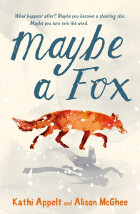
Maybe a fox by Kathi Appelt and Alison McGhee
Walker Books, 2017. ISBN 9781406372892
(Age: Upper primary - lower secondary) Highly recommended. Even if
this story had been written by one author, readers would marvel at
the skill and craftsmanship of the writing. Instead it is a
collaboration, all the more impressive for that because: a singular
voice rings out across the book; there are no stylistic fluctuations
along the way; and the narrative development is seamless. This is
despite being a complicated story, with several threads weaving
through. The central story is about Jules coming to terms with the
tragic and pointless death of her sister; this is the second tragedy
her family suffers and she and her Dad stay strong to support each
other. Other stories intertwine with this: Sam, the school friend,
hopeful for the return of the long-unseen catamount; his older
brother, Elk, returned from Afghanistan, but mourning a best friend
who didn't; the rambling yearling bear that brings out the local
hunters; the dangers and mysteries of the Slip, where the river
disappears into an underground cauldron for a while, and the
legendary but unfound Grotto, both of which hold resolutions to
these interlacing stories. But these resolutions don't come so
simply and comfortably. Like weft across braiding threads the tale
of Senna is thrown; Senna, the vixen of three kits born just as
Sylvie disappears; Senna of a mythical fox world, a Kennen with
connection to the human world. And her connection is Jules. The
fabric shimmers and tightens as these stories intersect and move to
a compelling conclusion that answers the question in the title.
Because of the implied middle school readership of the book it is
important to mention not a spoiler but an alert: perhaps this story
goes one tragedy too far. The ending is traumatic, with an
achingly-sad last chapter that is hard to bear. Other choices could
have been made that would have been uplifting and hopeful and still
been satisfying. With that one caution this extraordinary book is
highly recommended for upper primary and lower secondary readers.
Kerry Neary
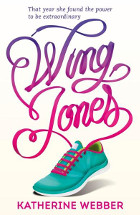
Wing Jones by Katherine Webber
Walker Books, 2017. ISBN 9781406369090
(Age: 13+) Highly recommended. Wing Jones is a confronting
novel about the aftermath of a car accident caused by drink-driving.
Focusing on the family of the person responsible, it gives insight
on the difficulties faced not only by the perpetrator, but the
family and friends of the perpetrator.
A world where you are a nobody and your big brother is a somebody is
always going to be difficult to navigate, let alone having both
Ghana and Chinese heritage in a school with a mostly white
population. Wing Jones is unlucky enough to be all of above - an
outsider to anything considered vaguely normal by her peers. As bad
as that is it all gets worse when her brilliant brother comes
crashing down from the pedestal she's placed him on and the police
come to the door with grim expressions for the second time in her
life.
As the news of Marcus' drunk driving spreads, the school is engulfed
by grief. From hero to villain in one night, Marcus' sister and best
friend, Aaron, bear the brunt of it alone. Marcus is trapped in the
hospital and they don't know if he'll ever wake up to face the two
charges of vehicular manslaughter to his name. Swamped by her older
brother's guilt and encouraged by her spirit animals, Wing must
learn a new way to cope before the weight of Marcus' guilt breaks
her. She starts to run - an act she'd avoiding since childhood - and
she's good. With Aaron's help and the slim glimmer of hope that her
athletics will help Marcus, Wing joins the track team and shocks not
only her classmates, but her mother and Grannies too.
Dealing with issues surrounding drink driving, bullying, and racism,
this coming of age story is highly recommended to people thirteen
and up.
Kayla Gaskell, university student
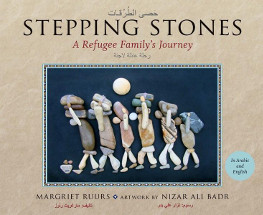
Stepping stones by Margriet Ruurs
Ill. by Nazar Ali Badr. UQP, 2017. ISBN 9780702259739
(Age: 5 - Adult) Recommended. Refugees, Syria, Arabic, Sculpture. A
worthy addition to the range of books about refugees with which to
engage children, Stepping stones, will delight younger
readers with its parallel text in Arabic, its amazing illustrations
and concise story, best read aloud. With others like Out
(Angela George, 2016) Teacup (Rebecca Young, 2016), Suri's
wall (Lucy Estela, 2016), Flight (Nadia Wheatley,
2015) and My two blankets (Irena Kobald, 2014), a class set
of books about refugees would be the richer for their inclusion,
allowing children to pick out and read several books, or work with a
class using these books to reflect the story of refugees today. Stepping stones is unique however in its depiction of the
people fleeing their homes. The illustrator, Nizar Ali Badr, a
sculptor, works from his home in Latakia in Syria, and the author,
having seen one of his stone pictures on the internet was propelled
into writing a story to match the image. It would be intriguing to
present the images to a group of children to write their own story,
they are so graphic and detailed, that I am sure they will
understand the story without hesitation.
Canadian author Ruurs, presents the story of this family whose love
holds them together, finally finding a place of refuge where they
are welcomed. Canada stands like a beacon of humanity in our world
today.
The parallel text in Arabic is beautiful, the calligraphy a standout
and will intrigue children as they look at the wonderful script,
wanting to know more. I can imagine classes using this book as part
of a discussion about refugees, allowing children to read it for
themselves and share it with others, along with the stories depicted
above. I can imagine children trying out the stone images for
themselves, or trying to write script in Arabic. All their efforts
will bring them to a closer understanding of the issue of refugees
through one child's story.
Fran Knight
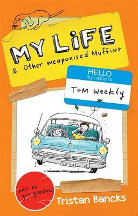
My life and other weaponised muffins by Tristan Bancks
Penguin Random House, 2017. ISBN 9780143781066
(Age: 9-12) Recommended. Themes: Humour; School life; Family. Tom
Weekly has once again shared the bizarrely crazy view of his life in
this collection of random meanderings. His life goes seriously
backwards at one point; toenails become inspirational food for
story-writing; his first longed-for kiss is hijacked; his dog does
something disgusting to his homework; he creates a money-making
venture to sell head lice as a means to escape school; and his own
mother uses muffins in a way that starts out well, but ends
disastrously. Nothing is ever boring in Tom Weekly's life.
Tristan Bancks has a bizarre sense of humour that is well fed by
suggestions from young devotees (and school brainstorm sessions).
His quizzes and his list of 'Would you rather' questions is also
enormously amusing. Any young reader who likes a little dose of
'gross' or 'yuck', with their humourous view of school and growing
up will enjoy this latest offering in the My Life series.
Carolyn Hull
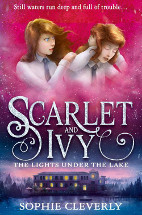
Scarlet and Ivy: The lights under the lake by Sophie Cleverly
Harper Collins, 2017. ISBN 9780008218324
(Age; 9+) Highly recommended. The lights under the lake is
another instalment in the Scarlet and Ivyseries and is just
as much of an adventure and a mystery as the other books. The great
thing about these books is that they are stand alone stories,
hinting at events in previous books to keep the readers up to date
with what is going on. Like the others, The lights under the
lake will keep readers wondering who is behind the mysterious
events.
Scarlet, Ivy, Ariadne and Rose all attend Rookwood School and have
become close friends, protecting each other through everything. As
part of a plan to relax and forget about the horrible events at the
school, the principal has organised a school excursion to a lakeside
hotel. It will be a chance for the girls to relax and learn about
nature. Unfortunately, the nasty prefects are in charge, mysterious
objects keep appearing in the hotel and someone is ransacking rooms.
The nasty prefects keep targeting Rose. Scarlet, Ivy and Ariadne
really don't know a lot about Rose and doubts start to set in. Will
the girls be able to save Rose from the prefects and her past? The lights under the lake is a mystery and
an adventure with excellent role models for girls. Scarlet and Ivy
are twins and always looking out each other. They will do anything
for their friends and are always working at overcoming their fears.
Ivy is the voice of reason while Scarlet acts before she thinks. The
difference is, Scarlet's seemingly inappropriate behaviour is always
in defence of someone she loves. Ariadne is intelligent and not
afraid to show it.
The story is descriptive and the vocabulary is easy and exciting to
read. Author, Sophie Cleverly, gives away just enough to keep the
reader guessing and they won't solve the mystery straight away.
Highly recommended for girls aged 9+.
Kylie Kempster
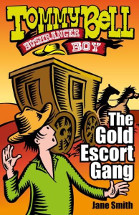
Tommy Bell: The gold escort gang by Jane Smith
Tommy Bell, bushranger boy series. Big Sky Publishing, 2017.
ISBN 9781925520217
(Age: Middle and upper primary) Tommy Bell continues his time travel
adventures in this third book of the Tommy Bell series, The
gold escort gang. Tommy can use his magic hat to transport
himself and his horse back to the colonial era. In the present time,
Tommy is under pressure to support a friend who wants him to help
steal a bike as a prank. Tommy wants to stay friendly but his moral
compass knows it is wrong to steal.
In the past, he meets Ben Hall, who has not made good decisions
during his life and has joined forces with the notorious bushranger
Frank Gardiner and is now a wanted criminal. As the title suggests,
Tommy becomes involved in a gold escort hold up and witnesses for
himself the impact the crime has on innocent bystanders. It is easy
to compare Tommy's dilemma about right and wrong with that of Ben
Hall's choices and the effect it has had on his life and family.
Jane Smith tells an exciting story and her knowledge of the colonial
era and bushrangers is evident. There is a comical situation where
Tommy witnesses some of the bushrangers having a nude swim when they
are interrupted by the police. This happened in real life, creating
a humorous scene where the bushrangers had to run to their horses
grabbing their clothes on the way. This is all explained in the
historical notes at the end of the novel. There is also a 'Q and A'
addition with Frank Gardiner.
The cover uses bold colours and has a feel of being printed due to
the strong black outlines. The font for the chapter beginnings have
a dated, colonial Australia feel and the page design resembles a
poster.
These books would appeal to middle and upper primary students. They
would be useful to read in conjunction with teaching the Australian
Curriculum in history in the year 4, 5 years.
Jane Moore
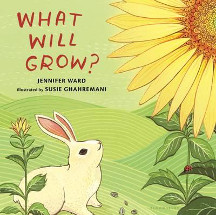
What will grow? by Jennifer Ward
Ill. by Susie Ghahremarni. Bloomsbury, 2017. ISBN 9781681190303
(Age: 3+) Recommended. Gardening. Natural world. Flora. Seeds. A
book about seeds which allows children to understand that each seed
has the promise of something else, is beautifully illustrated by
Susie Ghehremani, showing in bright pared-back illustrations the
habitat of each seed and the animal which will be found in its
vicinity. In this way children can focus on the seeds, animal and
habitat appropriate to the growing plant, adding to their knowledge
of the world around them.
Each double page represents one seed and in rhyming couplet gives
words that describe that seed or its habitat, and shows it and its
plant. So the first page shows round peas, then a pea plant replete
with seed pods showing clearly the peas inside. Over the page is a
pair of rabbits and small thin shaped seeds in the ground, producing
lettuce which the rabbits will adore. This page as with several
others requires the reader to lift a flap to revel the grown plant.
In this way the reader is introduced to a dandelion, tomato, oak
tree, apple tree and pumpkin amongst other vegetables and fruits.
The lift-the-flap will intrigue younger readers, especially when the
flap opens different ways to adjust to the plant being presented.
The last several pages shows what happens beneath the top soil, and
the last double page gives an overview of the seeds presented in the
book, while the last double page of all shows the seeds from
germination to plant to seed, engaging the younger reader in the
process of germination.
This would be a great introduction to a group of children about to
embark on growing things for themselves or setting up a class
garden.
Fran Knight
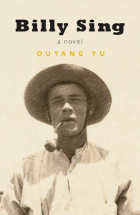
Billy Sing, a novel by Ouyang Yu
Transit Lounge Publishing, 2017. ISBN 9780995359444
(Age: Adult) Billy Sing was a Light Horse Trooper who served at
Gallipoli and later on the Western Front. A fine marksman even
before his military service, Sing became Australia's most famous
sniper with 150 confirmed kills. Other sources place his tally as
high as 300.
Sing was born to a Chinese father and an English mother and would
have suffered from the racist attitudes which prevailed at the time.
Ouyang Yu lends a narrative voice to Sing, telling his story from
beyond the grave and conveying an intellectual and emotional
dimension which emphasises his humanity and fragility. This is
important given that Sing was known as 'The murderer' or 'The
assassin' by his fellows and history frankly records him as the
highest scoring killer in the Australian army.
In the text, Sing is depicted as being much younger than he actually
was at the beginning of the First World War and the author possibly
sought to emphasise his physical and mental toughness. There is a
great deal of conversational philosophy and deep reflection on human
relations which is often difficult to accept given that this is work
of fiction. Sing's war service, whilst a central feature of the
book, was not detailed as prominently as I would have expected.
Perhaps this underlines that Billy Sing's life was much more than
four years spent as a soldier. The fact that the famous author Ion
Idriess was Billy's spotter is referred to only obliquely and
historical detail is presented as poetic recollection of individual
incidents, rather than in a more familiar narrative style.
The author does achieve his goal of making the reader understand the
appalling treatment that Billy endured during his difficult and too
short life. It is clear that what was just and fair had no bearing
on the life of Billy Sing and those he loved.
This is a complex work which may suit some adult readers.
Unfortunately the inclusion of the worst known profanity in the
opening lines of the novel (for no clear reason) would make this
book an unsuitable acquisition in most school libraries.
Rob Welsh
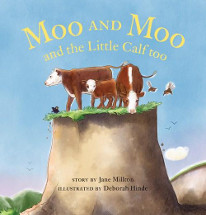
Moo and Moo and the little calf too by Jane Millton
Ill. by Deborah Hinde. Allen & Unwin, 2017. ISBN 9781877505928
Just after midnight on November 14, 2016, the earth under the
north-east of New Zealand's South Island started to shudder and
shake. Once again an earthquake was reshaping the landscape as
immovable forces fought for supremacy 15,000 metres below the
surface - not just a regular shake that Kiwis are used to, this one
was 7.8 on the Richter scale meaning widespread movement and damage.
Fast asleep in their paddock in the Clarence Valley on this bright
moonlit night were two cows and a calf, who soon found themselves
the subject of news
footage around the world as the shaking and quaking split
their sleep and their surroundings asunder and left them stranded on
an island two metres high and 80 metres from where they started.
Told in rhyme, Moo and Moo and the little calf too tells the
story of the three animals and how they were rescued, a story that
will fascinate young readers. Imagine if the chair or the carpet
they are sitting on suddenly moved and fell away and they were left
stranded so high they couldn't get down!
While there were many stories of the quake and its impact on the
landscape and the people, just as there are about recent devastating
weather events in Australia, we sometimes forget about the impact on
the wildlife that such phenomena have. The destruction of their
habitat, their dislocation from familiar food sources, their deaths
and injuries are often overlooked as the human drama plays out.
There was concern that the seal
colony at Ohau Point (where I had been with my grandchildren
exactly a year earlier) had been destroyed and with the seabed being
lifted 5.5metres in places, also concern for the marine life off the
coast.
So bringing this true story to life in a picture book that will
endure much longer than a short television news clip not only tells
the story of the cows but also puts a focus on other creatures who
endure the trauma as humans do. What happened to the sealife, the
birds, the kangaroos and all the other creatures during Cyclone
Debbie and the resulting floods? How do they survive during
devastating bushfires? What can be done to save them, help them, and
restore their habitats? What are their needs? Even kindergarten
students can start investigations along those lines, giving meaning
and purpose to the ubiquitous studies of Australia's wildlife so
they go beyond mere recognition.
While Moo and Moo and the little calf too might appear to
have a limited audience and timeframe, used as a springboard it
could be the beginning of something much greater. And that's without
even going down the path of the cause of earthquakes and how such
events give us the landscapes and landshapes we are familiar with.
Barbara Braxton
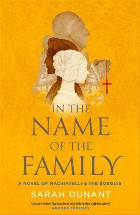
In the name of the family by Sarah Dunant
Little, Brown, 2017. ISBN 9781844087648
(Age: 15+) Highly recommended. This is a blockbuster, a historical
story of a world in moral disarray, ruled by enormously rich
families, their actions morally bankrupt, driven as they are by lust
for personal gain and power. In fact, lust in all its forms plays a
large role in this story. We read about the sexual romps, the
engorged appetites of the men and the women who pander to their
every need. While the men pursue land, wealth and power, the women
are there to entertain, as courtesans, and to bear children, as
wives. They can, and do, influence the men, however. Yet, this world
is depicted as very much a man's world.
It is a tale wonderfully told, in richly descriptive language. It is
not a light-hearted tale about good families and courageous people.
It is instead a powerful, dark, violent, manipulative and, at times,
despicable story. Yet it is also a wonderful and richly satisfying
book that makes the reader very happy to live in the modern world,
where at least there are strategies and laws that may prevent some
of the megalomaniacal actions that we read about in this history, or
so we hope!
Sarah Dunant has a brilliant grasp of the period, her deep and broad
research enabling her to reconstruct a world of the past, and to
construct it in a strong literary piece that is extraordinarily
detailed. The strength of the novel lies in the detailed retelling
of the times and the historically rich narration of the lives of the
main characters - the famous Borgias and Macchiavellis. When we use
the descriptor, 'Macchiavelian', we speak as if we know what that
means. Yet, after finishing this novel, we find that we may not have
known very much of their lives, and now we see, through a modern
mindset, a sense of the oppression of woman, the demands for sexual
favour, the sometimes terrible deeds such as the slaughtering of
women and children, families and small towns when deemed
'necessary', and we are exposed to truly evil characters. We
discover that most of us would know little about these times and
these families as we are drawn into an appalling world, one of
lechery, devious actions, plotting, evil deeds, and dark secrets.
Dunant makes sure that we know much more by the time we finish
reading this most entertaining historical novel.
Liz Bondar
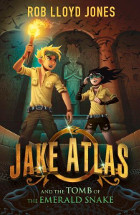
Jake Atlas and the Tomb of the Emerald Snake by Rob Lloyd Jones
Walker Books, 2017. ISBN 9781406361445
(Age: 10+) Highly recommended. Jake Atlas is not your average 12 and
a half year old. His parents are archaeology professors, his sister
is a genius and he is constantly in trouble.
In Jake Atlas and the Tomb of the Emerald Snake, the Atlas
family are on vacation in Egypt when Jake's parents go missing just
hours after checking in to the hotel. Jake and his sister, Pan, are
on their own. With Pan's intelligence and Jake's ability to get into
trouble, the siblings soon find themselves in the middle of a huge
adventure. They rob a museum, invade a tomb and nearly die as they
try and save their parents. Imagine Jake and Pan's surprise when
they discover their parents are just like Indiana Jones with the
fighting skills of a ninja! Once upon a time, Mr and Mrs Atlas were
treasure hunters and a mysterious group has now kidnapped them as
they need their skills to find the Tomb of Osiris. With high tech
gadgets and puzzle solving, Pan and Jake race against this
mysterious group to find the tomb and save their parents.
Set in Egypt with pyramids and tombs as the backdrop, readers will
learn about the mysteries of Egypt while enjoying the adventure of a
lifetime. As they read Jake Atlas and the Tomb of the Emerald
Snake, readers will be on the edge of their seats as Pan and
Jake match wits with mercenaries and treasure hunters. The events
are exciting and the vocabulary easy to read.
This novel is highly recommended to all readers aged 10+. It would
also be a great read aloud novel for the year 7 classroom as they
study ancient civilisations.
Kylie Kempster
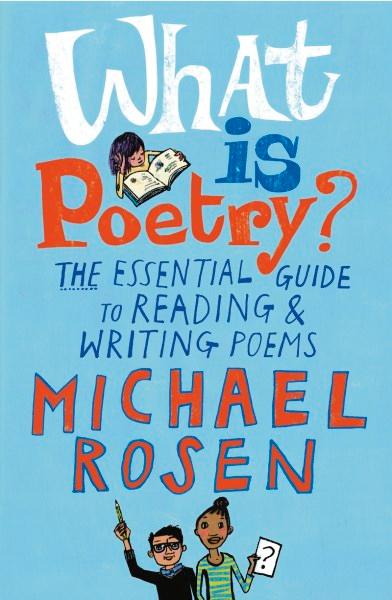
What is poetry? by Michael Rosen
Walker Books, 2017. ISBN 9781844287635
(Age: 11+) Highly recommended. What is poetry? gives readers
an insight into the messages and technical elements in poetry. In
chapter 1, author, Michael Rosen, looks at the symbolism, the irony
and the rhythm of poetry. He explains how poetry voices and captures
moments. Each section has a poem and some guiding questions or
comments to get readers thinking about each poem and its elements
and messages. Year 6/7 teachers, in a primary setting, could use
these poems in the class and follow Michael Rosen's comments and
questions by handing the discussion over to the students. Young
writers could also use this chapter to help them write better poems
or to understand their writing better.
Chapter 2 covers all you can do with a poem. The tasks include
reading poems, asking questions, looking for connections and using
poems with an arts curriculum. Michael Rosen offers ideas and
examples.
Chapter 3 looks at the thoughts Michael Rosen has when writing
poetry. The poetry examples could be read by students, they can
comment on possible feelings and then the class could discuss
Rosen's thoughts as read by the teacher.
Chapters 4, 5 and 6 look at ways to start writing poems as well as
the technical elements. Michael Rosen offers ideas that would help
guide the teaching program.
This book could be used as part of an author study. Students could
investigate Michael Rosen's poetry as well as other poets. It is
highly recommended for young writers aged 11+ and for teachers to
plan and prepare different poetry investigations.
Kylie Kempster
Down the line by Michael Panckridge
Legends series. Ford Street Publishing, 2017. ISBN
9781925272635
(Age: Middle and upper primary) Recommended. This is the third story
in the Legends series, with each book concentrating on a
different sport. The eight sports narratives feature surfing,
cricket, tennis, football, soccer, basketball, athletics and
swimming. Down the Line focuses on tennis.
The stories concentrate on the same characters and we follow them as
they compete in each sport to try to win 'The Legend' school trophy.
Mitchell Grey has been successful in the first legend trials but now
he must compete against his own friends as well as Travis Fisk, an
unlikeable bully. The stories follow both boy and girl competitors
and there are lots of descriptions of the games, scoreboard results,
statistics, maps and quizzes. All the scores and results of the
tennis competition and the overall competition are given at the end
of the novel.
Michael Panckridge uses his stories to highlight friendship, fair
play and bullying.
This book would appeal to students who play or are interested in
sport. They would enjoy reading the scores and trying the quizzes.
It is advertised as a series for reluctant readers aged 8 to 14
years, with 'current, kid-friendly vocabulary and language'. I
showed this book to a very sports focussed year 6 girl and she said
she was strongly interested in reading the novel. The books have
been reissued in more modern jackets and the Down the Line
cover appeals to both girls and boys as there is a photograph of
both. Michael provides teacher's
notes and black line masters.
Jane Moore