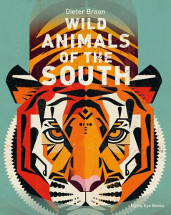
Flying Eye Books, 2017. ISBN 9781909263970
(Ages: 5+) Australian animals. African animals. South American
animals. Antarctic animals. This is a translated edition of a German
publication, with a second book, Wild animals of the north, also
available. There are many of these artsy, illustration-based
non-fiction books around for children and lots of them are
extraordinary in terms of their visual appeal as well as their
ability to engage young readers, many of whom are becoming more
discerning about the aesthetic qualities of their reading material
as well as shying away from text-heavy books. This one is organised
into four regions: South America, Africa, Asia and Australia. In
keeping with the visual focus, the contents are graphical (using a
map) and the index, organised by region, is pictorial (confusingly
not ordered alphabetically).
The introduction sets a conservationist tone for the reader as it
draws attention to the many species of animal currently threatened
with extinction. It opines 'We are intruders in the animal kingdom
and with every animal that dies out, our life on this planet loses a
part of its power and colour and beauty'. This is a wonderfully
written statement with the power and clarity to resonate with adults
and children alike. The author, by providing breath-taking
illustrations that display their beauty and immenseness, emphasises
that wild animals need to be respected and protected. The
illustrations are not completely realistic, but they are
scientifically accurate and incredibly detailed. The colours are
bright and vibrant, but not always true to life. Many of the
animals, composed of layered geometrical shapes, appear to pop off
the page, piercing you with their intense eyes.
This is a book to appreciate visually but is in no way a reference
or research book. Despite the introduction telling us, 'this book...
tells us how and where they live, what they look like, what they
eat, how they find each other or hide from one another and all the
other things they get up to' the illustrations really are the main
event and they deserve to be. Scientific names are given alongside
common names but aside from this inclusion (which is probably done
to give an exotic feel rather than for educational purpose) minimal
and sometimes no information is given about the included animals.
What information is given is limited in scope and often pertains to
one aspect (e.g. the kookaburra's laugh). In addition, it is far
from comprehensive; it includes only eighteen Australian animals and
a mere eight from the Antarctic region. While clearly not intended
as a reference book, it seems odd that information is not given for
each animal. Nevertheless, this is a beautiful book of art sure to
be treasured by animal lovers and young artists.
Nicole Nelson
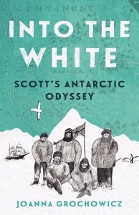
Into the white: Scott's Antarctic odyssey by Joanna Grochowicz
Allen and Unwin, 2017. ISBN 9781760293659
(Age: 10+) Recommended. Antarctica, Exploration, Heroism. This
extraordinary story of Captain Scott and his ill fated race to be
the first to make it to the South Pole, is given new resonance for
younger students in this highly readable book, Into the white.
Having heard of Scott and his fellow expeditioners at primary school
when Social Studies was filled with stories of well known people, I
knew about their heroism, their daring and some of the tales about
their trek. I read this thinking I knew at least the background of
the tale, but was pleasantly surprised: the story is compulsive and
the detail simply mind boggling. I can hardly imagine minus ten
celsius, let alone minus fifty, but these men trudged on. The
description of Wilson's hands bulging with frostbite and then saying
that they would keep going, paralleled the tale of another three
stuck on an ice flow being circled by killer whales, the poor horses
slipping into the water. Or having to kill the horses to feed the
dogs, or getting into sleeping bags that were wetter than they were.
All the stories in this book attest to their courage and bravery,
keeping on even though they knew that Amundsen from Norway would get
there first.
The comradeship of the crew is impressive, the leadership shown by
Scott amazing, and above all their reasons for being there a
salutary reminder of the values of those who have gone before us.
I would have loved a timeline but was able to access one quite
easily on the internet, which I kept referring to as I read. Written
for younger readers, it is still 256 pages long and supplemented
with a cache of photographs in the middle, several maps at the
beginning and appendixes at the end rounding off the story.
I hope more people will read of these brave adventurers.
Fran Knight
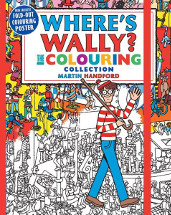
Where's Wally? The colouring collection by Martin Handford
Walker Books, 2017. ISBN 9781406375701
(Age: 8+) Highly recommended. With the interest in colouring in
going strong, both children and adults will find lots of pleasure in
this colouring book featuring Wally. Even those who are not so keen
on colouring in will still love the opportunity to find Wally in the
many black and white scenes that can be found in the book. Wally is
lurking near a pond, in a dinosaur park and in the middle of a
medieval festival as well as many other exciting and interesting
places. The pages present quite a challenge for the colourist to
complete, with their small and intricate drawings, and definitely
would be rather difficult for little hands to manipulate.
The paper is thick, the book sturdy and there are other challenges
to complete. I was taken with the Super Sneaky Villains who all look
like Wally with the exception of having mostaches and had fun trying
to find Wally in the pages of villains. At the back of the book is a
giant size poster featuring dinosaurs (and Wally is rather hard to
find here), which could be pinned up in a library, classroom or
bedroom and completed at leisure.
This book will give hours of relaxation and fun. It would also be a
fabulous gift for children who have to while away hours on a long
car or plane journey.
Pat Pledger
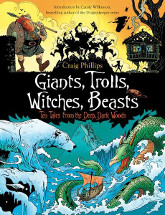
Giants, trolls, witches, beasts: Ten tales from the deep, dark woods by Craig Phillips
Allen and Unwin, 2017. ISBN 9781760113261
(Age: 10+) Highly recommended. Giants, Trolls, Witches, Beasts:
Ten Tales from the Deep, Dark Woods is a book of ten fairy
tales that readers would not have read before. The stories come from
across the globe, from countries such as Germany, Ireland and
Russia. Each story is told in comic form, making it appealing to all
reading levels. Once readers are familiar with how to read a comic,
they won't be able to put the book down. Being a collection of
stories means the book can be read anytime. Readers who struggle
with novels can read individual stores at different times and in any
order.
Read about ogres, witches, heroes, villains and an exploding dragon.
The detailed illustrations will keep readers busy as they tell the
story. Inside the book is a story for all interests. Vasilisa
the Brave is a female heroine with story elements very similar
to Cinderella. The King of the Polar Bears tells the
story of the polar bear king who receives a feather coat and must
defend himself against those who ridicule him. The Boy Who Was
Never Afraid has a male hero who shows kindness to even the
fiercest of creatures.
This book of tales is highly recommended for all readers aged 10+.
It would be a great book for students to use during the Daily Five
activity 'read to self' where the reading of pictures and text is
encouraged and modelled. The pictures tell the story, like all
comics, and the text is descriptive and easy to follow and read.
Kylie Kempster
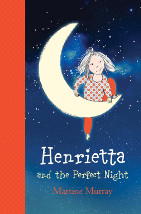
Henrietta and the perfect night by Martine Murray
Allen and Unwin, 2017. ISBN 9781760290245
(Age: 4-8) Recommended. This fifth book continues the adventures of
'Henrietta the Great Go-Getter'. She is going to have a new sibling,
start school and discover a friend. Henrietta is trying novel things
such as sleepovers and performing in plays. Henrietta befriends a
crying Olive Higgie on the first day of school. Although Henrietta
herself is anxious, it is her kindness towards Olive that makes the
first day enjoyable for them both. Henrietta's mother is quietly
supportive, offering love and understanding whenever Henrietta needs
it. Growing up, Henrietta the Great Go-Getter, is 'go-getting' and
she believes she is very brave having a sleep over with Olive and
dealing with Olive's big brother.
Henrietta feels jealous at first when Olive is given the lead part
of Noah is the class play but she knows that to be a real friend she
needs to congratulate and support Olive in the role. The last
chapter is of course the arrival of the new baby and a surprising
gift.
These small sized books are beautifully illustrated by Martine
Murray and have a restricted palette of soft colours. My only
complaint is that the white text on the light backgrounds are
difficult to read. The simple drawings are appealing and have a
child-like quality about them. Martine's stories are gentle and
realistic. It is easy to submerge into Henrietta's wonderful world
and experiences, enjoying apple trees, bugs and the occasional
apricot slice.
Jane Moore
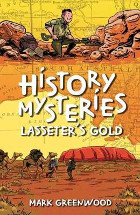
History mysteries series by Mark Greenwood
Lasseter's gold. ISBN 9780143309321 The last tiger. ISBN 9780143309253
(Age: Middle primary) Recommended. Two wonderfully enlightening
tales in the History mysteries series of books, giving a
fictional account of a real event in Australia's history, will be
well read as they offer excitement and adventure wrapped up in a
plethora of historical facts about our past.
The claim by Lasseter in 1900 that he had found a massive reef of
gold somewhere in Central Australia, still holds water today as
people search for it. He was able to convince people to back him in
1930 and an expedition set out from Alice Springs. But people soon
tired of his secrecy and seeming inability to understand the bush.
More of them began to question if he had ever been in the bush, and
so most went back to Alice Springs, leaving Lasseter and a gold
prospector to travel on. They split, and later Lasseter's body was
found buried in a shallow grave by Aboriginal people who had tried
to help him. But the story endures, especially after maps and
instructions were found in the bank after his death.
The story of the last thylacine in Australia is a poignant as it is
instructional, pointing to the fragility of our environment and
urging us to care for it.
Two other books have already appeared in this series, Diamond
Jack and The lost explorer, and the four together make
great reading for middle school people, introducing them to history
through a well told story with illustrations, maps and a glossary to
help the early learner.
Fran Knight
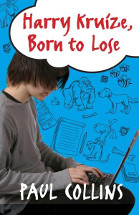
Harry Kruize, born to lose by Paul Collins
Hybrid Publishers, 2017. ISBN 9781925272628
(Age: 11+) This book draws heavily on one of the best-known poets
and fiction writers of Australia's colonial period - Henry Lawson
(1867-1922). One of Lawson's recurring themes in his yarns is dogs.
Many a boy wants to have the mateship and loyalty of a dog. The
stories Paul uses are pub yarns written for adults so many of the
underlying morals to the stories will leave kids shaking their heads
wandering what the connection is to the protagonist, 11 year old
Harry Kruze; this is where teachers will revel in helping readers to
dive into the finer details and discuss issues such as family
relationships, mental health and student bullying and examine
Harry's perception that life is 'all jumbled up and fragmented . . .
All messed up. And back to front'.
Harry Kruize describes himself as the Hobbit, feeling like 'a
walking disaster' and 'the class weirdo'. Not surprisingly he goes
through each school day keeping his head down to avoid his nemesis
Gavin Brickson, THE BRICK, while trying to make sense of his
mother's fluctuating moods. Although having a low opinion of himself
he dreams of becoming a writer and likes to think of himself as
represented by font that is 'bold face', 'clear' and 'straight to
the point'.
Paul Collins has cleverly interwoven Harry's voice into a class
assignment where students come up with a list of wishes and diarise
about them coming true or not. Without giving away any spoilers one
of Harry's seven wishes is for a dog, hoping that having a dog and
winning the Dog Day Race Cup might solve his lack of social skills
all the while helped along by some dubious advice from a 'friend'.
Personally I like the cover but I would have preferred to see it
representative of the main character's age. The pages are bordered
by Microsoft Word desktop which students will feel connected to. The
mix of font makes the appearance of the book attractive but a
reluctant reader would benefit from increasing the spaces between
lines. A warning also needs to be made regarding the graphic
goriness depicted in Collins' The dog that wasn't.
Overall, this is an interesting book for readers aged 11+ years. It provides many
opportunities for guided discussion about family relationships, mental
health, student bullying and empathy.
Paul Collins was born in England, raised in New Zealand and
immigrated to Australia in 1972. Paul is the founder of Ford Street
Publishing and runs the speaker's agency Creative Net. He strongly
believes in nurturing Australian talent and has selflessly dedicated
his time to ensuring children continue to be challenged and
entertained by their reading choices. Harry Kruize, born to lose
is one of Paul's 140+ books. For more information about Paul
Collins, stop by his website.
There you will find information about all Paul's books, helpful tips
for young writers and classroom tools for teachers.
Sharon Smith (Children's and Youth Services Librarian Riverina
Regional Library)
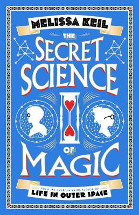
The secret science of magic by Melissa Keil
Hardie Grant Egmont, 2017. ISBN 9781760127763
(Age: 14+) Highly recommended. Coming of age. Mathematics. Magic
tricks. Sophia is very smart - she loves mathematics and finds it
easy to relate to logic. Joshua loves his magic tricks and is
obsessed with finding a way to get to know Sophia. He decides that
timing is everything and begins a campaign starting with leaving 2
of hearts card in her TARDIS wallet. As the end of school life
looms, both have to come to terms with change and work out what they
will do with their futures.
Melissa Keil is an award winning author (Life
in outer space and The
incredible adventures of Cinnamon Girl) and she
continues her winning approach in The secret science of magic.
Her two characters capture the reader's interest right from the
first chapter. Joshua, a tall lanky boy, loves all the illusions of
magic and although isolated at high school has a job and good
friends away from the angst of school politics. Sophia, despite
being exceptionally bright, is increasingly anxious because her best
and only friend, Elsie, is planning on moving to the US for college
and her relationship with her brother Toby is exceedingly tense. She
has never been interested in boys, but as Joshua gains her interest
with magic tricks and plays a giant illusion prank on her Drama
teacher, he begins to get under her skin. Sophia's anxiety escalates
during the narrative and this is handled sympathetically by Keil as
is the romance between the two protagonists. Joshua is caring and
understanding of Sophia's anxiety disorder and helpful when she has
problems with her friend Elsie.
Keil leavens her story with wonderful flashes of humour and
references to Dr Who, musicians and authors like Robin Hobb add a
dimension to the story. The insights into Mathematics and Grigori
Perelman, a reclusive Russian mathematician are also fascinating and
will have readers researching many of the things that are mentioned.
With its humour, diversity (Sophia is of Sri Lankan descent), its
sympathetic portrayal of anxiety and its gentle romance, The
secret science of magic would make a fascinating Literature
Circle or class text.
Pat Pledger
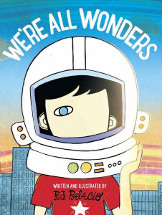
We're all wonders by R. J. Palacio
Penguin, 2017. ISBN 9780141386416
(Age: 4-7) Highly recommended. Paperback, 32 pages.
Imagination. Play. Emotions. Feelings. Acceptance. Tolerance. Special
needs. R. J. Palacio's best-selling novel Wonder introduced
readers to Auggie Pullman an ordinary boy with an extraordinary
face. This novel inspired the Choose Kind movement that encourages
everyone to choose kindness, be tolerant and accepting of other's
unique qualities. We're all wonders with its simple, bold statements and
colourful, graphic illustrations introduces Auggie and his dog Daisy
to younger readers. Palacio's desire is to help children understand
the need for tolerance, acceptance and kindness. Auggie does
ordinary things, riding a bike, eating an icecream and playing
ball, however he does not look ordinary. On the portrait wall, even
though there are students from different backgrounds, countries,
with different facial features, he stands out. His loving mother
says he is a wonder but he knows others see him as different.
Palacio's emotive, stylised illustrations beautifully portray
Auggie's emotions when his feelings are hurt: the little boy, his
dog, even the blue bird in the wagon all are drawn with their heads
down looking dejected. His helmet is drawn as a symbol of protection
and he blasts off across a starry galaxy to Pluto where all the
creatures who have the same unique faces welcome him. Auggie is
shown looking back to Earth wishing that there is room for everyone
to be loved and accepted.
This simple picture book is a fantastic starting point for families
to discuss tolerance, acceptance and physical differences. From the
front cover, to the last page where the world is reflected in
Auggie's one eye, this is a powerful picture book. We're all
wonders is a key book for teaching ethical understanding in
the Early Years: identifying and appreciating similarities and
differences in people; exploring how people feel when they are
included and excluded from groups and demonstrating appropriate
language when encouraging others.
Rhyllis Bignell
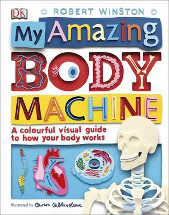
My amazing body machine by Robert Winston
Ill. by Owen Gildersleeve. DK Publishing, 2017. ISBN 9780241283806
Young children are always fascinated with their bodies and how they
work and this new publication from DK is the perfect starting point
for those who are ready to delve a little deeper.
Divided into nine sections, each dealing with a different but
related phenomenon of the body, with bite-sized chunks of
information in accessible text interspersed with colourful
informative diagrams and photos, this would be an ideal addition
to the family reference library, ready to consult when questions are
asked, as well as the school library collection. Having it out on
display so students can leaf through it as they wait will spark lots
of curiosity and a desire to find out more. The perfect introduction
to the role of the encyclopedia as a starting point to finding out a
little and sparking the desire to go to a more specialised book to
find out more.
DK have been at the forefront of introducing non fiction to young
readers for decades and this is no exception.
Barbara Braxton
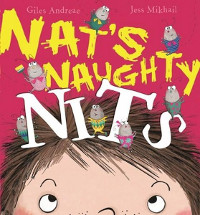
Nat's naughty nits by Giles Andreae
Ill. by Jess Mikhail. Orchard Books, 2017. ISBN 9781408329375
(Age: 4-6) Hardcover, 29 pages. Lice. Rhyming stories. Humorous
fiction. Health. Daily living. 'There are nits in the treetops,
Nits in the town,
Nits on the toilet seat with their pants pulled down!'
Giles Andreae tackles a new but very familiar subject in this funny
rhyming story. Nat's naughty nits have come to play, they have
invaded his hair and his life, they are even playing football,
eating treats and sleeping safe and sound. There is an abundance of
little black creatures up to all sorts of mischief, until Mummy
appears with her shampoo and comb. Nate's nits are gone, and he is
looking very smart until we see them travelling along the tabletop
off to find a new head.
Jess Mikhail's lively nits wear a bold array of outfits perfect for
their insect bodies, as they engage in a humourous range of
activities. Their funny expressions, up close antics and settings
are delightful, an amusing accompaniment to Andreae's rhyming story,
which is presented with a range of font sizes from big and bold to
tiny. Nat's naughty nits is a fun story to share with a family or
class, especially as an introduction to healthy living and how to
cope with this very common school problem.
Rhyllis Bignell
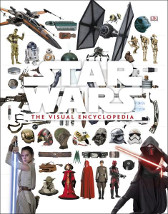
Star Wars: the visual encyclopedia by Tricia Barr, Adam Bray and Cole Horton
Dorling Kindersley, 2017. ISBN 9781465459626
(Age: 8+) Highly recommended. Encyclopedia, Star Wars, Film history,
Technology. The most amazing compendium of all things about Star
Wars is presented in this large format, heavy tome. What a
coverage: from set design to costume, machinery to ammunition, space
ships to galaxies, characters to flora and fauna, here is a
wonderful contribution to the plethora of books now written about
Star Wars, giving a bird's eye view of all the thought, design and
making that went into the preparation of the worlds created for that
series of films. Watching any of the films makes the audience gape
in wonderment at the array of things shown, but reading this book
underscores the brilliance of the creators, the range of ideas
developed, the level of sophistication of all the people who worked
on it. I couldn't put it down.
Divided into five sections: Geography, Nature, History Culture and
Science and technology, all aspects of the film are covered, with
the last taking up almost half of the book. The first section,
Geography, shows all the planets, both inner and outer that make up
the galaxy, as well as other celestial bodies traveling in space.
Specific detail is given about the mountains, rivers and make up
some of the planets, leading into urban geography and architecture.
Nature describes and shows some of the creatures which make up this
galaxy, leading from the most grotesque of animals to the human and
not quite human. History fills us in with the war between the powers
in the galaxy, with a timeline of events to make sure we know what
happened and when, in relation to other events. This section
includes all the protagonists, and there are many of these. Culture
shows us the design of the clothing, and leads onto food an art.
But the last section, Science and Technology, is huge. Droids,
security and medical droids, communications technology, equipment
and field gear, are described in detail, until the munitions pages
are reached. Here every reader will revel in the illustrations and
descriptions of the rifles, blasters, projectiles and shields, light
sabers, and starfighters. I loved the range of things explained and
illustrated and will look at the Star Wars films with a new
appreciation of the depth of design that went into these now classic
sci fi films.
Fran Knight
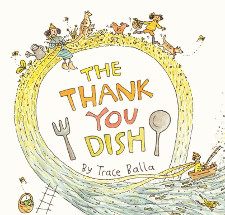
The thank you dish by Trace Balla
Allen and Unwin, 2017. ISBN 9781760292355
(Age: 3+) Highly recommended. Food, Gardens, Food production. When
Grace sits down at the table to eat the meal her mother has prepared
for her, she thanks all those involved in its making. She thanks Leo
for lending her a ladder to pick the lemons, the road workers for
laying the road on which she can ride her bike to the market stall,
she thanks Suki for selling them the kale and corn, the kangaroos
for not eating the carrots. A parade of people are thanked because
they have in some way been responsible for her meal.
The story underlines our interdependence on other people, it shows
how a small community can share its resources and produce, it
promotes a grass roots attitude to growing our own produce and
sharing it with others. For children it reveals how our lives are
dependent on others, from family and friends to neighbours and
workers, and will promote discussions abut how they can be involved.
There are now many schools with vegetable gardens.
The quirky illustrations reveal a myriad of detail as the girl sits
at her table thanking all those who had a hand in producing her
meal. Nods to home grown produce are given on each page: a vegetable
garden, fruit trees, local jams and relishes, a market stall are
depicted with Grace and her mother able to reach each on their
bikes, just like the author, Trace Balla.
This story oozes with love and family, with a friendly open
community sharing and helping each other, something which many more
people are aspiring to.
Fran Knight
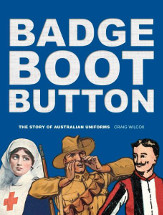
Badge, boot, button: the story of Australian uniforms by Craig Wilcox
National Library of Australia, 2017. ISBN: 9780642278937
Recommended as a Library reference book. Themes: Uniforms; Military
Uniforms; Australian History; Clothing. Uniforms are probably not
everyone's favourite item of clothing, as they are usually worn in
response to the authority of others or as a symbol of authority. In
this book, Craig Wilcox has looked at the changing nature of
uniforms in military and civilian contexts within Australia. With
pictorial evidence and magazine-style excerpts of detail from
specific examples, the book meanders from the early convict
experience, to the military and sporting arena, as well as giving a
nod to the influence of military history to civilian work uniforms
and government emergency services. Read from cover to cover, there
are difficulties in following the historical or chronological thread
(particularly when there are multiple pages of pictorial content or
sidebar examples interrupting the flow), but this will be an
interesting resource for those interested in the way clothing
reflects changing social priorities. References to everything from
'The Baggy Green Cap', to Sir John Kerr's Top Hat and topcoat
appearance, to volunteer outfits at the Sydney Olympics and the
changes of the attire of Flight attendants in an Australian context
are all given attention. Surprisingly there is no mention of Cathy
Freeman's unusual sporting 'uniform' and running outfit at the
Sydney Olympics, nor does Wilcox address the nature of fabric
technology changes and the subsequent impact in sporting fields.
Understandably in a book of this size (166 pages), it is not
possible to discuss every uniform permutation, and the social
pressures that lead to change are addressed only briefly. What this
book does do well though is to demonstrate that uniform can be
reflective of social and political change.
Carolyn Hull
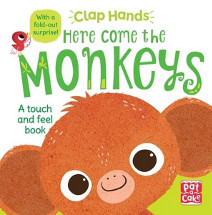
Clap hands series by Pat-a-cake
ISBN: 9781526380081.
Ages: 0 – 4) Recommended. Board Book.
Boldly illustrated as a series of four rhyming texts, each is your classic 'touch and feel' board book, every page featuring a differently textured material for parts of the characters' bodies. Here come the monkeys depicts different species of monkey on each page with Koko on page 3 bearing a lovely rough paw made of hessian that tells our little reader she must have been doing quite a lot of walking in addition to swinging from tree to tree. Each character is introduced by name and a little birdy, who remains nameless throughout the series, points out each feely feature. The reader is bid to clap hands for the clever creature at the turn of the page. My 11 month old granddaughter delights in the opportunity to display her recently acquired clapping skills after having a good feel. All the touchy textiles are well embedded making the book sturdy and long lasting. In the case of Here come the dinosaurs, the reader is introduced to a range of creatures falling under that umbrella with contractions of the species' names for each one. Terry is Pterodactyl's name and he sports one beautifully shiny foil wing which little birdy on the side sagely points out. The fold out surprise page at the end of each book provides an overview of and contextualizes the monkey, puppy, kitten or dinosaur varieties and providing an opportunity for further discussion with the older toddler. You do need to make the suggestion to your little reader however, that care must be taken with the fold-out, as it is not quite as sturdy as the rest of the book. A great little series for the very youngest of readers to get them hooked on books.
Elizabeth Avery