Hachette, 2019. ISBN: 9780733640025.
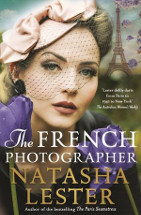
(Age: 16+) Recommended. Historical fiction. In 1942, Jessica May, a
beautiful and much sought after model for Vogue magazine, has her
career cut short when her ex-boyfriend sells her image for a Kotex
advertisement. She finds herself blacklisted because nobody wants a
model linked to the taboo subject of menstruation. But the flipside
is that for the first time she considers what she would really like
to do - and that is to become a photojournalist reporting on the war
front.
And so it passes that Jess finds herself, along with Martha
Gellhorn, Hemingway's wife, venturing as a female reporter into the
war zone. The story of The French photographer is a romance,
Jess falling in love with the dashing American officer, Dan
Hallworth, but it is also the story of the struggle of women war
correspondents to be recognised and respected alongside their male
counterparts. Jess goes from reporting on the nurses' stations at
the front, to documenting the Nazi concentration camps, to war
crimes committed by both sides. She is an intrepid photographer and
reporter who won't be held back by the conservative and chauvinistic
officers she has to report to.
However, interwoven with the story of Dan and Jess, is the story of
a young French child, Victorine, handed by her parents to an
American soldier to save from the advancing German army. Dan becomes
the only father Victorine knows, and Jess also becomes a trusted
friend.
Time shifts to 2004, and D'Arcy Hallworth, a young Australian art
handler, has the task of preparing an exhibition of the work of an
anonymous photographer, a job that sees her trying to untwist the
threads of her own family history, and follow her dream as a
documentary filmmaker. But first she has to uncover many secrets and
learn who to trust.
The two stories interweave in a way that keeps the reader engaged,
and the novel provides a blend of historical fact and fiction that
is both realistic and satisfying. Much of Jessica's story is based
on the experience of war photographer Lee Miller, renown for her
images of women in wartime, and most memorable for her iconic photo
taken in Hitler's bathtub, 1945. Lester includes an account of that
photograph in her story.
Readers of this novel will gain an appreciation of how difficult it
was for women to gain credibility in the workforce, and that whilst
the war opened up new opportunities for women, the doors were quick
to close again once the men had returned. Reading The French
photographer would provide students with an interesting entry
point to researching the history of women's roles during World War
II.
Helen Eddy
Squish Rabbit's pet by Katherine Battersby
University of Queensland Press, 2019. ISBN: 9780702260469.
(Age: 3-5) Recommended. Themes: Friendship, Responsibility, Love,
Pets, Eggs, Dreams. This is the third book featuring the cute little
rabbit Squish and once again children will delight in the soft cover
and the appealing illustrations. It follows Squish
Rabbit and Brave
Squish Rabbit. Squish has big dreams - a field of never-ending
carrots, matching outfits with his friend Twitch but what he really
wants is a puppy. Twitch helps him out with a toy puppy but it
wasn't quite right and when Squish finds a lonely egg while out
walking he brings it home, hoping that it will hatch a puppy. He
patiently cares for the egg and finally finds a friend.
Children will have lots of fun, knowing that eggs don't hatch
puppies, and will try to predict just what might hatch out of the
egg which looks similar to an Easter egg. What if it is a crocodile?
What will Squish do? This could lead to discussion about the
responsibility of looking after different pets and the joy of owning
one. Friendship too is an important theme and Twitch is helpful and
caring as he aids his friend in his quest for a pet.
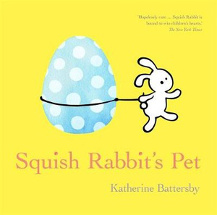
The line drawings of Squish are amazing - his feeling are apparent,
even though there are just a few black outlines on his face. The
soft pastels of the egg and background contrast beautifully with the
illustrations of the friends and toys. Each time the book is read,
the reader can find more to look at and think about.
Children who loved the first books will welcome another tale about
Squish, and teachers will find the teacher
notes a handy reference.
Pat Pledger
Peppa's muddy festival: a lift-the-flap book
Peppa Pig series. Ladybird Books, 2019. ISBN 9780241375884.
(Age: 1-4) Recommended for fans of Peppa Pig. Any parent who has a
child obsessed with Peppa Pig will welcome this sturdy board book
with lift the flaps, just right for small fingers. In Peppa's
muddy festival, the family is off to a children's festival
where they anticipate having lots of fun. But Mummy Pig is a bit
worried that it will rain and the ground will become very muddy. Not
so Peppa Pig, who loves muddy puddles.
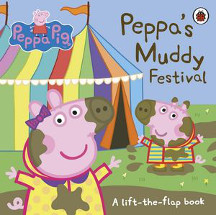
Very bold and vivid colours bring the children's festival to life.
Each activity has a flap to lift and children will have fun guessing
what is under each one, often ones that are not expected. The
family's overnight stay in a tiny tent is fun, but not as exotic as
the glamping that Suzy Sheep's family experiences or the joy of
finding that it has rained overnight and the ground has been turned
to mud. The expressions on the faces of the little animals as they
make mud castles and jump in muddy puddles are exquisite.
Warning, after reading this book to youngsters, it will be hard to
keep them out of puddles!
Pat Pledger
Joe Quinn's poltergeist by David Almond
Illus. by Dave McKean. Walker Books, 2019. ISBN: 9781406363197. 80
pgs.
(Age: 12+) Highly recommended. Themes: Ghosts, Death, Grief,
Beliefs, Coming of age. This dark, atmospheric graphic novel will
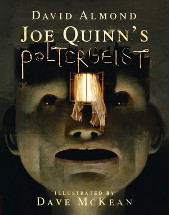
grab the reader's attention right from the first time the strange face with its gaping mouth on the front cover is glimpsed.
This is the fourth collaboration by Almond and McKean, (Mouse
bird snake wolf, Slog's
dad, and The savage) and as one would expect from two
such outstanding artists, it is stunning.
Davie is on the cusp of moving from childhood into his teen years.
He is interested Josephine Minto, and isn't sure of his beliefs
about God and ghosts. When Joe Quinn boasts of having a poltergeist
in his house and Davie sees bread and other objects flying through
the air, deep down there is a hope that ghosts do exist as that
would mean that his little sister might be one. The problem is that
Joe Quinn tells stories and when the local priest is called upon to
give his opinion, it turns out that he is not the holy person that
one would wish for.
Almond's exploration of grief and beliefs is dark and powerful. In
the introduction he writes about his childhood where St Patrick's
Church was full of believers but superstitions about ghosts abounded
and people flocked to Lourdes for its healing waters. And Davie's
story is full of the uncertainty of a changing world, one where even
the priest is questioning his spiritual beliefs.
Dave McKean's illustrations are as eye-catching and as
thought-provoking as in his previous collaborations with Almond.
They build on the story and give the reader a visual picture of all
the characters and their surroundings. The drunken, cigarette
smoking priest lurches into Joe's house, Josephine Minto shows off
her tennis skills and Davie, Joe and Geordie emerge as young adults.
This is a complex and clever book, certainly not for the very young,
with its dark themes and questioning of religious beliefs. It is a
coming of age story, with Davie throwing off his childhood and
realising that life goes on and his sister will be remembered 'in
memories and words'.
Pat Pledger
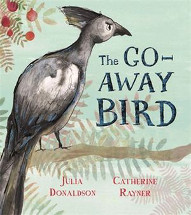
The go-away bird by Julia Donaldson
Illus. by Catherine Rayner. Macmillan Children's Books, 2019. ISBN:
9781509843589.
(Age: 4+) Highly recommended. Themes: Friendship, Birds. A bird in
South African has a call that sounds like 'go away' and is so named
the go-away bird. In this story of friendship, of people needing
others to survive, the Go-Away bird tells all the other birds who
come to roost in her tree to go away. A wonderful series of birds
come into the tree only to be told to go away. The Chit-Chit bird
wants to chat with her, but is told to go away. The Peck-Peck bird
wants to eat with her but is told to go away. The Flip-Flap bird
wants the Go-Away bird to come and fly with her, but is told to go
away. Donaldson cleverly writes a six line rhyming stanza
introducing each bird as they come by, telling the reader what the
bird wants to do. Each stanza finishes with the two lines But the Go-Away bird just shook her head
And what do you think she said?
Each bird is rebuffed by the Go-Away bird, with the words 'Go Away'
forming a large part of her response, encouraging readers and
listeners to join in, each time more heartily that the last.
But of course, readers will know that something will happen to make
her regret her rejection of the birds, and it does, in the form of a
large, brown bird. This one does not want to share a meal with her,
or fly with her or just chat. This one wants to eat her.
The Go-Away bird is frightened, but just then a Come-Back bird
happens by and calls out, making sure the other birds return.
Together the loud, colourful group of birds is able to scare off the
larger predator and so stay with the Go-Away bird in her tree.
With beautiful water colour illustrations by Rayner, the book is a
treat, the birds wonderfully conveyed, impelling all readers to use
google to find out more about these birds. Kids will love the
rhyming nature of the lines, love the repetition and prediction of
what rhyming word will be used to finish each line. They will love
calling out, Go-Away, and joining in with the fun of the story. And
they will love the look of the illustrations, the feathery leaves,
the round pink of the berries, the wonderful endpapers, the bright
colours of the birds and the menacing brown presence of the predator
filling the pages as he eyes off his lunch. A wonderful book to
stimulate discussions about birds, bird calls, friendship and the
value of being in a group, the fun of the story will be a treat to
all readers.
Fran Knight
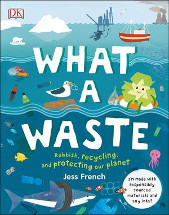
What a waste - rubbish, recycling and protecting our planet by Jess French
Dorling Kindersley, 2019. ISBN: 9780241366912.
(Age: 8-12) Recommended. Subjects: Recycling, Pollution,
Conservation. Vet and author Jess French introduces this
thought-provoking information book What a Waste with 'humans
are now producing more waste than ever before and our planet is
suffering'. She presents a challenge: 'the power to make a positive
change is in our hands.'
Presented with current facts, figures, graphic representations,
photographs, dialogue boxes in the vibrant DK style, many
environmental issues are explored. Did you know '92% of the world's
people are breathing polluted air?' Discover why we need forests and
learn about the threat to the orangutan population with the loss of
their habitat. Deforestation and land clearing are major problems
with 15 billion trees cut down each year.
The site of 'The Great Pacific Garbage Patch' in the north Pacific
Ocean contains plastic rubbish that weighs as much as 500 jumbo
jets. Simple but effective solutions are shown as well to reduce
plastic in the ocean: take three for the sea by removing rubbish on
beach visits, organise your own clean-ups and join in International
Coastal Clean-up Day.
Each spread includes clearly defined explanations, questions and
ways children, students, families and communities can assist in
recycling, reducing waste and protecting our environment. E-waste,
food waste, water waste and industrial waste are key areas of
concern. Bold statements and facts presented as percentages, eg. 45%
of lettuce in the UK is thrown out, provide interesting talking
points for environmental science lessons. What a waste is another visually outstanding DK information
book which presents current environmental concerns and shows how
people are developing solutions, giving hope for the future. Jess
French encourages us all, including younger readers to speak up, be
a plastic-free family and make positive changes.
Rhyllis Bignell
Kingfisher by Patricia A. McKillip
Ace Books, 2016. ISBN: 9780425271766.
(Age: 16+) Recommended. Themes: Fantasy, Coming of age. Mythopoeic
Fantasy Award for Adult Literature (2017. In an unusual blend of
Arthurian legends and those of the Fisher King, McKillip has given
readers a unique tale that contrasts with many of the popular urban
fantasy stories that dwell on werewolves and vampires. Hidden away
by his sorceress mother Heloise, Pierce Oliver does not know that
his father is alive and that he has an older brother. After he
encounters knights being driven in a limousine and using mobile
phones, Heloise admits the truth and he decides to go to Severluna,
where his father is part of the king's court. On his way he meets a
chef at the Kingfisher Inn, Carrie, who also wants to uncover
secrets that Merle her father has hidden from her. And at King
Arden's court, Prince Daimon, the King's bastard, also learns about
his mother, who he always believed was dead. The fates of these
three characters, Pierce, Carrie and Daimon, are all entwined and
manipulated masterfully by the author as King Arden sends his
knights out on a quest to find the sacred and powerful artefact of
the god Severen.
McKillip skilfully blends tropes from legend and modern urban
fantasy and readers may well find themselves looking up the legend
of the Fisher King, working out who he was and where he stood in the
story, as well as keeping tabs on possible characters that might
belong to the King Arthur references.
The strange world of sorcery and modern technology, is peopled with
a plethora of important secondary characters - it was helpful to
keep a list - all of whom play an important role for each of the
characters.
Intertwined with the masterful management of the legends, are
age-old themes of coming of age, of forgiveness and love and some
mouth-watering glimpses of food. Kingfisher is a rich and complex story that will
be remembered long after it is finished, as readers ponder the
combination of technology and myth and the relationships between
parent and young adult.
Pat Pledger
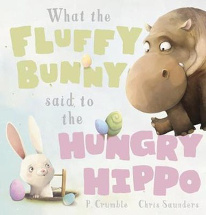
What the fluffy bunny said to the hungry hippo by P. Crumble
Illus. by Chris Saunders. Koala Books, 2019. ISBN: 9781742997551.
(Age: 4+) Recommended. Themes: Easter, Rabbits, Searching,
Hippopotamus, Animals. When Fluffy Bunny invites the Hungry Hippo to
slide down his hole in the ground to find some delicious eggs,
children will be delighted to see that the hippo has not a hope of
fitting in the little hole. But next he asks the mouse to follow him
down the hole and over the hill, and through the field, and later
the meerkat to climb down the hole, over the hill, through the field
and across the pond. As he asks each animal to follow him, Fluffy
Bunny gives another instruction as to where the animal must go. Not
only down the hole, but a series of other instructions leading to
the increasingly prized eggs.
Children will love following the bunny's instructions and enjoy
learning the string of directions, to be able to read along with
whoever is reading the book out loud. Listeners will add actions to
the instructions and join in with the telling, laughing at the hippo
still stuck with his head down the hole at the end of the book.
But when bunny asks the elephant, he is in for a shock as the
elephant has worked out for himself how to avoid the string of
directions and get the eggs more quickly.
A lovely book to introduce eggs at Easter, invite children to follow
directions, and teach them a few new animals as the bunny asks them
to follow him.
Teachers will be able to point out all the different words adding
detail to the eggs, introducing the significance of eggs to this
particular time of the year.
Fran Knight
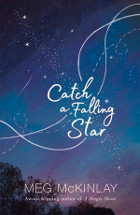
Catch a falling star by Meg McKinlay
Walker Books, 2019. ISBN: 9781925381207.
(Age: 10+) Highly recommended. Themes: Family, Skylab, Death, Grief,
Loss, Friendship, Astronomy. Twelve-year-old Frankie Avery is trying
to navigate life in 1979 in a small town in Western Australia, when
she hears reports of Skylab falling. In between dealing with school
reports, friendship issues and her mother working long hours,
Frankie must look after her brother, Newt. Newt is too young to
remember much about his father but loves to make and create
scientific projects. For his birthday Frankie gives him the
materials and instructions to make an antenna and this sets him on a
path that forms a main part of the story. Frankie's mum is working
hard at the hospital and seems to be there more than she is home,
often forgetting to be home on time or to do promised activities,
leaving Frankie to pick up the pieces and ensure that she and Newt
are fed and get to school on time.
As the story progresses, Frankie and Newt become more engaged in the
Skylab reports and are affected in different ways with different
consequences. Frankie must negotiate her pain at the loss of her
father, the responsibilities that her mother is placing on her and
her relationship struggles with her best friend and her mum. As Newt
becomes more and more obsessed with Skylab, Frankie must ensure that
he is kept safe.
Meg McKinlay has written this book perfectly for younger readers, as
she explores the importance of having something to hope for while
negotiating the isolation that grief brings to individual members of
a family. Frankie's relationships with her mum, brother and best
friend, Kat, are very real and honest and truly reflect the place
between being a child and an adolescent. Teacher
notes are available.
Mhairi Alcorn
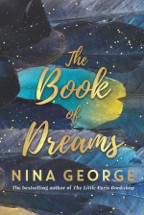
The book of dreams by Nina George
Simon and Schuster, 2019. ISBN: 9781471182976.
(Age: 17+) Recommended. This book was captivating. A powerful story
of relationships is told through the eyes of Henri, Eddie and Sam.
It tackles a subject of much debate - life after death.
The story begins as Henri Skinner is on his way to meet his son. He
rescues a young girl from the river and is hit by a car. He is in a
coma and visited by his son Samuel Noam Valentiner.
Henri is a hero in many ways and Eddie Tomlin is the woman he loves.
Eddie and Henri have a complicated relationship that has unfinished
business.'God' is a powerful figure in the book, guiding Eddie and
Sam as their journey alongside Henri through the in-between world of
coma unfolds. We see the characters Henri, Sam and Eddie slowly
developed through their perspectives on loss, missed opportunities
and reflections on the past.
The unfinished business of life is sensitively explored through
Sam's life experiences and the powerful dream sequences relayed by
Henri and Eddie. The intensive care unit provides Sam a
serendipitous meeting with Maddie, a young ballet dancer immersed in
a coma. Sam, as a synesthete, communicates with Maddie and Henri in
a way that enables him to connect with their current state and it is
this communication that drives the last chapters with a sense of
urgency and intensity that keeps the pages turning and evokes tears
for the reader. The resolution of the unfinished business between
Sam's mother and Henri brings clarity to a family relationship
offering hope to Sam.
This is a story told sensitively and evocatively as it explores love
- first love, fathers and sons, friendship, family and the
willingness to be open to and accepting of love. The book explores
the boundaries between life and death from differing perspectives
without judgement and leaves the reader with this...
'There's more between life and death than we can tell from here.'
Linda Guthrie
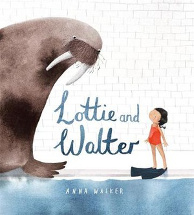
Lottie and Walter by Anna Walker
Puffin Books, 2019. ISBN: 9780143787181.
(Age: 3+) Recommended. Themes: Fear, Swimming, Swimming lessons,
Confidence. When Lottie goes to the pool with her webbed feet ready
to swim, she cannot dive in. She knows a secret, one her mother or
baby brother or even the swimming teacher do not know; there is a
shark in the pool and it wants to eat her. Each Saturday morning she
goes to the pool, gets into her swimming gear, then takes them off
again when ready to leave. She does not even get wet.
One day mum tells her that the next Saturday will be the pool party.
She reminds Lottie how much she enjoys parties.
Lottie is confused, but when she looks into the puddle at her feet,
she sees, not a shark but a walrus. Walter follows her home, where
she discovers that he does not talk, but sings instead. He also
likes books and bubble baths and fish fingers, just like Lottie.
When she goes to sleep, Walter is there, singing away her fear of
the dark.
The next Saturday, Lottie goes to the pool, and sits back watching
her friends having a pool party. She does not join in but spying
Walter in the pool, singing, she takes a giant leap.
This delightful tale of overcoming fears will resonate with all
children who have a fear: fear of the dark, of spiders, of being
alone, of swimming, of something new.
The book allows children to see that Lottie can overcome her fear,
and encourages them to do the same.
The delightful watercolour illustrations will entice readers to seek
out Lottie and Walter as they turn the pages, contrasting Lottie's
worries with the enthusiasm of the rest of the group playing in the
pool. Readers will simply adore Walter, watching out for him as he
encourages Lottie to dive into the pool and join her friends. Mr
Huff (2014) also by Walker, has a similar underlying theme,
that of overcoming a fear, enjoining children to realise that their
fear has no base and can be overcome. Both books deal with mental
health in a way that encourages empathy. Teacher's
notes are available.
Fran Knight
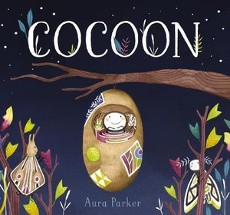
Cocoon by Aura Parker
Scholastic, 2019. ISBN: 9781742765129.
(Age: 4+) Themes: Metamorphosis, Moths and butterflies, Cocoons,
Insects. Dawn and her friends are larvae, aware that soon they will
change and become encased in a cocoon from which they will emerge as
moths or butterflies. The group cannot wait. They dream of weaving
their cocoon and developing wings while inside their cocoon.
The story then follows Dawn and her friends as this stage of their
development occurs. Parker creates humorous watercolour
illustrations to show the insects as they eat an enormous amount of
leaves, waiting for their cocooning. When Dawn feels that her time
has come, she begins to weave her cocoon, at first knitting one
which simply does not work. When she arrives at the correct method
of enveloping herself within the cocoon, she settles down, wondering
just when her wings will appear.
Young readers will be enthralled waiting with Dawn as her change
appears, and imagining what she will turn into. Parker's use of the
correct words will facilitate an introduction for young readers to a
natural science lesson leading on to a discussion about moths and
butterflies and their life cycles.
On the last endpaper, the author has included a number of things for
readers to seek out.
Fran Knight
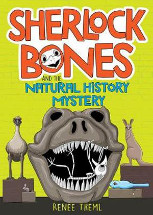
Sherlock Bones and the natural history mystery by Renee Treml
Allen and Unwin, 2019. ISBN: 9781760523954.
(Age: 9+) Themes: Mystery, Graphic story, Museums. This book could
best be described as oddball. With a simple cartoon-graphic style,
the main character, aptly named as Sherlock Bones, is shown as a
tawny frogmouth skeleton 'living' in the Natural History Museum. His
sidekick, Holmes, is an avian taxidermy specimen! When a blue
diamond in the Museum goes missing, Sherlock is 'on the case'. A
raccoon is a bizarre associate and occasional annoyance.
With exceptionally lame humour and quirky illustrations, this is a
few minutes of entertainment that will require the 'suspension of
disbelief' as it is far from a credible tale. It is really suited to
children who struggle with reading and need a 'graphic' text, or
more able readers who need a few minutes of distraction, and the
eccentricity of the book will probably drive its own interest. Teacher's
tips are available.
Carolyn Hull
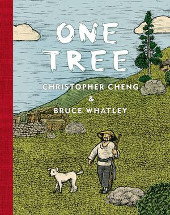
One tree by Christopher Cheng
Illus. by Bruce Whatley. Puffin, 2019. ISBN: 9780143786733.
(Age: 4+) Highly recommended. Themes: Environment, Change,
Urbanisation, China, Gardens. A boy who lives in an apartment in a
city is saddened that his Grandfather who lives with them rarely
speaks; his father has told him that this man was always full of
stories, particularly about his farm where he lived beneath a large
tree.
The boy knows well the story of the old man, taking his produce to
the village market, where if someone asked where he lived, he
proudly pointed to the large tree on the hill.
But now the crowded apartments block the old landscape, and he is
unhappy, looking only at a picture on the wall of his farm. But a
chance sighting of a small seedling growing in the footpath gives
the boy and his grandfather a way of communicating, a way to talk to
each other, one to tell his stories and teach the younger child, the
boy to listen and learn from his grandfather.
Christopher Cheng's heritage gives a resounding strength to this
wonderful story of youth and age, of change and adaptation. The
apartment houses represent a new way of life, one that the old man
finds hard to accept, remembering instead the open fields and hills
where he once lived. His memories come back when the boy brings home
the seedling, Grandfather gradually becoming involved in the growing
of the seedling, buying soil and a pot, telling the boy he must talk
to his tree, leave it on the balcony for warmth and sunlight, and
bring it in at night against the cold. The two sit together as their
plant multiplies, and the boy is proud when they can go to the
market and look up and recognise their flat by searching for the
green on the balcony. Sharing the seedlings means others put pots on
their balconies and the small act by one boy stimulates others in
his neighbourhood.
Whatley's masterful illustrations, using new techniques which
reference ages old lino and woodblock printing, will engage the
readers as he contrasts their lives. The life of the older man on
his farm, with his life today in the crowded city, the boy's life,
swamped by rows of moving feet on the footpath with Grandfather's
lone years tending his land. The images evolve through the story,
showing a reclusive old man becoming one who is engaged and
communicating, the landscape once open and forested to one filled
with apartment blocks, a boy who is puzzled to one who is rapt in
the attention of his grandfather. Poignant and evocative, Whatley's
detailed illustrations will remain with the reader as they close the
last page and think about the boy and his family.
This is a beautiful testimony to the place of older people within a
family, the wisdom they can pass on, the changes they have seen and
their evolving relationships with the younger generation. Cheng
inhabits his story with an almost mythic quality; it is like reading
a fable which readers will ponder long after the story has finished.
Teacher's
notes are available.
Fran Knight
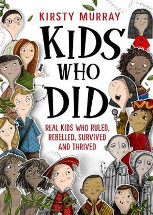
Kids who did - Real kids who ruled, rebelled, survived and thrived by Kirsty Murray
Allen and Unwin, 2019. ISBN: 9781760524470.
(Age: 10+) Highly recommended. Themes: Children; Biography;
Survival; Overcoming difficulties; Fear; Prejudice; War; Sports;
Heroes and heroism. This is a collection of biographical accounts of
the lives of young people who have made a difference or who are
worthy of being noticed. Beginning with stories of ordinary kids and
their acts of bravery in extreme circumstances, it moves through an
array of amazing stories - whiz-kids using their extreme
intelligence; wild and feral children from history; historical
rulers who struggled to maintain power; rebels, battlers, change
agents and survivors who, despite their youth, were doing more than
might be expected of people so young.
This is an amazing and inspiring assortment of young people, many of
whom are not well known, and from all corners of the globe. The
consequence of this selection is that the reader discovers
motivation from the 'ordinary' beginnings of many of these
change-makers. Often their mark on the world has been significant
and is still evident. Some stories from History are quite
confronting - Holocaust and Child exploitation survivors; but there
are also uplifting accounts of heroism and personal resilience.
This book is written in an easy-to-read style with segues into each
section written in bold font to introduce a new direction. Kirsty
Murray's clear style will appeal to young readers. This will
certainly be a book that I will be recommending to encourage the
reading of the Biography genre.
Highly recommended for ages 10+.
Carolyn Hull