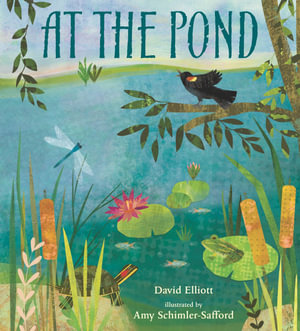
At the Pond by David Elliott and Amy Schimler-Safford
Candlewick Press, 2022. ISBN: 9781536205985.
The red-winged blackbird spreads his tail and sings his hello morning song; he has sung it since the bright and misty world began.
When the soft pink of the dawn sun starts peeking over the pond, a new day has begun for all the animals who live in it and around its watery edges. The friendly duck family, the mysterious water striders, and the busy beaver are a few of the many fascinating and familiar animals included in this glowing poetic tribute to the lively ecosystem of the pond.
Pairing poems with pictures, this is an introduction to the animals and plants that call the pond home, and while they may not all be those that young Australian readers are familiar with, it sets up the opportunity to investigate what a local pond might have and would look like. Do we even call them ponds? Or are they dams and billabongs?
This is another invitation to look more closely at the world around us, especially those parts we tend to take for granted, to extend vocabulary and writing skills to describe it in poetry or depict it in artworks, or if that isn't a strength, create a brief factual description using those included as a model.
Barbara Braxton
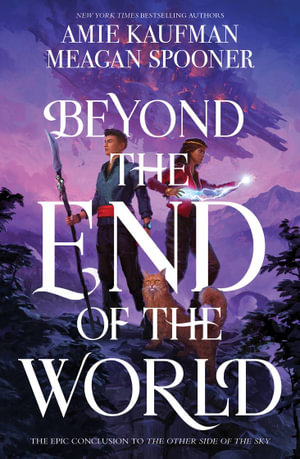
Beyond the end of the world by Amie Kaufman and Meagan Spooner
Allen & Unwin, 2022. ISBN: 9781760529581. (Age:14+) Highly recommended.
This sequel to The other side of the sky brings an end to Kaufman and Spooner’s fantasy duology in a most satisfying way. Continuing directly from the first book, the reader discovers Alciel, the city in the sky, where Nimh has been taken with Inshara. Nimh has lost her memory and Inshara is determined to wrest her power from her. Meanwhile North is determined to find a way to get back to his city in the clouds and rescue Nimh.
The story is told in two voices, that of Nimh and North, with brief passages from other characters scattered throughout the book. From Nimh we learn about the sky city, the Queen, the engineering, and way of life. From North the culture and clashes, power plays and the Fisher King are all described vividly. This dual narration ensures that the worlds of Alciel and Below, the beliefs and main characters, twists and plots all come alive as Nimh, and North try their best to understand what is going on and to save their worlds.
Kaufman and Spooner are talented story tellers who are masters of action driven plots and have a flair for writing believable scenarios that keep the reader glued to the page. The romance between Nimh and North is beautifully devised as well.
The authors have managed to blend what initially reads as a fantasy in with science fiction and it works really well to make a most satisfying conclusion. Readers who enjoy other books by these two authors are sure to enjoy this duology and may like to try books by Laini Taylor and Jay Kristoff.
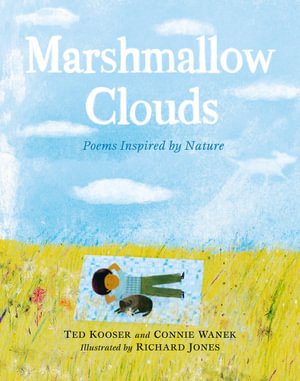
Marshmallow clouds: Poems inspired by nature by Ted Kooser & Connie Wanek
Walker Books, 2022. ISBN: 9781529507072.
There have been a number of books over the last couple of years like that have encouraged young readers to explore their immediate environment with critical, sensitive eyes to discover the detail hiding in the big picture.
But what if, as well as their senses and science brain, they also took their imagination out to play? And what they saw really did become a clown on the top of the hill, up on one leg, juggling a pie, rather than just a winter tree with a long-vacated squirrel's nest on the end of a branch?
The subtitle of the US version of this book by former US poet laureate Ted Kooser and and poet Connie Wanek is "Two Poets at Play Among Figures of Speech" and while a bit dull, nevertheless, it sums up this stunning collection of blank verse poems perfectly. By letting their imaginations out to play, and using similes and metaphors and other literary devices beloved of English teachers, a thunderstorm becomes something that has become lost in the dark of the house, not wanting to wake us but crashing into walls as they stumble about, occasionally striking a match to see their way; tadpoles become commas making them "the liveliest of all punctuation;" and a book is transformed into a sandwich with all sorts of goodness between its folded pitta covers!
Organized by the elements of Fire, Water, Air and Earth and accompanied by distinctive, sparse illustrations that interpret the words but which don't interfere with the picture created by the reader this is an intriguing anthology to dip and delve into, for letting the imagination roam free, wander, and stay healthy. So while we understand that a fire has no stomach, is "never full, never satisfied" and thus must never be set free, it is an entirely different story for our imaginations.
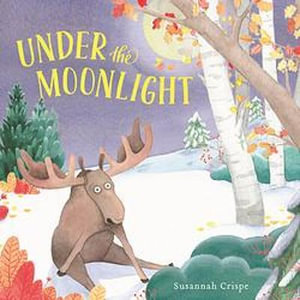
A bedtime story in verse this charming tale of a frightened moose will give hope to all who fear things that go bump in the night. Moose settles down in the snow for his night time sleep. Surrounded by the cold winter, other animals forage for their food in the snow drifts. But something disturbs moose and he wakes, a little disoriented and frightened. He spies a pack of wolves in the hill nearby, he imagines a creature lurking in the forest, a barn owl screeches over his head. He sees the bush quivering and investigating scares a rabbit. He enters a dark cave only to find a sleeping bear. He runs back to his spot in the forest and there finds a little mouse just as fearful as moose. Together they find peace and sleep through the night with each other as company.
A charming and uplifting tale of companionship, of friendship, of the power of togetherness to overcome fears and moments of anxiety, this story will have children empathising with the fearful moose and feeling relaxed as he finds a friend to share the night with.
Soft illustrations cover each page, giving a good impression of the environment in which Moose lives, and also radiating with the cold of the background. Kids will shiver reading the story and point out the many aspects which make Moose’s habitat cold. Many children will marvel at the flora and fauna spotted in the pages, adding to their knowledge of the place where Moose lives.
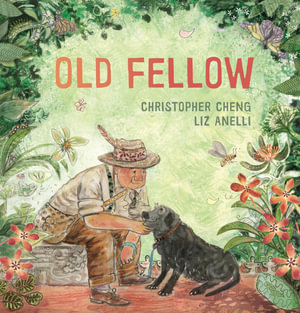
An old man and his equally old dog have a routine. They rise in the morning, do a few stretches then eat their breakfast, before going to the park. And here they meet all their old friends.
In lovely evocative text, Christopher Cheng reveals the two elderly companions, spending their days together with friends, marvelling at the beauty of the world near their home.
Equally the illustrations put the two in a place and time, a park where they are known and loved, where they feel comfortable and safe, a place where friends gather to talk and gossip, play with the ball, throw a ball for the active dogs, play games and just sit.
I adored the endpapers, bookending the day: the first showing the pair in the morning before they get out of bed, the last endpaper showing them in the evening, winding down their day. Readers will love looking at the detail on each page, seeing what the old fellow has collected over the years, ruminating on why it may be important to him, thinking of their own possessions and why they have been kept.
At the park they see a dog chasing its tail, a lost dog, a boy using his Dalmatian like a horse, a fountain from which they drink after their long walk, and another dog who presents the old fellow with a flower. They notice that the chickens are out agin, and see another older man wheeling his dog in a pram. They spy their neighbour Peta and sit with her to play chess. They walk around the park noticing the new flowers and landscaping, the butterflies, birds and immense colour. As they go home they are happy to find their way, unlike last time when they got lost.
Revealing many people’s lives as they grow older, Cheng contemplates the winding down of life, the quiet easing of a life well lived, the two content to meet friends in a garden. Both the man and his dog are relaxed and comfortable with their lives, and the book reveals the promise of relaxed ease in old age. Classroom ideas are available.
Themes Old age, Dogs, Animals, Gardens, Friendship.
Fran Knight
The not so chosen one by Kate Emery
Text Publishing, 2022. ISBN: 9781922458605. (Age:14+) Recommended.
As a fan of stories that revolve around schools that teach magic (Deadly education by Naomi Novik, Iron trial by Holly Black and Cassandra Clare, Sorcery of thorns by Margaret Rogerson), the blurb attracted me to The not so chosen one. Lucy is a regular teenager who receives an enrolment into Drake’s College, a school for students with magical abilities. Although she doesn’t think that she has any talent she goes to the school and is soon leading a double life, going to regular classes in the mornings and attending lessons about spells in the afternoons. Not even her mother or best friend know that Drake’s is a school for magic, and she learns to keep silent about it. She is also keeping silent about her unplanned pregnancy.
She becomes friendly with the teacher’s assistant, Jack, and although she can understand her lessons, her magic ability does not materialise. Meanwhile something bad seems to be happening to students and when her classmate Andrea collapses, she decides to investigate who is behind the danger events.
Lucy’s voice is funny and snarky, and it is easy to relate to her feelings about the school and her fellow students. She is also a determined character who wants to uncover the identity of the person who is attacking students. This combination of a school for magic (in Perth!) and a mystery works well and the suspense is kept up right to the surprising conclusion. Lucy’s unplanned pregnancy will also keep the reader questioning about her decisions and secrecy.
I enjoyed the setting and combination of real life and magical school and believe that readers who enjoy the magical school trope will be happy to read The not so chosen one. Book Club notes are available from the publisher. #LoveOzYA’s Dayna Smith chats to Kate Emery about her novel here.
Ford Street Publishing, 2022. ISBN: 9781925804928. (Age:3+) Highly recommended.
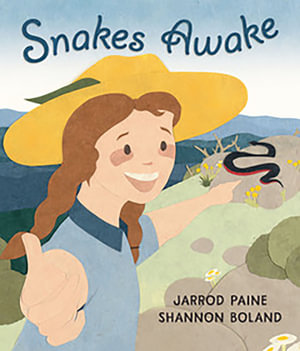
This is an apt book to be published during the winter months, warning people of the danger lurking in the coming spring and summer when people are anxious to get out and enjoy the open air after months of being inside. The story warns of the dangers of walking in the bush and tells readers how they should behave to minimise the possibility of getting bitten by a snake.
With about 3000 snakebites a year in Australia, resulting in two deaths with 13% needing anti venom medication, snakebite is a real concern. Many animals, particularly dogs and cats, are bitten and some die, while up to 88% recover.
Mum and her daughter love to walk in the bush, taking care to take water, a mobile phone, and first aid kit, while both women wear strong boots and long pants. During the walk, mum points things out to her daughter: look before walking over a log, check the path ahead, quietly back away if a snake is sighted.
They recalled their neighbours, who having a back yard with many hiding places for snakes, had to ring a snake catcher. The story shows the snake catcher at work, and children will be able to talk about ways of minimising the possibility of snakes hiding in their yards.
Without being overly pedantic, the story encapsulates many of the messages needed for young readers to be aware of but not frightened by snakes. Boland’s technique using gouache, pencil and layered paper, gives a impression of collage with bold accents of colour, giving a wonderful background to the story. The earthy colours accentuate the bush where many snakes can be found, alerting readers to the places where they must be extra careful. The book gives rules about walking in the bush and survival and these are repeated in the next two pages after the story is finished, followed by two pages showing how someone with a snake bite should be treated. Teacher's notes are available.
Themes Snakes, Snake bite, Bush lore, Snake catchers.
Fran Knight
Do lions hate haircuts? by Bethany Walker and Stephanie Laberis
Walker Books, 2022. ISBN: 9781406388411.
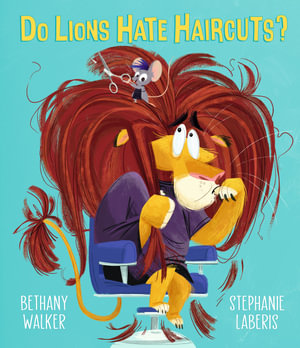
Leonard the Lion is king of the beasts, master of the Savannah, leader of his pride and a great big baby when it's time for a haircut!
Nobody, NOBODY, can cut Leonard's hair to his liking. That is, until he meets a little mouse called Marvin. Despite his scepticism that a mouse could help a lion, Leonard gives him a try and is so impressed by the wild and whacky styles Marvin creates with his teeny-tiny comb and scissors that soon they are best buddies.
However Leonard wants Marvin to cut his hair and HIS HAIR ONLY. So when Leonard sees Marvin giving Zebra a new hairdo, Leonard is jealous and refuses to have his hair cut at all. But the folly of that plays out when he hears Marvin in trouble and he rushes to his rescue...
This is a fast-paced story that has several twists and turns, including the ending, and which will engage young readers, especially those who are not keen about getting their hair cut. Perhaps they will suffer the same fate as Leonard! Hilarious illustrations that are bright and bold really enhance the text and the creatures' faces are so expressive that discussing how each is feeling and why is a must.
Apart from a subtle message about finding friendship in unexpected places, this is a story that will be enjoyed just for the fun of it.
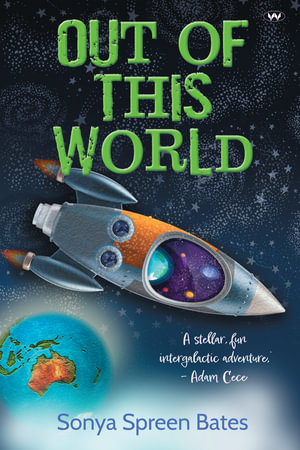
Out of this world: Star-studded haiku by Sally M. Walker and Matthew Trueman
Walker Books, 2022. ISBN: 9781536203561.
one minuscule speck grows into the universe a mind-boggling birth
Defined as a traditional Japanese three-line poem with seventeen syllables, written in a 5/7/5 syllable count which often focuses on images from nature, haiku emphasises simplicity, intensity, and directness of expression making it an effective way to get students to focus on the essence of an object and then use succinct, descriptive vocabulary to portray it so every word has to work hard.
In this stunning union of poetry, art and science, haiku is used to explore the universe through a lunar eclipse, beyond the orbiting planets, and into glowing galaxies and twinkling constellations out to Ultima Thule, the most extreme limit of the journey which "longs for a visitor with coal and a carrot", and all accompanied by the most imaginative illustrations that are almost photo-like so that not only does the reader learn about the vast beauty of space but they are left in wonder and awe of its magnificence. The minimal text structure of haiku means just the nucleus of the phenomenon is offered as a teaser, leaving the reader with a tempting taste to learn more...
the Eagle landed one giant leap for mankind footprints in the dust
Some of this is offered in the comprehensive, well-researched final pages which explore such topics as constellations and astronomers, the birth of the universe, stars, the solar system, moons and eclipses, asteroids, meteors, and comets, but the whole offers an opportunity for students to engage in their own interest-driven investigation with the challenge of summarising their findings in their own haiku and artwork.
Barbara Braxton
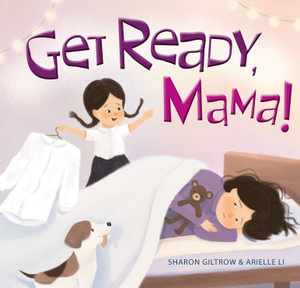
Get ready, Mama! by Sharon Giltrow and Arielle Li
EK Books, 2022. ISBN: 9781922539083. (Age:3+)
Getting Mama ready for the day can be a challenge. you'd better watch out that she doesn't sneak back into bed, try to distract you with cuddles, get breakfast all over her top, or. wait, is Mama watching TV?! Learn how to get Mama up and ready despite her mischievous delaying tactics with this essential guide to dealing with morning mayhem! Little ones will delight in the cheeky role-reversal that sees a young girl doing everything she can to get her reluctant mother out of the house, and teachers, particularly will enjoy the twist in the tale.
But apart from being a funny story that will resonate with everyone who has ever wanted 'just five more minutes', this has great value in maths and literacy lessons that focus on sequencing and its vocabulary, as well as time. Identifying the essential tasks and routines that must be done, sorting them into order, allocating sufficient time for each, comparing and contrasting breakfast menus, looking for hacks that might shortcut the morning rush (although sleeping in your school uniform which was the preferred choice of one previous student is not recommended)... it's a story that will resonate widely with every child. Teachers' notes are available.
Barbara Braxton
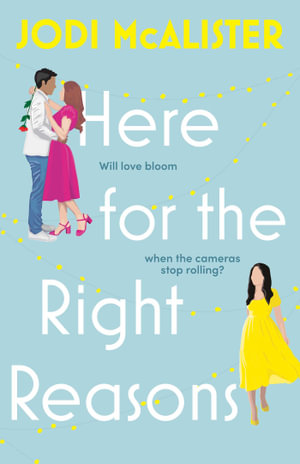
Here for the right reasons by Jodi McAlister
Simon & Schuster, 2022. ISBN: 9781761104961. (Age:Adult) Recommended.
As a fan of the YA Valentine series by Jodi McAlister I was keen to read an adult novel by her and I was not disappointed. The setting of a TV show, Marry Me, Juliet, is sure to engage anyone who is a fan of the TV show Bachelor, while people like me who do not watch reality TV will enjoy learning about how such shows are set up and filmed. Cece James and Olympic gold medallist Dylan Jayasinghe Mellor are both characters that readers can emphasise with. Cece has been brought up in foster homes and has trouble believing anyone can stay with her, while Dylan is plagued with anxiety attacks. Both have their own reasons for being on the show – Cece is an unemployed student and really needs the money, while Dylan wants to promote his men’s mental health charity. When Cece gets eliminated on the first night of the show, she thinks that everything is over for her, but the director of the show is persuaded to film a developing friendship between Dylan and Cece.
The other Juliets on the show are all accomplished and clever women and could become Juliet to Dylan’s Romeo and tension is built up amongst them. The global pandemic and lockdowns also mean that the women must stay in a bubble, and this gives McAlister the opportunity for the reader to get to know many of them.
This is a feel-good romantic comedy with some great dialogue. It is enjoyable to read about the antics of the Juliets to win over Romeo while the slow growth of friendship and attraction between Cece and Dylan is a delight to read.
Themes Romantic comedy, Love, Anxiety.
Pat Pledger
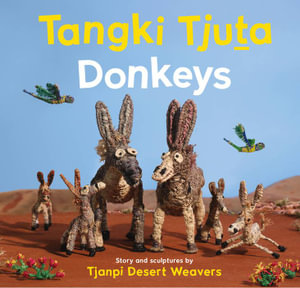
Tangki Tjuta Donkeys by Tjanpi Desert Weavers
Allen & Unwin, 2022. ISBN: 9781761180149. (Age:3+) Highly recommended.
Listen to the story in Pitjantjatjara. Voice artistry by Tjulyata Tjilya, edited by Dan Bleby. An English version will be available soon.
The story of donkeys and their role in the lives of the Anangu people of the northern parts of South Australia, is spectacularly told in this brightly funny and wonderfully illustrated book. Brought in by Europeans, donkeys were quickly picked up by the locals, using them as transport between their communities, becoming friends and helpers.
The donkeys helped the Anangu make the journey, which once they walked, between Areyonga and Ernabella, the donkeys always making sure they arrived home safely. We are shown wonderful images of the woven donkeys set against the desert landscape, the birds, small animals and sparse vegetation also woven from local desert grass or tjanpi. All readers will develop a sound idea of the environment in which these people live, and watch out for the known objects showing the encroachment of European society.
The donkeys, malpa wiru, are recreated here in the woven form made famous by the Tjanpi Desert Weavers, and readers will laugh out loud at the antics of the animals. No more so than when a donkey crashes into a tree, spilling blind Older Brother from his back. The looks on the donkey’s face is telling of his embarrassment as he waits for Older Brother to be helped up onto his back once more. Or of the baby donkeys first learning to use their legs, or the donkey peering into a shopping trolley. Each individual sculpture had me looking closely at the way it was made, what it showed me about the lives of these people in the remote areas of this site.
An introduction tells readers about the artists, their faces shown on the end papers, while at the end of the book is a page of information about the Tjanpi Desert Weavers and their growth out of the women’s movement which promotes life, creativity and country. More information can be found here.
Told in Pitjantjatjara and English and illustrated with the funny and very original woven sculptures of the donkeys seen in outback Australia, the weavings made by the Tjanpi Desert Weavers are an absolute joy, full of life and humour, reflecting the background of this cultural group.
Themes Aboriginal themes, Donkeys, Humour, Western Desert, Anagu people.
Fran Knight
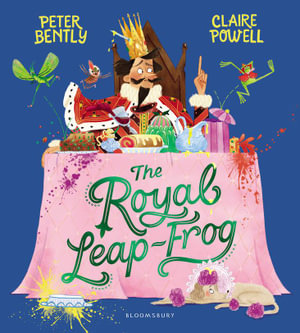
The royal leap-frog by Peter Bently and Claire Powell
Bloomsbury, 2022. ISBN: 9781408860113.
Peter Bently (The Great Dog Bottom Swap) has written a rollicking story that is great fun to read aloud. Claire Powell's illustrations are exuberant, brimming with personality-filled characters and intricate and amusing details. Her work is similar in style to that of Alex T. Smith (Mr Penguin series, The Adventures of Egg-Box Dragon). This is the pair's second retelling of a Hans Christian Andersen story (The King's Birthday Suit based on The Emperor's New Clothes is also available).
The Royal Leap-Frog is a witty take on the classic tale The Leaping Match, telling the story of a flea and a grasshopper who head to the castle to get the King to decide who can jump the highest. When a frog decides to join them they aren't enthused but they also don't feel threatened. 'Fine,' said the grasshopper. 'Sure,' said the flea. 'But you don't stand a chance. And the frog thought, We'll see!'. The competition itself is a domino effect of chaos: there's food being flung, fleas in collars and a flurry of pepper sneezes. The King and his people are completely underwhelmed by the whole messy affair. Can the frog impress him with smart thinking and be declared the winner?
The colourful, patterned Elizabethan dress worn by the royals as well as the outfits of the bugs are delightful, while the frog is clearly part of the bourgeoisie, with his raggedy buttoned shirt and necktie. Children will be ensconced in these vibrant pages and the fun story they tell. The takeaway message is that it is more effective to gain admiration by appealing to one's sense of self, rather than with your own prowess, but perhaps it would have been nice if the story was modernised slightly more (do we really need to be talking about the King being 'higher' than everyone else? And having princesses kissing frogs in the hope of finding a prince?).
Themes Fables, Rhyming Stories, Humorous Stories.
Nicole Nelson
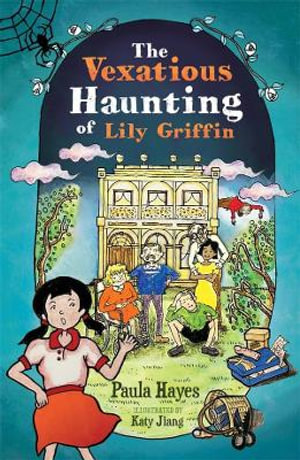
The vexatious haunting of Lily Griffin by Paula Hayes. Illus. by Katy Jiang
The vexatious haunting of Lily Griffin is a set of 3 novels in one. The first story, Lily in the mirror, was a CBCA Notable book in 2017. This is followed by Lily in full bloom and Lily in a pickle - all of which star Lily Griffin in her own words as she commits her life and thoughts into her journal. These novels are full of a multitude of characters, most of whom go by their own name and nicknames given to them by other people which may also vary according to the person. This makes comprehension a little difficult and demands an intrepid and dedicated reader. Lily herself is a little, quirky wordsmith and her interpretations and perspectives don't always align with the reality of situations. This makes for hilarious reading but also demands much concentration and joining of the dots by the reader. These books are therefore recommended for skilled readers.
Western Australian author, Paula Hayes loves to write in the genre of magical realism. Thus the 'Lily' books are set in two parallel worlds - the world of Lily's higgledly-piggledly family and school-life and the magical world of the 'Rosy room' in Lily's grandfather's house in which Lily conducts her paranormal investigations.
In the Rosy Room there are old papers, old trinkets, a singular old mirror and ghosts of past family members. In the back garden is a little house full of memorabilia and ghosts too. Lily, with her love for the dark and mysterious, is able to communicate with the other world and put a stop to the 'vexatious' hauntings. Meanwhile in the real world, Lily has to negotiate school and especially very vicious bullies.
Possibly the best book is the second one - Lily in full bloom because the narrative settles and the characters are allowed to grow. Hayes skilfully develops the character of Lily's troubled adolescent brother Linden from a stereotypical, flat, nuisance of an older sibling into a fully rounded, interesting, sensitive and authentic character. The incident with the bullies is raw, vicious and powerful, both in the rank and disturbing behaviour of the bullies, the clever and brave response of Lily's quirky little group of friends (all bully targets for different reasons) and the sudden and unexpected show of strength and loyalty from Linden which becomes a turning point for him as an individual and for his relationship with his odd little sister.
Although Hayes deals with deep themes including adoption, dementia, death, grief and bullying, the reader views the action through the eyes of Lily; through her playful droll humour, her sometimes faulty conception of situations and motives and her genuine niceness and natural curiosity. This makes the everyday nastiness and the paranormal situations - some of which are macabre and distubing indeed...bearable.
For a very strange and unusual read, for a dabble into two parallel worlds - the world of real-life family and school and the paranormal world with both being populated with many warm and horrible and annoying characters, try The vexatious haunting of Lily Griffin.
You may or may not like The vexatious haunting of Lily Griffin but it's worth a read because it demands a different headset from the reader - an openness to accepting a parallel world alongside the real and the ability to suspend normal and enter into the paranormal. Teacher's notes are available.
Themes Family, Siblings, Dementia, Grief, Love, Adoption, Social anxiety, Bullying.
Wendy Jeffrey
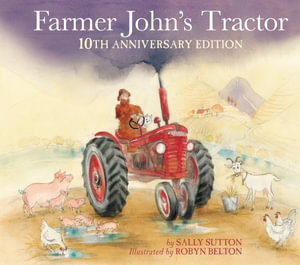
Farmer John's tractor by Sally Sutton. Illus. by Robyn Belton
An orangey-red old tractors sits in a shed, seemingly rusting and unused, until there is a flood. A car with two little girls gets stuck in the rising floodwaters. The jeep that tries to rescue them rolls on its side; a tow truck gets stuck and the fire-engine slams to a halt on a slip. Then Farmer John comes up with an idea. Unlocking the door to the shed, he brings the trusty tractor to the rescue.
Teachers doing a unit with young children about disasters and in particular floods, will find this beautiful picture book very useful. The illustrations in watercolours by Robyn Belton bring the wet weather to life. The swirling murky waters of the flooding river, the brown mud and the oppressive sky tell vividly what can happen during a flood. The oppressive atmosphere is lightened with humorous touches like the chickens nesting on the tractor and the little dog following the farmer around. There is a plethora of detail in each of the pictures for inquisitive children to pore over and talk about.
The story of the tractor, which is rusty but trusty, will appeal to young children as will the rhyming language that makes it a good read aloud. The fact that this is the 10th anniversary of Farmer John's tractor is testament to its lasting appeal.